





About this worksheet
This Grade 6 worksheet practices converting metric lengths when decimals are involved. Children use visual place-value models, fill in equivalent measurements, and apply conversions to short problems. It aligns to CCSS 5.MD.A.1, which asks students to convert standard units within one measurement system and use those conversions in problems. A separate answer key is provided.
Aligned to 5.MD.A.1
How does place value help with metric conversions?
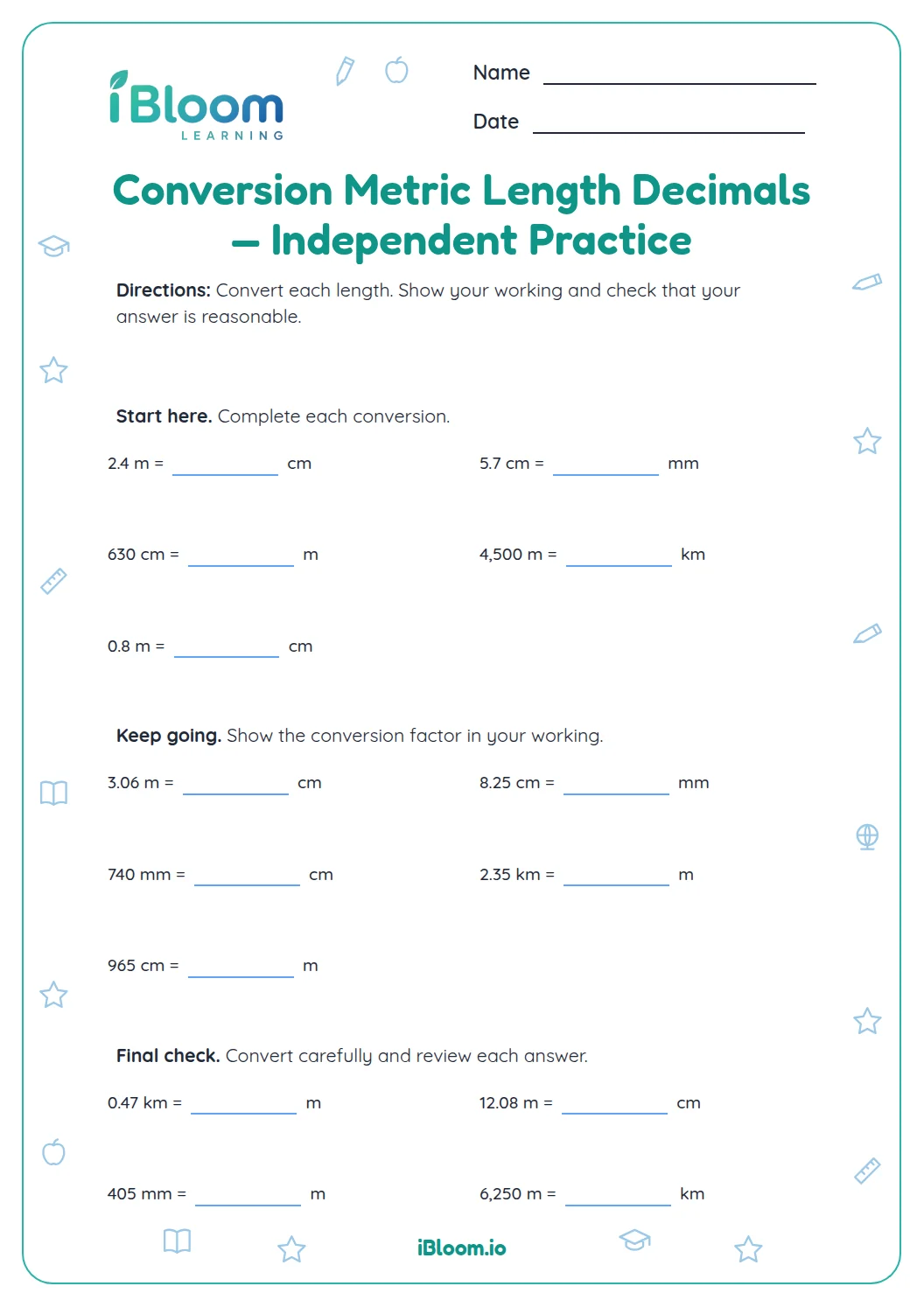
Each move between metric units changes the scale by a power of ten. Moving from meters to centimeters multiplies by 100, while centimeters to meters divides by 100. In Part A, 0.36 m is 36 cm.
How can you check a decimal conversion?
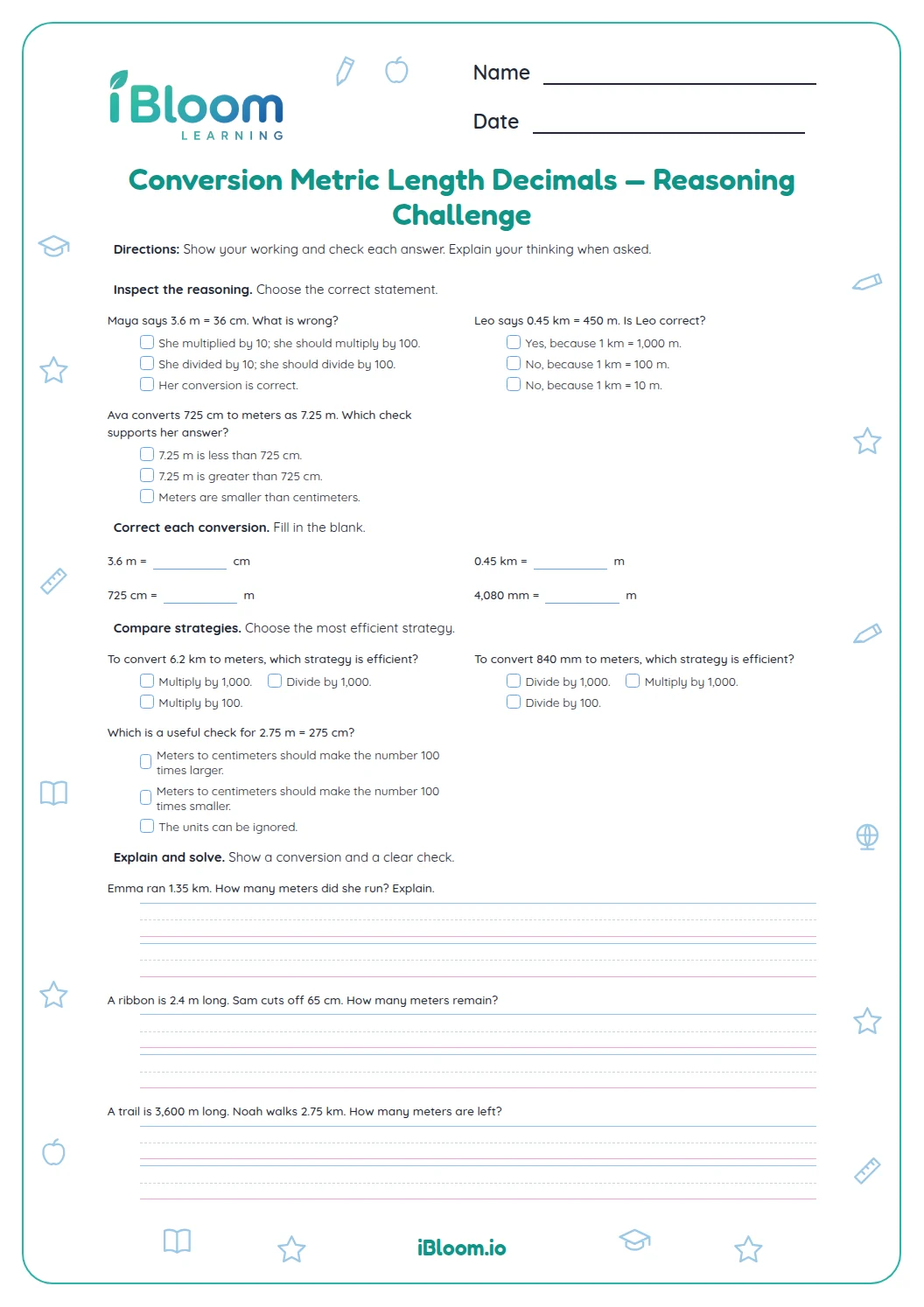
Estimate the size first. A measurement in centimeters should have a number 100 times the number of meters. For example, 3.2 m is 320 cm, so it is longer than 315 cm.
How to use this worksheet
- 1Write the starting and ending units.
- 2Choose the conversion factor.
- 3Multiply or divide by powers of ten.
- 4Place the decimal and attach the unit.
- 5Estimate whether the answer is a sensible size.
Common mistakes and quick fixes
The mistake
Moving the decimal the wrong way.
The fix
Ask whether the new unit is smaller or larger.
The mistake
Forgetting the unit in the answer.
The fix
Copy the target unit beside the number.
The mistake
Treating 100 cm as 10 cm.
The fix
Write the unit fact before calculating.
Curriculum alignment
This worksheet practices the skill described in the standard below.
Convert among standard measurement units within a given measurement system.
On this sheet: Children convert metric lengths written as decimals and use conversions in problems.
Show the official wordingHide the official wording
Convert among different-sized standard measurement units within a given measurement system (e.g., convert 5 cm to 0.05 m), and use these conversions in solving multi-step, real world problems.
What to practice next
Make more practice
Further reading
Questions parents and teachers ask
How many centimeters are in a meter?
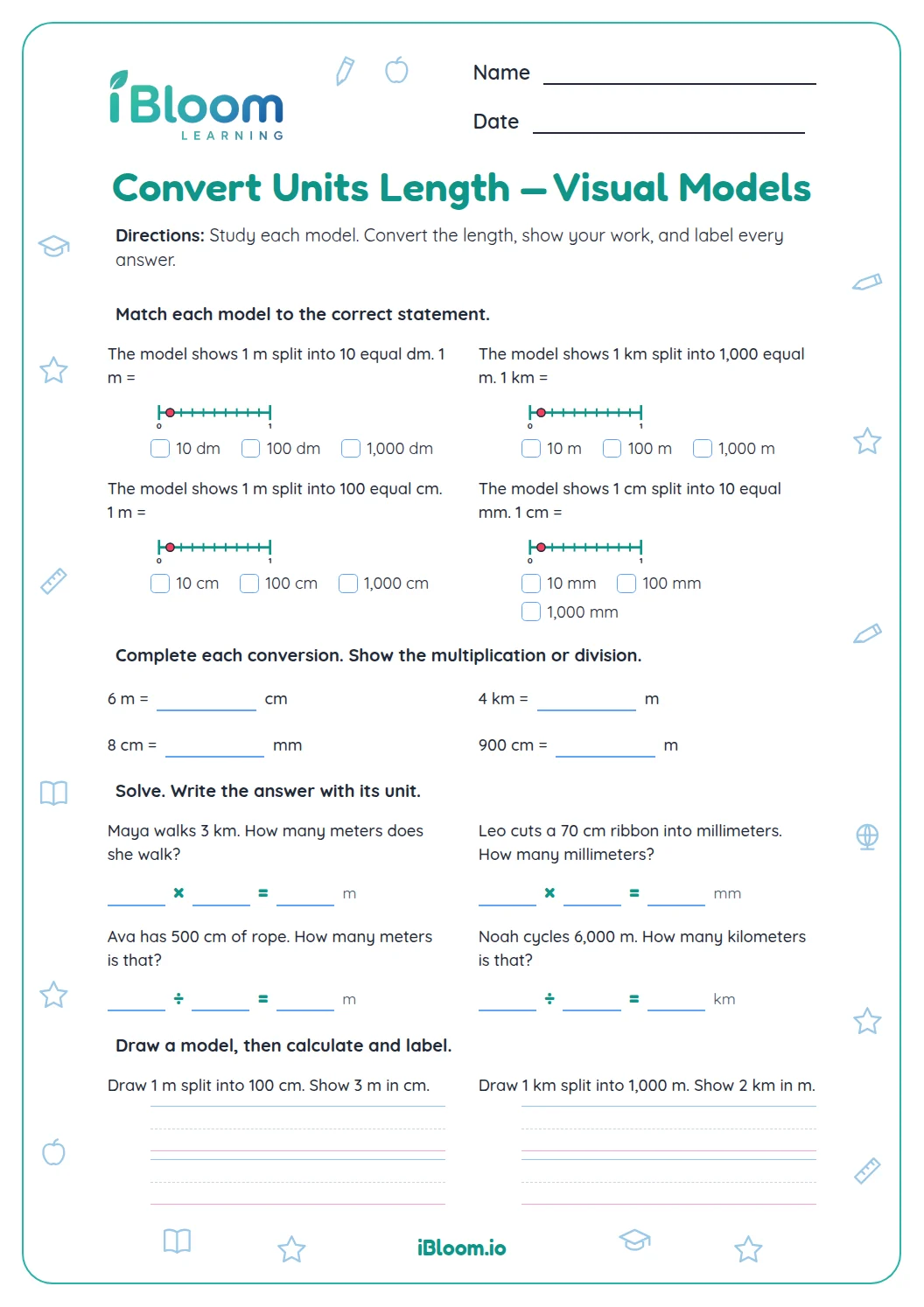
There are 100 centimeters in one meter. To convert meters to centimeters, multiply by 100; to convert centimeters to meters, divide by 100. For example, 3.6 m equals 360 cm because 3.6 × 100 = 360. The first grid has 36 of 100 squares shaded, representing 0.36 of a meter or 36 centimeters.
How do you convert kilometers to meters?
One kilometer is 1,000 meters. Multiply a kilometer amount by 1,000 to find meters, or divide meters by 1,000 to find kilometers. For example, 0.72 km is 720 m. For example, 0.72 km × 1,000 = 720 m; the converted number is larger because meters are smaller units.
Why do some models use hundredths grids?
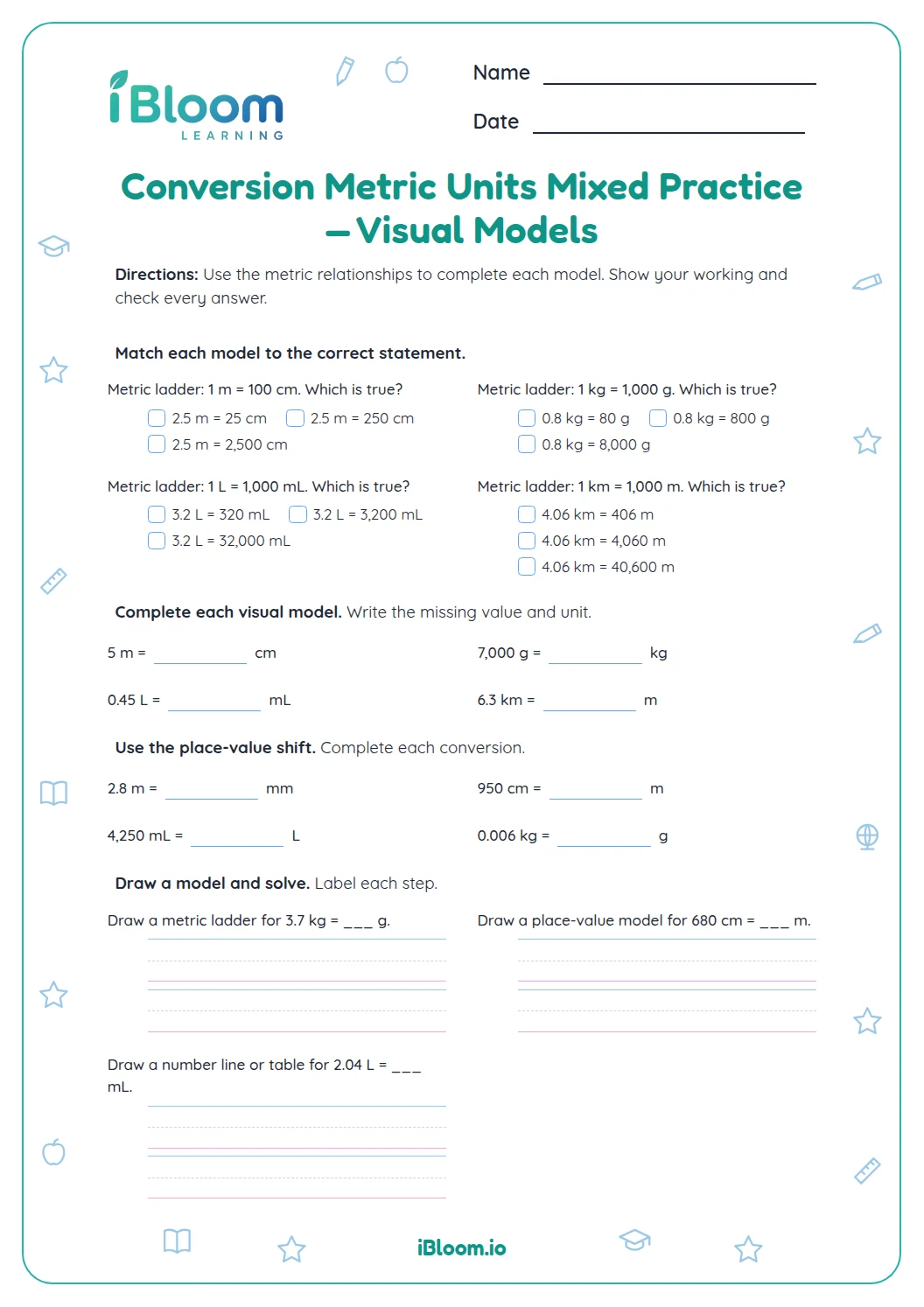
A hundredths grid makes parts of a whole meter visible. A grid with 36 of 100 squares shaded represents 0.36 m, which is 36 hundredths of a meter or 36 cm. Use the shaded portion as a model for decimal parts, then apply the same place-value reasoning to other unit pairs.
How can you check whether a conversion is reasonable?
Think about whether the new unit is larger or smaller. The numerical value grows when meters become centimeters, because centimeters are smaller units. Compare the answer with the original length to catch a decimal shift. A quick estimate catches common errors: 8,450 mm is less than ten meters, so 8.45 m is reasonable.
Should every answer include a unit?
Yes for written conversions and word problems. Include the target unit, such as 36 cm or 1.25 m, so the amount is clear. Blank equations already print the requested unit beside the blank. The final problems ask learners to apply the same unit relationships in contexts and comparisons.