





About this worksheet
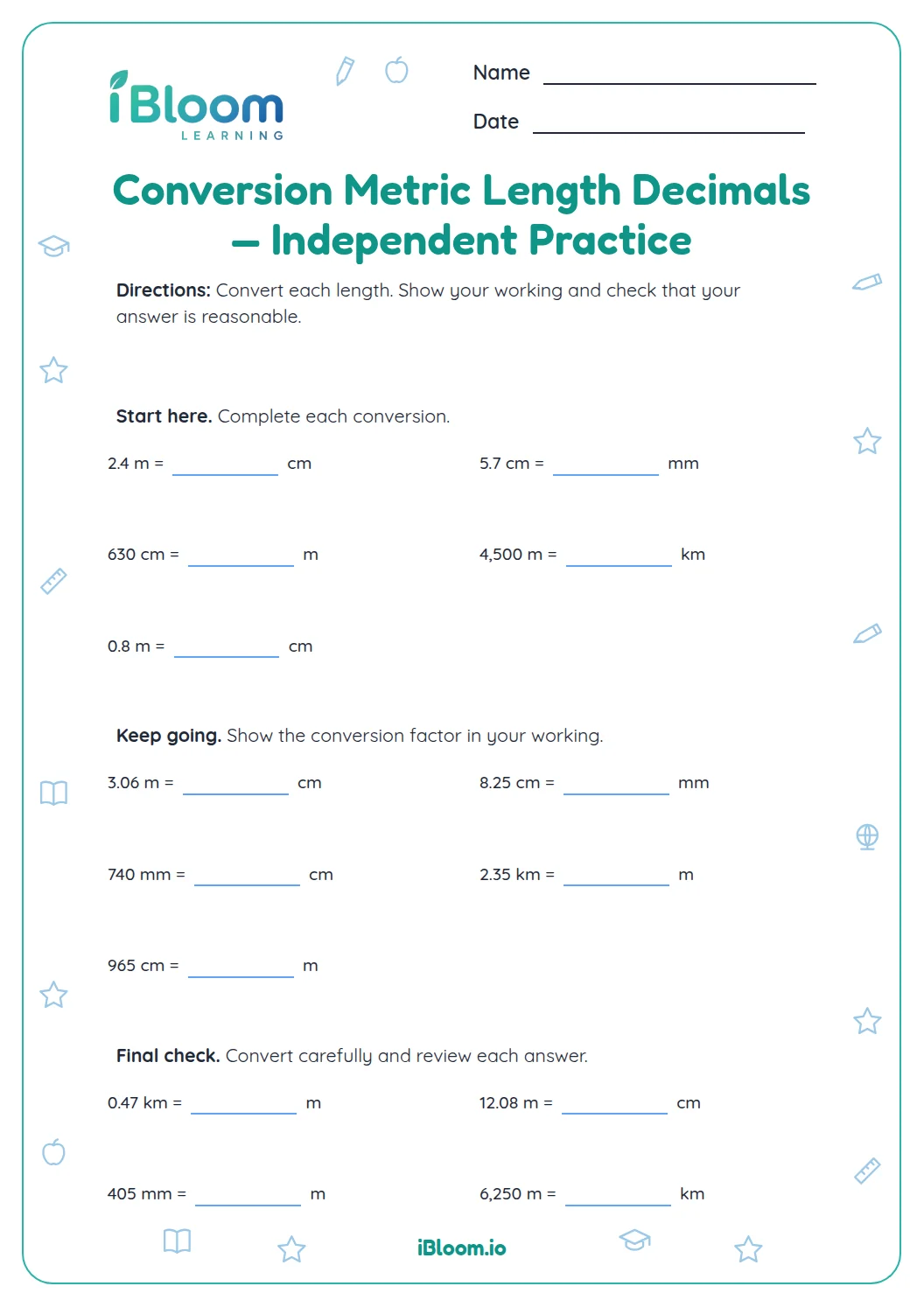
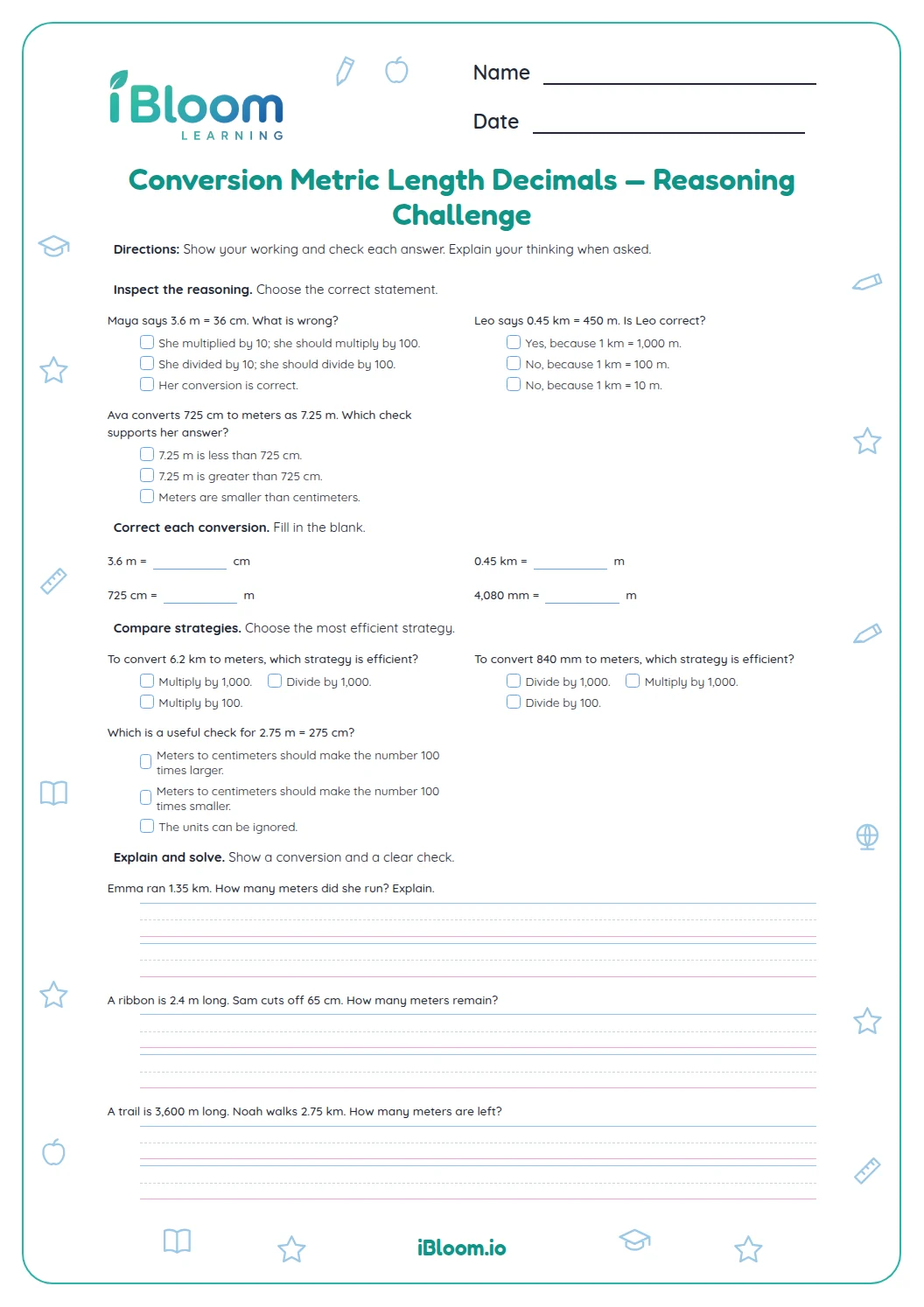
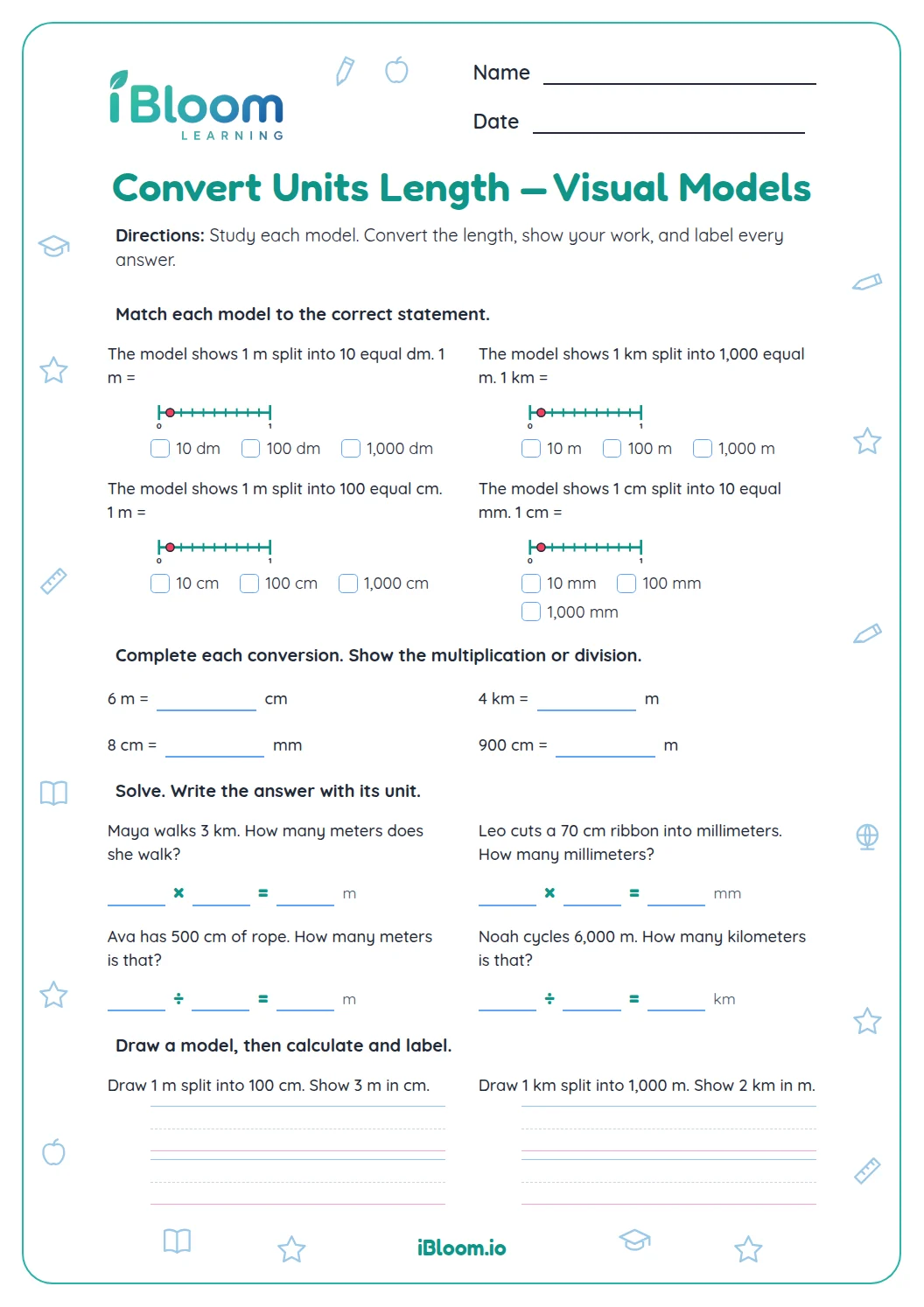
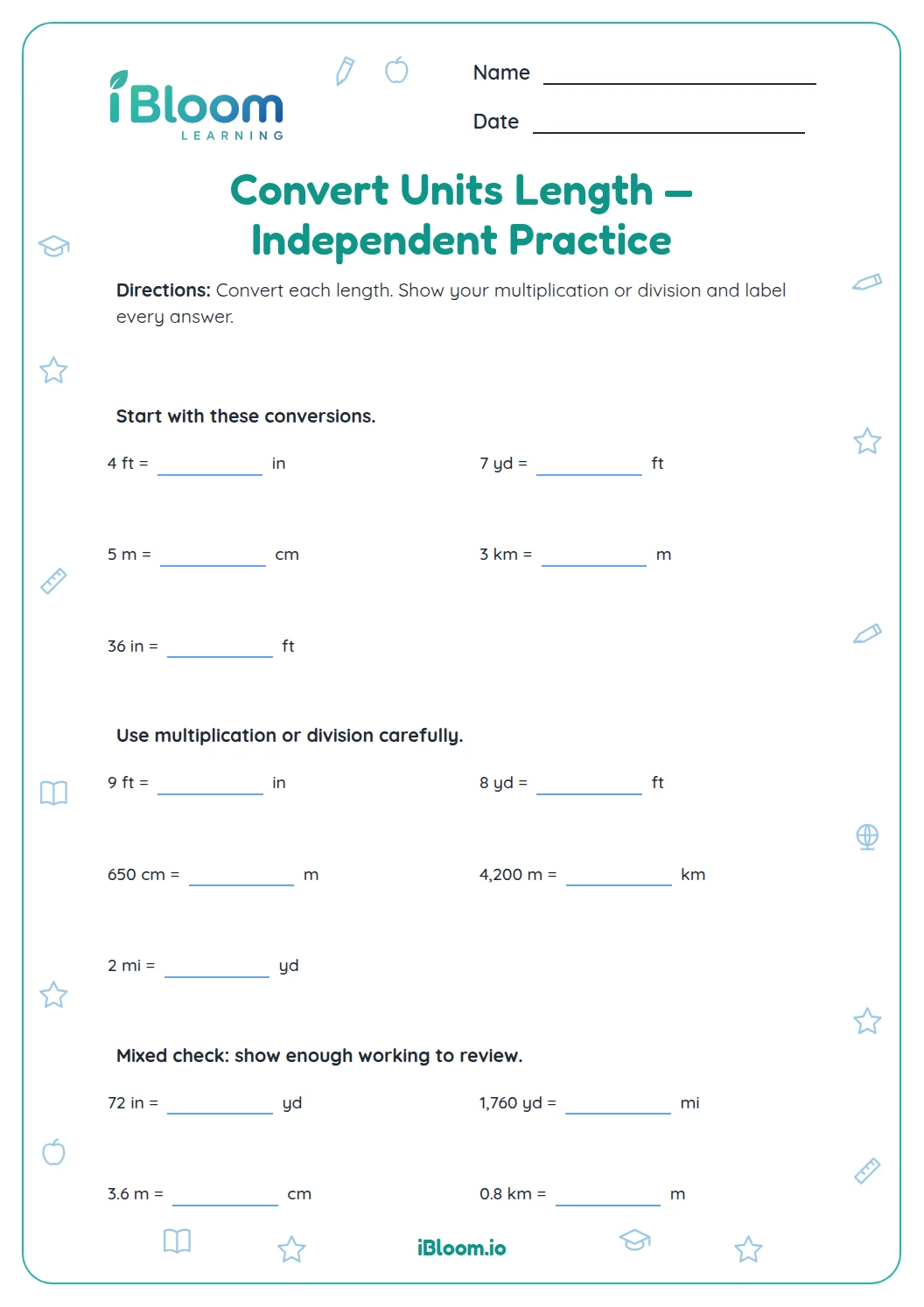
This Grade 6 guided-practice worksheet builds fluency converting metric lengths written as decimals. Students choose equivalent measures, complete conversion equations, and solve short problems involving meters, millimeters, centimeters and kilometers. The worked routine is to identify the unit relationship, scale the measurement, and label the answer in the requested unit. The tasks align with CCSS 6.RP.A.3.d, which applies ratio reasoning to measurement conversions. A separate answer key lists the converted values and word-problem answers.
Aligned to 6.RP.A.3.d
How should a student begin a metric conversion?
Read both units and identify how their sizes compare. One meter is 100 centimeters and 1,000 millimeters; one kilometer is 1,000 meters. Moving to a smaller unit increases the number of units, while moving to a larger unit decreases it.
Part A checks these relationships in multiple-choice form. Students should estimate whether the converted number ought to be larger or smaller before choosing.
- Questions 1–5: select an equivalent measurement
- Questions 6–11: fill in a converted value
- Questions 12–16: apply conversions in a situation
Where does the decimal point move?
Rather than relying only on a point-moving trick, multiply or divide by the number of smaller units in the larger unit. For meters to centimeters, multiply by 100; for centimeters to meters, divide by 100.
A quick size check catches many errors: 0.8 m is less than 1 m, so its centimeter value should be less than 100 cm.
- 10.8 m × 100 = 80 cm
- 2There are 100 centimeters in one meter.
- 3The result is smaller than 100 cm, as 0.8 m is less than 1 m.
How do conversions help solve length problems?
Convert all lengths to a common unit before adding or subtracting. In question 13, 1.25 km plus 0.75 km is 2 km, which equals 2,000 m.
For equal sections, divide the full length by the number of sections after using consistent units. Include the final unit in the answer so the measurement is complete.
What should students check in the answer key?
Compare the number and unit together. An answer of 80 is incomplete if the prompt asks for centimeters; an answer of 80 mm would be a different length.
Use the key to find the first step that went wrong: the unit relationship, the multiplication or division, or the final unit label.
How to use the worksheet
- 1Circle or underline the starting and requested units.
- 2Recall how many smaller units make one larger unit.
- 3Choose multiplication or division based on the direction of conversion.
- 4Write the result with the exact unit asked for.
- 5For a word problem, convert lengths to the same unit before combining them.
- 6Check whether the final value is a reasonable size.
Conversion errors to avoid
The mistake
Multiplying when converting centimeters to meters.
The fix
Since a meter is larger than a centimeter, divide the number of centimeters by 100.
The mistake
Changing 2.06 km to 206 m instead of 2,060 m.
The fix
One kilometer contains 1,000 meters, so multiply 2.06 by 1,000.
The mistake
Adding 1.25 km and 0.75 km to a length already written in meters without converting.
The fix
Convert both distances to the same unit before combining them.
Common Core alignment
The conversions and applied length questions use ratio reasoning to move between metric units.
Use ratio reasoning to convert metric length units.
On this sheet: Students scale metric lengths and apply the conversions to totals, differences and equal sections.
Show the official wordingHide the official wording
Use ratio reasoning to convert measurement units; manipulate and transform units appropriately when multiplying or dividing quantities.
What to practice next
Make more practice
Further reading
Questions parents and teachers ask
Which metric length units appear?
The worksheet uses millimeters, centimeters, meters and kilometers. Students convert between nearby units such as millimeters and centimeters, as well as larger jumps such as kilometers to meters, then apply those relationships in short word problems. Each item names the requested unit.
How many questions are included?
There are 16 questions across three parts: five multiple-choice conversions, six missing-value conversion equations and five applied length problems. The last part provides equation space so students can show the calculation. The separate key gives the expected value and unit. The mix moves from checking to correcting.
What is the key relationship between meters and centimeters?
One meter equals 100 centimeters. To change meters to centimeters, multiply by 100; to change centimeters to meters, divide by 100. For example, 0.8 meter is 80 centimeters. The choice items include other metric pairs to practice the same reasoning.
Why do students need to include units?
The number alone does not tell which length is meant. A result of 80 centimeters is different from 80 millimeters. Each prompt names the requested unit, and the answer key includes that unit for the applied problems. Students can use the unit label to check whether they converted in the right direction.
How can a student check whether a conversion is reasonable?
Compare the starting length with a familiar benchmark. A measurement less than one meter must be less than 100 centimeters, and converting to smaller units should make the numerical value larger. This quick estimate can catch a misplaced decimal. It is useful before checking the answer key.