






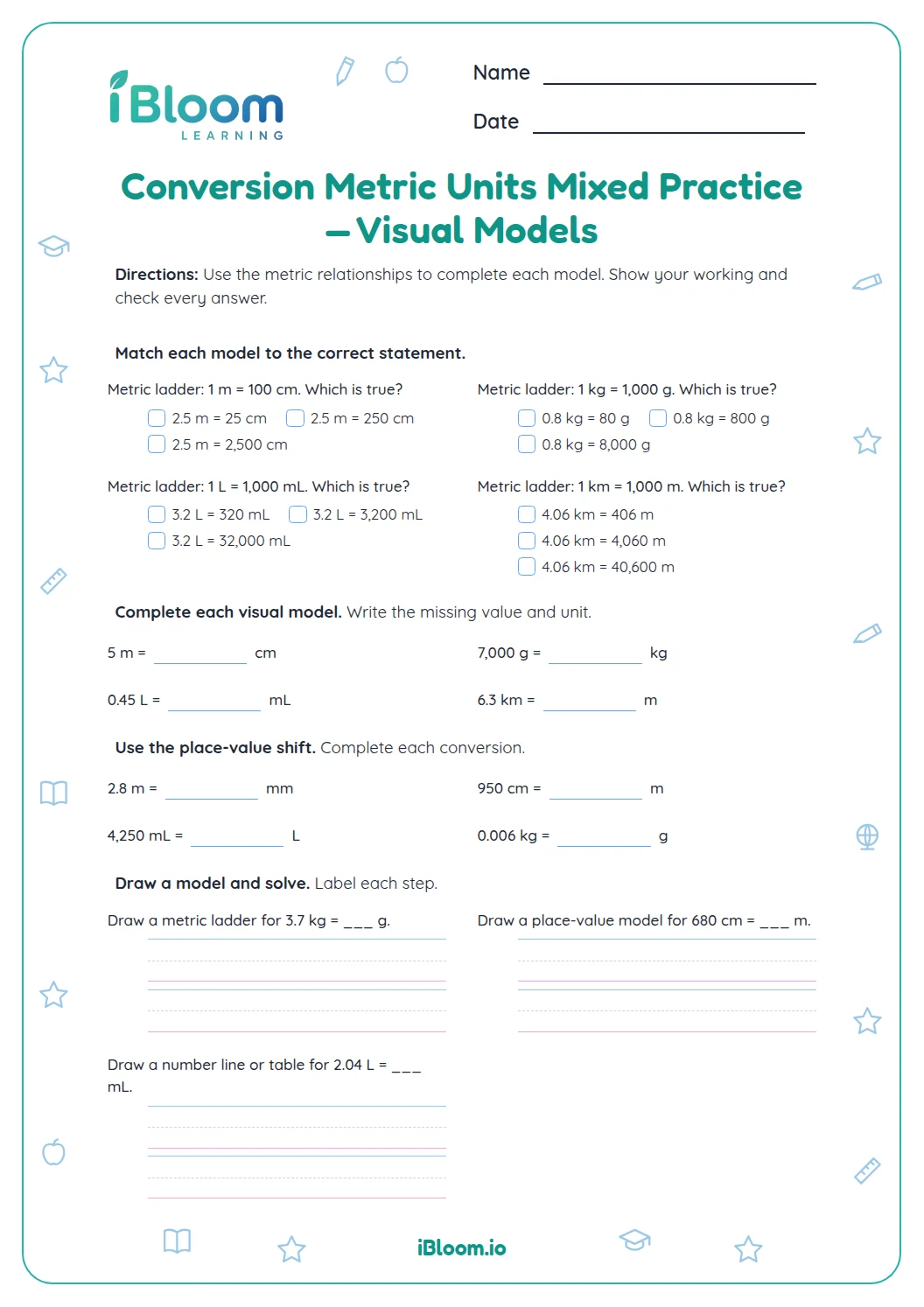

About this worksheet
This free printable worksheet gives Grade 6 students guided practice converting metric mass and volume when decimals are involved. A fact strip reminds them that 1 kg = 1,000 g, 1 L = 1,000 mL and 1 g = 1,000 mg. Students multiply to get a smaller unit, divide to get a larger one, solve three word problems with working space, and choose answers by estimating first. The sheet practices Common Core 6.RP.A.3.d, using ratio reasoning to convert measurement units. A two-page answer key is included.
Aligned to 6.RP.A.3.d
What is on this metric conversion worksheet?
Part A gives four conversions to a smaller unit: 2.4 kg to grams, 3.6 L to milliliters, 0.075 kg to grams and 0.75 g to milligrams. Part B reverses the direction with 4,500 g to kilograms, 850 mL to liters, 45 mL to liters and 875 mg to grams. A fact strip with the three 1,000 relationships sits at the top of Part A, and Part B reminds students to divide by 1,000.
Part C has three word problems with a working box: a 2.75 kg bag of flour, a 0.65 L bottle, and 450 mg of salt in each of 6 servings. Part D has three multiple-choice questions, including which of 0.8 L, 750 mL and 0.09 L is the greatest.
- Part A: multiply to a smaller unit, 4 conversions
- Part B: divide to a larger unit, 4 conversions
- Part C: show your steps, 3 word problems
- Part D: choose the answer, 3 multiple-choice questions
How do students know whether to multiply or divide?
Ask whether the new unit is smaller or larger. A gram is smaller than a kilogram, so it takes many more of them, and the number gets bigger: multiply by 1,000. A liter is larger than a milliliter, so it takes fewer of them, and the number gets smaller: divide by 1,000.
An estimate catches wrong-way moves. 2.4 kg is a little more than 2 kg, so the answer in grams should be a little more than 2,000, not 0.0024.
- 1Each serving has 450 mg of salt. How many grams are in 6 servings?
- 26 servings: 450 × 6 = 2,700 mg
- 3Milligrams to grams: 2,700 ÷ 1,000 = 2.7
- 4Answer: 2.7 g
What happens to the decimal point when you multiply or divide by 1,000?
Multiplying by 1,000 moves the decimal point three places to the right, adding zeros when needed: 0.075 kg becomes 75 g and 0.75 g becomes 750 mg. Dividing by 1,000 moves it three places to the left: 45 mL becomes 0.045 L and 875 mg becomes 0.875 g.
Saying why the point moves helps too: the number gets 1,000 times larger because the new unit is 1,000 times smaller, and the other way around.
How do you compare amounts in different units?
Change them to the same unit first. Question 14 asks which is greatest: 0.8 L, 750 mL or 0.09 L. In milliliters these are 800 mL, 750 mL and 90 mL, so 0.8 L is the greatest.
Comparing the numbers 0.8, 750 and 0.09 without converting would point to 750, which is the common trap.
How to use this worksheet at home or in class
- 1Read the three facts at the top of Part A and have your student say each one in words.
- 2Before each conversion, decide whether the new unit is smaller or larger, and predict whether the number will grow or shrink.
- 3Write the factor, 1,000, and the operation in the working space for the word problems.
- 4Check each answer with an estimate: is 2,750 g a reasonable amount for a bag of flour?
- 5Use the answer key, and for any miss, redo it by moving the decimal point three places.
Common mistakes and quick fixes
The mistake
Dividing instead of multiplying for question 1 and writing 0.0024 g.
The fix
Grams are smaller than kilograms, so the number must get bigger. 2.4 kg is 2,400 g.
The mistake
Stopping at 2,700 mg in question 11 and leaving off the last step.
The fix
The question asks for grams. Divide 2,700 mg by 1,000 to get 2.7 g.
The mistake
Choosing 750 mL for question 14 because 750 is the biggest number.
The fix
Convert to one unit first: 0.8 L is 800 mL, which is more than 750 mL.
Common Core alignment
Grade 6 students use ratio reasoning to convert measurement units.
Convert units using the 1,000-to-1 relationship, multiplying or dividing as the units require.
On this sheet: Every question converts between metric units using a 1,000 to 1 ratio, with decimals and a multi-step word problem.
Show the official wordingHide the official wording
Use ratio reasoning to convert measurement units; manipulate and transform units appropriately when multiplying or dividing quantities.
What to practice next
Make more practice
Further reading
Questions parents and teachers ask
What does this metric conversion worksheet cover?
It covers mass and volume conversions with decimals among kilograms, grams, milligrams, liters and milliliters. There are 14 questions: eight number-sentence conversions, three word problems with working space and three multiple-choice questions. A fact strip at the top of Part A reminds students of the 1,000 relationships.
How do you convert milligrams to grams?
Divide by 1,000, because 1 g = 1,000 mg. Question 8 asks for 875 mg in grams, which is 0.875 g. In question 11, 450 mg × 6 servings is 2,700 mg, and 2,700 ÷ 1,000 = 2.7 g. The decimal point moves three places to the left.
What are the answers?
Part A: 2,400 g, 3,600 mL, 75 g and 750 mg. Part B: 4.5 kg, 0.85 L, 0.045 L and 0.875 g. Part C: 2,750 g, 650 mL and 2.7 g. Part D: 3,070 g, 6.2 g and 0.8 L. The two-page key shows each result and marks every multiple-choice answer.
Why does every conversion on this sheet use 1,000?
Kilo- means 1,000 times the base unit and milli- means one thousandth of it, so every pair on this sheet is 1,000 apart. Students apply one idea in both directions, multiplying or dividing by 1,000, and can focus on where the decimal point goes.
How can students check their answers?
Estimate first. Ask whether the new unit is smaller or larger and whether the number should get bigger or smaller. A bag of flour at 2.75 kg should be about 2,750 g, not 0.00275 g. Students can also convert back and see if they return to the start.
How long does it take?
Plan on about 20 minutes. Page 1 holds Parts A and B plus the first word problem, and page 2 holds the other two word problems and the multiple-choice questions. Students who finish early can write their own conversion word problem for a partner.