





About this worksheet
This Grade 6 worksheet practices decimal conversions between liters and milliliters and between kilograms and grams. Students convert in both directions, solve measurement situations, compare amounts, and correct a conversion error. The 14 questions fill two worksheet pages, with a separate answer key.
Aligned to 6.RP.A.3.d
Why does a metric conversion use 1,000?
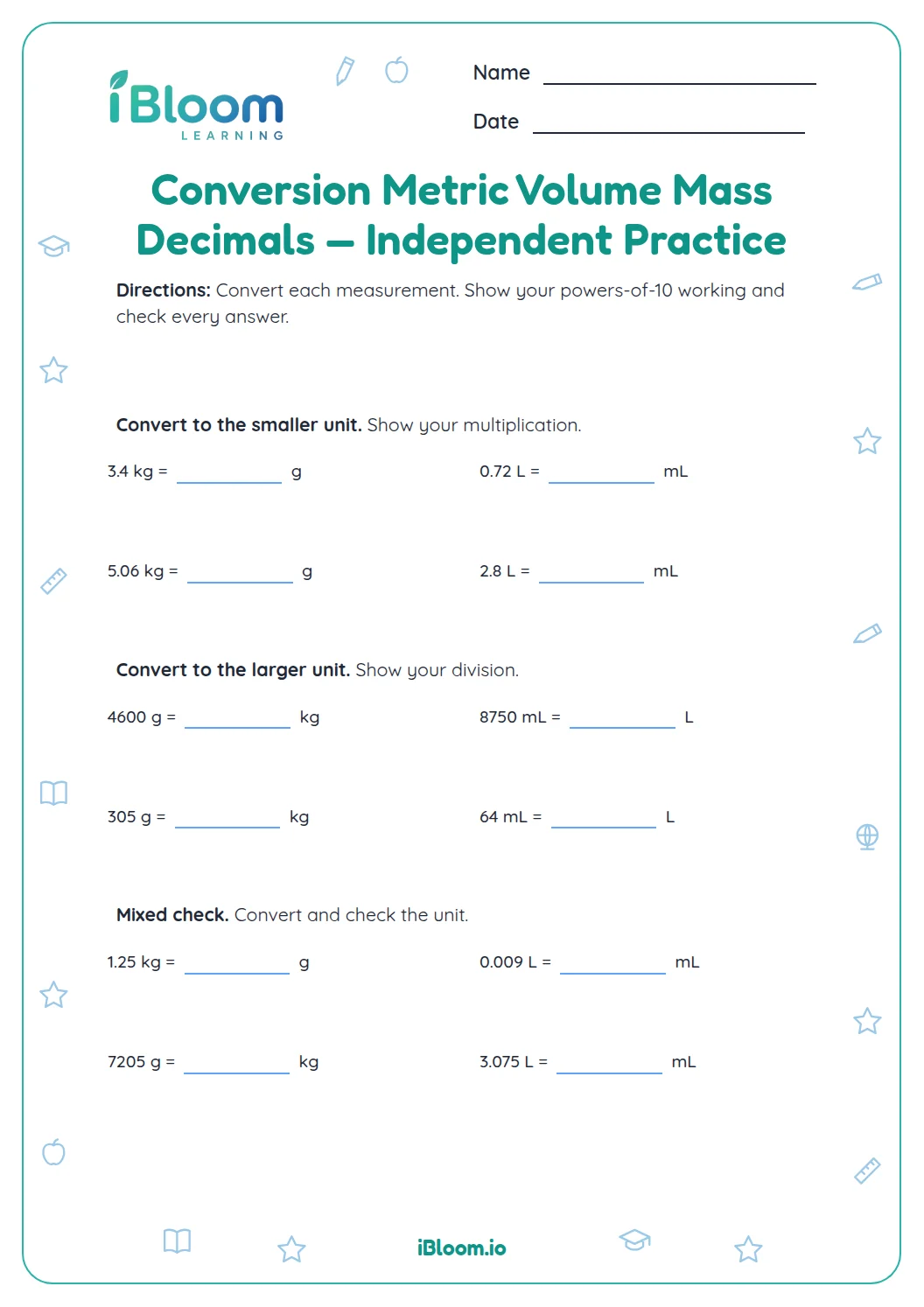
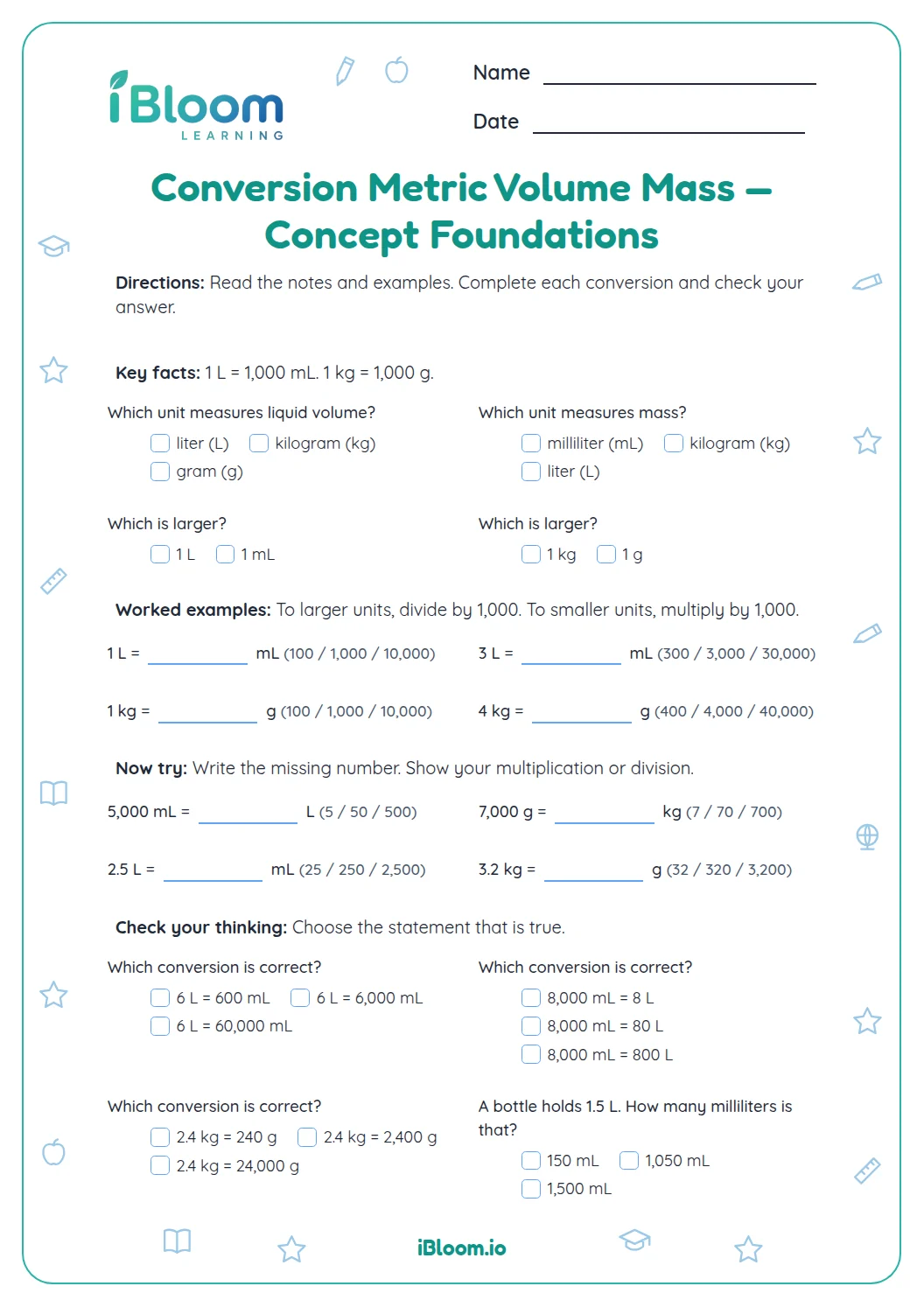
A liter equals 1,000 milliliters, and a kilogram equals 1,000 grams. To change to the smaller unit, multiply by 1,000; to change to the larger unit, divide by 1,000.
Question 1 converts 3.4 L to milliliters: 3.4 × 1,000 = 3,400 mL. Question 2 converts 2,750 mL to liters: 2,750 ÷ 1,000 = 2.75 L.
- 13.4 L × 1,000 = 3,400 mL
- 2The smaller unit gives a larger number.
How can you check whether a conversion makes sense?
Identify the starting and target units before calculating. If the answer is in the smaller unit, its number should grow; if it is in the larger unit, its number should shrink. For example, question 3 changes 0.86 kg to 860 g.
How do the word problems use conversions?
Questions 7–10 apply the same conversions to bottles, rice, a jug and a parcel. Question 12 converts 4.5 L to 4,500 mL, then divides by 500 mL per cup to find 9 cups.
How to use this worksheet
- 1Read the starting and target units.
- 2Use 1,000 mL = 1 L or 1,000 g = 1 kg.
- 3Multiply when changing to the smaller unit; divide for the larger unit.
- 4Check whether the converted number should grow or shrink.
- 5Write the requested unit when the question asks for it.
- 6For question 12, convert liters to milliliters before dividing by 500.
Common mistakes and quick fixes
The mistake
Multiplying in both directions
The fix
Ask whether the target unit is smaller. If so, the number grows; if larger, divide.
The mistake
Dropping or shifting the decimal the wrong way
The fix
Use 1,000 × or ÷ explicitly, then count three decimal places.
The mistake
Leaving off units
The fix
Copy the requested unit into the answer and check it matches the starting measure.
Common Core alignment
This worksheet practices the listed Common Core skill through its questions.
Use ratio reasoning to convert metric units in the worksheet problems.
On this sheet: Students scale liters and kilograms by 1,000 and use the converted measures in situations.
Show the official wordingHide the official wording
Use ratio reasoning to convert measurement units; manipulate and transform units appropriately when multiplying or dividing quantities.
What to practice next
Make more practice
Further reading
Questions parents and teachers ask
What relationship does this sheet use?
Each pair uses a factor of 1,000: 1 L = 1,000 mL and 1 kg = 1,000 g. Multiplying by 1,000 converts to the smaller unit, while dividing by 1,000 converts to the larger unit. Every question uses one of these relationships.
Why is 3.4 L equal to 3,400 mL?
A liter contains 1,000 milliliters, so multiply 3.4 by 1,000. The result is 3,400 mL. Question 1 practices this conversion, and the answer key shows the value and unit so students can carefully check their work at home or in class.
How can I check the decimal placement?
Use the size of the units as a check. Smaller units require a greater count, so 0.86 kg should become hundreds of grams, not a smaller number. Multiplying or dividing by 1,000 also shifts the decimal three places.
Does the worksheet include both mass and volume?
Yes. Questions 1, 2, 5, 7, 9, 11 and 12 include liters and milliliters; questions 3, 4, 6, 8, 10, 13 and 14 include kilograms and grams. The worksheet uses both pairs in direct conversions, measurement situations and comparisons.
How do students solve question 12?
First change 4.5 L to 4,500 mL. Then divide 4,500 mL by 500 mL per cup to get 9 cups. The question combines a metric conversion with equal groups, so the final answer names the number of cups.
Is an answer key included?
Yes. A separate key lists answers for all 14 questions. Students can check each converted value, compare measurements after expressing them in the same unit, and review the corrected conversion in the final multiple-choice item. Units in the key make the requested measure clear.