



About this worksheet
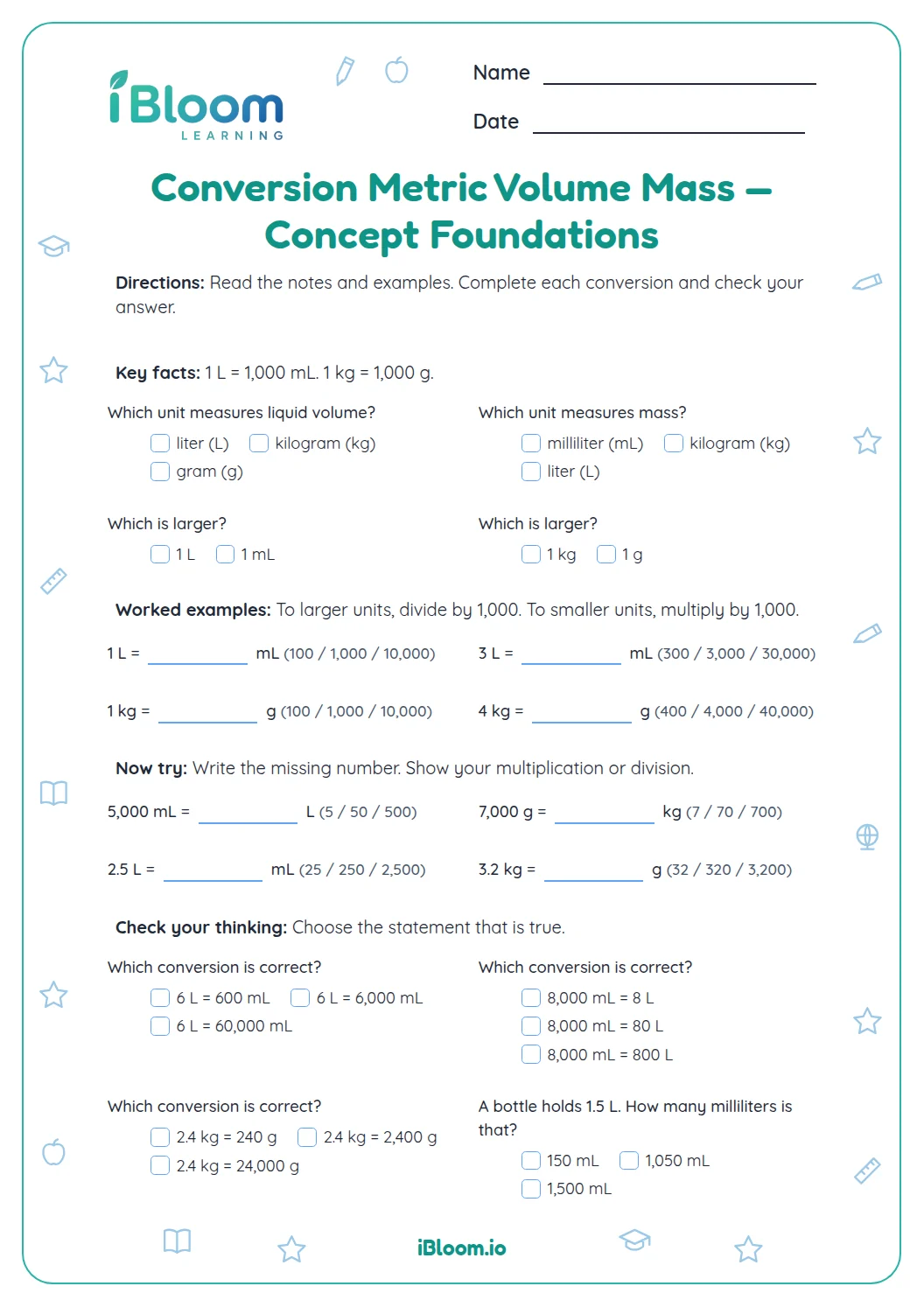
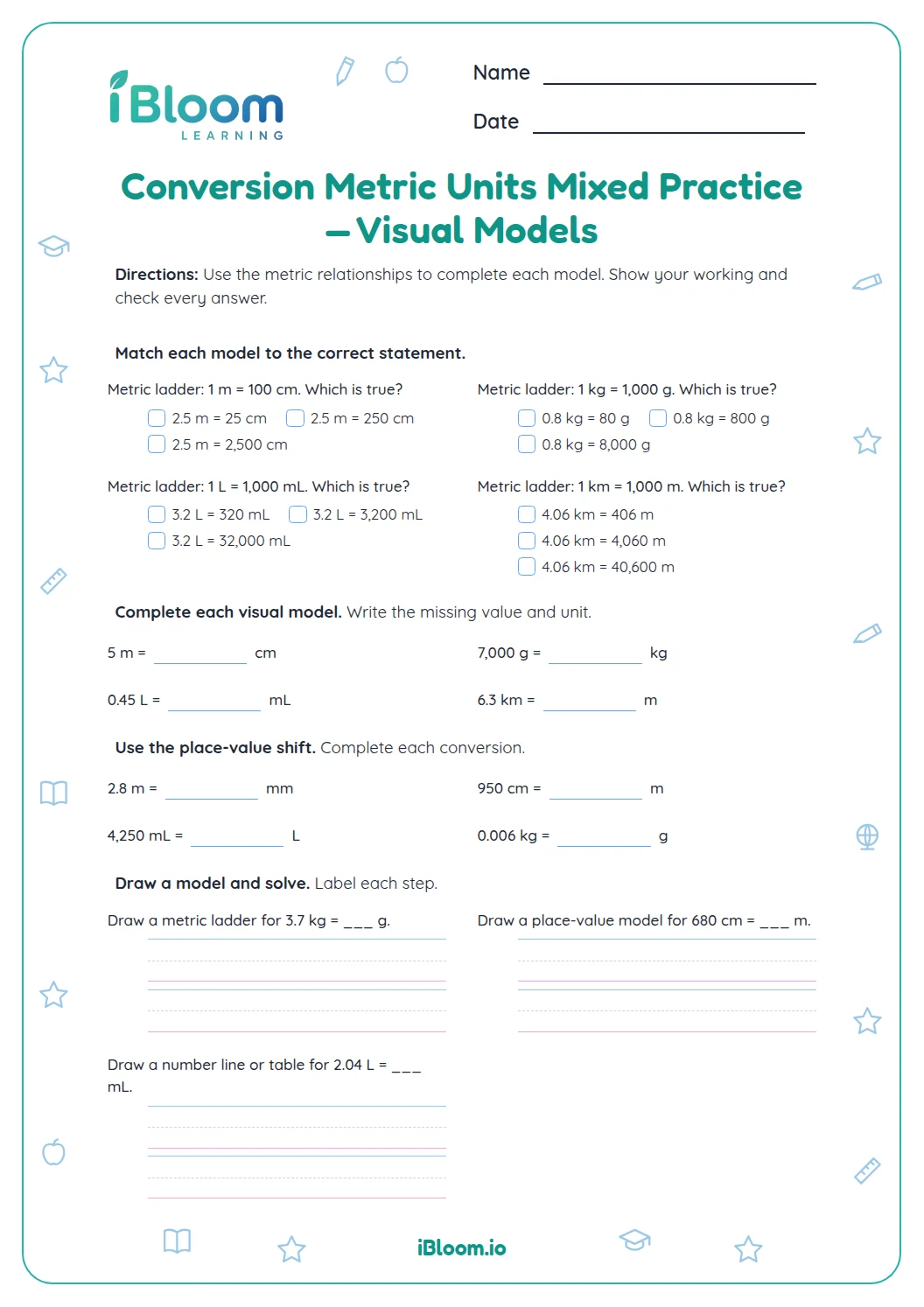
This Grade 6 worksheet practices converting metric units of volume and mass. Learners use container, number-line, and table models, then convert between liters and milliliters and between kilograms and grams. The 14 questions include whole-number and decimal quantities, with a separate answer key.
Aligned to 5.MD.A.1
Which metric facts connect the units?
One liter equals 1,000 milliliters, and one kilogram equals 1,000 grams. A conversion changes the number and unit while keeping the measured amount the same.
How do visual models help?
A filled liter container can represent 1,000 mL. A number line can locate 1.5 L between 1 L and 2 L. Repeated equal parts show how many smaller units make a larger unit.
What is included?
Part A reads models. Part B completes model-based conversions. Part C converts in both directions. Part D applies the relationships to short contexts and explains one conversion.
Convert with a model
- 1Write the relationship: 1 L = 1,000 mL or 1 kg = 1,000 g.
- 2For a larger unit to a smaller unit, count thousandths or multiply by 1,000.
- 3For a smaller unit to a larger unit, divide by 1,000.
- 4Check that the converted number and unit describe the same amount.
Common mix-ups
The mistake
Writing 650 mL = 650 L.
The fix
A liter contains more than a milliliter, so the number of liters is smaller: 0.65 L.
The mistake
Converting 2 kg 350 g to 2,350 kg.
The fix
Convert the kilograms to grams first, then add 350 g.
Curriculum alignment
Metric conversions practice measurement reasoning and place value.
Convert among standard measurement units.
On this sheet: Learners use metric unit relationships to convert measures and solve short real-world problems.
Show the official wordingHide the official wording
Convert among different-sized standard measurement units within a given measurement system (e.g., convert 5 cm to 0.05 m), and use these conversions in solving multi-step, real-world problems.
What to practice next
Make more practice
Questions parents and teachers ask
Which metric relationships does this sheet use?
The worksheet uses 1 liter = 1,000 milliliters and 1 kilogram = 1,000 grams. Learners apply both relationships to whole numbers and decimals. For example, 1.8 L equals 1,800 mL because each liter contains 1,000 milliliters. Keep the unit labels attached to each quantity while converting.
What visual models are included?
The questions include filled containers, number lines, and tables. Each model connects a measured quantity to an equivalent amount or equal group. Learners read the model and use the metric relationship to find the requested amount. The drawings are paired with questions that ask learners to interpret the quantities.
How do I convert liters to milliliters?
Multiply the number of liters by 1,000. For 4 L, calculate 4 × 1,000 to get 4,000 mL. When converting milliliters to liters, divide by 1,000, so 650 mL is 0.65 L. Check that the result is expressed in the requested unit.
How do I convert kilograms to grams?
Multiply kilograms by 1,000 to find grams: 3.6 kg equals 3,600 g. To change grams to kilograms, divide by 1,000: 2,075 g equals 2.075 kg. Keep the unit in the answer so the quantity is clear. This keeps the direction of the conversion clear.
How many problems and pages are there?
The worksheet has 14 questions in four parts, followed by a separate answer key. It begins with visual models, then practices metric relationships, conversions in both directions, and applied quantities. The worksheet and its separate answer key each use three pages.