







About this worksheet
This free Grade 6 worksheet practices metric volume and mass conversions in practical settings: recipes, lab supplies, parcels, water, and shared portions. Children move between liters and milliliters and between kilograms and grams, then use those conversions to add, subtract, divide, or count equal servings. Several contexts require more than one step. The questions align with CCSS 6.RP.A.3.d, using ratio reasoning to convert measurement units.
Aligned to 6.RP.A.3.d
What metric relationships help solve the problems?
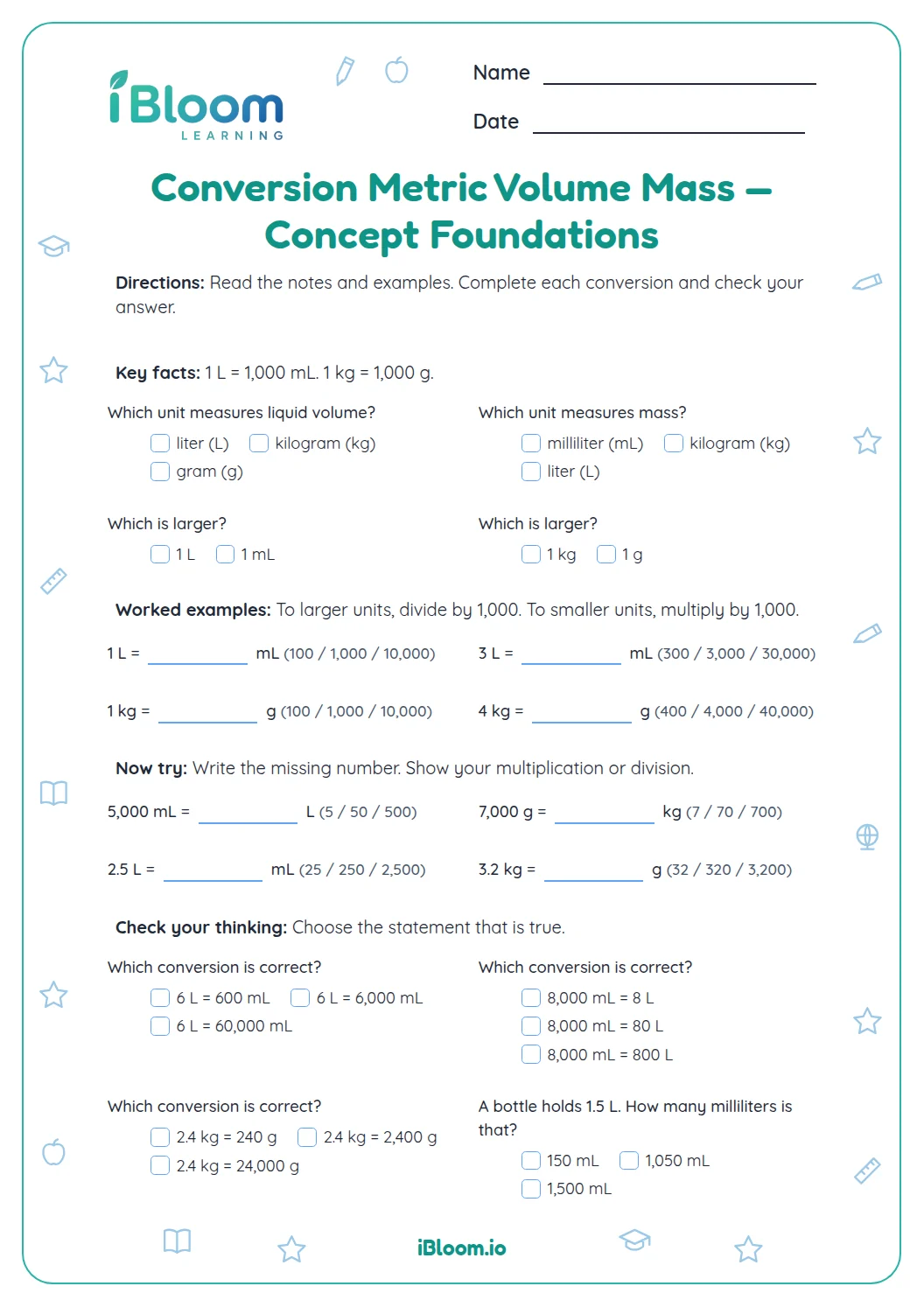
One liter equals 1,000 milliliters. One kilogram equals 1,000 grams. Use these equal relationships to multiply or divide by 1,000, then keep the unit attached to the number.
- 13 L = 3,000 mL
- 2Subtract the 750 mL poured out.
- 33,000 − 750 = 2,250
- 4There are 2,250 mL left.
When should the conversion happen?
Convert to a common unit before adding or subtracting. When a quantity is shared equally, divide in a unit that gives a whole-number result, then state that unit in the answer.
What is on the worksheet?
The 14 situations move from direct conversions to combining, removing, or sharing amounts. Children practice both metric volume and mass, then choose answers with the requested units.
- Part A: direct volume and mass conversions
- Part B: multi-step and equal-group situations
How to use this worksheet at home or in class
- 1Keep 1 L = 1,000 mL and 1 kg = 1,000 g nearby, or write them on scrap paper.
- 2For each problem, underline the starting amount and circle the requested unit.
- 3For a mixed-unit problem, convert both amounts to the same unit before choosing.
- 4Check that the answer is reasonable: milliliters are a smaller unit than liters, and grams are smaller than kilograms.
- 5Use the key to check both the number and its unit.
Common mistakes and quick fixes
The mistake
Writing 4 L as 400 mL.
The fix
A liter is 1,000 milliliters, so multiply liters by 1,000 to find milliliters.
The mistake
Adding 2 kg and 1,500 g without matching units.
The fix
Convert 2 kg to 2,000 g first, then add to get 3,500 g.
The mistake
Giving a correct number with the wrong unit.
The fix
Circle the unit named in the question and write that unit after the result.
Common Core alignment
This page practices the listed Common Core skill with examples drawn from the worksheet.
Use ratio reasoning to convert measurement units.
On this sheet: Each context applies a metric unit relationship and several require operations after converting.
Show the official wordingHide the official wording
Use ratio reasoning to convert measurement units; manipulate and transform units appropriately when multiplying or dividing quantities.
What to practice next
Make more practice
Further reading
Questions parents and teachers ask
How many milliliters are in a liter?
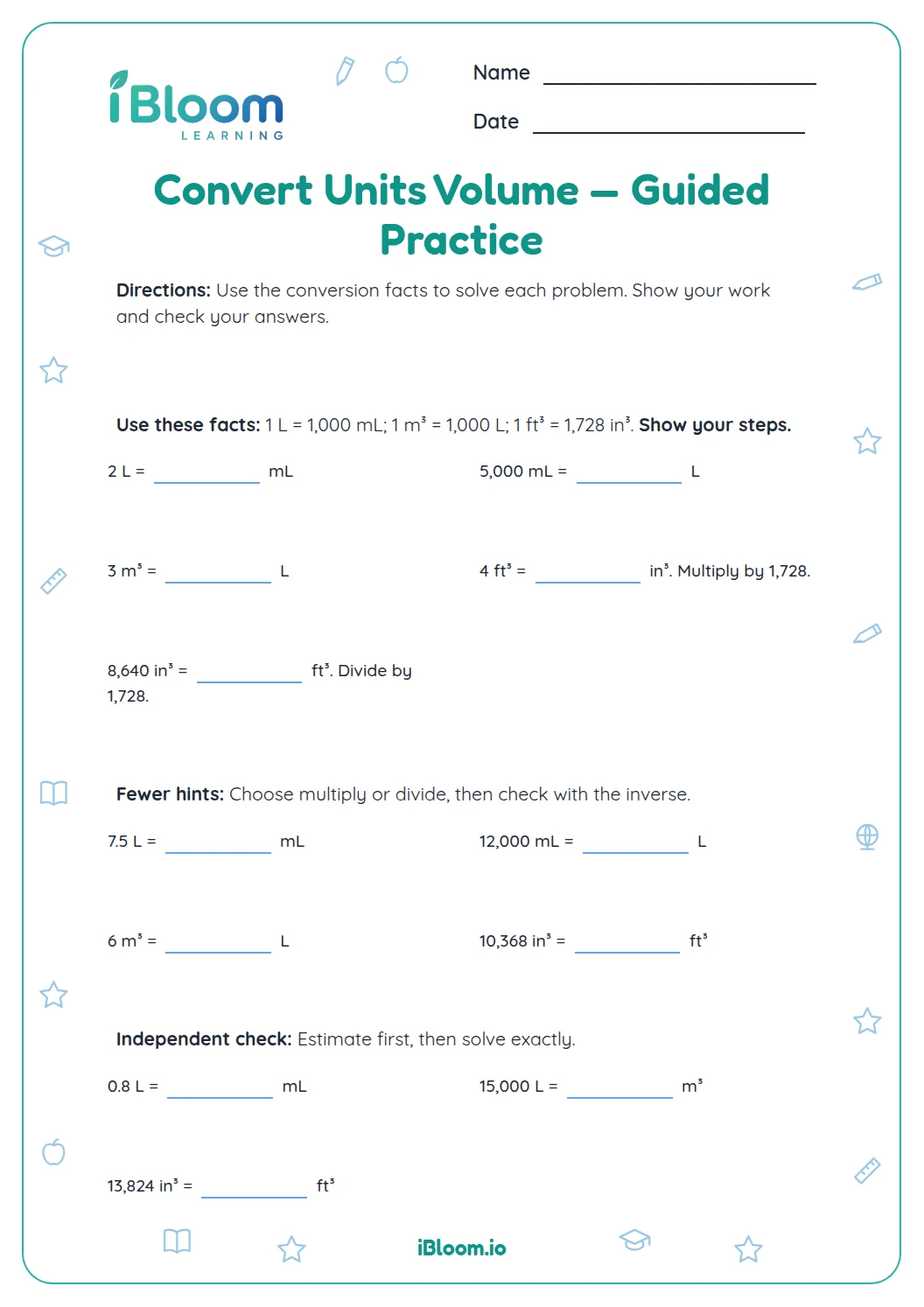
One liter equals 1,000 milliliters. To change liters to milliliters, multiply by 1,000; to change milliliters to liters, divide by 1,000. The worksheet then uses that relationship in recipes, water containers, and serving problems. Use the same relationship for every conversion.
How many grams are in a kilogram?
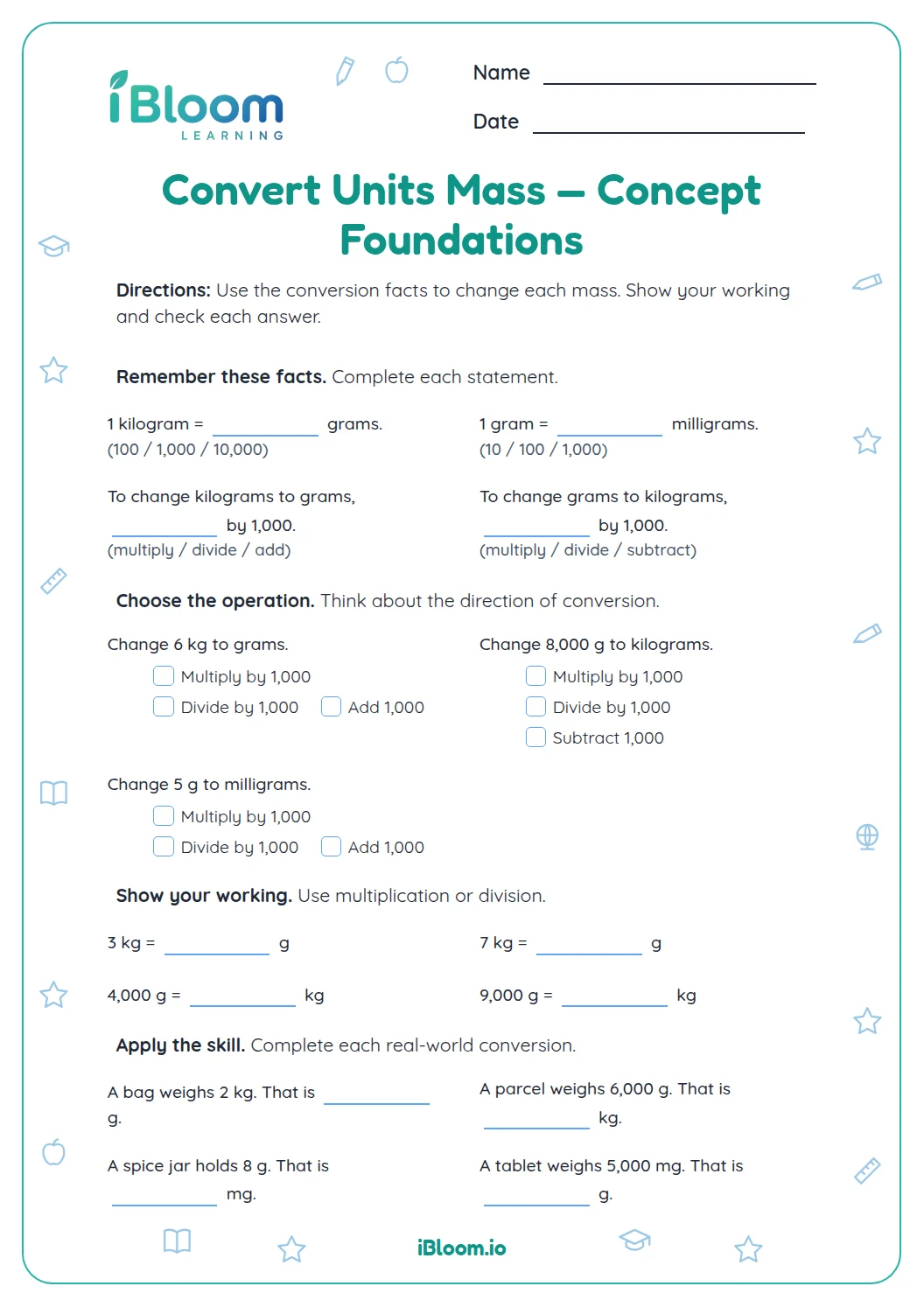
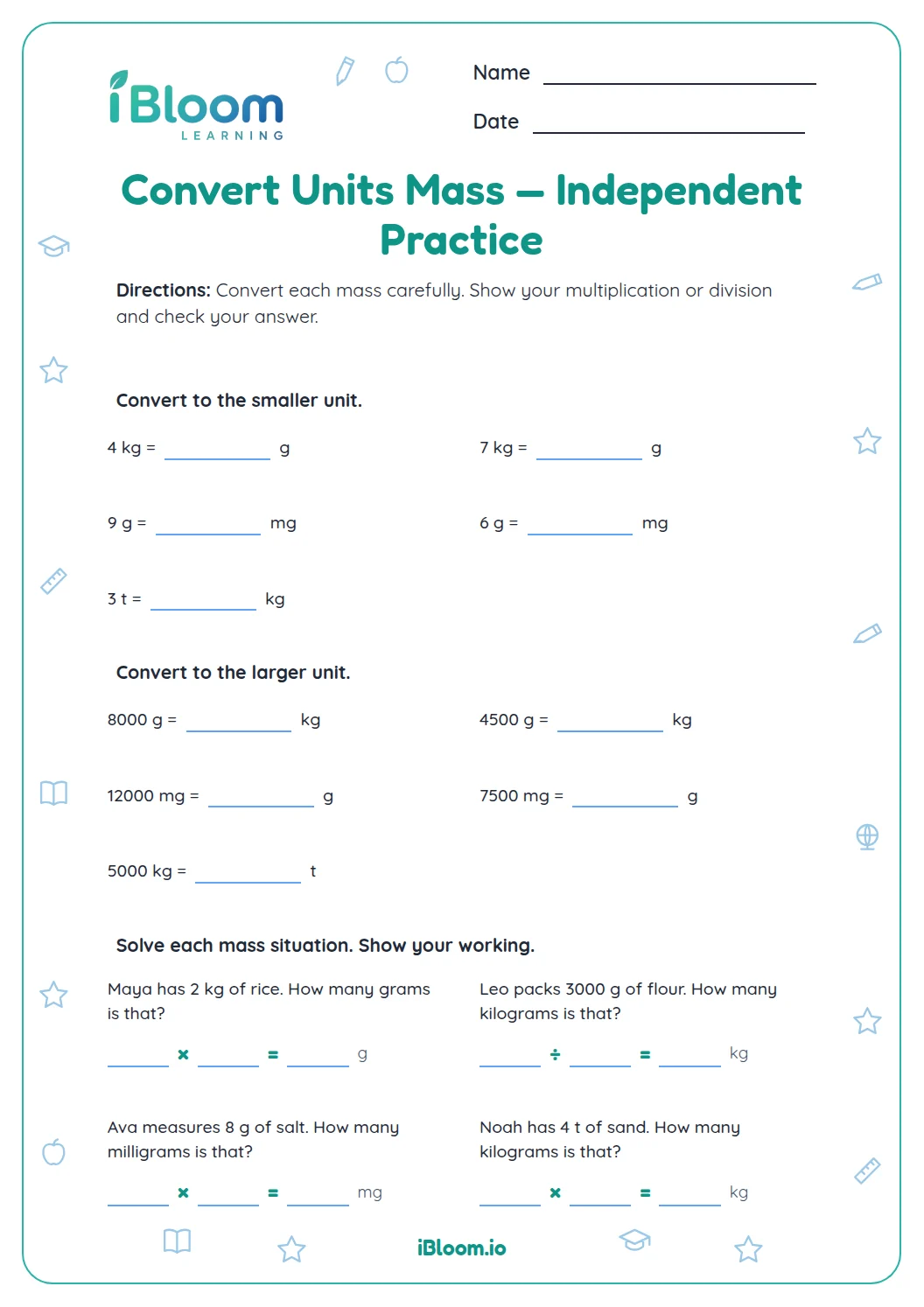
One kilogram equals 1,000 grams. Convert kilograms to grams by multiplying by 1,000, or divide grams by 1,000 to express the same mass in kilograms. Several questions use this fact before adding or sharing a mass. Then keep the requested unit in the final result.
Should children convert before adding measurements?
Yes. When amounts use different units, first express them in the same unit, then add or subtract. For example, change 2 kilograms to 2,000 grams before combining it with 1,500 grams. This avoids combining unlike units by mistake in a single problem.
Does the key include units with each answer?
Yes. The answer key includes the unit requested in each question, such as milliliters, grams, or servings. Check the unit as well as the number so the result answers the actual situation. The unit should match the question’s context.
How many cups can 5 liters fill if each cup holds 250 milliliters?
Convert 5 liters to 5,000 milliliters, then divide by 250 milliliters per cup. The result is 20 cups. This worksheet uses that same two-step idea: express the total and serving size in matching units before dividing. The units match before you count the servings.