





About this worksheet
This printable worksheet is for Grade 6 learners practicing converting customary and metric mass units. It offers 18 carefully sequenced questions, plus a separate answer key. It aligns with 6.RP.A.3.d.
Aligned to 6.RP.A.3.d
How do customary mass conversions work?
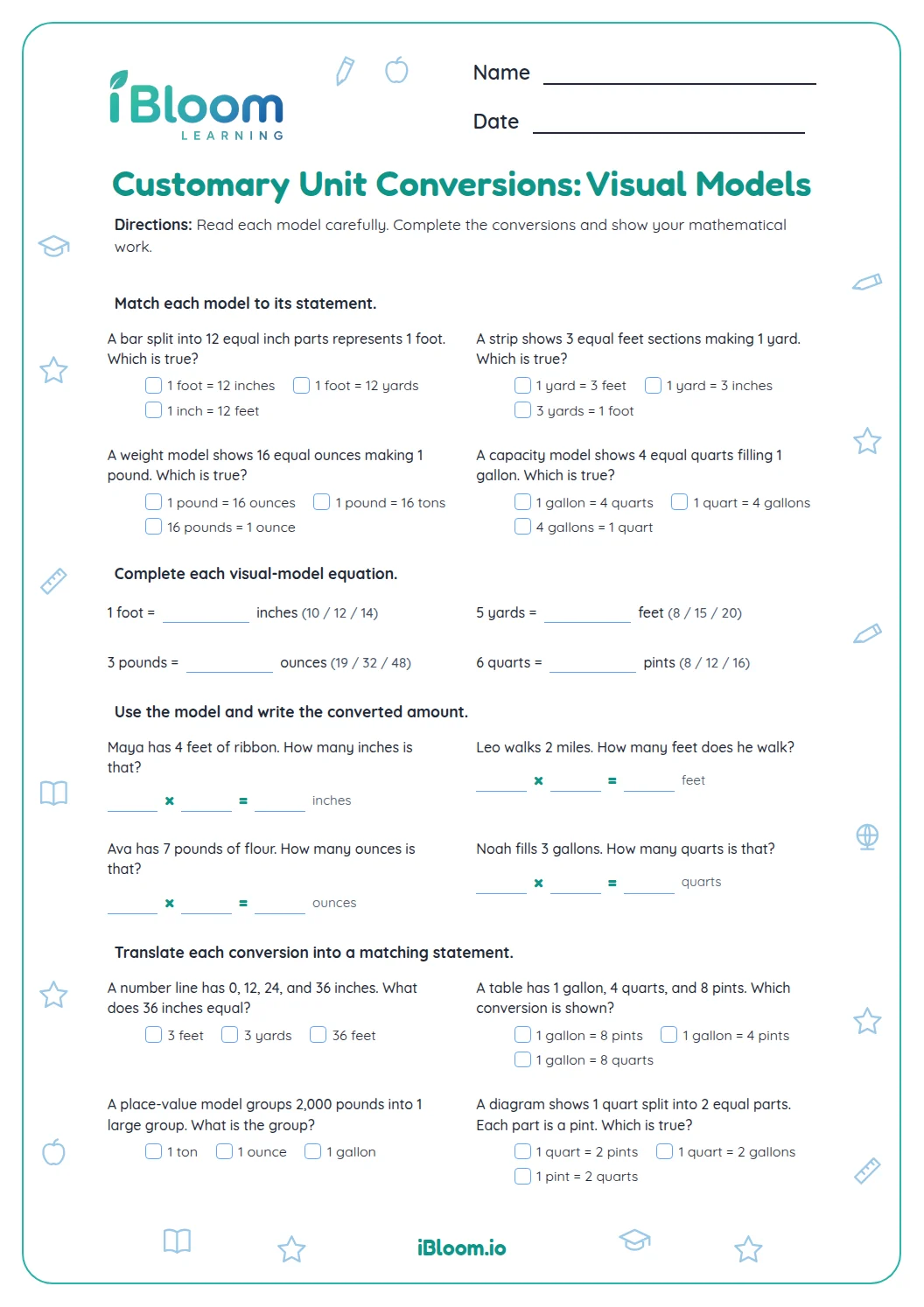
There are 16 ounces in 1 pound. For question 1, multiply 6 pounds by 16 ounces per pound: 6 × 16 = 96 ounces.
How do metric mass conversions work?
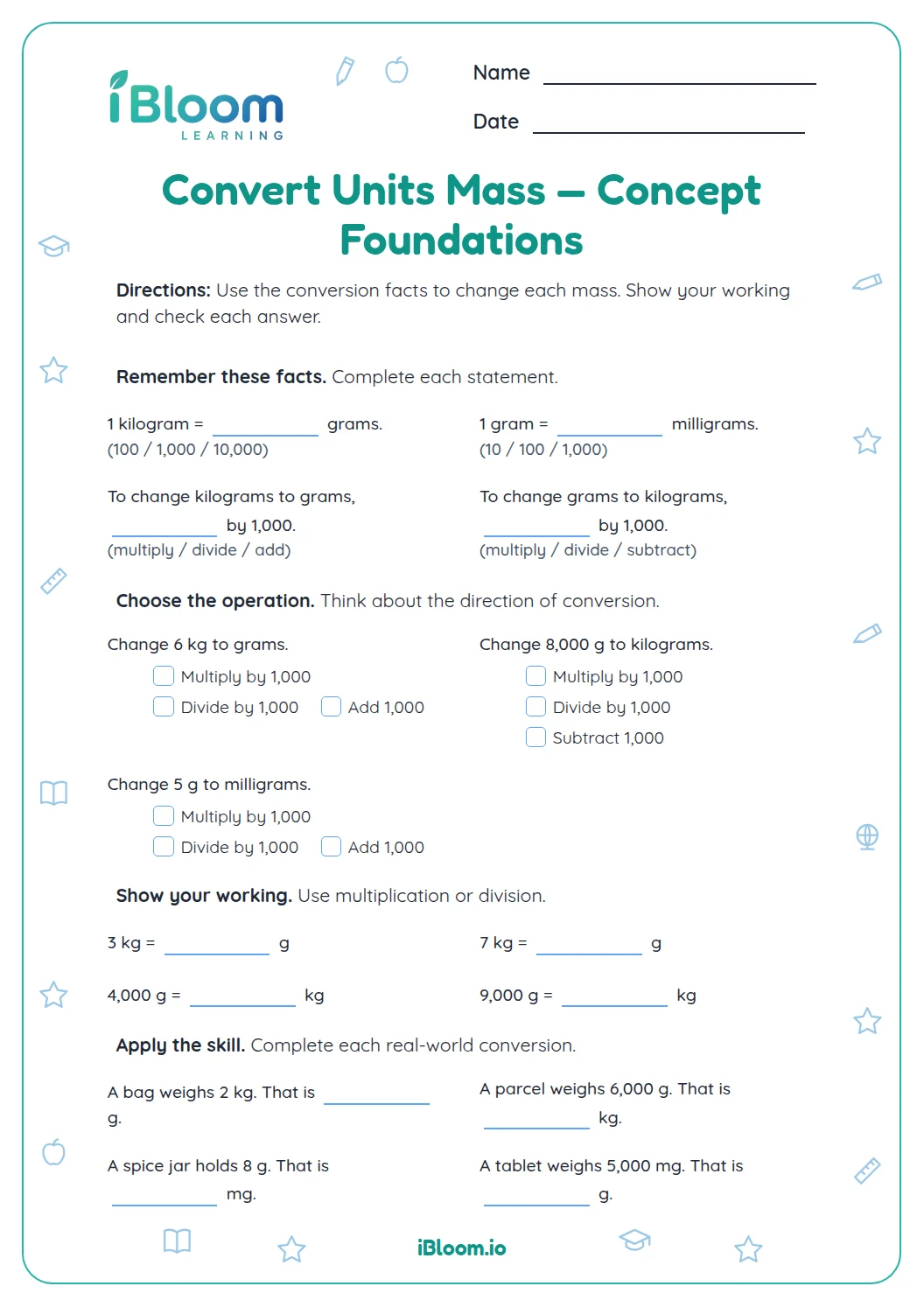
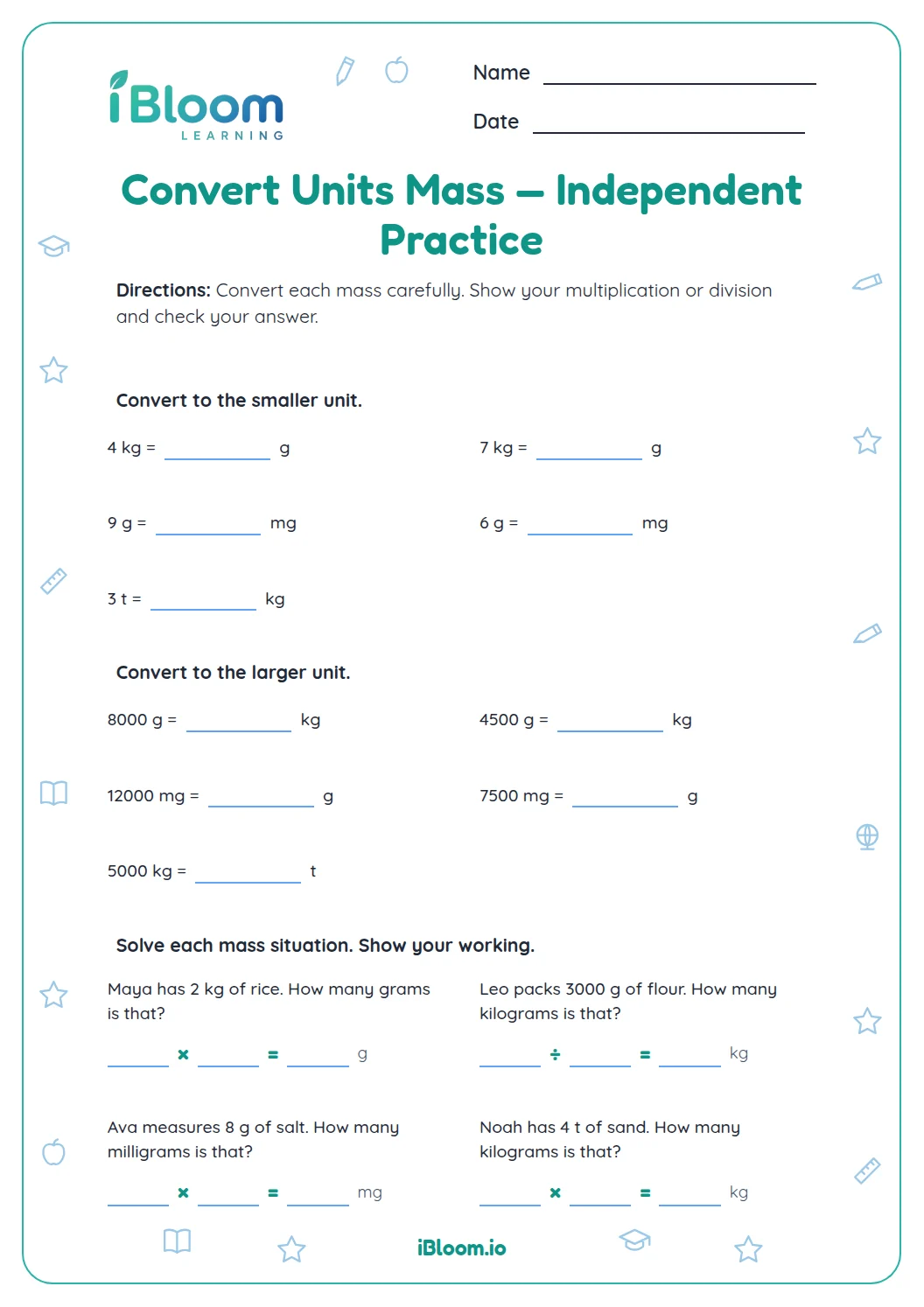
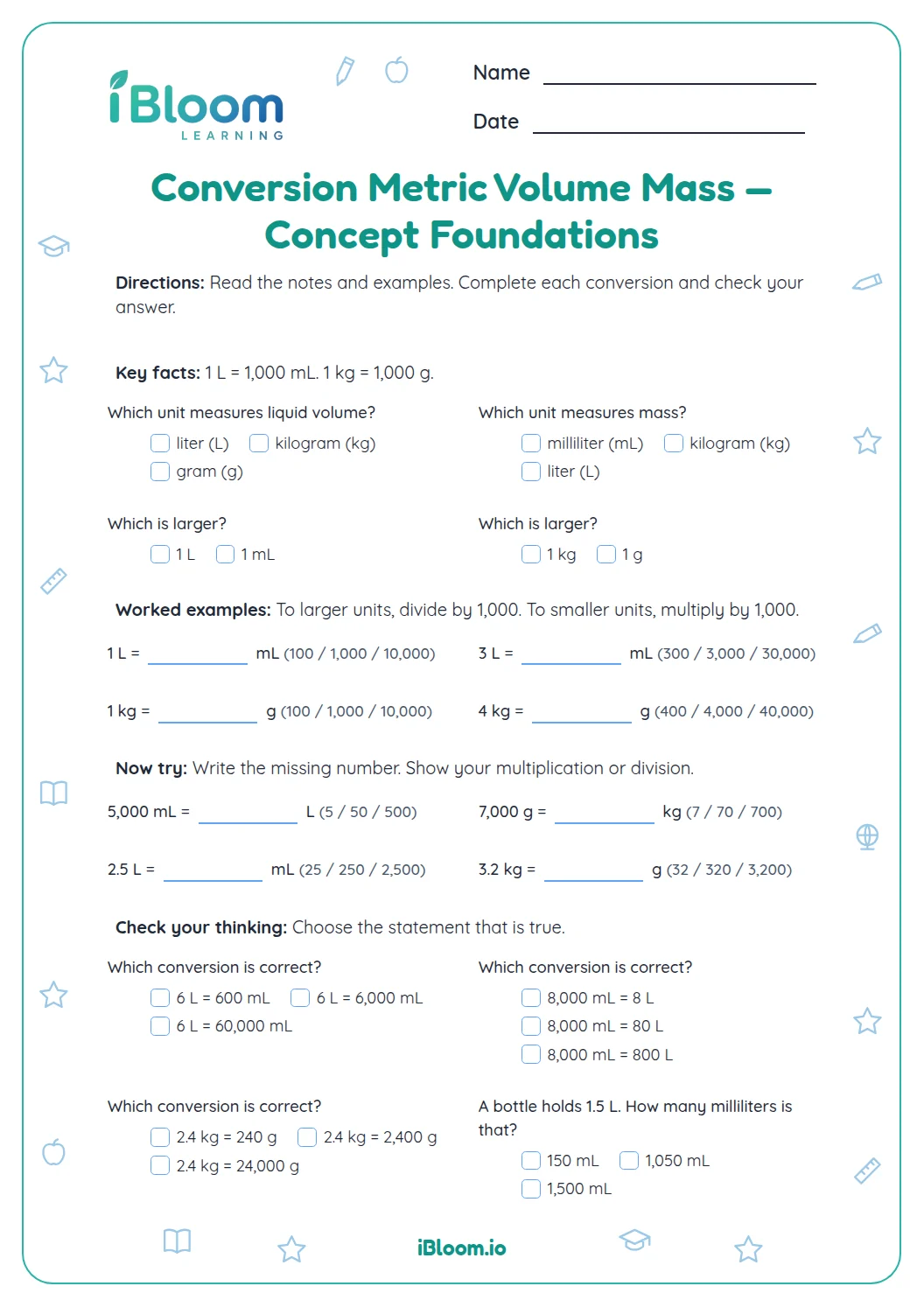
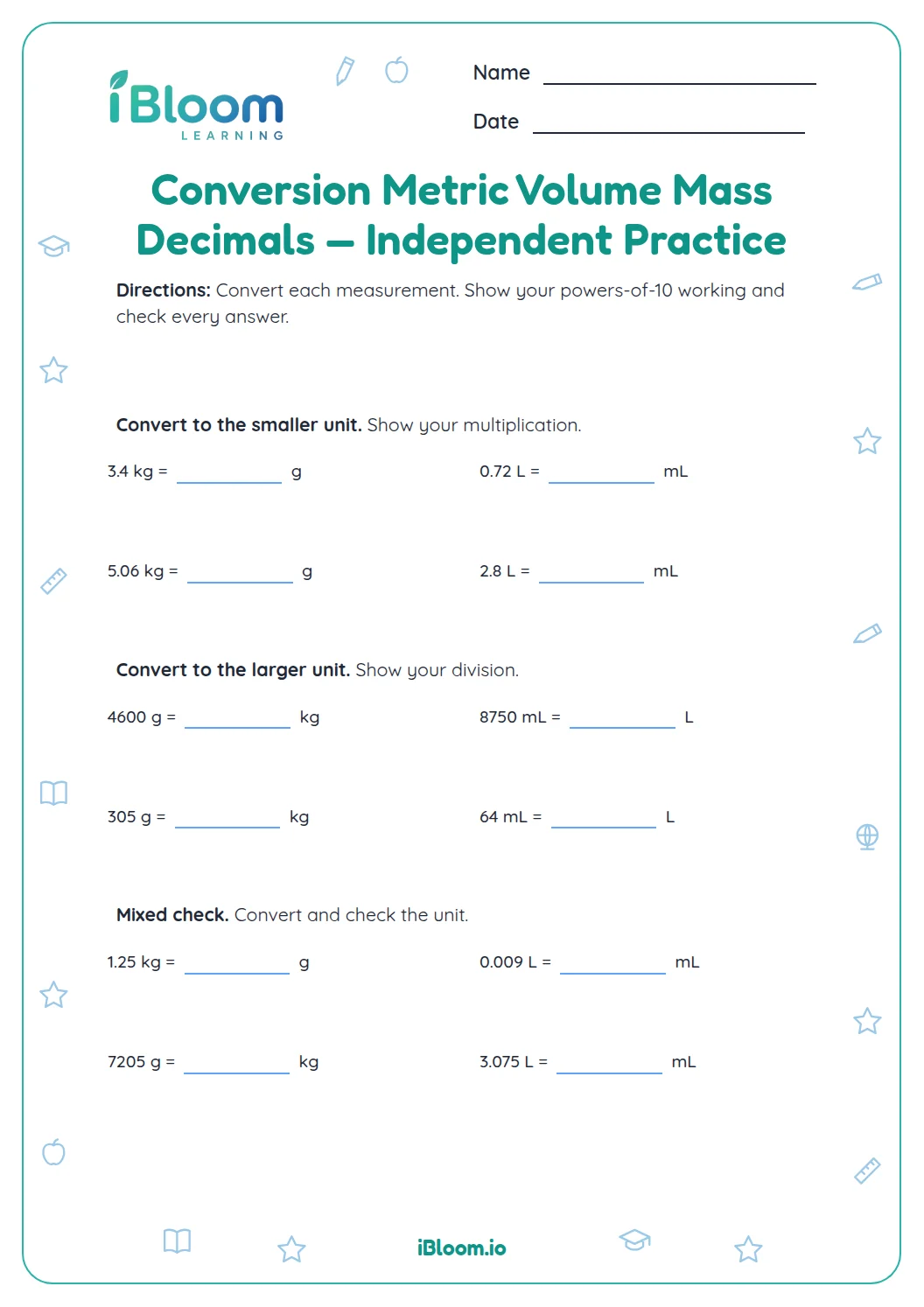
There are 1,000 grams in a kilogram. Multiply kilograms by 1,000 to get grams; divide grams by 1,000 to get kilograms. Question 4 converts 4,500 grams to 4.5 kilograms.
How can a conversion help compare masses?
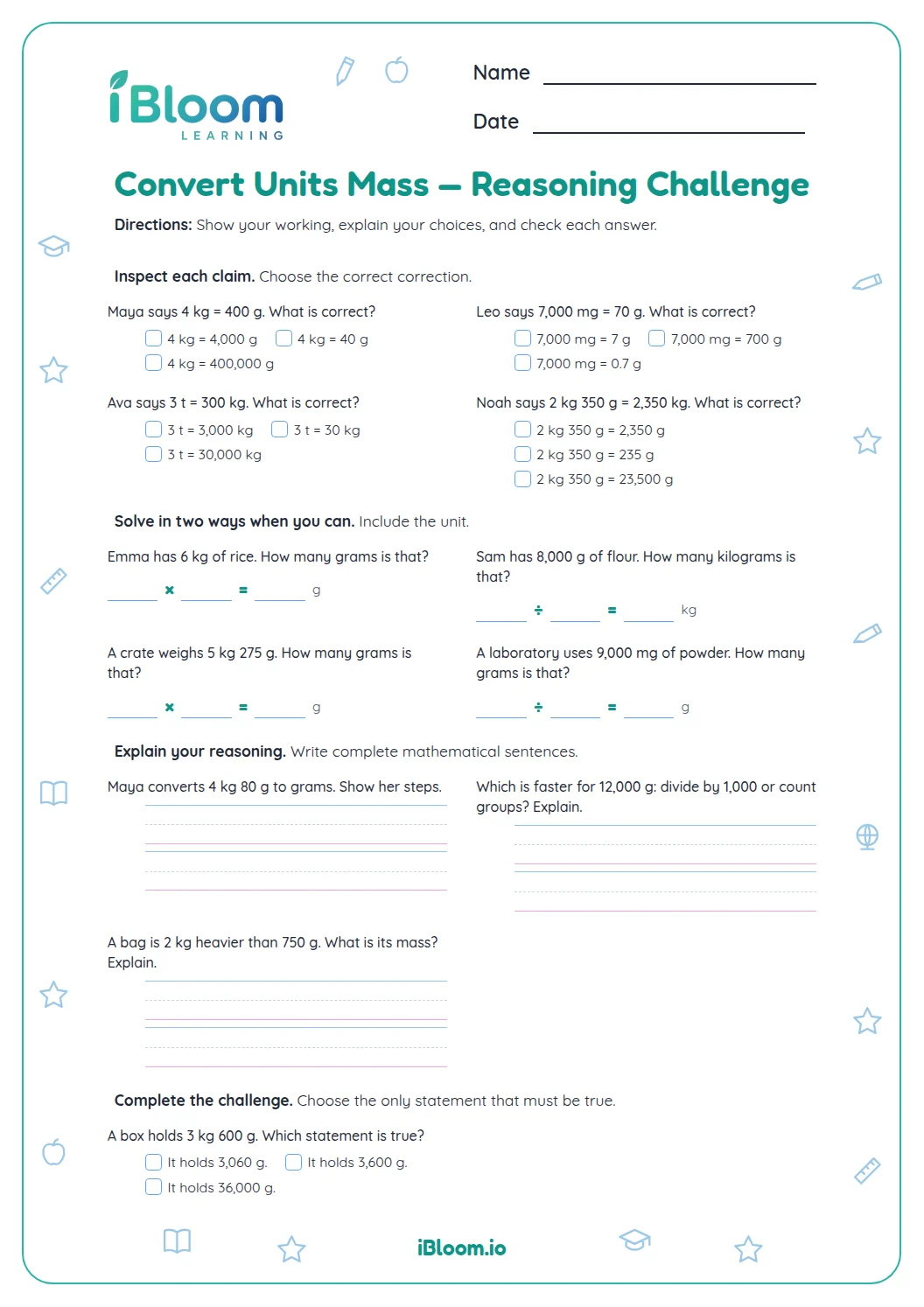
Convert both quantities to the same unit before comparing. In question 17, 5,200 grams is 200 grams more than 5 kilograms, because 5 kilograms is 5,000 grams.
How to use this worksheet
- 1Read all directions before beginning.
- 2Complete each question in order and show the requested unit or evidence.
- 3Check each response against the separate key.
Common mistakes and quick fixes
The mistake
Multiplying by 1,000 when changing grams to kilograms.
The fix
Divide by 1,000 to make the number smaller when converting grams to kilograms.
The mistake
Using 16 ounces per ton.
The fix
Keep the relationships straight: 16 ounces per pound and 2,000 pounds per ton.
The mistake
Comparing 5,200 grams with 5 kilograms without converting.
The fix
Change 5 kilograms to 5,000 grams, then compare the numbers.
Curriculum alignment
This worksheet practices the measurement and reasoning standard through its problems.
Use conversion ratios to change mass units and solve problems.
On this sheet:
Show the official wordingHide the official wording
Use ratio reasoning to convert measurement units; manipulate and transform units appropriately when multiplying or dividing quantities.
What to practice next
Make more practice
Further reading
Questions parents and teachers ask
Which units are used?
The questions use pounds, ounces, and US tons, along with grams and kilograms. Convert within the stated customary or metric relationships and include the unit requested in the prompt. Use the worked relationship from the page to check the units and calculation.
How many ounces are in a pound?
One pound equals 16 ounces. To change pounds to ounces, multiply by 16; to change ounces to pounds, divide by 16. For example, 6 pounds is 96 ounces. Use the worked relationship from the page to check the units and calculation.
How do I convert grams to kilograms?
There are 1,000 grams in a kilogram. Divide grams by 1,000 to express the same mass in kilograms, so 4,500 grams is 4.5 kilograms. Use the worked relationship from the page to check the units and calculation. The examples name the unit so learners can see what the final answer should include.
How many pounds are in a US ton?
One US customary ton equals 2,000 pounds. Multiply tons by 2,000 to find pounds; for example, 1.5 tons is 3,000 pounds. Use the worked relationship from the page to check the units and calculation. The examples name the unit so learners can see what the final answer should include.
Is an answer key included?
Yes. A separate answer key gives each converted mass, comparison, and application result. Check that the number and unit both match what each prompt requests. Use the worked relationship from the page to check the units and calculation.