Free printable practice
Convert Units Mass Practice Activities
Grade 6 students practise converting mass units using multiplication, division, place value, and real-world measurement situations.
Free printable worksheet PDFs
Preview every available page, then download the free worksheet PDF for home, homeschool, tutoring, or classroom practice.
Preview the exact activity before downloading it.
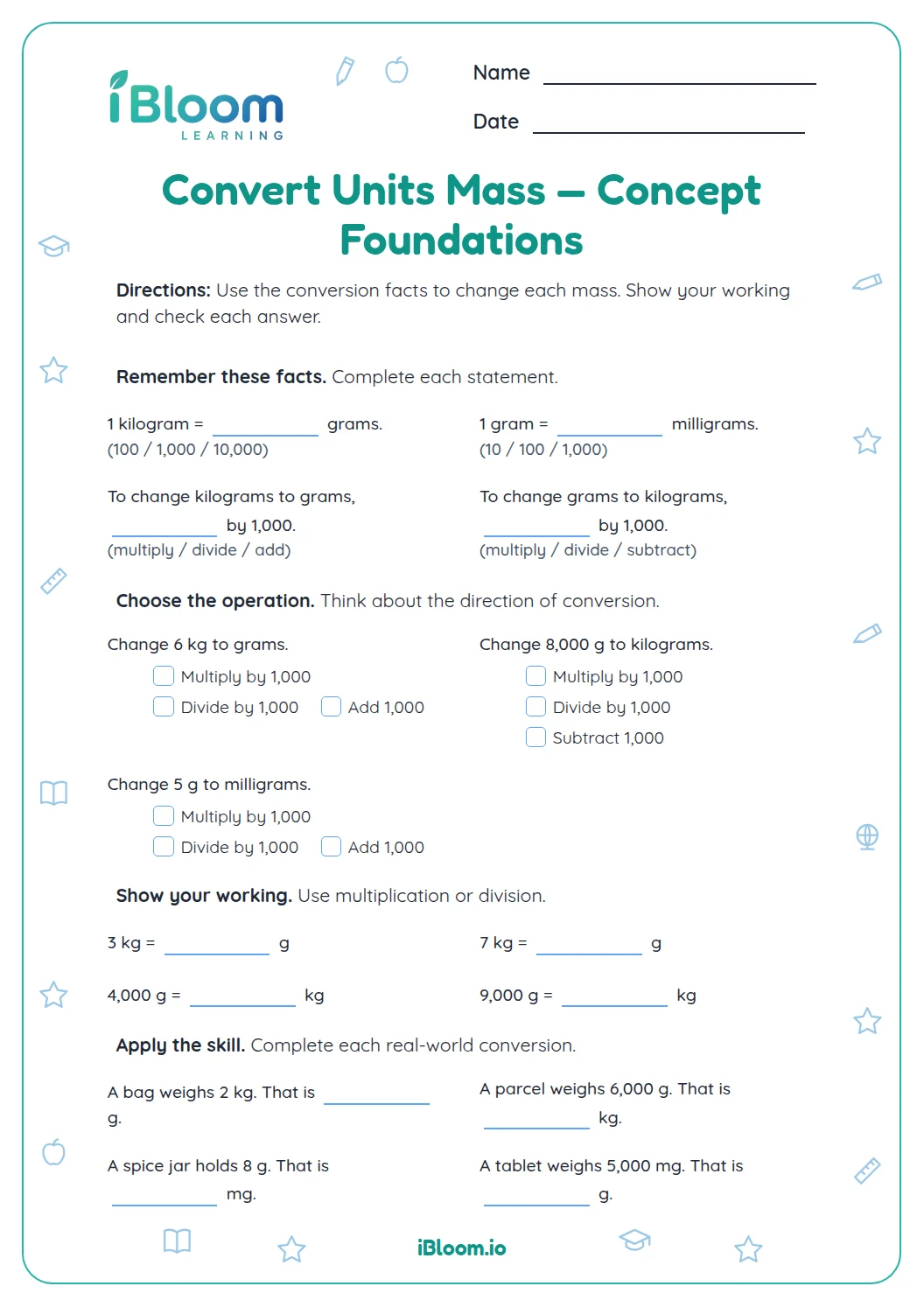 Convert Units Mass — Concept FoundationsGrade 6 students practise converting mass units using multiplication, division, place value, and real-world measurement situations. This Grade 6 foundations worksheet adds concise teaching notes, worked examples, and supported first attempts.Grade 6Free PDF preview6 pages
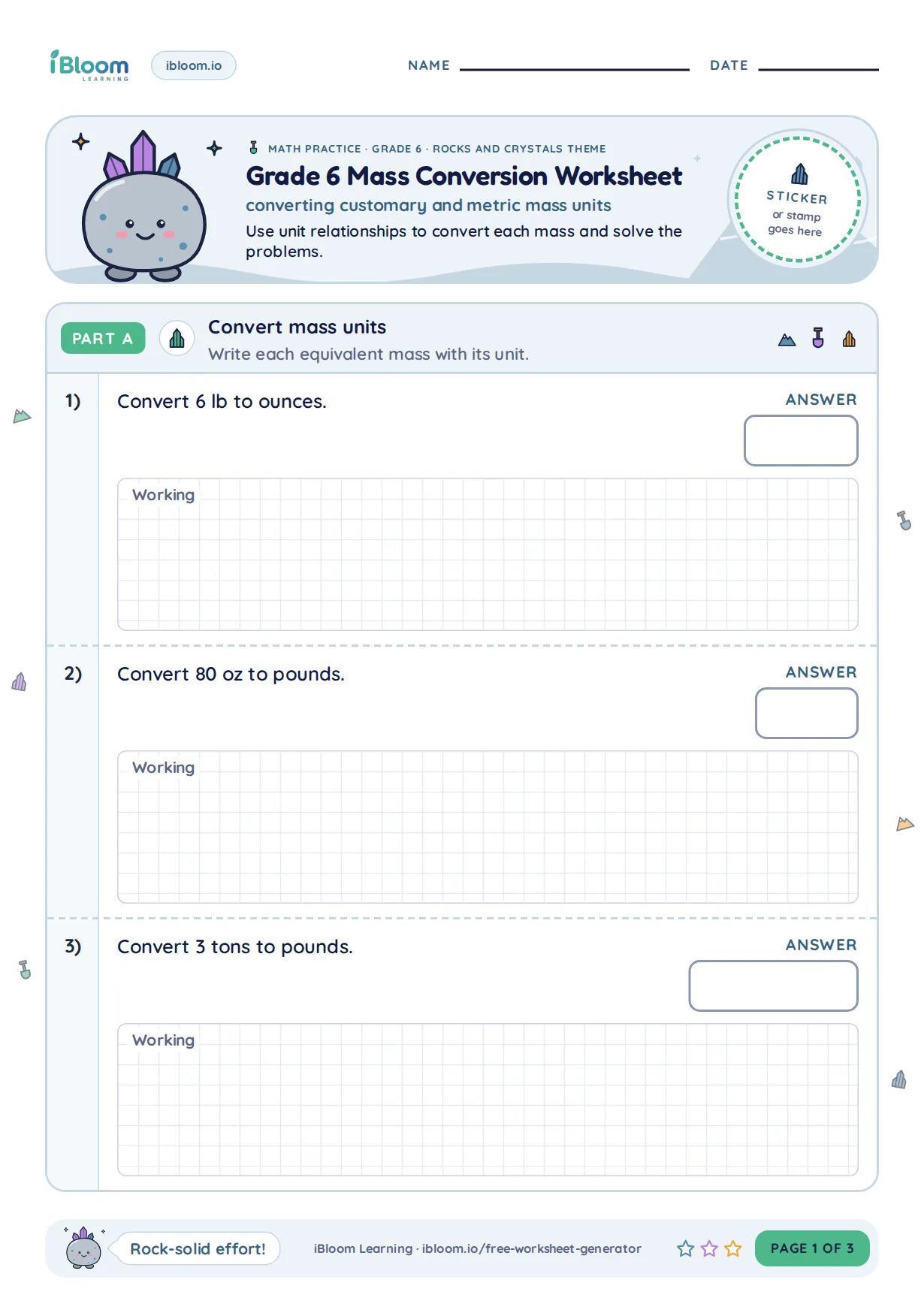 Convert Units Mass — Guided PracticeGrade 6 students practise converting mass units using multiplication, division, place value, and real-world measurement situations. This Grade 6 guided-practice worksheet progresses from prompts and checkpoints to independent questions.Grade 6Free PDF preview
 Convert Units Mass — Visual ModelsGrade 6 students practise converting mass units using multiplication, division, place value, and real-world measurement situations. This Grade 6 visual-model worksheet connects suitable diagrams, tables, number lines, or place-value models to mathematical notation.Grade 6Free PDF preview
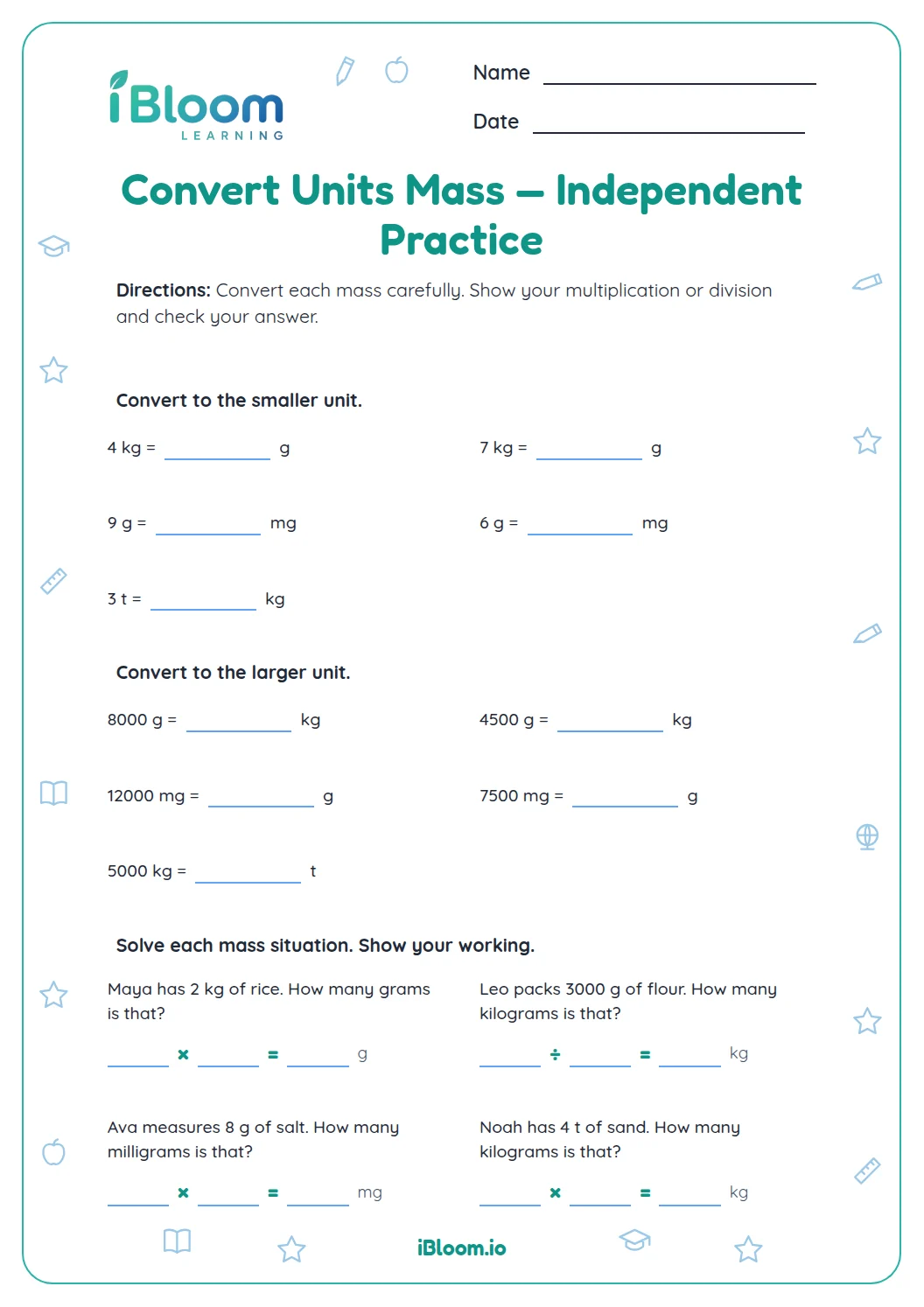 Convert Units Mass — Independent PracticeGrade 6 students practise converting mass units using multiplication, division, place value, and real-world measurement situations. This Grade 6 independent-practice worksheet provides a balanced sequence of accurate, grade-level exercises.Grade 6Free PDF preview8 pages
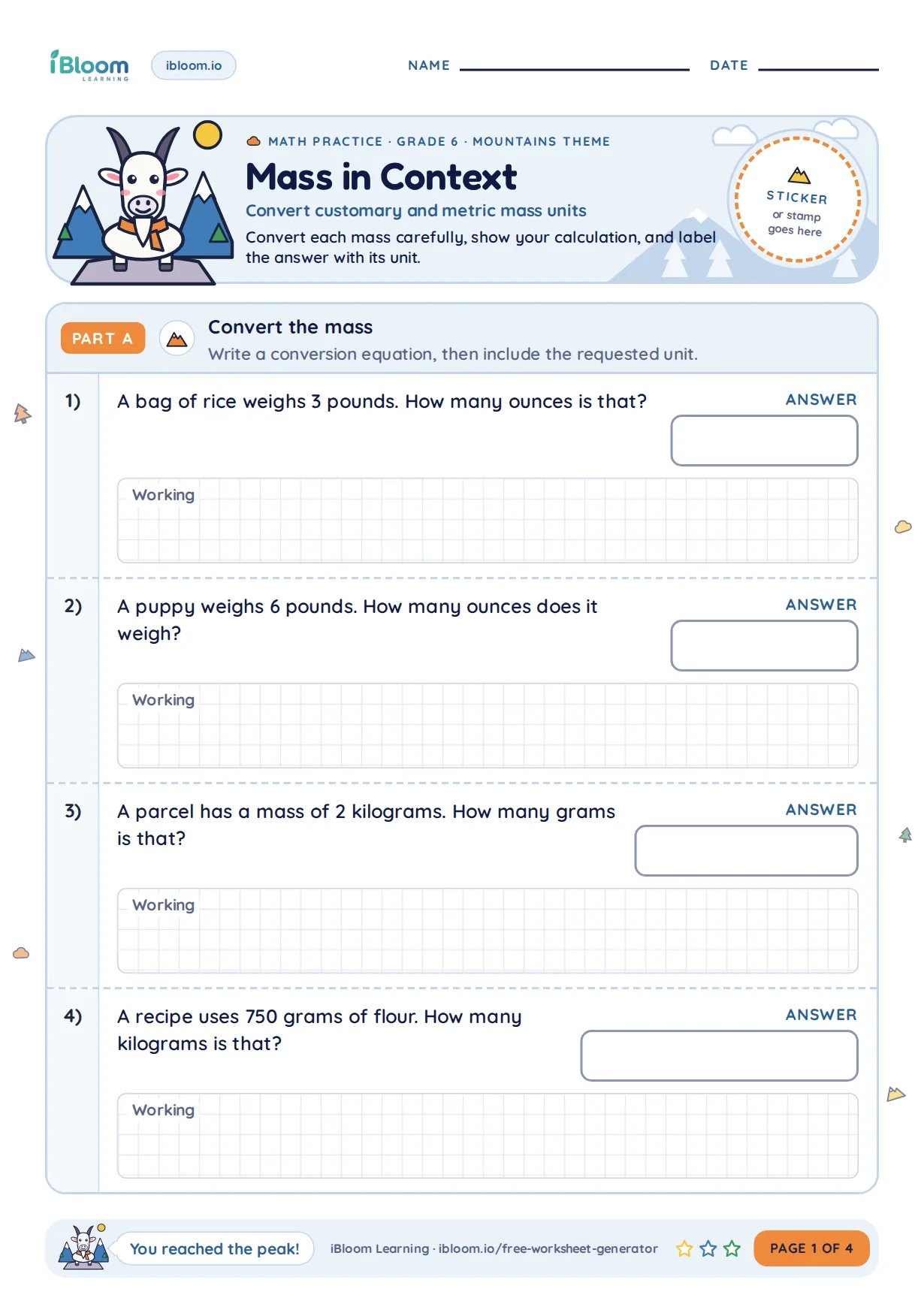 Convert Units Mass — Real-World ProblemsGrade 6 students practise converting mass units using multiplication, division, place value, and real-world measurement situations. This Grade 6 application worksheet uses realistic one-step and multi-step situations with room to model and solve.Grade 6Free PDF preview
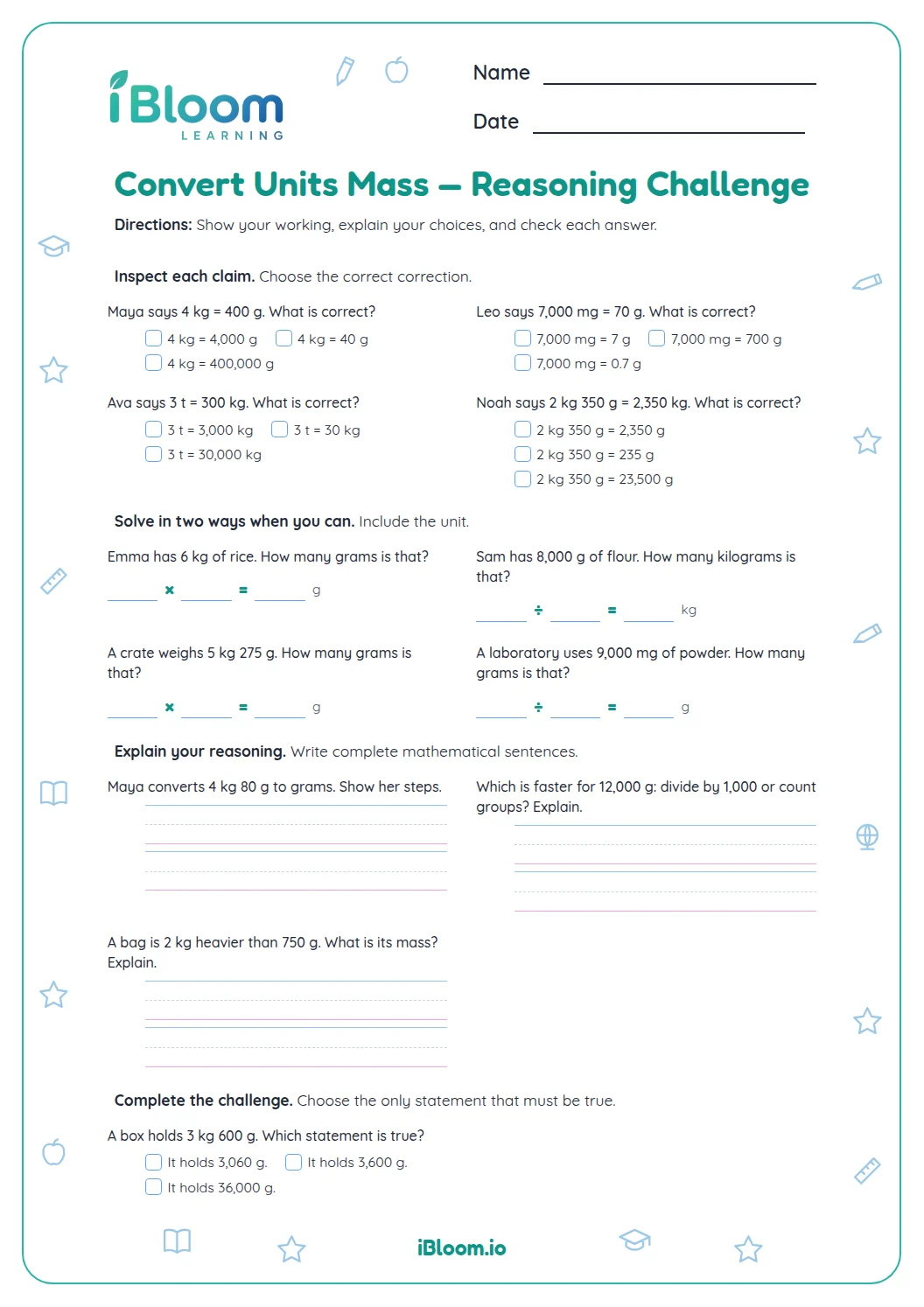 Convert Units Mass — Reasoning ChallengeGrade 6 students practise converting mass units using multiplication, division, place value, and real-world measurement situations. This Grade 6 reasoning worksheet combines error analysis, strategy comparison, missing information, and a gentle extension.Grade 6Free PDF preview
Practice that builds confidence
What students learn
These Grade 6 measurement worksheets help students convert units of mass with confidence. Children practise moving between related units, such as milligrams, grams, kilograms, ounces, pounds, and tons, while paying attention to whether the new unit should make the number larger or smaller.
The printable activities include direct conversions, mixed-unit practice, word problems, and comparison tasks. Students use conversion facts, multiplication, division, and decimal place value to solve problems that feel connected to everyday objects, packages, recipes, and science measurements.
Converting mass is more than memorizing facts. Grade 6 students learn to match the unit relationship to the operation: changing from a larger unit to a smaller unit usually makes the number bigger, while changing from a smaller unit to a larger unit usually makes the number smaller. Practice may include metric units such as milligrams, grams, and kilograms, as well as customary units often used for weight, such as ounces, pounds, and tons.
How the worksheets build the skill
The pages move from straightforward unit changes to problems that require choosing the correct conversion. Students may complete number sentences, compare two masses after converting them to the same unit, or solve word problems about bags of fruit, boxes, animals, medicine labels, or science samples. This progression helps them connect multiplication, division, fractions, decimals, and measurement vocabulary.
A simple parent routine
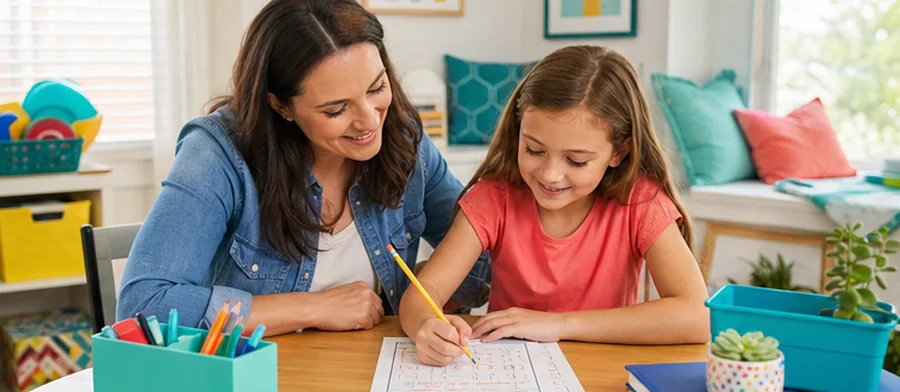
At home, begin by reviewing one conversion fact, such as 1 kilogram = 1,000 grams or 1 pound = 16 ounces. Ask your child, “Are we going to a smaller unit or a larger unit?” Then have them estimate before calculating. For example, 3 kilograms should become more than 3 grams, so 3,000 grams is reasonable. End by asking them to explain the operation they used.
Classroom uses for teachers
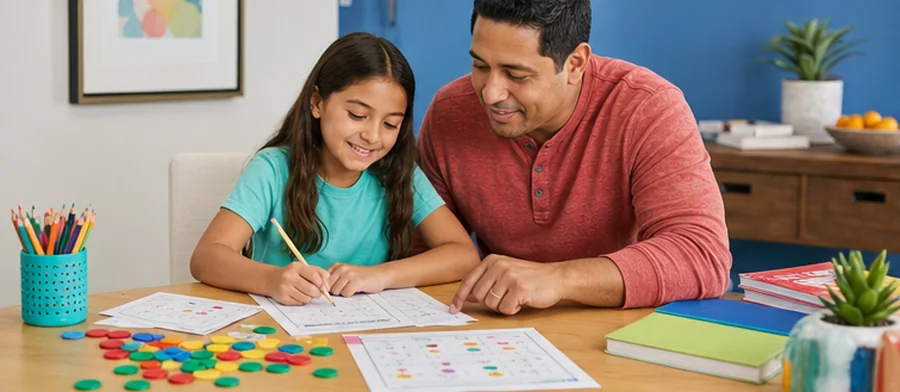
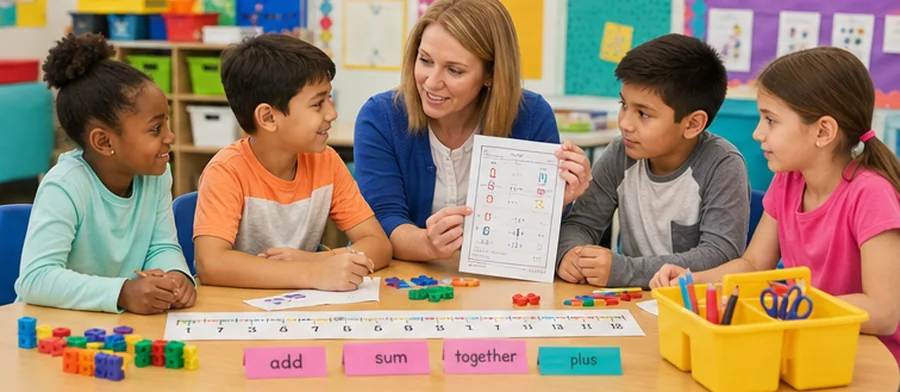
Teachers can use these printables for measurement review, small-group reteaching, math centers, homework, or quick checks after a lesson on unit conversion. They also work well as partner tasks: one student solves while the other checks whether the answer makes sense by looking at the unit size.
Common errors to watch for
Many students multiply when they should divide, drop zeros in metric conversions, or compare masses without first converting to the same unit. Another common mistake is treating metric and customary units as if they use the same scale. Encourage students to underline the starting unit, circle the target unit, and write the conversion fact before solving.
Free printable PDF download
Use this grade 6 convert units of mass worksheet page to preview the activity, print it, or download it as a PDF for quick practice. It works well for homework, homeschool lessons, tutoring, morning work, revision, and classroom centers.
Answers and answer key support
After the child completes the worksheet independently, parents and teachers can use the answer support or answer key information to check the work, review mistakes, and choose the next practice step.
Why iBloom worksheets help
iBloom worksheets give Grade 6 learners repeated, focused practice without turning measurement into guesswork. The mix of direct calculations and real-world questions helps children see mass conversions as a usable math tool. A child-friendly strategy is: name the units, decide if the unit gets smaller or larger, choose multiply or divide, then check if the answer is reasonable.
Helpful answers
Frequently asked questions
What mass units are practised in these Grade 6 worksheets?
Students practise common metric mass units such as milligrams, grams, and kilograms, and may also work with customary units used for weight, such as ounces, pounds, and tons.
How can students tell whether to multiply or divide when converting mass?
They should first decide whether the target unit is smaller or larger. Converting to a smaller unit usually means multiplying; converting to a larger unit usually means dividing.
Do these worksheets include word problems?
Yes. Along with direct conversions, the practice includes real-world measurement situations that ask students to convert, compare, or reason about masses.
Why do students need to convert masses to the same unit before comparing?
Numbers alone can be misleading because the units have different sizes. For example, 2 kilograms and 500 grams cannot be compared fairly until they are expressed in the same unit.
What is a good way to help a child check a mass conversion answer?
Ask the child to estimate based on unit size. If kilograms are converted to grams, the number should get larger; if grams are converted to kilograms, the number should get smaller.
Is this grade 6 convert units of mass worksheet free?
Yes. You can preview it for free and use the printable worksheet for home or classroom practice.
Can I download this grade 6 convert units of mass worksheet as a PDF?
Yes. Use the worksheet download option to save a printable PDF, or print the worksheet directly from the page.
Does this grade 6 convert units of mass worksheet include answers or an answer key?
When the activity has fixed answers, iBloom includes answer support so parents and teachers can check the completed worksheet.