






About this worksheet
This Grade 6 measurement worksheet gives learners practice choosing and applying mass conversion factors in real situations. Problems move from direct conversions to mixed-unit and multistep contexts, including customary and metric units. It aligns with Common Core 6.RP.A.3 through ratio reasoning and equations, with a separate answer key.
Aligned to 6.RP.A.3
How do I convert kilograms to grams?
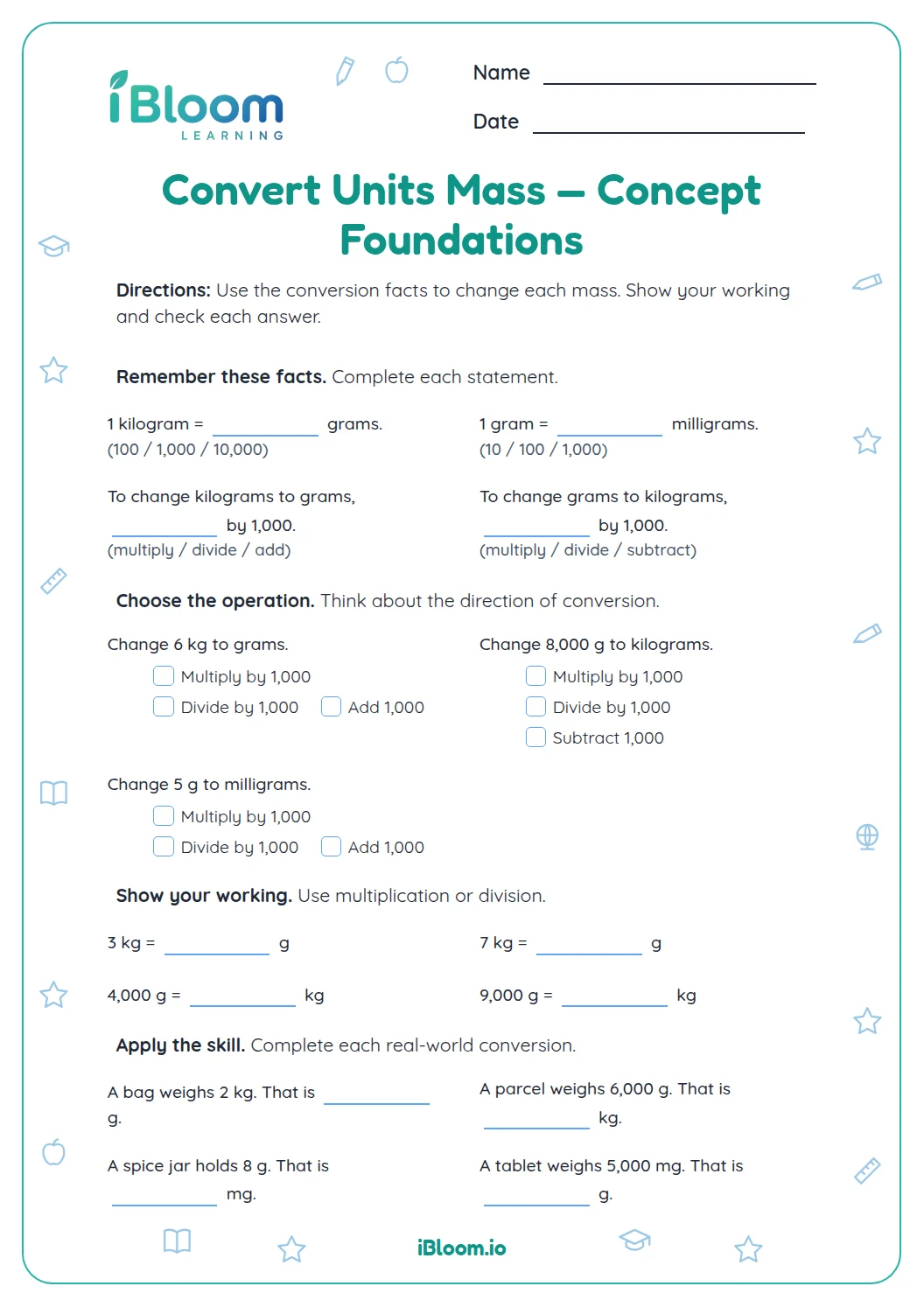
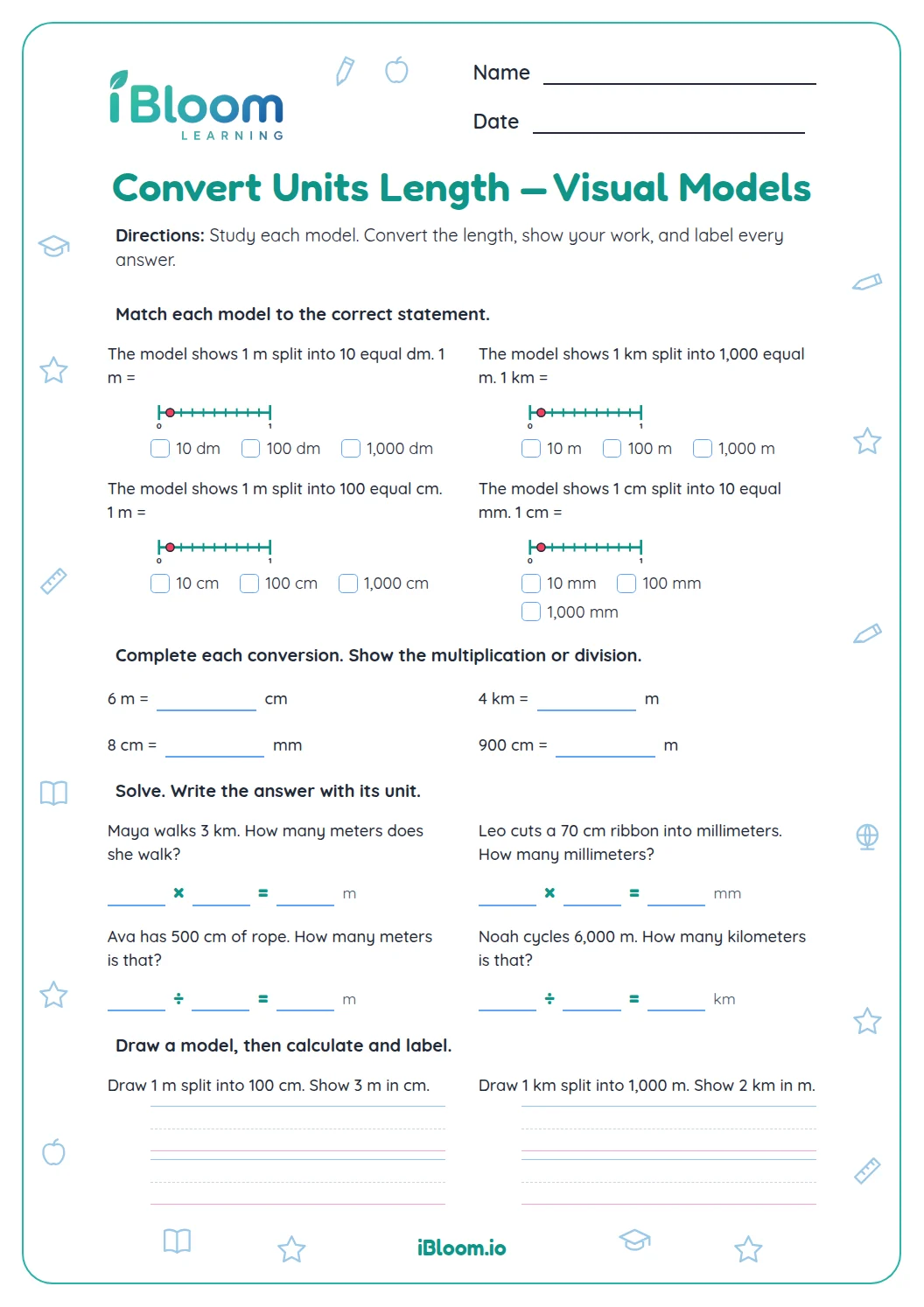
There are 1,000 grams in 1 kilogram. Multiply kilograms by 1,000, or divide grams by 1,000 to convert the other way.
- 14.25 kg × 1,000 = 4,250 g
- 2Answer: 4,250 grams
What will learners practice?
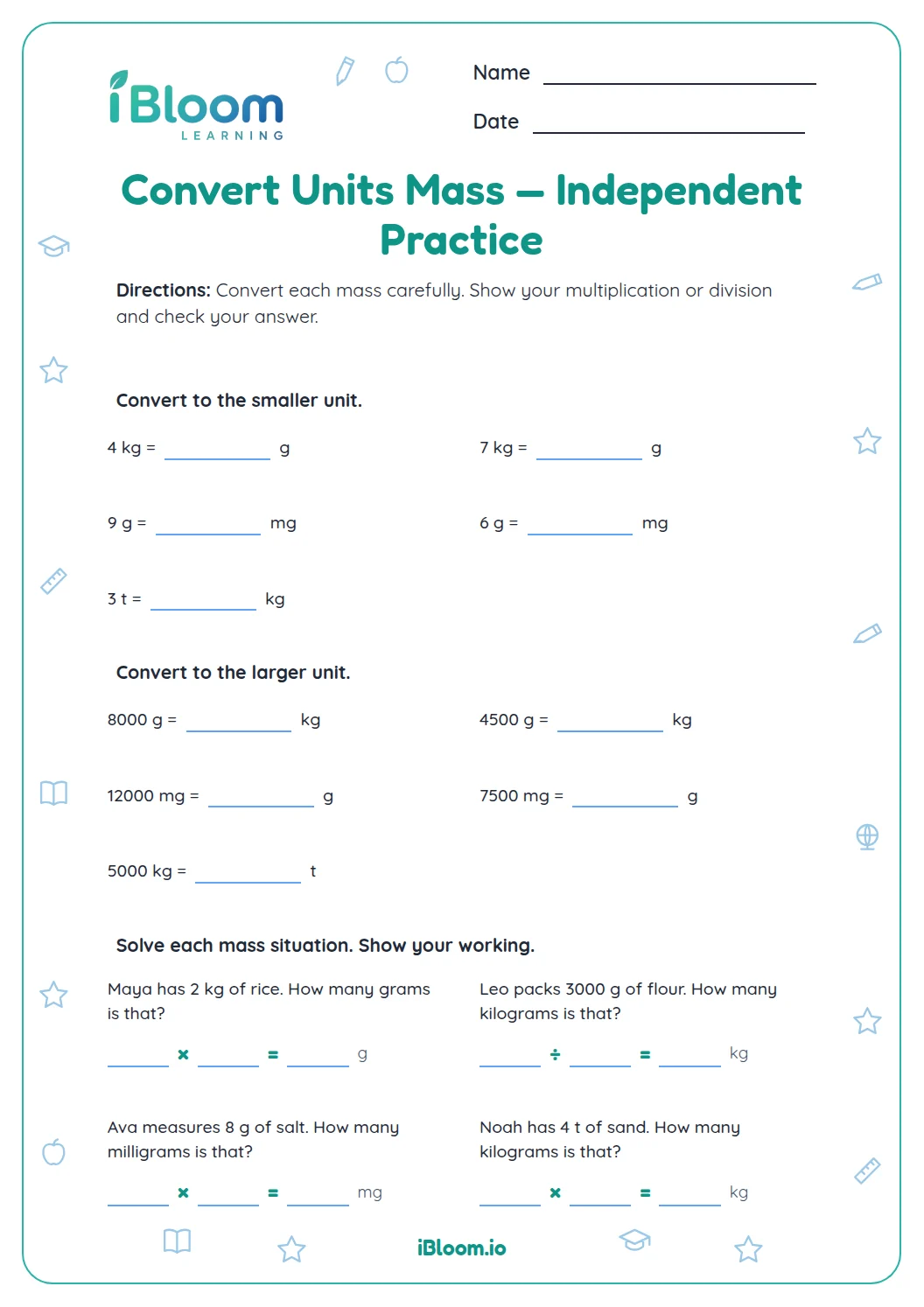
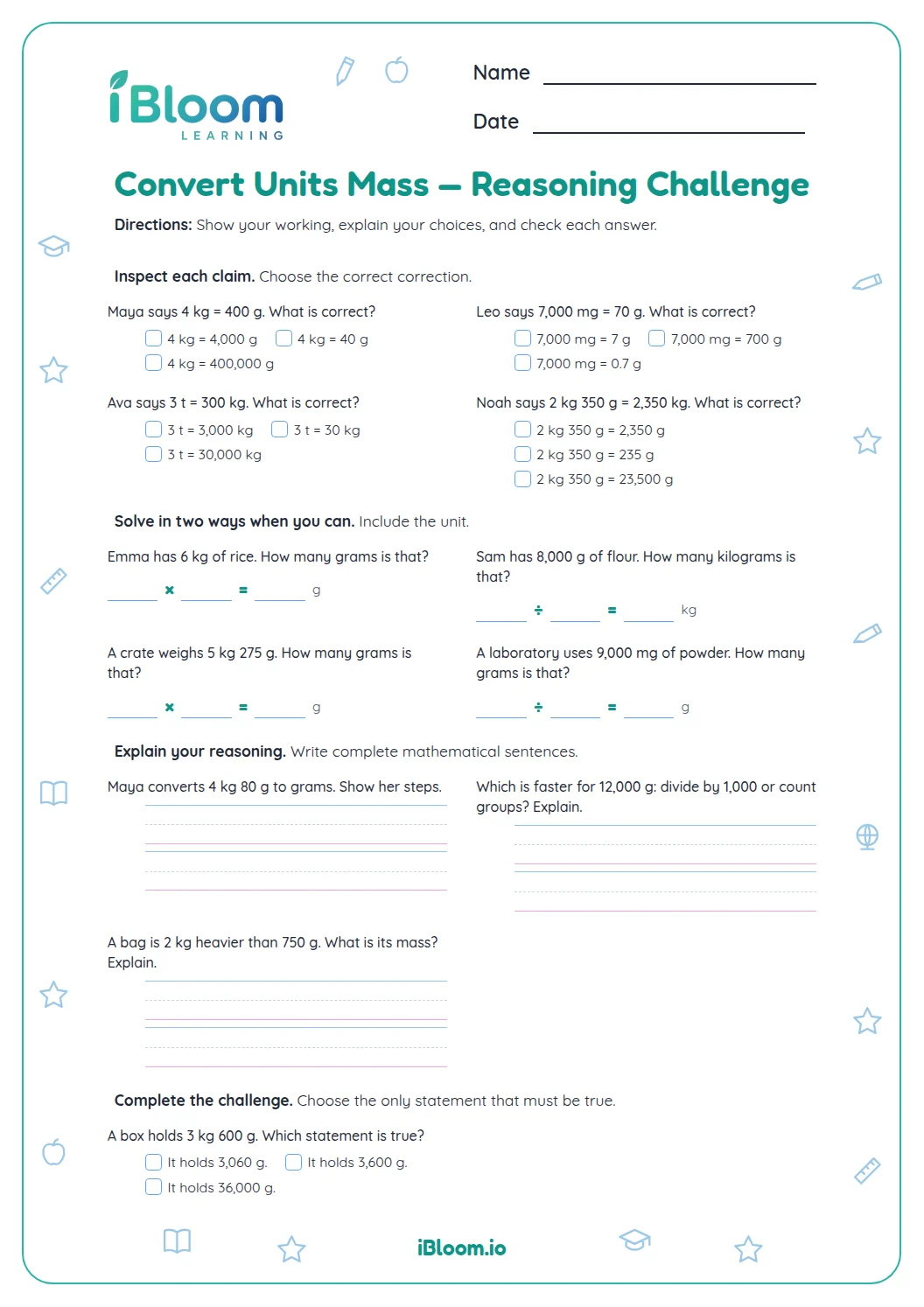
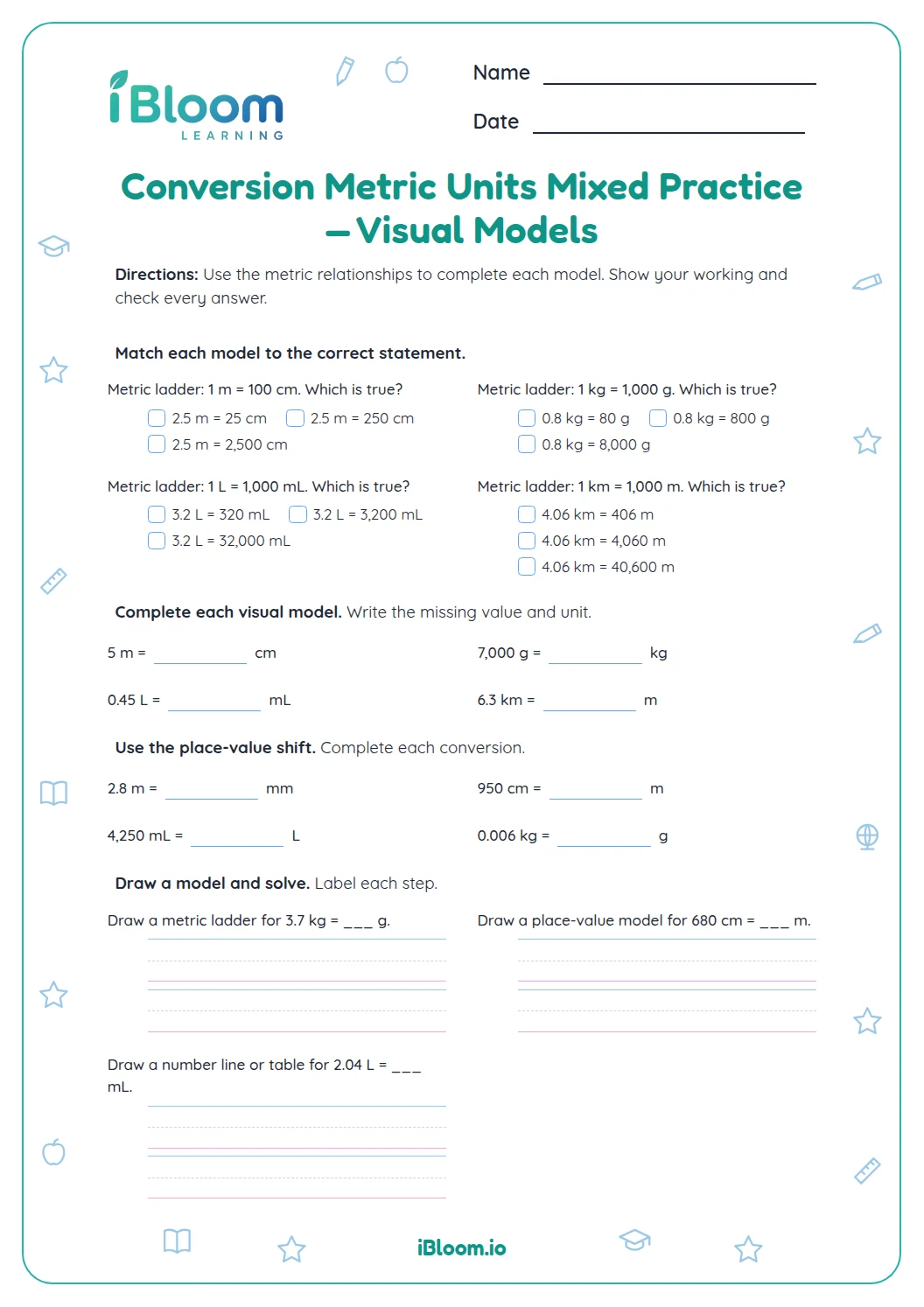
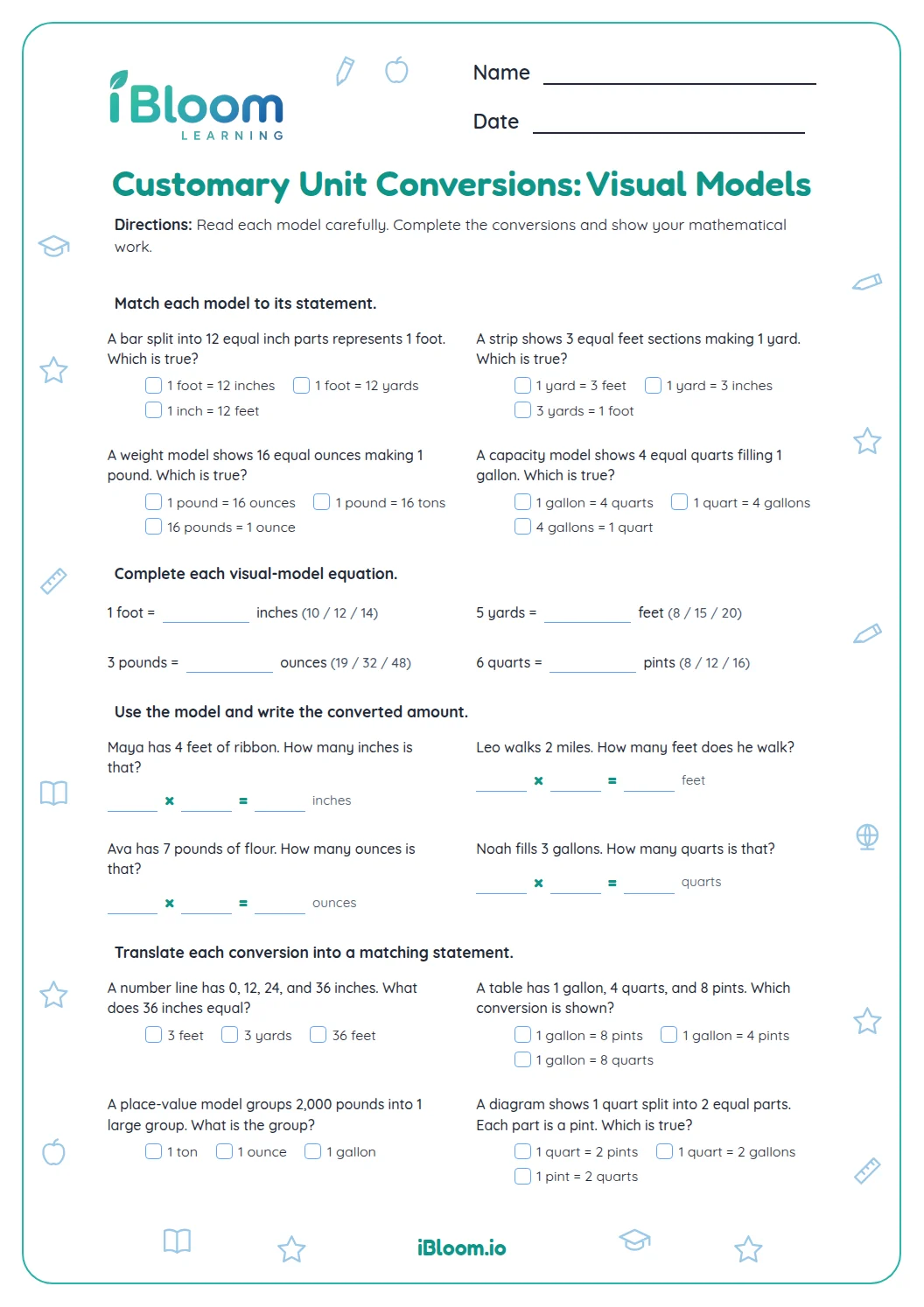
Sixteen problems practice converting mass units, combining mixed units, and solving short context problems.
How can I use the answer key?
Check each response after the learner finishes a part. For open responses, compare the answer with the model and accept other clear, correct wording.
How to use this worksheet
- 1Write the conversion relationship needed for the units in the problem.
- 2Multiply or divide by the correct factor, keeping the units beside the numbers.
- 3For mixed units, convert each part to the requested unit before combining.
- 4Check that the size of the answer makes sense, then compare with the key.
Common mistakes and quick fixes
The mistake
How do I convert pounds and ounces to pounds?
The fix
Convert the ounces to a fraction or decimal part of a pound. Since 8 ounces is half a pound, 6 ounces is 6/16 or 0.375 pound.
The mistake
What should the answer unit be?
The fix
Use the unit named in the question. Check whether the answer should be ounces, pounds, grams, kilograms, or tons before writing it.
The mistake
How can I check a conversion?
The fix
Use the inverse conversion. If 2.25 kilograms equals 2,250 grams, divide 2,250 by 1,000 to return to 2.25 kilograms.
This worksheet practices the listed Common Core skill.
Use conversion ratios and equations to solve mass problems in context.
On this sheet:
Show the official wordingHide the official wording
Use ratio and rate reasoning to solve real-world and mathematical problems, e.g., by reasoning about tables of equivalent ratios, tape diagrams, double number line diagrams, or equations.
What to practice next
Make more practice
Further reading
Questions parents and teachers ask
How many ounces are in a pound?
There are 16 ounces in 1 pound. Multiply the number of pounds by 16 to convert to ounces, as in the problems about bags and parcels on this worksheet. Write the conversion factor next to the numbers so the units cancel in the right direction.
How do I convert kilograms to grams?
There are 1,000 grams in 1 kilogram. Multiply kilograms by 1,000 to get grams, or divide grams by 1,000 to get kilograms. Keep the unit with the final answer. Estimating first also helps you notice when a converted mass is unexpectedly large or small.
How do I convert pounds and ounces to pounds?
Convert the ounces to part of a pound, then add that part to the pounds. Since 16 ounces make a pound, 8 ounces is 0.5 pound and 6 ounces is 0.375 pound. Keep each intermediate amount labeled, especially when a story combines pounds and ounces.
What should the answer unit be?
Use the unit named in the question. Before writing your answer, check whether the problem asks for ounces, pounds, grams, kilograms, or tons. This simple check catches many unit-label mistakes. For decimal amounts, line up the place values and check that the decimal point makes sense.
How can I check a conversion?
Use the inverse conversion. If 2.25 kilograms equals 2,250 grams, divide 2,250 by 1,000 to return to 2.25 kilograms. A check should bring you back to the starting amount. A quick estimate can catch a misplaced decimal before you finish the problem.