






About this worksheet
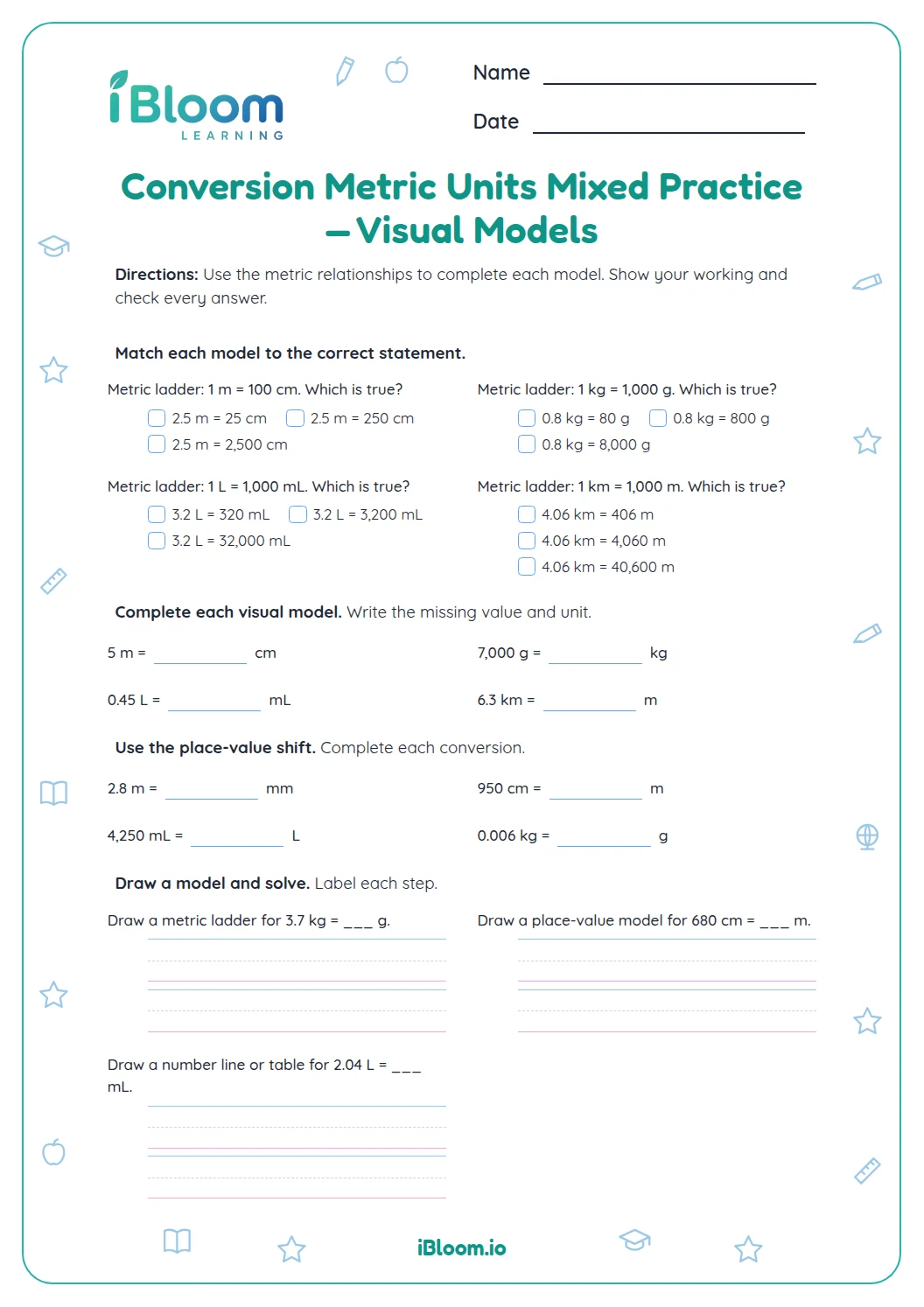
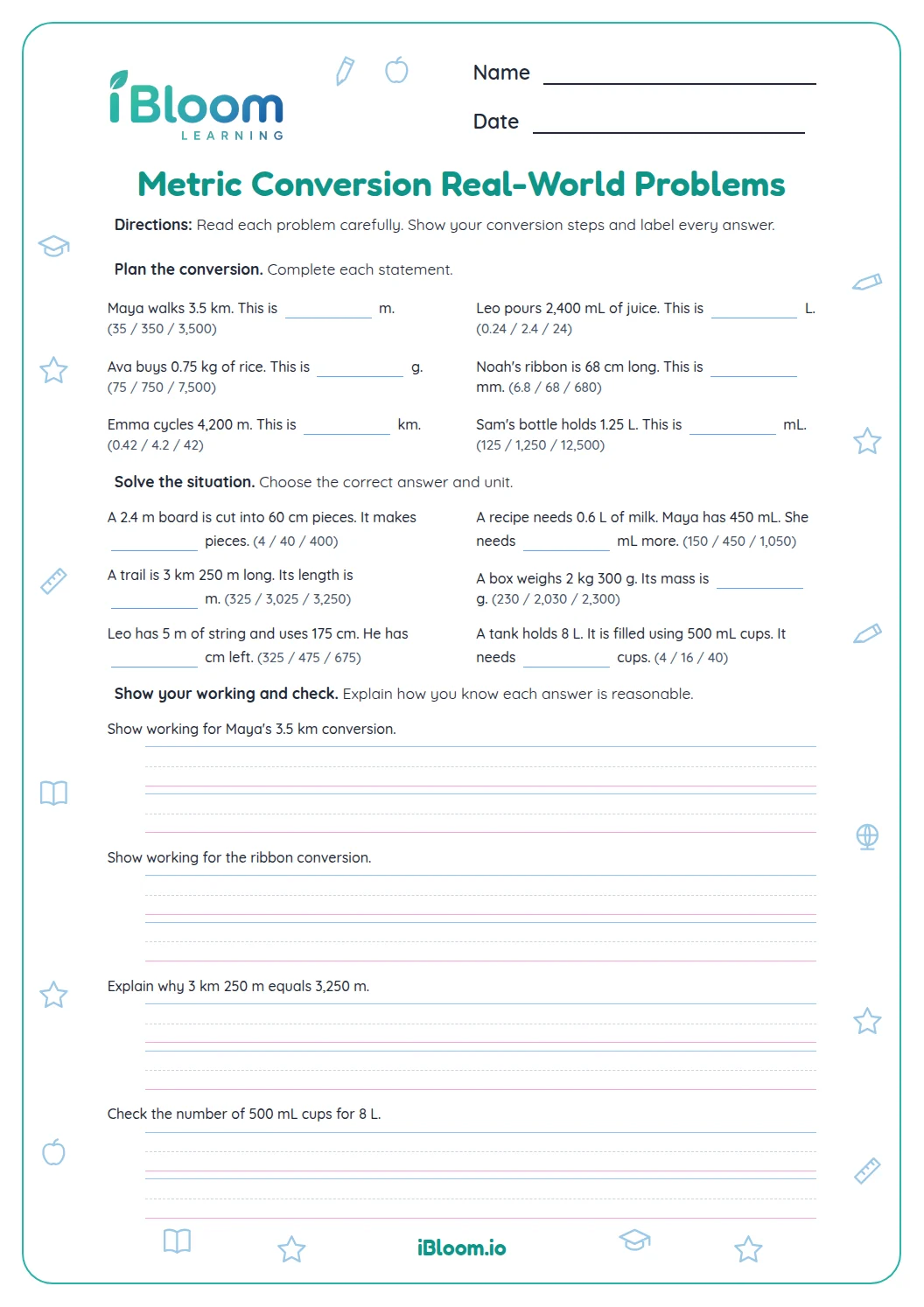
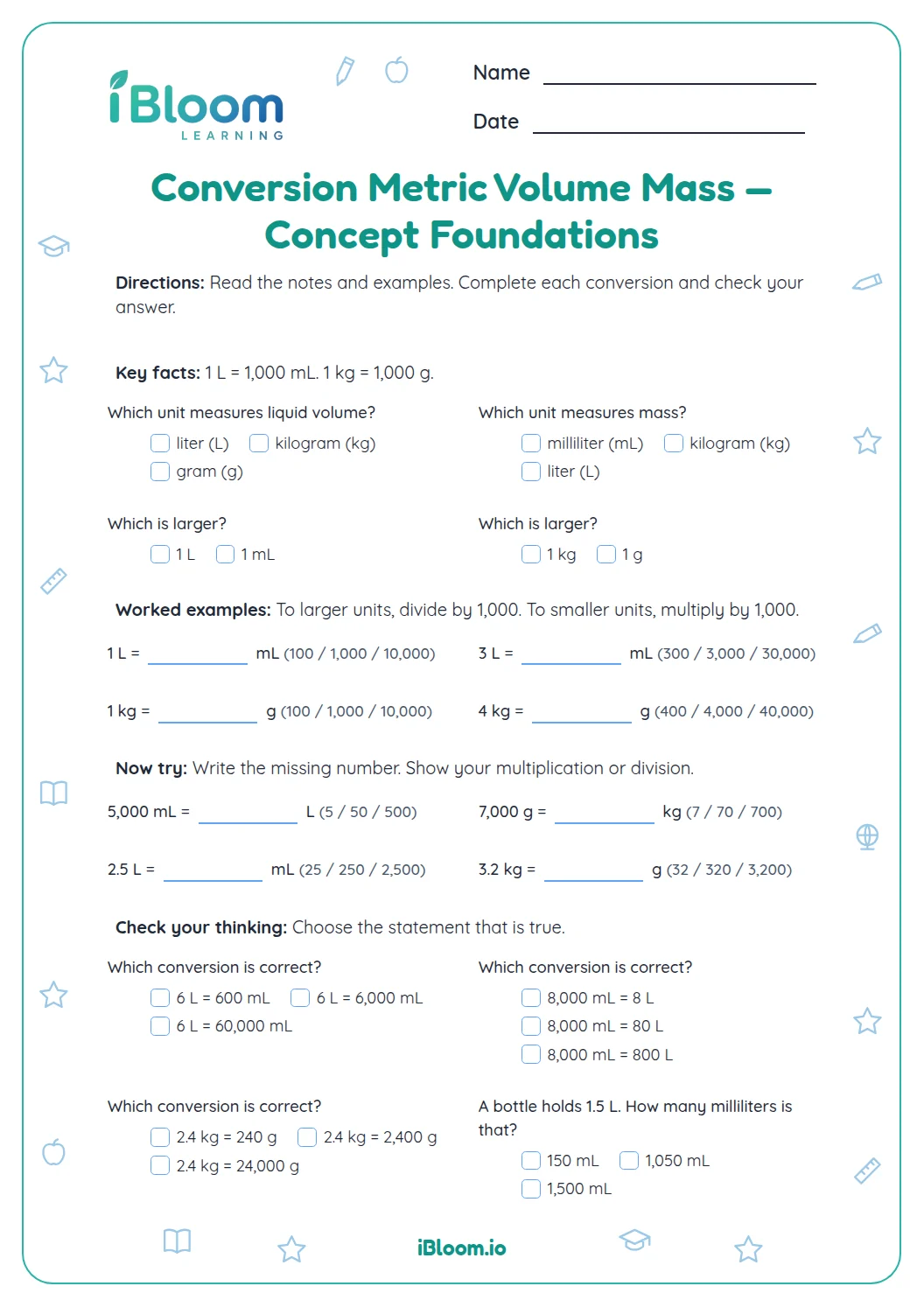
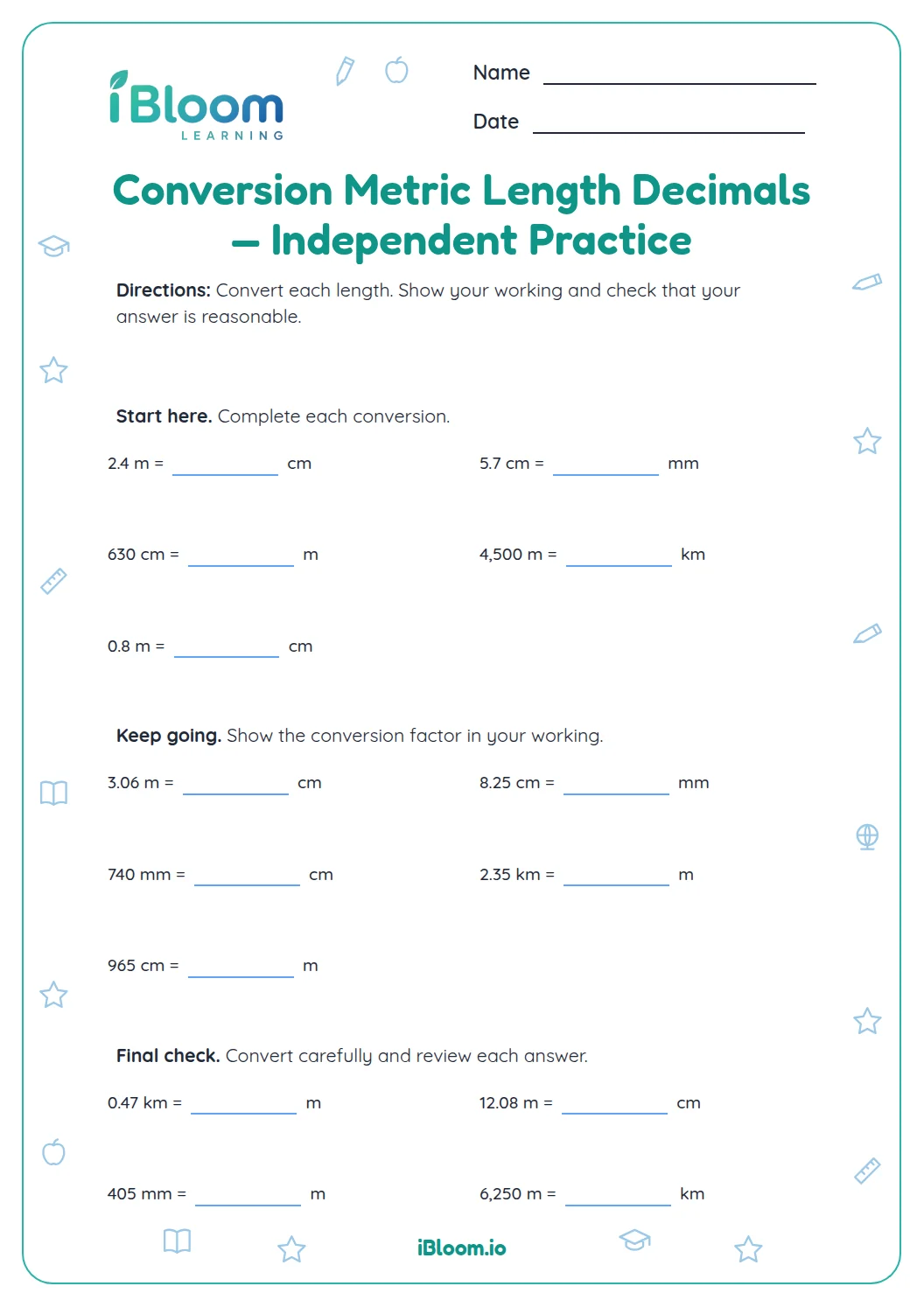
This Grade 6 metric conversion worksheet offers 16 guided questions across length, mass, and capacity. Students convert among kilometers, meters, centimeters, millimeters, kilograms, grams, liters, and milliliters, including decimal amounts. A separate answer key supports checking. The practice connects to Common Core 6.RP.A.3.d: use ratio reasoning to convert measurement units and transform units appropriately through multiplication or division.
Aligned to 6.RP.A.3.d
How do metric length units relate?
Metric units are related by powers of ten in this worksheet’s examples: 1 kilometer = 1,000 meters, 1 meter = 100 centimeters, and 1 meter = 1,000 millimeters. Moving to a smaller unit makes the number larger; moving to a larger unit makes it smaller.
Question 1 converts 3 meters to centimeters. Since each meter contains 100 centimeters, multiply 3 by 100 to get 300 centimeters.
- 13 m = ___ cm
- 21 m = 100 cm
- 33 × 100 = 300
- 4Answer: 300 cm
- 5Check: 300 cm ÷ 100 = 3 m
How do mass and capacity conversions work?
Use the relationship for the unit pair: 1 kilogram = 1,000 grams and 1 liter = 1,000 milliliters. For a smaller unit to larger unit, divide by 1,000; for larger to smaller, multiply by 1,000.
Keep the unit label beside the answer while you work. It helps show whether the converted amount should be larger or smaller.
What should I check when decimals appear?
A decimal conversion uses the same unit relationship as a whole-number conversion. For example, 625 mL becomes 0.625 L because 625 is divided by 1,000. Check that the decimal point moved three places and that the amount still represents the same volume.
How to use this worksheet
- 1Identify the starting and target units.
- 2Recall the number of smaller units in one larger unit.
- 3Decide whether the number should grow or shrink.
- 4Multiply or divide by the unit relationship.
- 5Write the unit and reverse-check the conversion.
Common mistakes and quick fixes
The mistake
Moving the decimal in the wrong direction.
The fix
Ask whether the target unit is smaller or larger before calculating.
The mistake
Using the right number but omitting the unit.
The fix
Write the target unit after every converted amount.
The mistake
Treating 1,000 milliliters as 100 milliliters.
The fix
Write the full relationship first: 1 L = 1,000 mL.
Curriculum alignment
This practice connects the worksheet tasks to the standard below.
Use ratio reasoning to convert measurement units.
On this sheet: The worksheet converts among metric units of length, mass, and capacity by multiplying or dividing by unit relationships.
Show the official wordingHide the official wording
Use ratio reasoning to convert measurement units; manipulate and transform units appropriately when multiplying or dividing quantities.
What to practice next
Make more practice
Further reading
Questions parents and teachers ask
Which metric units are practiced?
The 16 questions include kilometers, meters, centimeters, and millimeters for length; kilograms and grams for mass; and liters and milliliters for capacity. A separate answer key gives the converted number for each item, so students can check both the decimal and the target unit.
How do I know whether to multiply or divide?
Think about the size of the unit. Converting a larger unit to a smaller unit makes the number larger, as in 3 meters = 300 centimeters. Converting a smaller unit to a larger unit makes the number smaller, as in 450 centimeters = 4.5 meters.
What is 625 milliliters in liters?
625 milliliters is 0.625 liters because 1 liter equals 1,000 milliliters. To change milliliters to liters, divide by 1,000. The decimal point moves three places left, and the answer key shows this conversion in question 8. Students can multiply back to check.
Does the worksheet include length, mass, and capacity?
Yes. The opening section practices length, the next section mixes mass and capacity, and the final section reviews all three measurement types. This variety helps students choose the appropriate metric relationship for each conversion and see how the same reasoning works across units.
How can students check a metric conversion?
Convert the answer back to the starting unit. For example, 4.5 meters should return to 450 centimeters when multiplied by 100. A reverse check can show whether the decimal point moved in the correct direction and whether the answer is a sensible size.