





About this worksheet
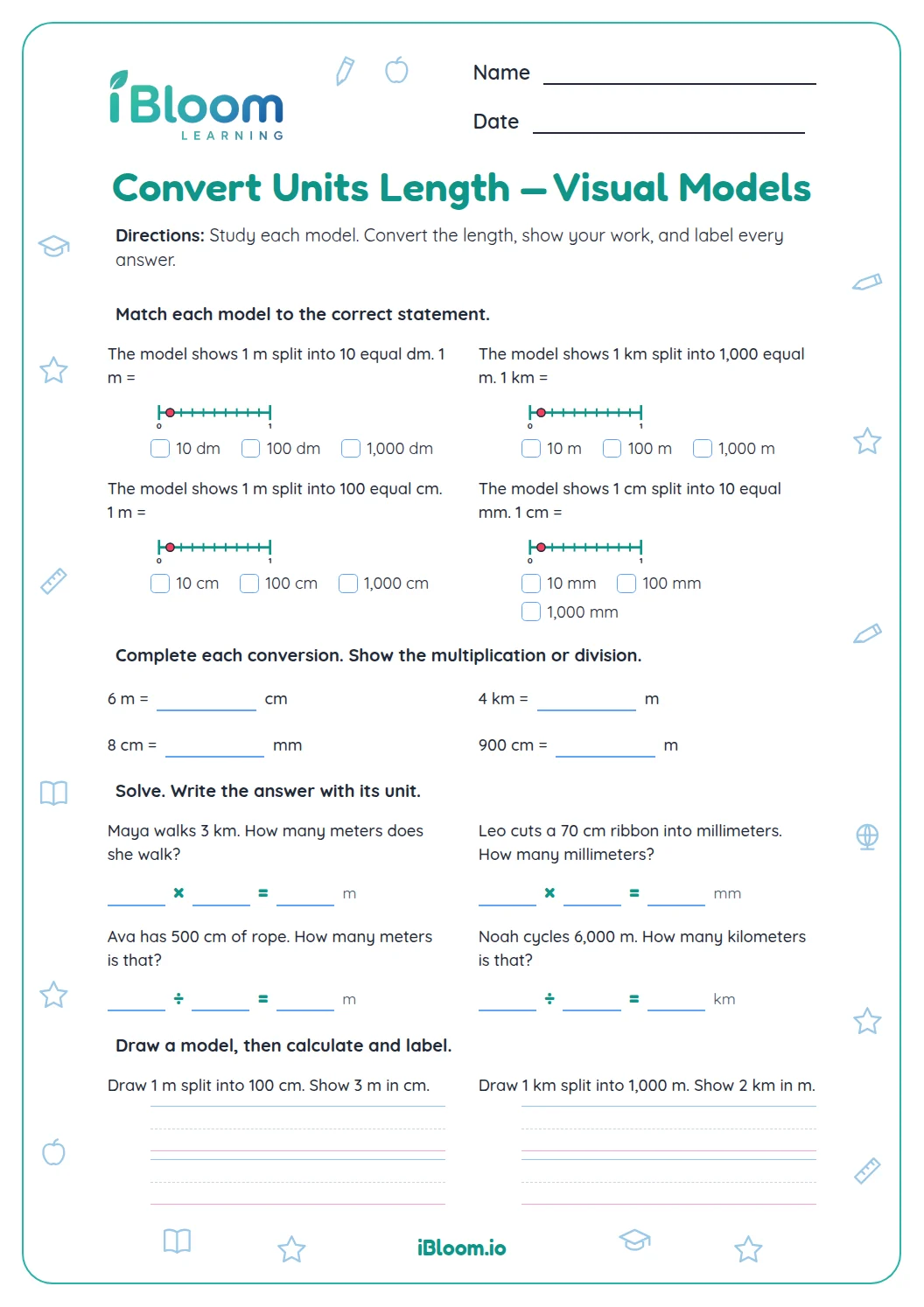
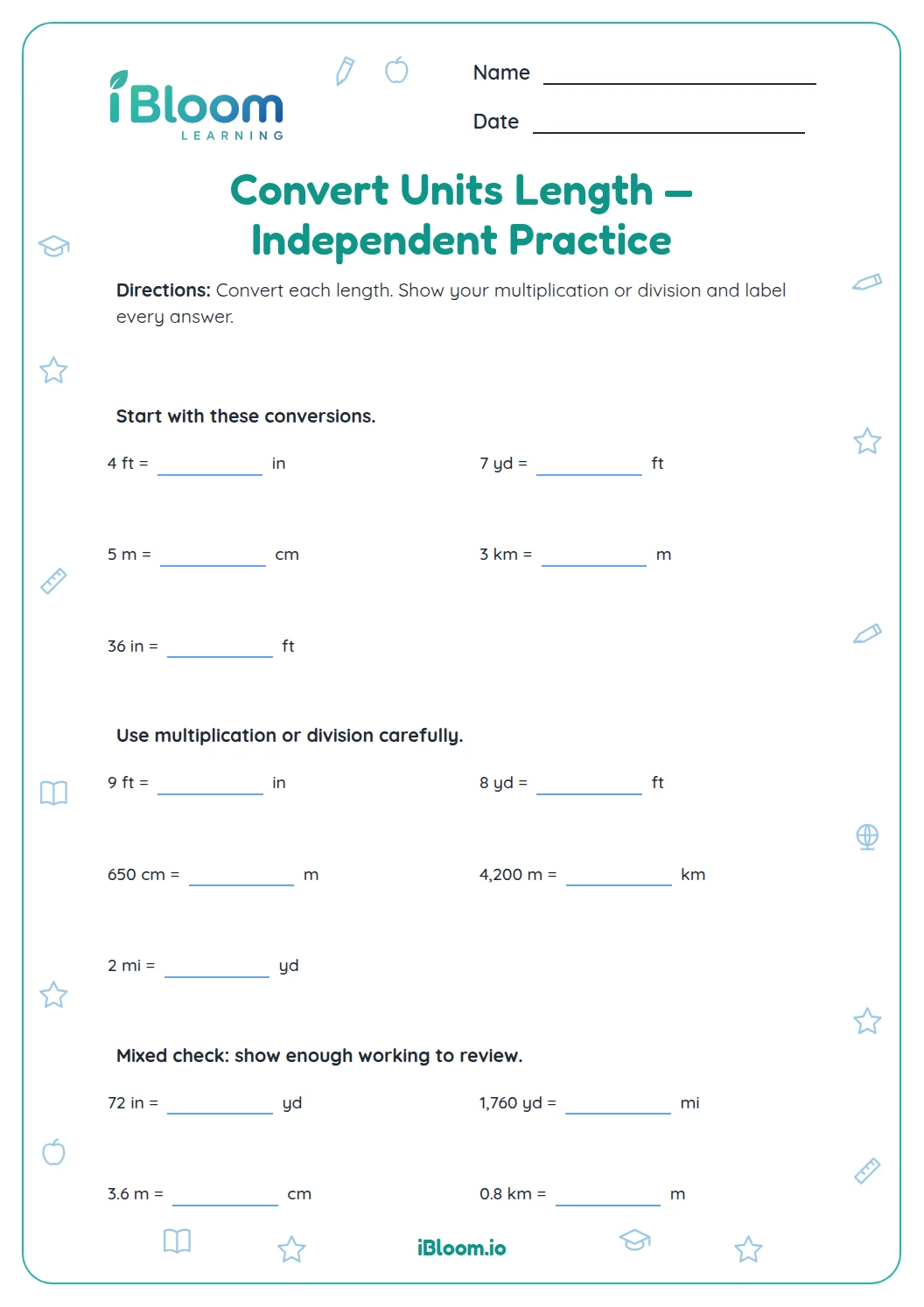
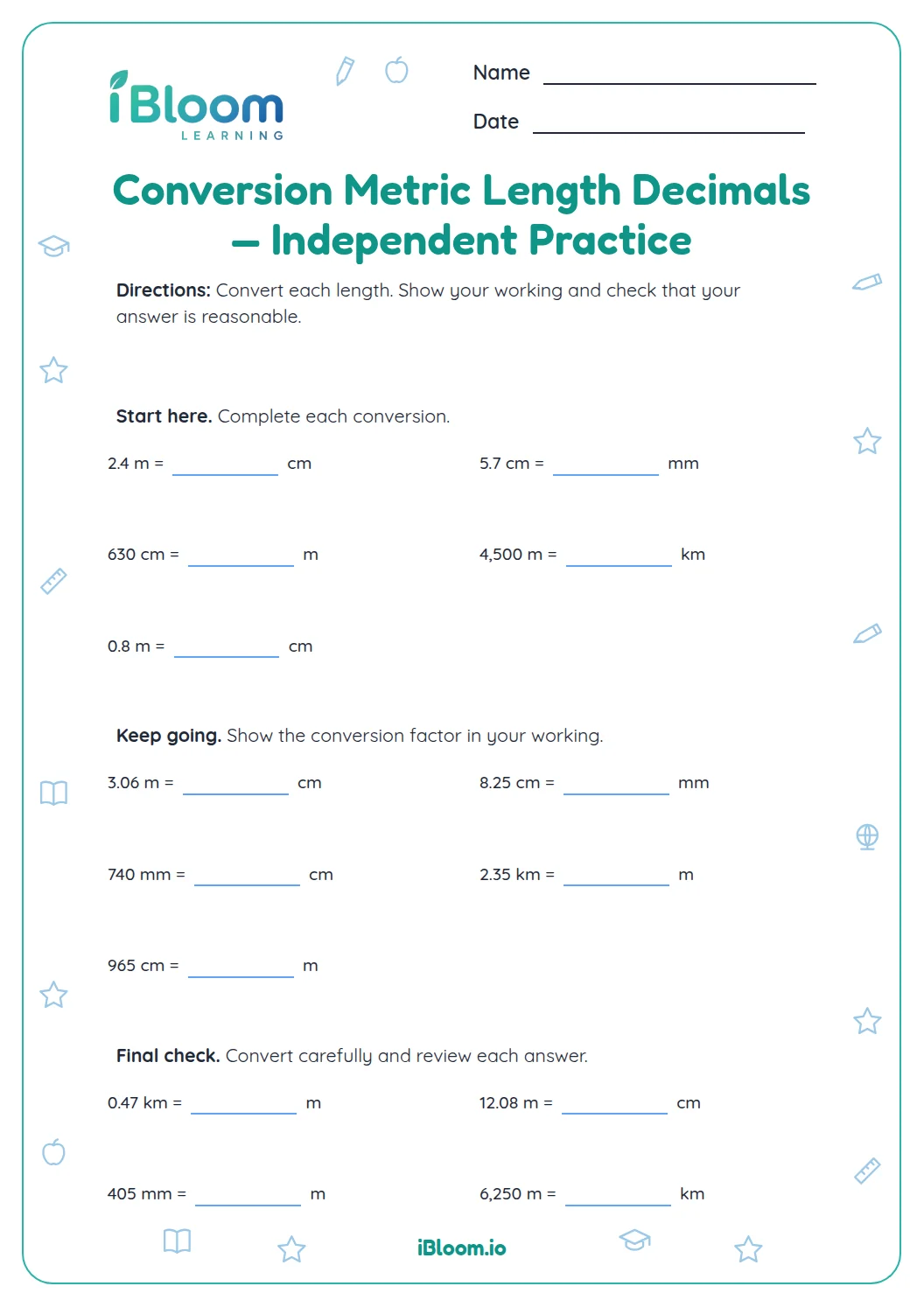
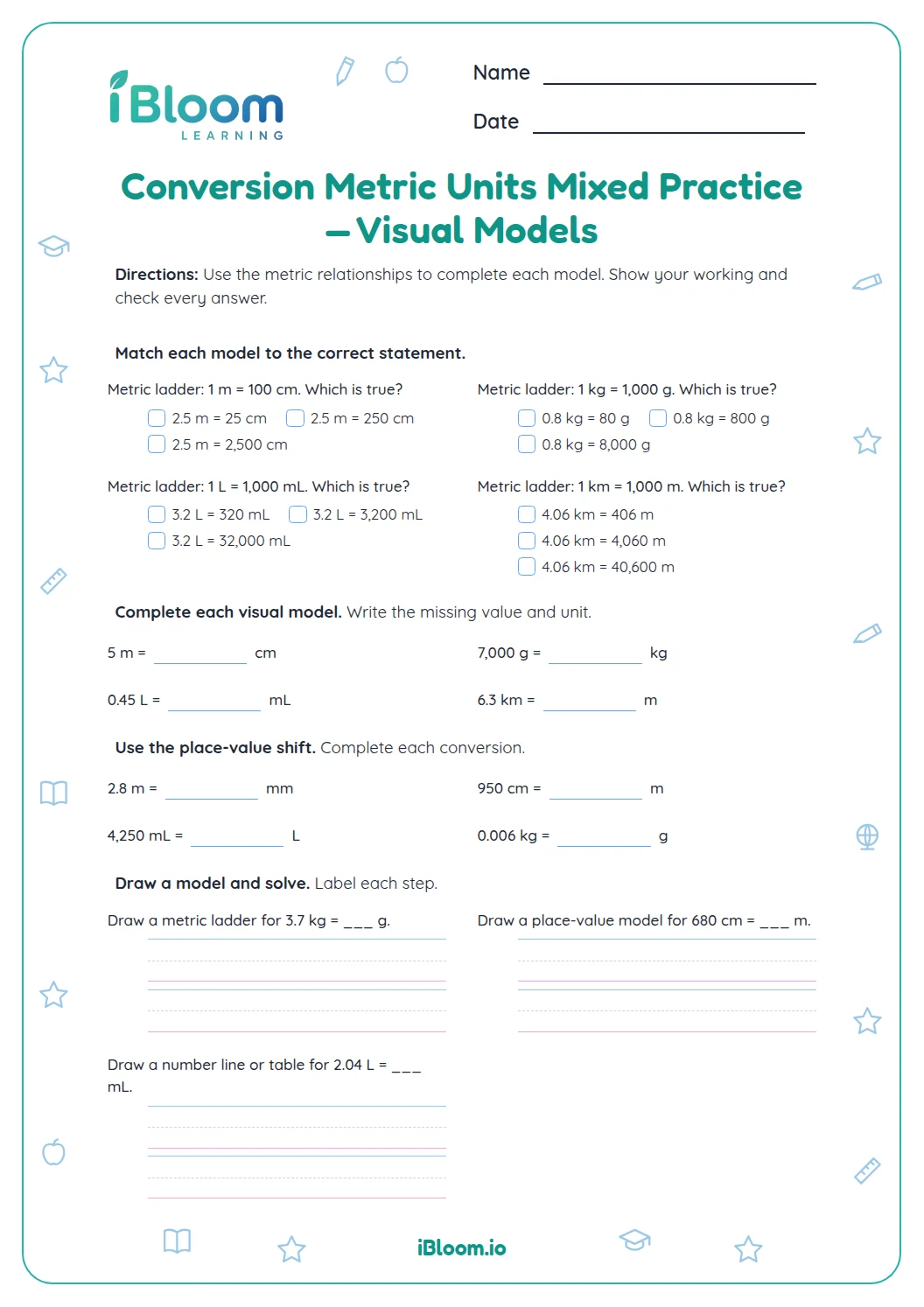
This Grade 6 worksheet builds a practical method for converting metric lengths: write the relationship between the units, then use it to find the missing measurement. Students complete 16 fill-ins covering kilometers, meters, centimeters, and millimeters, including decimal conversions and four short length situations. A separate answer key gives each converted value with its unit where needed.
Aligned to 6.RP.A.3.d
How do metric length units relate?
Each larger metric length unit contains a fixed number of smaller units: 1 kilometer = 1,000 meters, 1 meter = 100 centimeters, and 1 centimeter = 10 millimeters. The conversion factor tells how many of the smaller units make one larger unit.
In questions 1–4, students identify those relationships and the factor for converting meters to centimeters.
- 13 m = ___ cm
- 21 m = 100 cm
- 33 × 100 = 300
- 4So 3 m = 300 cm
When should you multiply or divide?
When changing from a larger unit to a smaller unit, multiply by the number of smaller units in one larger unit. When changing from a smaller unit to a larger unit, divide by that number. Check that the converted number makes sense: centimeters should be a larger number than meters for the same length.
How can you keep units clear in a word problem?
Write the starting measurement and the unit you want. Then write a conversion equation and label the answer. For question 13, first divide 240 cm into 3 equal pieces to get 80 cm per piece, then convert 80 cm to 0.8 m.
How to use this worksheet
- 1Mark whether the target unit is smaller or larger than the starting unit.
- 2Write the matching unit relationship before calculating.
- 3Multiply when converting a larger unit to smaller units; divide in the reverse direction.
- 4Keep the unit beside your result.
- 5Estimate whether the result should have a larger or smaller number than the starting value.
Common mistakes and quick fixes
The mistake
Multiplying when converting centimeters to meters.
The fix
Meters are larger units, so divide the centimeter measurement by 100.
The mistake
Using 1,000 as the factor for meters to centimeters.
The fix
Write 1 m = 100 cm first; 1,000 is the factor for kilometers to meters.
The mistake
Leaving off the unit in a word problem.
The fix
Write the requested unit after the number so the result answers the question.
Common Core alignment
The conversions use ratio reasoning and keep units attached to each measurement.
Convert lengths by multiplying or dividing with unit ratios.
On this sheet: Questions use metric conversion factors and unit-aware length problems.
Show the official wordingHide the official wording
Use ratio reasoning to convert measurement units; manipulate and transform units appropriately when multiplying or dividing quantities.
What to practice next
Make more practice
Further reading
Questions parents and teachers ask
What is the conversion factor from meters to centimeters?
There are 100 centimeters in 1 meter, so multiply meters by 100 to find centimeters. For example, question 5 converts 3 m to 300 cm. To convert centimeters to meters, divide by 100 instead. Keep the unit attached to the result.
How do I know whether to multiply or divide?
Compare the size of the units. Converting from a larger unit to smaller units uses multiplication; converting from smaller units to a larger unit uses division. Questions 5–10 practice both directions, and writing the unit relationship first helps select the factor.
How many meters are in a kilometer?
There are 1,000 meters in 1 kilometer. So 7 km is 7,000 m, while 1,600 m is 1.6 km. The number changes in opposite ways because kilometers are larger units than meters. Questions 6 and 10 practice each direction.
How do I convert centimeters to millimeters?
Multiply centimeters by 10 because 1 cm equals 10 mm. Question 8 converts 8 cm to 80 mm. To change millimeters to centimeters, divide by 10, as question 16 demonstrates. Check that the smaller unit has the larger numeral.
How should students show a word-problem conversion?
Write a conversion equation and label the final result in the requested unit. For example, 5 m × 100 = 500 cm. In question 13, divide 240 cm into 3 equal pieces to get 80 cm, then convert 80 cm to 0.8 m.
Does this worksheet include an answer key?
Yes. A separate answer key lists all 16 answers, including units for the story problems. Use it to check the conversion factor, arithmetic, and final unit after students complete the worksheet. For a word problem, check both the number and the requested unit.