



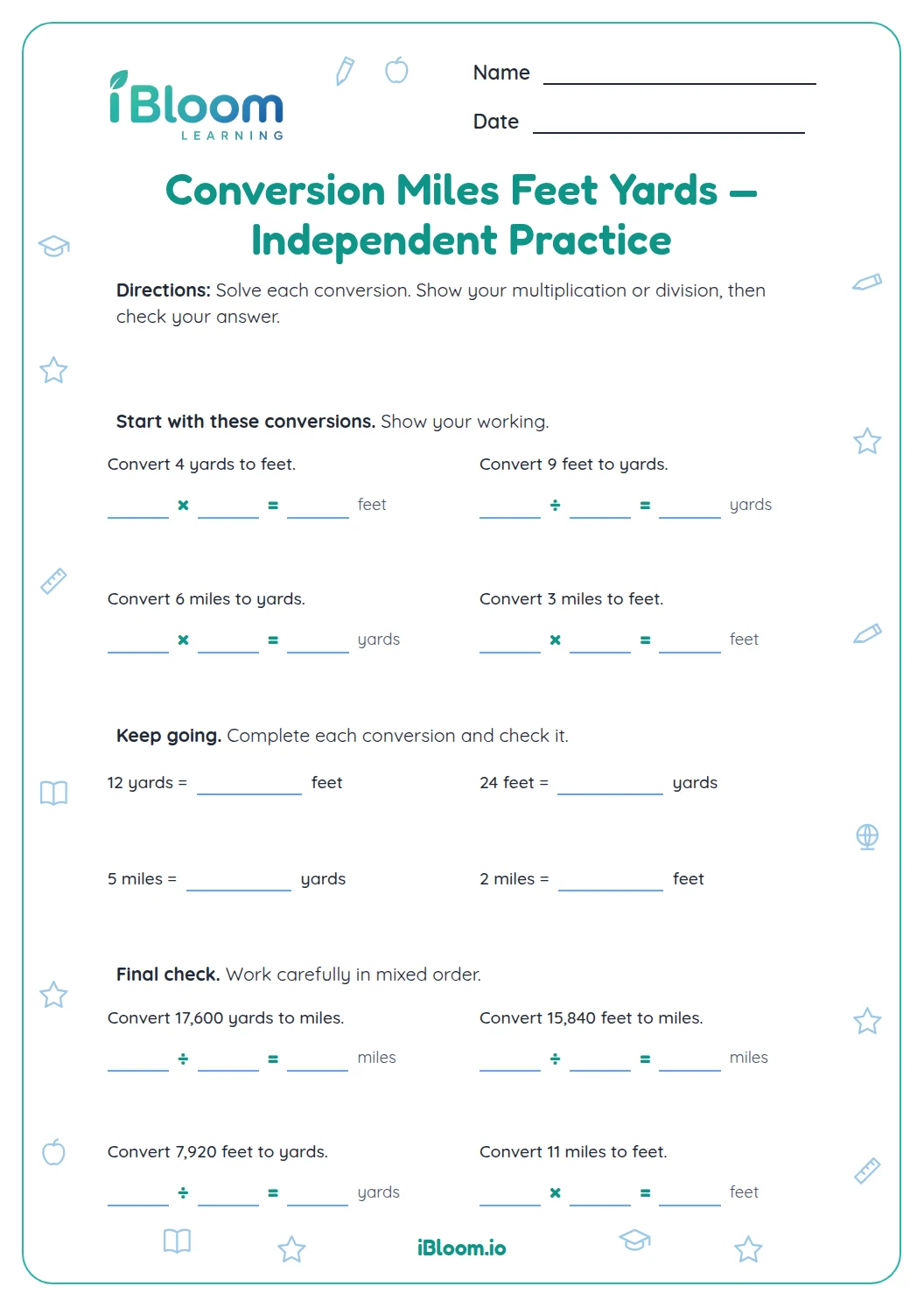
About this worksheet
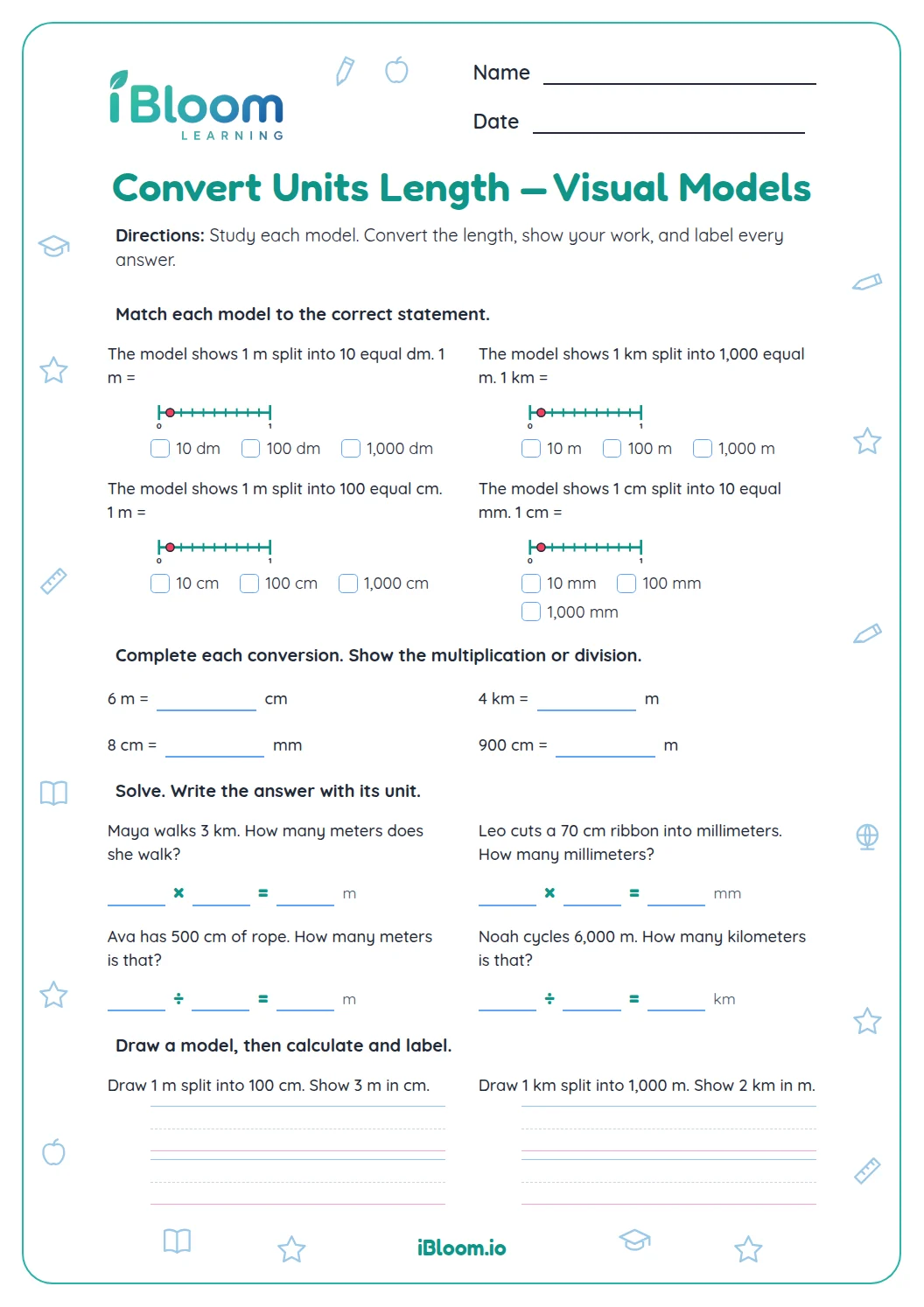
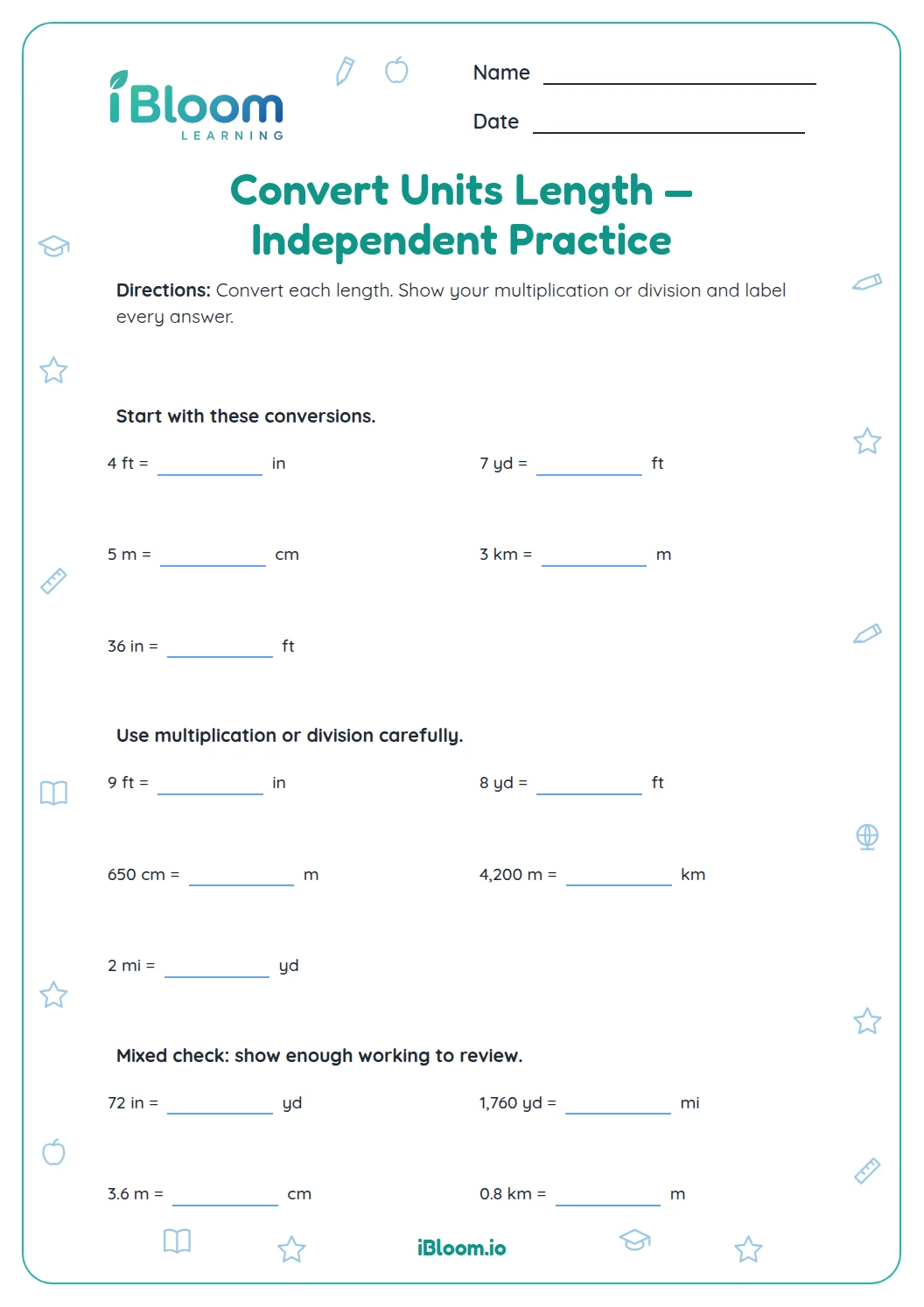
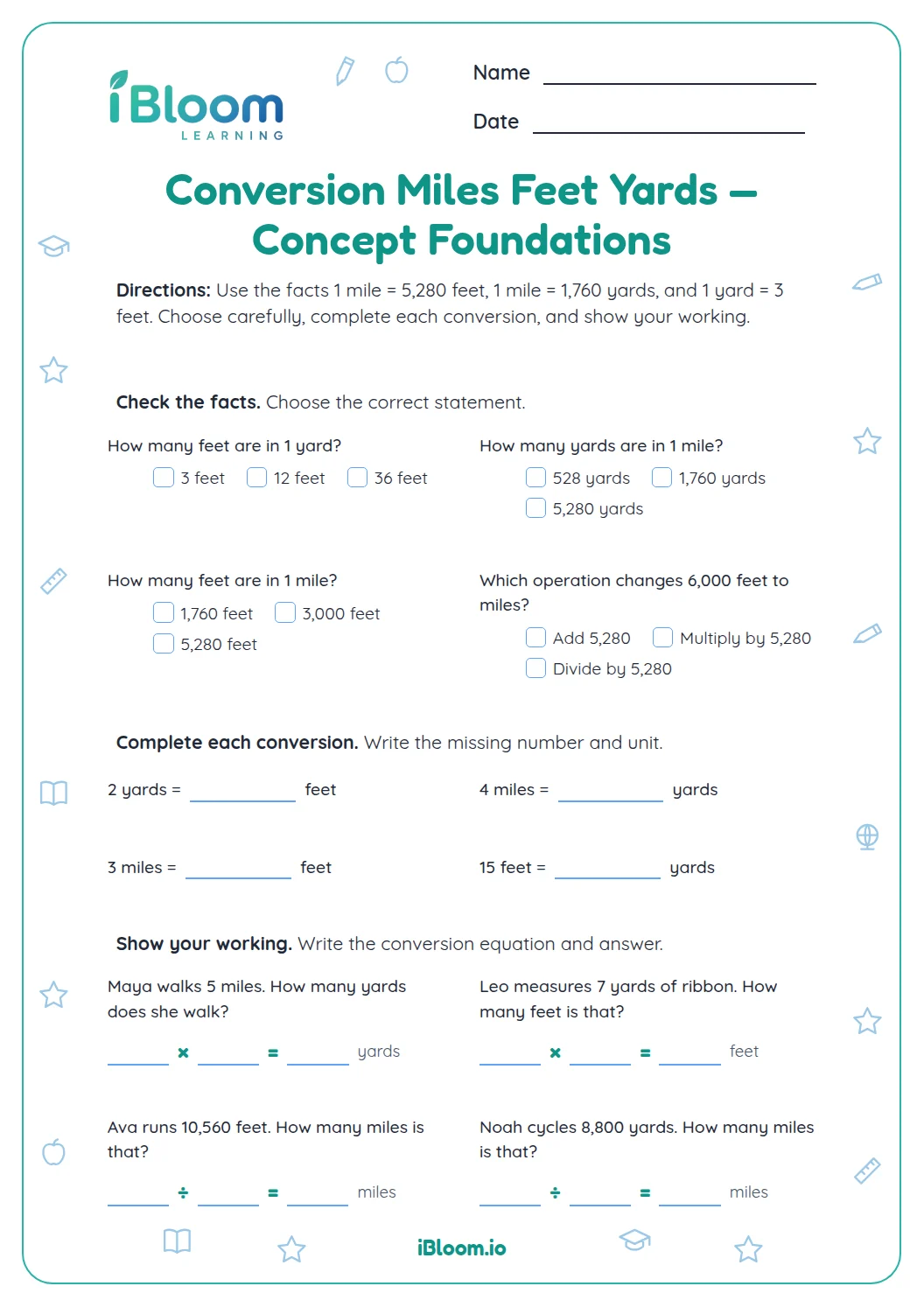
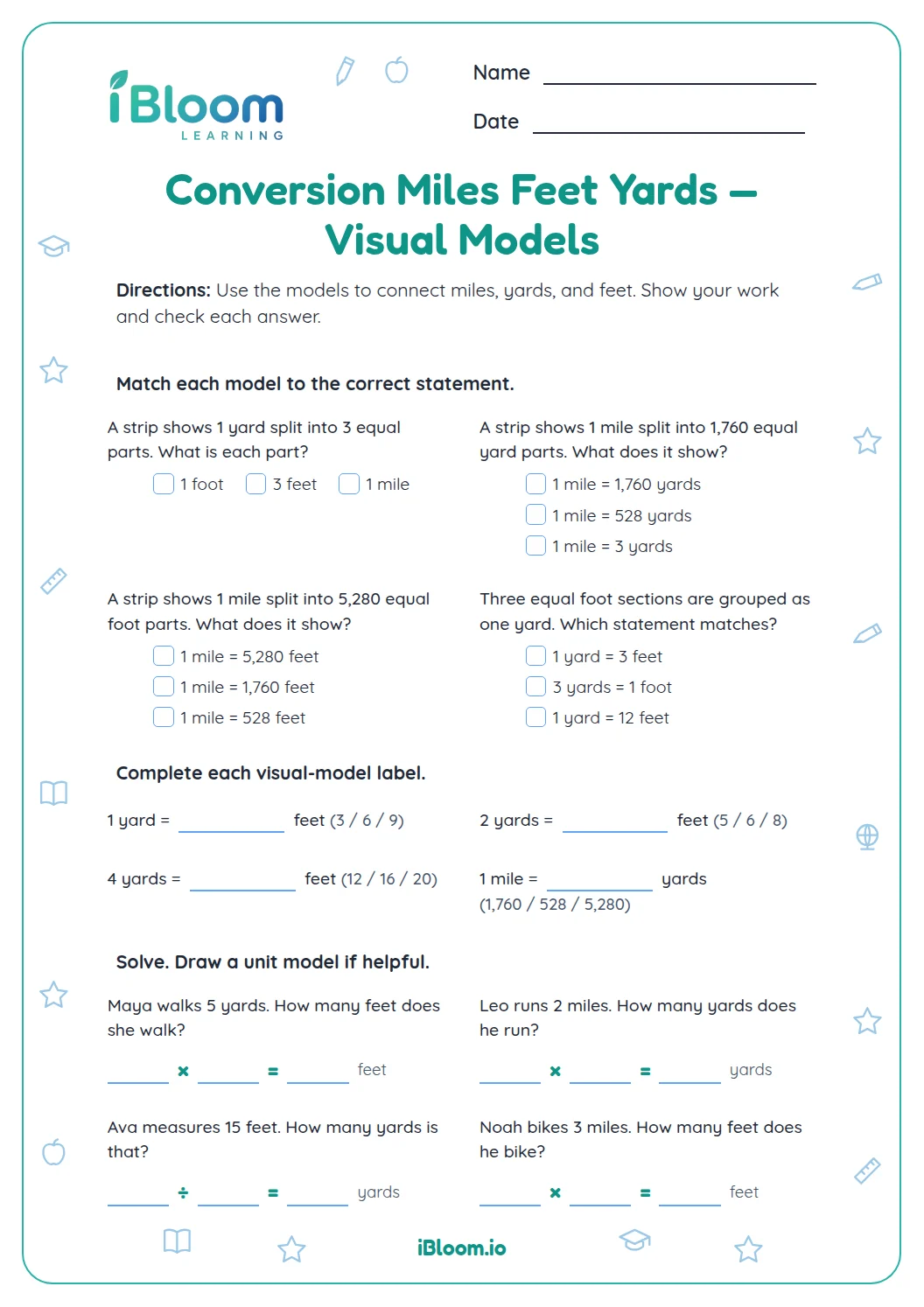
This Grade 6 worksheet asks students to convert metric and customary lengths, compare measurements, and solve multi-step problems involving paths, ribbons, and distances. It includes 16 problems, from direct unit changes to an error correction and mixed-unit reasoning. Students show steps and attach units. A separate answer key is included.
Aligned to 5.MD.A.1
How do metric length conversions work?
Metric conversions use powers of ten. To change meters to centimeters, multiply by 100. Question 1 turns 2.4 m into 240 cm. To change millimeters to meters, divide by 1,000.
How do you combine feet and inches?
Use 12 inches per foot and 3 feet per yard. Question 5 changes 5 yards to 15 feet, then adds 2 feet for 17 feet.
What helps with a multi-step length problem?
Convert all quantities to the same unit before combining. In question 12, change 2.4 km to 2,400 m, then subtract 750 m to get 1,650 m.
How to use this worksheet
- 1Write the conversion fact you need.
- 2Choose multiply or divide by the conversion factor.
- 3Convert each quantity to a common unit before combining.
- 4Keep units in each line of work.
- 5Estimate to check the size of the result.
Common mistakes and quick fixes
The mistake
Multiplying when the answer should be a smaller unit value.
The fix
Ask whether the target unit is larger or smaller before choosing the operation.
The mistake
Combining feet and inches without converting.
The fix
Rename both measurements in feet or inches first.
The mistake
Dropping a zero or decimal place.
The fix
Use the conversion fact to check how many times larger one unit is.
Common Core alignment
Students use unit relationships to convert and reason through length problems.
Convert length units and use conversions in multi-step problems.
On this sheet: Students convert metric and customary length units and use equivalent lengths in multi-step situations.
Show the official wordingHide the official wording
Convert among different-sized standard measurement units within a given measurement system (e.g., convert 5 cm to 0.05 m), and use these conversions in solving multi-step, real world problems.
What to practice next
Make more practice
Questions parents and teachers ask
What is a reliable way to convert meters to centimeters?
One meter equals 100 centimeters, so multiply meters by 100. Question 1 uses that relationship: 2.4 m × 100 = 240 cm. To convert centimeters to meters, divide by 100, as in question 2. Naming the unit helps confirm the direction of conversion.
How should students solve mixed-unit questions?
Rename the measurements in the same unit before combining them. In question 5, 5 yards equals 15 feet; adding 2 feet gives 17 feet. Question 12 changes 2.4 km to 2,400 m before subtracting 750 m. Writing the conversion first keeps the units consistent.
Why are units written in the answer?
Units say what each number measures and help catch conversion errors. Question 12 asks for meters, so the result is 1,650 m. For a rate or count, use the requested unit too, such as pieces in question 16.
What does the answer key show?
The separate answer key gives the result for all 16 conversions and applications. It includes units when the prompt asks for a named measurement, such as feet, centimeters, or kilometers; students can compare their work against the conversion relationships.