





About this worksheet
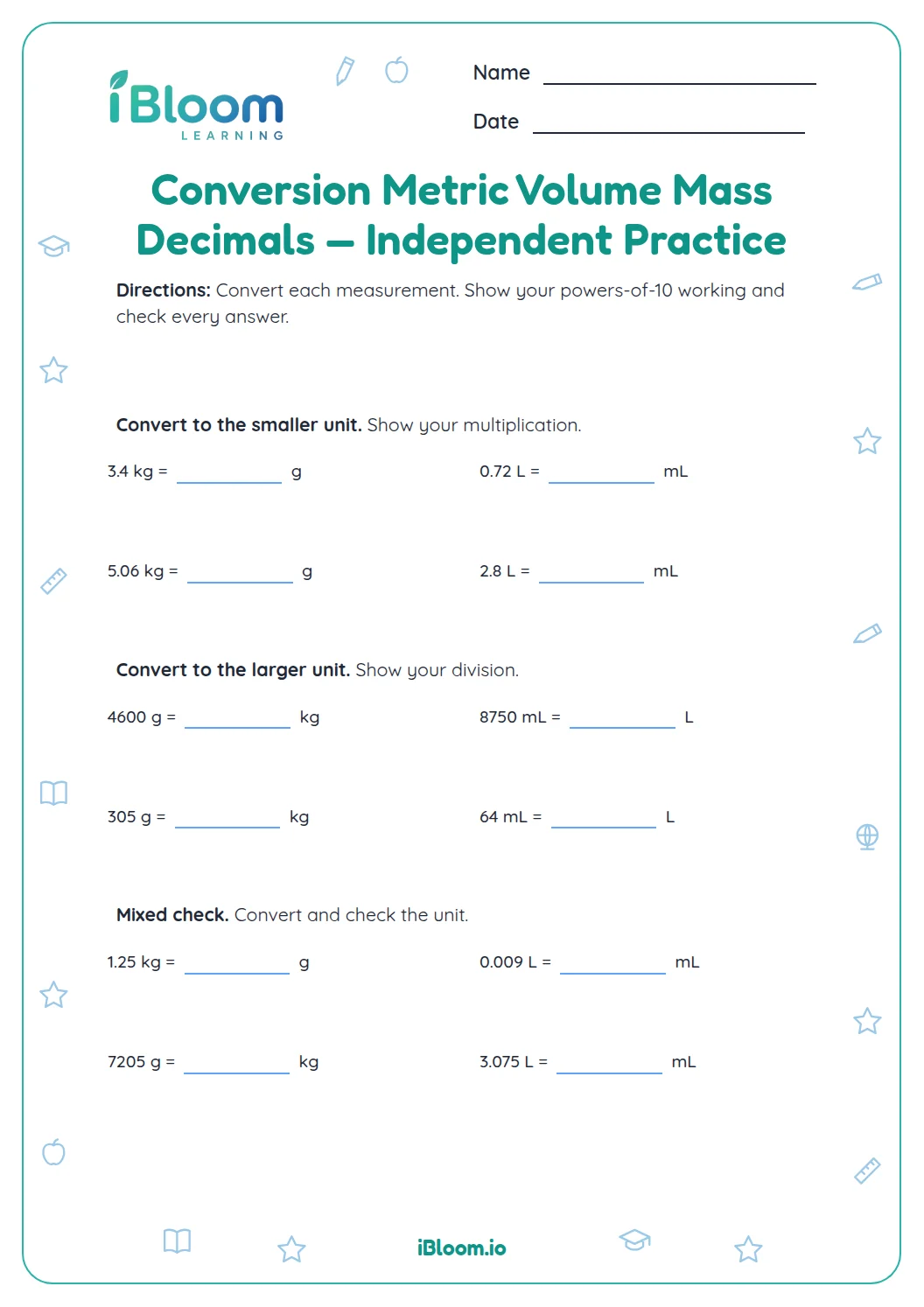
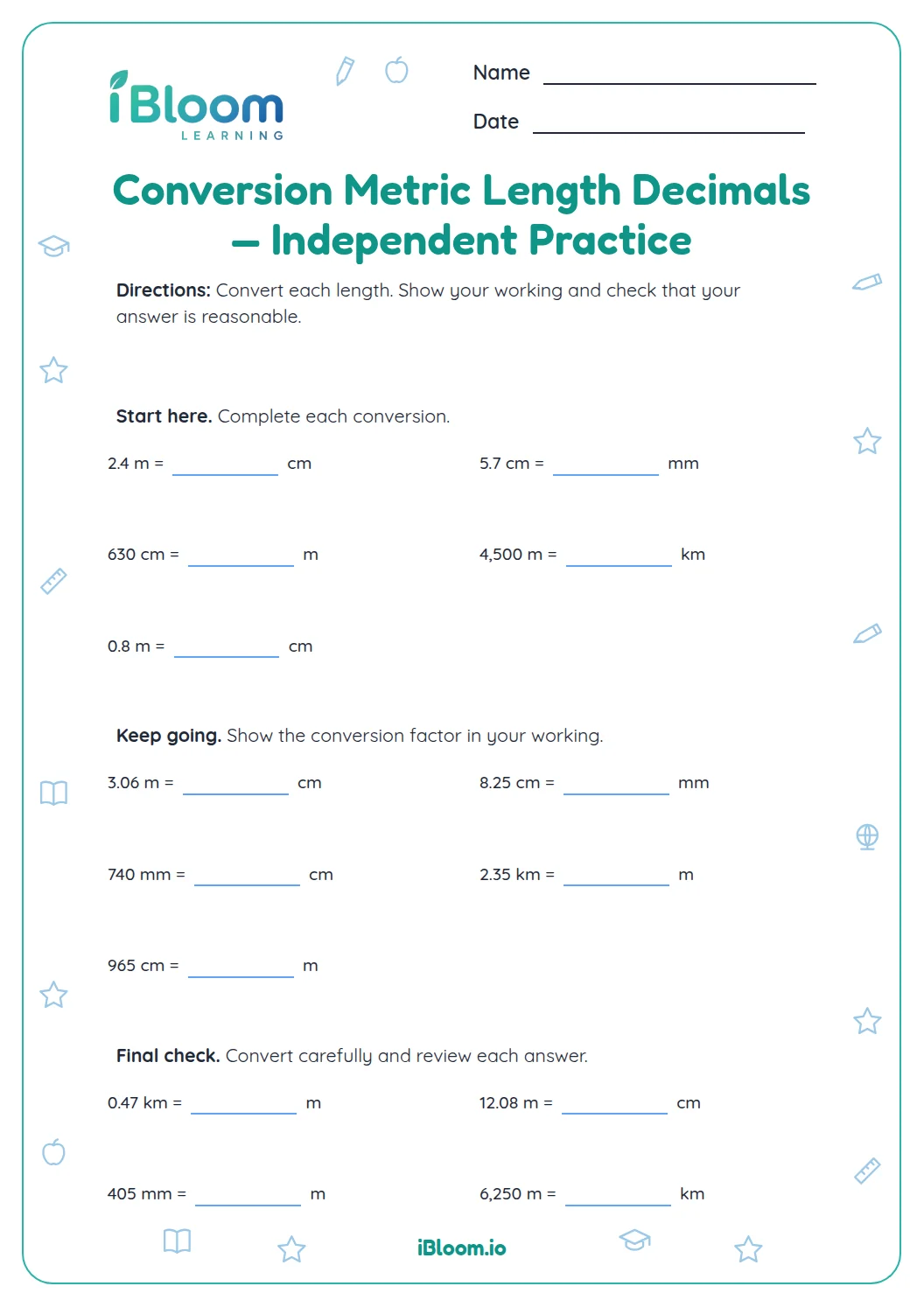
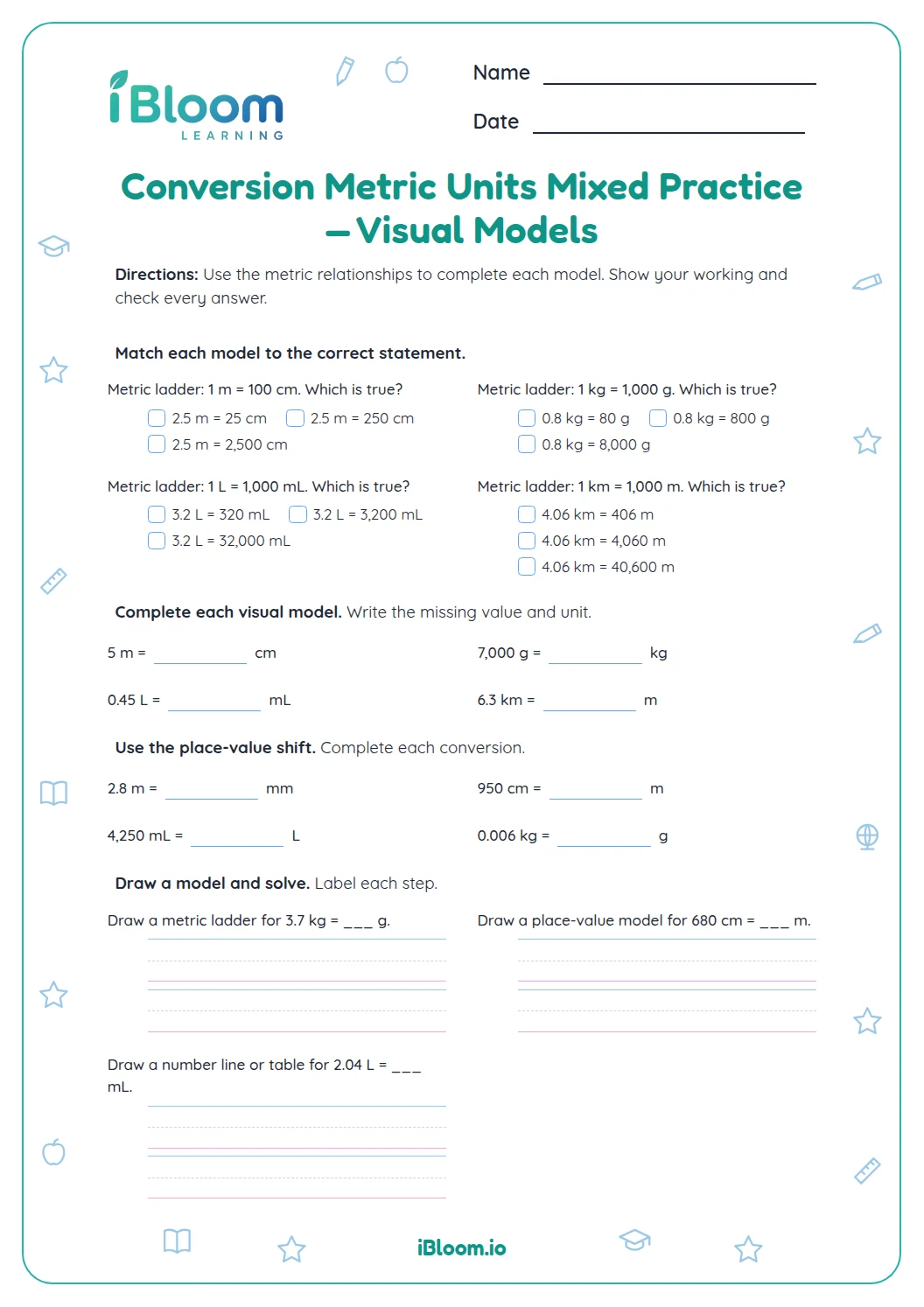
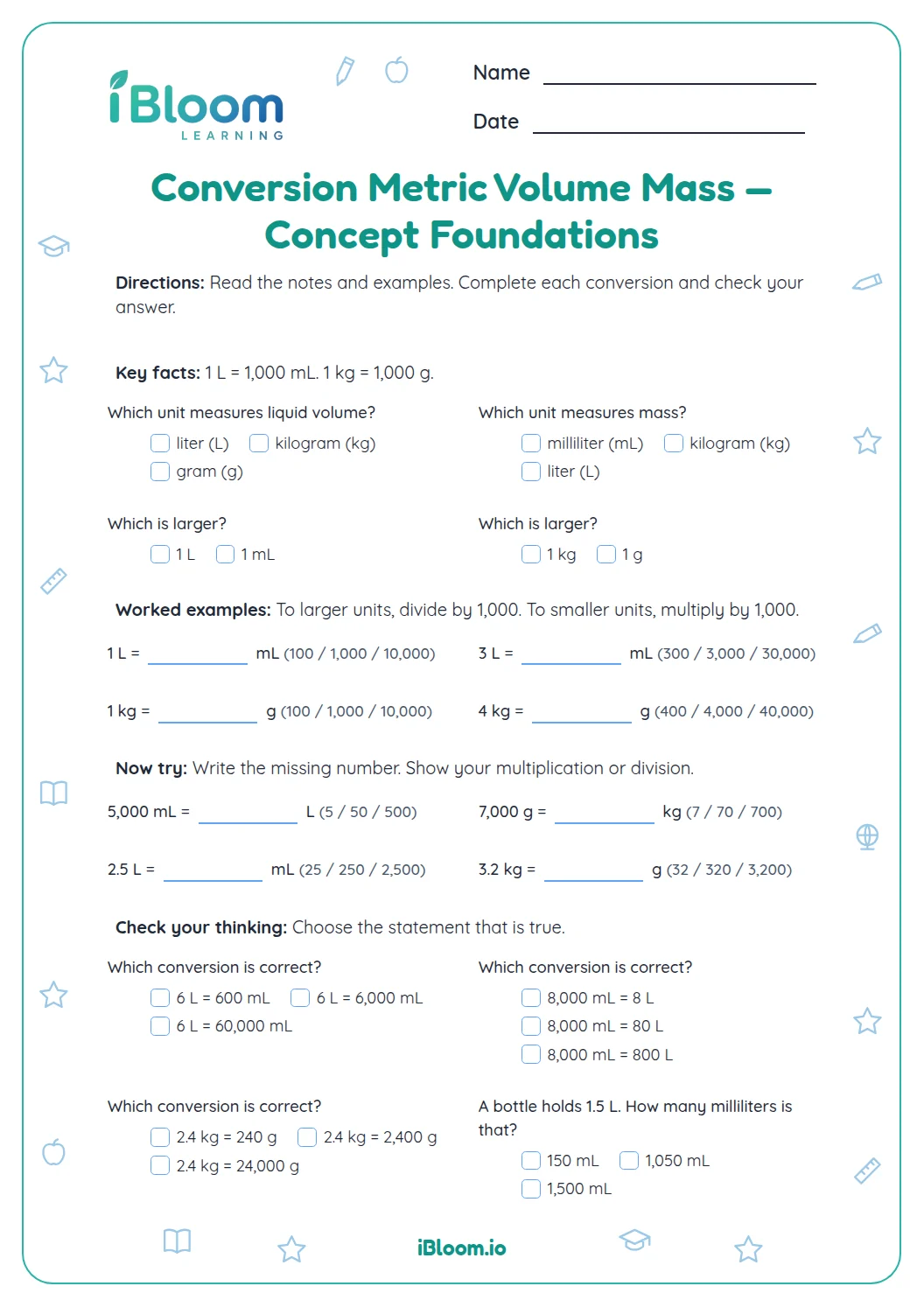
This Grade 6 worksheet offers 15 metric conversion problems with decimals. Learners convert liters and milliliters, convert kilograms and grams, and use those relationships in real-world situations, including a two-step volume problem. The answer key lists converted values with units where needed. The sheet practices CCSS 5.MD.A.1.
Aligned to 5.MD.A.1
How do you convert liters and milliliters?
One liter equals 1,000 milliliters. Multiply a liter amount by 1,000 to express it in milliliters; divide milliliters by 1,000 to express them in liters.
Question 1 converts 2.4 L to 2,400 mL. The amount is unchanged; only the unit and number representation change.
- 12.4 L = ___ mL
- 2Multiply 2.4 by 1,000.
- 3Answer: 2,400 mL.
How do you convert kilograms and grams?
One kilogram equals 1,000 grams. Multiply kilograms by 1,000 for grams, or divide grams by 1,000 for kilograms.
The final story converts 3 L to 3,000 mL, then subtracts 850 mL to find what remains.
How can you check a metric conversion?
Estimate the size before calculating. A quantity written in smaller units uses a larger number; a quantity written in larger units uses a smaller number. Check the unit on the answer line.
How to use this worksheet
- 1Write the unit relationship: 1 L = 1,000 mL or 1 kg = 1,000 g.
- 2Decide which unit is smaller.
- 3Multiply or divide by 1,000.
- 4Include the requested unit.
- 5For a two-step problem, convert before adding or subtracting.
Common mistakes and quick fixes
The mistake
Moving the decimal the wrong way.
The fix
Check whether the answer should have more or fewer units.
The mistake
Subtracting unlike units.
The fix
Convert both quantities to the same unit first.
The mistake
Leaving off the unit label.
The fix
Include mL, L, g, or kg as the question requests.
Curriculum alignment
This worksheet practices the following Common Core skill.
Convert measurements within a measurement system.
On this sheet: Learners convert metric mass and volume units and use conversions in contexts.
Show the official wordingHide the official wording
Convert among different-sized standard measurement units within a given measurement system (e.g., convert 5 cm to 0.05 m), and use these conversions in solving multi-step, real world problems.
What to practice next
Make more practice
Further reading
Questions parents and teachers ask
How many milliliters are in one liter?
One liter equals 1,000 milliliters. To convert liters to milliliters, multiply by 1,000; for example, 2.4 L is 2,400 mL. The first section practices volume conversions in both directions. This relationship is used in the volume conversion questions and the pitcher and tank stories.
How many grams are in one kilogram?
One kilogram equals 1,000 grams. Multiply kilograms by 1,000 to find grams, or divide grams by 1,000 to find kilograms. The mass section includes decimal amounts such as 2.05 kg and 425 g. This is the conversion relationship used in the mass exercises and parcel context.
Why can the number change while the amount stays the same?
The units have different sizes. A milliliter is smaller than a liter, so the same volume is written with a larger number of milliliters. When converting to a larger unit, the number becomes smaller while the measured amount stays equal.
What kinds of real-world problems are included?
The final section uses a pitcher, recipe batches, a parcel, a bag of rice, and a water tank. Each problem asks learners to convert units, combine equal amounts, or find what remains, with the answer written using its requested unit.
How many questions and pages are there?
There are 15 questions: five convert liters and milliliters, five convert kilograms and grams, and five use real-world situations. The worksheet spans two pages, with a separate two-page answer key. The key shows the converted values and includes units for the word-problem answers.
How can a student check a conversion?
Check whether the number moves in the expected direction and then confirm the unit. Converting 750 mL to liters gives 0.75 L, a smaller number because liters are larger units. The answer key shows the expected values and units.