





About this worksheet
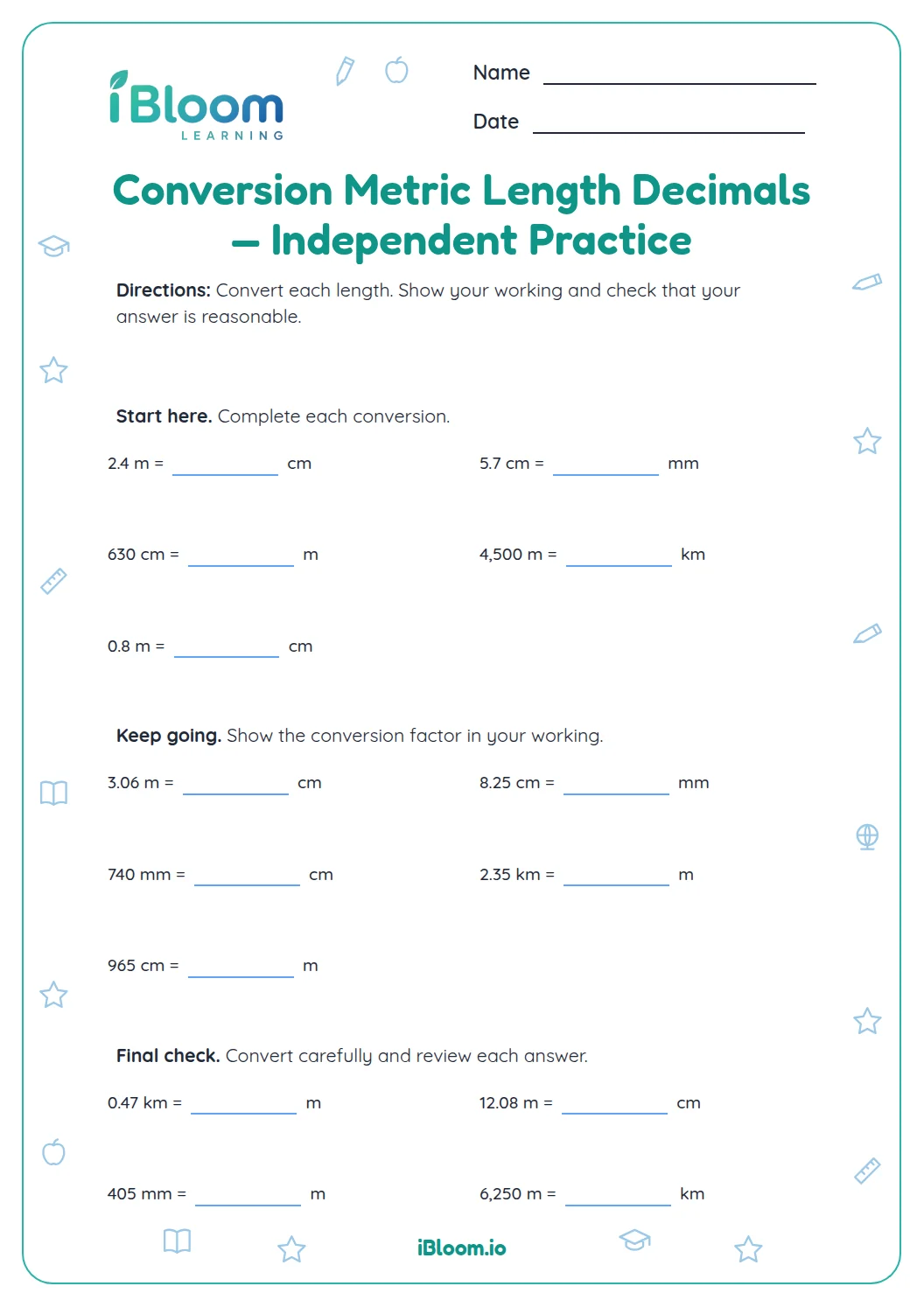
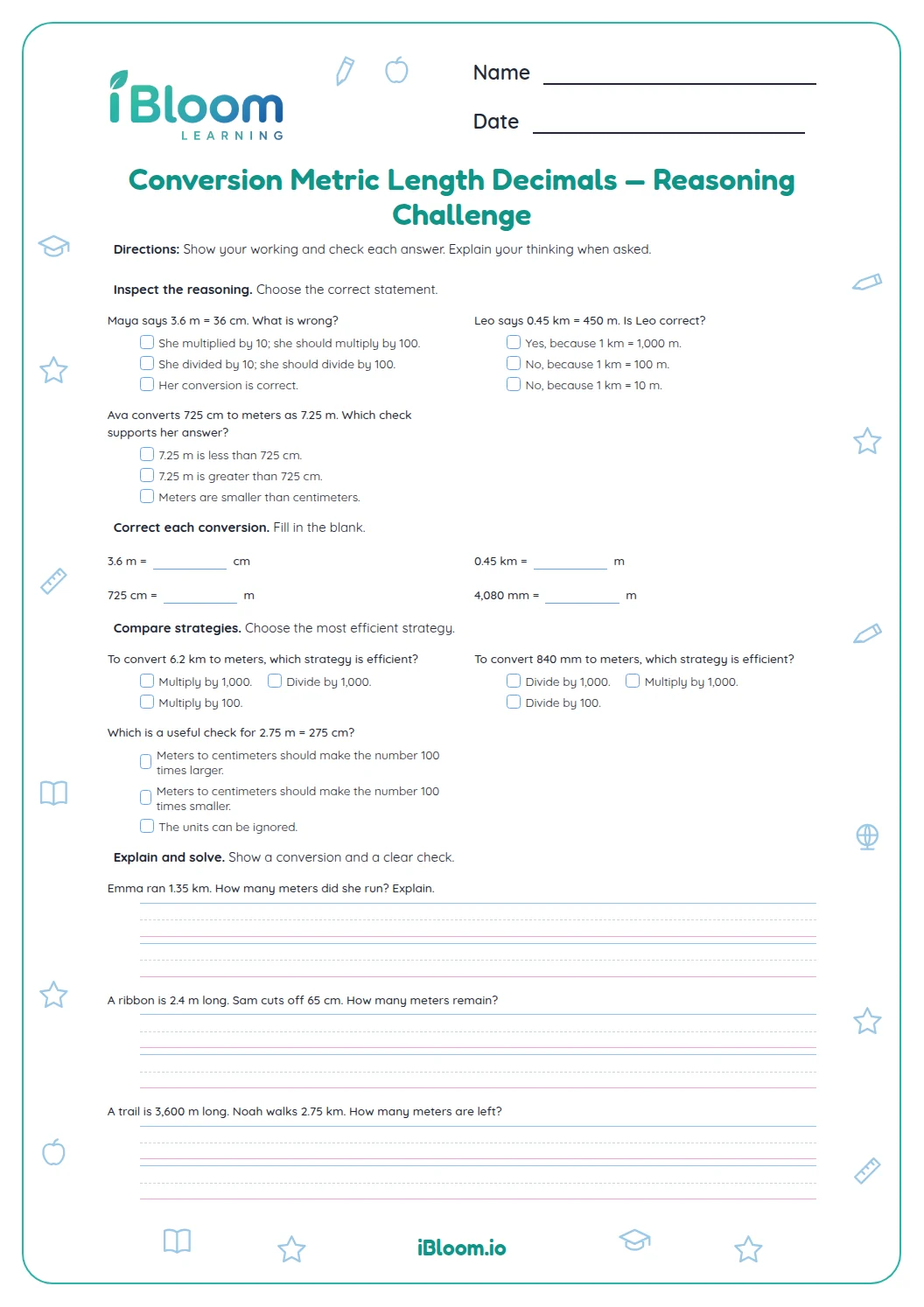
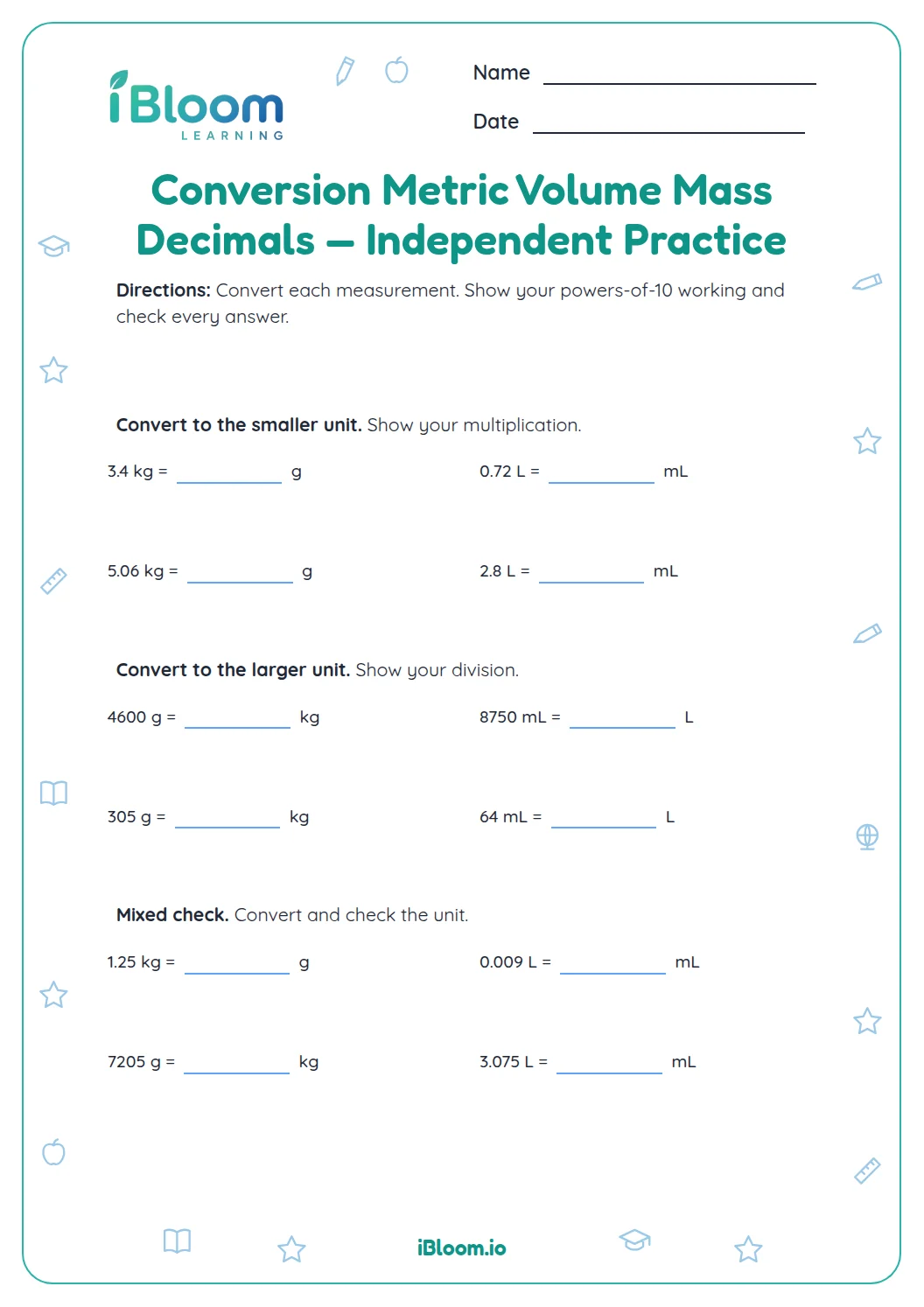
This Grade 6 worksheet practices converting metric units of length in decimal and real-world situations. Children work with millimeters, centimeters, meters and kilometers, compare measurements, and solve stories that combine conversions with addition or subtraction. It includes 17 questions across three parts and a separate answer key. The conversion work practices Common Core 6.RP.A.3.d: using ratio reasoning to convert measurement units.
Aligned to 6.RP.A.3.d
How do metric length units relate?
Each step between neighboring metric length units changes by a factor of 10, 100 or 1,000. For example, 1 meter is 100 centimeters, so 2.45 meters is 245 centimeters.
Question 1 converts 3.6 meters to centimeters: 3.6 × 100 = 360 cm. To check, convert 360 cm back by dividing by 100.
- 13.6 m = ___ cm
- 21 m = 100 cm
- 33.6 × 100 = 360
- 4Answer: 360 cm
What real-world situations does the sheet use?
Part A builds conversion fluency. Part B compares and combines lengths, and Part C applies conversions to routes, craft materials and measured objects. The final stories include both one-step and multi-step calculations.
How can a child check a conversion?
Estimate the size before calculating. A length measured in meters becomes a larger number when written in centimeters; a length in kilometers becomes a smaller number when written in meters. Convert the answer back when practical.
How to use this worksheet
- 1Write the unit relationship beside each conversion.
- 2Multiply when changing to a smaller unit and divide when changing to a larger unit.
- 3Keep the unit in every intermediate result.
- 4For two-step stories, convert first, then combine lengths.
- 5Estimate and convert back to check.
Common slips and quick fixes
The mistake
Multiplying when changing centimeters to meters.
The fix
Divide by 100 because a meter is larger than a centimeter.
The mistake
Treating 0.072 km as 7.2 m.
The fix
Use 1 km = 1,000 m, so 0.072 km = 72 m.
The mistake
Adding lengths before converting them to the same unit.
The fix
Convert each length to the requested unit, then combine.
Use metric unit relationships to convert and combine lengths in practical problems.
On this sheet:
Show the official wordingHide the official wording
Use ratio reasoning to convert measurement units; manipulate and transform units appropriately when multiplying or dividing quantities.
What to practice next
Make more practice
Further reading
Questions parents and teachers ask
How many questions are on the worksheet?
There are 17 questions in three parts. Children first convert lengths, then compare and combine measurements, and finally solve length stories with one or more steps. The separate key lists each result so families can check the calculations and units.
Which metric units appear?
The worksheet uses millimeters, centimeters, meters and kilometers. Some questions give decimal measurements, and several ask children to express a result in a particular unit. Reading the unit after each number helps keep the quantities organized as children convert and compare the different lengths.
What is 3.6 meters in centimeters?
3.6 meters equals 360 centimeters because 1 meter equals 100 centimeters. Multiply 3.6 by 100, then label the result in centimeters. Converting 360 centimeters back to meters gives 3.6 meters, which checks the calculation and confirms that the answer has the correct unit and reasonable size.
How should a child solve a two-step length story?
First convert the given lengths to the unit requested in the question. Then add, subtract or divide as the story describes. For example, the ribbon problem converts 2.4 meters to 240 centimeters before subtracting the 75 centimeters cut off. The answer is 165 centimeters.
Does the answer key come with the worksheet?
Yes. The printable answer key is included after the worksheet pages. It gives the value for every question, including the ordered list and the two results requested in the final lap problem. Check the units as well as the numbers when reviewing each response.