





About this worksheet
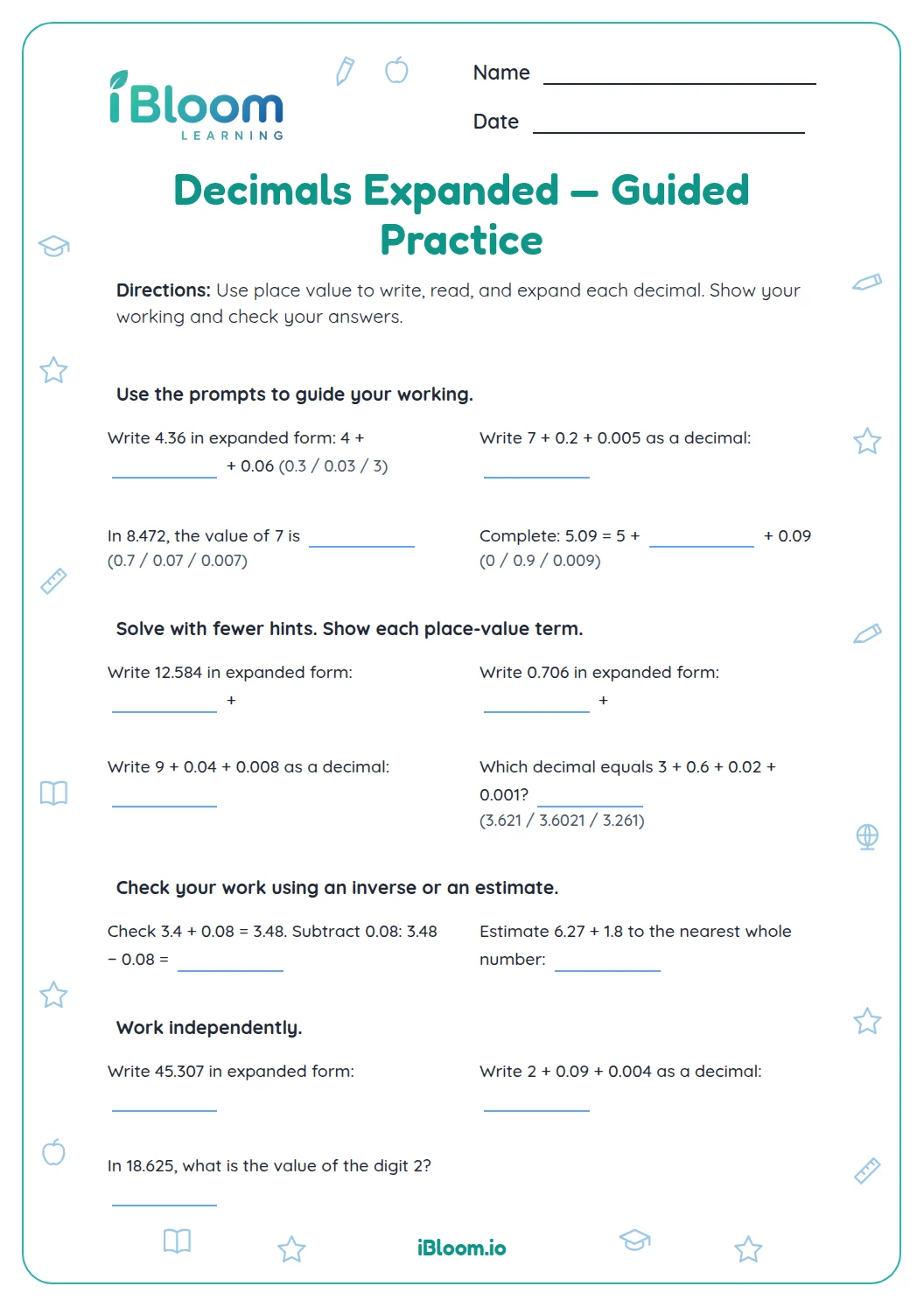
This worksheet builds decimal expanded form from tenths through thousandths. Learners identify digit values, complete expansions with zero placeholders, convert sums to standard form, and expand decimals with several nonzero places. A final explanation checks understanding of trailing zeros.
Aligned to 5.NBT.A.3.a
What does expanded form show?
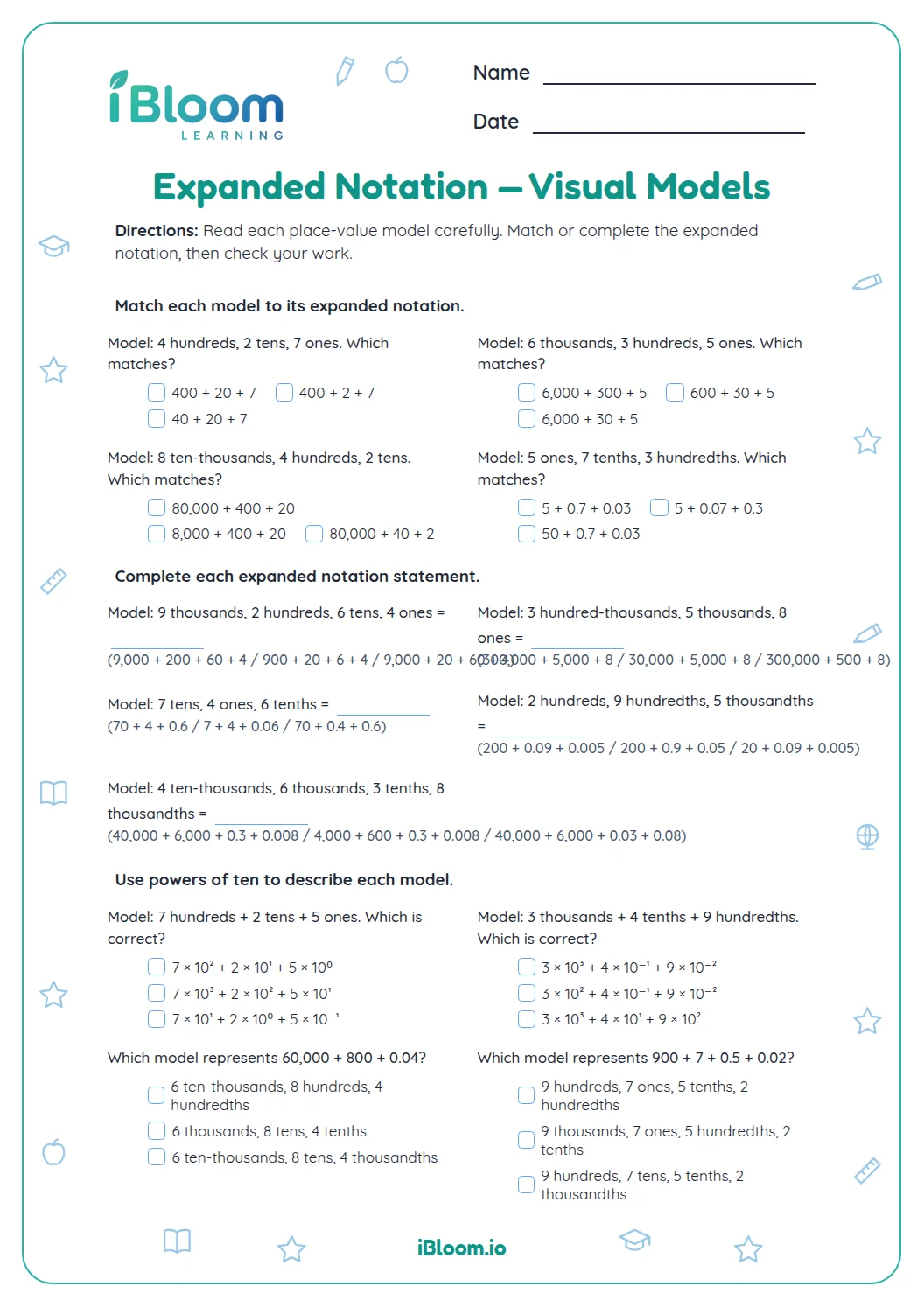
Expanded form names the value contributed by each digit. In 4.307, the 3 is three tenths and the 7 is seven thousandths: 4 + 0.3 + 0.007. The zero in the hundredths place contributes nothing.
Why do zeros matter?
A zero can hold a place even when it contributes no amount. In 9.205, the 0 keeps 2 in the tenths place and 5 in the thousandths place. Do not slide digits across the decimal point.
What does the practice include?
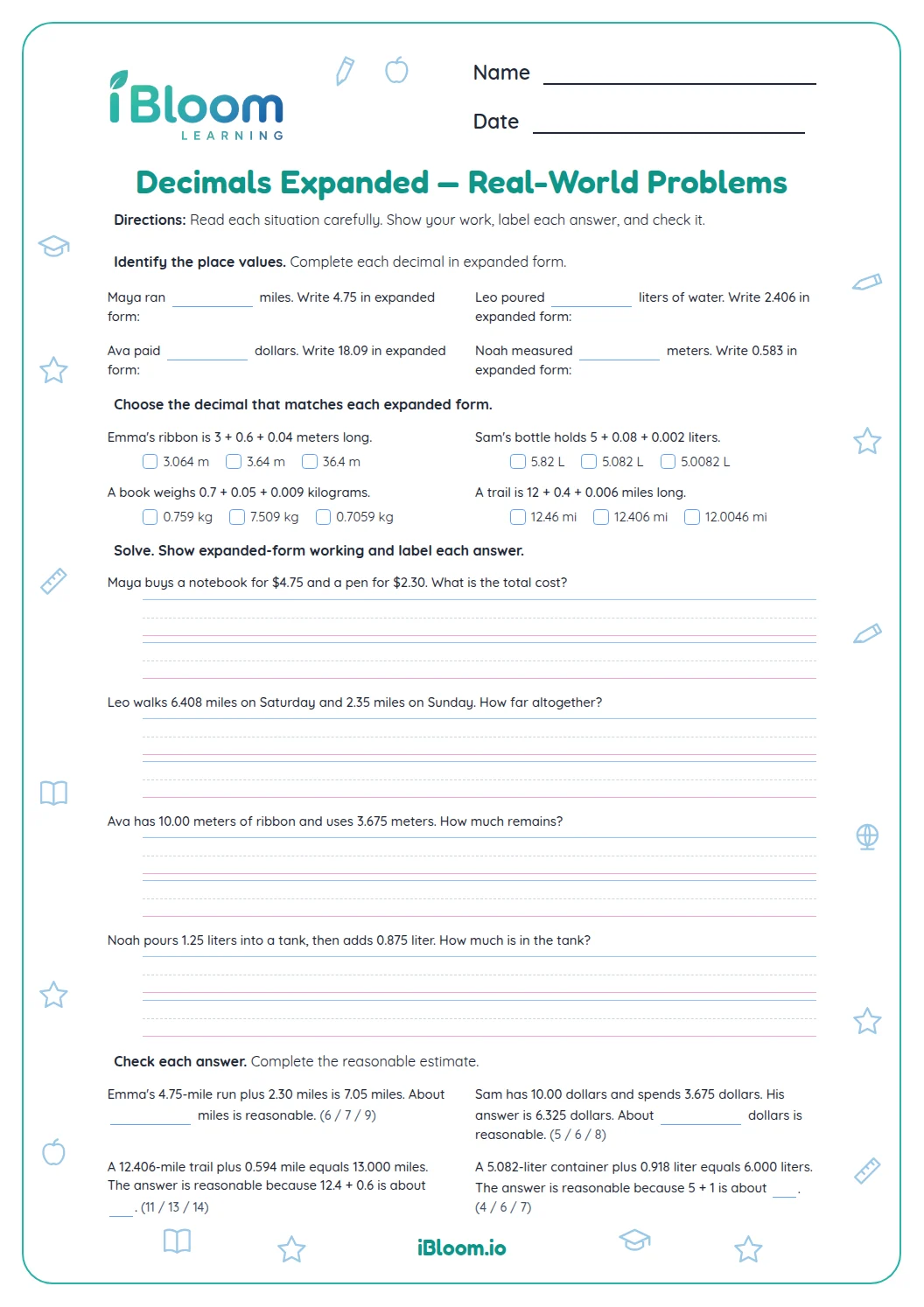
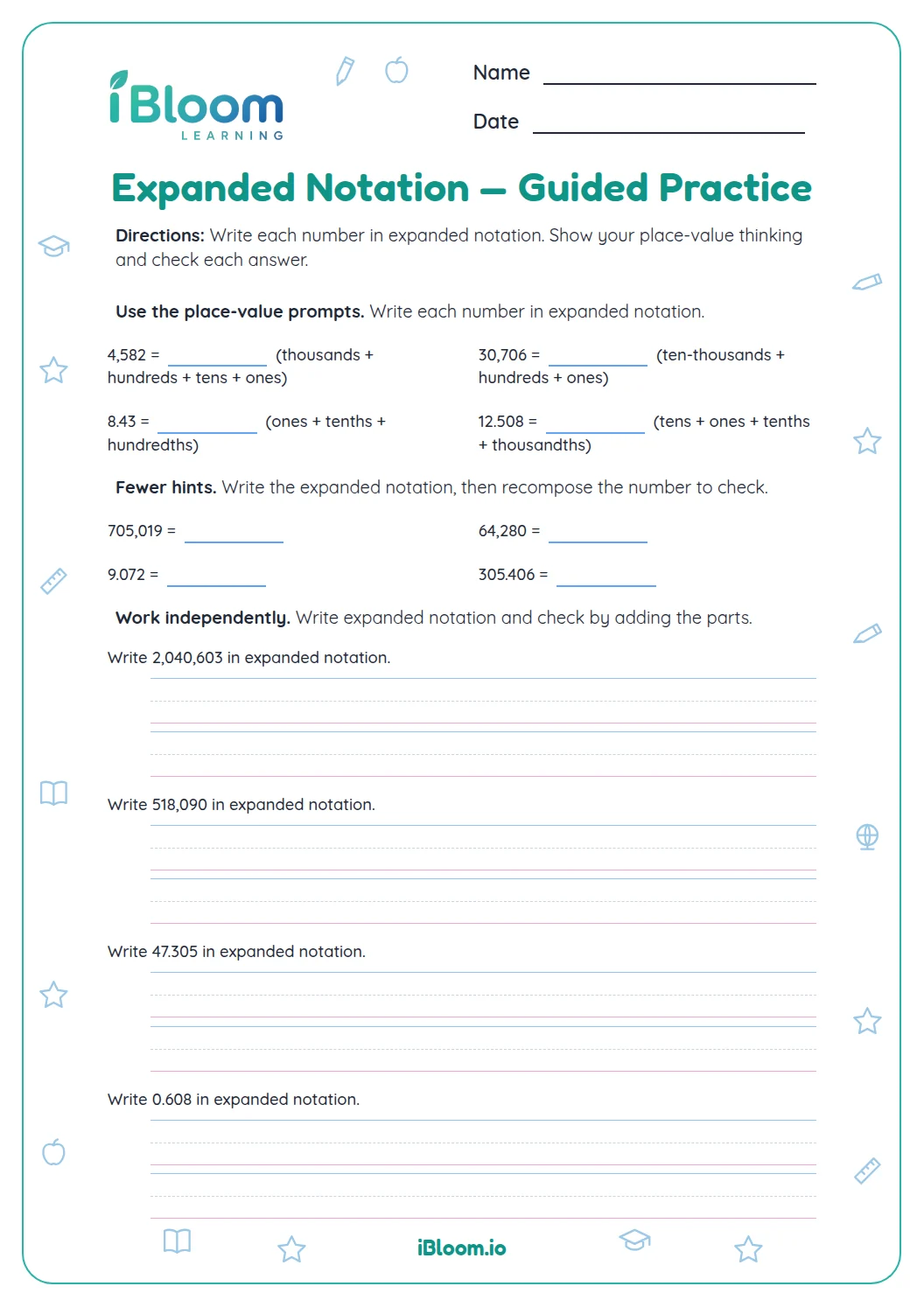
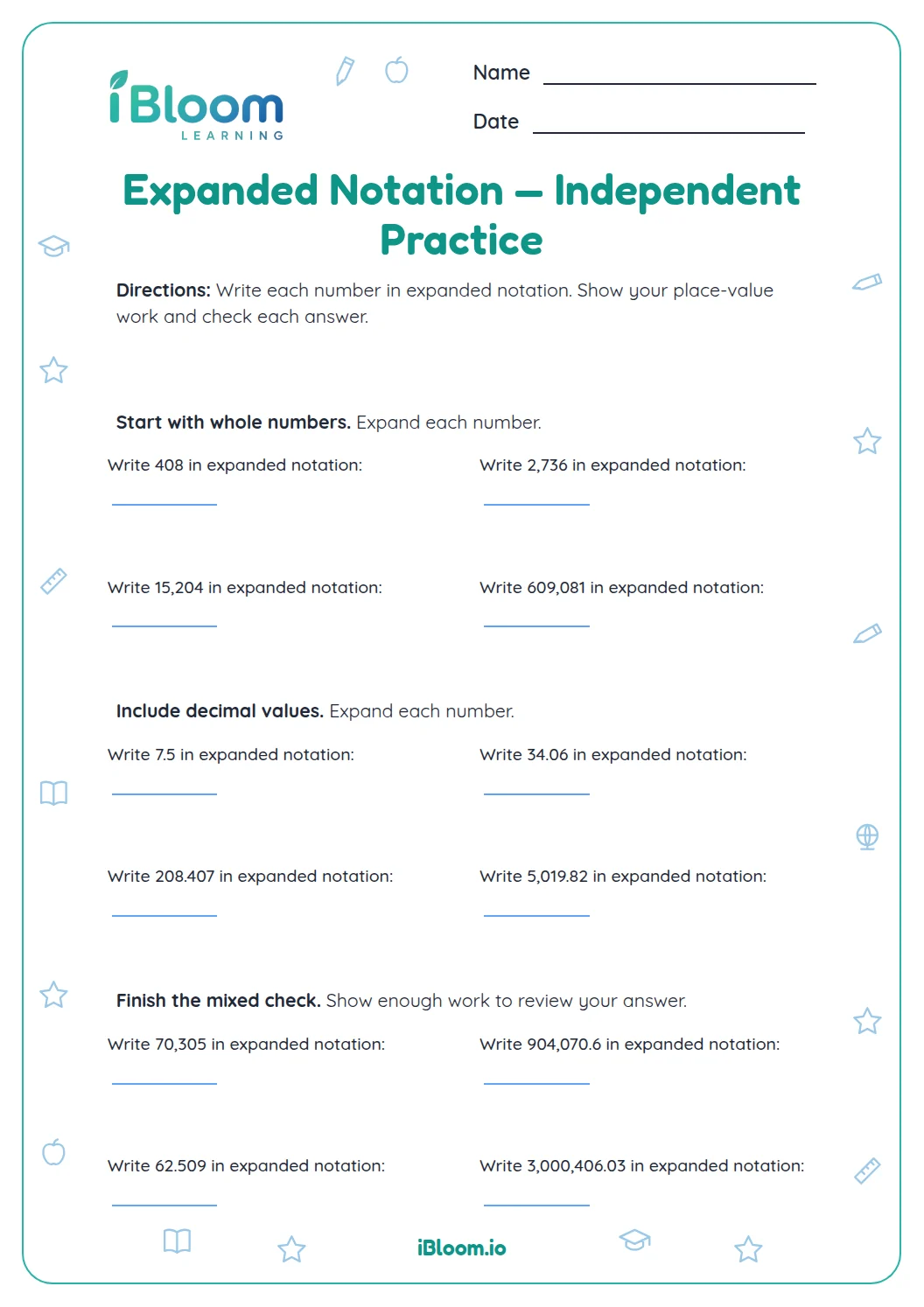
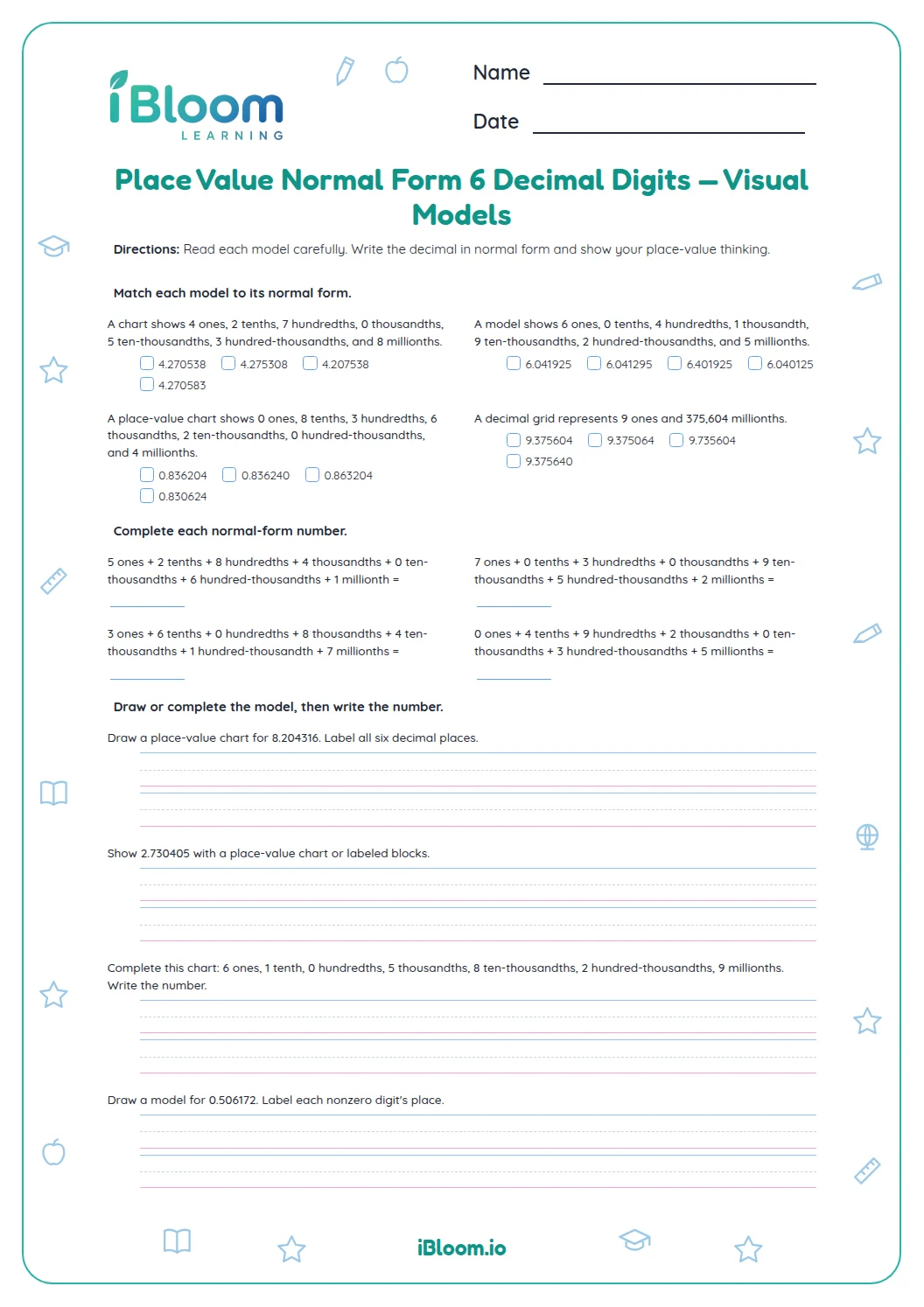
Part A identifies values and expansions. Part B fills missing terms. Part C recombines sums. Part D expands larger decimals and explains a trailing zero.
Work through decimal expansions
- 1Read the place name from the digit’s position.
- 2Write zero-valued places only when a prompt asks for every place; otherwise list nonzero terms.
- 3Recombine by lining up decimal places.
- 4Check equivalent decimals by comparing place values, not the number of written digits.
Common mix-ups
The mistake
Reading 0.08 as eight tenths.
The fix
The 8 is in the hundredths place, so its value is 0.08.
The mistake
Writing 2 + 0.4 + 0.005 as 2.45.
The fix
Keep the hundredths placeholder: the sum is 2.405.
Curriculum alignment
The worksheet uses expanded form to connect decimal digits with their place values.
Use expanded form for decimals.
On this sheet: Learners write decimals as sums of the values of their nonzero digits.
Show the official wordingHide the official wording
Read and write decimals to thousandths using base-ten numerals, number names, and expanded form, e.g., 347.392 = 3 × 100 + 4 × 10 + 7 × 1 + 3 × (1/10) + 9 × (1/100) + 2 × (1/1000).
What to practice next
Make more practice
Further reading
Questions parents and teachers ask
What does decimal expanded form show?
Expanded form writes a number as the sum of the value of each digit. For example, 6.38 is 6 + 0.3 + 0.08. The worksheet practices tenths, hundredths, and thousandths, including numbers with a zero placeholder. It makes clear what each digit contributes to the total.
Why can a zero appear in a decimal without adding value?
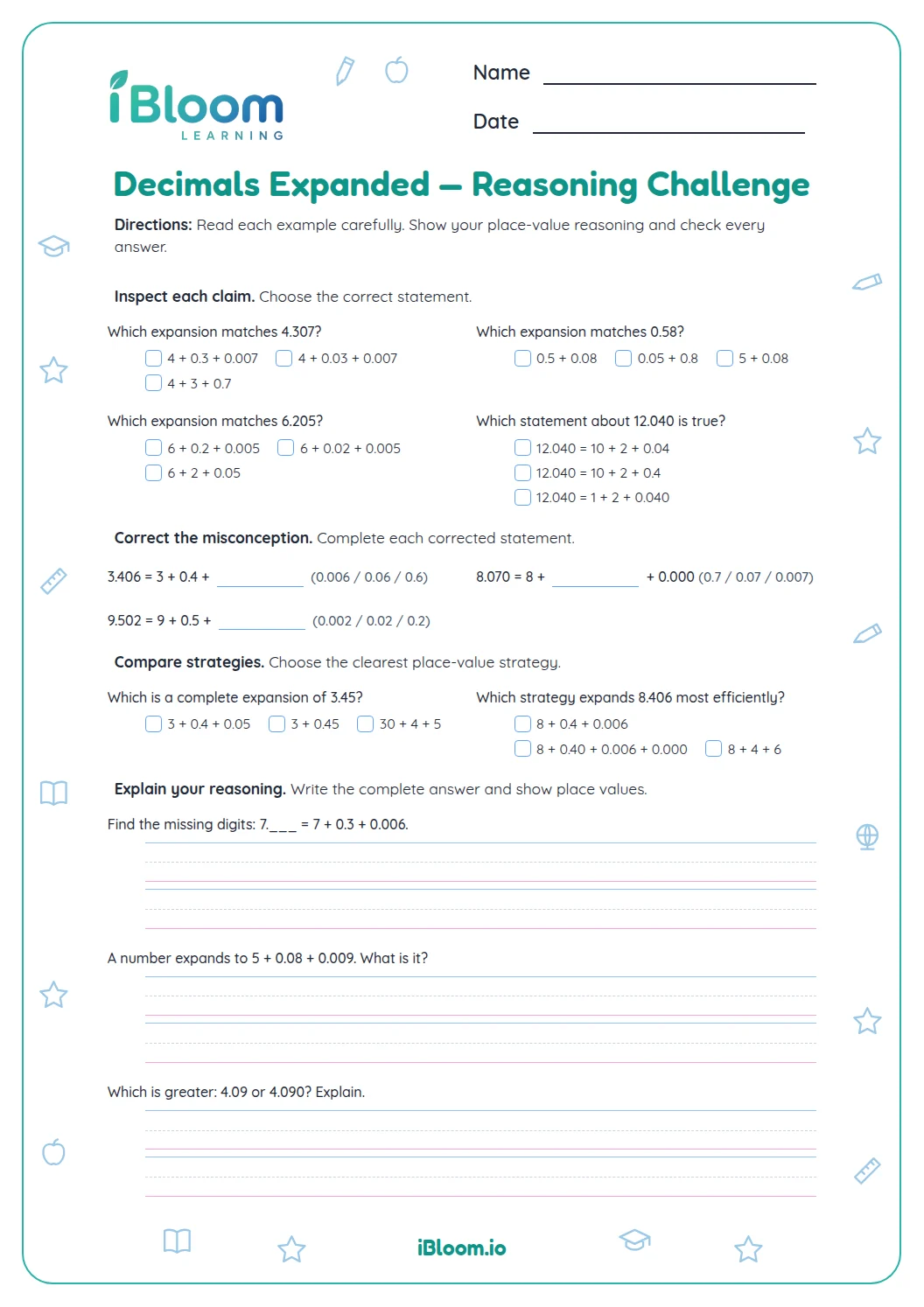
A zero marks an empty place. In 3.40, the 4 means four tenths and the 0 means zero hundredths, so the value is the same as 3.4. The final question asks learners to explain this relationship. The place-value names keep the explanation precise.
How do I handle a missing place value?
Name the place of each shown digit first, then compare the equation with the standard decimal. In 9.205 = 9 + 0.2 + ___ + 0.005, the blank is zero hundredths. This keeps each digit aligned to its correct place.
What is included in the answer key?
The key gives the correct choices, missing decimal terms, recombined standard-form decimals, and sample expanded forms. Equivalent sums can be accepted if each nonzero digit has the correct value. For the explanation item, look for the idea that a trailing zero does not change the number.
How many questions are on the worksheet?
There are 18 questions in four parts. Learners identify place values, complete expansions, recombine decimal sums, and write or explain expanded forms. The printable has three worksheet pages followed by a separate answer key. Each part moves from recognizing place value to writing and explaining expanded form.