




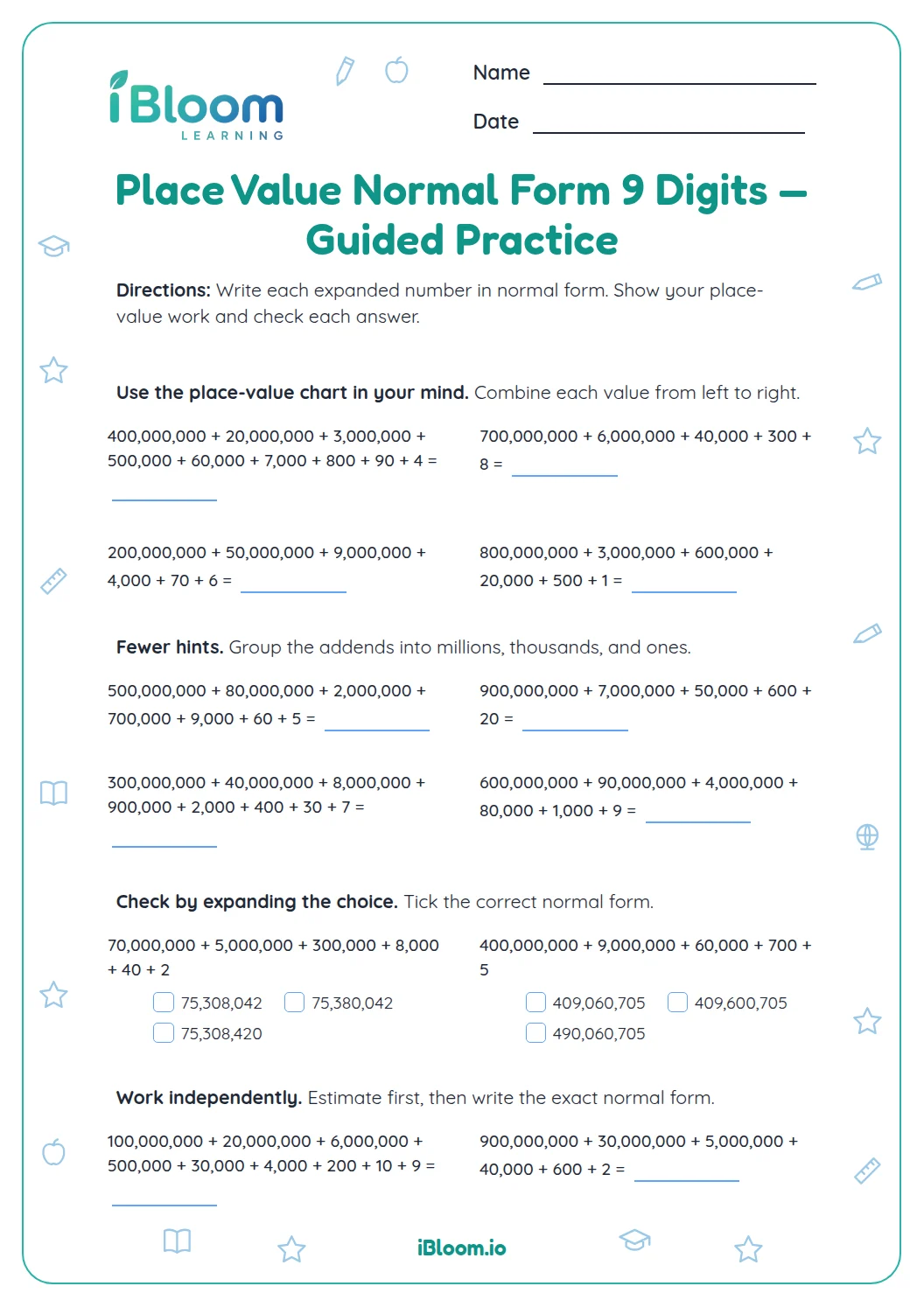
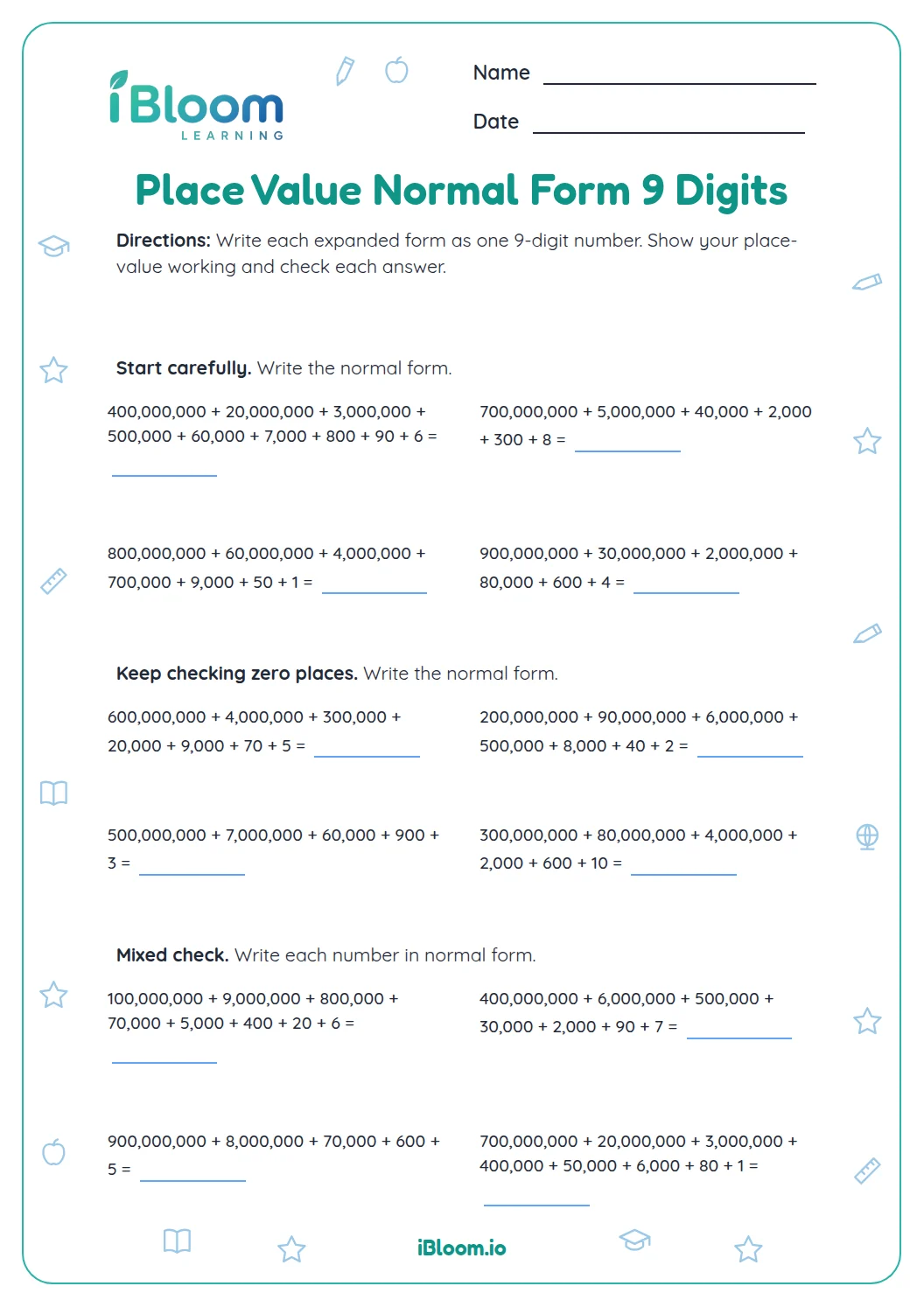

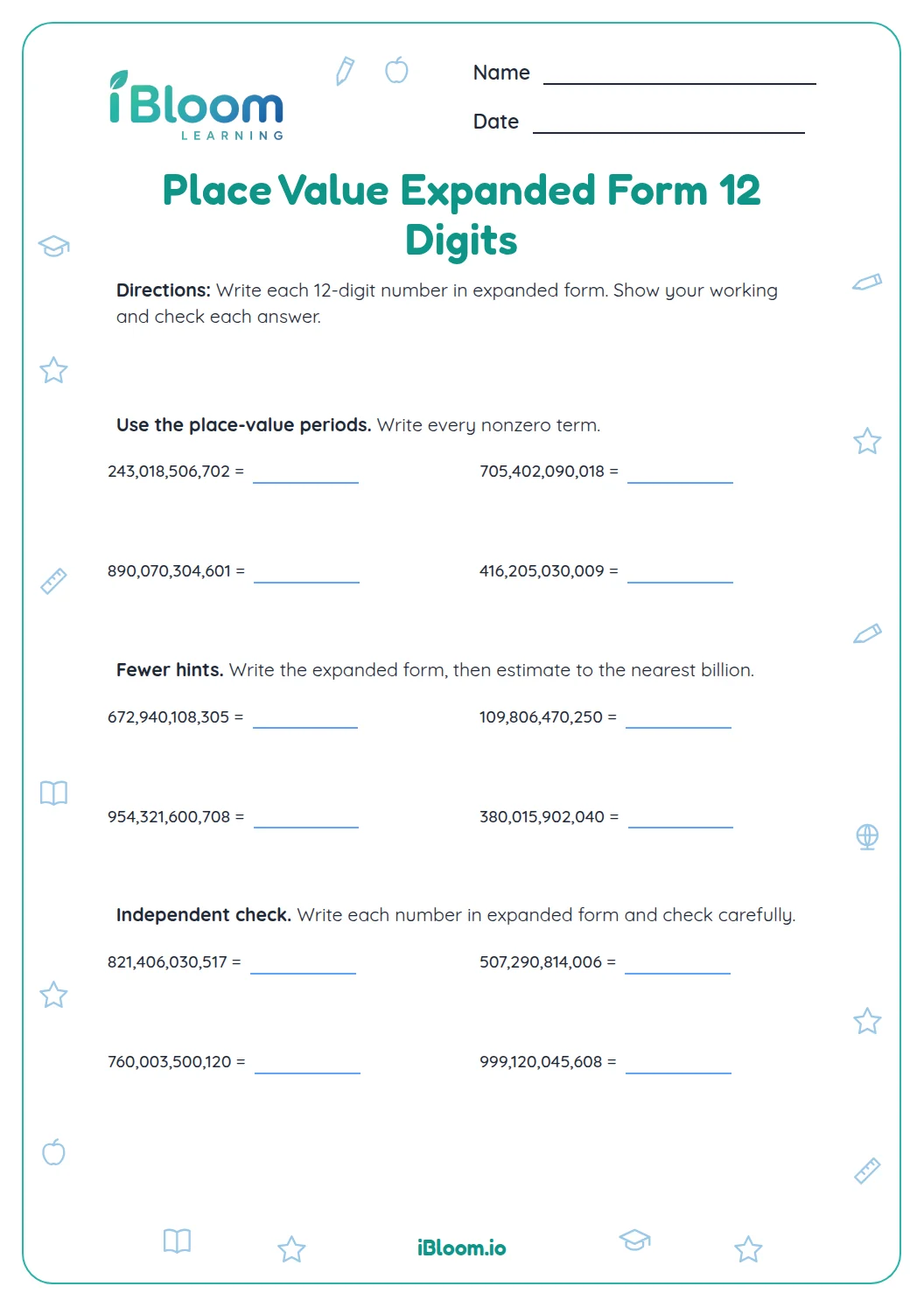

About this worksheet
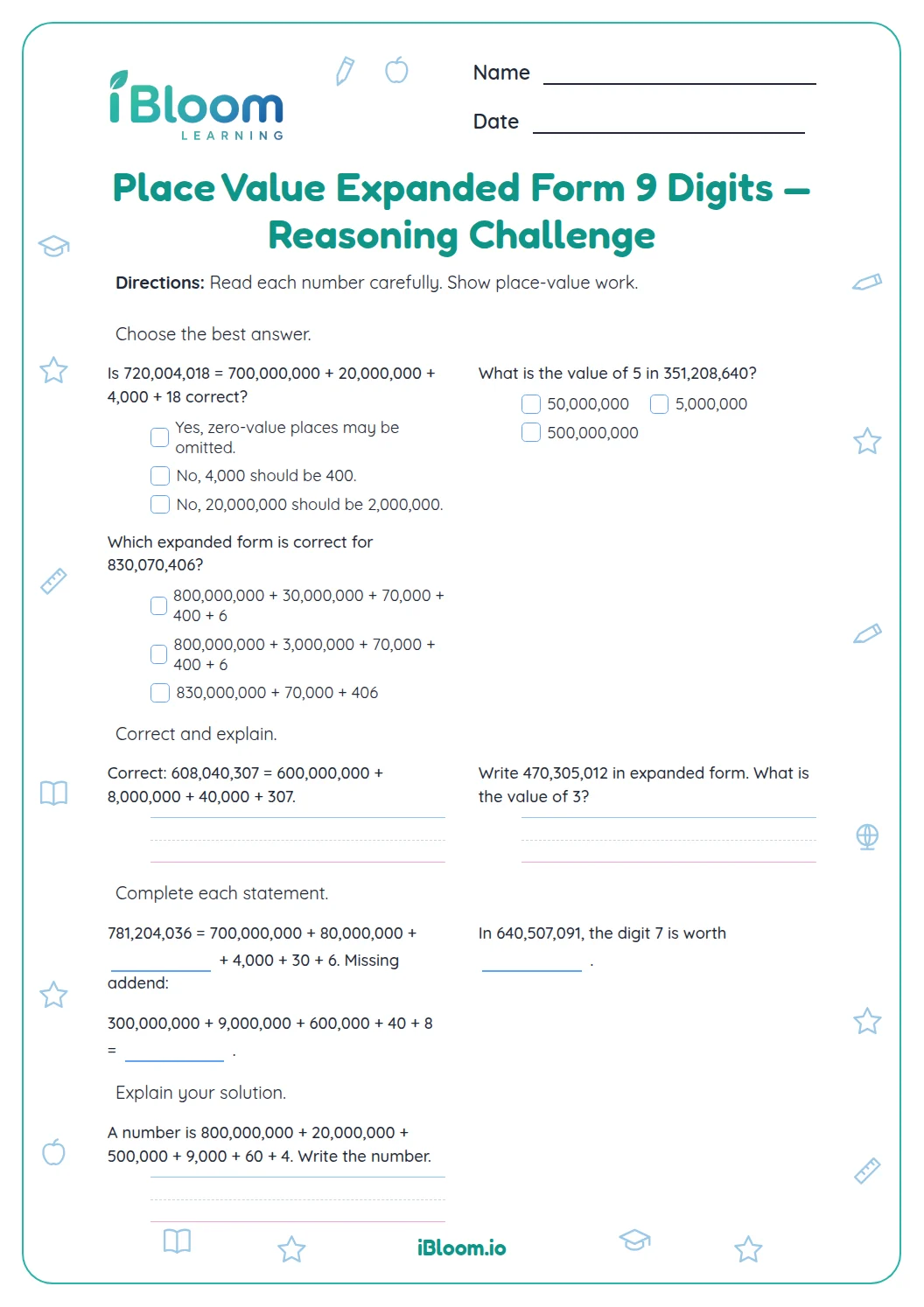
This Grade 6 place-value worksheet builds fluency with nine-digit expanded form. In each of 15 questions, learners identify a selected digit and write its value as an expanded-form term, such as 80,000,000 for the 8 in 583,214,709. Items include internal zero places so children must track each digit’s position. A separate answer key is included.
Aligned to 4.NBT.A.2
How do digits become expanded-form terms?
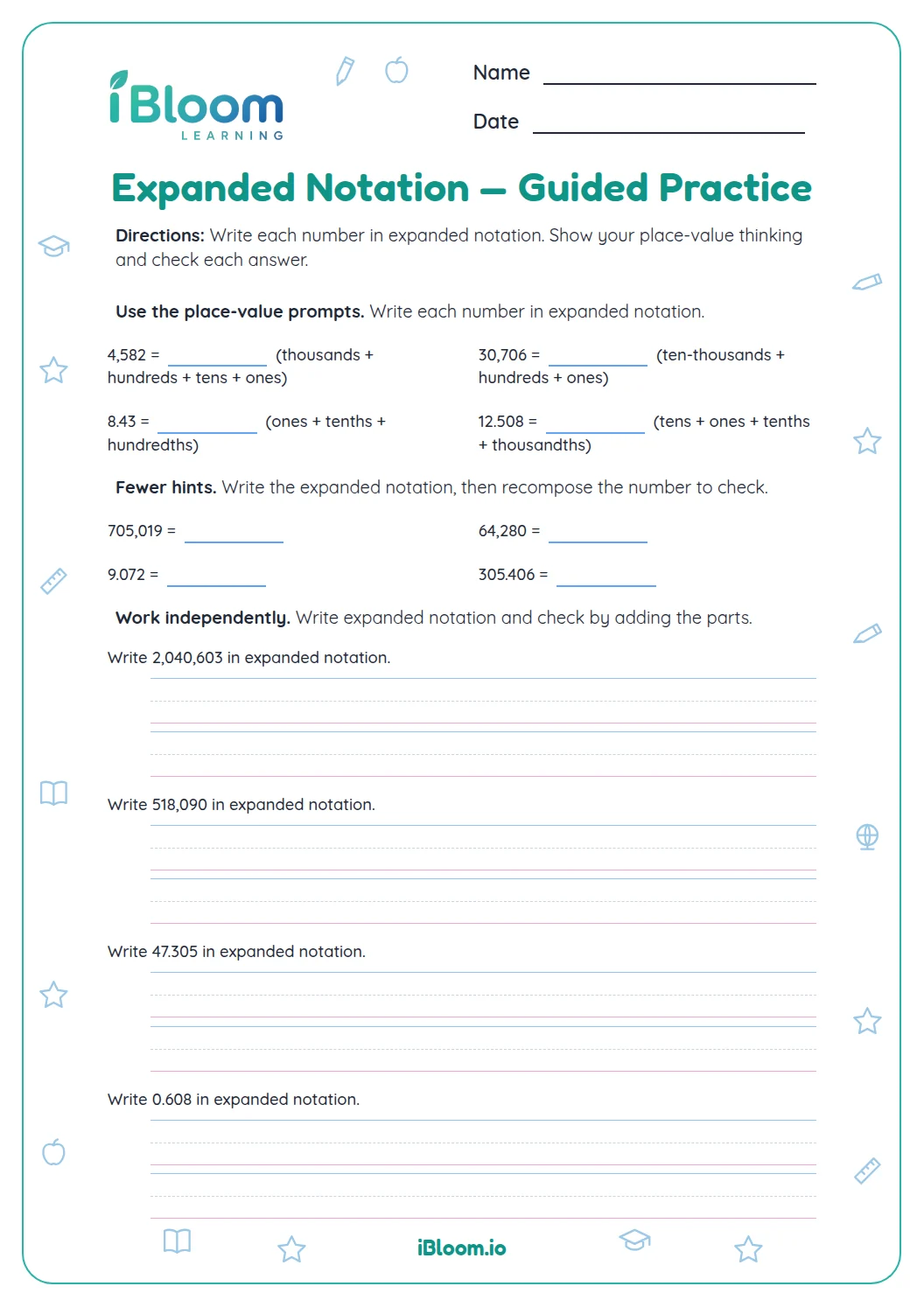
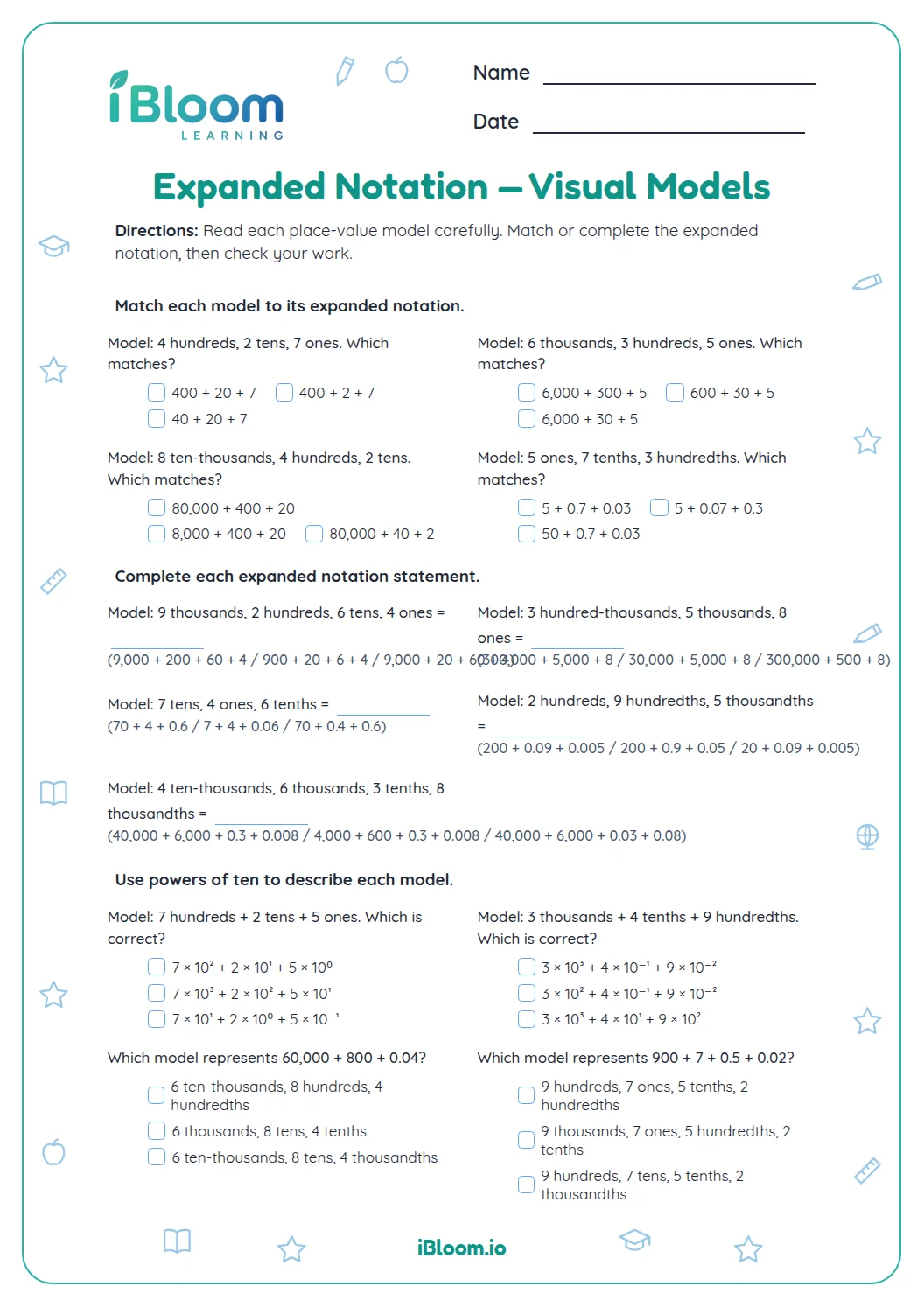
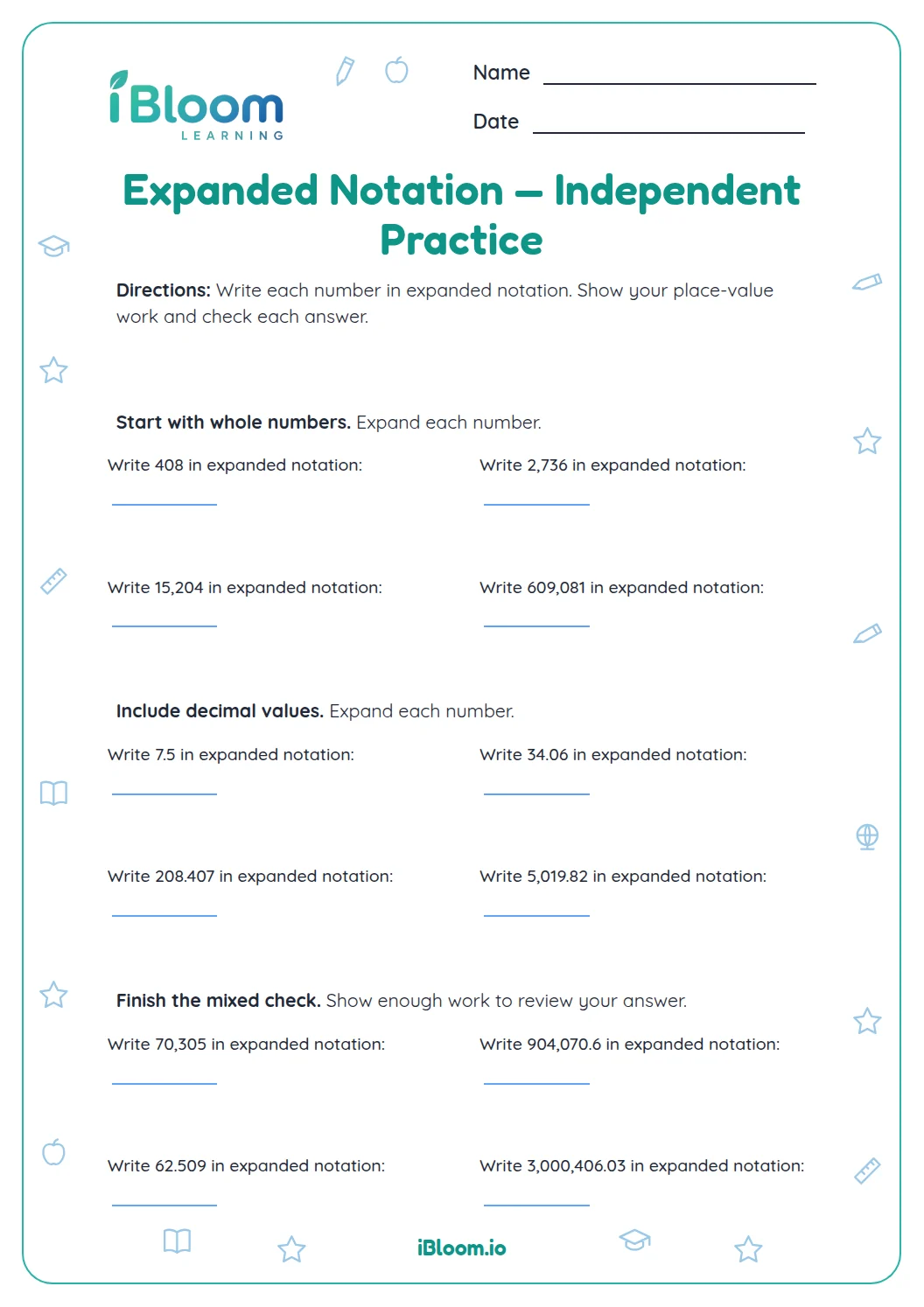
Expanded form writes a number as the sum of the values of its digits. In question 1, the 8 in the ten-millions place contributes 80,000,000.
- 1583,214,709
- 2The expanded-form term for 8 is 80,000,000.
How do zero digits affect expanded form?
A zero contributes no amount, so it has no expanded-form term. Its place still matters in the standard number. In 907,030,406, the 3 is in the ten-thousands place, so its term is 30,000.
What is on the practice pages?
Fifteen fill-in questions ask children to identify a digit’s expanded-form term in a nine-digit number. Items with internal zeros require careful attention to place value.
How can I use this worksheet?
- 1Mark the digit places from hundred-millions through ones.
- 2Write each nonzero digit as its value in expanded form.
- 3Leave out zero-valued terms, but keep their places in the standard number.
- 4Rebuild the standard number and check its commas.
What can children check as they work?
The mistake
Leaving out a place value when a digit is zero.
The fix
Keep the zero in the standard-form number even though its expanded term is omitted.
The mistake
Writing a digit instead of its place value.
The fix
Name the place first, then multiply the digit by that place value.
The mistake
Combining terms from different places incorrectly.
The fix
Check that each expanded term matches the digit directly above it.
Common Core alignment
This worksheet practices reading and writing multi-digit numbers through place value.
Write and interpret expanded form for nine-digit whole numbers.
On this sheet: Every item asks learners to represent or interpret the named place-value parts.
Show the official wordingHide the official wording
Read and write multi-digit whole numbers using base-ten numerals, number names, and expanded form. Compare two multi-digit numbers based on meanings of the digits in each place, using >, =, and < symbols to record the results of comparisons.
What to practice next
Make more practice
Further reading
Questions parents and teachers ask
What is expanded form?
Expanded form writes a number as the sum of the values of its digits. For example, the 8 in 583,214,709 contributes 80,000,000. This worksheet asks learners to identify one digit’s value at a time, then check its place in the full nine-digit number.
Do zero digits appear as terms?
A zero digit contributes zero, so it is usually omitted from an expanded-form sum. It still holds its place in standard form. In 907,030,406, the 3 is in the ten-thousands place and contributes 30,000. The questions ask for nonzero digit values.
How do I find a digit’s value?
First locate the digit in the number, then name its place. Multiply its face value by that place value: an 8 in the ten-millions place is worth 80,000,000. Each item names a digit and asks for its expanded-form term, which the key lists.
How many questions are included?
There are 15 fill-in questions. Each shows a nine-digit number and asks for the expanded-form term represented by one selected digit. Some numbers contain zeros between nonzero digits, so checking place position matters. The key provides the value expected for each selected digit.
Why are commas useful in these numbers?
Commas separate a whole number into groups of three digits, making the hundreds, thousands, and millions periods easier to read. When finding a digit’s value, begin at the rightmost group and locate the digit’s place. Then compare the resulting term with the answer key.