





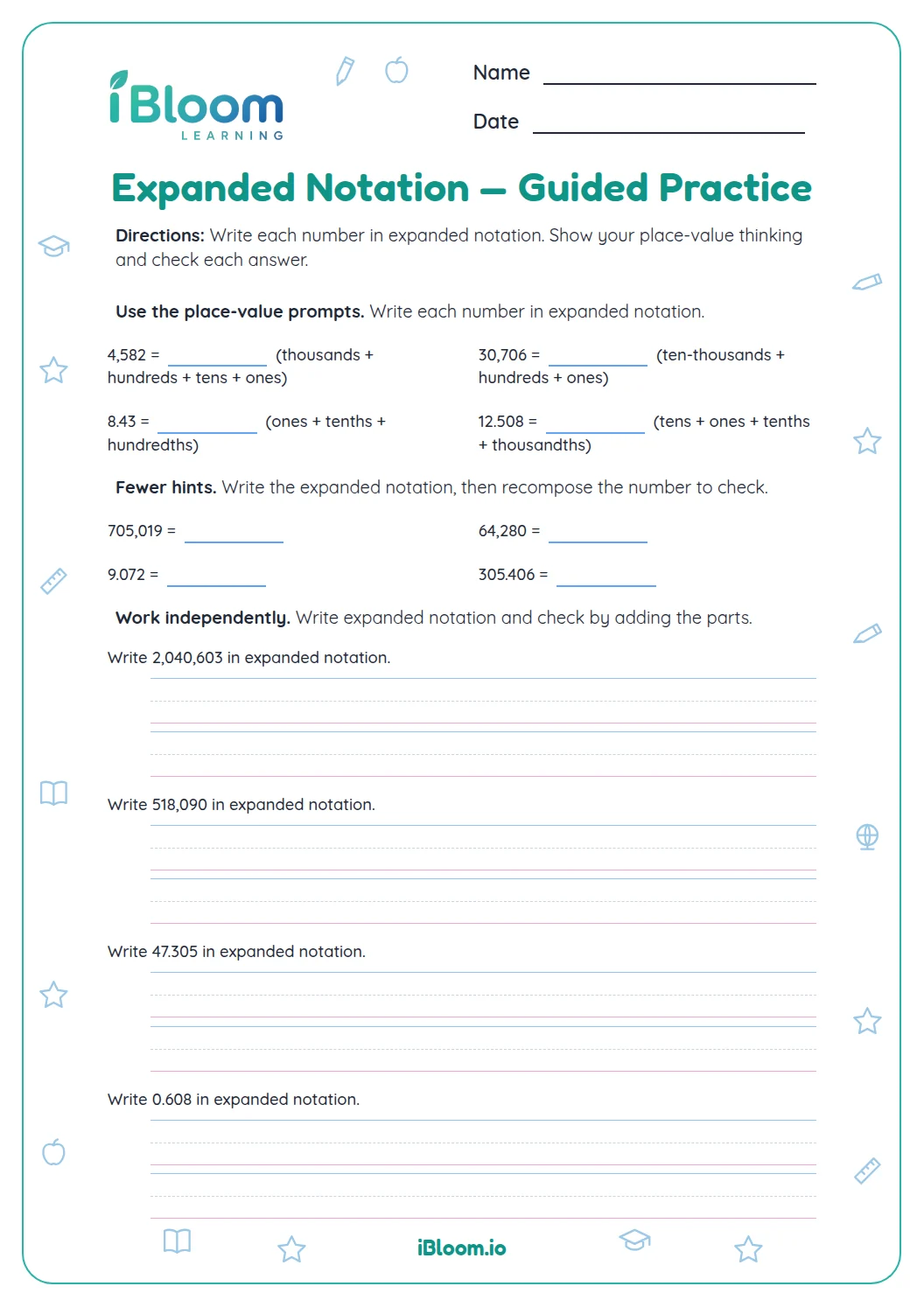
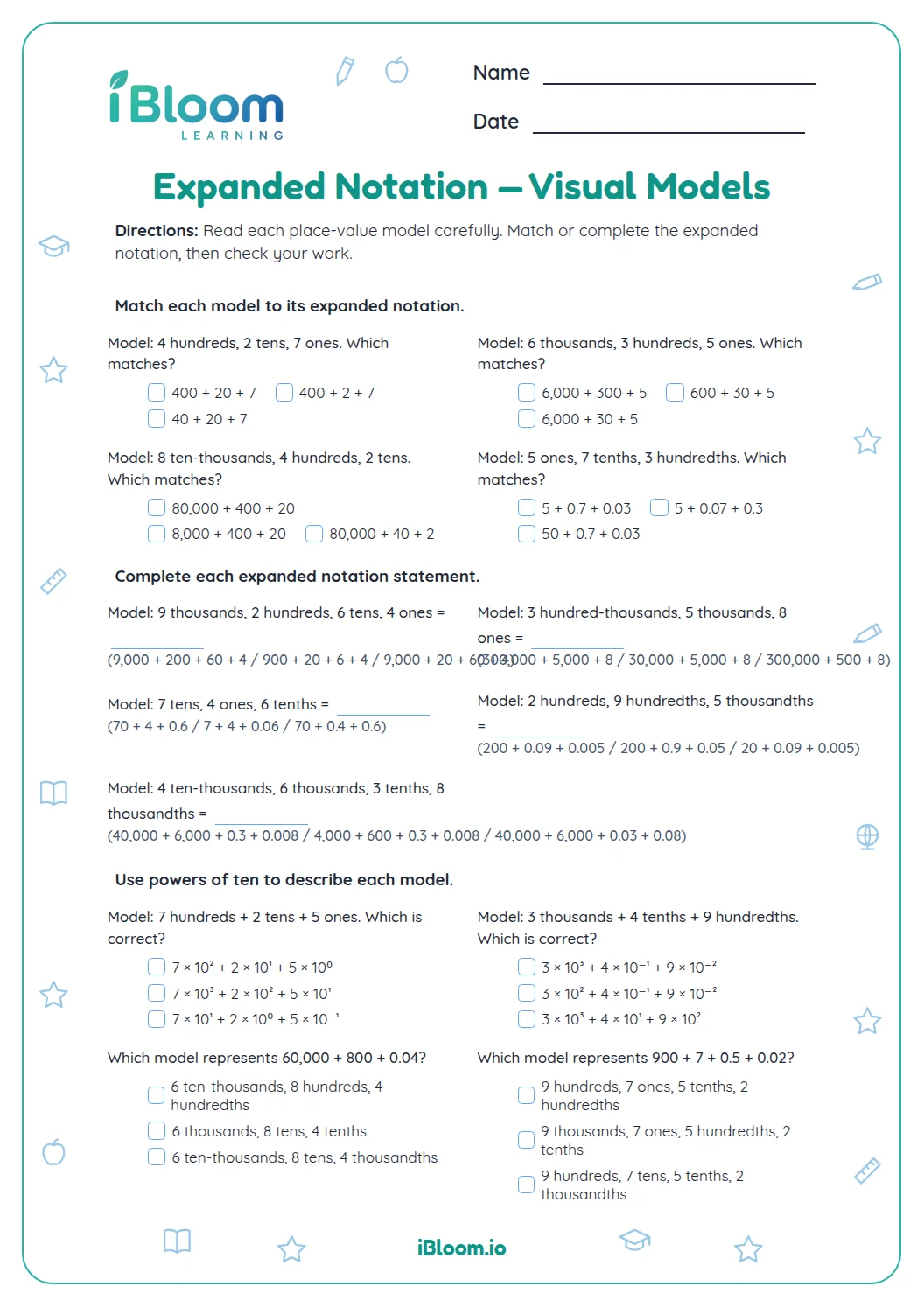
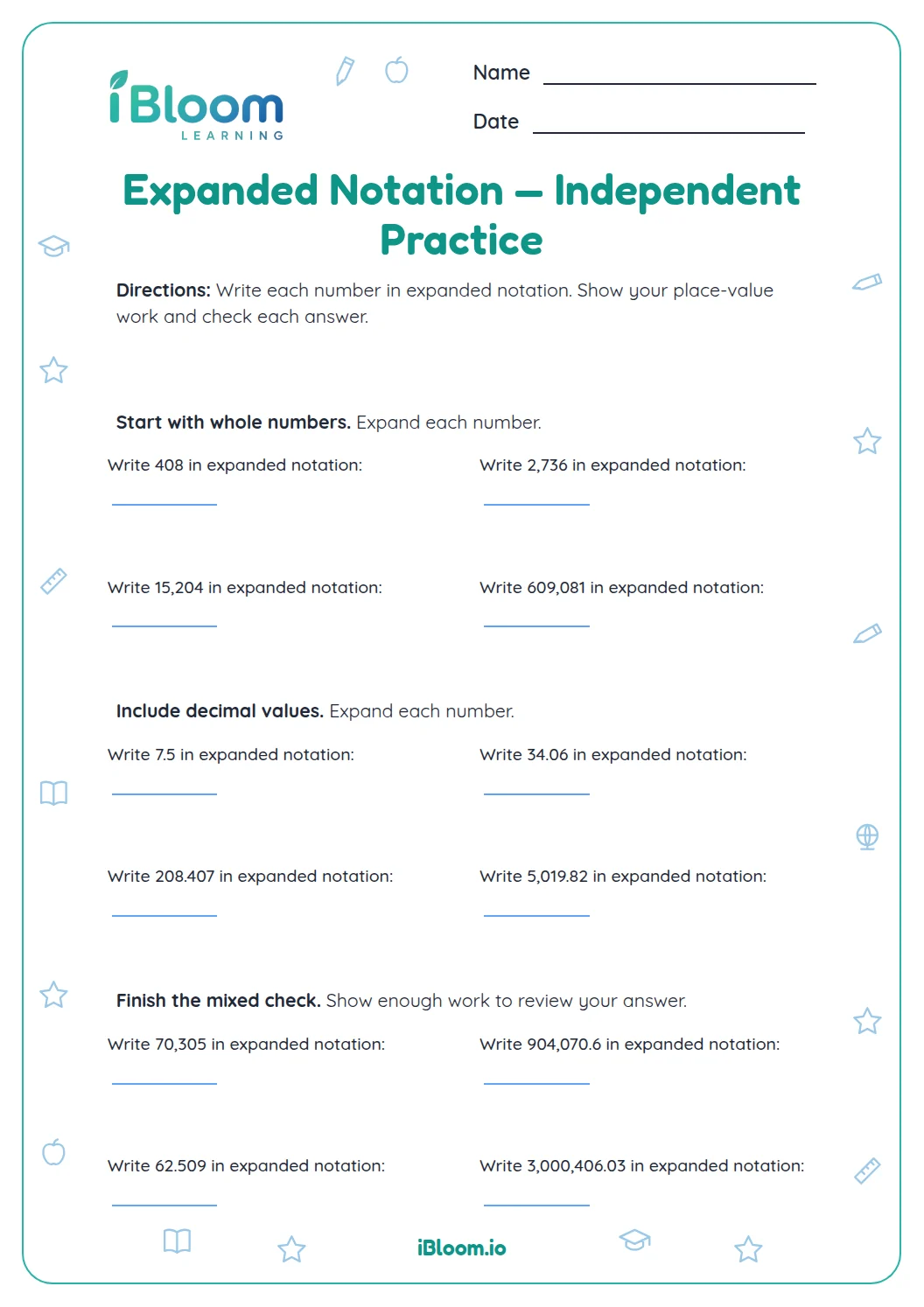
About this worksheet
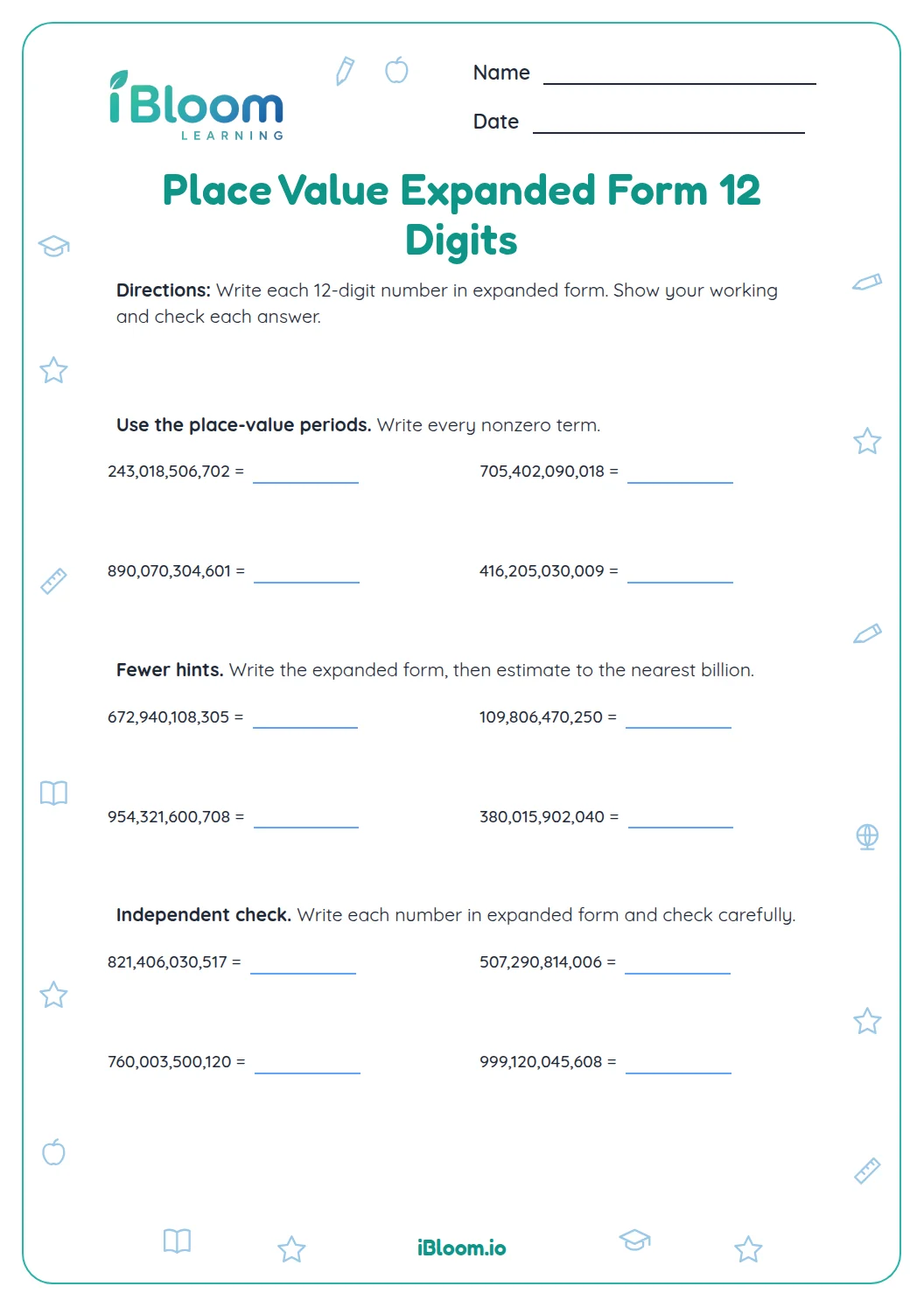
This Grade 6 printable works with 12-digit whole numbers in three forms. Students complete four expanded forms by finding a missing place value term, combine four expanded sums into standard form, and identify the value of a named digit in four more numbers, and compare the value of the same digit in neighboring places twice. A separate answer key includes the expanded sums and correct digit values. The final two questions practice the ten-times relationship in CCSS 5.NBT.A.1. The sequence follows the old sheet’s movement between number forms and place-value recognition.
Aligned to 5.NBT.A.1
How do you find a missing term in expanded form?
Expanded form writes a number as a sum of place values. Find the missing term by comparing the number with the known sum. In 348,205,017,906 = 348,205,017,900 + ___, the missing term is 6.
- 1348,205,017,906 = 348,205,017,900 + ___
- 2Missing term: 6
How do expanded terms return to standard form?
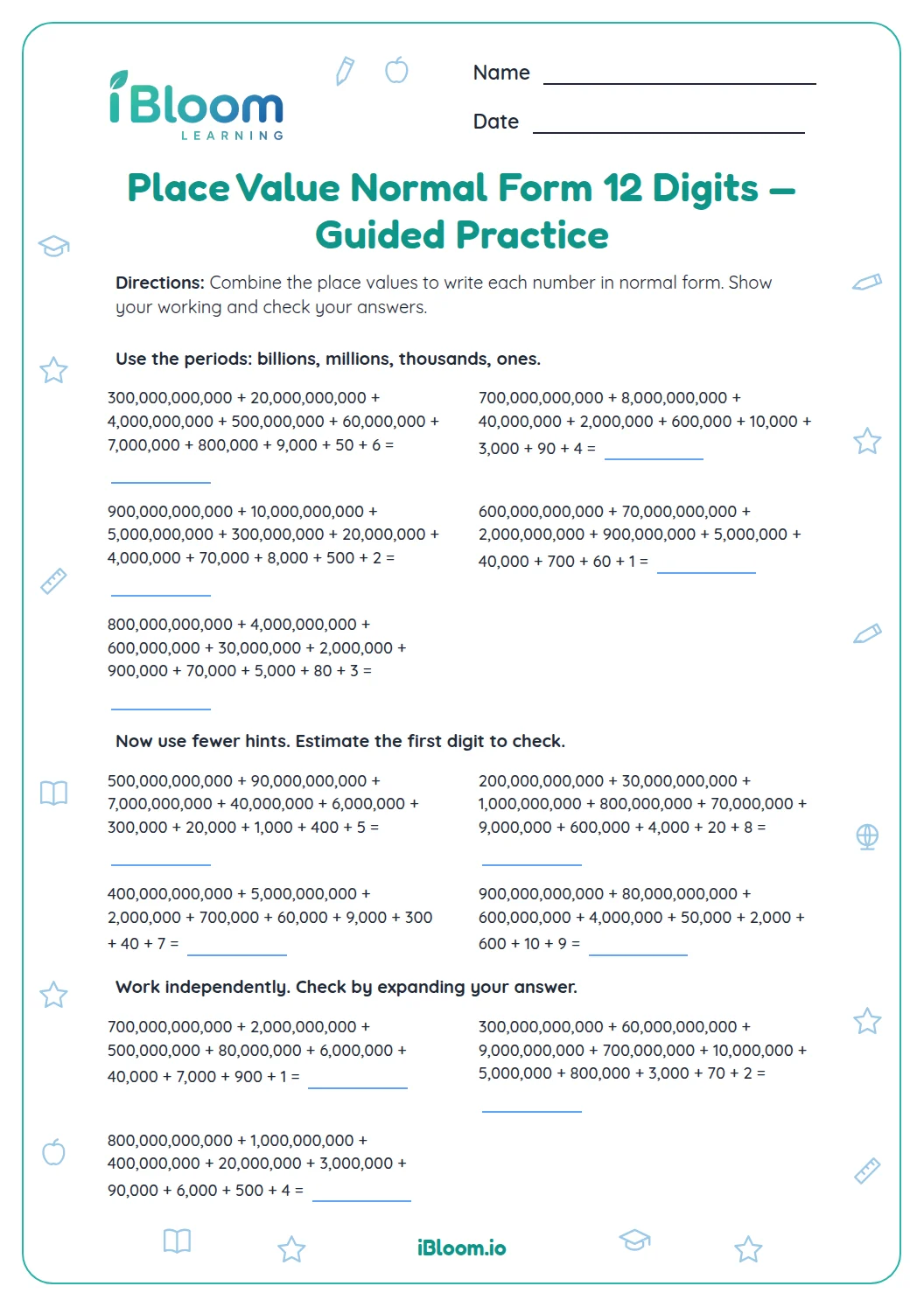
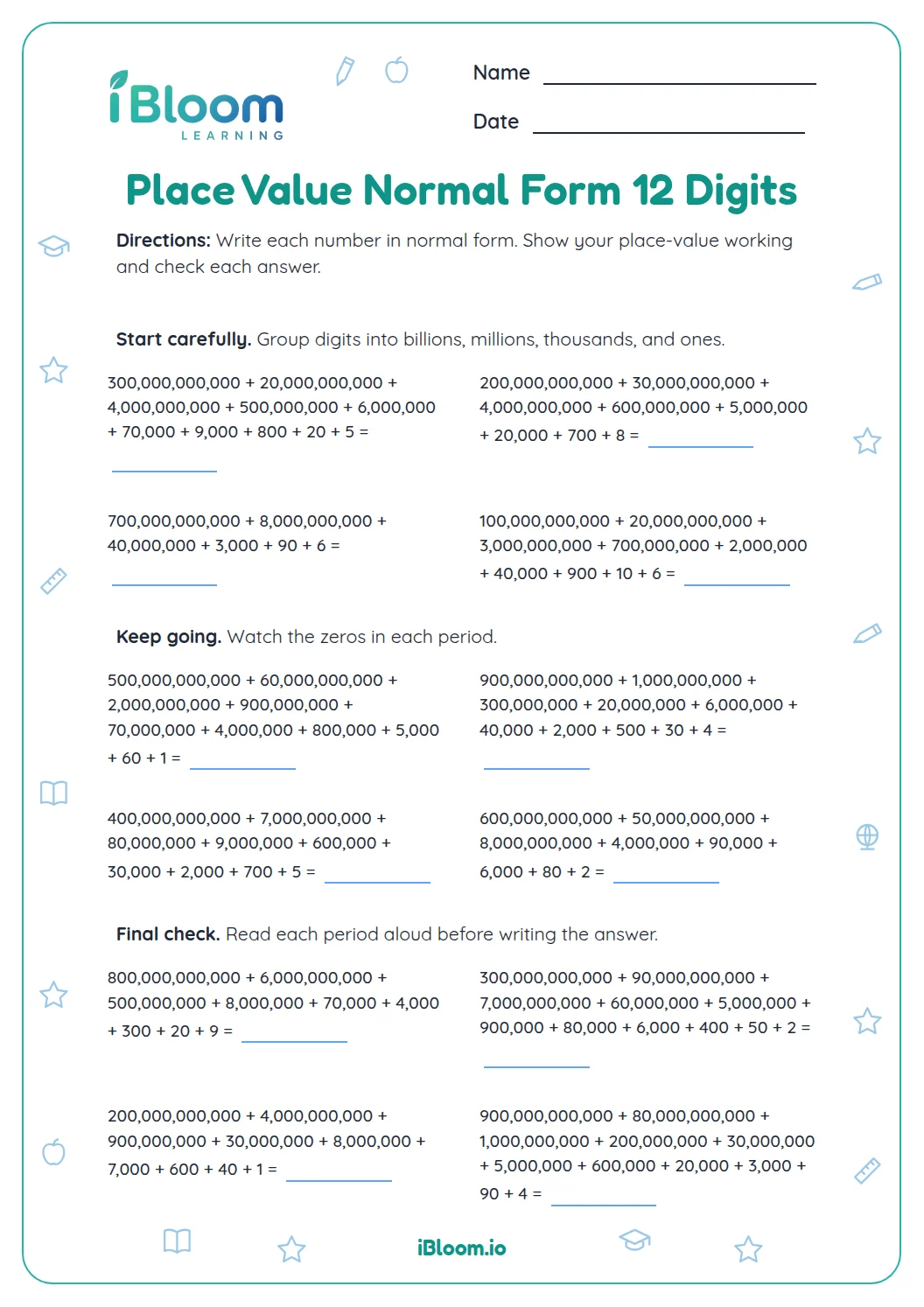
Combine the values by place. Keep the commas in groups of three as you add; a place with no term is still a zero place in the standard-form number. Part B gives four sums to combine.
How can you find a named digit’s value?
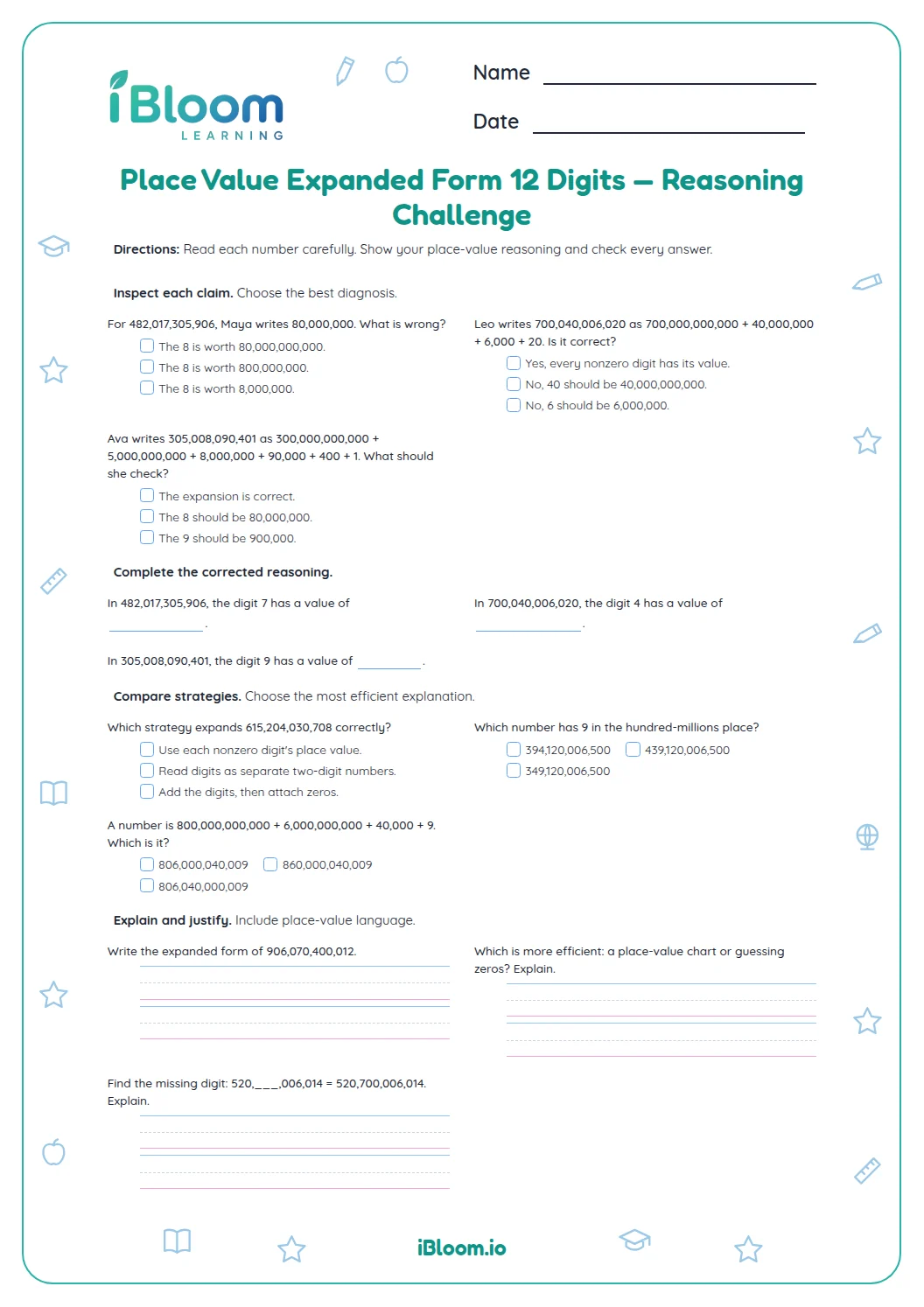
Part A has four missing expanded-form terms, Part B has four sums to combine into standard form, Part C has four named-digit questions, and Part D compares the value of the same digit in adjacent places twice. The answer key includes each result.
How to use this worksheet
- 1Read the 12-digit number carefully, keeping each comma group in place.
- 2For expanded form, write the value of every nonzero digit.
- 3For standard form, add the place-value terms and preserve empty places with zeros.
- 4For a named digit, locate its position before selecting a value.
- 5Use the answer key to compare each term and comma group.
Common mistakes and quick fixes
The mistake
Writing the digit alone instead of its value.
The fix
Name its place first: 6 in the ten-billions place is 60,000,000,000.
The mistake
Dropping an empty place when combining terms.
The fix
Keep the digit positions aligned and use zeros for places without a term.
The mistake
Grouping digits incorrectly around commas.
The fix
Starting from the right, separate the whole number into groups of three digits.
Common Core alignment
Students compare the value of the same digit in neighboring places, alongside expanded-form and digit-value practice.
Compare how a digit’s value changes by a factor of 10 from one place to the next.
On this sheet: The final two items compare the same digit in adjacent places; other items practice expanded form and digit value.
Show the official wordingHide the official wording
Recognize that in a multi-digit number, a digit in one place represents 10 times as much as it represents in the place to its right and 1/10 of what it represents in the place to its left.
What to practice next
Make more practice
Further reading
Questions parents and teachers ask
How many questions are included?
There are 14 questions: four missing terms in expanded-form equations, four equations to combine into standard form, four multiple-choice digit-value questions, and two place-value comparisons. The answer key shows each response across two pages. Each section uses a different form of the same place-value idea.
What does expanded form mean here?
Expanded form writes a number as a sum of place values. The first part shows each 12-digit number as a known large sum plus one missing place-value term, so students find the remaining amount. They can use the same place-value labels that appear in the examples.
Do students need to write zero-value terms?
No. The expanded-form answers list nonzero place values only. In standard form, however, zeros still hold empty places, so students must preserve the digit positions while combining the terms. Write the standard-form number with zeros in places that have no nonzero term; do not omit those place holders.
How do I help with a digit-value question?
Have the student point to the named digit, identify the place from right to left, then write the digit’s value in that place. For example, 6 in the ten-billions place has a value of 60,000,000,000. This place-value check works for each of the four named-digit questions in Part C.
Is an answer key included?
Yes. The key gives the missing expanded-form terms, each combined standard-form number, each named-digit value, and both comparison answers. It spans two answer-key pages and follows the worksheet’s question order. Students can compare the place names as well as the final numeric answers.
What place-value relationship do the final questions practice?
The final two questions compare the value of the same digit in neighboring places. A digit in a place represents ten times as much as it represents one place to its right, as students see when comparing the 5s or 7s in the given numbers.