




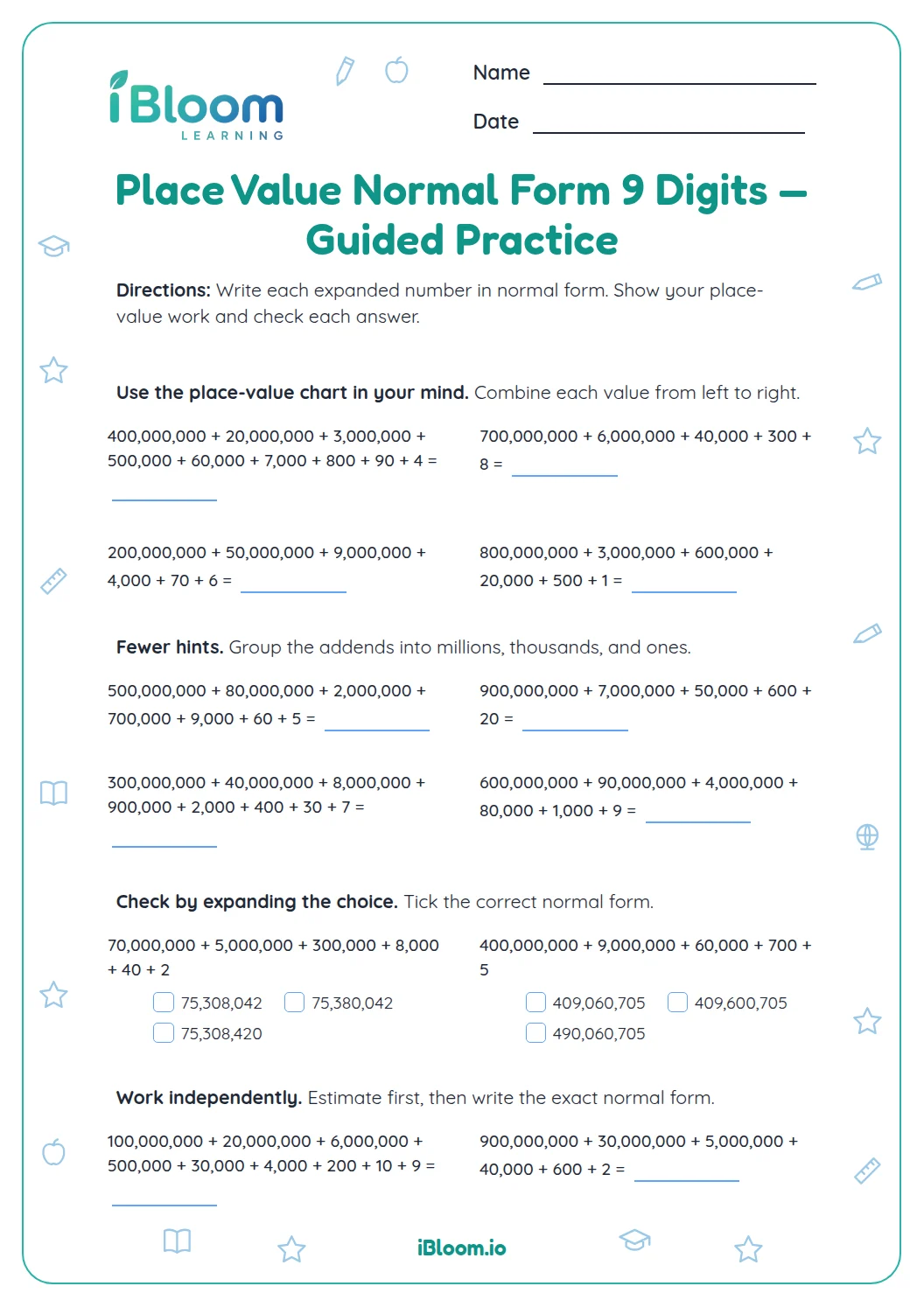
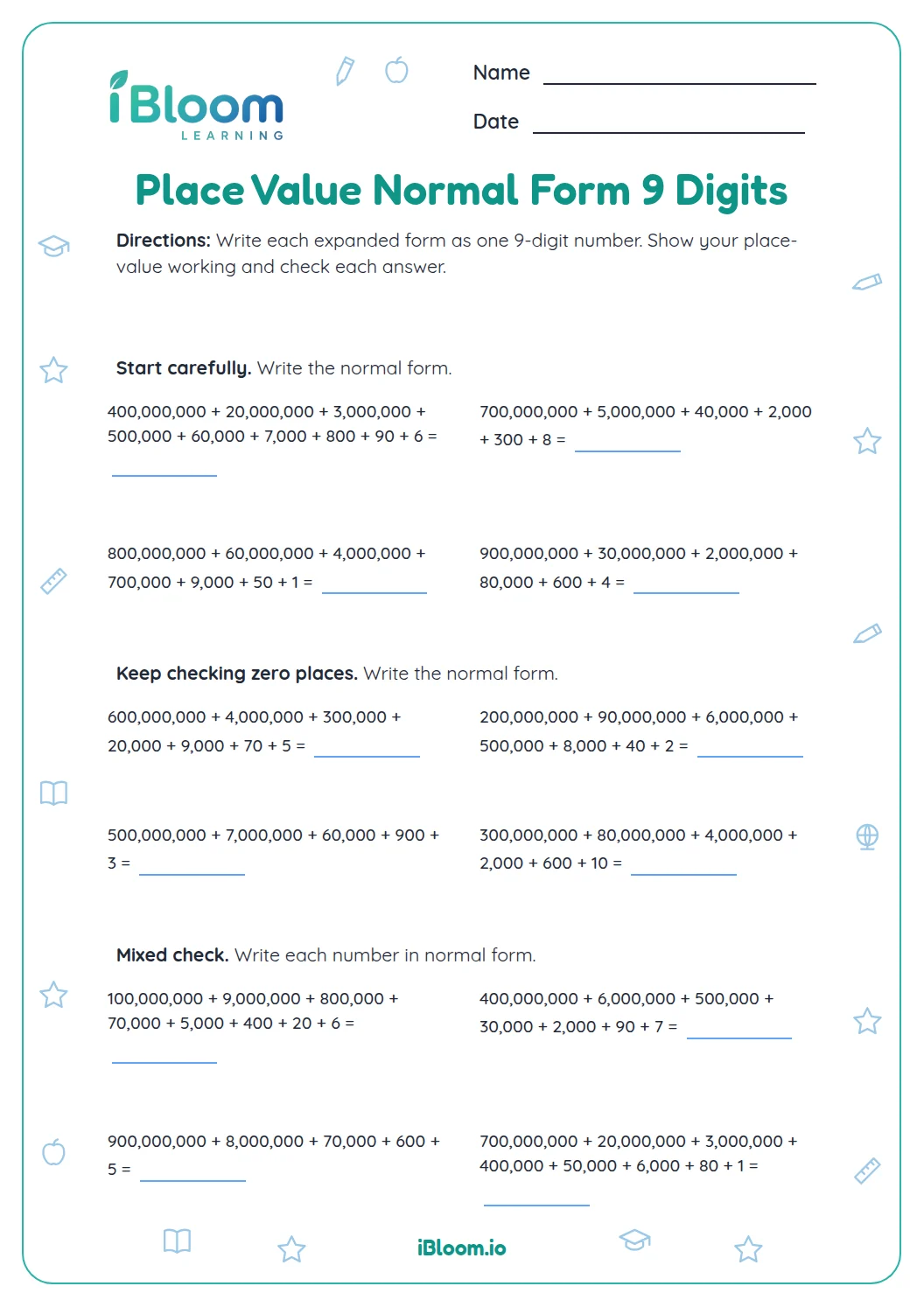

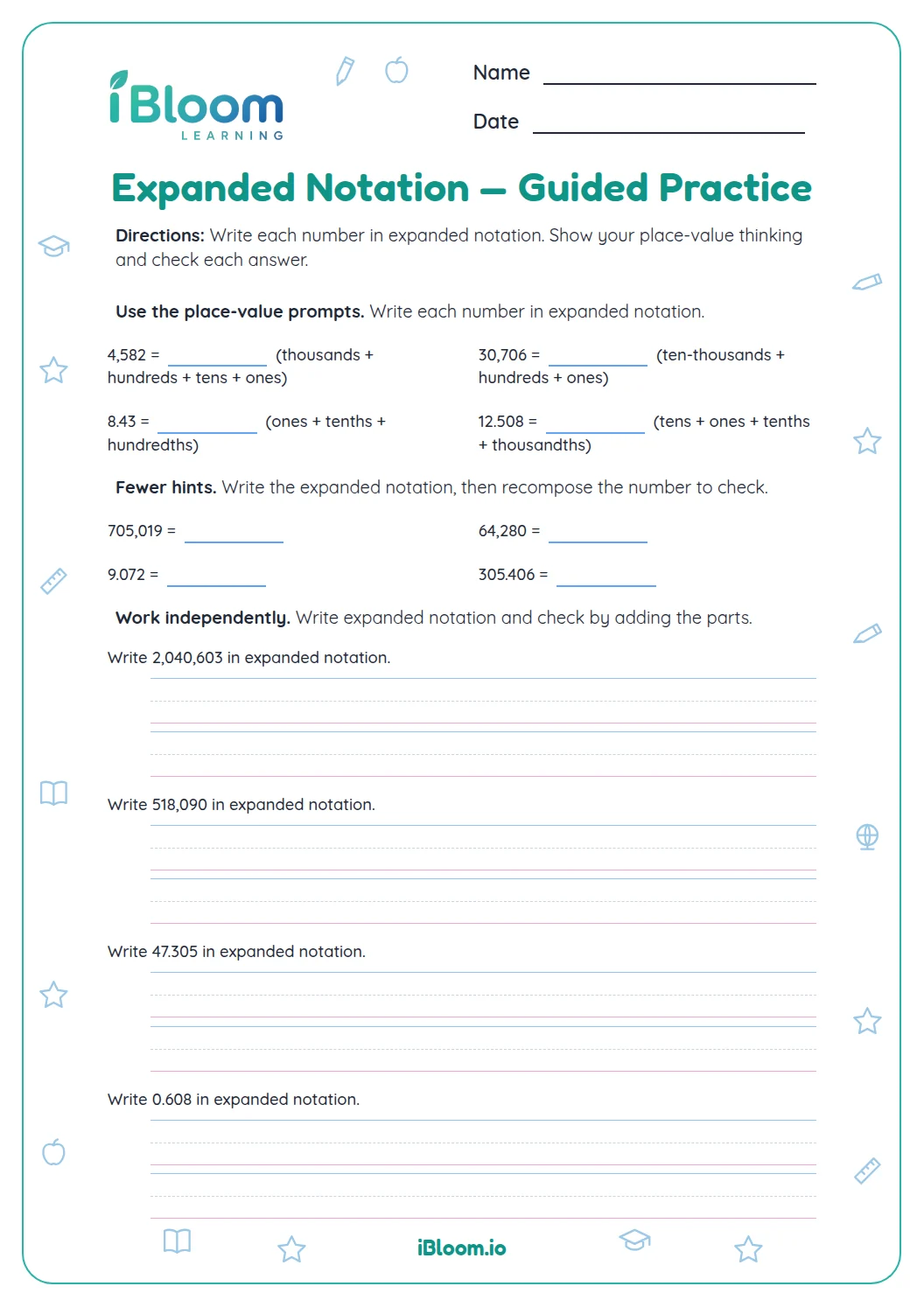
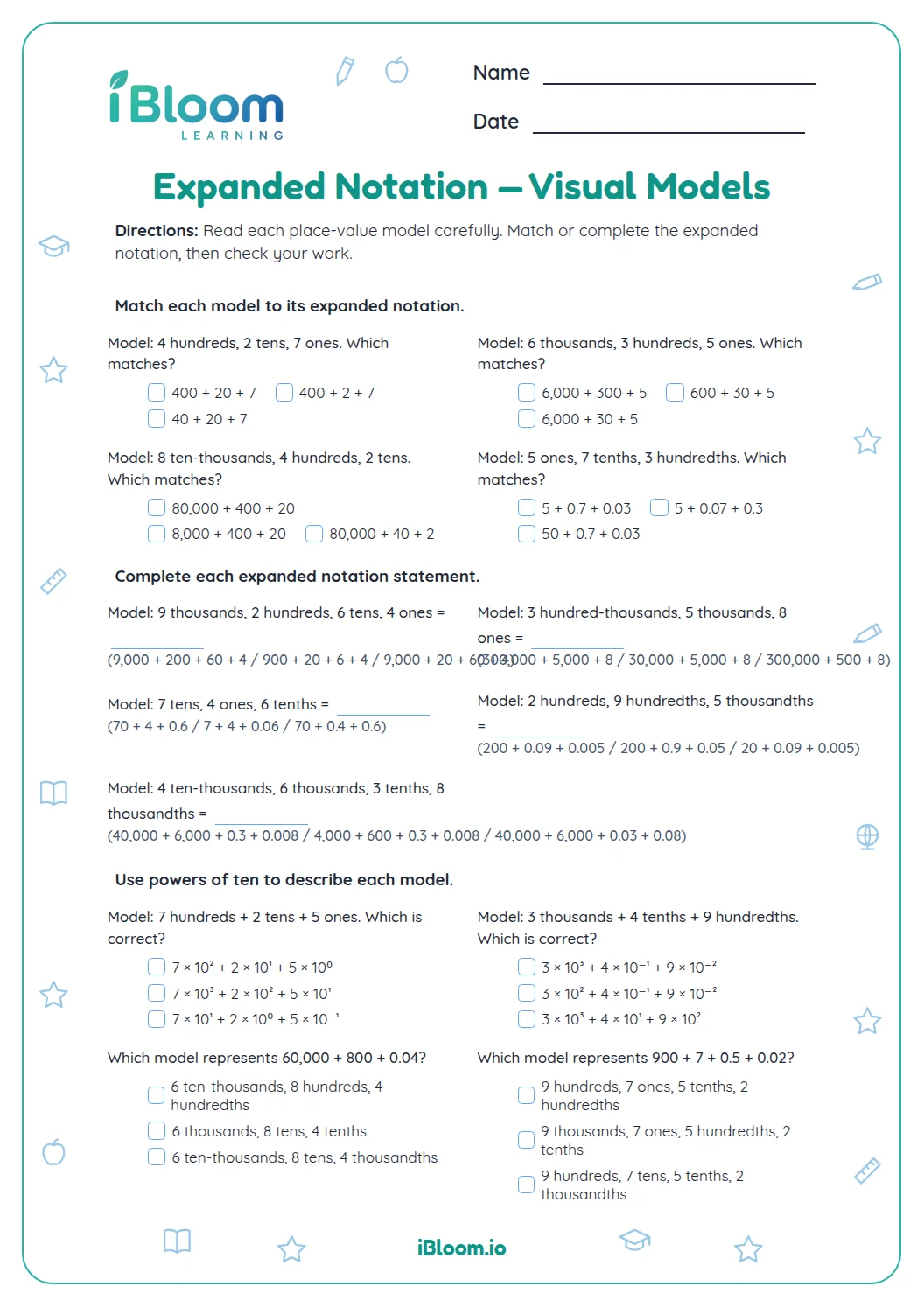

About this worksheet
This Grade 6 printable uses place-value tables to help learners read twelve-digit numbers, locate digits by place, and name digit values. Fourteen questions move from reading and completing table entries to interpreting digit values in whole numbers. The separate answer key makes it easy to review each place and value after practice.
How can a place-value table help read a large number?
A table separates a number into named places. Read across from the largest place to the ones, keeping the commas between groups of three digits. In question 1, the first digit of 482,761,309,584 is in the hundred-billions place.
The same digit has a different value in a different column. A 4 in the hundred-billions place means 400,000,000,000, while a 4 in the thousands place means 4,000.
- 1Number: 482,761,309,584
- 2Read the first place: hundred billions
- 3Digit in that place: 4
- 4Answer: 4
How is a digit different from its value?
A digit is one of the symbols 0 through 9. Its value depends on the place it holds. In question 9, the digit 6 is in the hundred-millions place, so its value is 600,000,000. Moving one place to the right makes a digit worth one tenth as much.
What will children do with the visual models?
The tables group each twelve-digit number by period so learners can identify a digit or complete a missing table entry. The other questions ask children to name a digit’s value.
- Part A reads four digits from completed place tables.
- Part B selects a digit missing from each table.
- Part C names digit values and selects a place-value answer.
- The last part returns to two twelve-digit models.
How to use this worksheet
- 1Read the number’s comma groups from left to right.
- 2Find the named row in the table.
- 3Match the digit in that row to the number.
- 4For value questions, include the place’s zeros.
- 5Check that every digit stayed in its original position.
Common mistakes and quick fixes
The mistake
Giving only the digit when asked for its value.
The fix
Name the place and write the full value, including zeroes.
The mistake
Skipping a zero place and shifting later digits.
The fix
Track each row in order, even when the digit is zero.
The mistake
Confusing the ten-millions and hundred-millions places.
The fix
Read place names one row at a time from right to left.
What to practice next
Make more practice
Further reading
Questions parents and teachers ask
What does a digit’s place tell you?
Its place tells how much the digit is worth in the number. For instance, 6 in the hundred-millions place has a value of 600,000,000. The worksheet tables name each position so children can connect a digit to its place.
How do I read a twelve-digit number?
Group digits in threes from the right, then read the named groups from left to right. Commas mark the groups. The table names each place, helping learners locate the requested digit without losing their position in the number.
What is the difference between a digit and its value?
A digit is a symbol from 0 through 9; its value depends on its place. In 590,263,841,705, the digit 8 is in the hundred-thousands place, so it represents 800,000. Question 12 asks children to make this distinction clearly. Locate the row first, then say the place name before writing the number.
Why are zeroes important in a large number?
A zero holds a place even though it contributes no amount in that position. Without it, the other digits could shift and change the number’s value. Use the table row labels to keep zero places in the correct locations.
What is the normal form of a number?
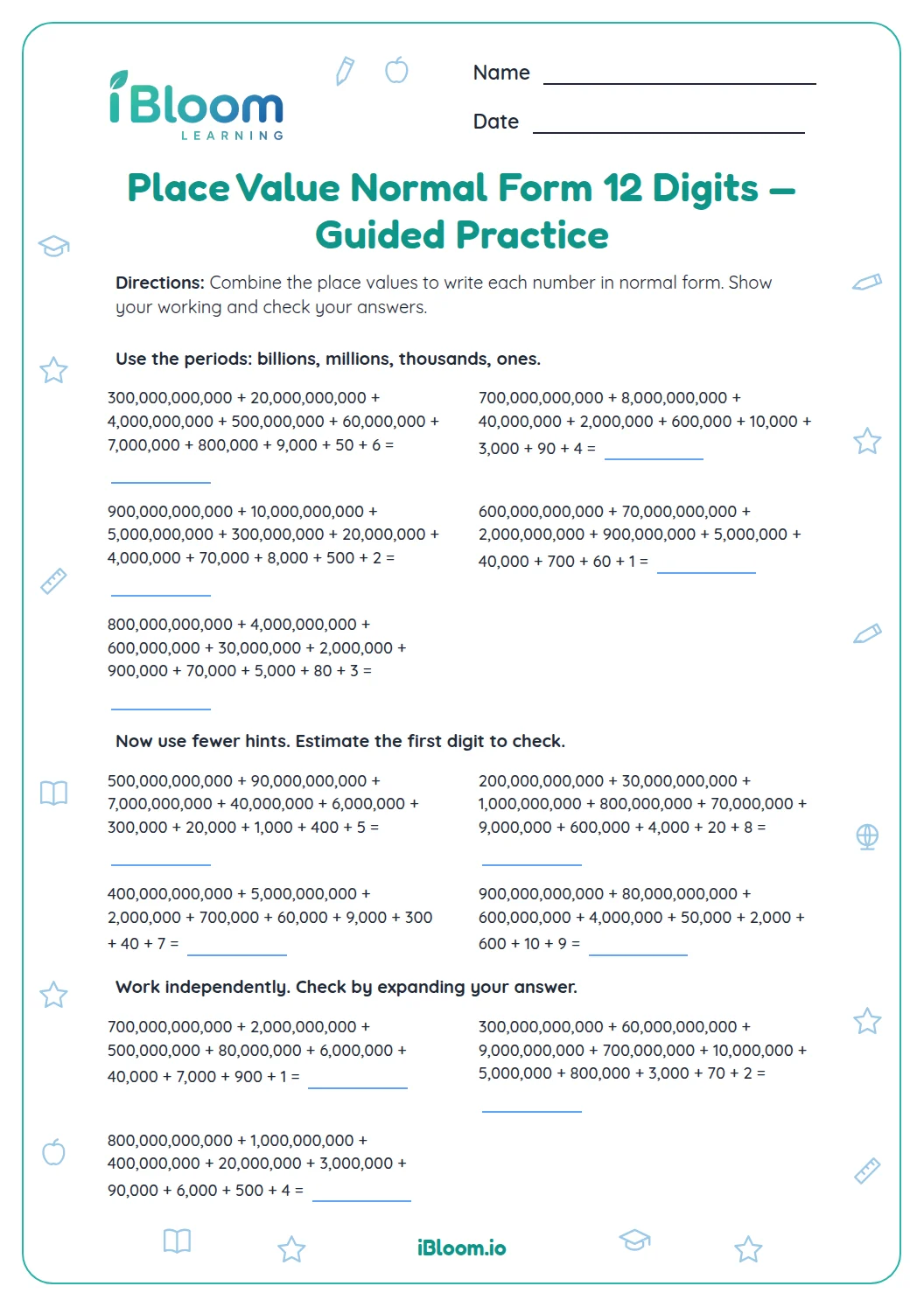
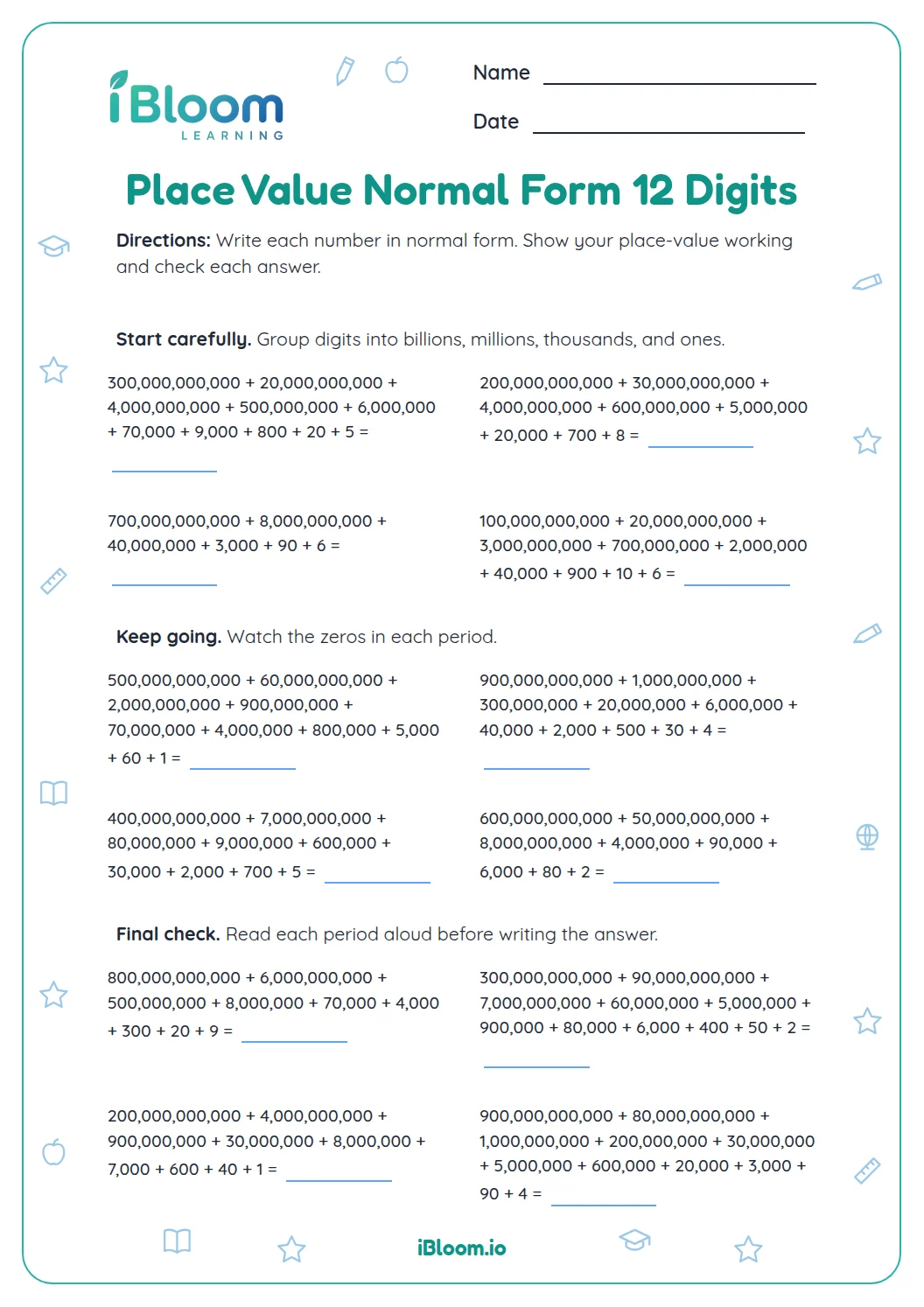
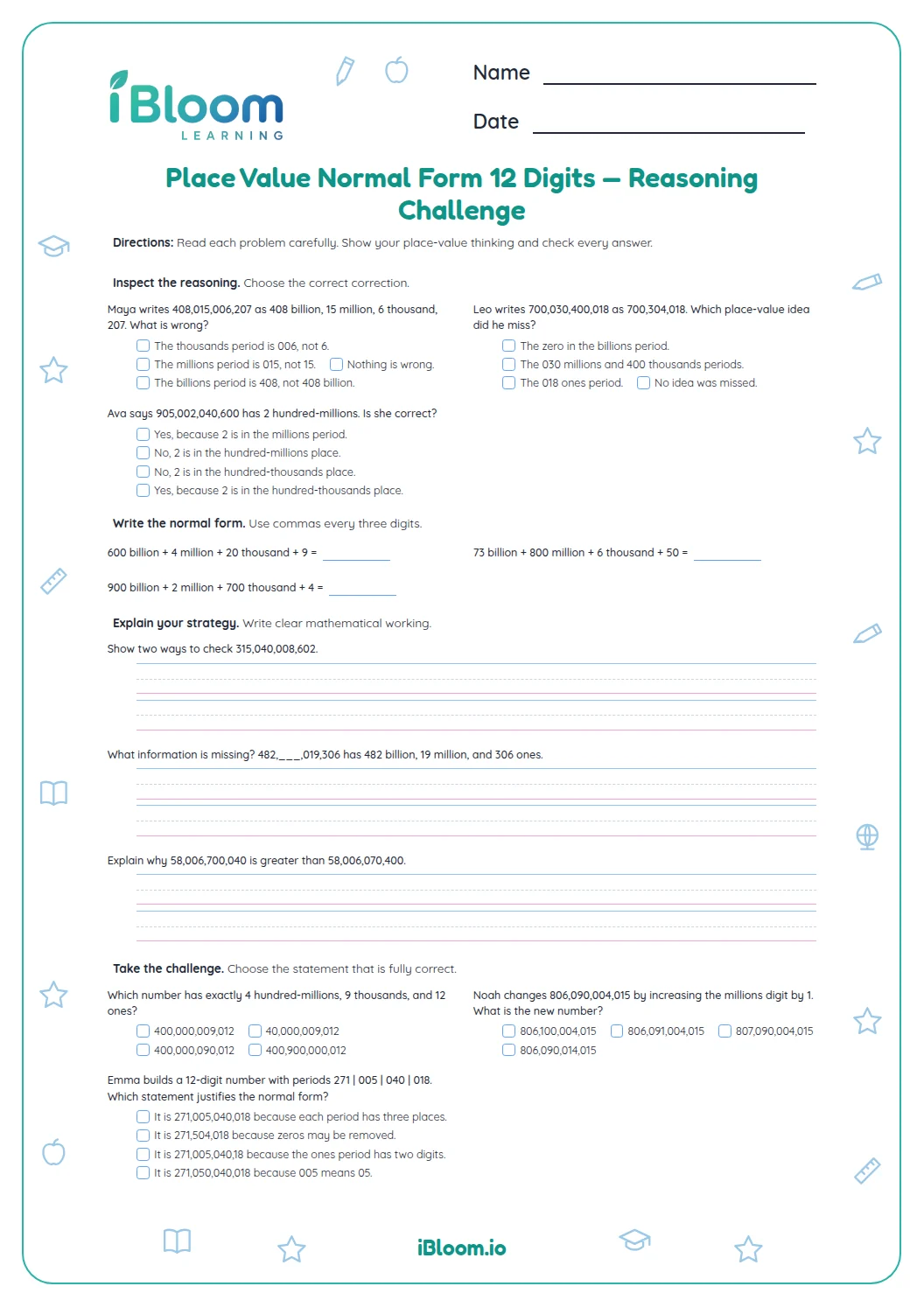
Normal form is the usual way to write a number with its digits grouped by commas, such as 482,761,309,584. This sheet starts with normal-form numbers and uses place-value tables to analyze their digits and values in context. Say the place name aloud and write its full value to avoid confusing it with the digit.
How does place value connect to powers of ten?
Each step to the left is ten times the value of the place on its right. That relationship explains why 6 in the hundred-millions position represents ten times as much as 6 in the ten-millions position. Learners use that structure to interpret the tables.