





About this worksheet
This Grade 6 printable develops place-value fluency with nine-digit whole numbers. Students read place-value charts, name the value of a digit, convert expanded expressions to standard form, and write numbers in expanded form. The practice connects each digit to its place and value, building on Common Core place-value expectations.
Aligned to 5.NBT.A.1 and 4.NBT.A.2
How do place names determine digit value?
In 347,205,816, the 3 is in the hundred-millions place, so its value is 300,000,000. The 4 is in the ten-millions place and has value 40,000,000. Zeros hold places even when a place contributes no value.
- 1347,205,816
- 23 hundred millions, 4 ten millions, 7 millions …
- 3Read the places from left to right to keep the zeros in their positions.
How do standard and expanded forms connect?
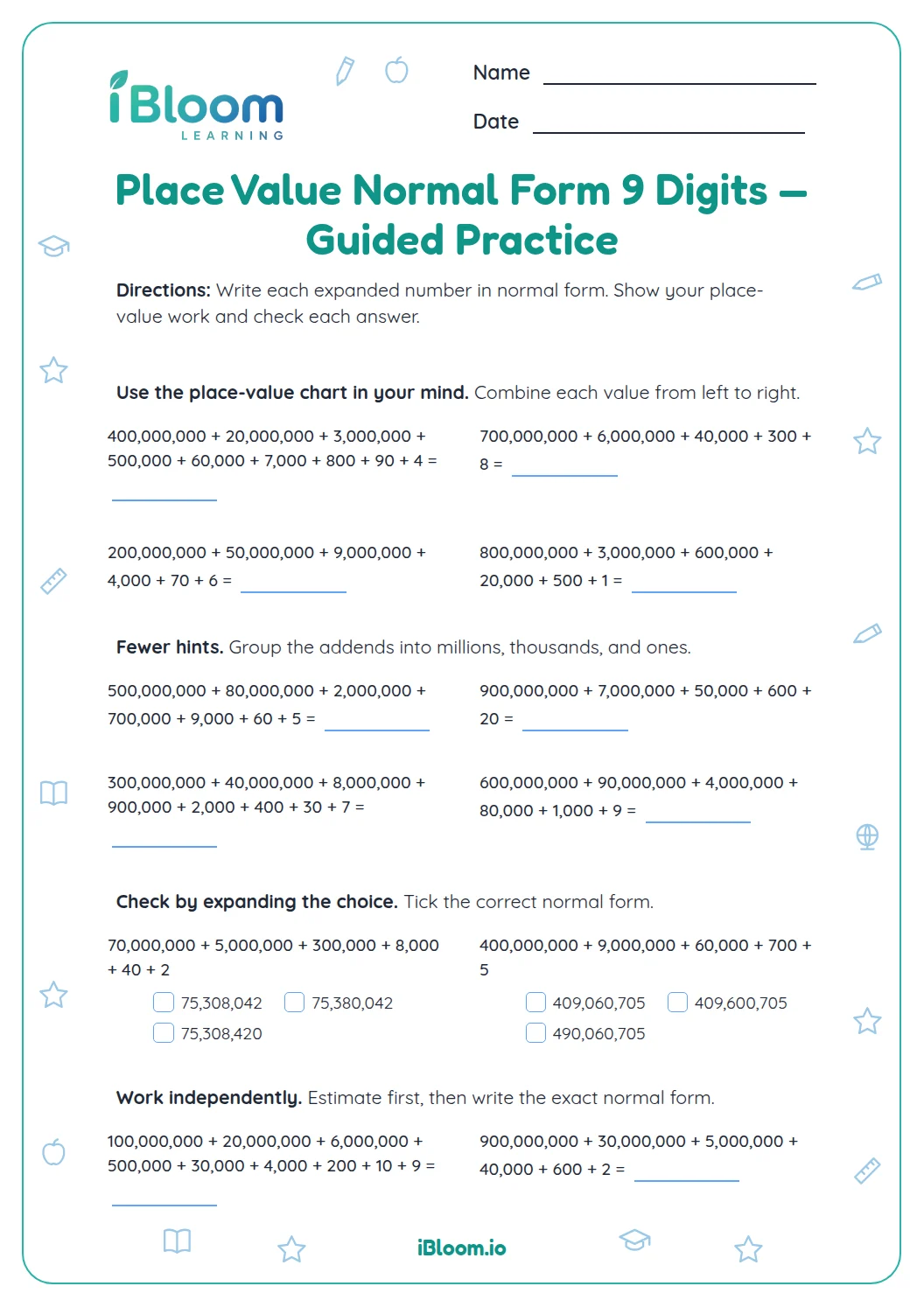
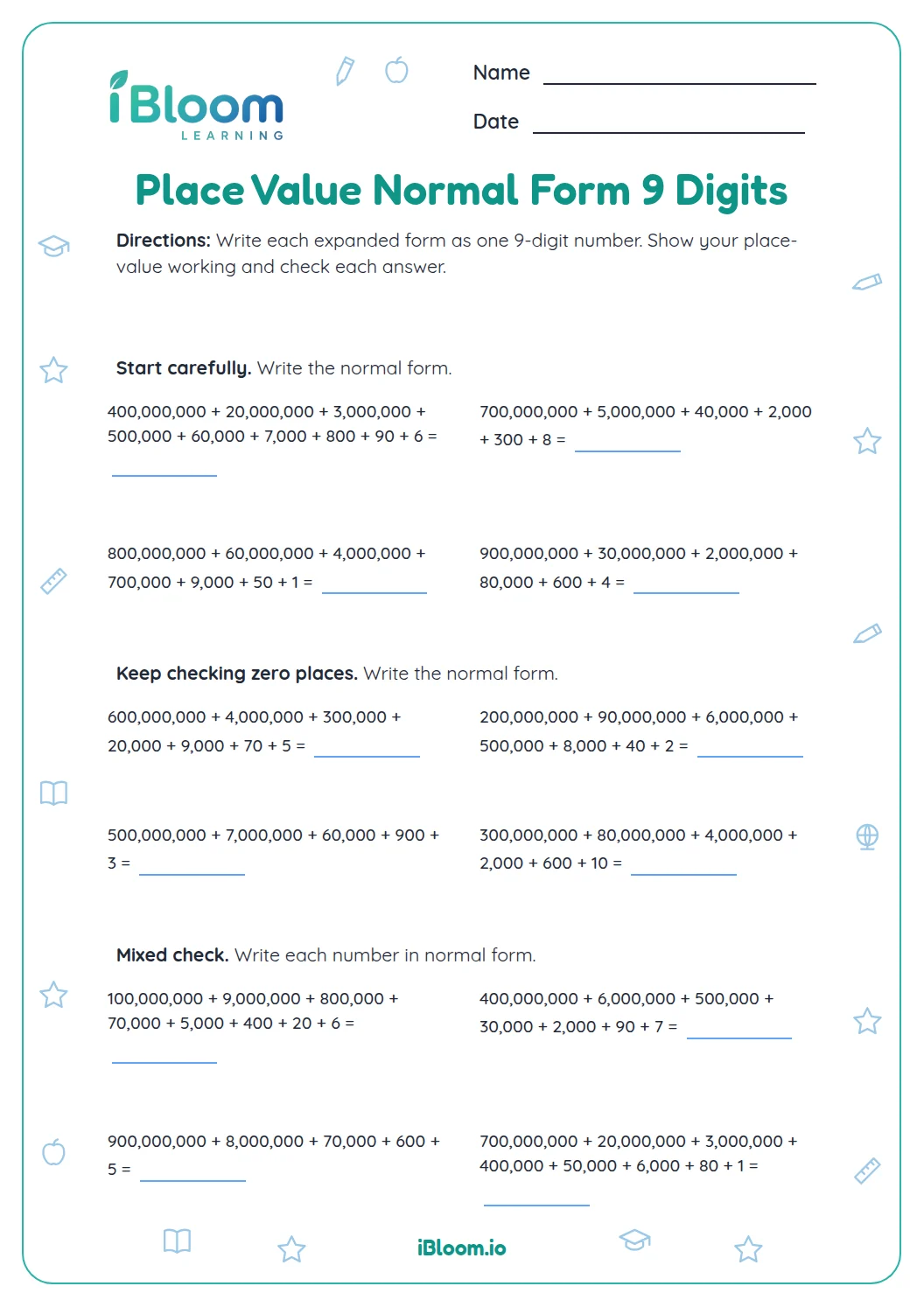
Standard form writes the number with digits and commas. Expanded form adds the value of each nonzero digit. For example, 74,302,056 is 70,000,000 + 4,000,000 + 300,000 + 2,000 + 50 + 6.
Question 9 reverses that process by combining place values into one standard-form number.
What do the visual models ask students to notice?
The chart-reading questions spell out each digit’s place so students can focus on the relationship between a position and a value. The remaining questions apply that understanding to value, standard form, and expanded form.
How can you use this worksheet?
- 1Read the number from its greatest place to its ones place.
- 2Keep zero digits in their positions when writing standard form.
- 3For a digit value, name the place and multiply the digit by that place unit.
- 4To expand a number, write each nonzero digit’s value as a sum.
- 5To return to standard form, combine the values and group digits in threes.
What mistakes should learners watch for?
The mistake
Dropping a zero and shifting later digits.
The fix
Mark commas in groups of three and preserve every placeholder zero.
The mistake
Giving the digit instead of its value.
The fix
Name the place first, then state the digit multiplied by that place unit.
The mistake
Listing digits rather than place values in expanded form.
The fix
Write each nonzero digit with its full value before adding.
Common Core alignment
This worksheet gives focused practice with the named skill.
Use place-value relationships to compare the values of digits.
On this sheet: Students identify place values and compare values based on digit positions.
Show the official wordingHide the official wording
Recognize that in a multi-digit number, a digit in one place represents 10 times as much as it represents in the place to its right and 1/10 of what it represents in the place to its left.
Read and write multi-digit whole numbers in standard and expanded form.
On this sheet: Students write standard and expanded forms of large whole numbers and name digit values.
Show the official wordingHide the official wording
Read and write multi-digit whole numbers using base-ten numerals, number names, and expanded form. Compare two multi-digit numbers based on meanings of the digits in each place, using >, =, and < symbols to record the results of comparisons.
What to practice next
Make more practice
Further reading
Questions parents and teachers ask
What does normal form mean here?
Normal form means writing a number with digits, such as 347,205,816. The worksheet also asks students to move between that form and expanded form, which lists each nonzero place value as a sum. The place-value charts make digit positions visible.
How many digits do the numbers have?
The first six items use nine-digit charts from the hundred-millions place through the ones place. Other questions also use nine-digit whole numbers when asking students to identify digit values or write standard and expanded forms. Each chart preserves zero placeholders.
Why do some numbers include zeros?
Zeros hold places so that other digits stay in the correct positions. In 802,041,609, zeros mark places with no tens of millions, hundred thousands, or tens. Keeping each zero in place preserves the values of the digits around it.
What is expanded form?
Expanded form writes a number as the sum of its nonzero place values. For 74,302,056, that is 70,000,000 + 4,000,000 + 300,000 + 2,000 + 50 + 6. The worksheet asks students to read charts and move between these two forms.
How should students solve a digit-value question?
First locate the digit’s place, then state the amount it represents. In 682,405,731, the 8 is in the ten-millions place, so its value is 80,000,000. Naming the position helps distinguish the digit itself from the amount it represents.