



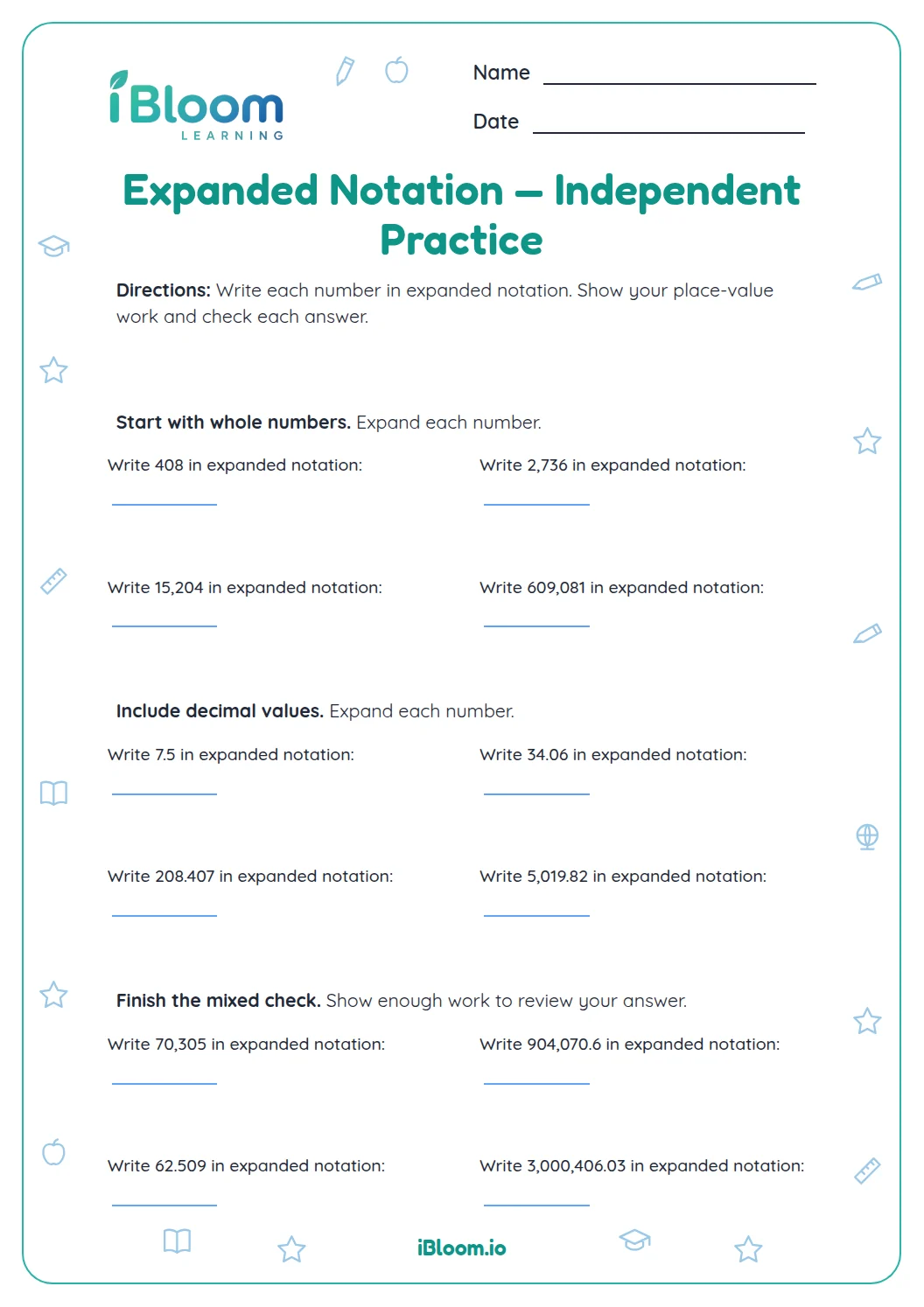


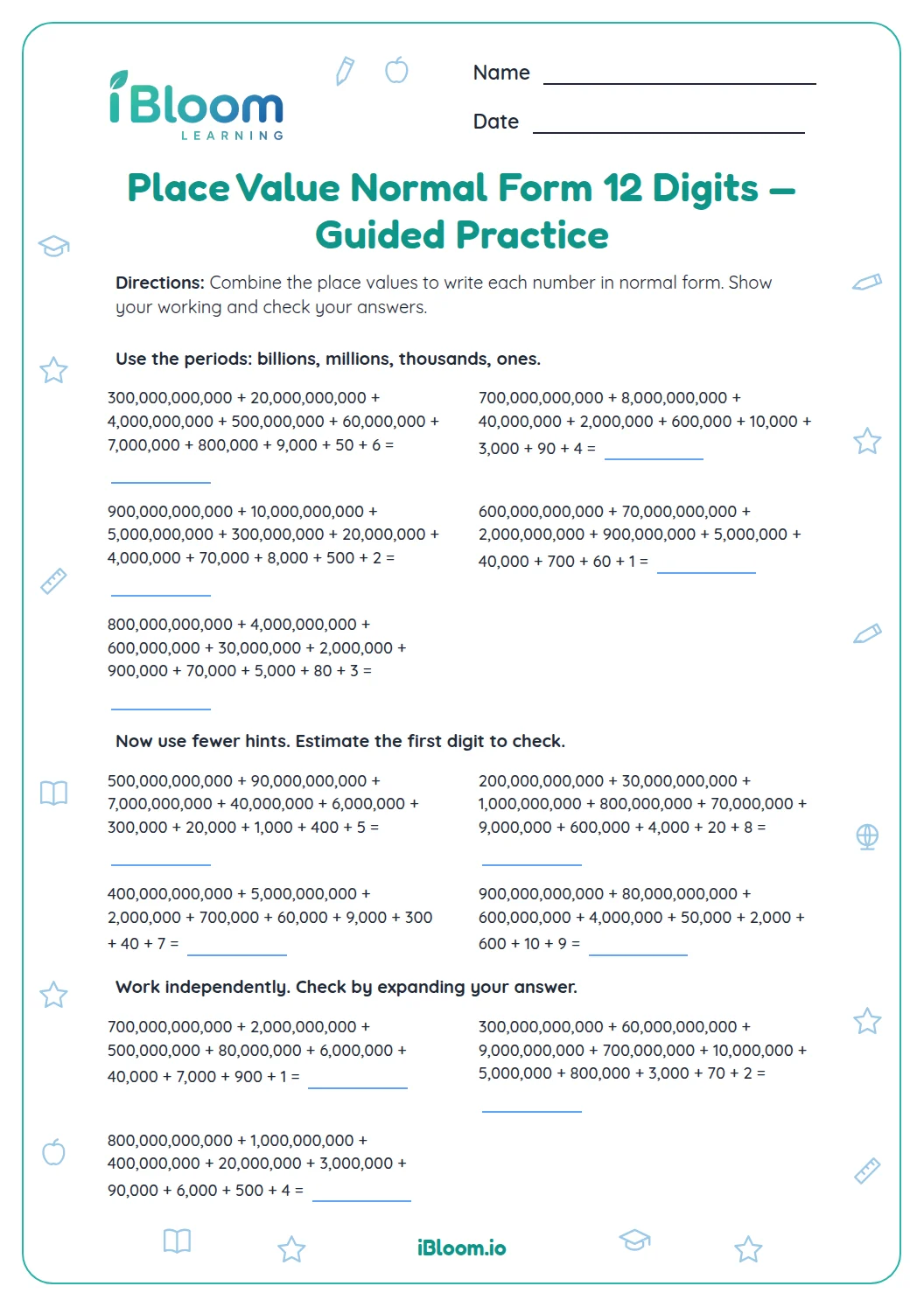
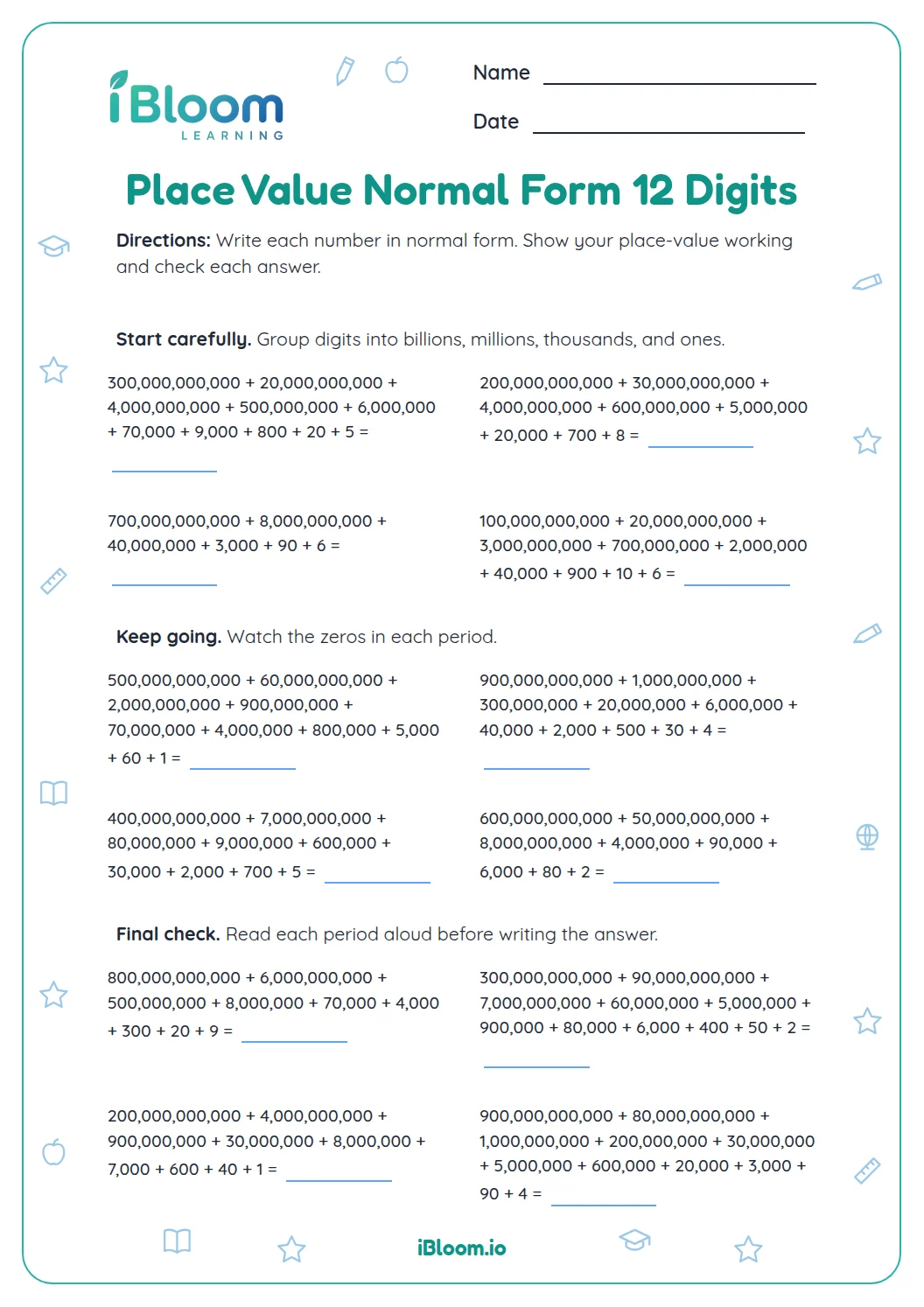
About this worksheet
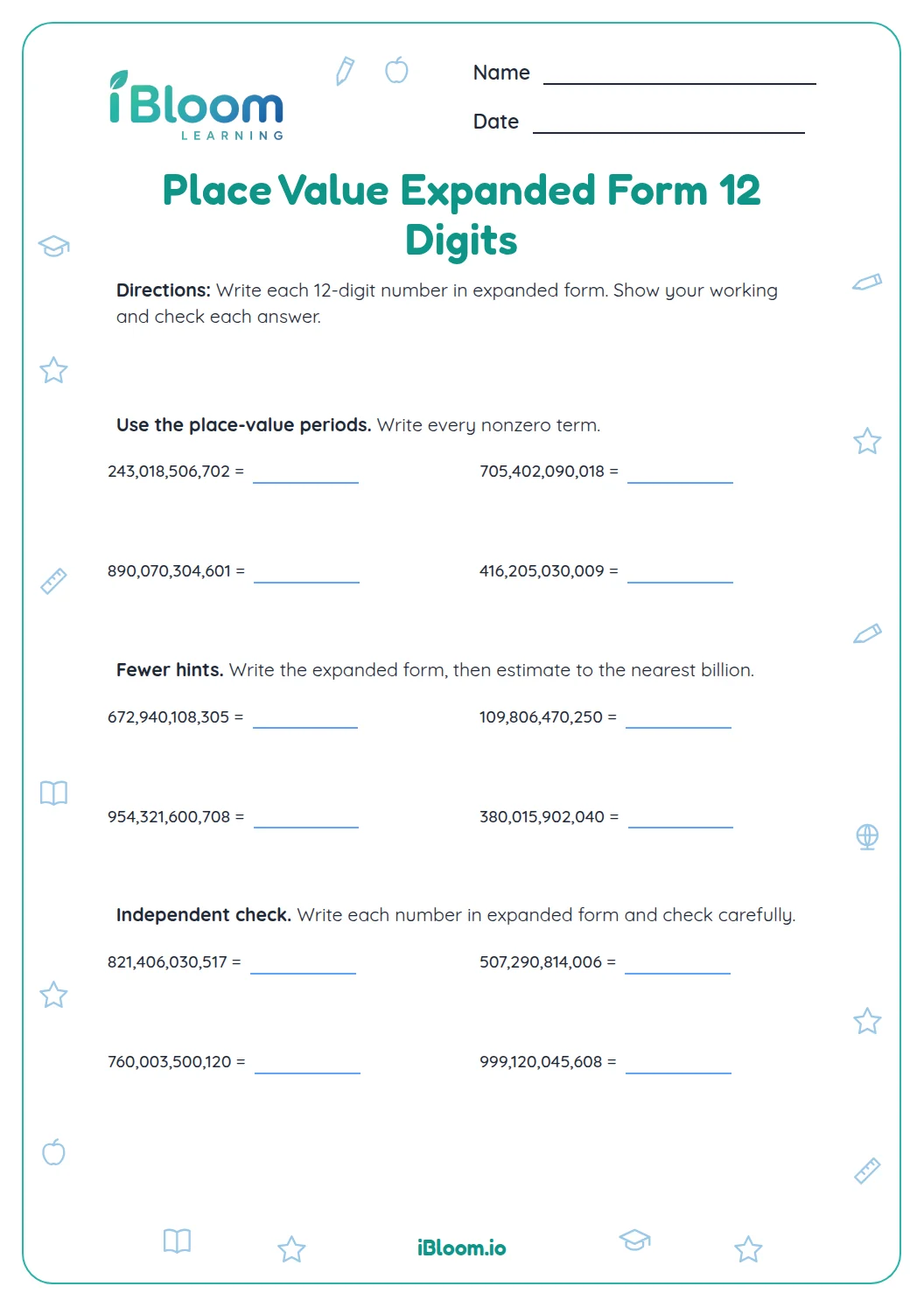
This Grade 6 printable builds place-value reasoning with 14 real-world data situations. Each gives a 12-digit whole number and asks children to complete its expanded form by supplying the coefficients for its nonzero place values. The examples reach from the hundred-billions place through ones, and include internal zeroes. A separate key lists the expanded terms. The work aligns with CCSS 5.NBT.A.3.a, which includes writing numbers in expanded form.
Aligned to 5.NBT.A.3.a
How do you write a large number in expanded form?
Read each digit by its place, then add the nonzero place values. A 3 in the hundred-billions place contributes 300,000,000,000; a 4 in the billions place contributes 4,000,000,000.
Question 1 gives 380,000,000,000. Its expanded form is 3 × 10^11 + 8 × 10^10.
- 1380,000,000,000
- 23 × 10^11 + 8 × 10^10
What do you do with zero digits?
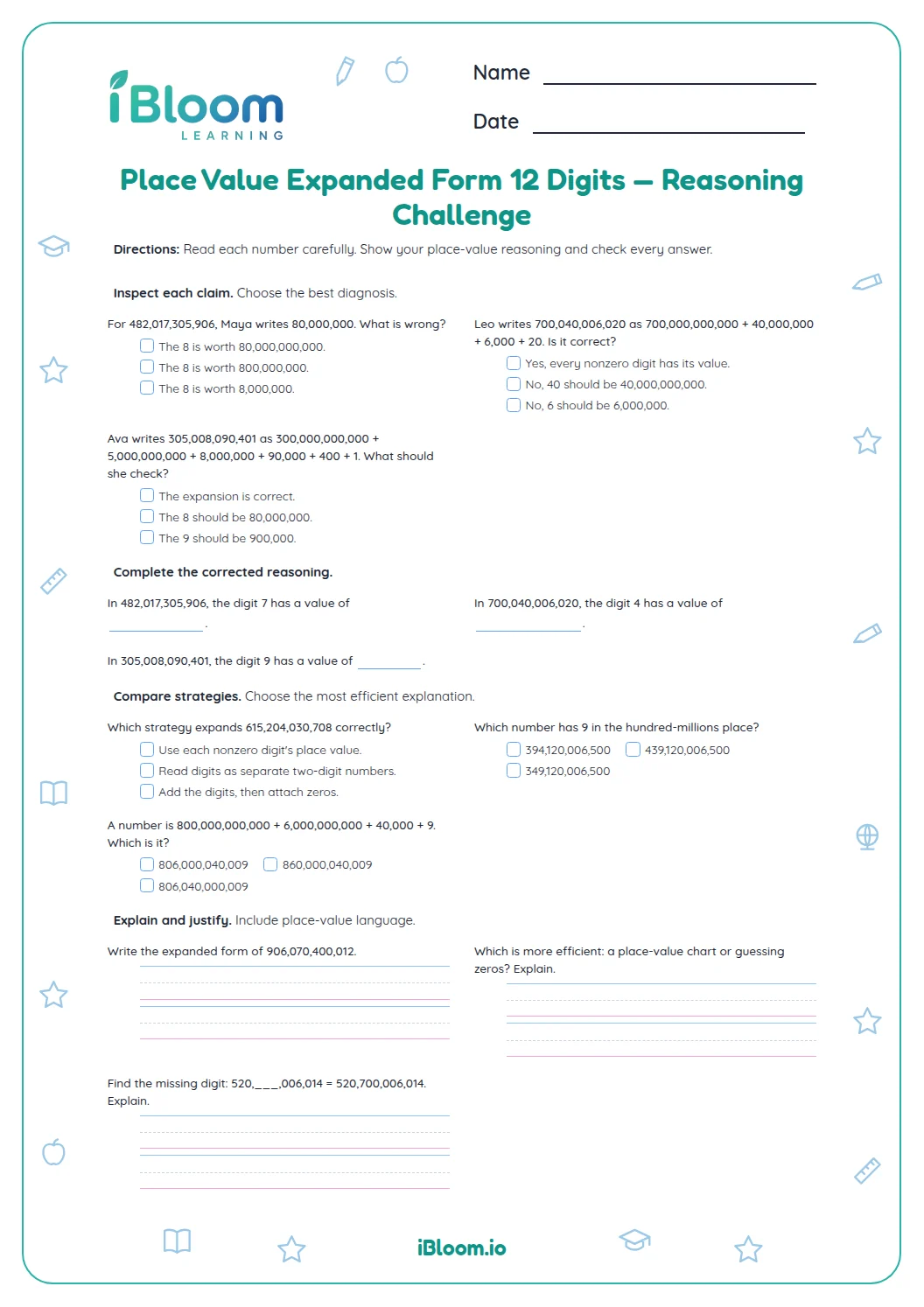
A zero marks a place but contributes no value to the sum, so leave that term out. Keep the places on either side in the correct positions. For example, 706,041,285,619 has no ten-billions or ten-millions term, but both zeroes still help locate the other digits.
Where do the numbers come from?
Each of the 14 data contexts gives a 12-digit number and a matching sum with coefficient blanks. Children use the powers of ten to identify the missing digits.
- Part A: complete five expanded-form equations
- Part B: complete five more equations
- Part C: complete four final equations
How to use this worksheet
- 1Read the full number and group digits into periods.
- 2Name the place of each digit from left to right.
- 3Match each power of ten to its digit place.
- 4Enter the digit in the matching coefficient blank.
- 5Leave out zero-value terms while preserving the other place values.
- 6Check each term against the answer key.
Common mistakes and quick fixes
The mistake
Reading a digit without its place.
The fix
Say the place name aloud before writing its value.
The mistake
Writing a zero term or skipping a place shift.
The fix
Omit zero terms and use commas to verify each value.
The mistake
Reordering the digits when forming the sum.
The fix
Keep the expanded terms in the same left-to-right order as the original number.
Common Core alignment
The task practices writing numbers in expanded form using place-value values.
Write each large whole number as a sum of its nonzero place values.
On this sheet: Write each large whole number as a sum of its nonzero place values.
Show the official wordingHide the official wording
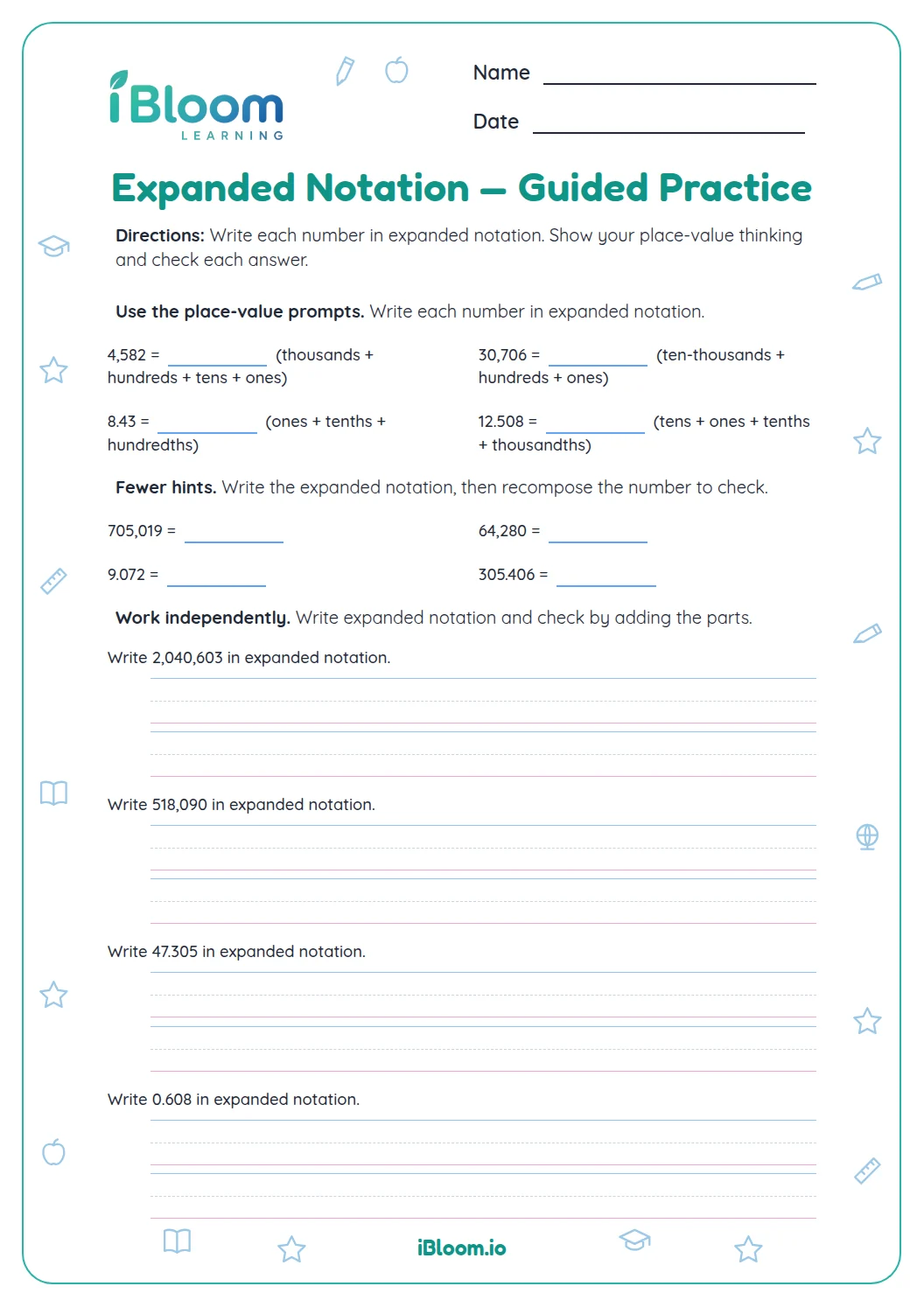
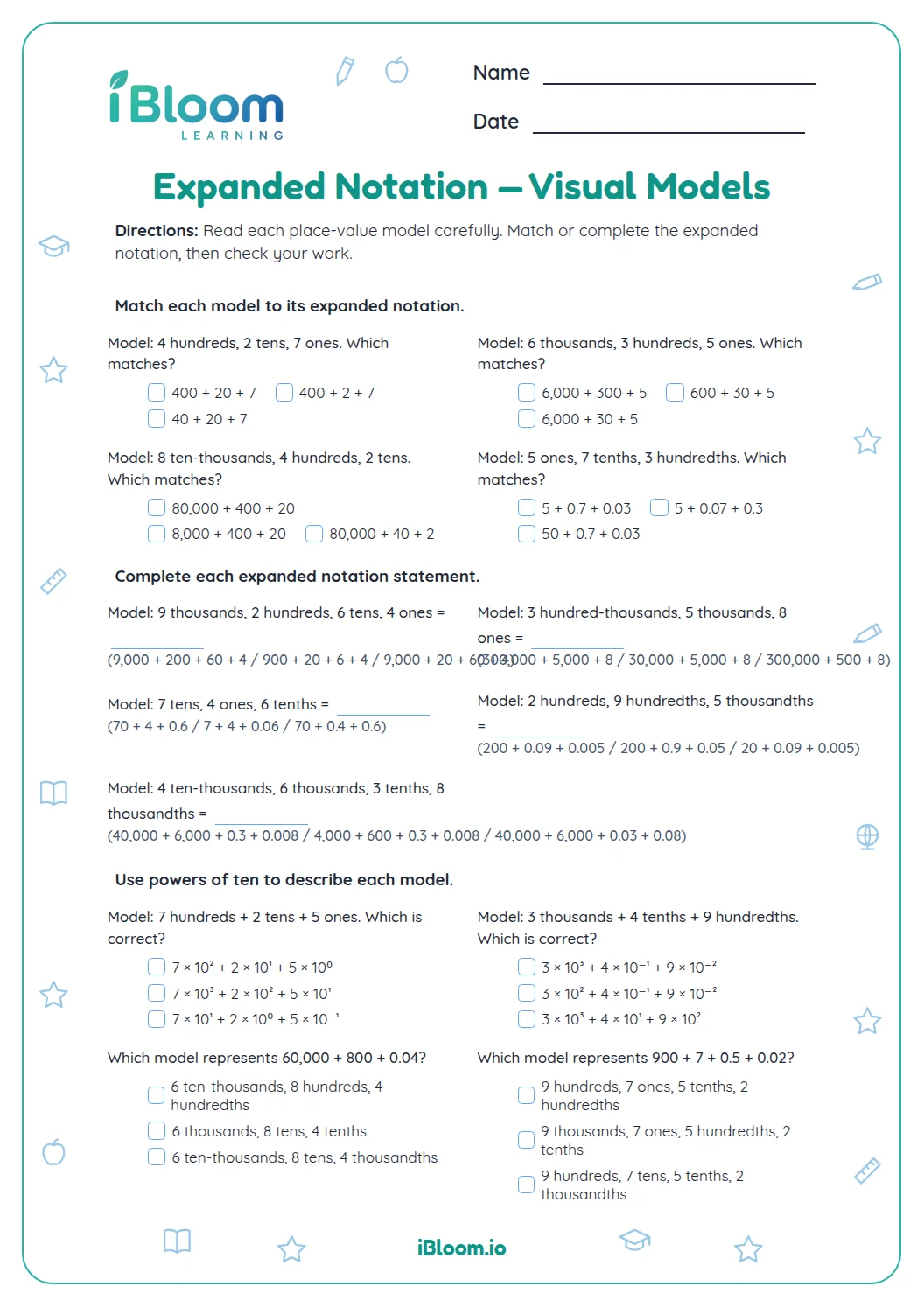
Read and write decimals to thousandths using base-ten numerals, number names, and expanded form, e.g., 347.392 = 3 × 100 + 4 × 10 + 7 × 1 + 3 × (1/10) + 9 × (1/100) + 2 × (1/1000).
What to practice next
Make more practice
Further reading
Questions parents and teachers ask
What does expanded form show?
Expanded form shows the value contributed by each digit. For example, 384,205,716,932 begins 300,000,000,000 + 80,000,000,000 + 4,000,000,000. The remaining nonzero digits are written the same way and added. The separate answer key gives a clear way to check the result after the child has finished.
Should zero places appear as terms?
No. A zero contributes zero, so it does not need a term in the sum. It still holds its place in the original number, which helps you identify the correct value of digits to its left and right. The separate answer key gives a clear way to check the result after the child has finished.
How many digits are in each number?
Each question gives a 12-digit whole number, with values from the hundreds of billions through ones places. Children practice expanded form by naming the value of each nonzero digit and adding the terms. The separate answer key gives a clear way to check the result after the child has finished.
Why are the numbers in real-world settings?
The brief situations give a reason to read large data totals, such as a library record or a science count. The contexts are just settings for the numbers; the math task in every question is to write expanded form. The separate answer key gives a clear way to check the result after the child has finished.
How should commas be used?
Commas group digits into periods of three places so the number is easier to read. When writing each expanded term, keep the commas in the place-value number, such as 80,000,000,000 for 8 ten-billions. The separate answer key gives a clear way to check the result after the child has finished.
Is there an answer key?
Yes. A separate key gives the expanded sum for each of the 16 numbers. It omits zero-value terms and keeps the nonzero place values in descending order, making it straightforward to compare each response. The separate answer key gives a clear way to check the result after the child has finished.