




About this worksheet
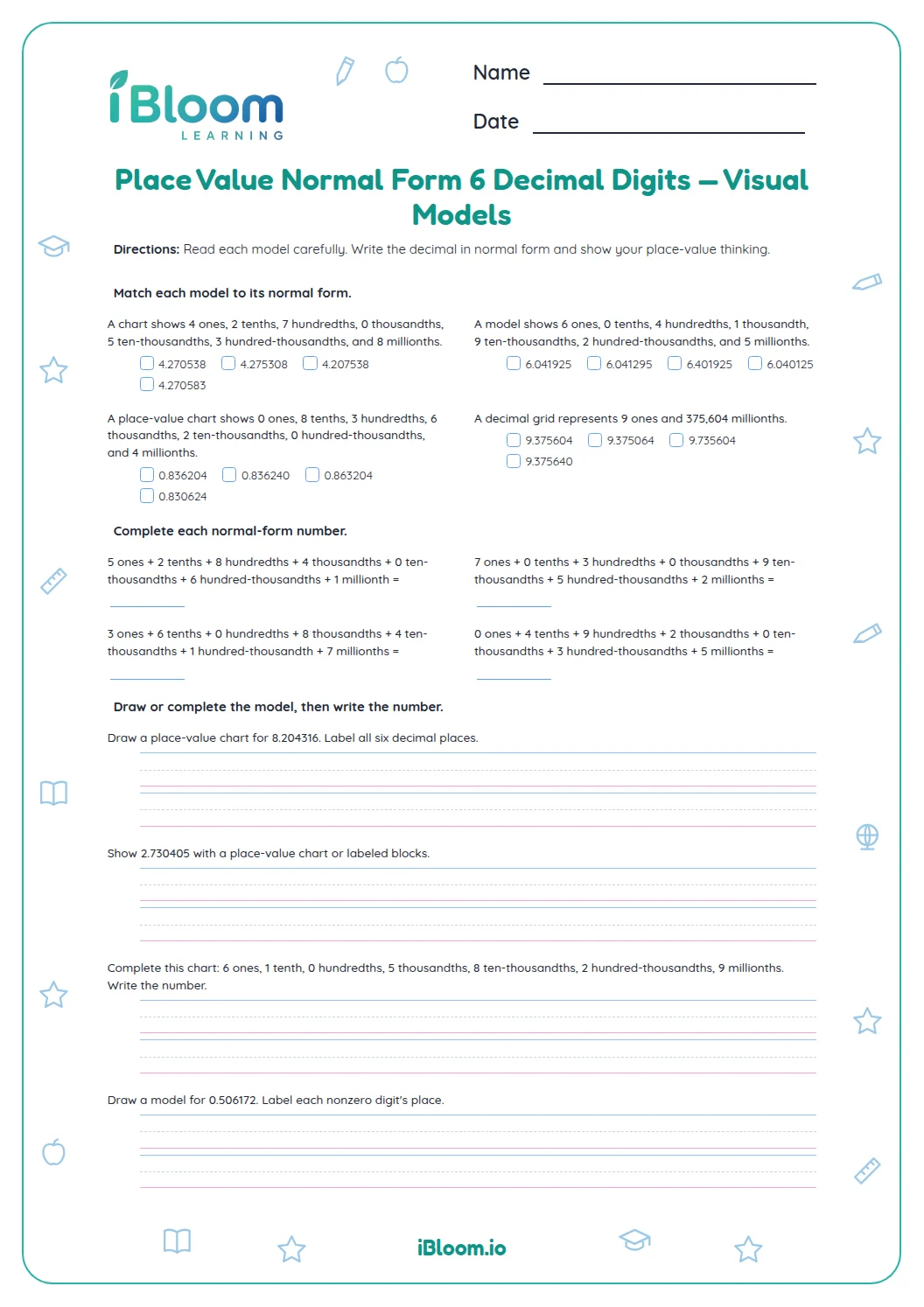
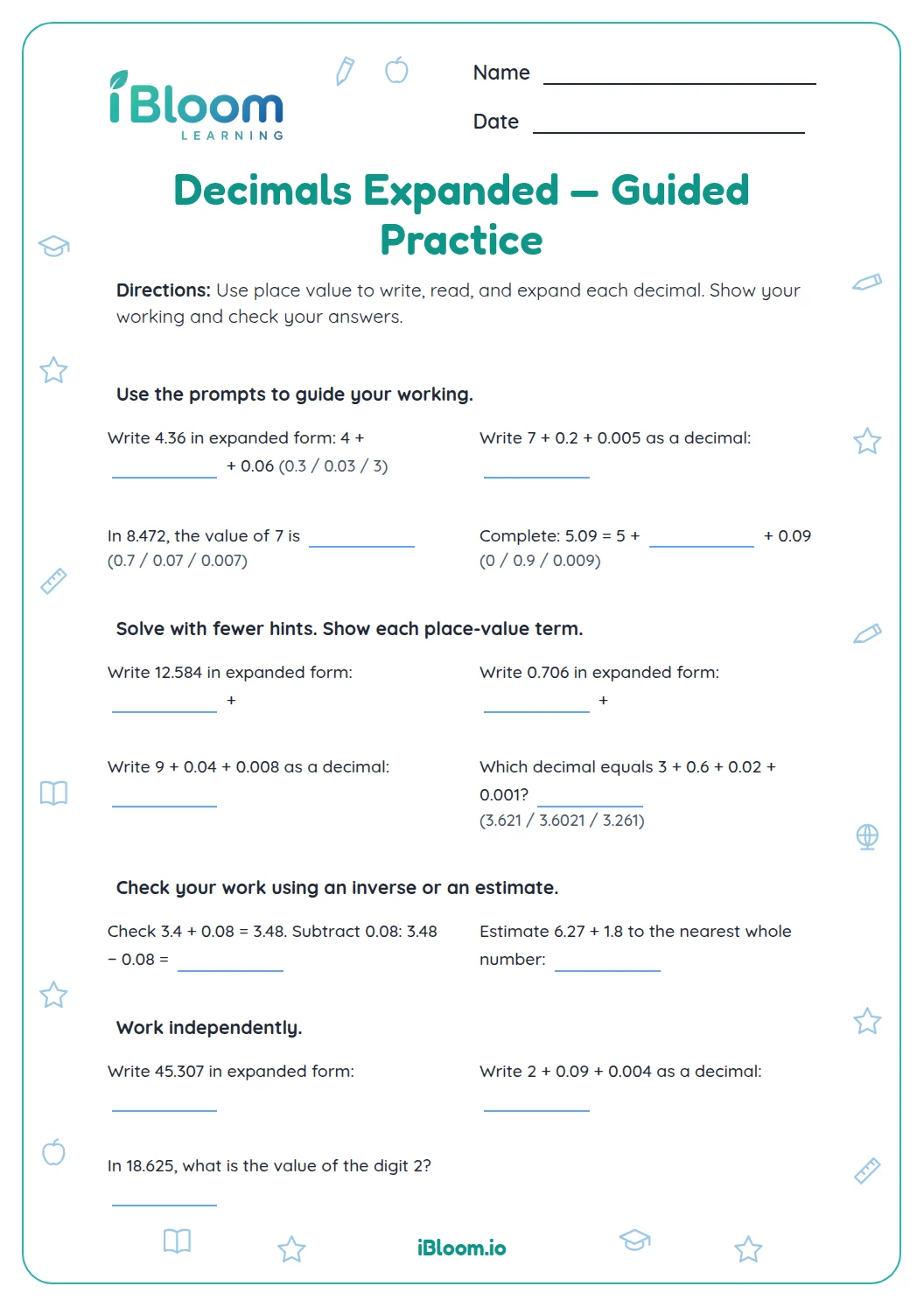
This guided practice moves from naming a decimal to combining expanded values, identifying a digit’s value, comparing decimals, and finding a missing place-value part. The examples include zeros inside a number so learners must keep each digit in its correct place.
Aligned to 5.NBT.A.3
What this worksheet practices
Practice standard form, expanded form, decimal names, and digit values through the millionths place.
How to use the practice
The practice is organized into 2 parts, with 14 questions and a separate answer key.
Common Core alignment
This worksheet practices the grade-level skill named in the page title.
Read, write, and compare decimals to thousandths.
On this sheet: These Grade 6 problems extend the named place-value skill through millionths.
Show the official wordingHide the official wording
Read, write, and compare decimals to thousandths.
What to practice next
Make more practice
Further reading
Questions parents and teachers ask
What does a zero do in a decimal number?
A zero can hold a place so the other digits keep their correct values. In 14.206, the zero shows that there are no hundredths; the 2 is still in the tenths place and the 6 is in the thousandths place.
How can I compare 0.608 and 0.68?
Write 0.68 as 0.680 so both numbers have the same number of decimal places. Then compare thousandths: 680 thousandths is greater than 608 thousandths, so 0.68 is greater. Adding a zero at the end does not change a decimal’s value.
Where is the thousandths place located?
The thousandths place is the third place to the right of the decimal point. In 4.027, the 0 is in tenths, the 2 is in hundredths, and the 7 is in thousandths. Each place is one tenth the value of the place to its left.
How do you write a decimal in standard form?
Add the value of each digit. For example, 3 + 0.5 + 0.08 + 0.006 is 3.586. A zero may have no value to add, but it can still hold a place inside the written number. Read all six decimal places carefully.