





About this worksheet
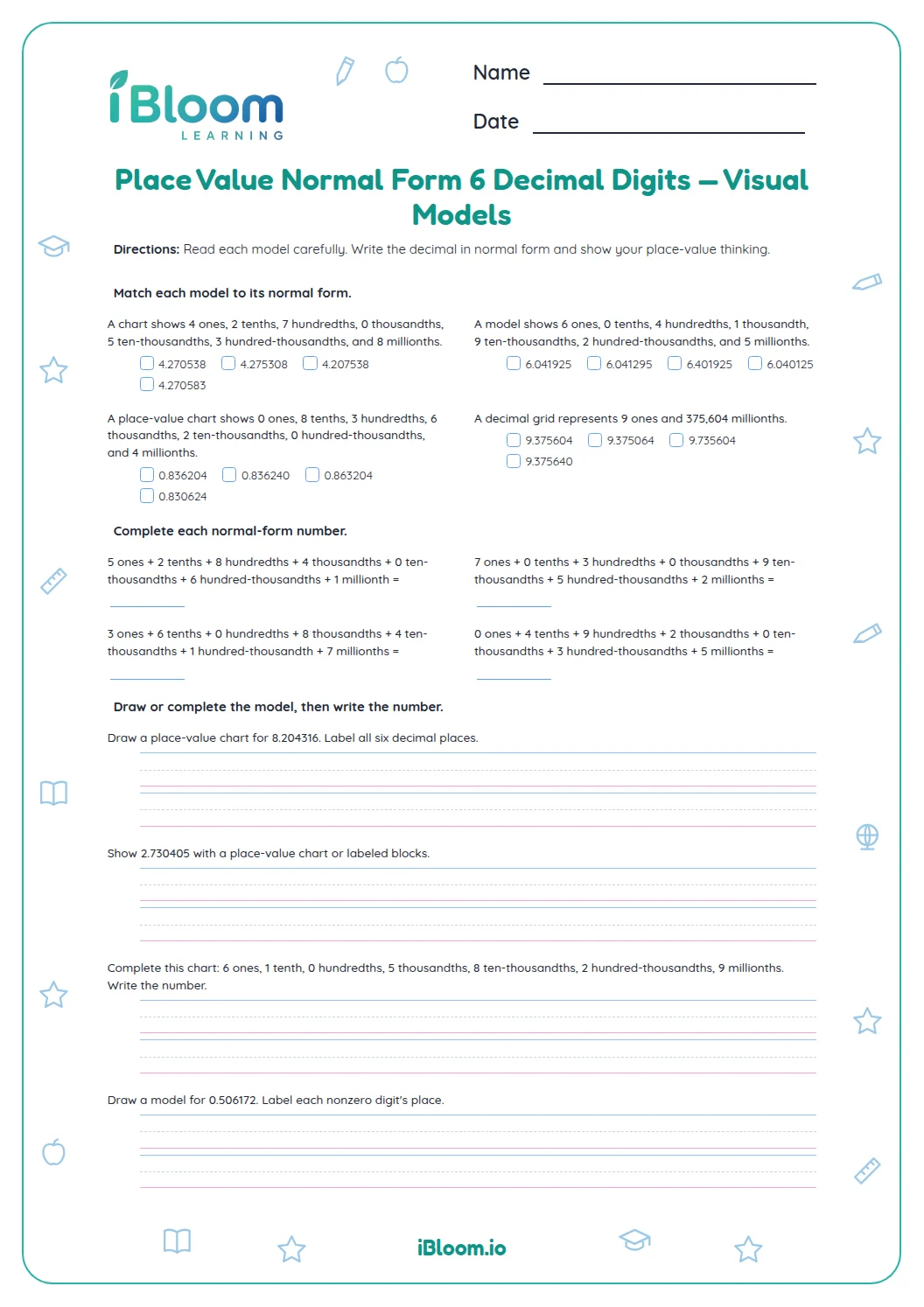
This Grade 6 place-value worksheet works with decimals written to six places. Students move between standard, word, and expanded forms; identify digit values; compare decimals; and explain place-value reasoning. The 14 questions use six digits after the decimal point, including trailing zeros where they help make the place value visible.
How do the decimal forms connect?
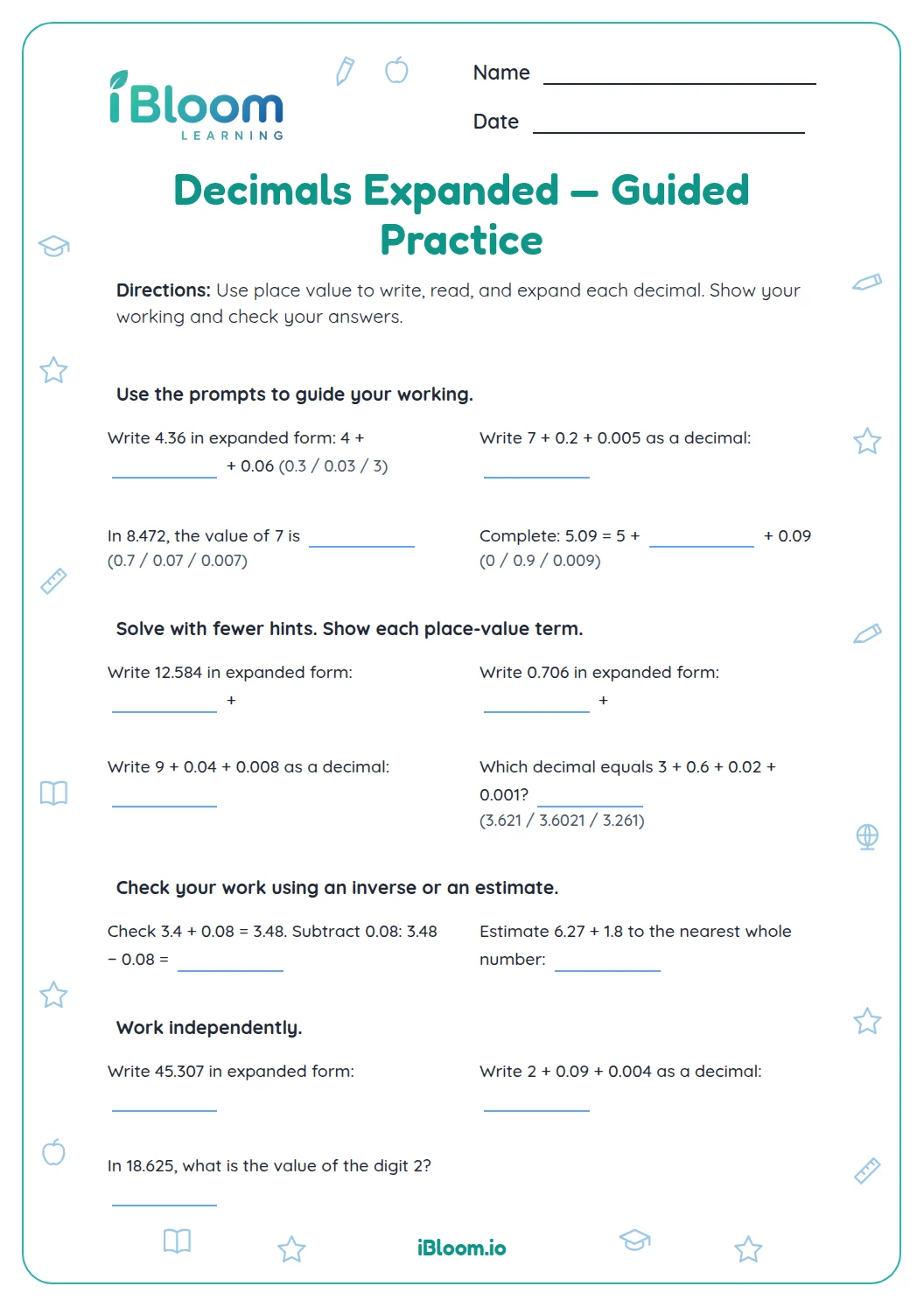
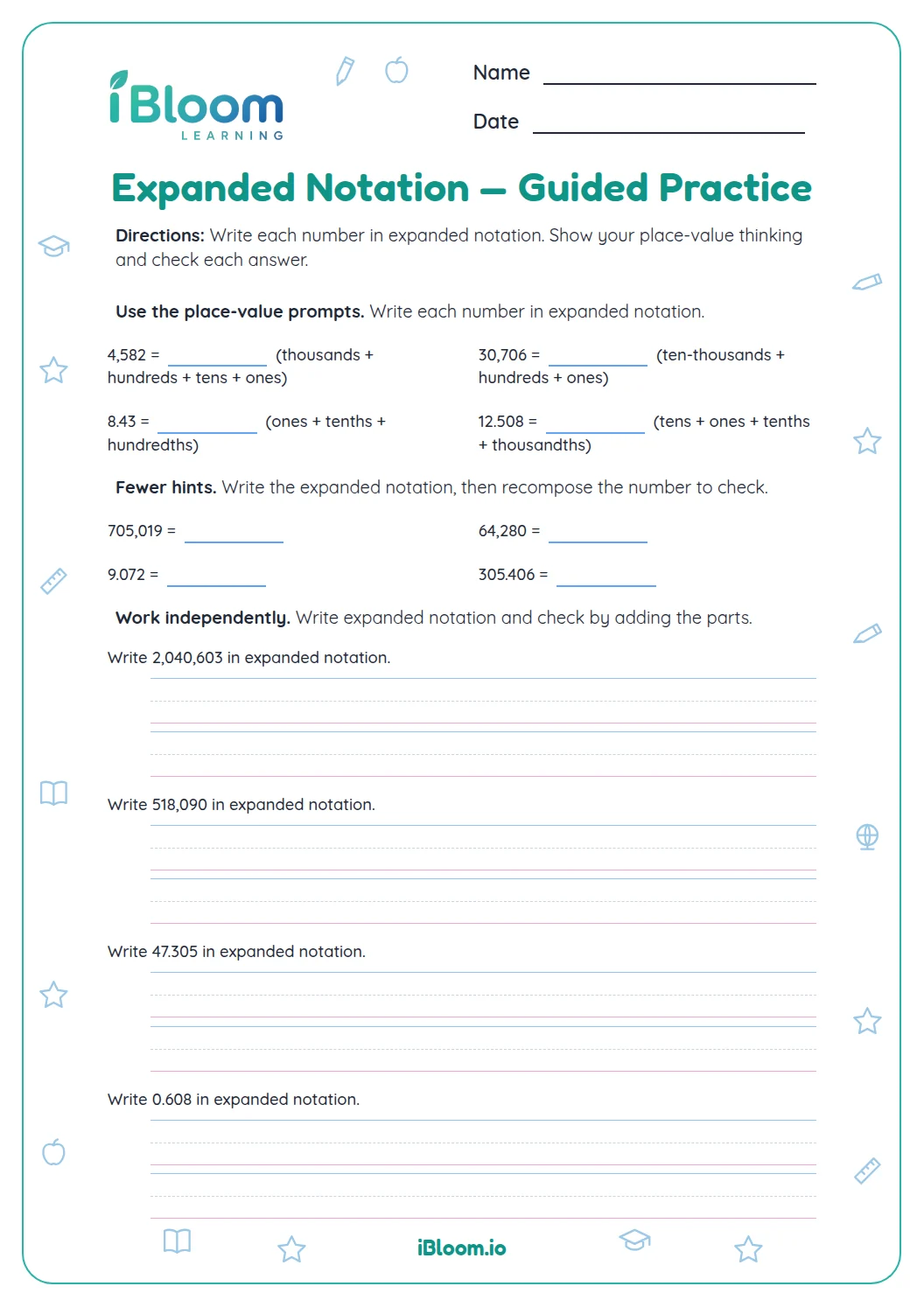
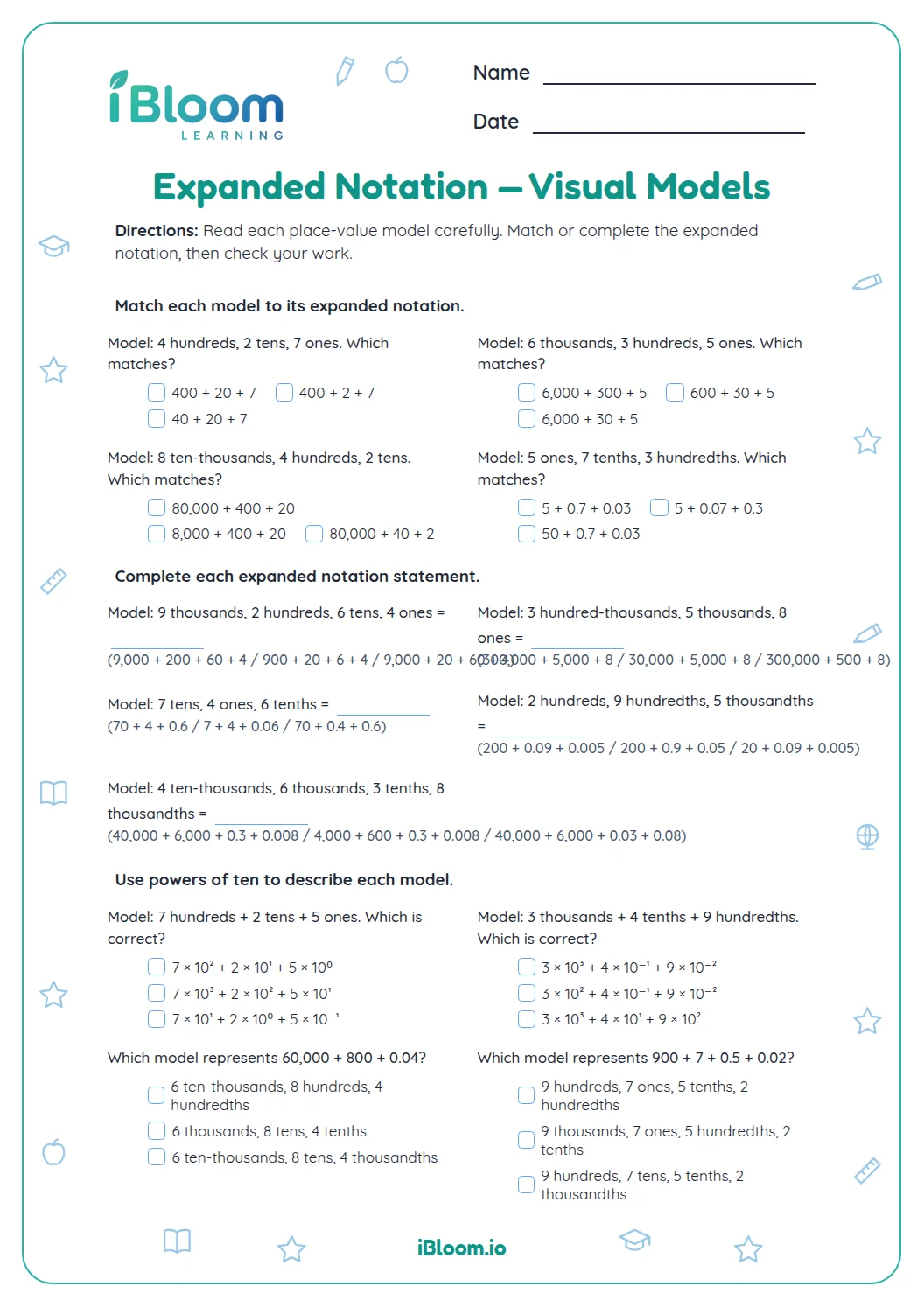
Standard form shows the number with a decimal point. Word form names the fractional part, and expanded form separates the value contributed by each place. This sheet asks students to move between these representations.
Keep the six places visible while reading or rewriting a decimal; a zero can mark an empty place.
- Questions 1 and 6 use word form.
- Questions 3, 4, 10, and 12 connect standard and expanded forms.
- Questions 2, 5, and 9 identify a digit’s value or place.
How can expanded form be written as a decimal?
Place each value in its matching column, then combine the parts. Keep zero placeholders when a place has no value.
- 130 + 0.4 + 0.0007 + 0.000002 = 30.400702.
How can students compare long decimals?
Compare the whole-number parts first. If they match, compare decimal digits from left to right, keeping place values aligned. Trailing zeros do not change the value.
What does place-value reasoning explain?
A digit’s value depends on its position, not just the digit itself. Use the place name to state the value and check a proposed comparison by aligning all six decimal places.
How to use this worksheet
- 1Read the number and note the place named in the question.
- 2Line up decimal places when comparing two values.
- 3For expanded form, add the value of each nonzero digit.
- 4Use zeros to hold empty places and keep six decimal positions clear.
- 5Check each response against the separate key.
Common mistakes and fixes
The mistake
Reading a digit without its place.
The fix
Name the column first, then state the digit’s value.
The mistake
Treating a trailing zero as a new value.
The fix
Remember that adding zeros to the right of a decimal does not change its value.
The mistake
Comparing decimals by their number of digits.
The fix
Align the decimal points and compare one place at a time from left to right.
What to practice next
Make more practice
Questions parents and teachers ask
How many decimal places do the questions use?
The worksheet displays six places after the decimal point, through the millionths place. Some questions include zeros in empty places or at the end of a decimal. The separate answer key shows the corresponding forms and values. Read each place name carefully as you work.
What is expanded form?
Expanded form writes a number as the sum of the values of its digits. For example, 30.400702 is 30 + 0.4 + 0.0007 + 0.000002. Each nonzero part names a place value, while zero places keep the digits aligned. That way, each digit stays aligned with its correct value.
Why are zeros important in these decimals?
A zero can hold a place so the digits to its right stay in the correct columns. A zero at the end of a decimal can also show the number written to six places without changing its value. Pay attention to which use applies.
How should students compare six-place decimals?
First compare the whole-number parts. If they are equal, compare tenths, then hundredths, thousandths, and each later place until the values differ. Aligning decimal points helps prevent comparing digits from different places. Use the place-value names to explain the comparison.
What does “millionths” mean?
A millionth is one of one million equal parts of a whole. It is the sixth place to the right of the decimal point. In 0.000001, the 1 is in the millionths place and has a value of one millionth.
Does the worksheet include an answer key?
Yes. The answer key is separate from the worksheet and lists the correct response to all 14 questions. Students can use it after trying each item, then revisit any place-value step that led to a different answer. Check both the digits and the corresponding place names.