












About this worksheet
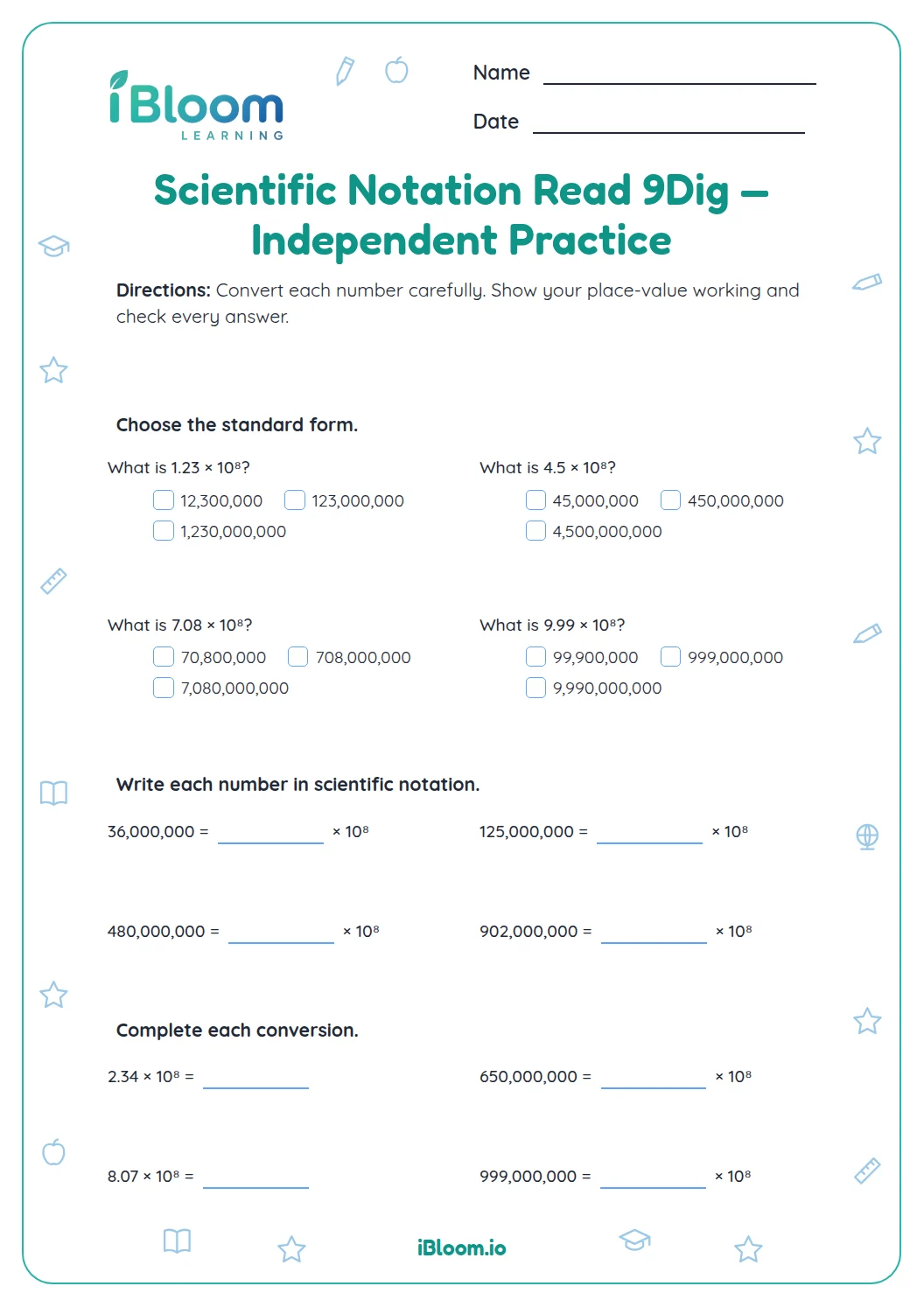
This free printable is for Grade 6 learners writing nine-digit whole numbers in scientific notation. Sixteen short-answer questions begin with familiar shifts, then include interior zeros and coefficients near the ends of the 1-to-10 range. Each answer expresses the original number as a coefficient multiplied by a power of ten. The answer key makes it possible to check both the coefficient and exponent. The worksheet practices whole-number exponents for powers of ten, connecting to CCSS 5.NBT.A.2.
Aligned to 5.NBT.A.2
Where should the decimal point go?
Move the decimal until one nonzero digit remains to its left. The number of places moved determines the exponent, and the digits between the first and last nonzero places stay in order.
- 1Question 1 starts with 123,000,000.
- 2Move the decimal eight places: 1.23 × 10^8.
How do interior zeros affect the coefficient?
Zeros inside a number hold places and must remain when the coefficient is written. Part B asks learners to track those positions in examples such as 706,000,000 and 901,000,000.
How can the exponent be checked?
Multiply the coefficient by the power of ten to recover the original number. If the decimal shift or exponent is off by one, the reconstructed number will be ten times too large or too small.
How to use this worksheet
- 1Write the number with an understood decimal point at the end.
- 2Move the decimal until exactly one nonzero digit is to its left.
- 3Count the places moved and use that count as the exponent on 10.
- 4Keep every digit in order, including interior zeros.
- 5Multiply back mentally to check the original number.
Common mistakes and quick fixes
The mistake
Dropping a zero between nonzero digits.
The fix
Keep each digit in its original order when forming the coefficient.
The mistake
Using the coefficient’s decimal digits as the exponent.
The fix
Count the decimal places moved from the original number.
The mistake
Moving the decimal one place too few or too many.
The fix
Multiply the coefficient by 10^n and compare with the starting number.
Curriculum alignment
The conversions connect decimal shifts with whole-number powers of ten.
Learners use whole-number exponents to express powers of ten while writing large numbers.
On this sheet: Each conversion links the number of decimal places shifted to a whole-number exponent on 10.
Show the official wordingHide the official wording
Explain patterns in the number of zeros of the product when multiplying a number by powers of 10, and explain patterns in the placement of the decimal point when a decimal is multiplied or divided by a power of 10. Use whole-number exponents to denote powers of 10.
What to practice next
Make more practice
Further reading
Questions parents and teachers ask
What does scientific notation show?
It writes a number as a coefficient multiplied by a power of 10. In this worksheet, each nine-digit whole number is rewritten with a coefficient at least 1 and less than 10, while the exponent records how many places the decimal moved.
How many places does the decimal move for a nine-digit number?
The decimal moves so the coefficient begins with one nonzero digit before the decimal point. For most nine-digit numbers here, the shift is eight places, so the power is 10^8; a number beginning with a two-digit whole-number part can use a different exponent.
Why do some questions include zeros inside the number?
Zeros inside a number hold places and must remain when the coefficient is written. For example, 706,000,000 becomes 7.06 × 10^8, so the zero between 7 and 6 remains and the exponent restores the original place value when multiplied.
Does the exponent always equal eight?
No. The exponent tells how far the decimal moved to make the coefficient at least 1 and less than 10. For 64,200,000, the coefficient is 6.42 and the decimal moves seven places, giving 6.42 × 10^7; multiplying back confirms the value.
What does the answer key show?
The separate key lists each coefficient and exponent. To check one, multiply the coefficient by the stated power of 10 and compare the result with the original nine-digit number, including any zeros between nonzero digits. This catches a decimal shift that is one place off.