






About this worksheet
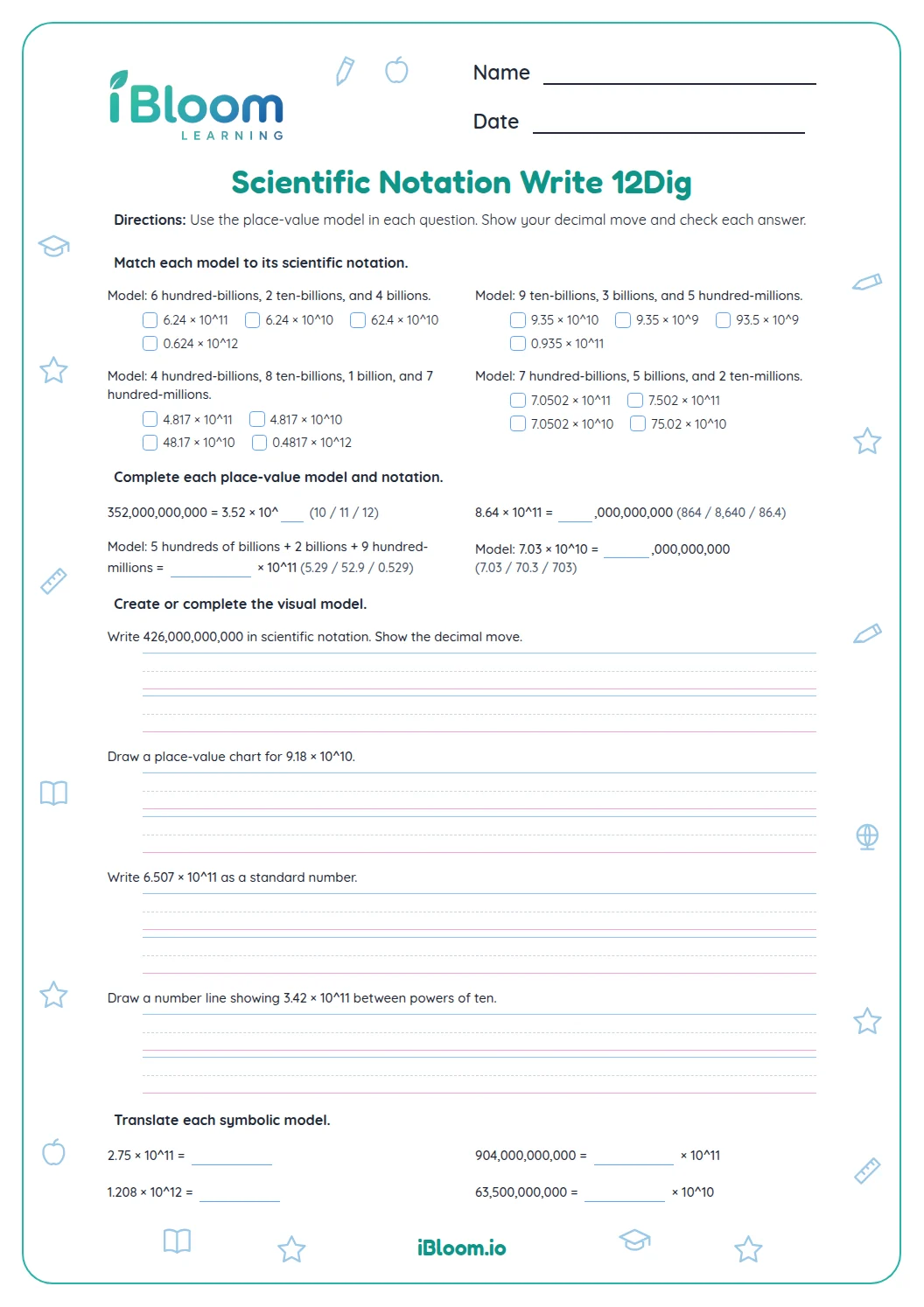
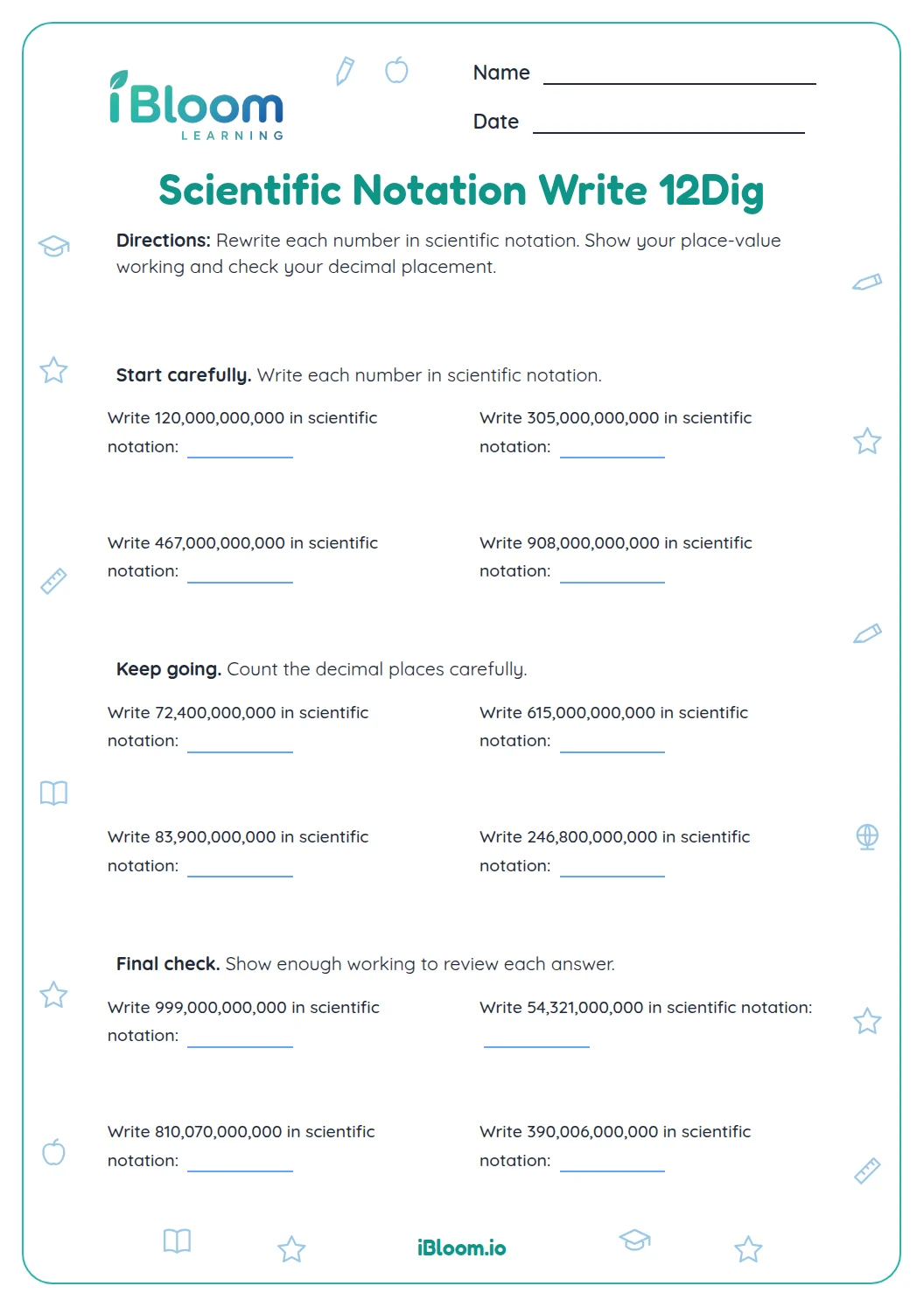
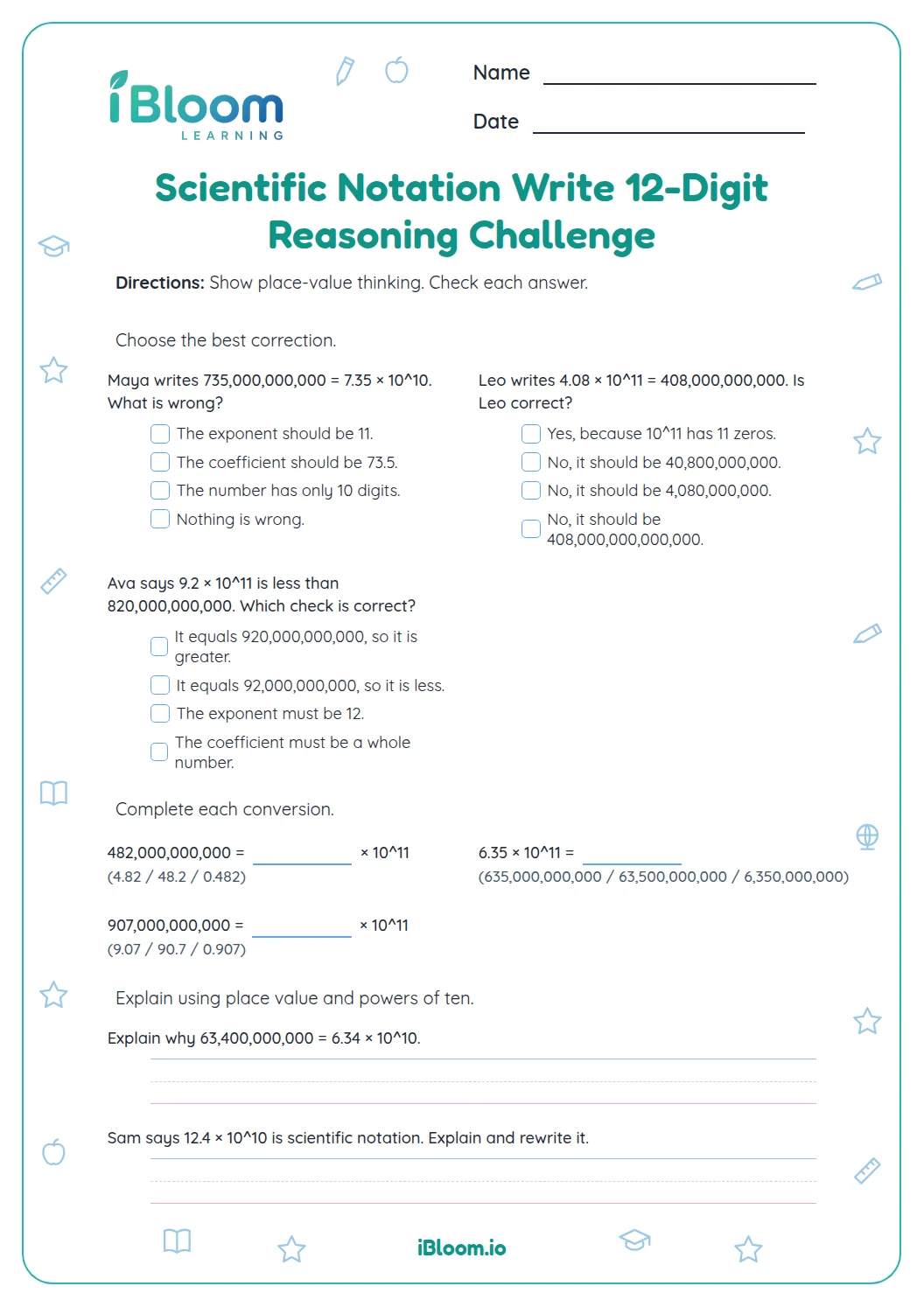
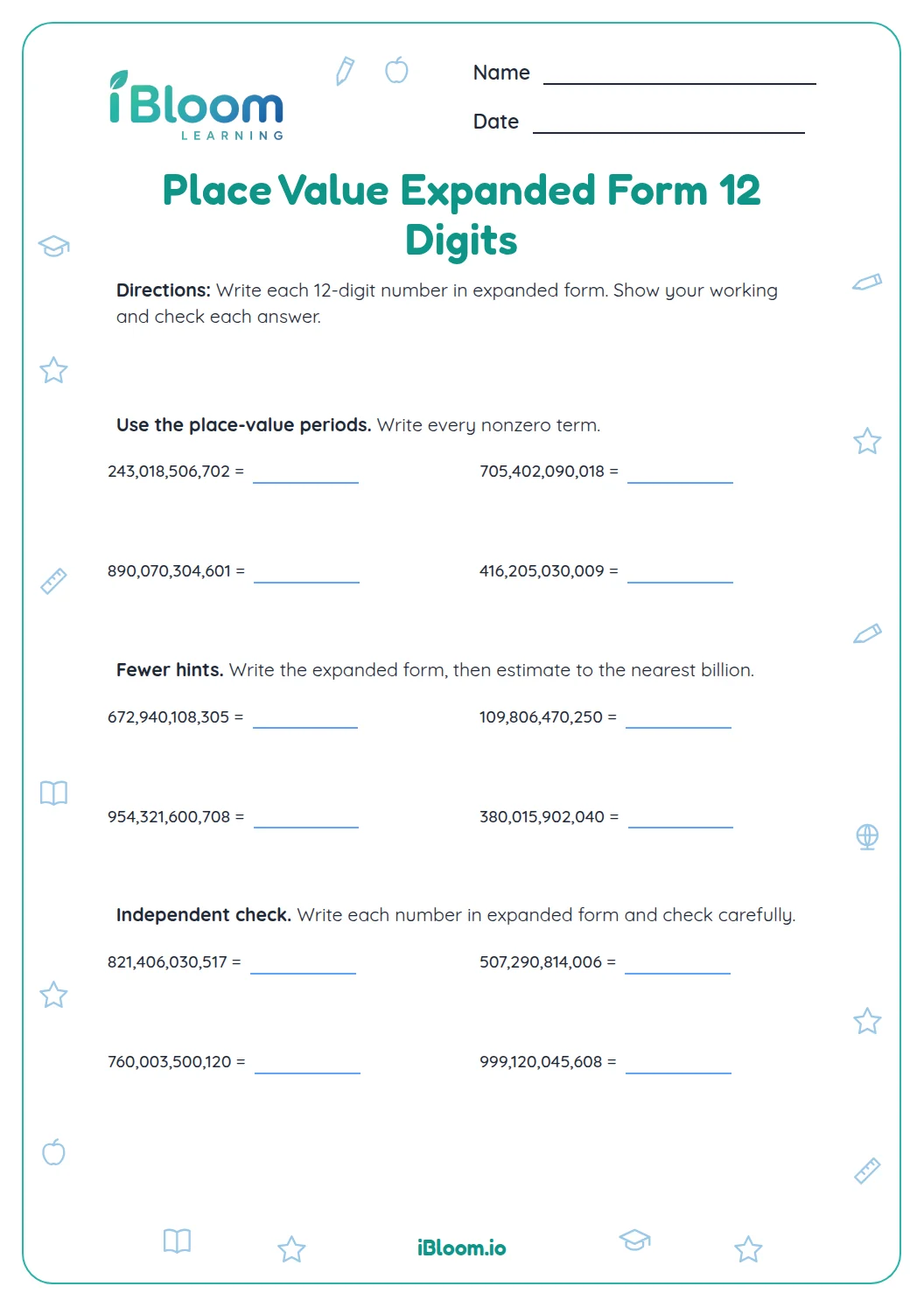
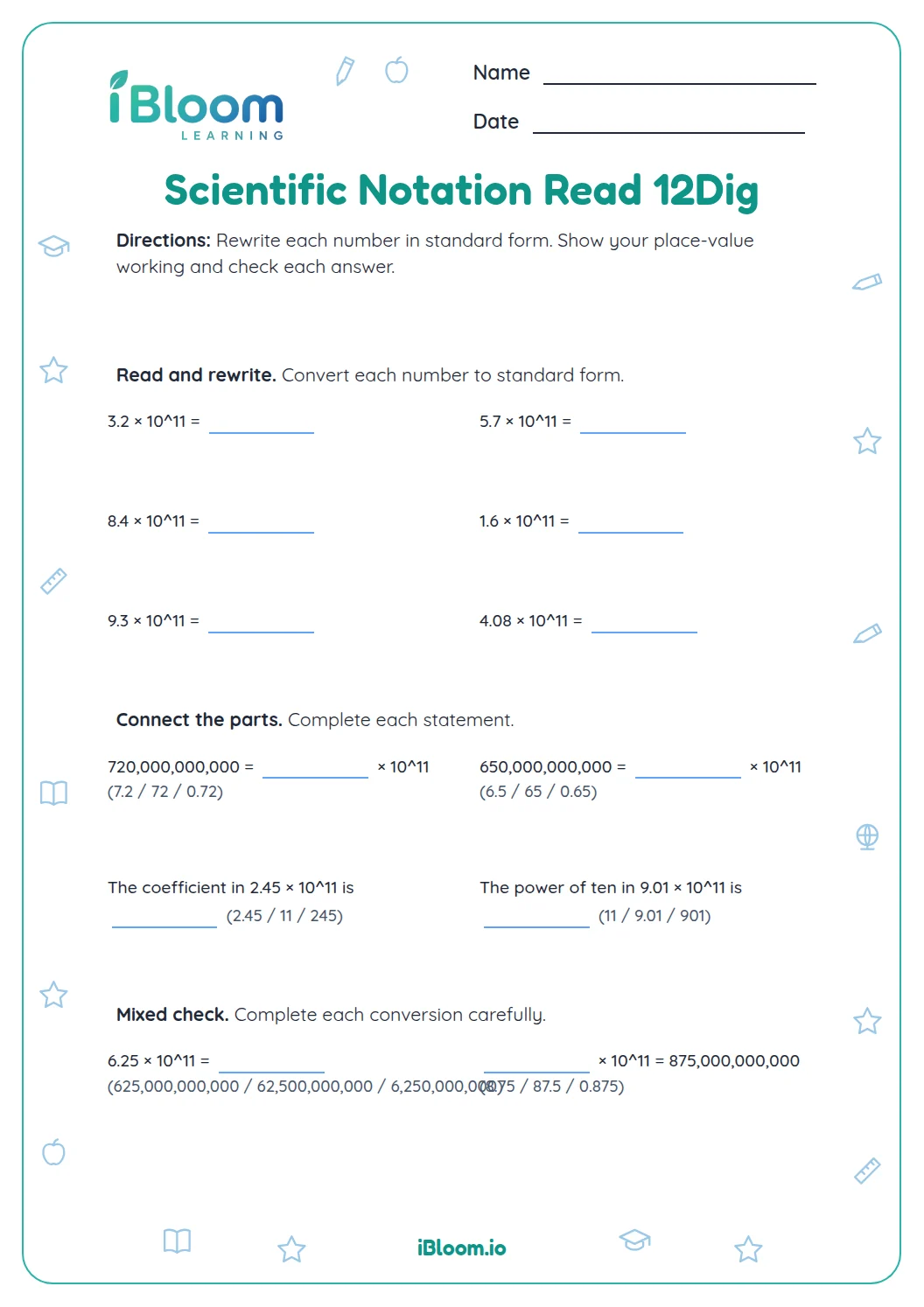
This free Grade 6 worksheet connects whole-number exponents to writing large numbers. Part A develops powers of 10, Part B supplies part of a scientific-notation expression, and Part C asks students to write six complete expressions for 12-digit numbers. The 14 questions support Common Core 6.EE.A.1 through writing and evaluating numerical expressions with whole-number exponents. Examples include round hundred-billion values and numbers with zeros between significant digits. A separate answer key preserves the exact value of every number, including the two longest final answers.
Aligned to 6.EE.A.1
What does the exponent tell students?
In 10^3, the exponent 3 tells how many factors of 10 are multiplied: 10 × 10 × 10 = 1,000. Part A connects this notation to 10^11, or one hundred billion, then asks for the value of 4.7 × 10^11.
Multiplying a factor by 10^11 makes its value 100,000,000,000 times as large. That is the scale needed for a 12-digit whole number when the first factor is at least 1 and less than 10.
Where does the decimal point go?
Scientific notation has one nonzero digit to the left of the decimal point. Start at the implied decimal point after the last digit of a whole number, then count eleven places left for a 12-digit number.
Question 8 includes an internal zero. Preserve that zero in 7.08; it keeps the 8 in the hundredths place of the first factor.
- 1708,000,000,000 becomes 7.08000000000 after eleven place shifts.
- 2Trailing decimal zeros may be removed: 7.08.
- 3708,000,000,000 = 7.08 × 10^11.
Which zeros can students remove?
Trailing zeros after the last nonzero decimal digit can be removed without changing the numerical value. Zeros between nonzero digits must stay. Thus question 11 needs 5.06, not 5.6, as its first factor.
The final two questions ask for exact expressions. For 600,000,000,004, the first factor is 6.00000000004. Multiplying back by 10^11 restores the 4 to the ones place. Write carefully enough to count all ten zeros between 6 and 4.
How to use this worksheet
- 1Evaluate the powers in Part A as repeated multiplication by 10.
- 2Read the first-factor rule under Part B before completing the notation.
- 3Mark the implied decimal point after the final digit, then count eleven places left.
- 4Write the factor and 10^11, retaining every zero between nonzero digits.
- 5Multiply each completed expression back mentally by shifting place values eleven places right.
Common mistakes and quick fixes
The mistake
Using exponent 12 because the original number has 12 digits.
The fix
Count the moves from the decimal point at the end to the position after the first digit: there are eleven.
The mistake
Writing 70.8 × 10^10 as the finished scientific notation.
The fix
Use a factor below 10. The normalized expression is 7.08 × 10^11.
The mistake
Shortening 5.06 to 5.6.
The fix
Keep the zero between 5 and 6. Those factors represent different values.
Common Core alignment
Write and evaluate powers of 10 in expressions for large whole numbers.
On this sheet: Part A evaluates powers of 10; Parts B and C write numerical expressions with exponent 11.
Show the official wordingHide the official wording
Write and evaluate numerical expressions involving whole-number exponents.
What to practice next
Make more practice
Further reading
Questions parents and teachers ask
Why do all the 12-digit conversions use exponent 11?
A 12-digit whole number has eleven places after its first digit. Moving the decimal point from the end to just after that first digit takes eleven moves. The factor 10^11 restores the original value, as in 300,000,000,000 = 3 × 10^11 on this worksheet.
Must students round the long numbers at the end?
No, the final questions ask students to keep every digit and write an exact expression. For 123,456,789,012, the answer is 1.23456789012 × 10^11. Rounding that first factor would change the original number. Check the digits in order against the answer key before checking the exponent.
How can my child check the number with many zeros?
Multiply the first factor back by 10^11 and check where the final 4 lands. In 6.00000000004 × 10^11, it lands in the ones place, giving 600,000,000,004. If the 4 lands in the tens or tenths place, recount the decimal places in the first factor.
What makes 7.08 × 10^11 scientific notation?
The first factor, 7.08, is at least 1 and less than 10, and it is multiplied by a power of 10. Those two features make the expression scientific notation. In question 8 it represents 708,000,000,000 exactly; the zero between 7 and 8 must remain.
How should I introduce the exponent before the large numbers?
Start with question 1 by writing 10 × 10 × 10 and finding 1,000. Then explain that 10^6 means six factors of 10, giving 1,000,000. Have your child use that same meaning for 10^11 before completing the scientific-notation expressions in Parts B and C.