



About this worksheet
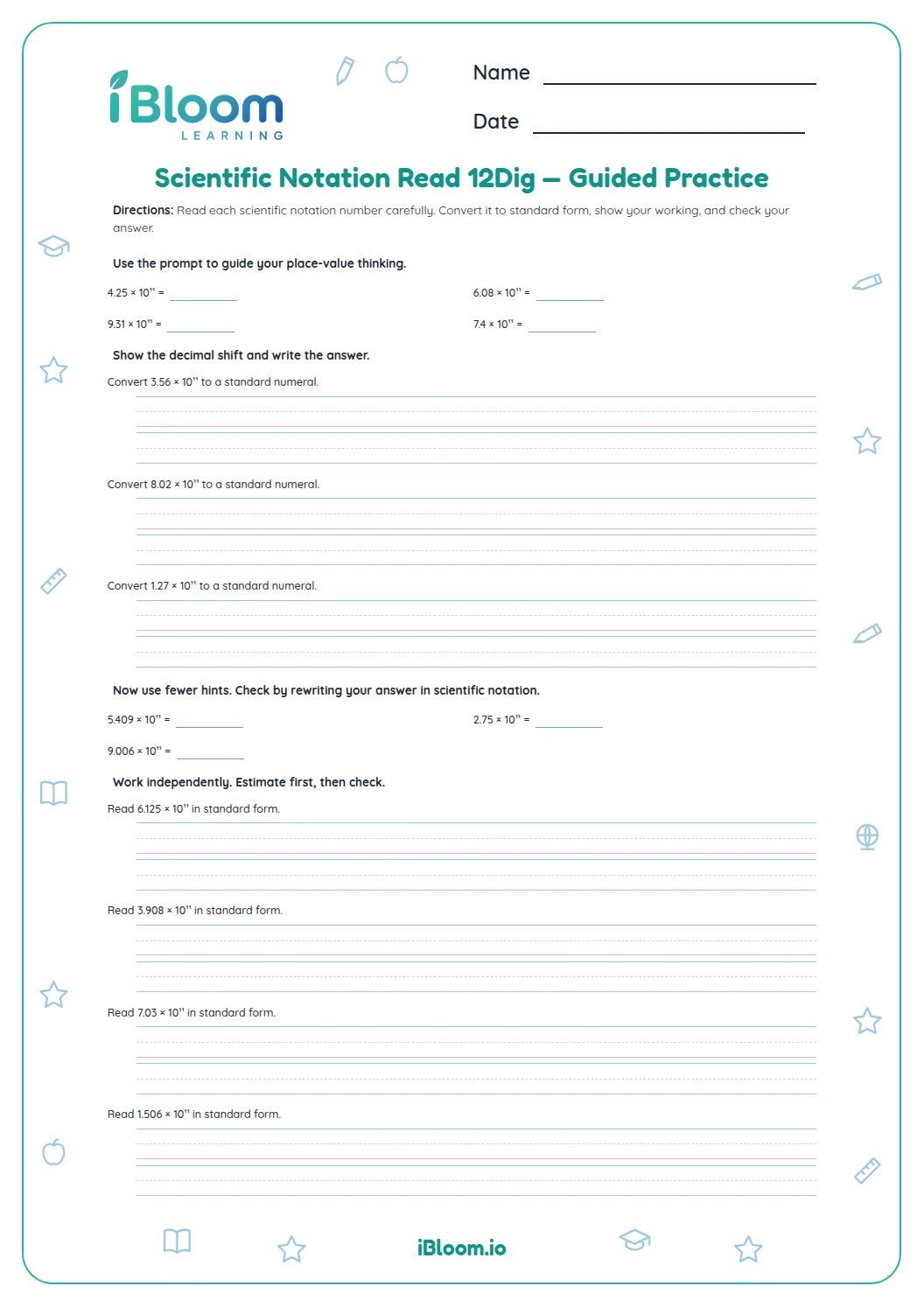
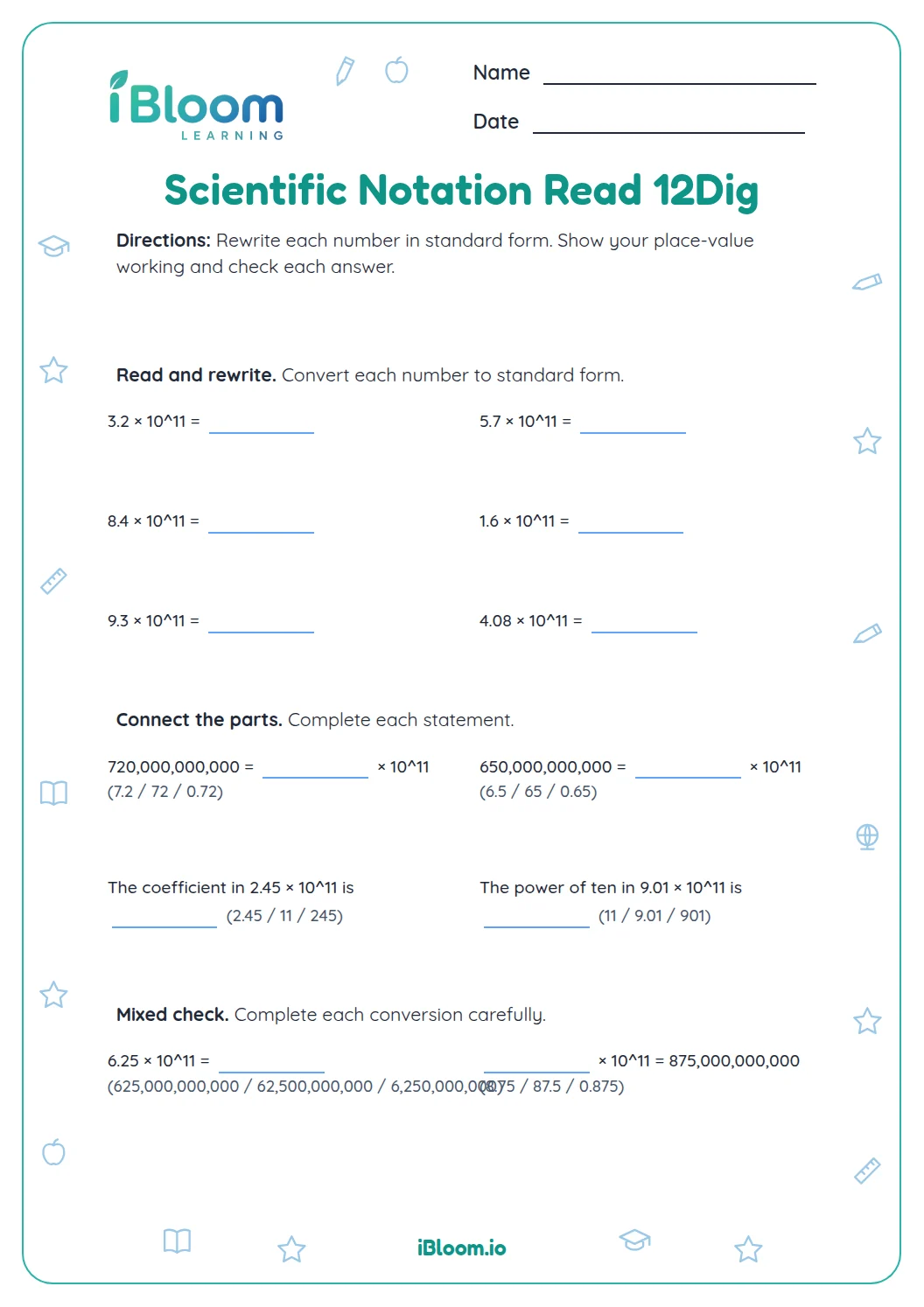
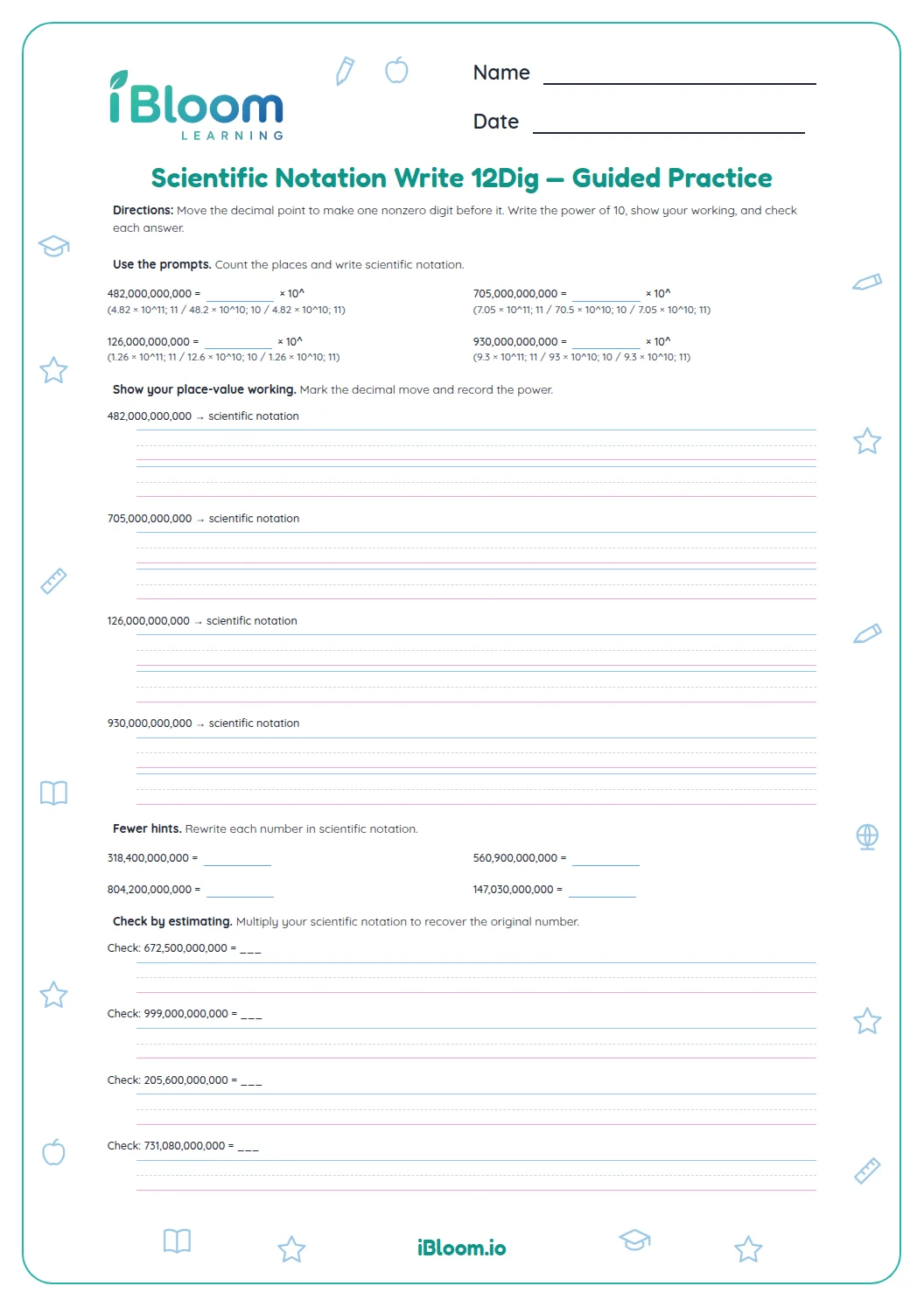
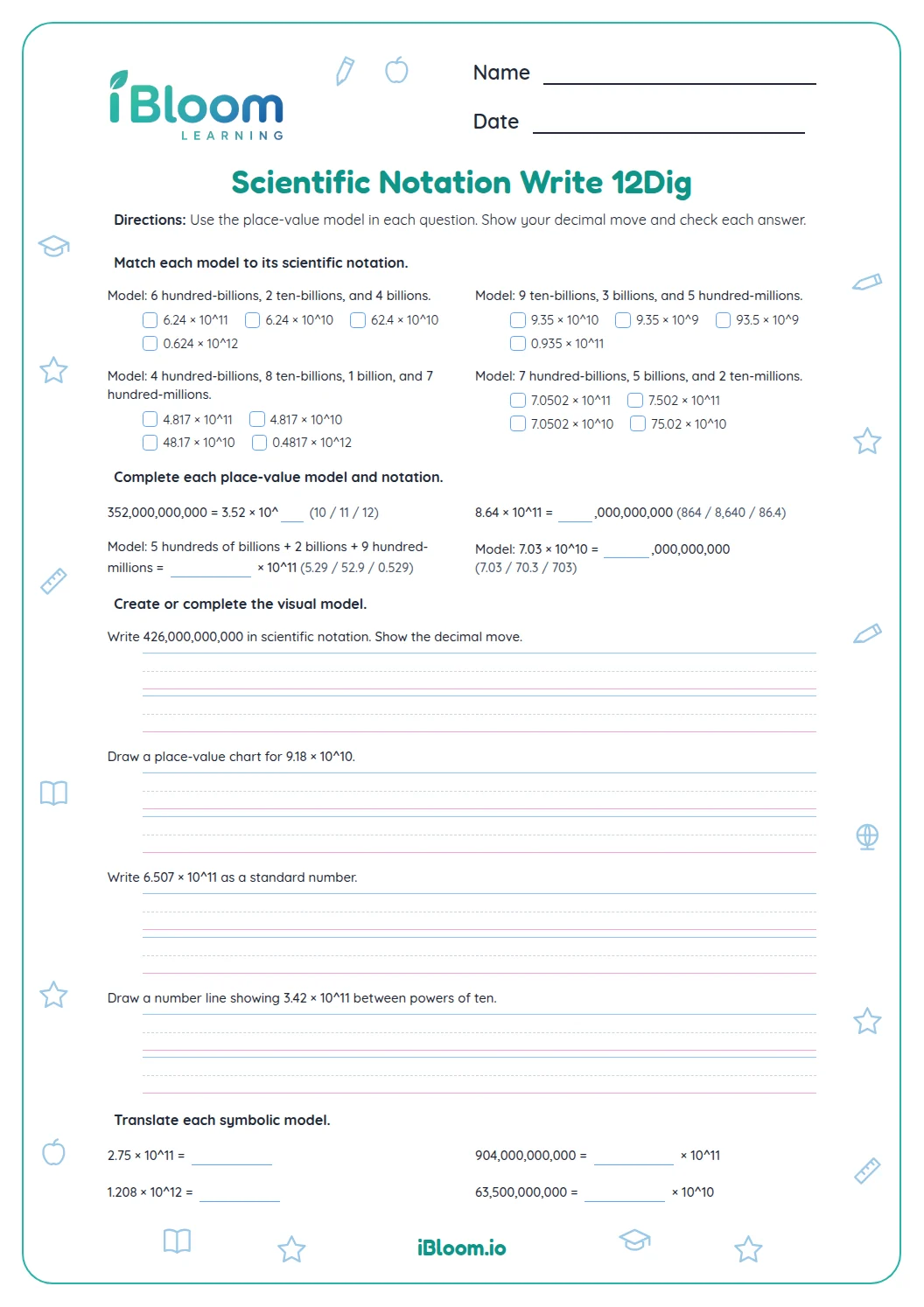
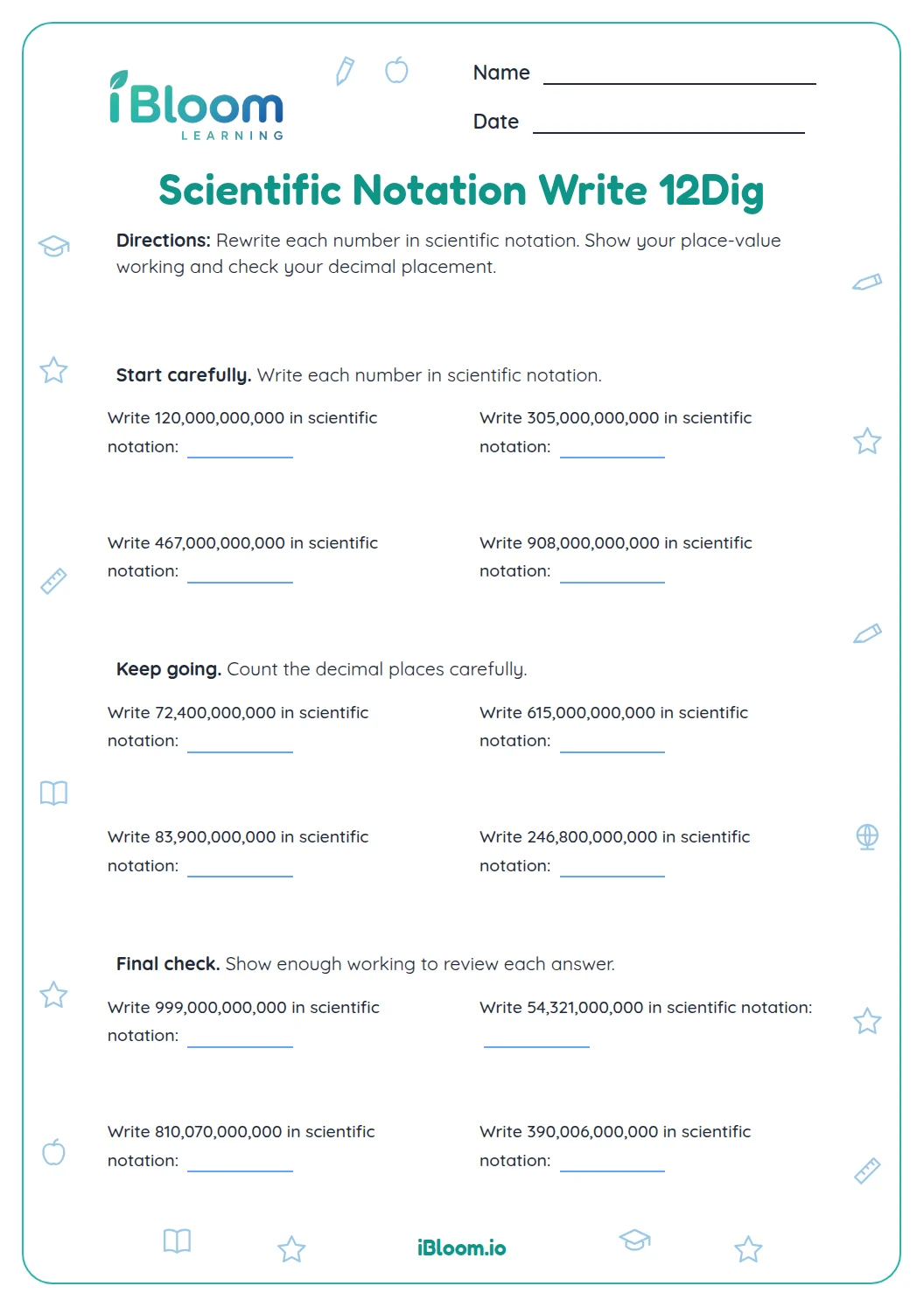
This Grade 6 place-value worksheet introduces reading twelve-digit whole numbers in scientific notation. Students convert between standard form and a decimal factor multiplied by a power of ten, then compare equivalent forms. Sixteen questions progress from direct conversions to mixed recognition, and a separate answer key shows each equivalent value.
What does scientific notation show?
Scientific notation writes a number as a decimal factor multiplied by a power of ten. The exponent tells how many places the decimal point shifts to make the standard form.
In this practice, the values are large whole numbers. Students read the exponent, move the decimal point, and keep the zeros that hold places.
How do you convert to standard form?
For a positive exponent, move the decimal point to the right by the exponent’s number of places. Add zeros where needed so the digits stay in their correct place values.
- 14.263 × 10^11
- 2Move the decimal 11 places to the right.
- 3Keep the 4, 2, 6, and 3 in order; fill remaining places with zeros.
- 4Answer: 426,300,000,000
What conversions are on the sheet?
The 16 questions include direct conversions, multiple-choice equivalences, and a final mixed set. All standard-form values use twelve digits, so students repeatedly attend to the scale of the number.
How to use this worksheet
- 1Read the coefficient and exponent before moving the decimal.
- 2Move the point the number of places shown by the exponent.
- 3Keep all significant digits in the same order.
- 4Insert zeros in any empty place-value positions.
- 5Estimate the size and compare with the answer key.
Common mistakes and quick fixes
The mistake
Moving the decimal in the wrong direction.
The fix
A positive power makes a number greater than the coefficient; move right.
The mistake
Dropping an important zero.
The fix
Write place-value commas after converting and count all digit positions.
The mistake
Changing the coefficient digits.
The fix
Keep the coefficient digits in their original order as the decimal moves.
What to practice next
Make more practice
Further reading
Questions parents and teachers ask
What does the exponent mean in scientific notation?
The exponent tells how many places the decimal point moves when converting to standard form. With a positive exponent, move the decimal to the right. This worksheet uses the idea to write twelve-digit whole numbers in both forms.
Does this worksheet include an answer key?
Yes. The answer key is a separate page and gives the standard-form or scientific-notation answer for all 16 questions. It can be used to check the decimal movement and the zeros in each converted number. Every full-number value in the practice has twelve digits, keeping attention on large-number place value.
Why are there so many zeros in some answers?
Zeros hold empty place-value positions after the coefficient’s digits have been moved. They keep the number at the correct size. Students should preserve the digits in order and use commas to make the full number easier to read. The answer options contrast a shifted exponent or an incorrectly scaled coefficient with the correct equivalent notation.
How many questions are included?
There are 16 questions: five conversions to standard form, five multiple-choice matches, and six mixed conversions. The worksheet keeps its attention on large whole numbers written with twelve digits. Students can use comma groups to count the digits and check that their standard-form answer has the intended magnitude.
How can I check a conversion?
Estimate the size first, then count how many places the decimal moves. Compare the number of digits in the standard form with the exponent and make sure the coefficient digits stay in order. This check works in either direction: rewrite the coefficient and power of ten, then compare the value represented.