




About this worksheet
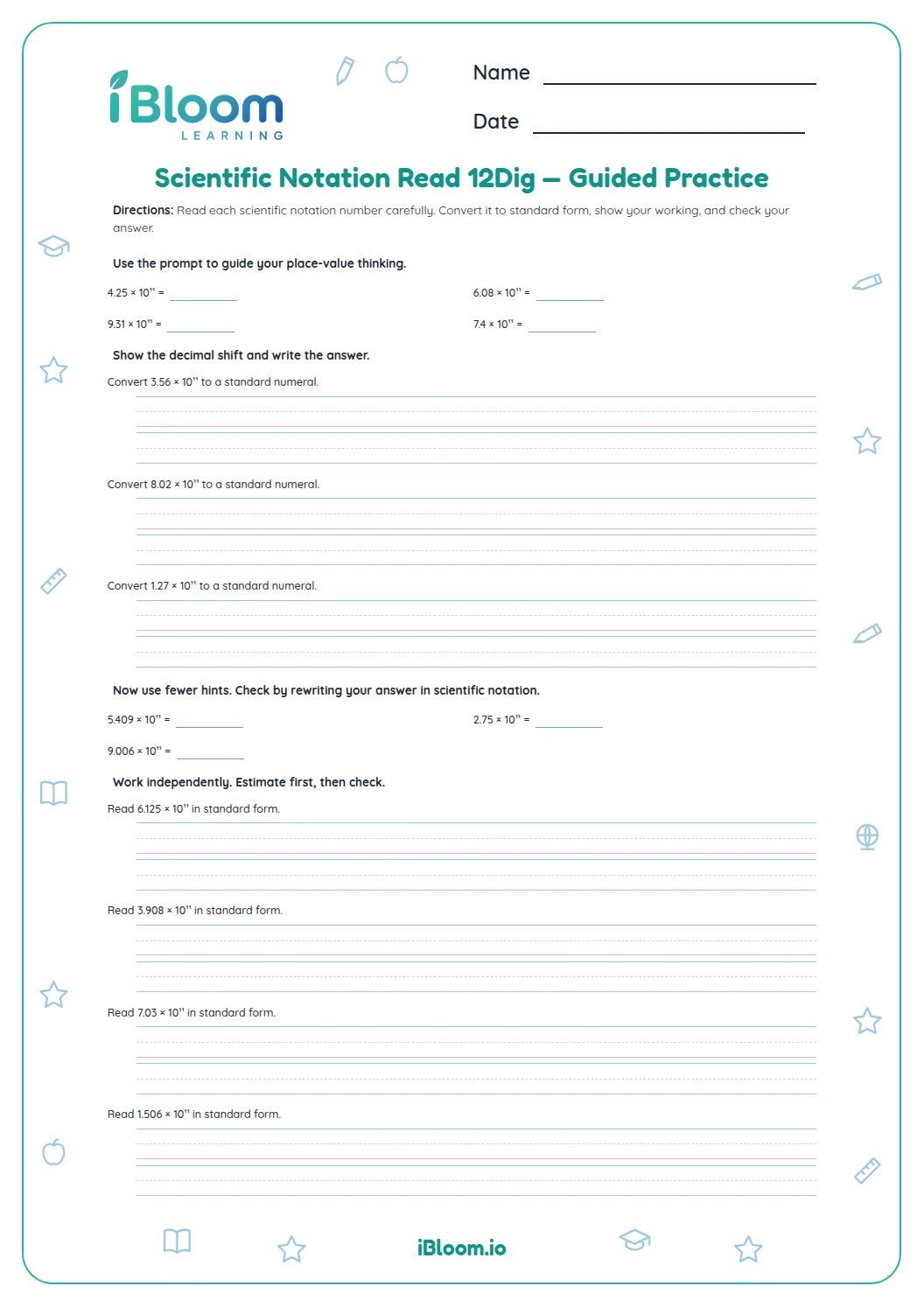
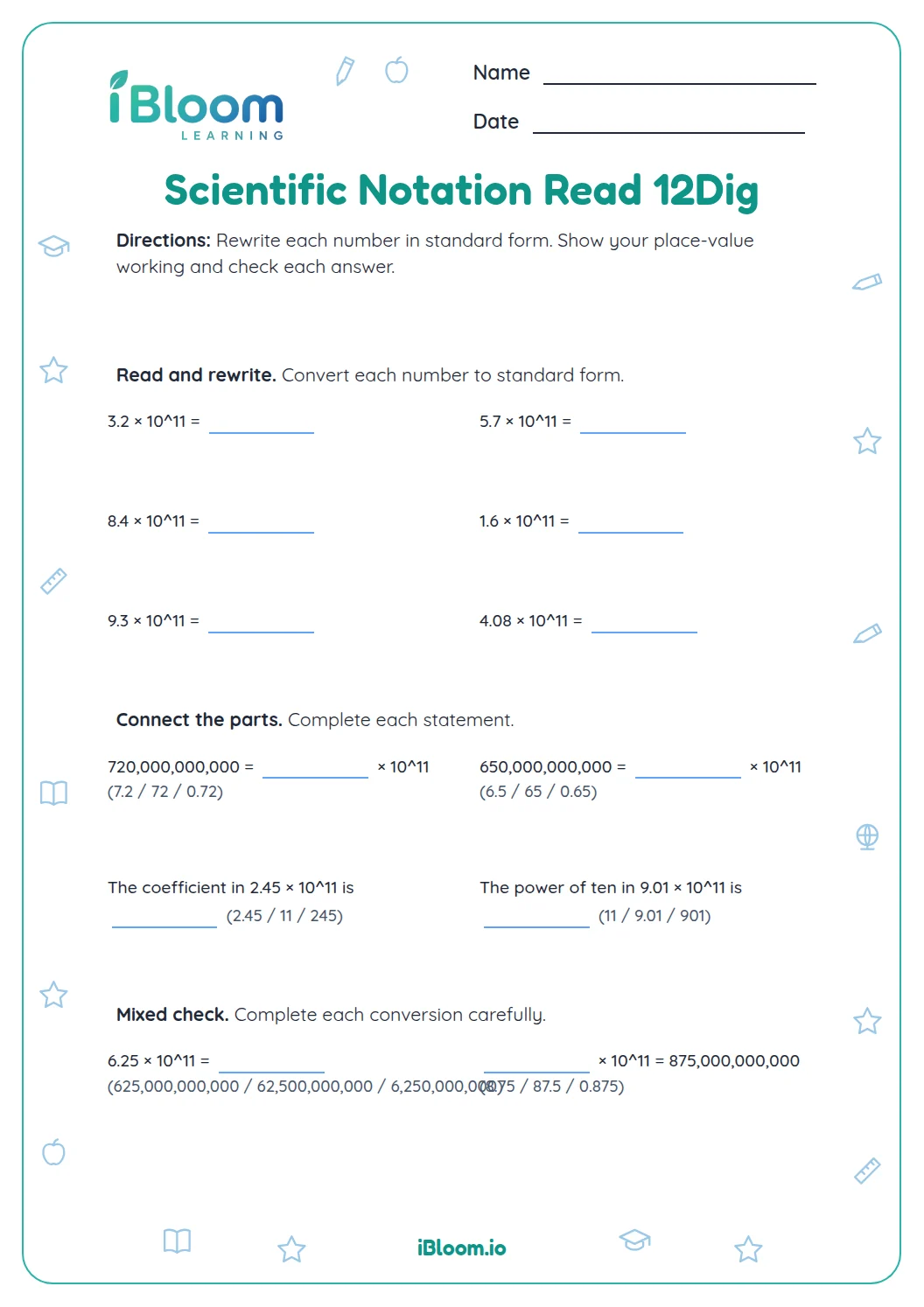
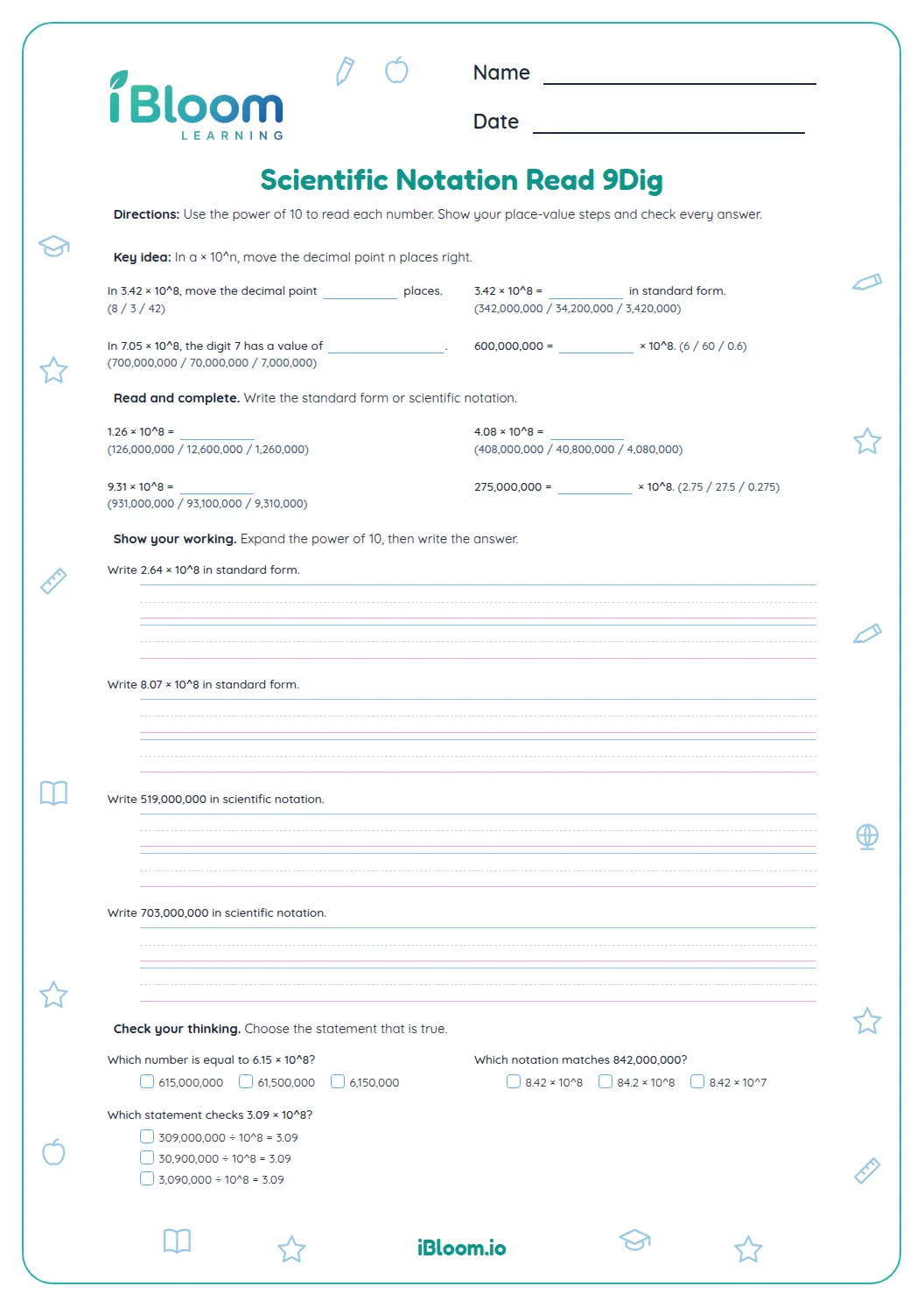
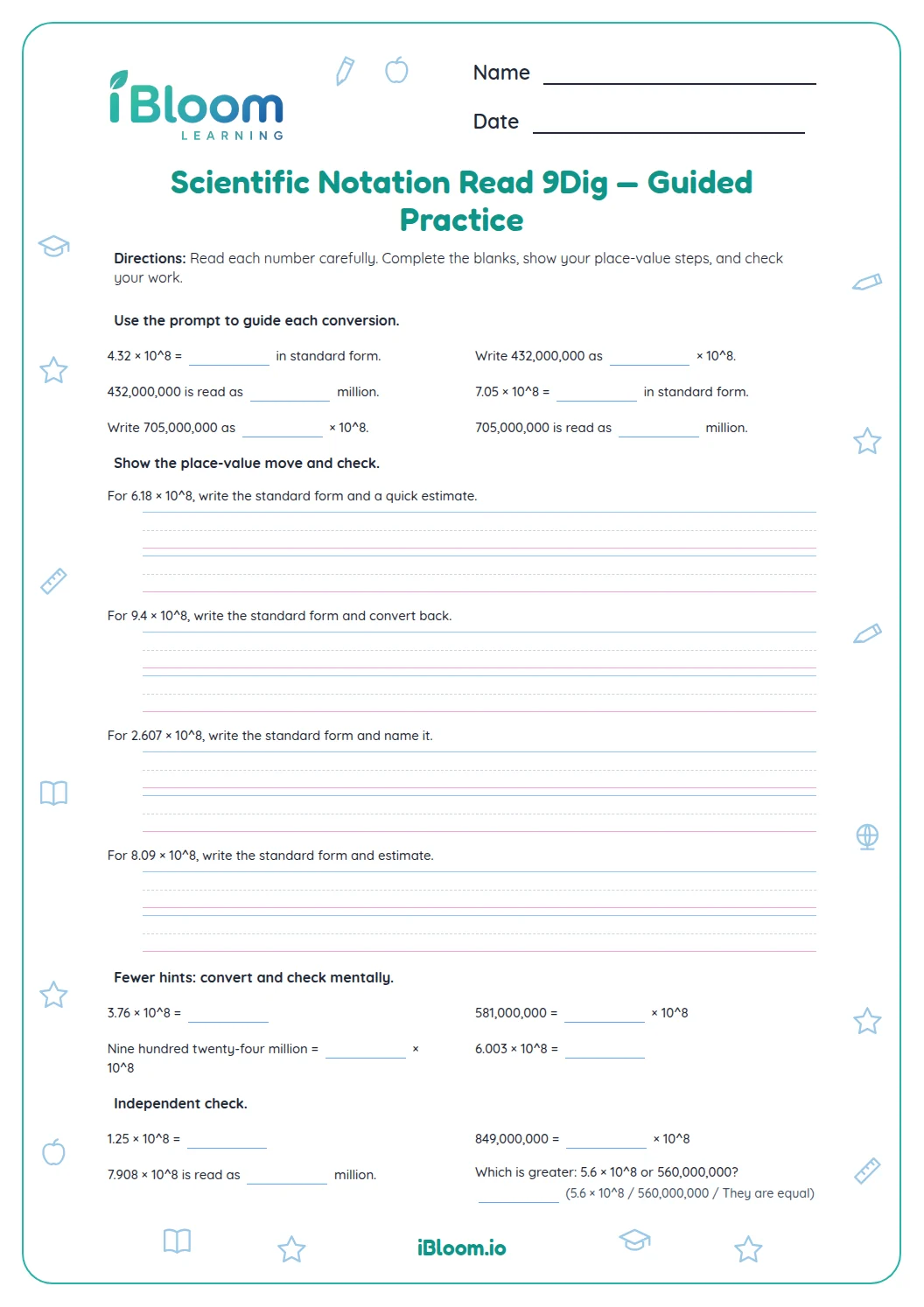
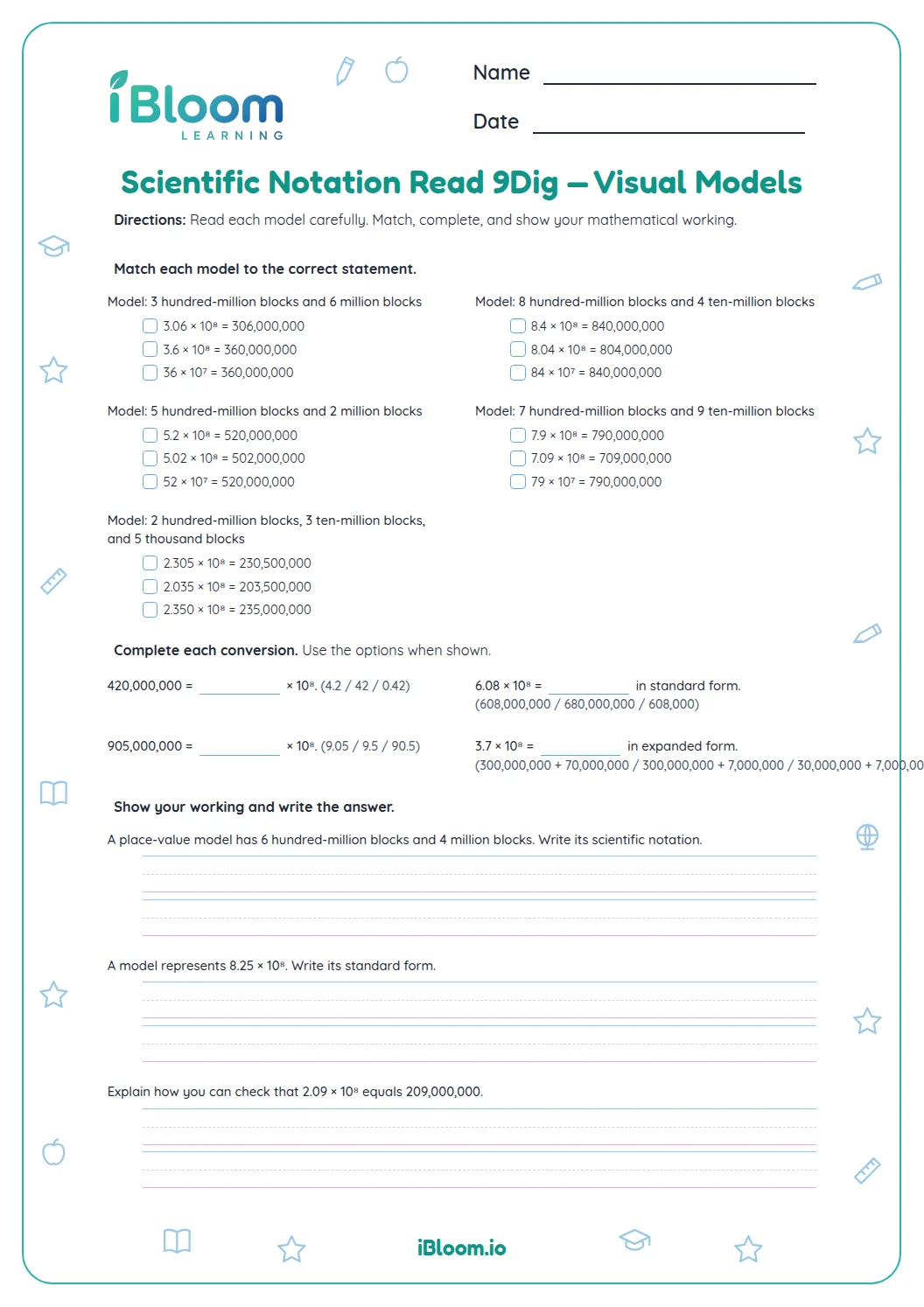
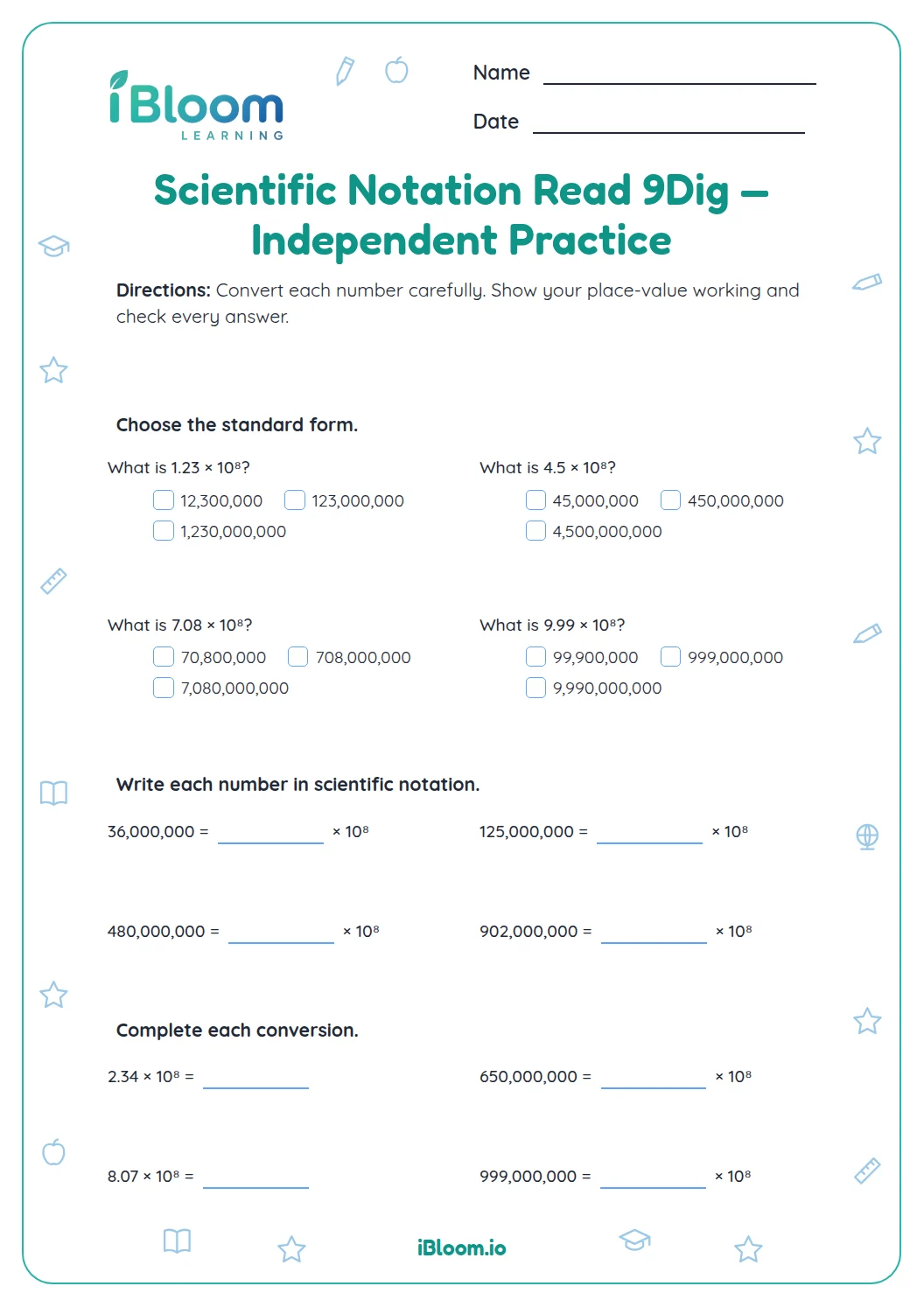
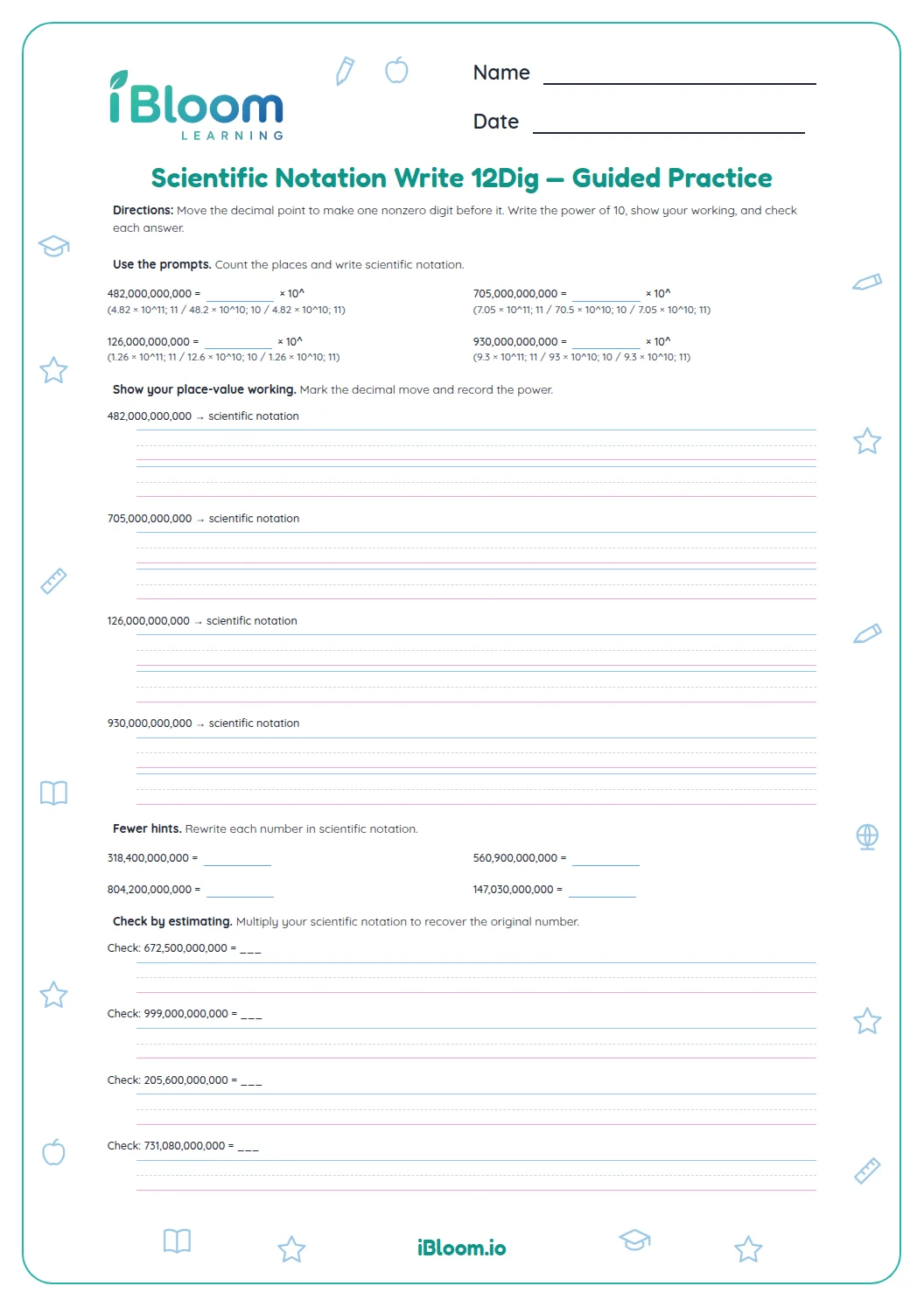
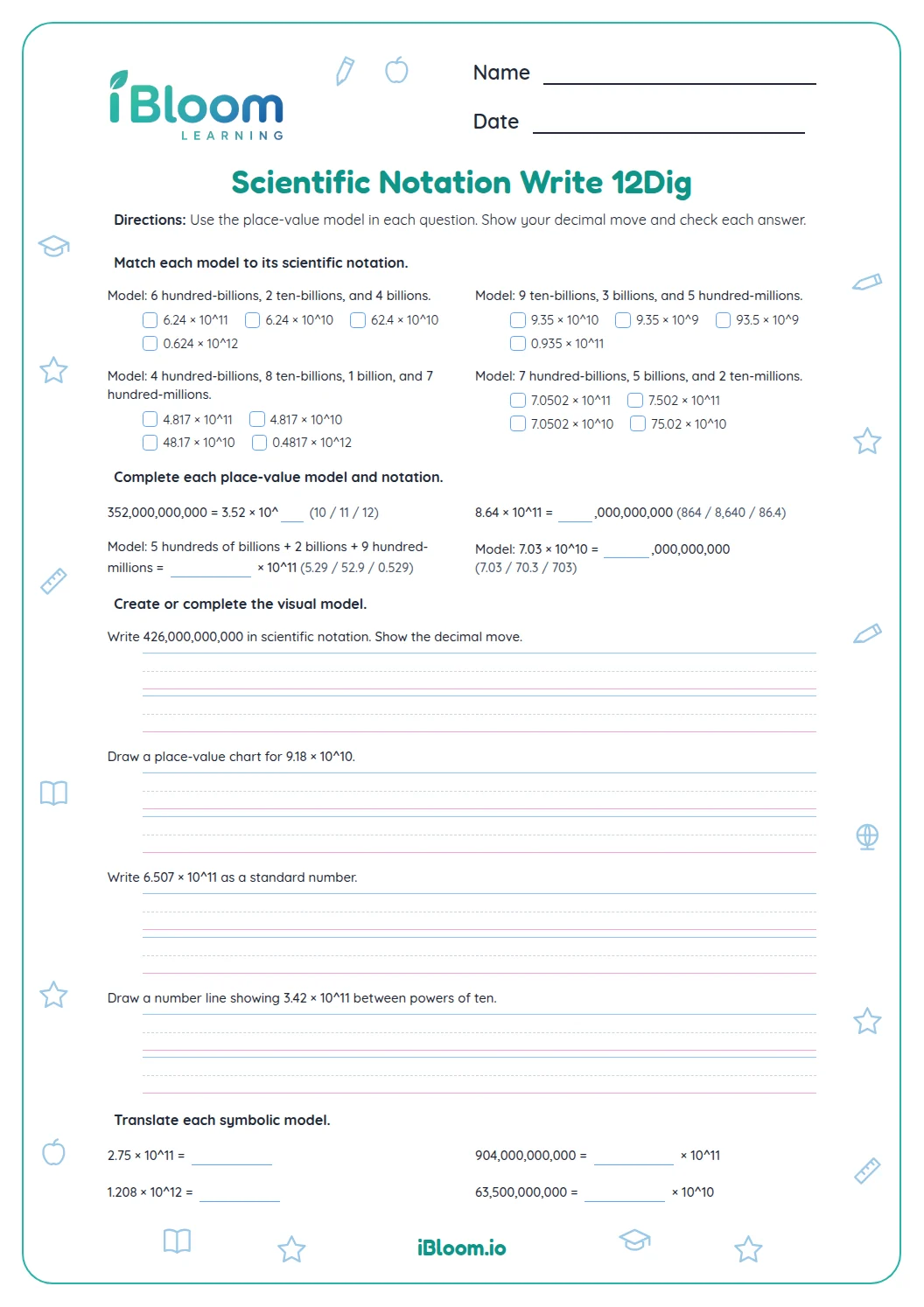
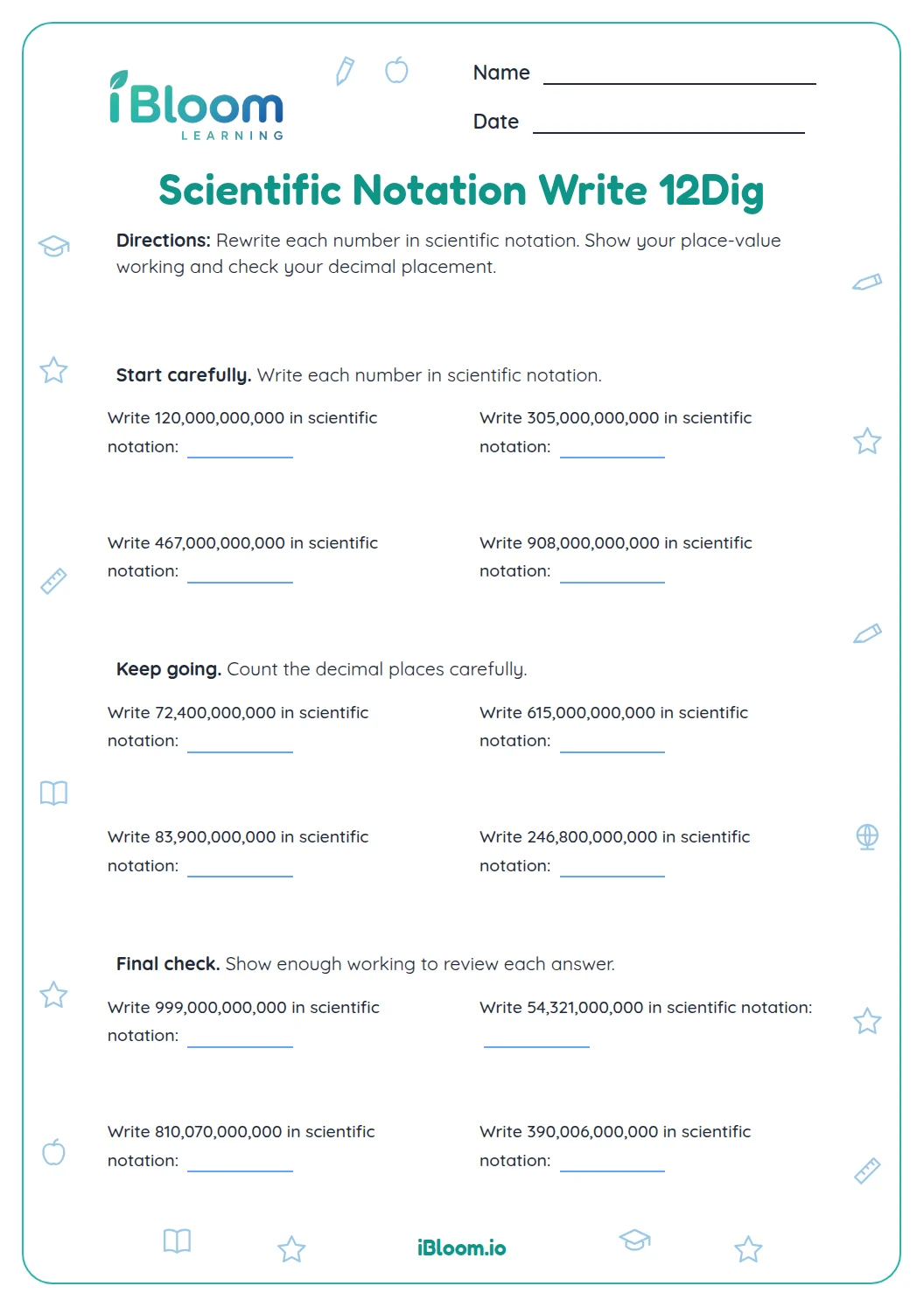
This free printable Grade 6 worksheet builds place-value fluency with 12-digit numbers and scientific notation. Students first name digit values and identify a named place, then convert large quantities between standard form and scientific notation and compare two quantities. The answer key shows the correct value or equivalent form for all 16 questions.
What does this worksheet ask students to do?
The first eight questions name places or digit values in numbers with as many as 12 digits. The next eight connect standard form to scientific notation and compare real-world-sized quantities.
The numbers are broken into readable groups with commas. Students still need to identify each place accurately rather than count digits from the left.
How does scientific notation show a large quantity?
Scientific notation writes a number as a factor from 1 up to (but not including) 10 times a power of ten. The exponent tells how many places the decimal point moves to return to standard form.
For q9, 4.20815 × 10⁹ moves the decimal point nine places right, giving 4,208,150,000.
- 14.20815 × 10⁹
- 2Move the decimal 9 places right: 4,208,150,000.
How can students compare numbers with different exponents?
First compare the powers of ten. A number multiplied by 10¹¹ is greater than a number multiplied by 10¹⁰ when the leading factors are close to 1.
For q13, 8.9 × 10¹¹ is greater than 9.1 × 10¹⁰ because the first quantity is in the hundreds of billions and the second is in the tens of billions.
How to use this worksheet
- 1Read each comma-separated number in groups of three digits.
- 2For Part A, say the digit’s place name before choosing its value.
- 3For Part B, identify the exponent and move the decimal the matching number of places.
- 4Compare the size of the powers of ten before comparing the factors.
- 5Use the answer key to check both the digit place and the complete number.
Common mistakes and quick fixes
The mistake
Reading 8 as 8,000,000 in q1.
The fix
Count the place from the right: the 8 is in the hundred-millions place, so its value is 800,000,000.
The mistake
Moving the decimal left for a positive exponent.
The fix
A positive exponent makes a number at least as large as its factor; move the decimal right to write standard form.
The mistake
Comparing only the leading digits in q13.
The fix
Compare the exponents first: 10¹¹ is ten times 10¹⁰, so 8.9 × 10¹¹ is larger here.
What to practice next
Make more practice
Questions parents and teachers ask
What does the exponent mean?
The exponent tells how many places the decimal point moves to write a number in standard form. In 4.20815 × 10⁹, move it nine places right to get 4,208,150,000. The factor stays the same while its scale changes.
How do I find a digit’s value?
Locate the digit, name its place, then multiply the digit by that place value. In q1, 8 is in the hundred-millions place, so it represents 80,000,000,000. A digit’s face value and its value in the whole number are different.
Why are commas helpful in long numbers?
Commas separate a whole number into groups of three digits, starting from the right. Read the group names from right to left: ones, thousands, millions, billions and trillions. The commas help you find a digit’s place without counting every digit individually.
Can scientific notation represent a number smaller than one?
Yes. A negative exponent moves the decimal point left, making a small positive value. This sheet practices large quantities and positive exponents, so its examples move the decimal point to the right when converting back to standard form. Use a negative exponent when the value is smaller than one.
What should students check in the answer key?
Check that the named digit has the right place value and that every conversion matches its exponent. For example, 3.05 × 10¹¹ equals 305,000,000,000. If a zero group is missing, compare groups of three digits to locate the error.
What practice can come next?
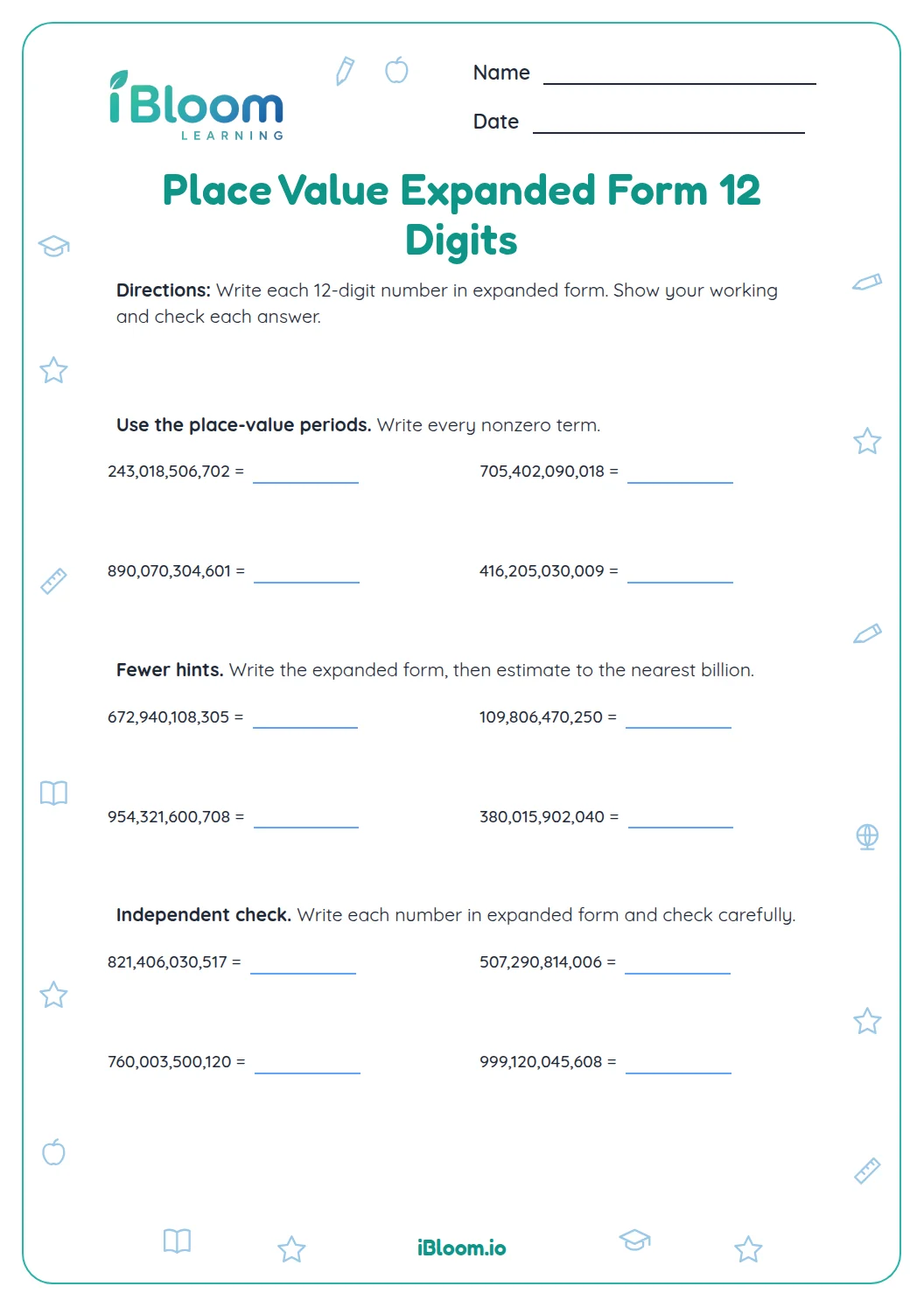
Students can read nine-digit quantities, convert 12-digit numbers into scientific notation, or write numbers in expanded form. The linked sibling activities revisit place value with different digit counts and conversion directions, with additional chances to explain how the place values relate.