





About this worksheet
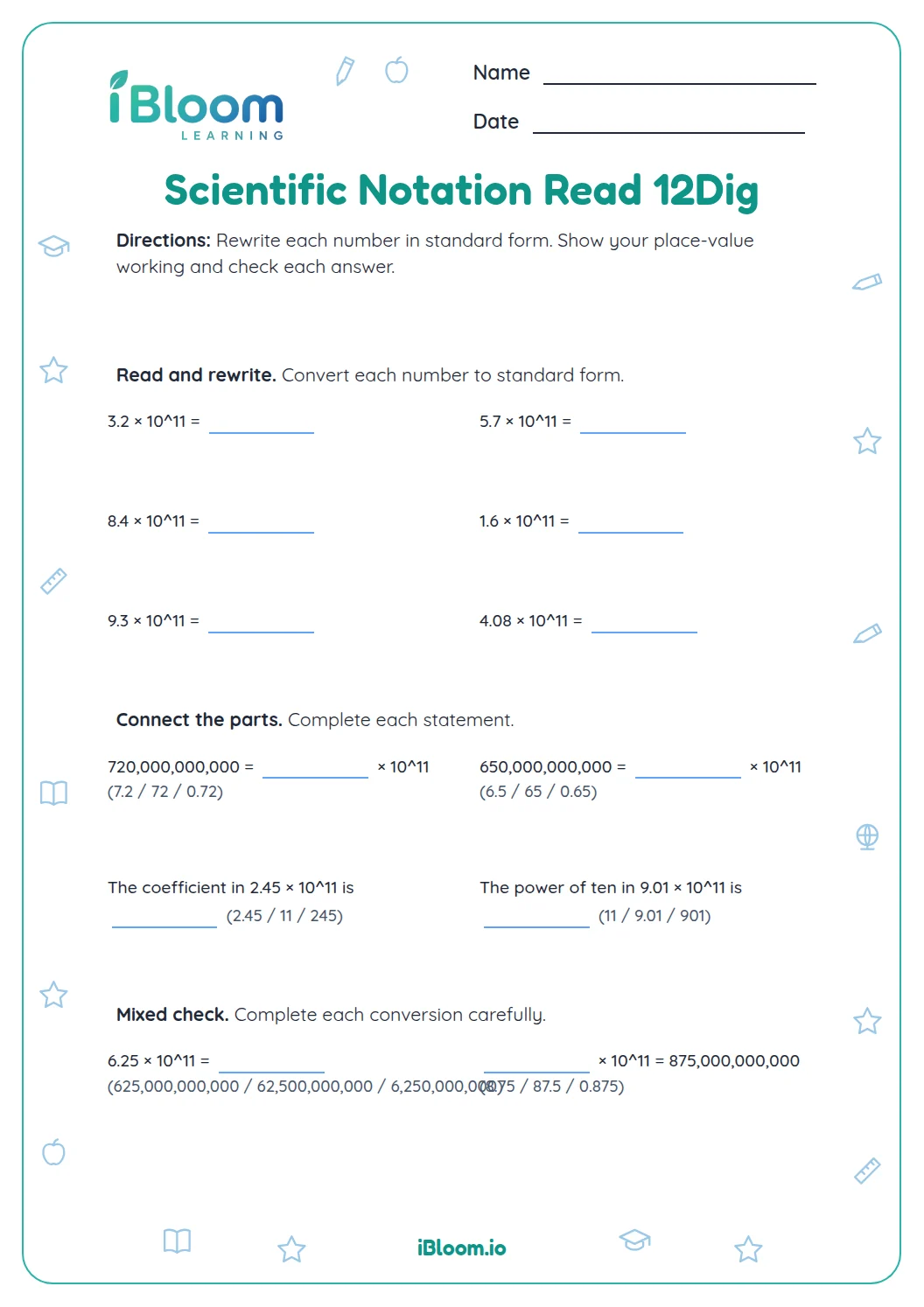
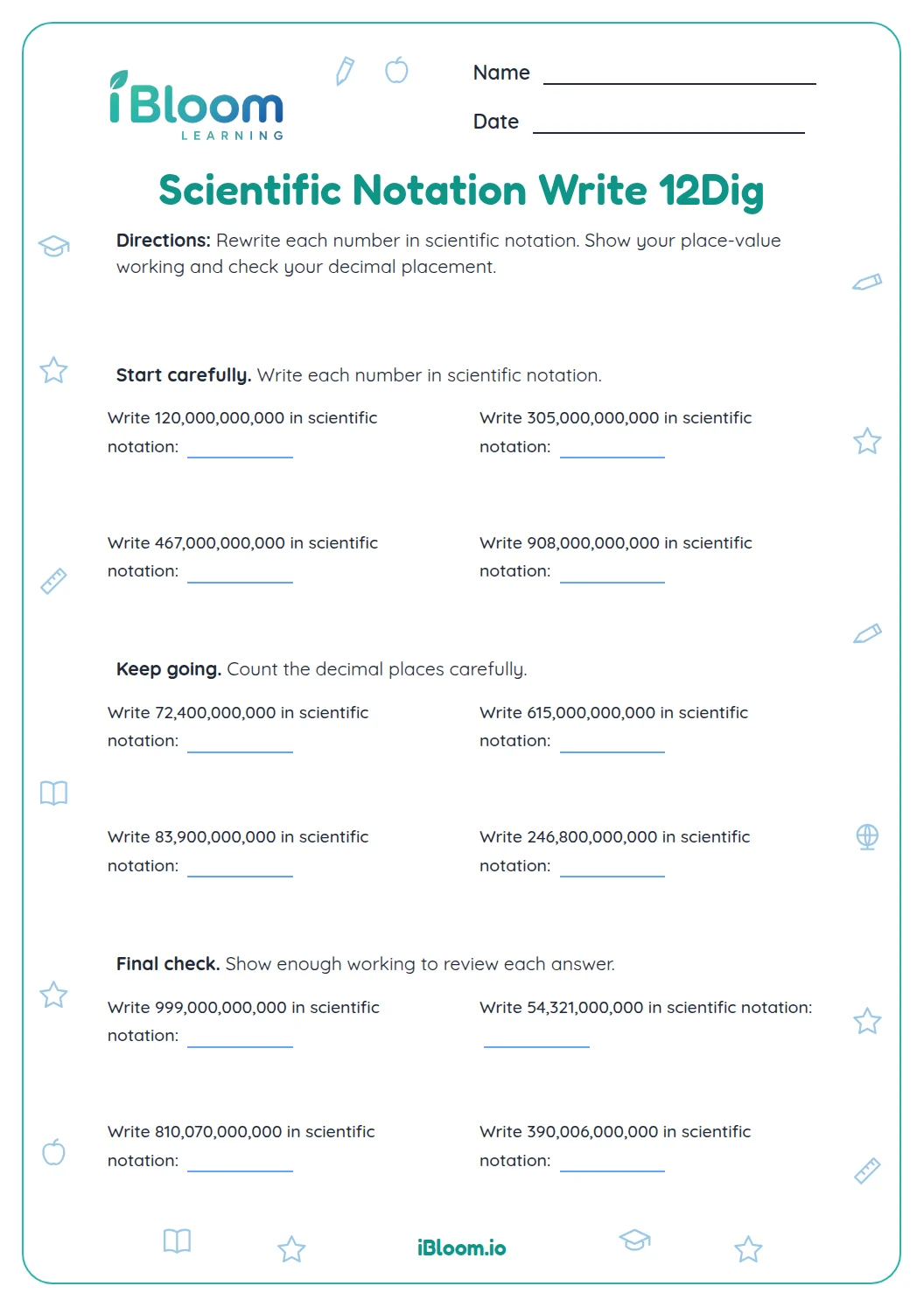
This Grade 6 worksheet gives students practice reading and converting large numbers written with powers of ten. Fifteen questions move from reading values aloud to writing standard form and comparing magnitudes. A separate answer key shows each result.
Aligned to 6.EE.A.1
What is on this worksheet?
Part A asks students to read scientific notation and write its standard form.
Parts B and C compare large values and check place-value shifts.
- Part A: read and convert powers of ten
- Part B: compare values in scientific notation
- Part C: check digit counts and equivalent forms
- A separate answer key is included
How should students approach the harder questions?
For a positive exponent, move the decimal point right. Then place commas in groups of three digits.
- 16.25 × 10^11 = 625,000,000,000.
- 2Read the groups from left to right: six hundred twenty-five billion.
Why practice this skill?
Scientific notation lets readers express very large quantities compactly and compare their scale.
How to use this worksheet
- 1Read the direction under each part before beginning.
- 2Work one question at a time and show calculations when a problem asks for them.
- 3Use the answer key to discuss any answer that was difficult to explain.
- 4Ask the student to make one new example using the same skill.
Common mistakes and quick fixes
The mistake
Moving the decimal the wrong direction for a positive exponent.
The fix
A positive exponent makes a number of at least 1 grow; move the decimal right.
The mistake
Forgetting placeholder zeros.
The fix
After moving the decimal, fill each skipped place with a zero before grouping digits.
Curriculum alignment
This practice targets the stated Common Core skill for the grade.
Evaluate whole-number powers of ten in scientific notation.
On this sheet: Questions use powers of ten to convert scientific notation and compare values.
Show the official wordingHide the official wording
Write and evaluate numerical expressions involving whole-number exponents.
What to practice next
Make more practice
Questions parents and teachers ask
How do I read a number such as 3.04 × 10^10?
A positive exponent means the value grows from the coefficient, so move the decimal point to the right. Move it exactly as many places as the exponent names. Use zeros as placeholders wherever the coefficient has no digit to move into that place.
Does the exponent tell the number of digits?
After moving the decimal, check that every place has a digit. Add zeros where needed, then place commas in groups of three from the right. This makes a long value easier to read and helps confirm its millions, billions or trillions group.
Why use scientific notation for large amounts?
The exponent tells how many places to move the decimal, not always how many digits the final number has. A coefficient such as 3.7 already has two significant digits, and shifting it ten places produces an eleven-digit whole number. Counting all places makes the result easy to verify.
What should I check after converting?
The exponent tells how many places to move the decimal, not always how many digits the final number has. A coefficient such as 3.7 already has two significant digits, and shifting it ten places produces an eleven-digit whole number.