






About this worksheet
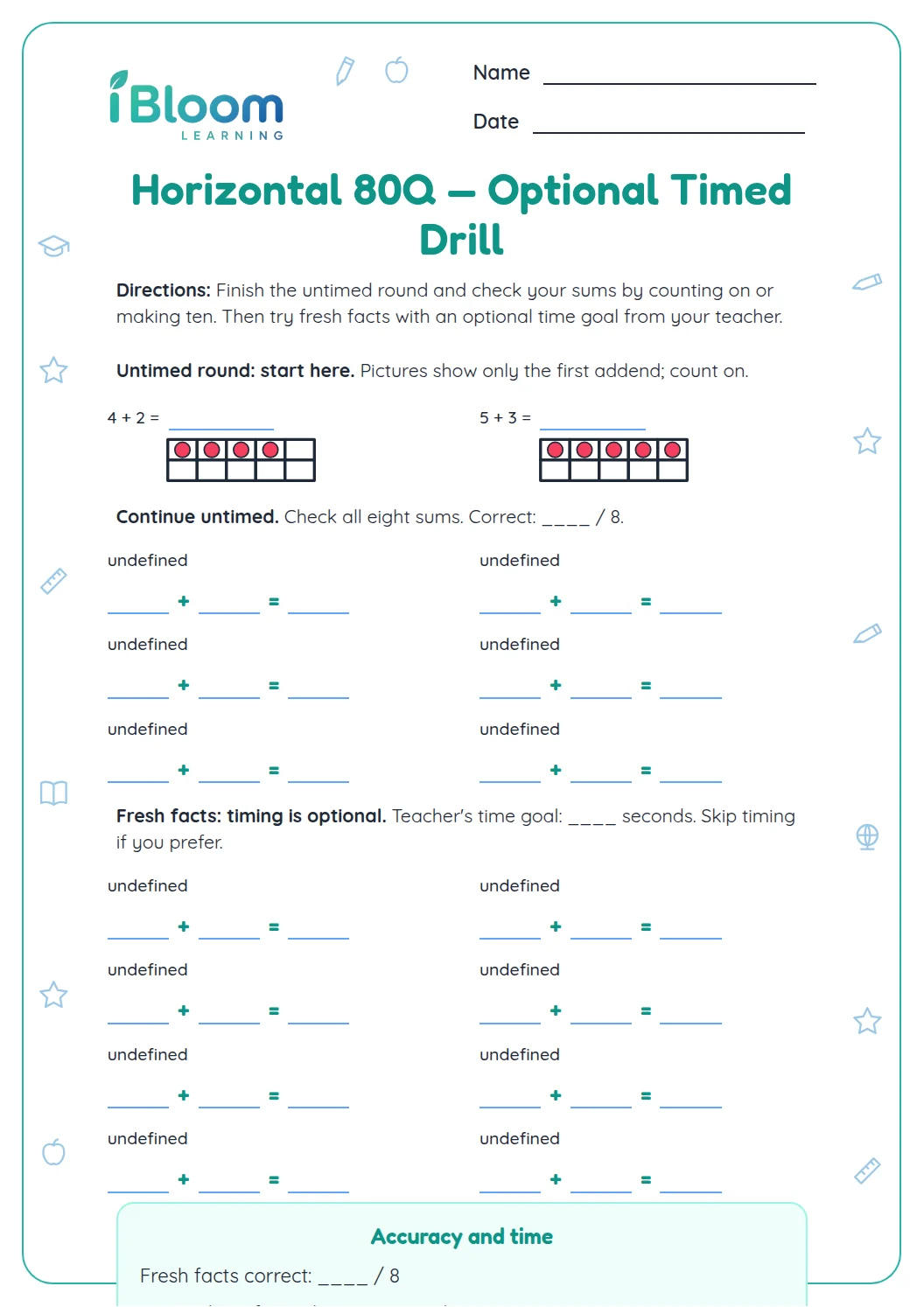
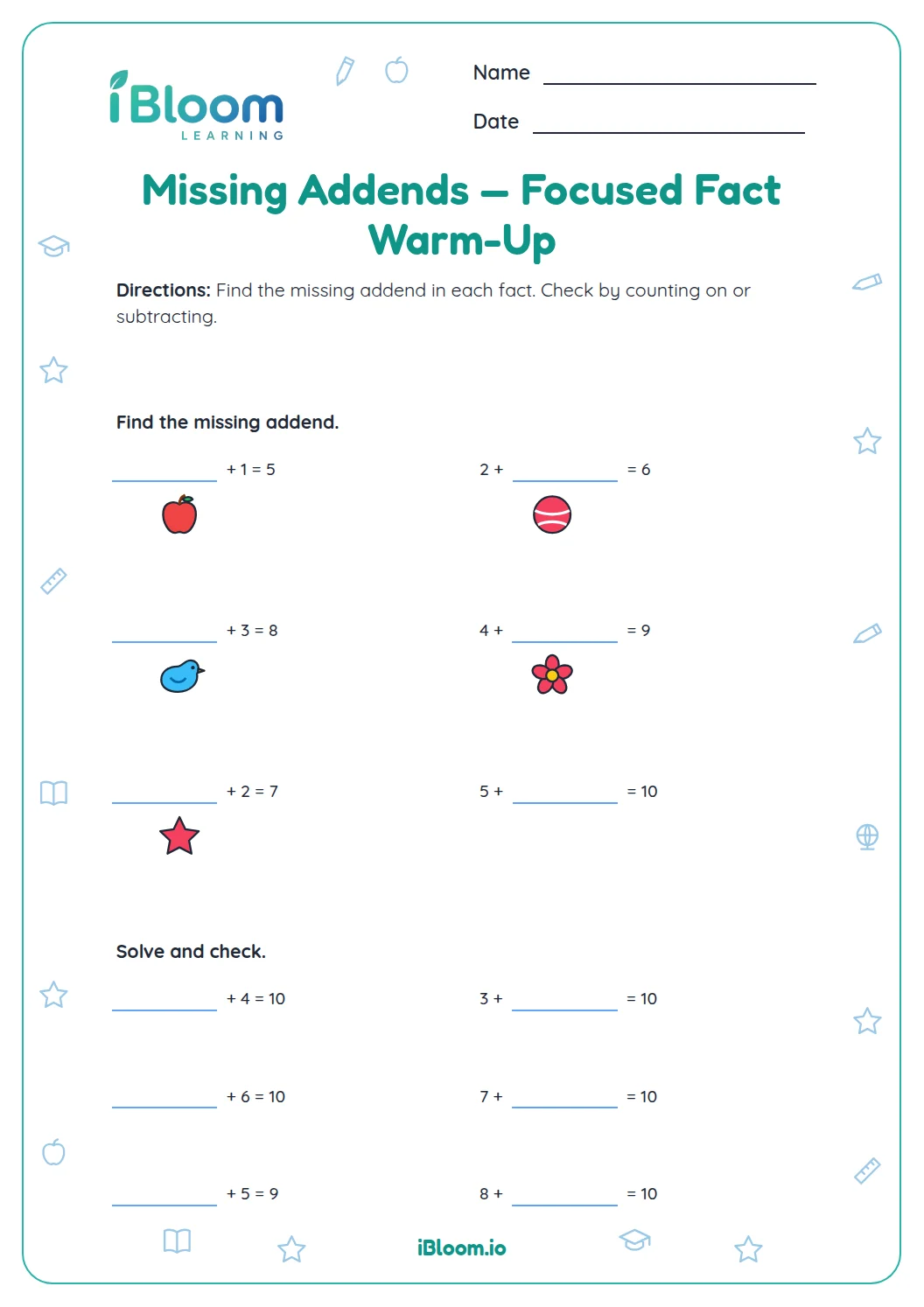
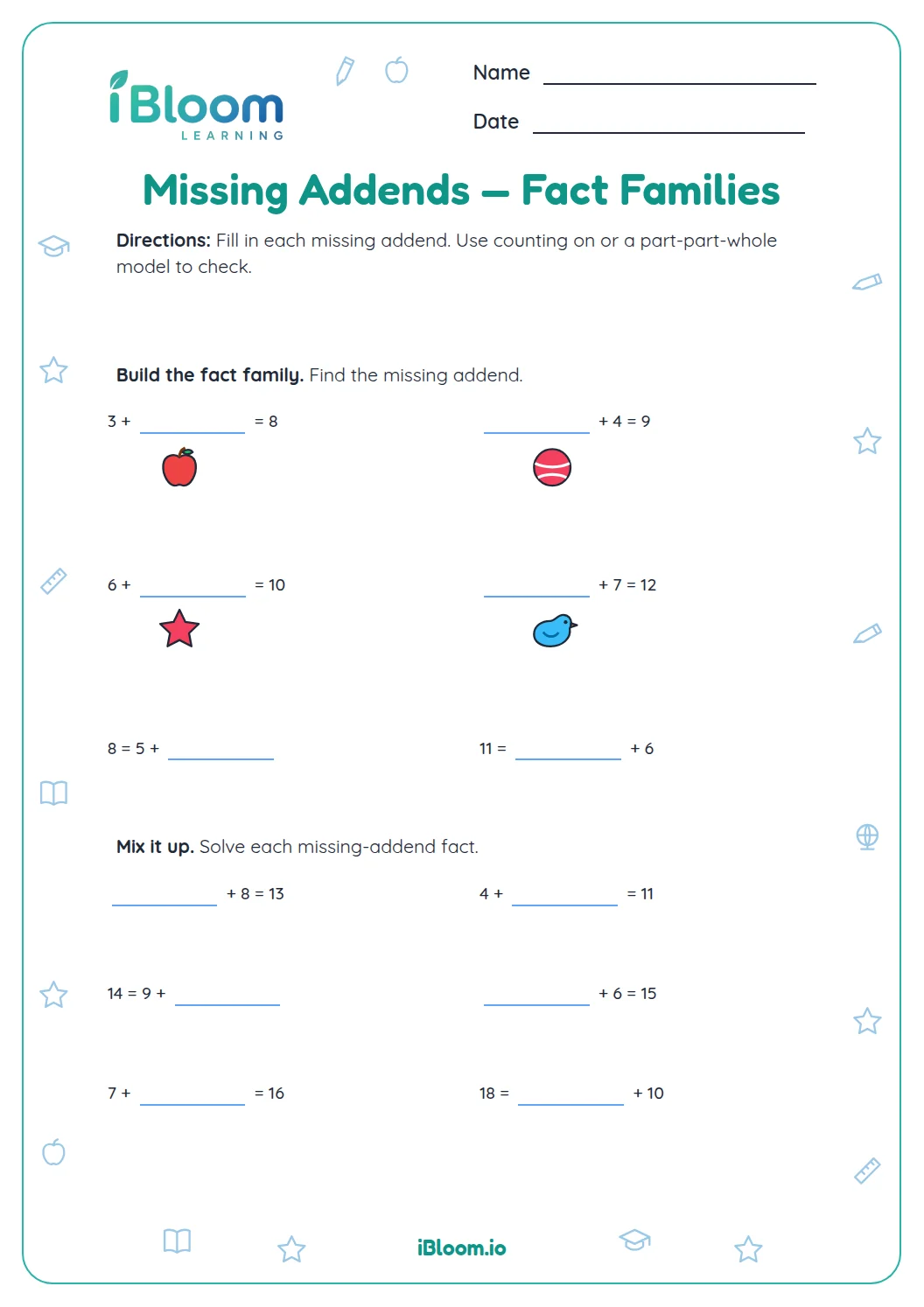
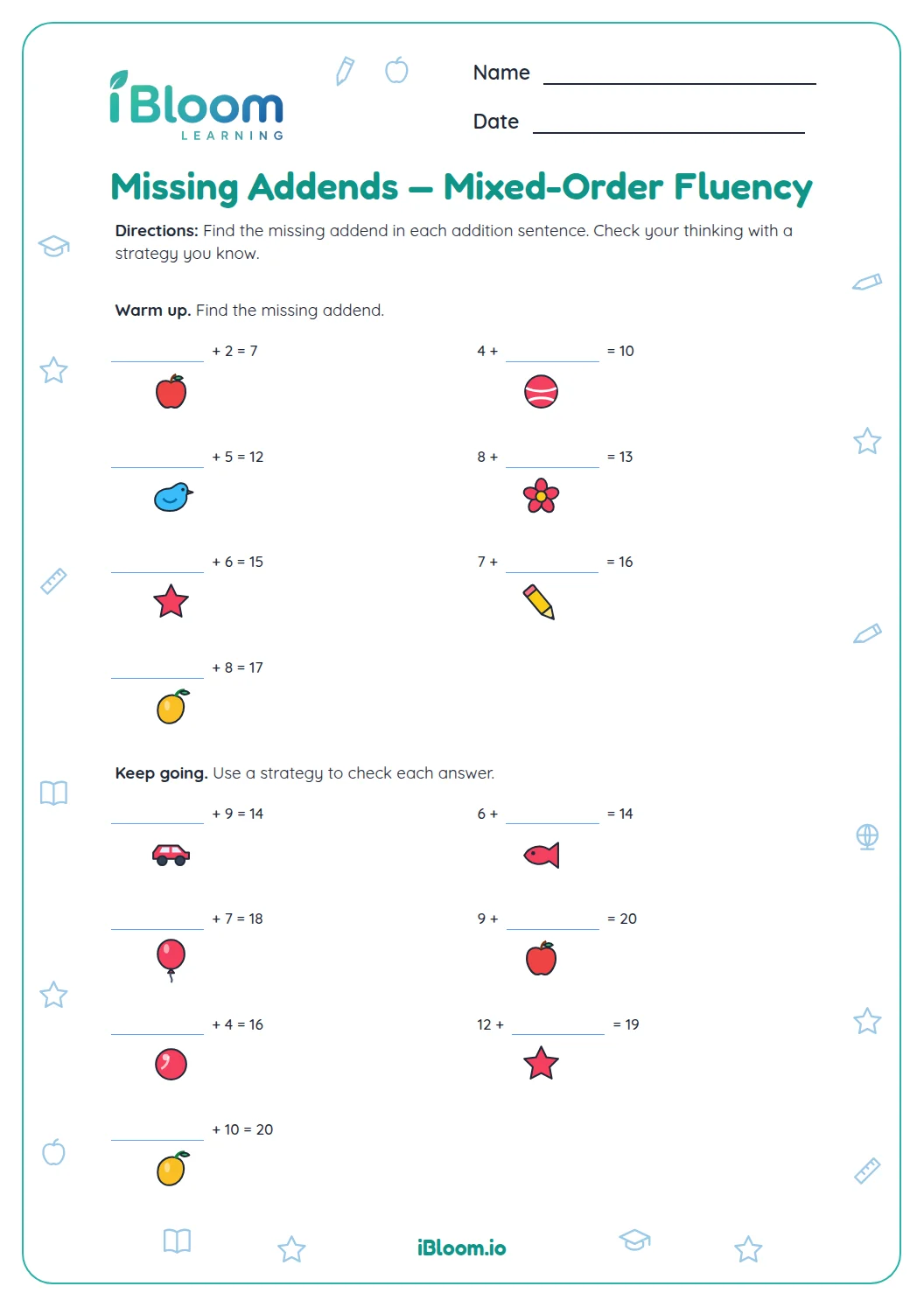
This printable Grade 1 math worksheet has 80 horizontal number sentences built around related addition and subtraction facts. Students solve addition facts with sums through 12, then subtract a part from the whole to find a related number. A separate answer key lists every answer. The page gives practice with addition and subtraction fluency described in CCSS.Math.Content.1.OA.C.6.
Aligned to CCSS.Math.Content.1.OA.C.6
What does the addition part practice?
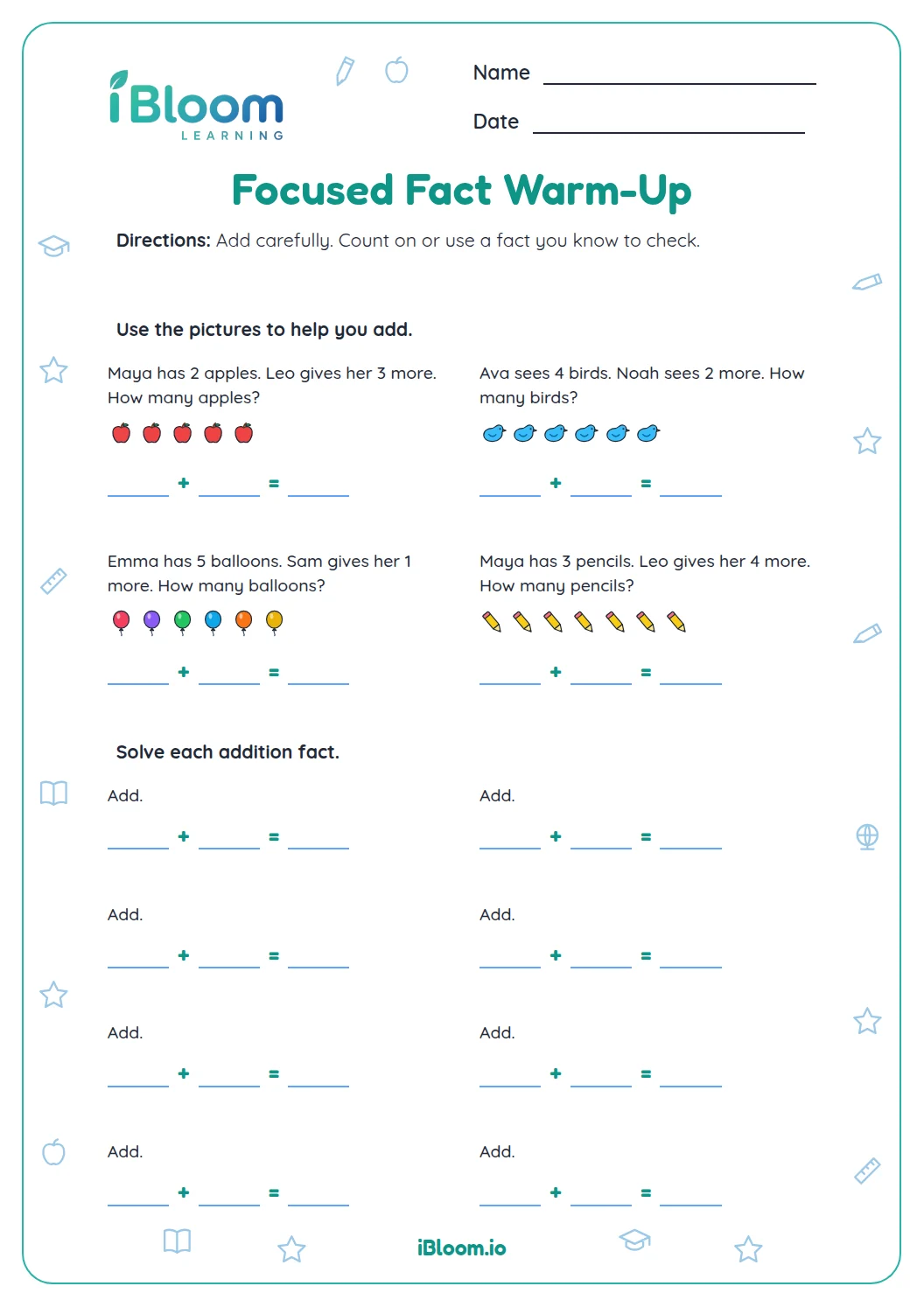
Part A has 40 addition facts in horizontal form. The equations include both orders for related addends, such as 1 + 2 and 2 + 1, so students can notice that the sum stays the same.
How does subtraction connect to addition?
Part B has 40 subtraction facts. Each subtraction sentence uses a whole and one of its parts; the missing result is the other part.
- Check a subtraction fact by adding its answer to the number subtracted.
- Keep the minus sign and the order of the numbers in view.
How can a fact family help?
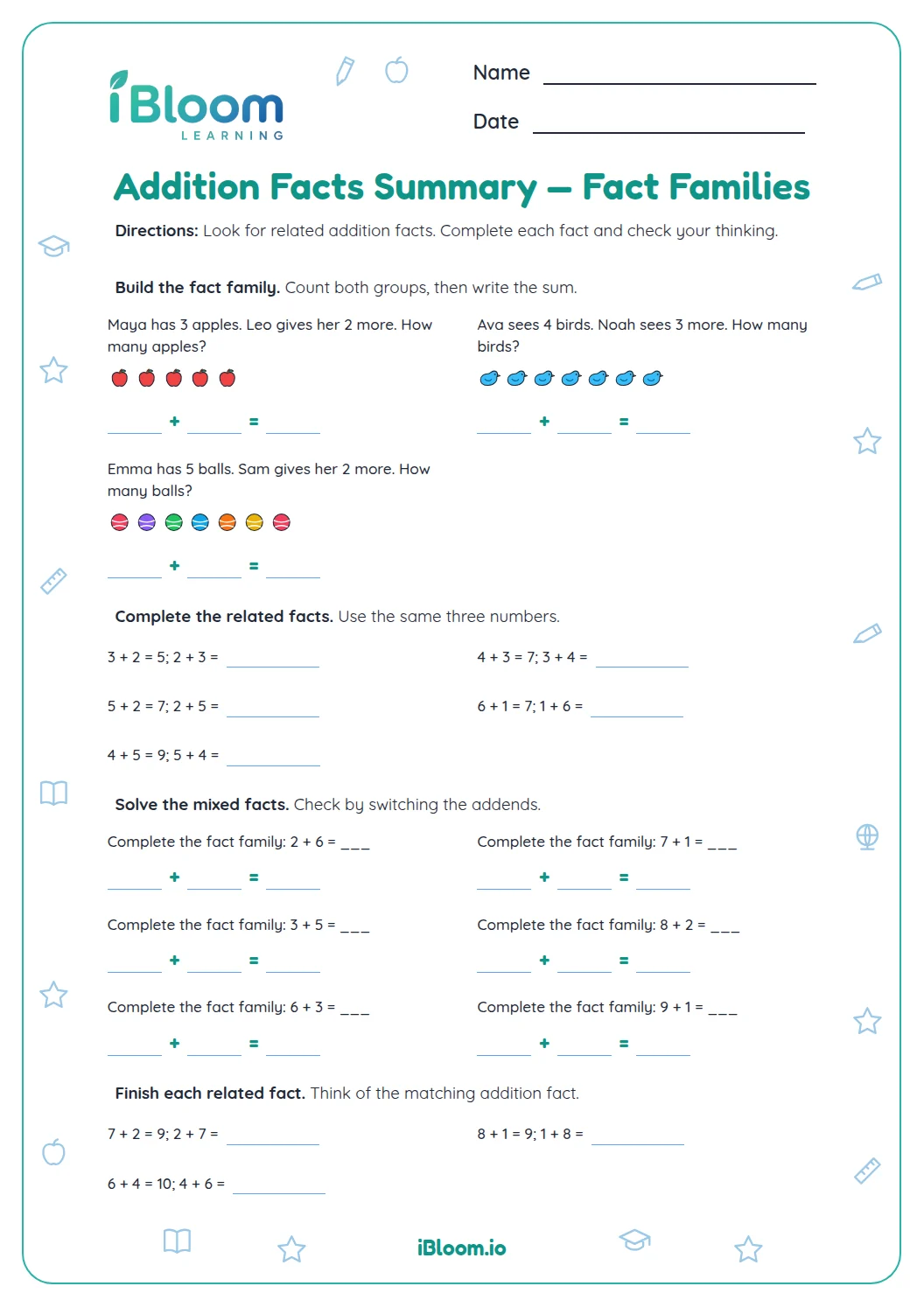
Related facts share the same three numbers. Solving one can help check another.
- 11 + 2 = 3; the related subtraction fact is 3 − 1 = 2.
How to use this worksheet
- 1Complete the addition facts in Part A.
- 2Read each number sentence from left to right.
- 3Use the whole and parts to solve Part B.
- 4Check a subtraction answer with addition.
- 5Take a short pause if you lose focus during the 80 facts.
- 6Compare answers with the key when finished.
Mistakes to watch for
The mistake
Reversing the whole and a part in subtraction.
The fix
Start with the larger number, then take away the named part.
The mistake
Changing the sum when addends switch order.
The fix
Count the same objects in a different order; the total stays the same.
The mistake
Writing a related fact’s answer in the wrong equation.
The fix
Check each equation on its own and match its numbers.
Curriculum alignment
Students solve addition and subtraction facts and use related facts to check their work.
Students practice addition and subtraction fact fluency with sums through 12.
On this sheet:
Show the official wordingHide the official wording
Add and subtract within 20, demonstrating fluency for addition and subtraction within 10. Use strategies such as counting on; making ten (e.g., 8 + 6 = 8 + 2 + 4 = 10 + 4 = 14); decomposing a number leading to a ten (e.g., 13 - 4 = 13 - 3 - 1 = 10 - 1 = 9); using the relationship between addition and subtraction (e.g., knowing that 8 + 4 = 12, one knows 12 - 8 = 4); and creating equivalent but easier or known sums (e.g., adding 6 + 7 by creating the known equivalent 6 + 6 + 1 = 12 + 1 = 13).
What to practice next
Make more practice
Further reading
Questions parents and teachers ask
How many problems are on this fact families page?
There are 80 horizontal number sentences: 40 addition facts in Part A and 40 subtraction facts in Part B. The questions use related numbers so students can connect sums to differences. The separate answer key follows the same problem order.
What is a fact family?
A fact family uses the same three numbers in related addition and subtraction sentences. For example, 1 + 2 = 3 connects to 3 − 1 = 2. This worksheet gives repeated practice with those relationships across many number pairs.
What number range does the worksheet use?
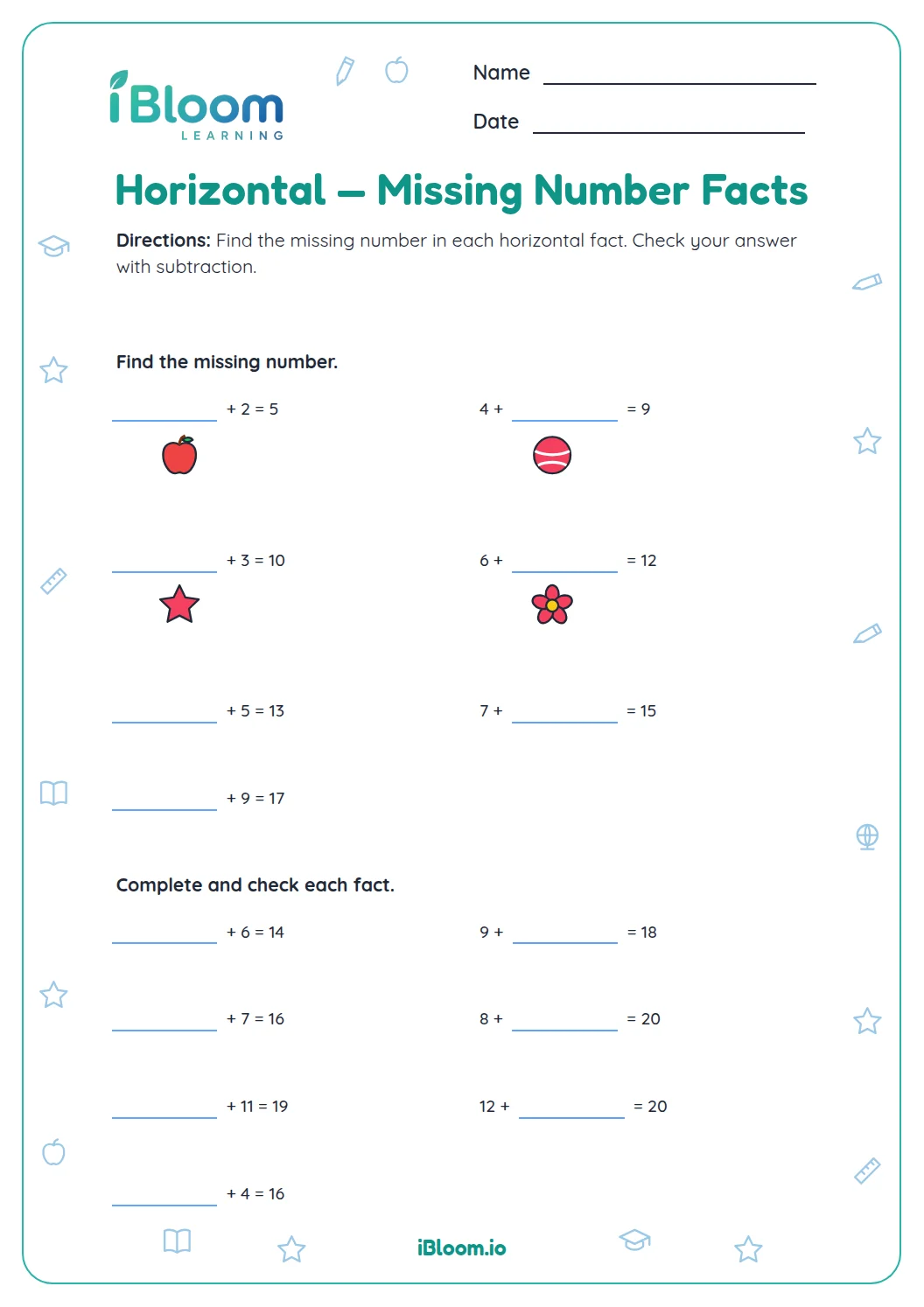
The addition sums range from 3 through 12, and the related subtraction facts stay within that range. These are horizontal equations with one missing answer. Students can use counting or a known related fact to solve each one. Each equation has its own matching answer in the printed key.
How can a student check a subtraction answer?
Add the answer to the number that was taken away. For example, if a student solves 3 − 1 = 2, checking 2 + 1 = 3 confirms the relationship. The key provides the expected answer for each individual equation.
How should families pace 80 questions?
The worksheet is four pages, so a student can complete one page at a time or take a brief pause between parts. Encourage careful reading of each sign and number. Check the answer key after the student has worked through a set.