





About this worksheet
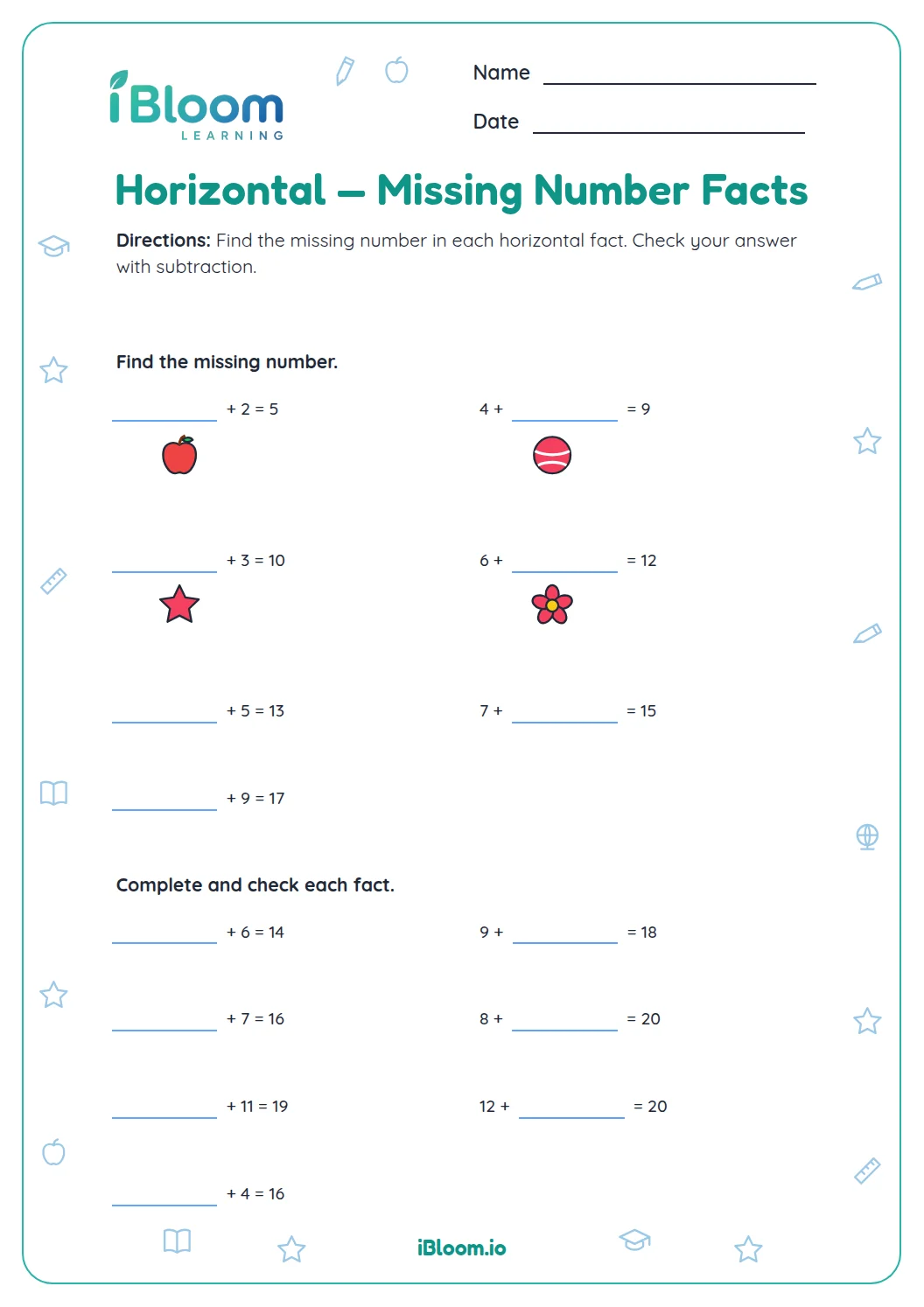
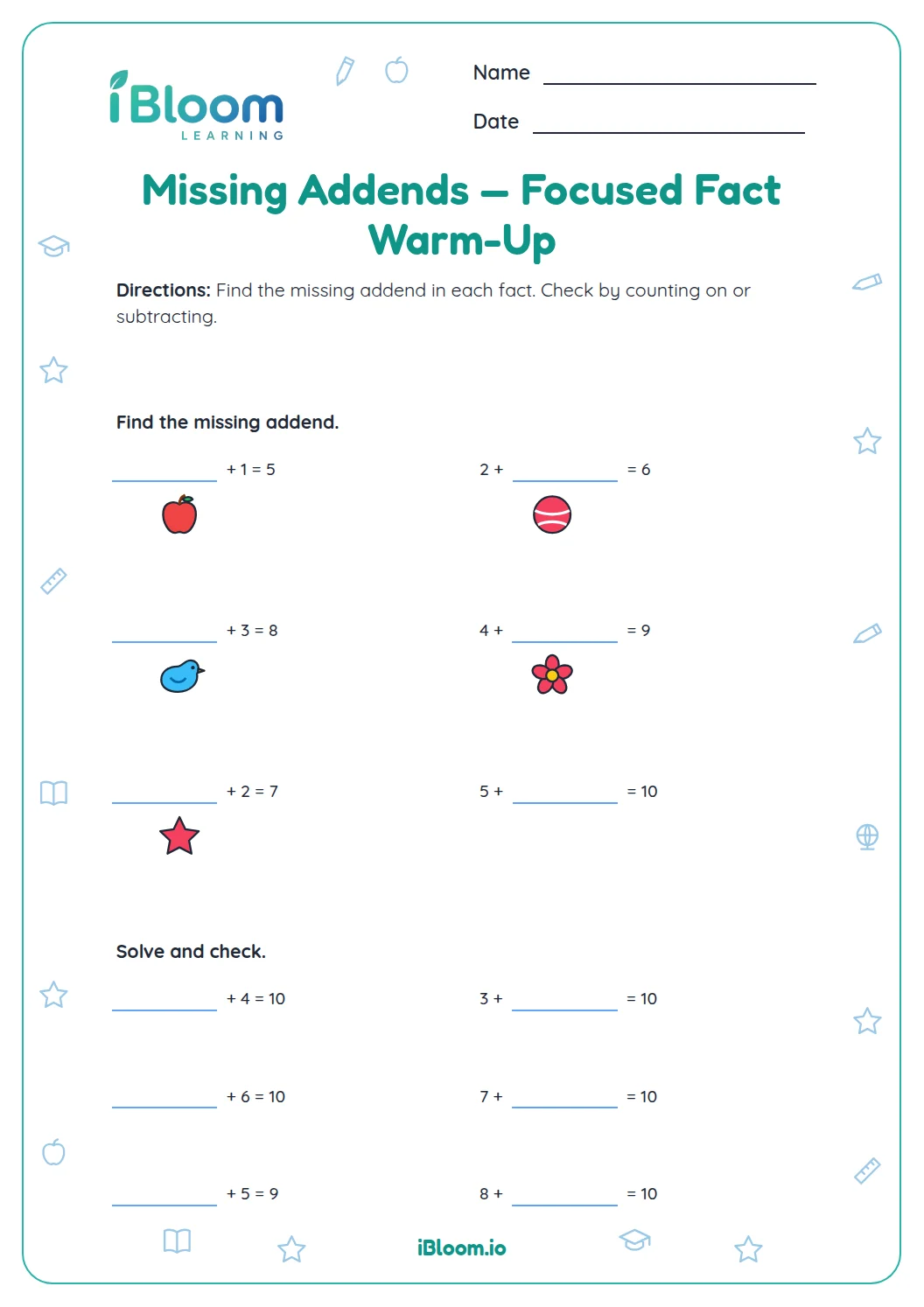
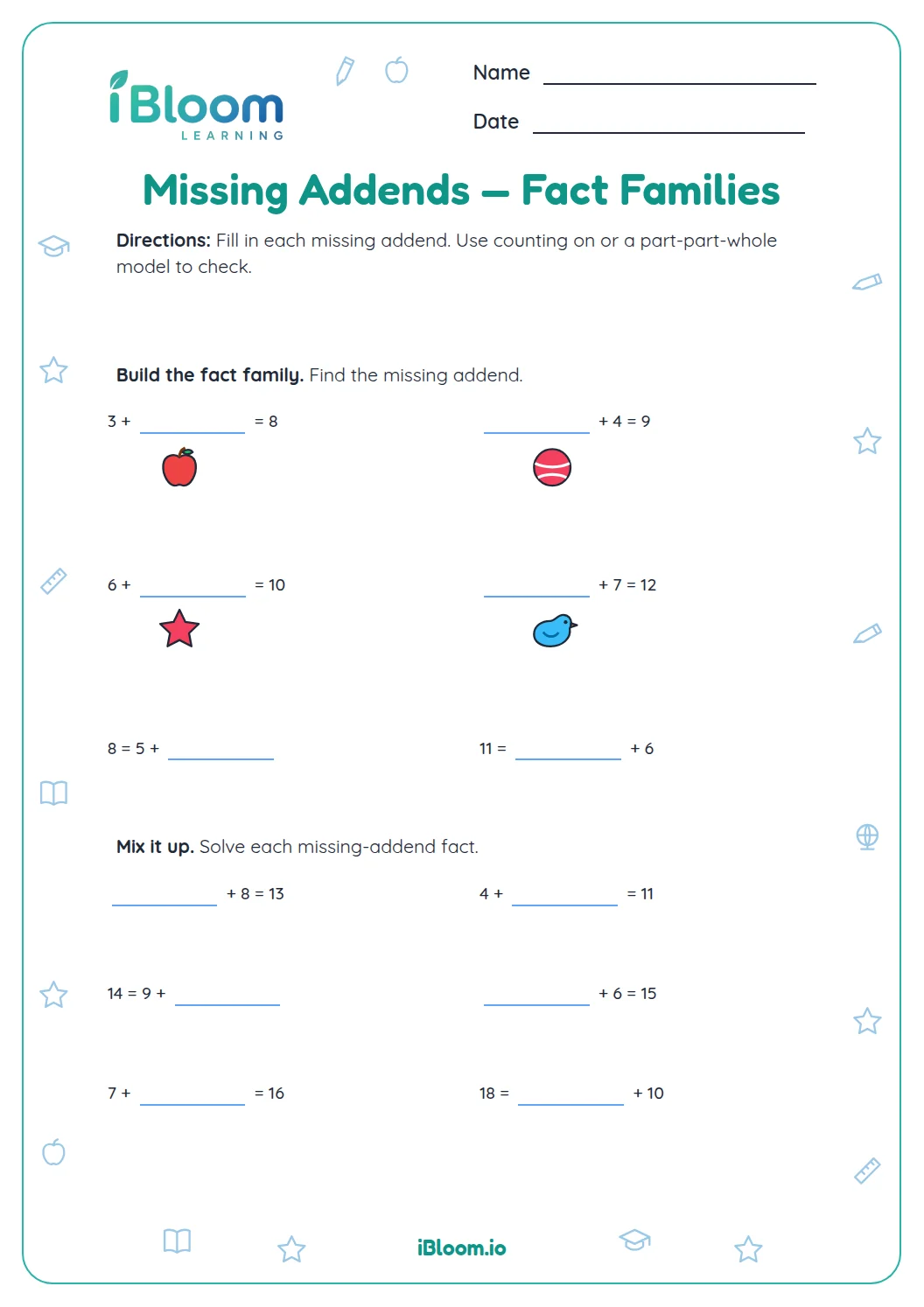
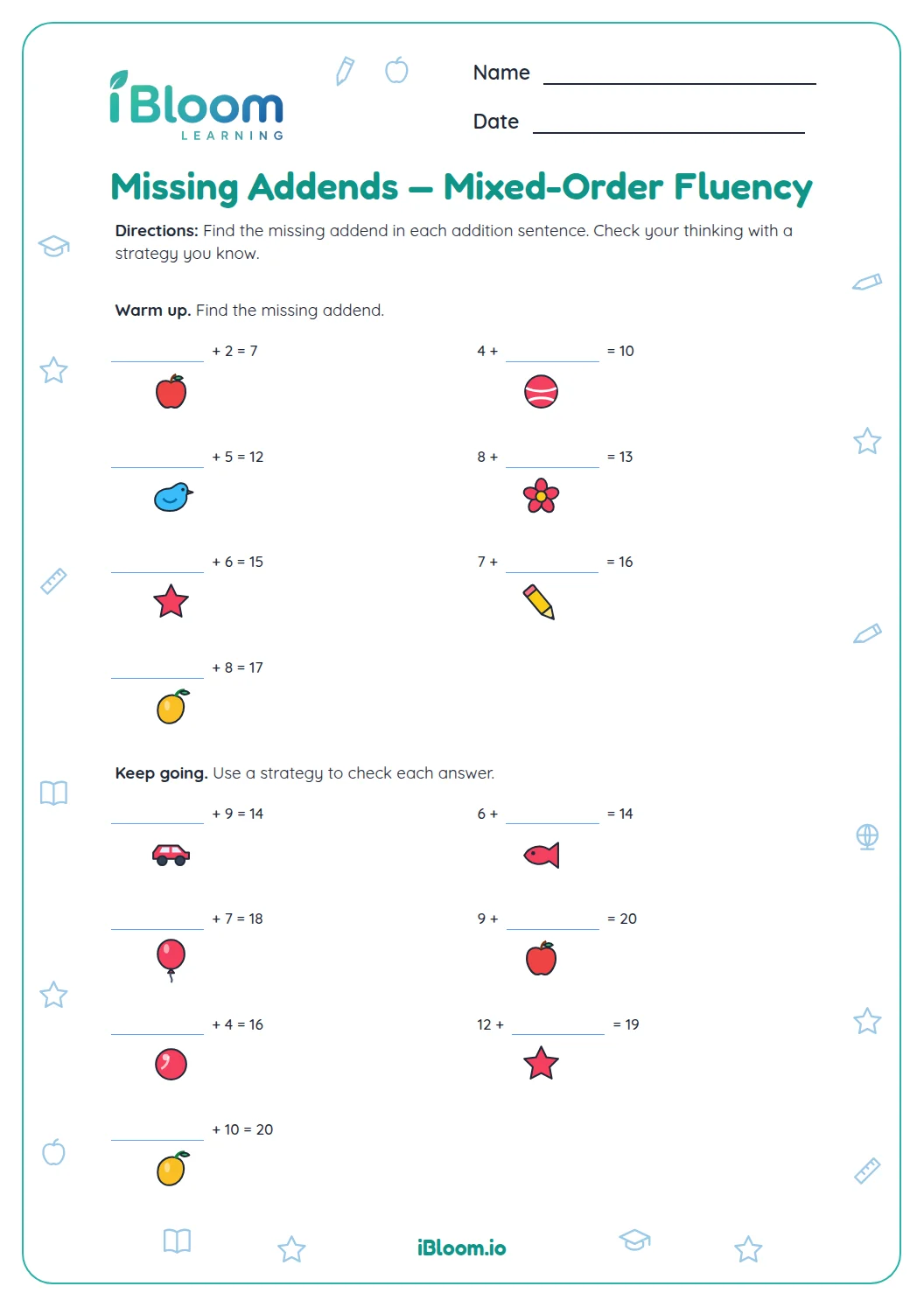
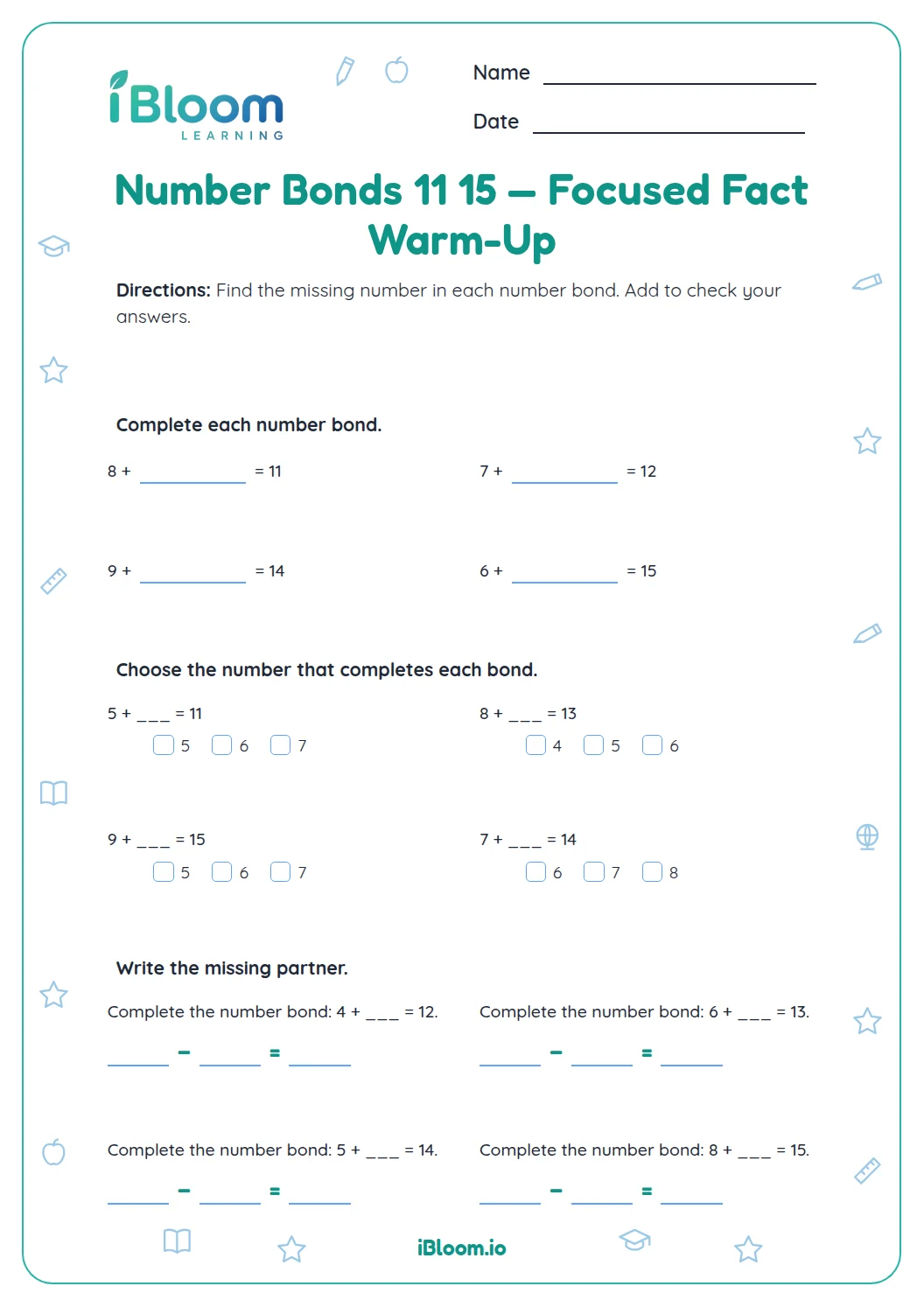
This Grade 1–2 printable connects parts and wholes to addition facts. Students find missing parts in eight number bonds, then solve eight horizontal equations with sums within 20. The separate answer key lists each missing number and sum. Number bonds make the relationship between parts and whole visible as students build addition fluency.
How does a number bond show an addition fact?
A number bond shows a whole and its two parts. If the whole is 13 and one part is 6, the other part must be 7 because 6 + 7 = 13. The bond makes the relationship visible before a student writes the equation.
In question 1, the whole is 13 and one part is 4. Find the missing part by asking what combines with 4 to make 13.
- 1Whole: 13
- 2Known part: 4
- 34 + 9 = 13, so the missing part is 9.
How can a known fact help with a new equation?
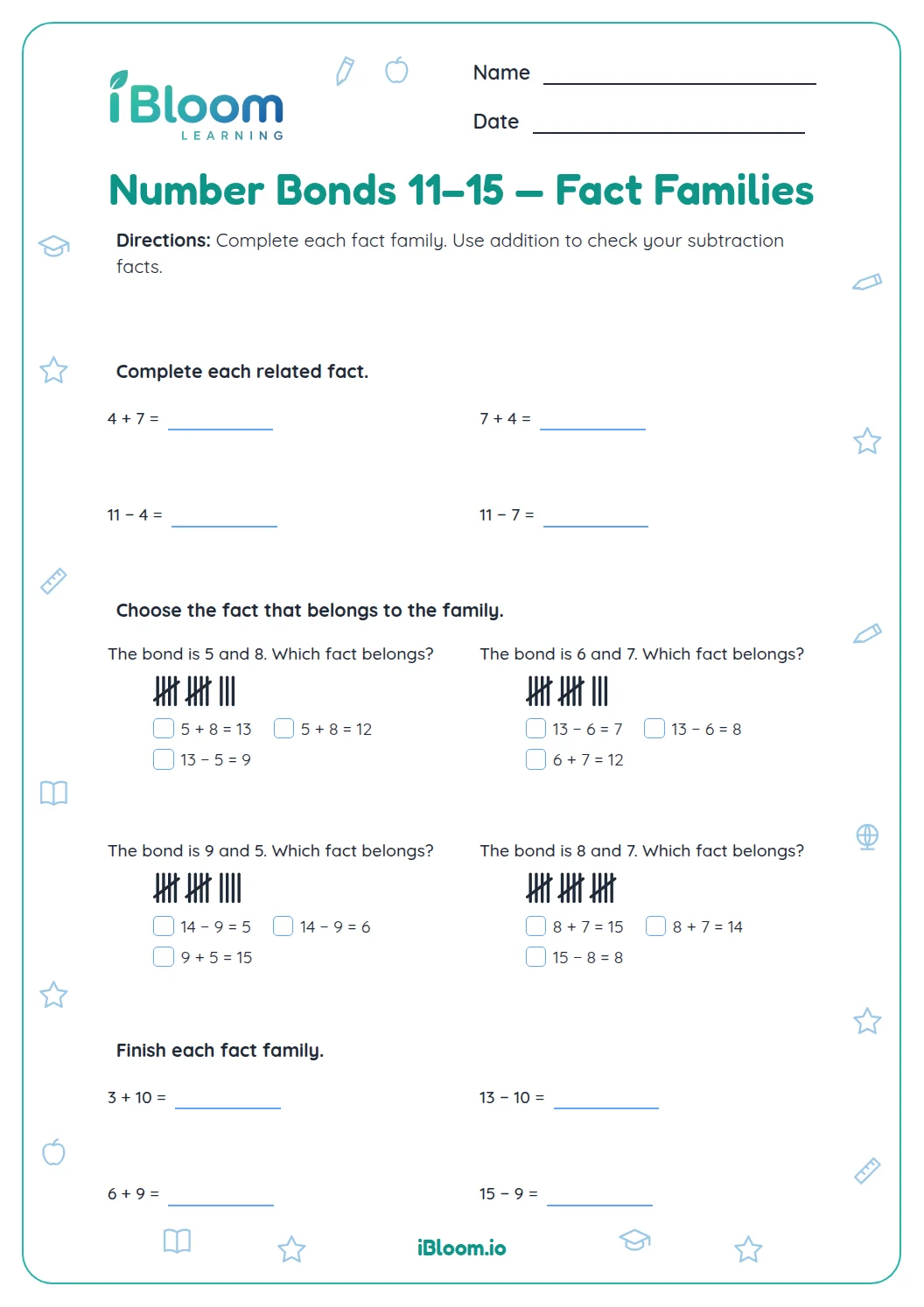
Addition facts can check one another. If 9 + 4 = 13, then 13 is the whole and 9 and 4 are its parts. Subtraction reverses that relationship: 13 − 9 = 4.
Part B practices finding sums. Students can use the same part-and-whole idea to make sure each sum fits its addends.
What will students complete?
The sheet has eight number bonds and eight horizontal addition equations. All sums stay within 20, and every item has one answer. The answer key is printed separately.
How to use this worksheet
- 1Name the whole and the known part in each bond.
- 2Ask which number joins the known part to make the whole.
- 3For an addition equation, combine the two addends to find the sum.
- 4Check that the parts add to the whole in a fact family.
- 5Use the answer key to review and explain one relationship aloud.
Common mistakes and quick fixes
The mistake
Subtracting the known part from the wrong number.
The fix
The whole is the total; compute whole minus known part.
The mistake
Writing an addend as the sum.
The fix
Check by adding both parts and comparing with the whole.
The mistake
Treating related facts as unrelated problems.
The fix
Keep the same three numbers together and identify their part–whole roles.
What to practice next
Make more practice
Questions parents and teachers ask
What is a fact family?
A fact family is a group of equations that use the same numbers. The parts combine to make a whole, and subtraction can reverse the addition. For example, 6 + 7 = 13 and 13 − 6 = 7 use the same three numbers.
How do children solve a missing part?
Start with the whole and take away the known part, or think of the addition fact that makes the whole. In a bond with whole 13 and part 4, the missing part is 9 because 4 + 9 = 13.
Are the questions within 20?
Each number bond and equation uses a sum no greater than 20. That keeps attention on addition relationships and gives children repeated practice with familiar facts. Students may check each sum by combining the two parts shown in the problem.
What does the answer key show?
The key lists the missing part in every number bond and the sum for each equation. Students can check answers, then explain which two parts combine to make each whole shown in a bond. It also helps families see the fact relationship clearly.
How many pages does this printable have?
There are 16 questions across four worksheet pages, followed by a separate answer key. The first eight items use number bonds with a missing part; the next eight are horizontal addition equations. The key lists each missing number and sum so students can check both kinds of practice.