

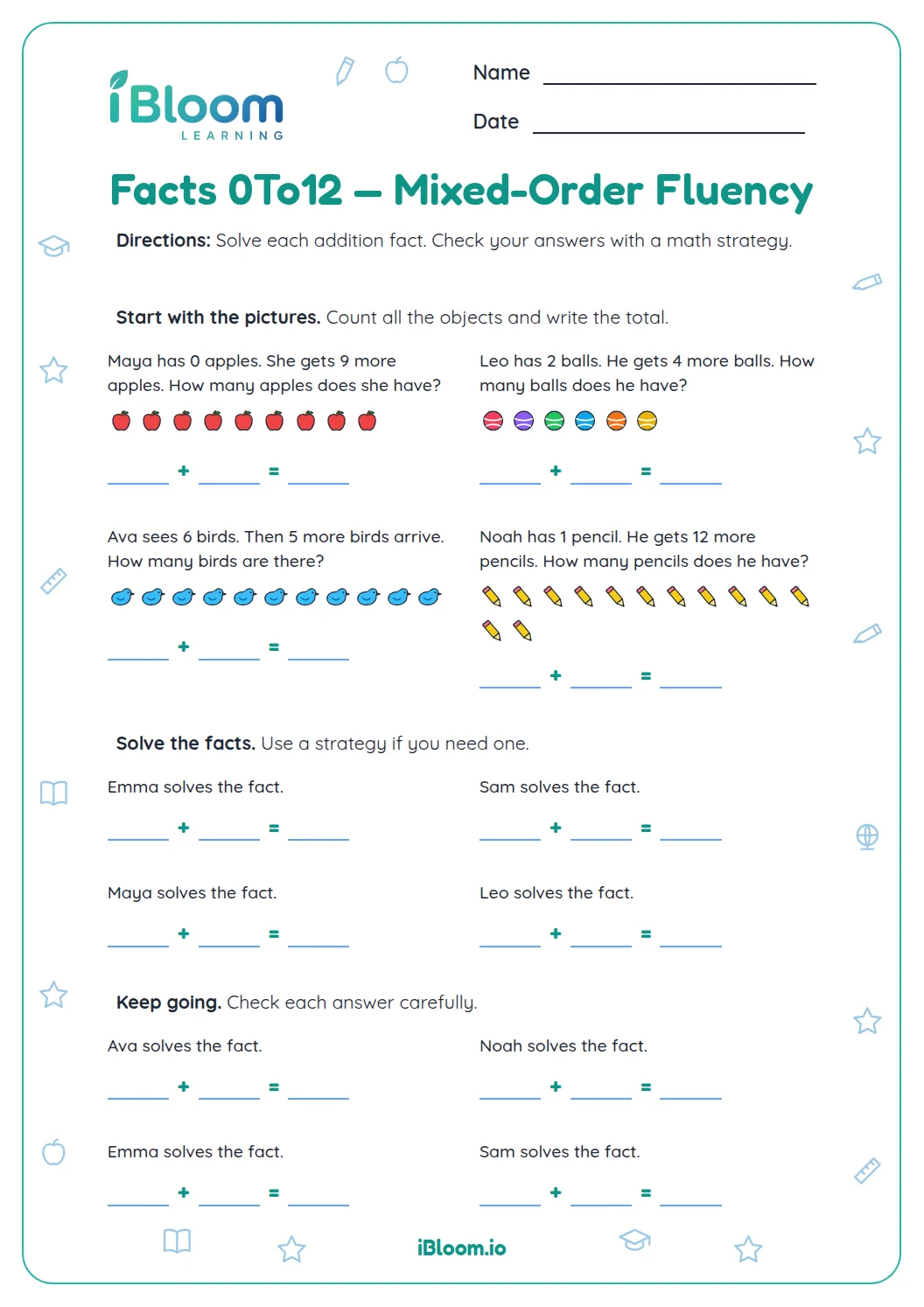
About this worksheet
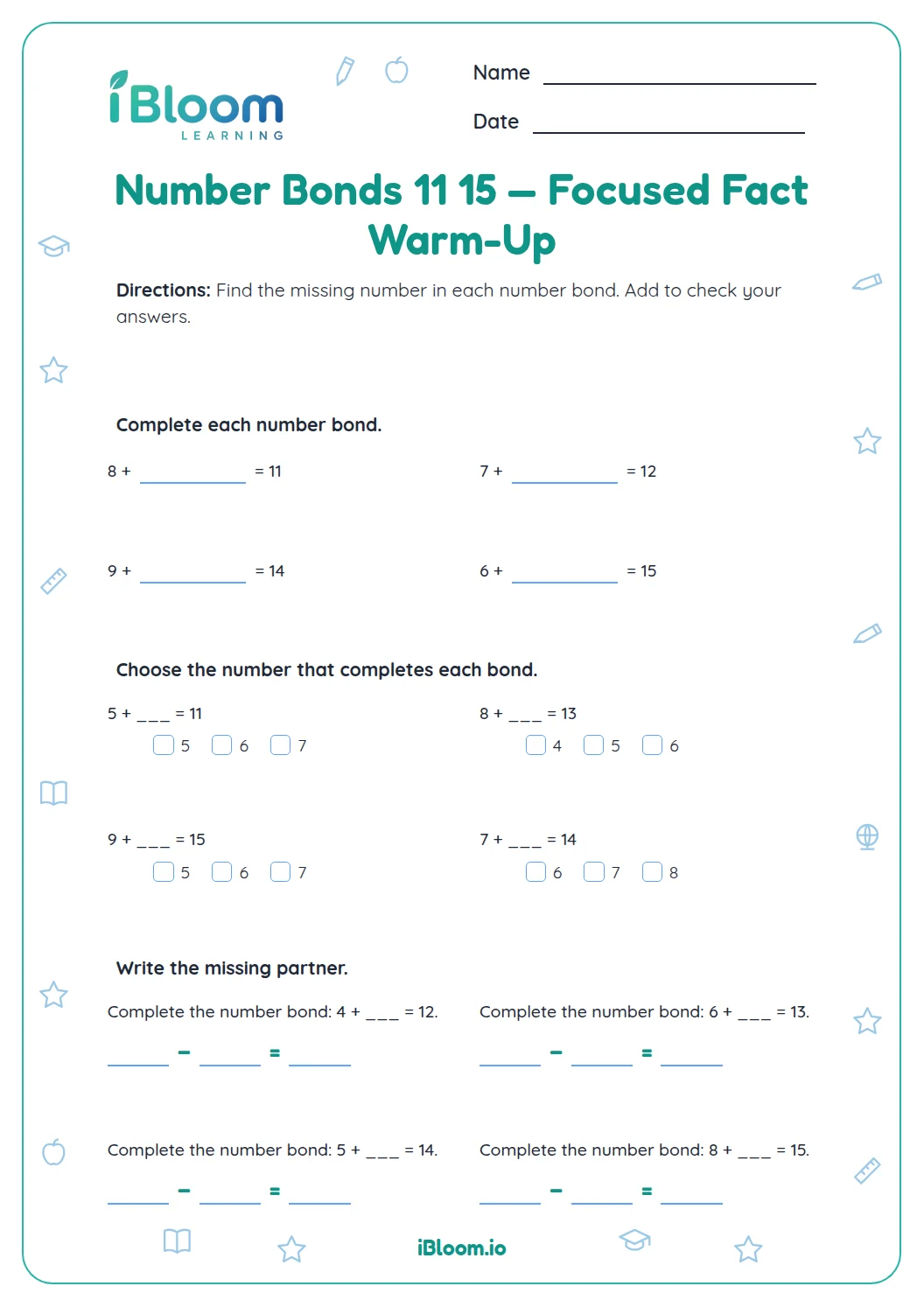
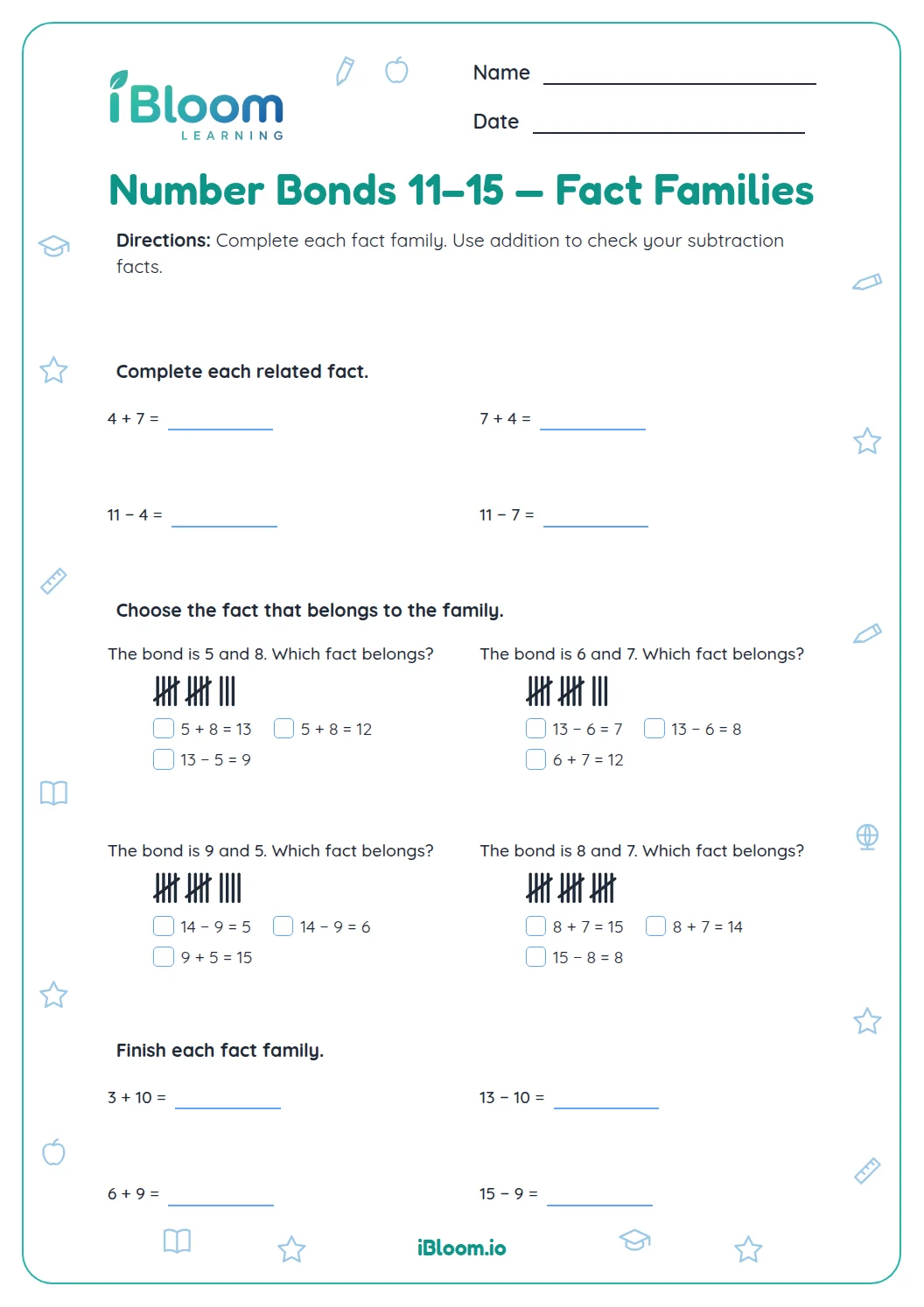
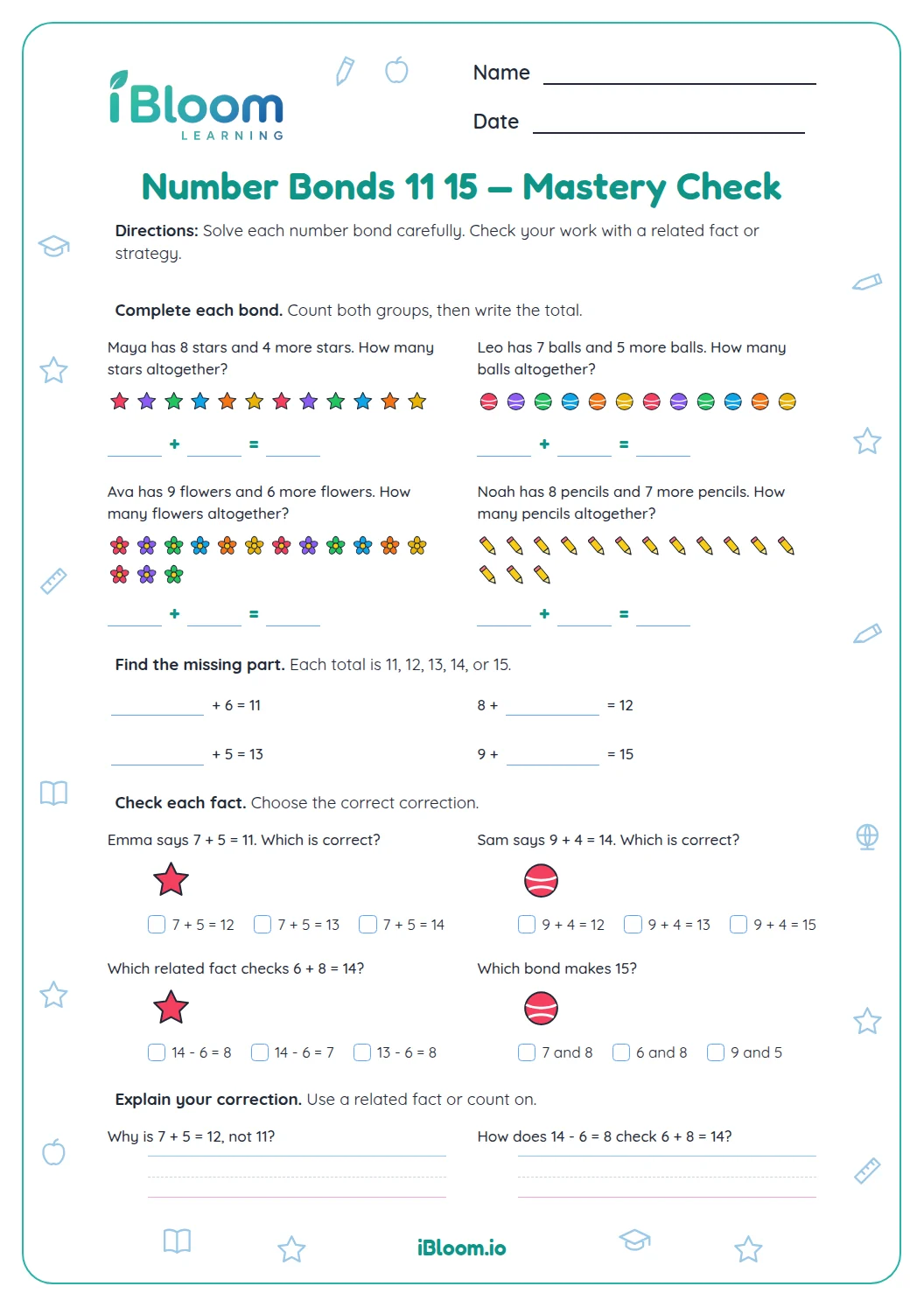
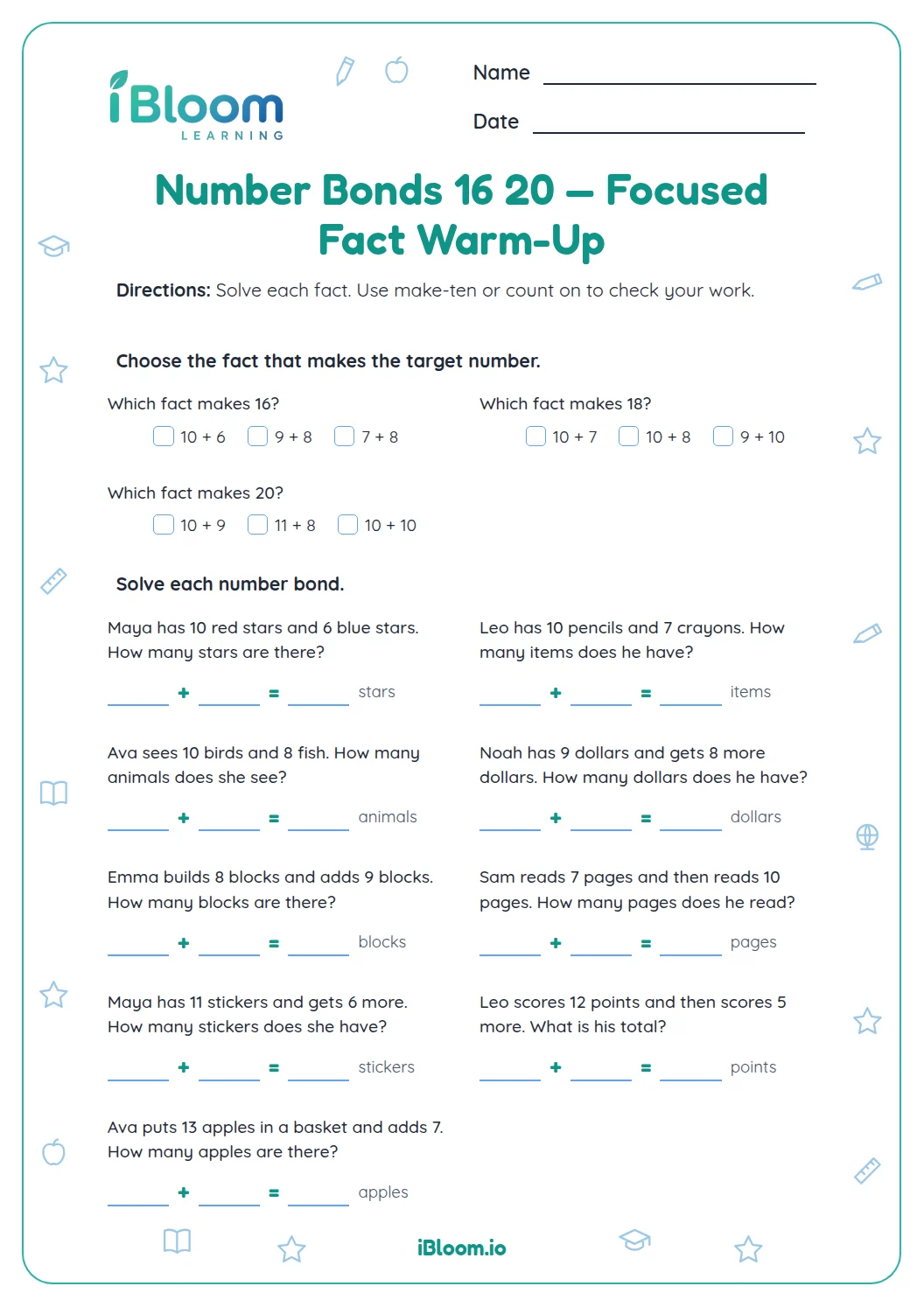
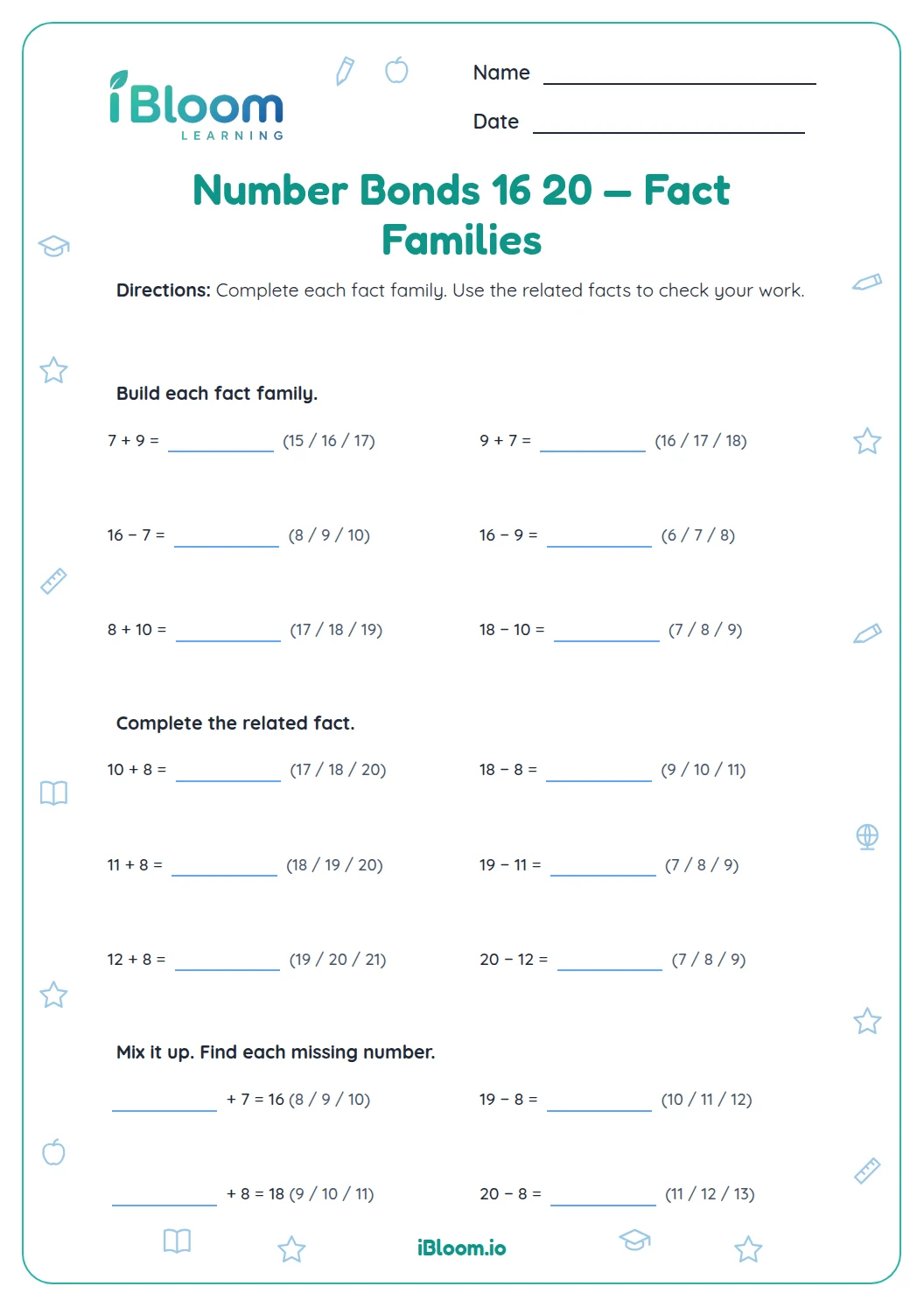
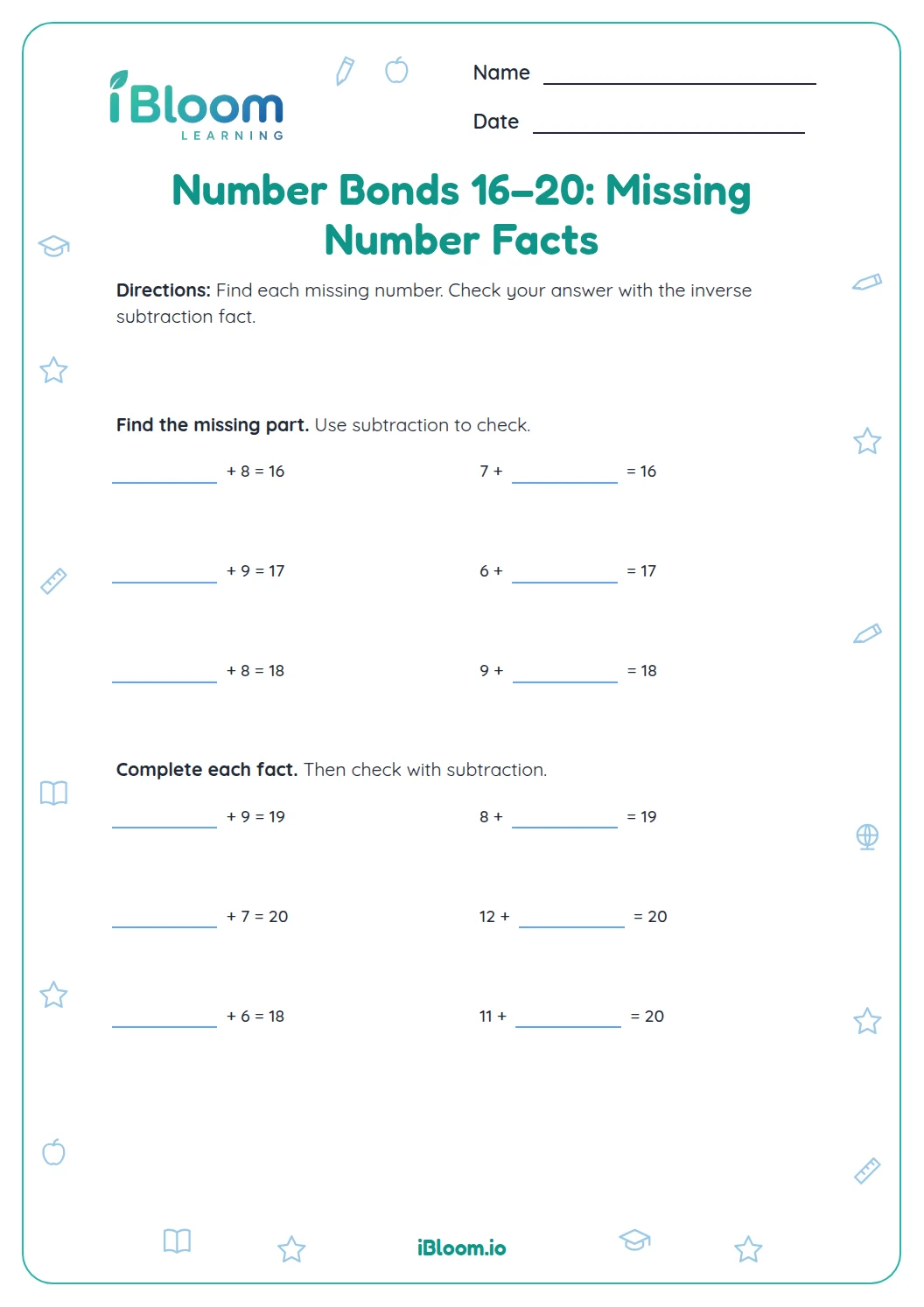
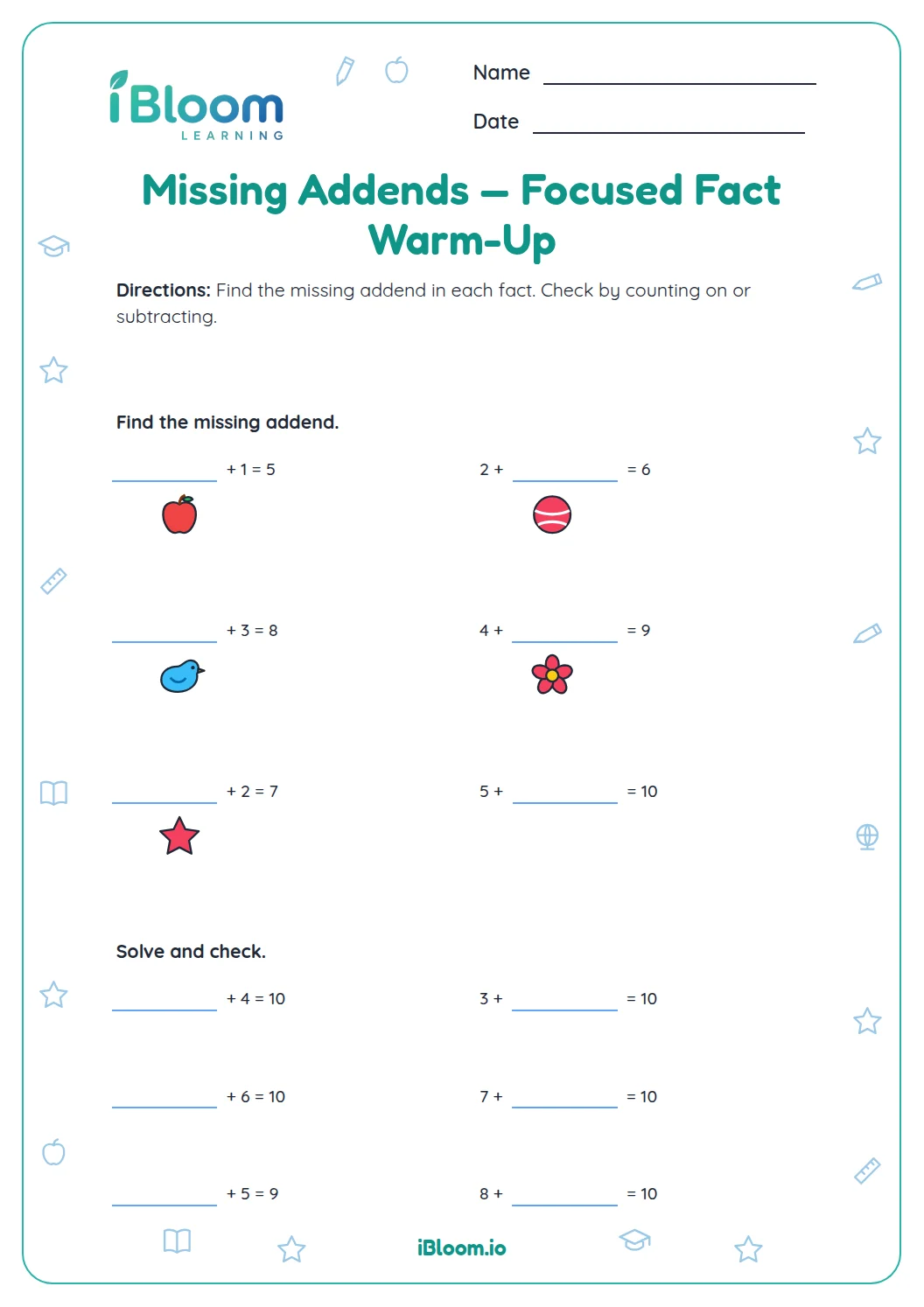
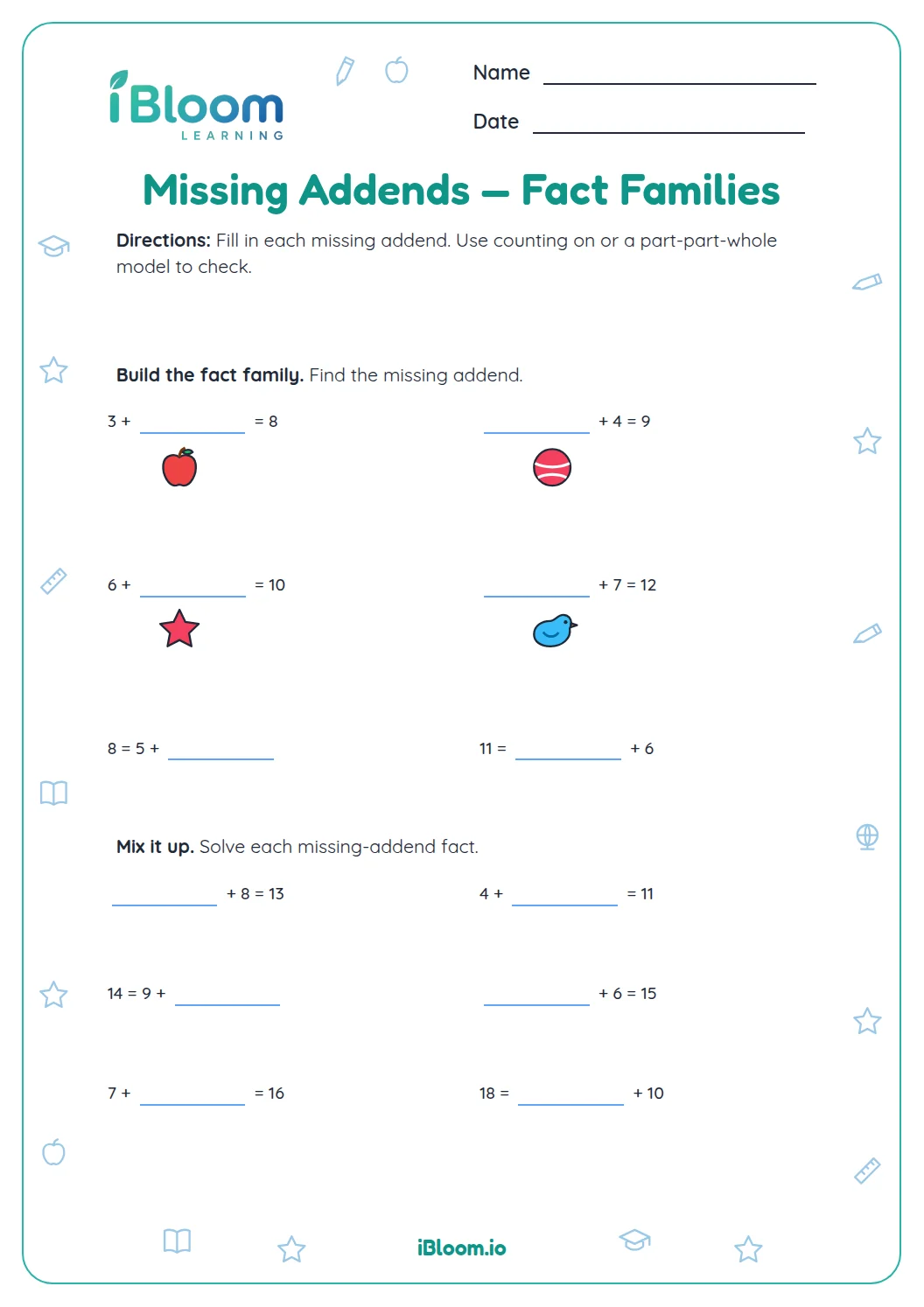
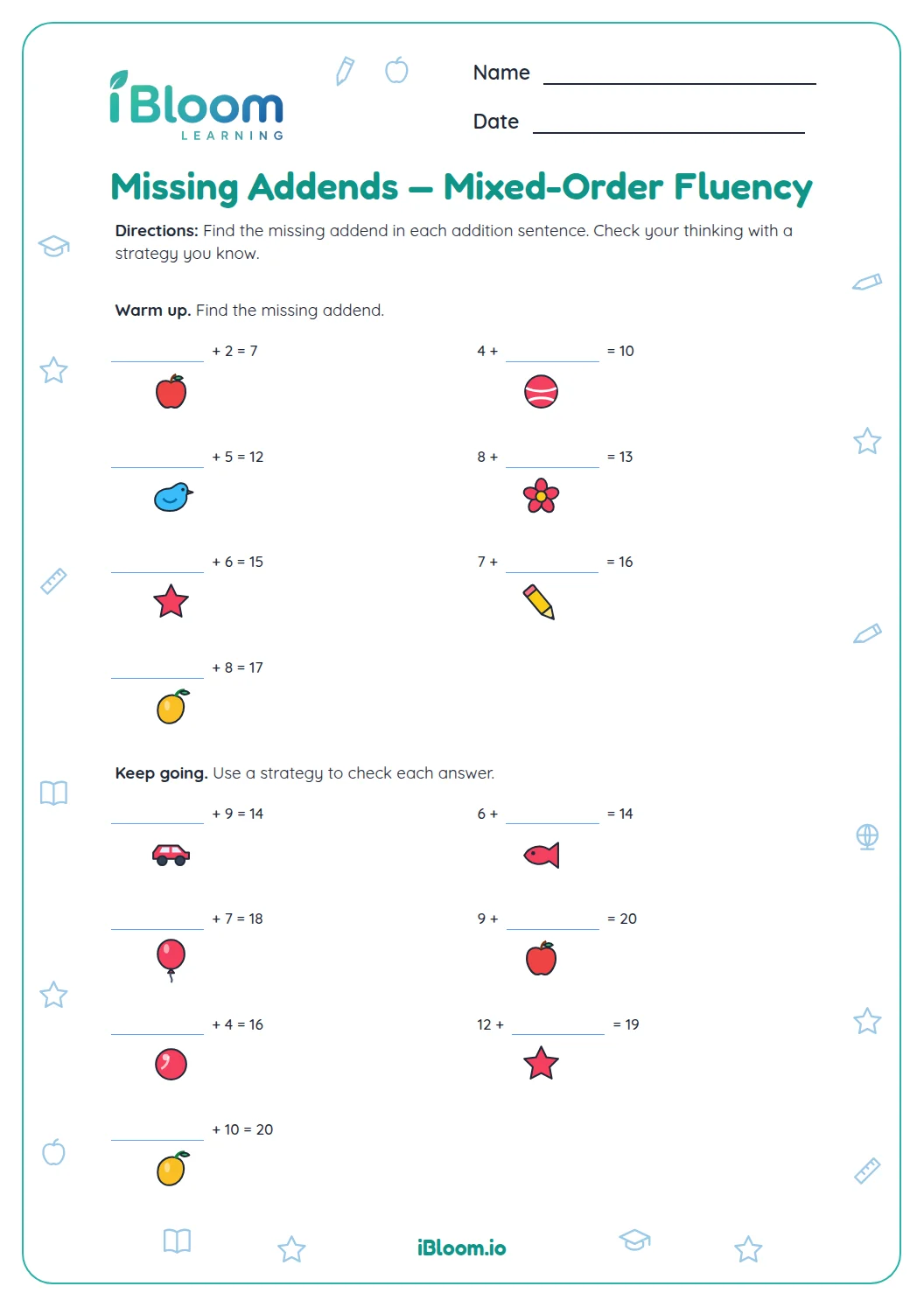
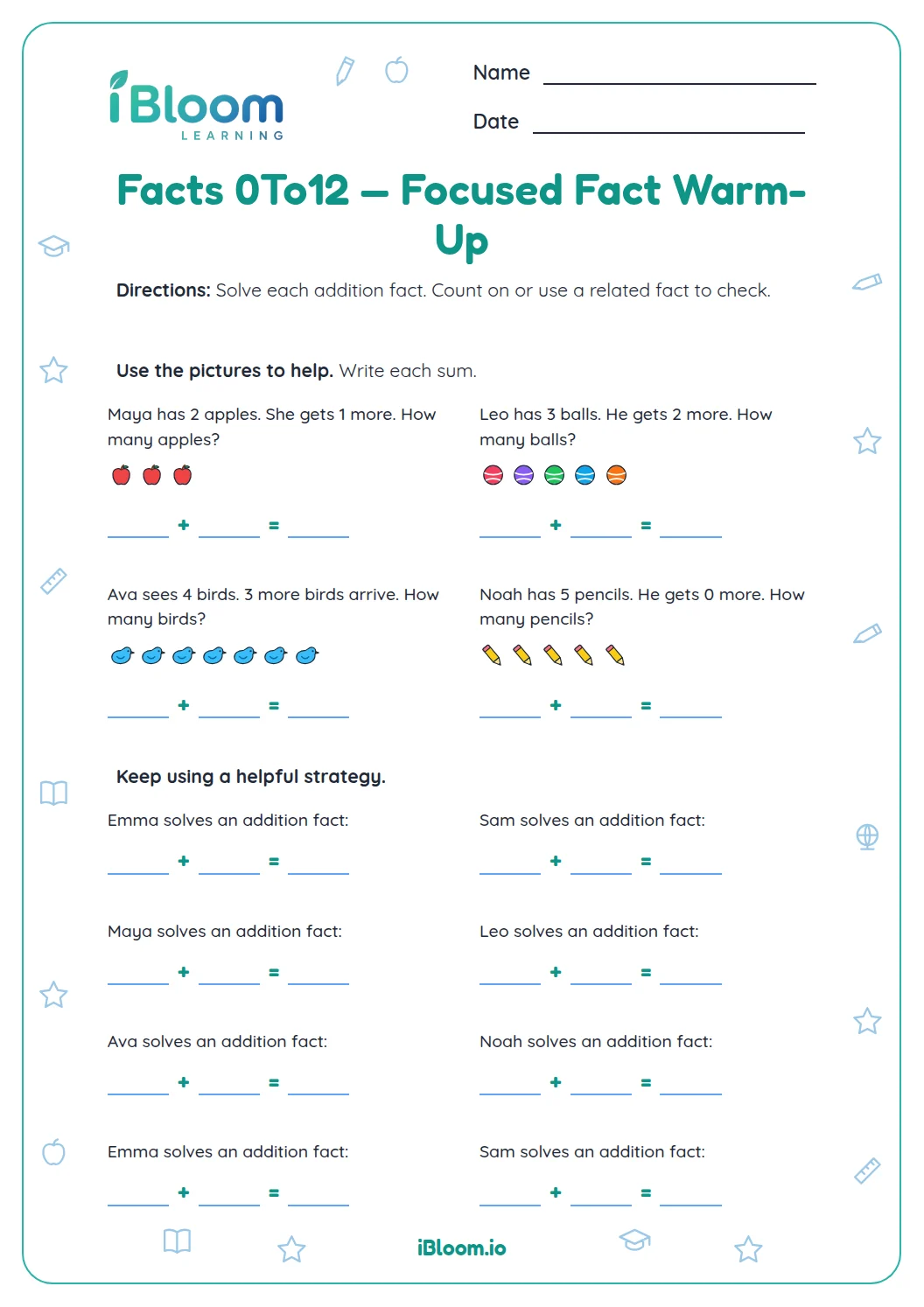
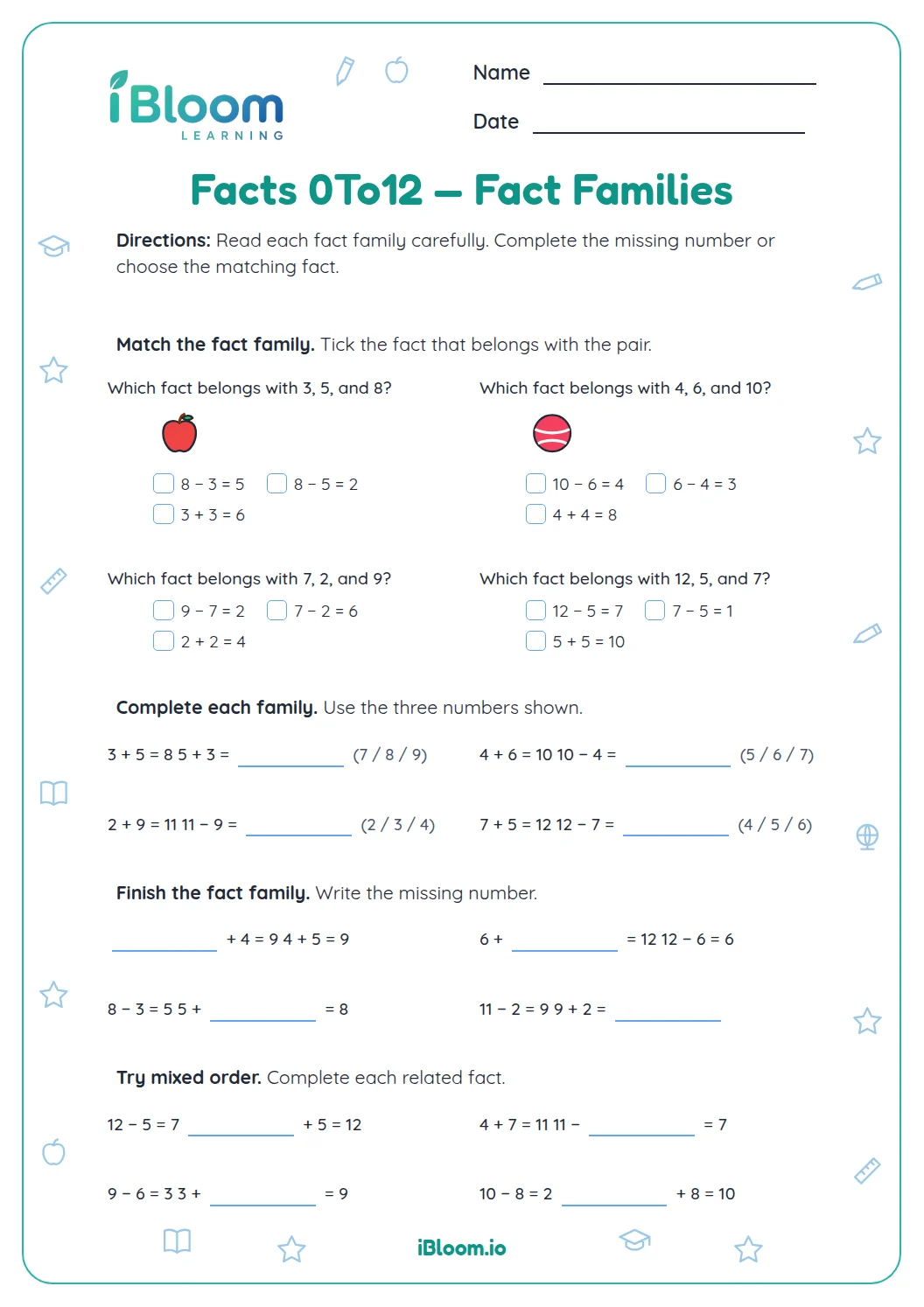
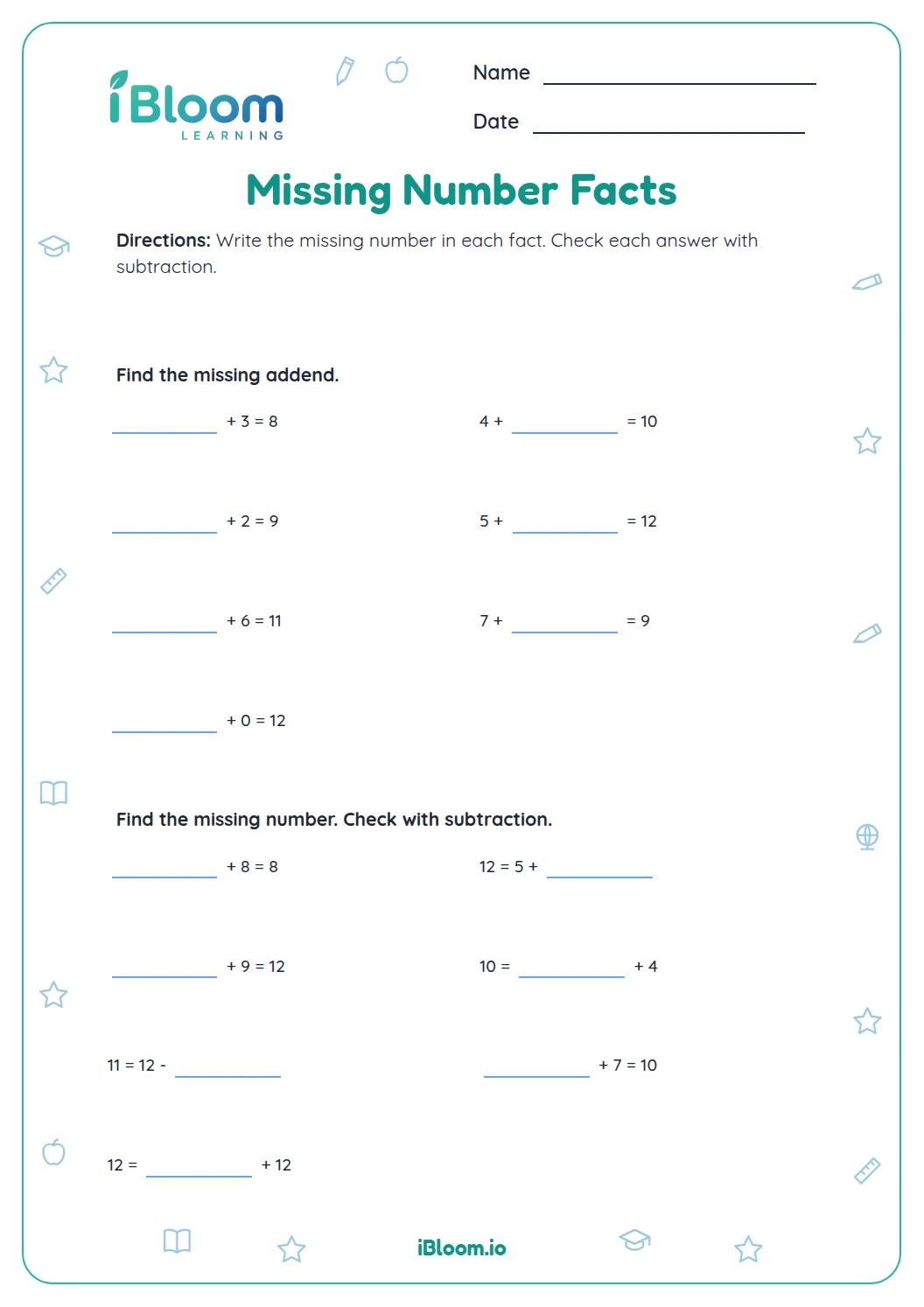
This printable number-bond worksheet gives Grade 1–2 learners 17 mixed-order problems with totals from 11 through 15. Ten number-bond diagrams ask for a missing part, two equations ask for a whole, and five short addition stories apply the same part-whole thinking. The separate key lists each answer.
Aligned to 1.OA.C.6
What do the parts and whole mean?
The whole is the total amount, and the parts are amounts that combine to make it. A number bond makes that relationship visible. The order of the parts can change, but their sum stays the same.
How can you find a missing part?
A number bond shows a whole and the parts that make it. For question 1, the whole is 11 and one part is 3, so the missing part is 8 because 3 + 8 = 11.
- 1Whole: 11; known part: 3
- 2Think: 3 + what number = 11?
- 311 − 3 = 8
- 4Answer: 8
How does mixed-order practice build fluency?
The totals appear in varied order, and the missing number changes position. This prompts students to reason about the relationship instead of relying on a repeated sequence. Every whole from 11 through 15 is included.
Steps for number bond practice
- 1Read the whole at the top of the bond.
- 2Identify which part is already given and which part is blank.
- 3Find the missing number by counting on or subtracting the known part.
- 4For a complete bond, add both parts to find the whole.
- 5Check that the two parts combine to the total.
- 6Use the answer key to review any fact that felt difficult.
Common number bond mistakes and fixes
The mistake
Subtracting the whole from the known part.
The fix
Start at the whole and subtract the part you already know.
The mistake
Adding the whole and one part together.
The fix
Remember that the whole already includes both parts.
The mistake
Assuming a part must be larger or appear on a particular side.
The fix
Read the numbers and find the relationship; either part can be larger.
Curriculum alignment
Use addition and related subtraction strategies to solve facts within 20.
On this sheet: Students use known parts, missing addends, and addition facts to find totals from 11 to 15.
Show the official wordingHide the official wording
Add and subtract within 20, demonstrating fluency for addition and subtraction within 10. Use strategies such as counting on; making ten (e.g., 8 + 6 = 8 + 2 + 4 = 10 + 4 = 14); decomposing a number leading to a ten (e.g., 13 - 4 = 13 - 3 - 1 = 10 - 1 = 9); using the relationship between addition and subtraction (e.g., knowing that 8 + 4 = 12, one knows 12 - 8 = 4); and creating equivalent but easier or known sums (e.g., adding 6 + 7 by creating the known equivalent 6 + 6 + 1 = 12 + 1 = 13).
What to practice next
Make more practice
Further reading
Questions parents and teachers ask
Which totals are practiced?
The 17 problems cover every total from 11 through 15. Ten number-bond diagrams ask for a missing part, two equations ask for a whole, and five short stories use those totals. The totals appear in mixed order so students must read each whole and known part.
What is a number bond?
A number bond is a simple model that shows a whole and the parts that make it. For example, 14 can be split into 6 and 8 because 6 + 8 = 14. The worksheet sometimes leaves a part blank and sometimes leaves the whole blank.
How can my child find the missing number?
Have your child name the whole and the known part, then ask what must be added to reach the whole. Subtraction can check the idea: for 14 and 6, compute 14 − 6 = 8, then verify 6 + 8 = 14.
Does the worksheet include equations as well as bonds?
Yes. The worksheet includes ten number-bond diagrams with the missing part in different positions, followed by two addition equations with the whole missing. Five short stories then use addition facts with totals from 11 through 15, so students apply the same part-whole idea in context.
Should students race to finish?
No timer is needed. The goal is accurate, increasingly comfortable recall. Let a child use counters, draw dots, or count on when a fact is unfamiliar, then check whether the two parts add to the whole. Repeated practice can make familiar sums easier to retrieve.
What is included with the printable?
The download contains three worksheet pages and three answer key pages. It has 17 questions: ten number-bond diagrams, two addition facts, and five addition word problems. The key lists the answer for each item so an adult can review the work quickly.