


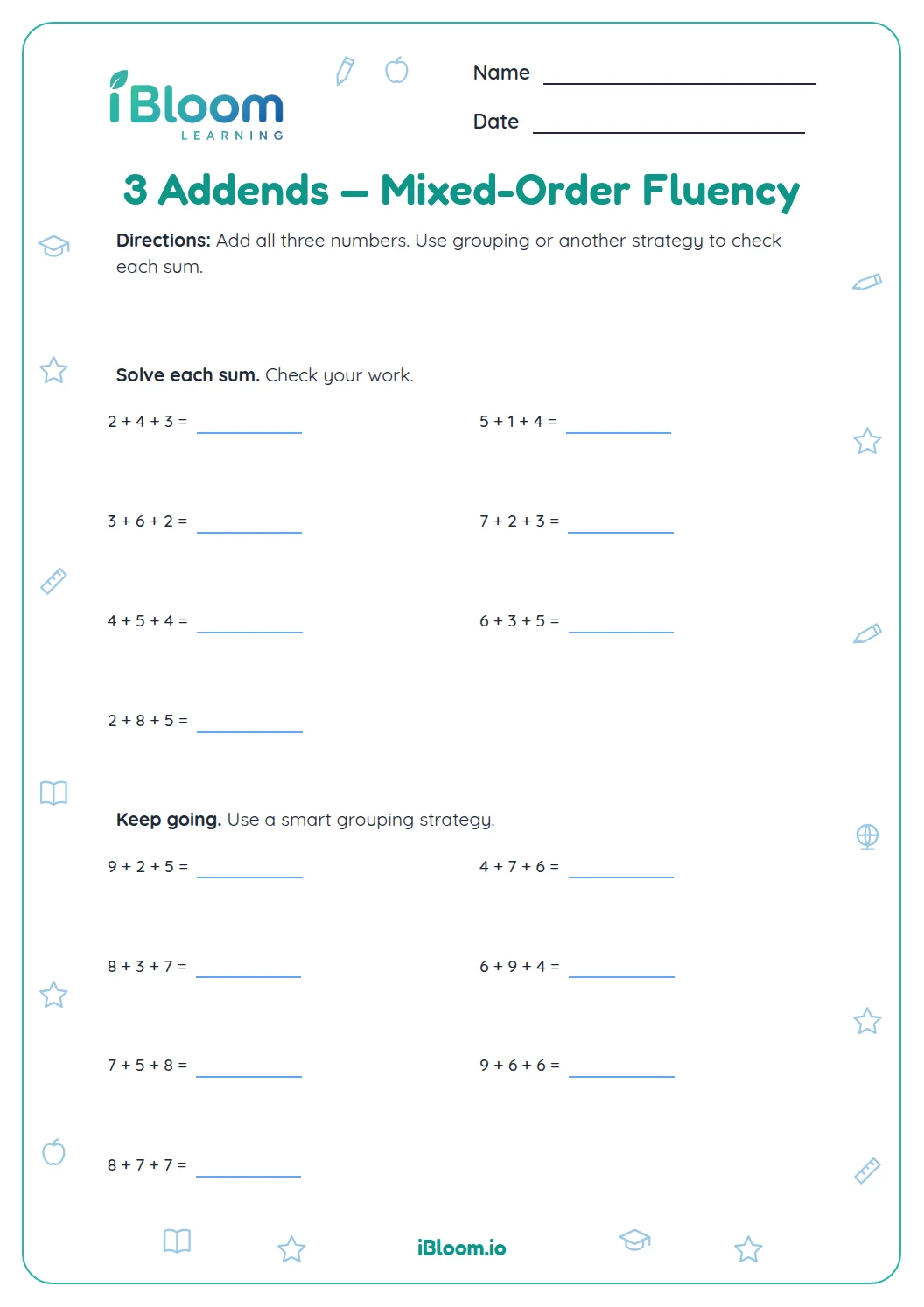
About this worksheet
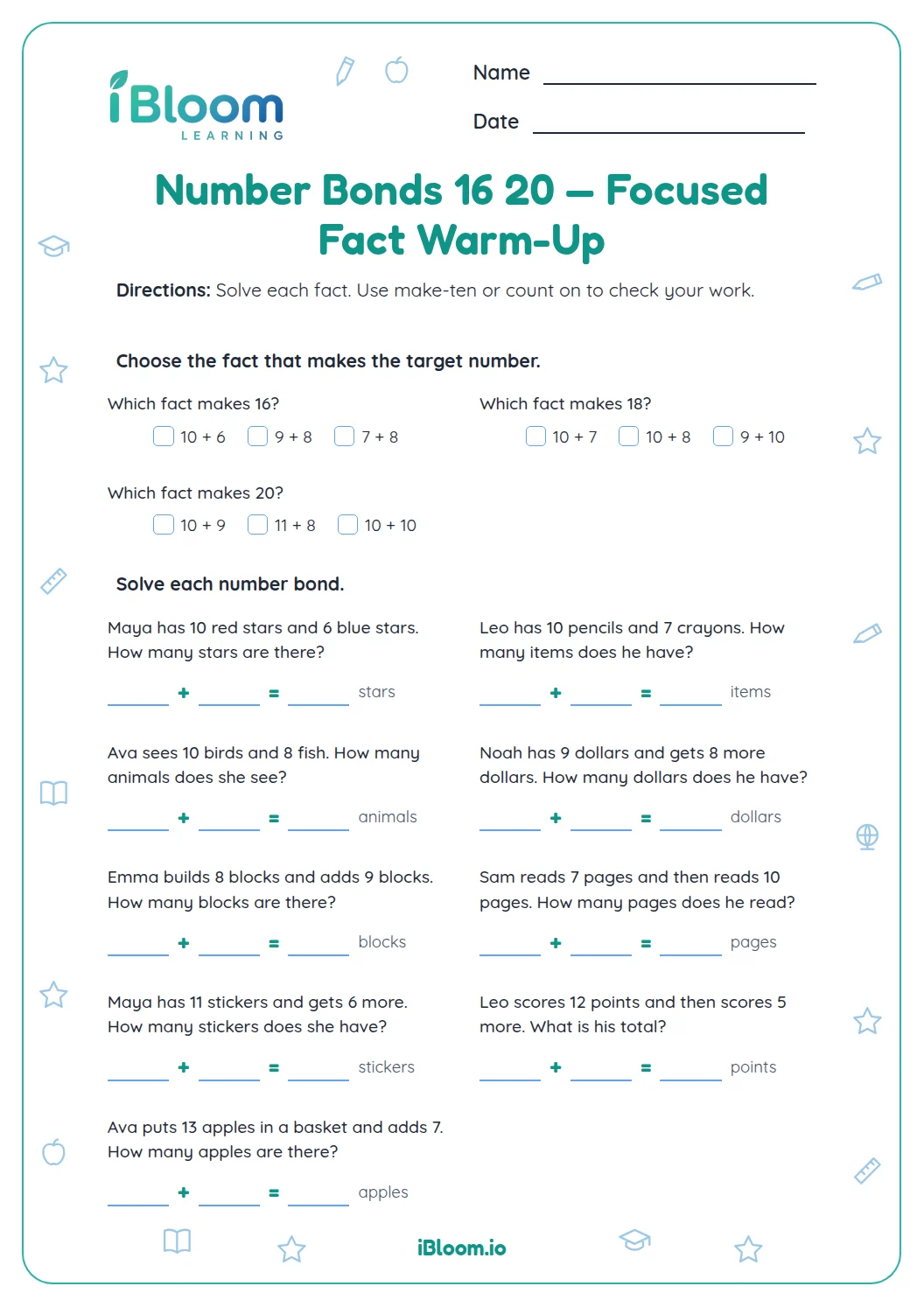
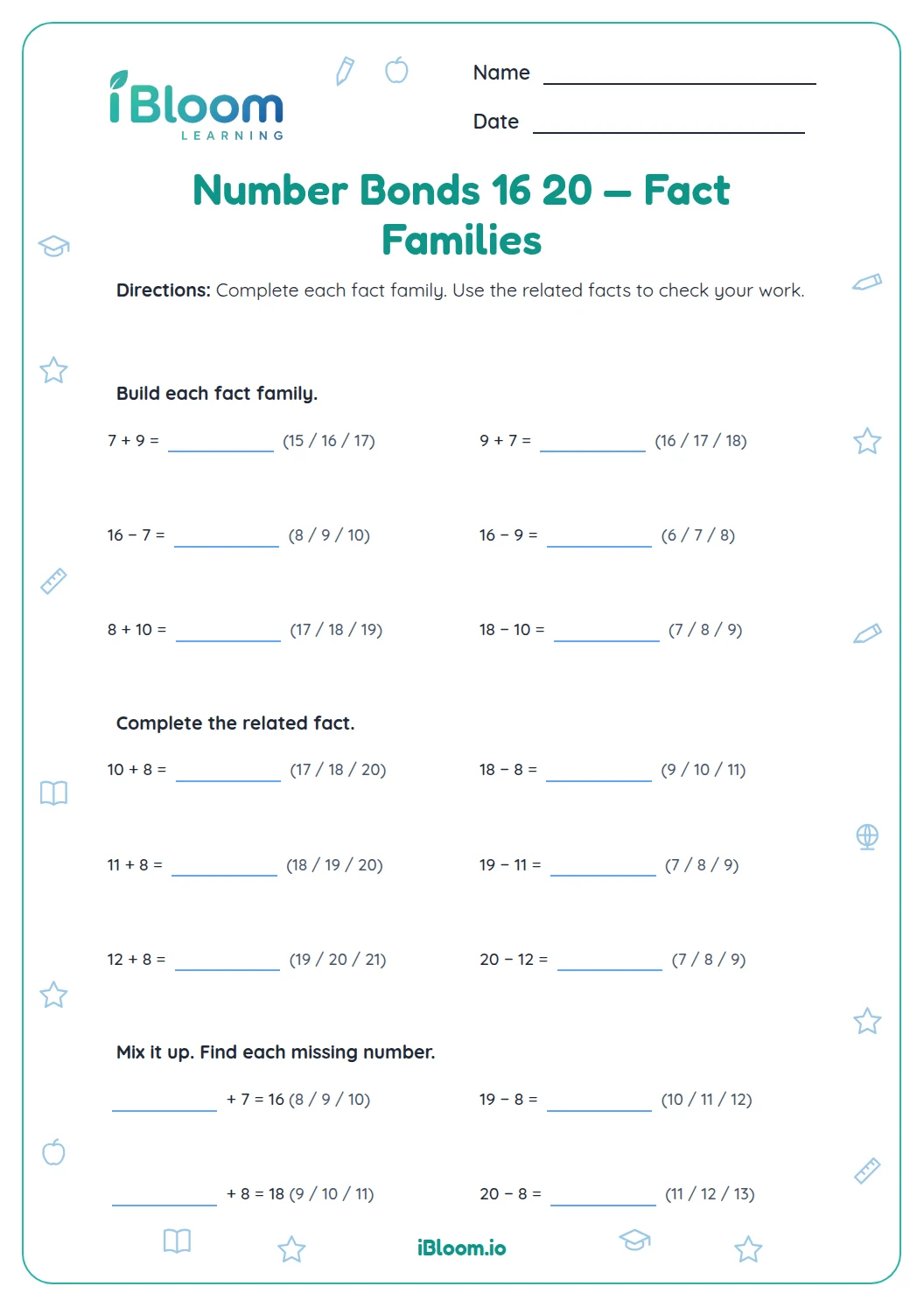
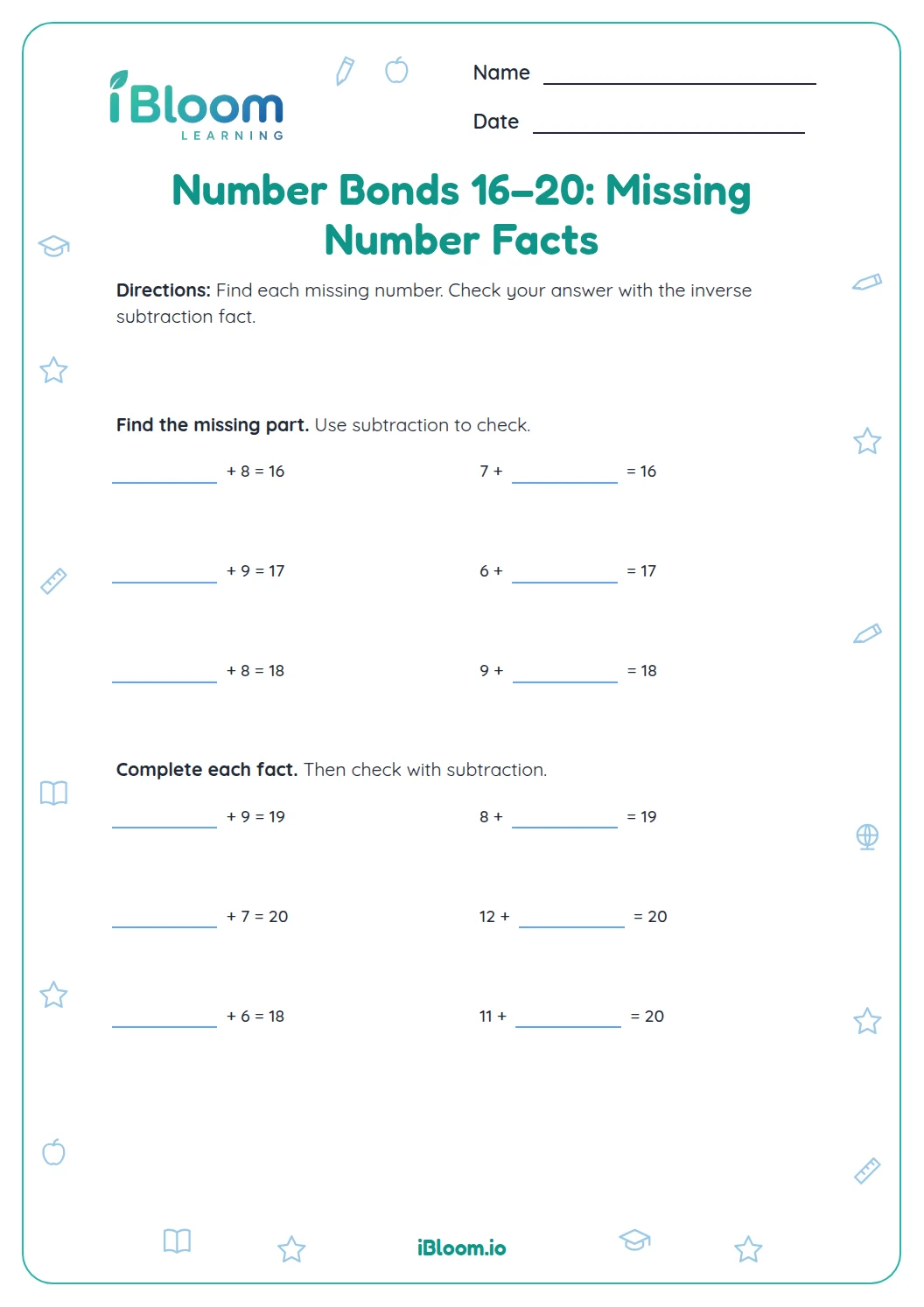
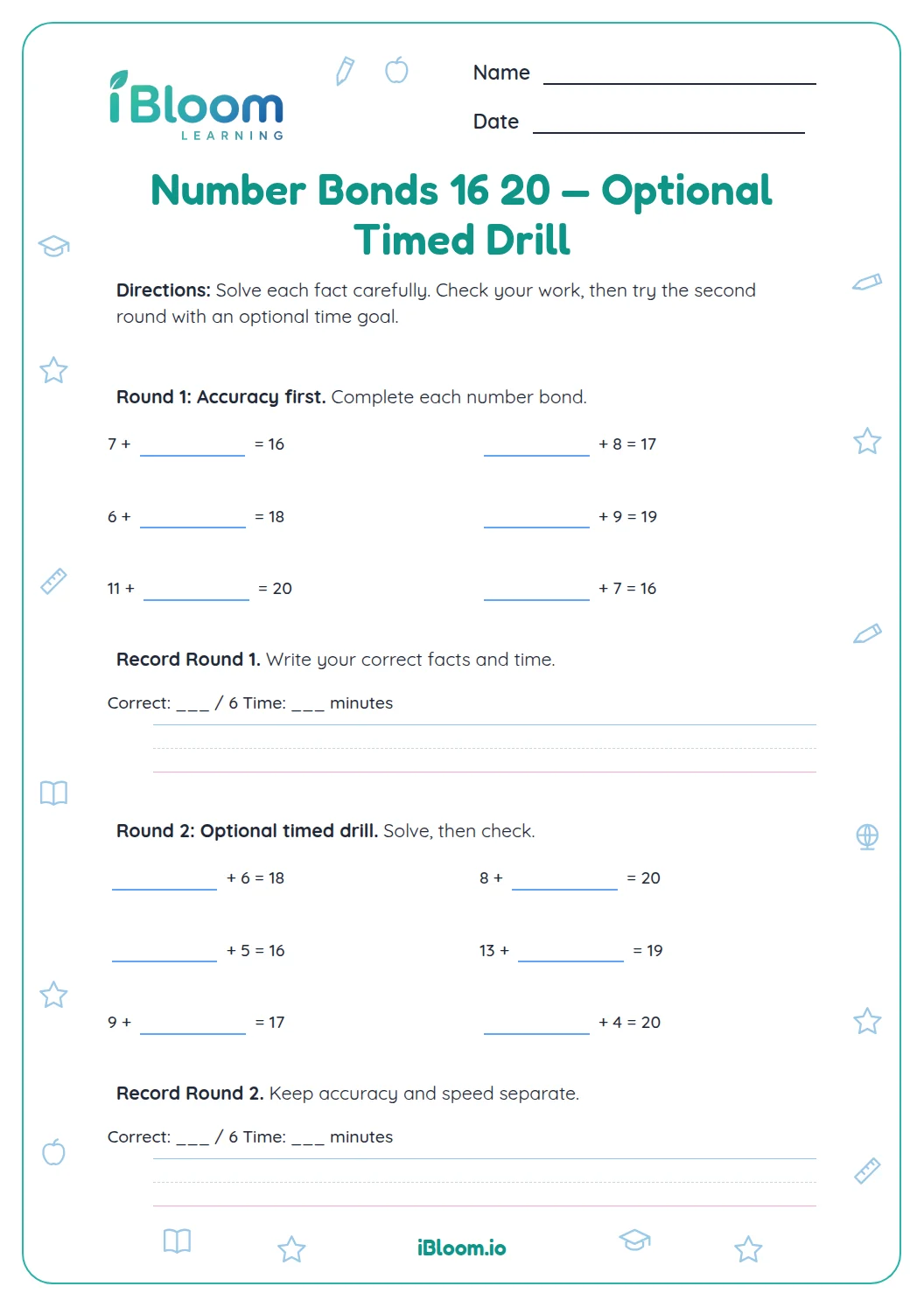
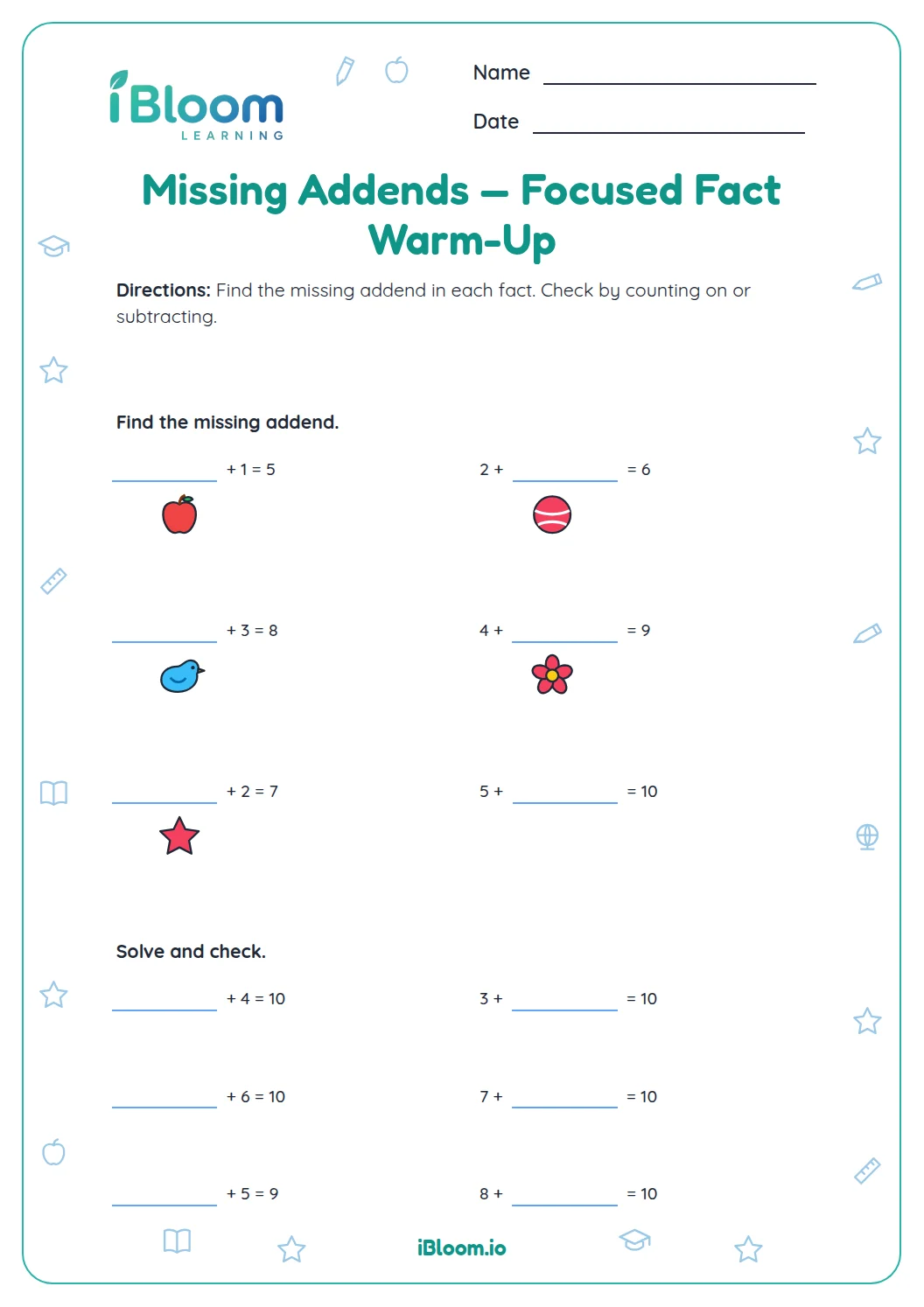
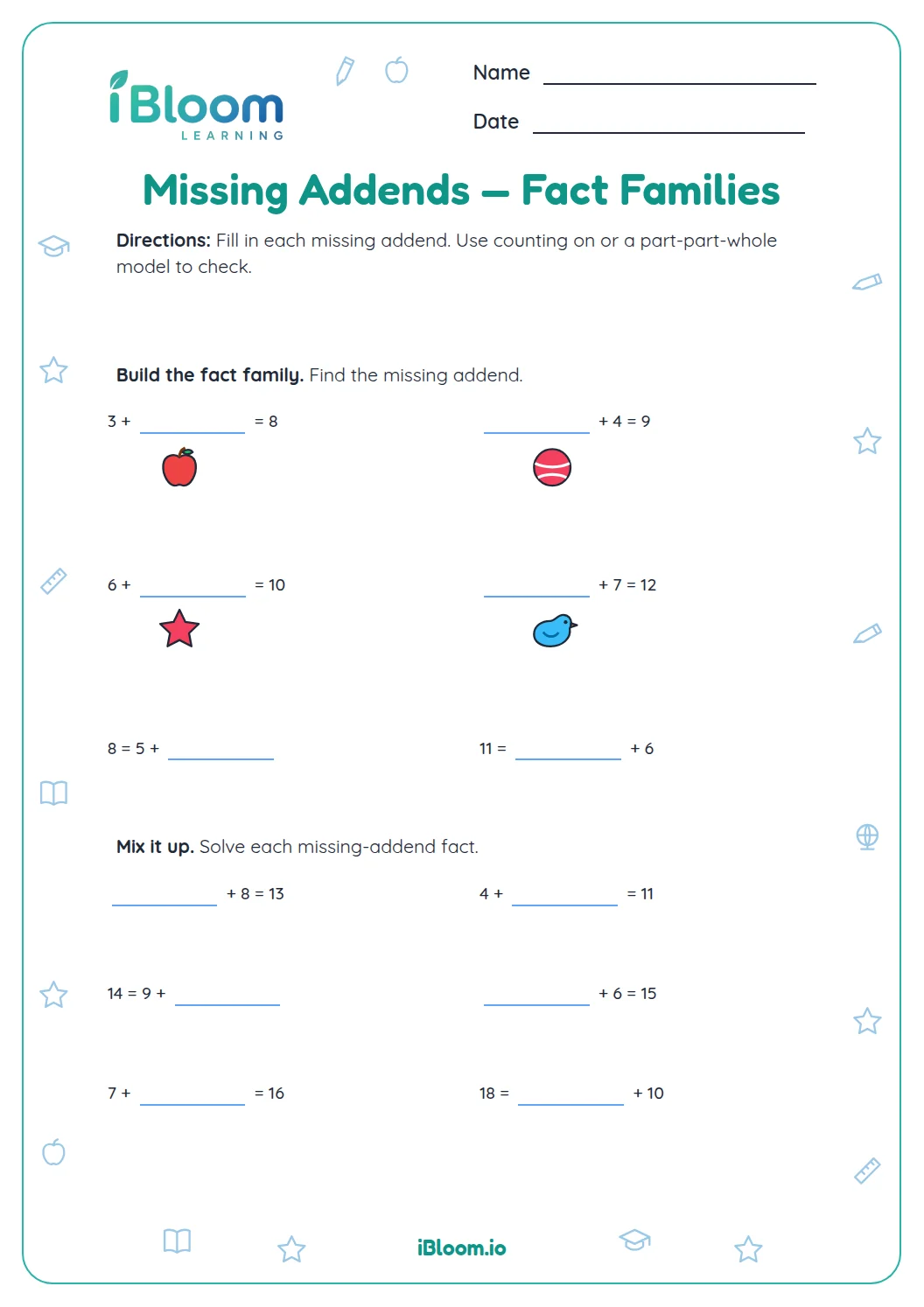
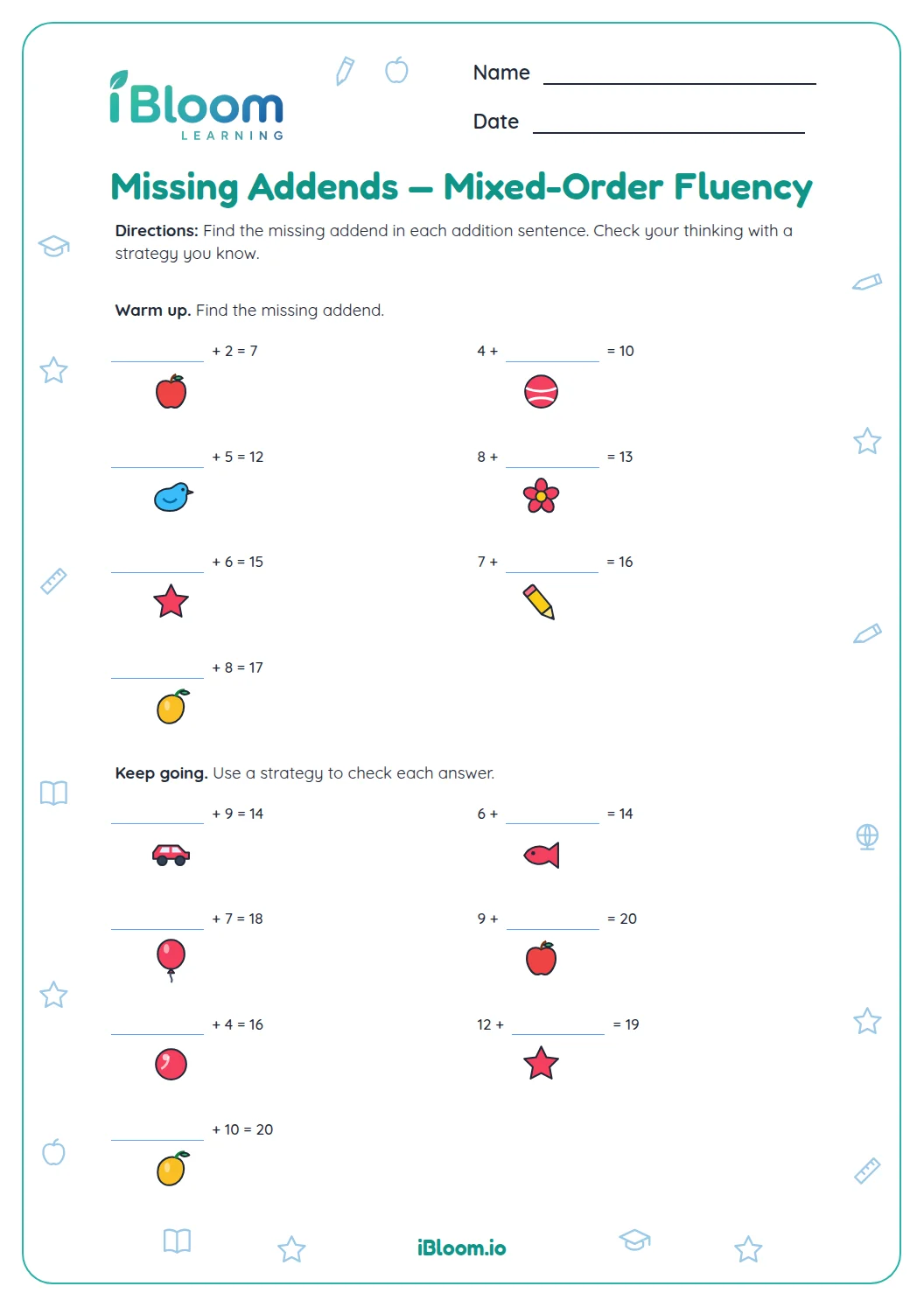
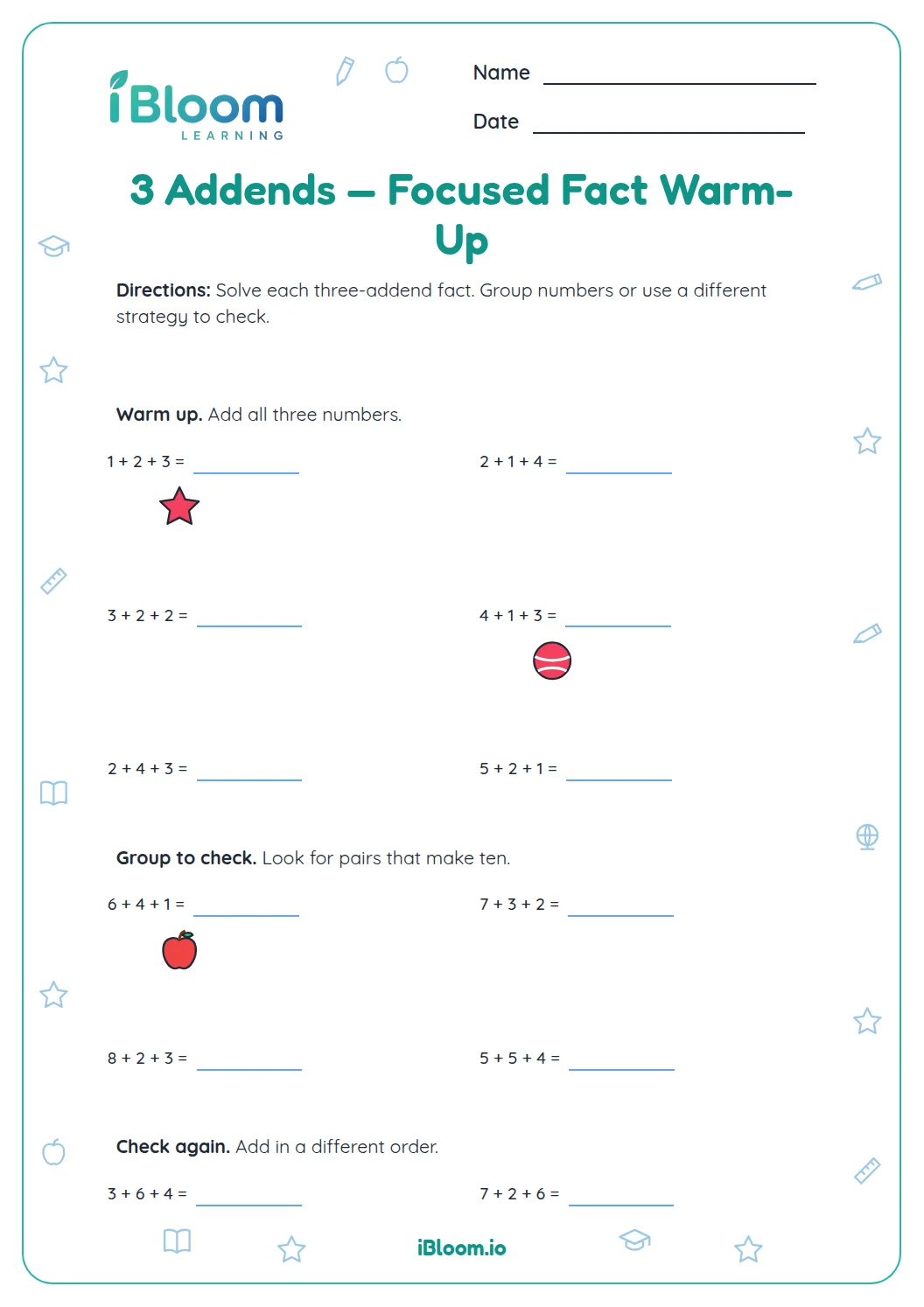
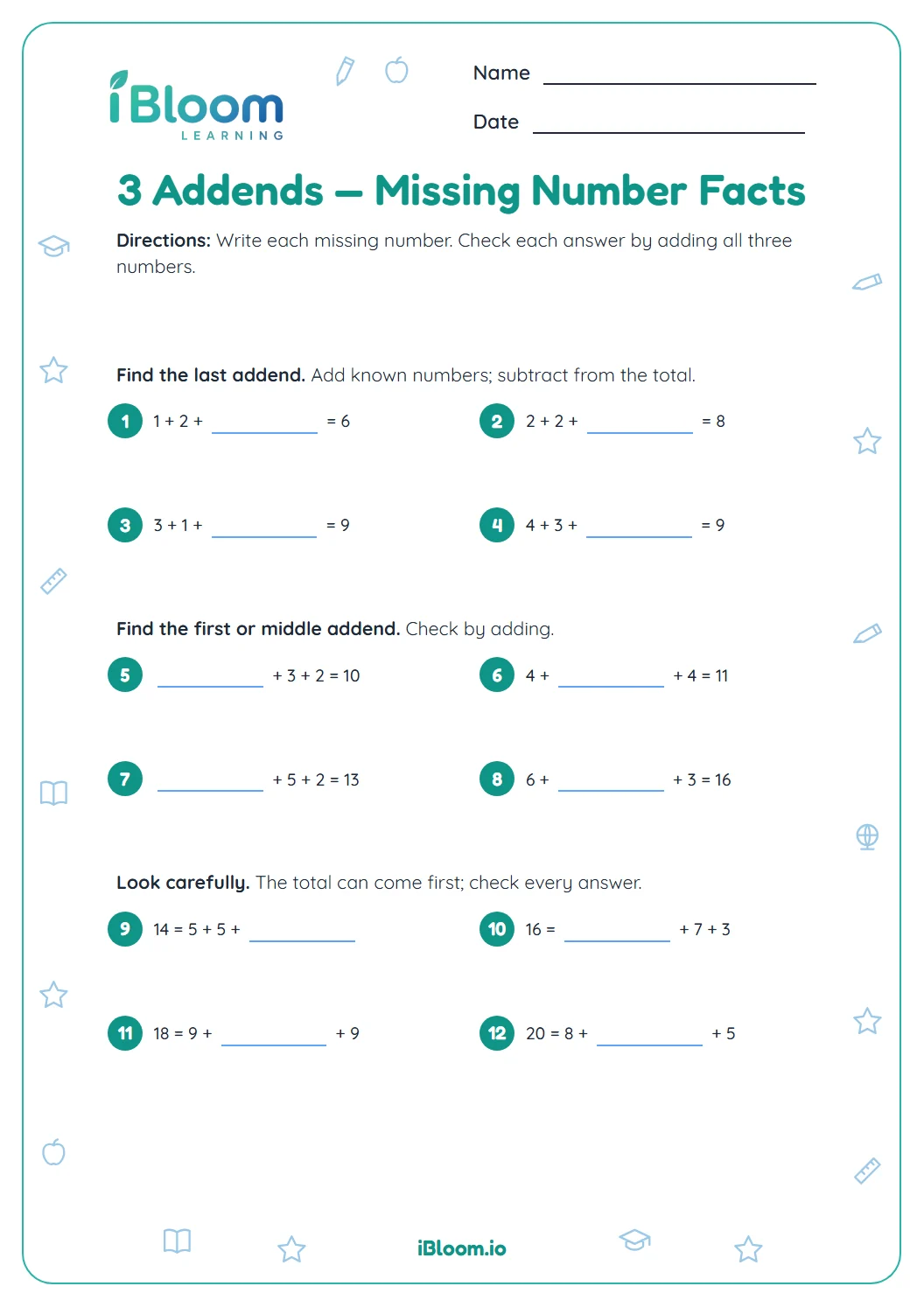
This free printable worksheet gives Grades 1–2 learners 24 addition bonds with totals from 16 through 20. Part A has eight sums in mixed order. Part B has sixteen equations with a missing addend, sometimes first and sometimes second. Students can use doubles, make-ten strategies, or the relationship between addition and subtraction to find each missing number. The sheet supports Common Core 2.OA.B.2 through mental calculation within 20. Use it for a brief practice session, then check the separate answer key and revisit any facts that needed counting.
Aligned to 2.OA.B.2
Why are the totals mixed together?
The sums switch among 16, 17, 18, 19, and 20, so students need to read each equation. They cannot fill the blanks by following a rising number pattern. The five totals all appear in both parts.
How can making ten help with 9 + 8?
Think of 8 as 1 and 7. Give the 1 to 9 to make 10, then add the remaining 7. This strategy keeps the quantity the same while making the sum easier to recall.
- 19 + 8 = ___
- 2Split 8 into 1 and 7.
- 39 + 1 = 10; 10 + 7 = 17.
- 4Answer: 17
How do you find a missing part?
In question 9, ___ + 9 = 18, the total is already given. Ask which number joins 9 to make 18. The double 9 + 9 gives the missing part, 9.
After filling a blank, read the entire equation aloud. For a first-position blank, keep the addends in their printed order when checking so the child notices that the blank is still one of the parts.
Some missing parts are greater than ten. In 6 + ___ = 17, count from 6 to 10, then from 10 to 17: 4 + 7 = 11. Check with 6 + 11 = 17.
How to use this worksheet
- 1Name the two parts and the total in a familiar fact such as 8 + 8 = 16.
- 2Complete Part A, using a known double or making ten when helpful.
- 3For Part B, point to the total before finding the missing part.
- 4Read each completed equation to check that both parts make the total.
- 5Use the key to select two facts to practice aloud again.
Mistakes to notice and fix
The mistake
Adding the known part to the total in Part B.
The fix
Point to the number after the equals sign and name it as the whole; find the part needed to reach it.
The mistake
Writing the same total all the way down a column.
The fix
Read both addends each time; the totals deliberately change order.
The mistake
Losing one when making ten.
The fix
Split only one addend, then keep track of the part left after making ten.
Common Core alignment
Use mental strategies to complete addition bonds with totals from 16 through 20.
On this sheet: Students find totals and missing parts in mixed-order addition equations within 20.
Show the official wordingHide the official wording
Fluently add and subtract within 20 using mental strategies. By end of Grade 2, know from memory all sums of two one-digit numbers.
What to practice next
Make more practice
Further reading
Questions parents and teachers ask
Does the sheet include every total from 16 to 20?
Yes, 16, 17, 18, 19, and 20 all appear in each part. Part A asks for totals, while Part B supplies the total and hides one part. This gives children practice with the full range while changing which information they need to find.
Are there number-bond circles to fill in?
The bonds are written as addition equations with one blank. Children still identify two parts and their whole, the same relationship represented by a number-bond diagram. You can say “part plus part makes whole” aloud before beginning and point to each position in an equation.
Should I time this fluency practice?
Timing is optional; the worksheet works well without a timer. Let children choose a mental strategy and check their answers first. If you later repeat the sheet, compare their explanations and accuracy as well as their pace, keeping the practice brief and manageable for the learner.
What if a child cannot recall 9 + 8?
Use making ten to work out the fact. Split 8 into 1 and 7, add 1 to 9, then add 7 to 10 to get 17. Afterward, ask the child to say the original equation again so the strategy connects back to the fact.
How is the answer key useful for missing addends?
The key gives the number that belongs in each blank. Have children substitute that number into the original equation and read the whole fact aloud. For example, question 9 becomes 9 + 9 = 18, which confirms that the missing part makes the stated total.