




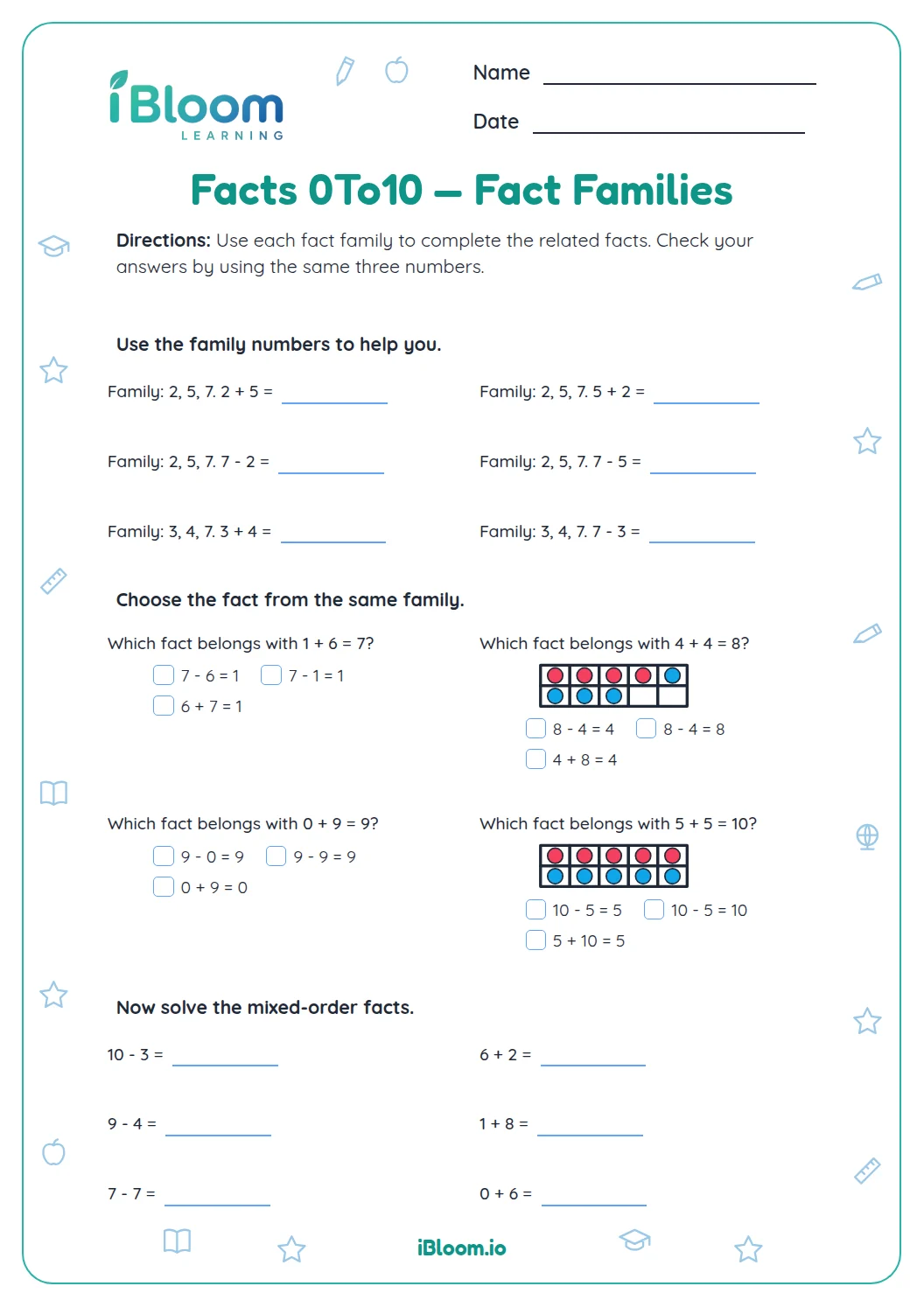


About this worksheet
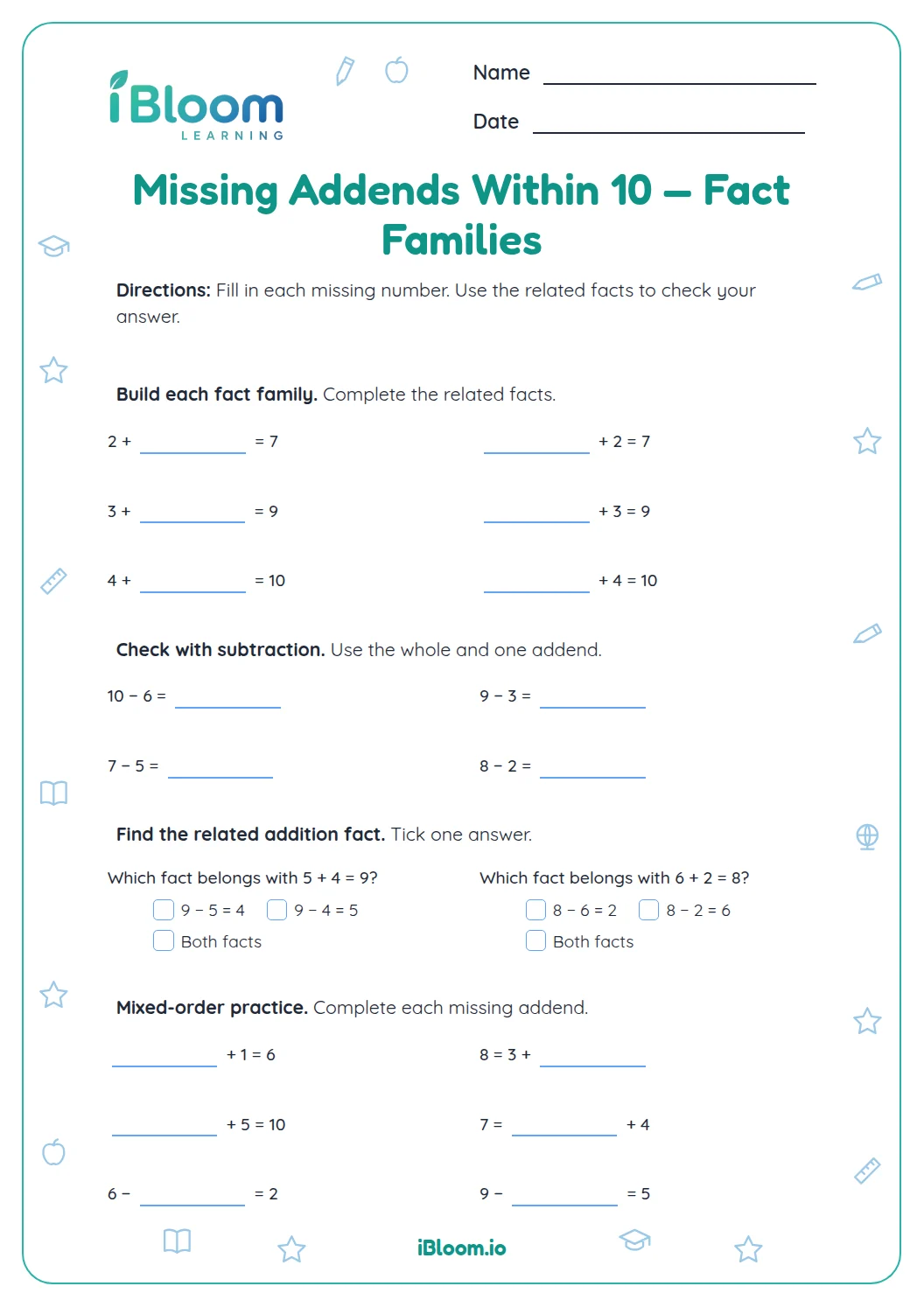
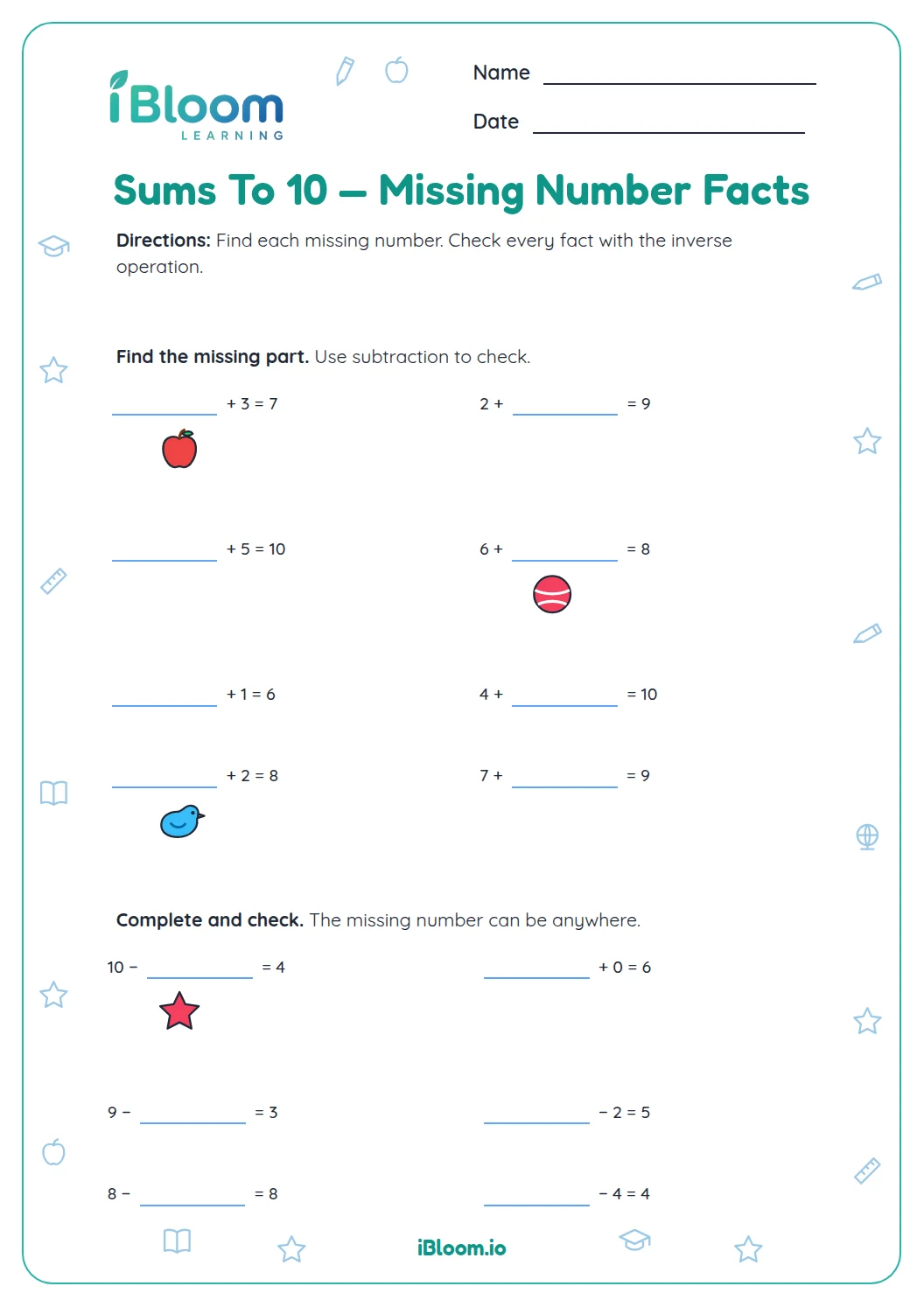
This Grade 1 printable gives children focused practice with missing addends that make 10 and the related subtraction facts. Part A asks for missing parts in addition equations, Part B uses choices, and Part C mixes addition and subtraction. The examples center on pairs such as 8 and 2, so children can reason by counting on and check with a related fact. CCSS 1.OA.B.4 describes subtraction as an unknown-addend problem. The answer key is included as a separate page.
Aligned to 1.OA.B.4
How does making ten help find an addend?
Ten is a useful whole. If one part is 8, count on 2 to reach 10. For a blank before a number, turn the fact around: ___ + 6 = 10 is the same pair as 6 + ___ = 10.
Question 1 is 8 + ___ = 10. Since 8 needs 2 more, write 2. The related subtraction fact, 10 − 8 = 2, checks it.
- 18 + ___ = 10
- 28 needs 2 more to make 10.
- 3Answer: 2
- 4Check: 8 + 2 = 10
How can subtraction check an addition fact?
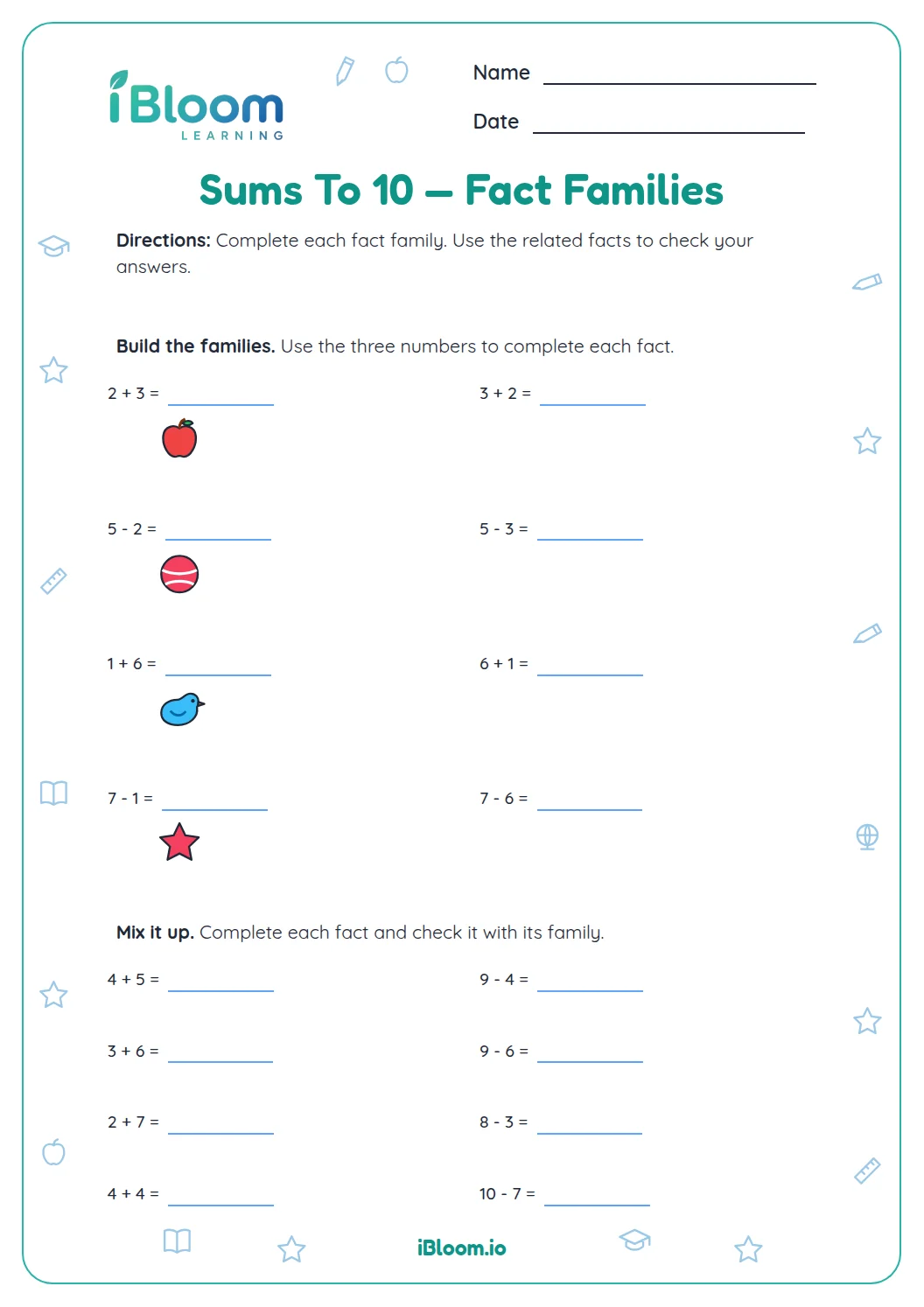
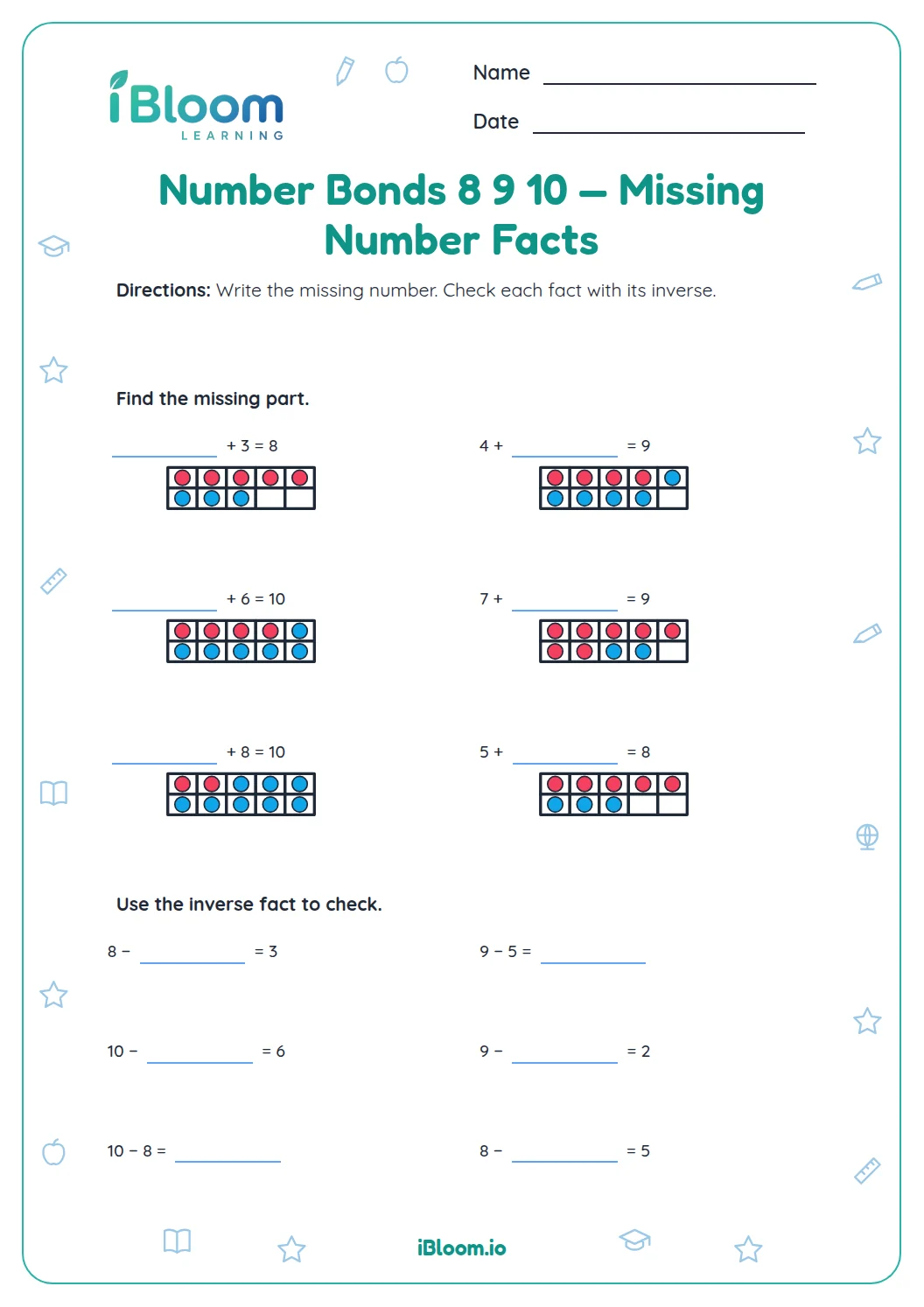
The same three numbers appear in a fact family. If 4 + 6 = 10, then 10 − 6 = 4 and 10 − 4 = 6. The final part of the sheet mixes both forms so children choose the operation the sentence uses.
What will children practice?
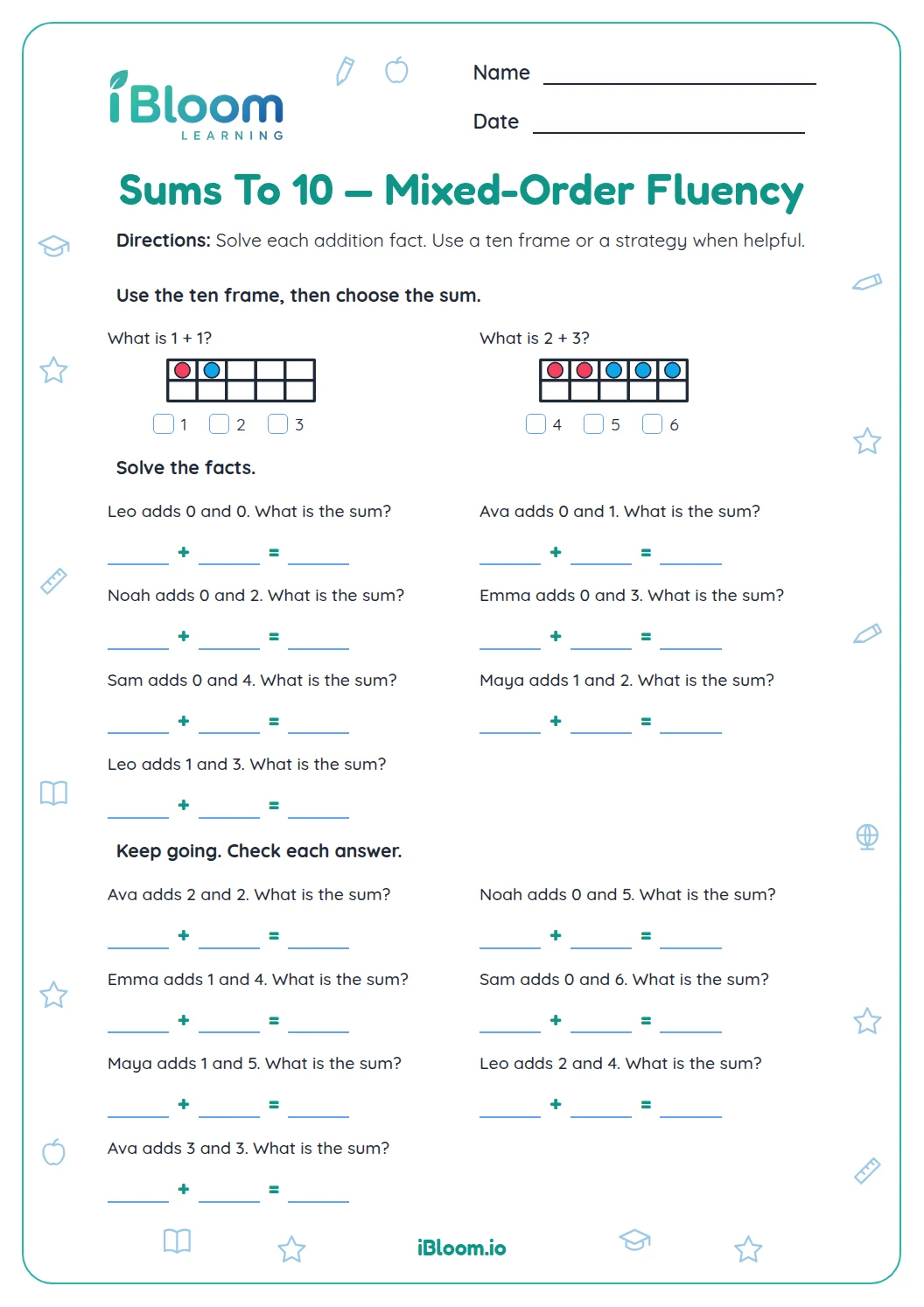
The 16 items move from direct missing addends, to choosing an addend, to mixed addition and subtraction facts. Every fact connects to 10 and stays within Grade 1 number limits.
- Part A completes addition facts to 10.
- Part B selects the missing addend from three choices.
- Part C uses addition and subtraction to find the unknown.
- A separate key gives all 16 answers.
How to use this worksheet
- 1Read the whole equation aloud and identify the total.
- 2Start at the known addend and count up to 10.
- 3Write the number counted as the missing addend.
- 4For subtraction, use the matching addition fact.
- 5Check by substituting the answer into the equation.
Common mistakes and quick fixes
The mistake
Subtracting the known number from the blank side without reading the total.
The fix
Point to the total first, then ask what combines to make it.
The mistake
Writing the known addend again in the blank.
The fix
Count on from that number to 10 and record only the extra amount.
The mistake
Treating 10 − 6 like 10 + 6.
The fix
Use counters to remove 6 from a group of 10, then check with 6 + 4.
Common Core alignment
This worksheet practices the following Common Core skill.
Use addition and subtraction relationships to find a missing addend.
On this sheet: Children use facts that make ten and the related subtraction facts.
Show the official wordingHide the official wording
Understand subtraction as an unknown-addend problem. For example, subtract 10 - 8 by finding the number that makes 10 when added to 8.
What to practice next
Make more practice
Further reading
Questions parents and teachers ask
What does it mean to make ten?
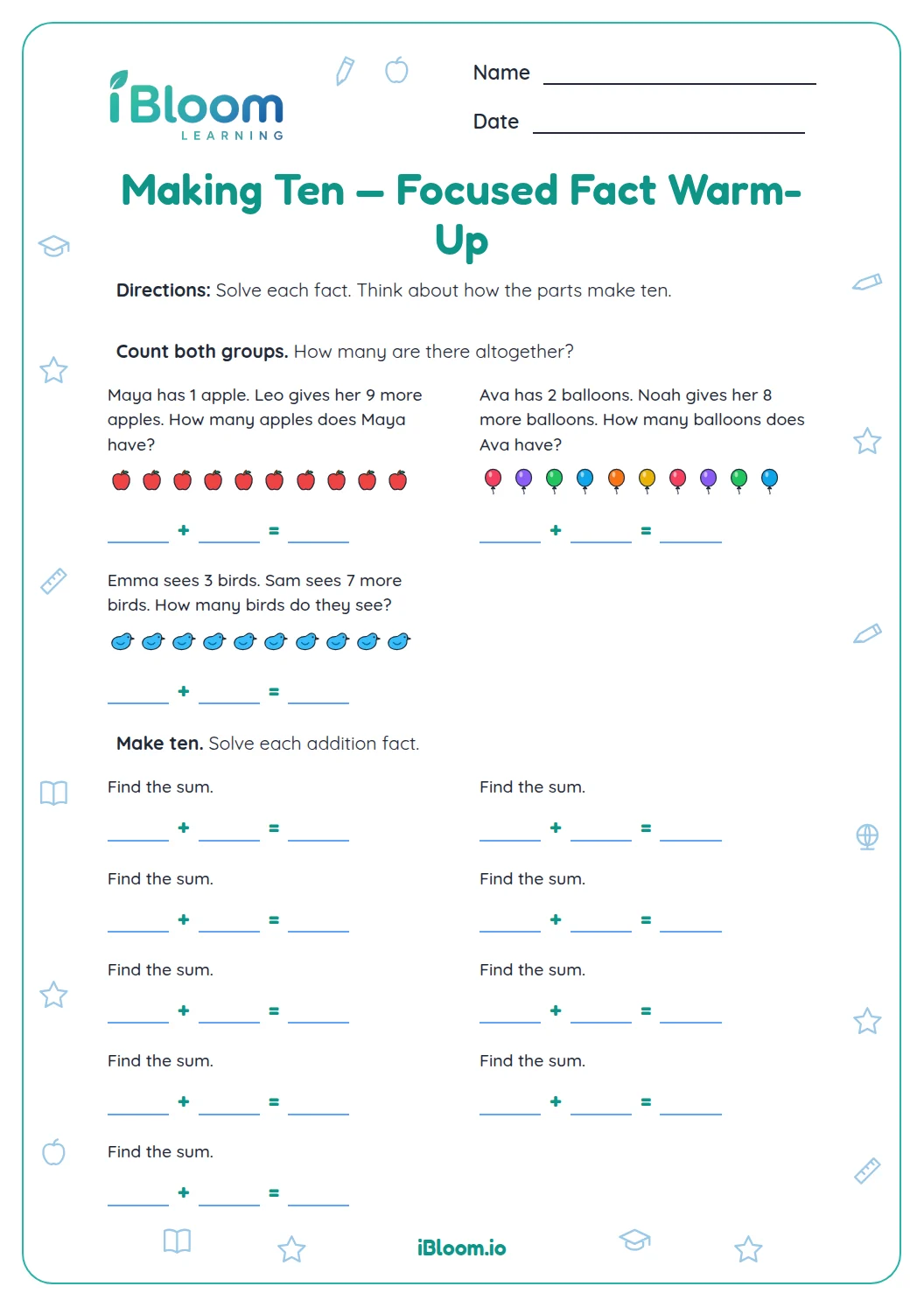
Making ten means finding the amount needed to join a number and reach 10. For example, 8 needs 2 because 8 + 2 = 10. Children can count on, use a ten frame, or recall the pair. The worksheet practices that idea with missing numbers.
How can my child solve 10 − 7?
Think of the related addition fact: 7 + ___ = 10. Since 7 needs 3 more, 10 − 7 = 3. This connection is useful because every subtraction item on the sheet can be checked by adding the answer back.
Why are some blanks before the first addend?
The position of a blank changes how the fact looks, but not the number pair. In ___ + 6 = 10, the missing part is the same part that completes 6 + ___ = 10. Encourage your child to read the whole equation before writing.
How many questions are on the printable?
There are 16 questions in three parts: five direct missing-addend facts, five multiple-choice facts, and six mixed addition or subtraction facts. The answer key is separate, so an adult can check work without printing it beside the practice page.
What should I do if a fact is hard to remember?
Use small objects or fingers to show the known part, then add counters until there are 10. Count only the extra counters. For 6 + ___ = 10, four counters are needed; repeat with a new fact and gradually move back to mental recall.
What can we practice after this page?
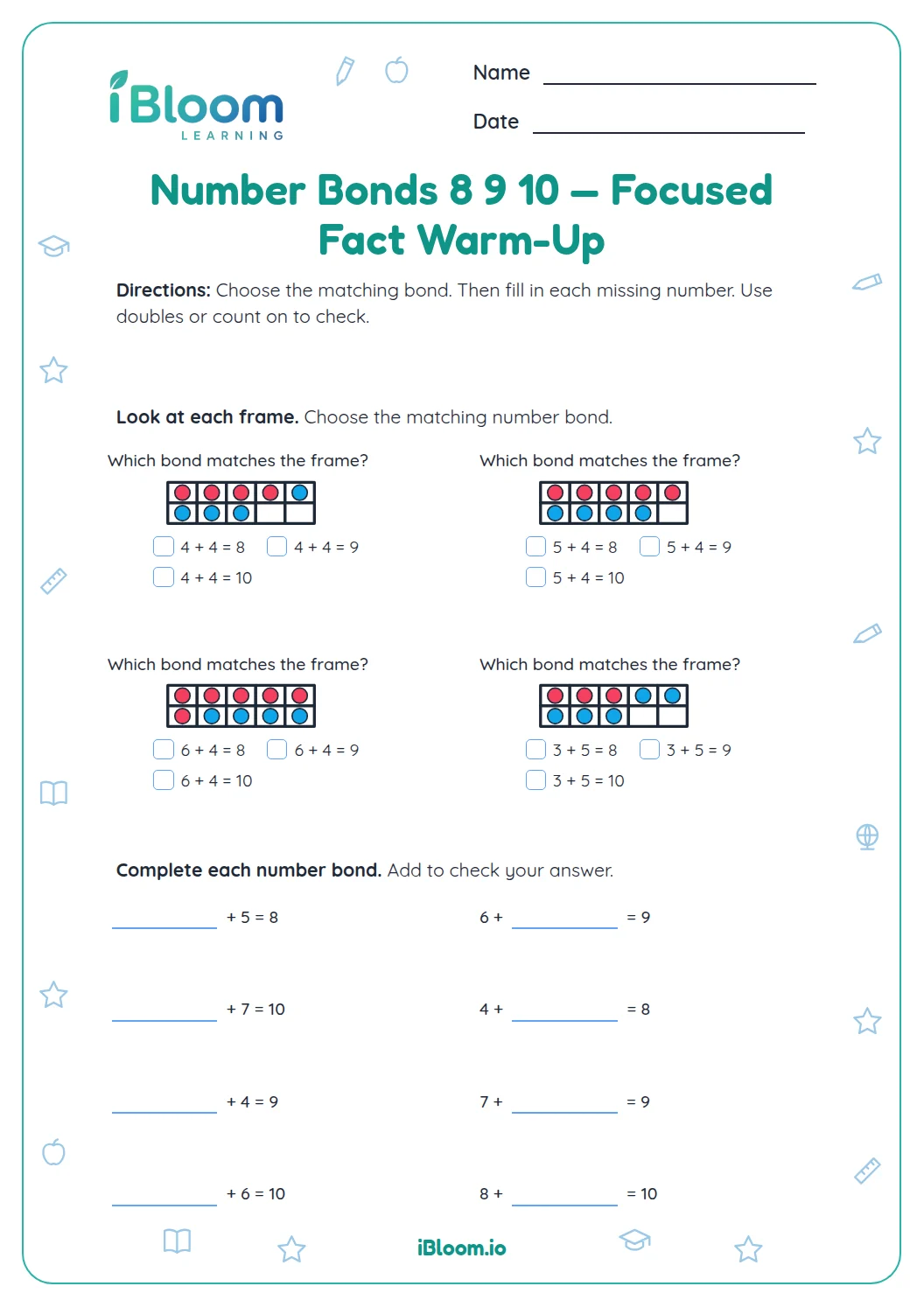
A number-bond page is a helpful next step because it shows the whole 10 and its two parts together. Children can also try mixed addition facts within 20, then connect each addition pair to its matching subtraction facts. Use the included key after the learner has completed the facts to review each answer together.