



About this worksheet
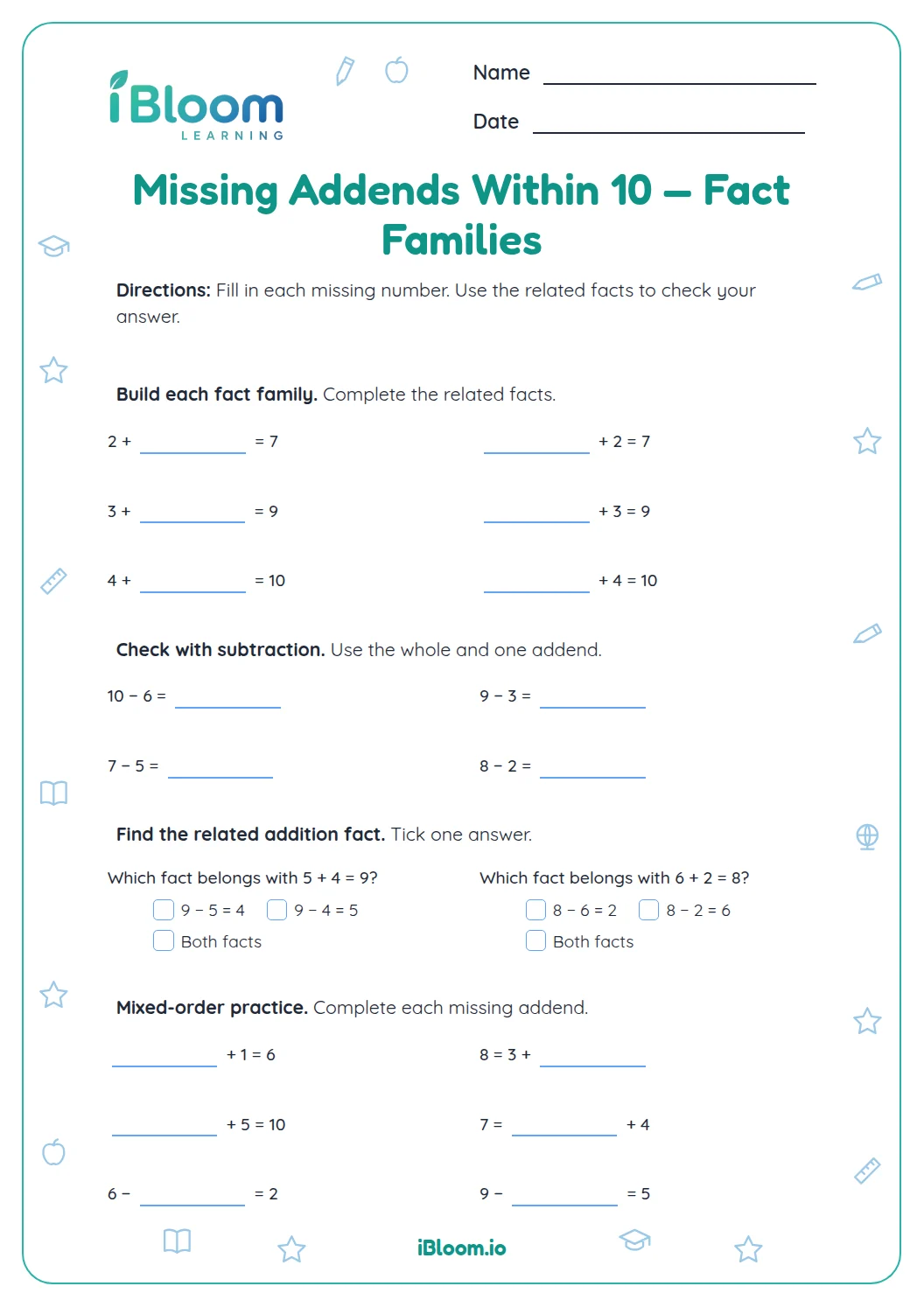
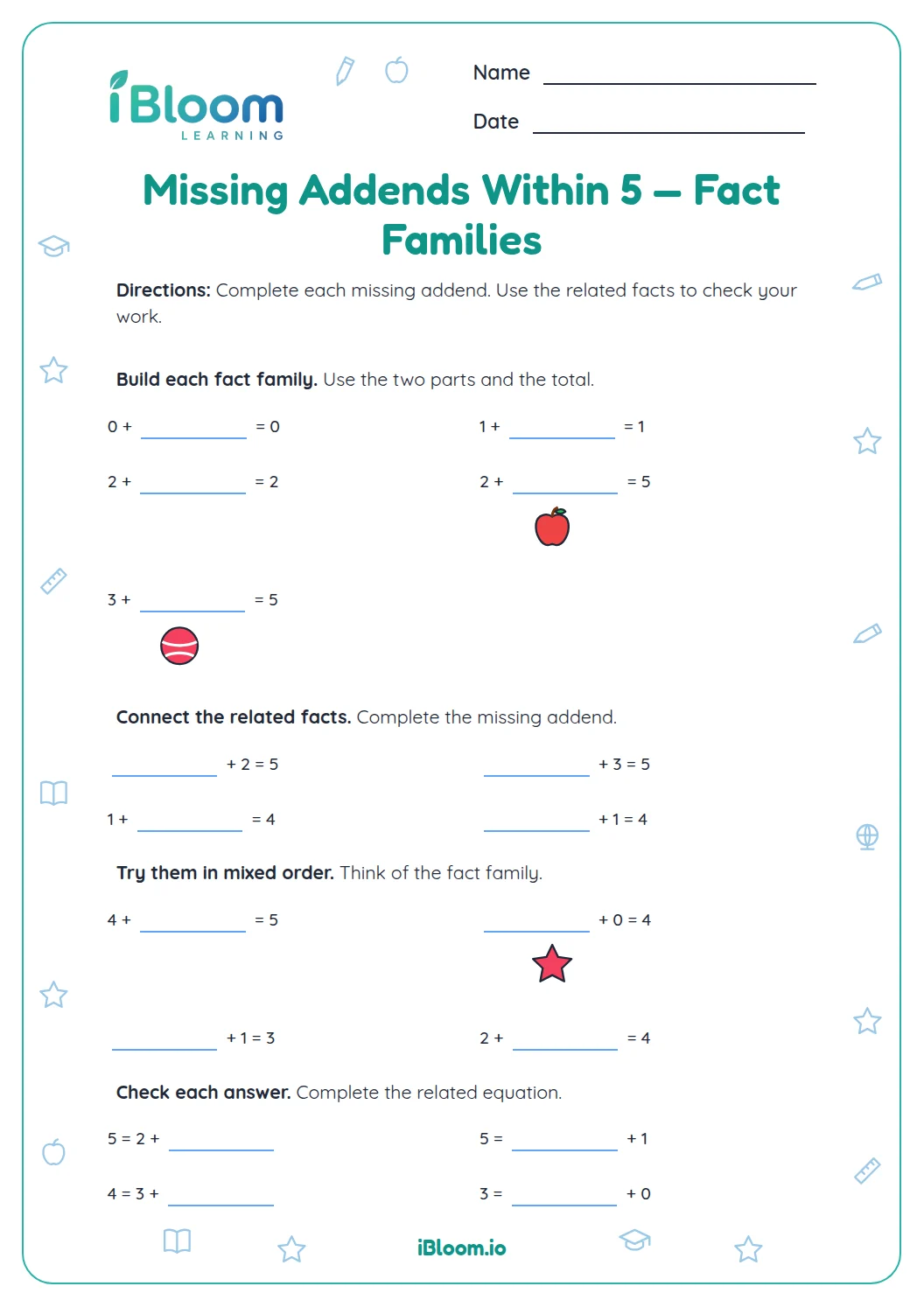
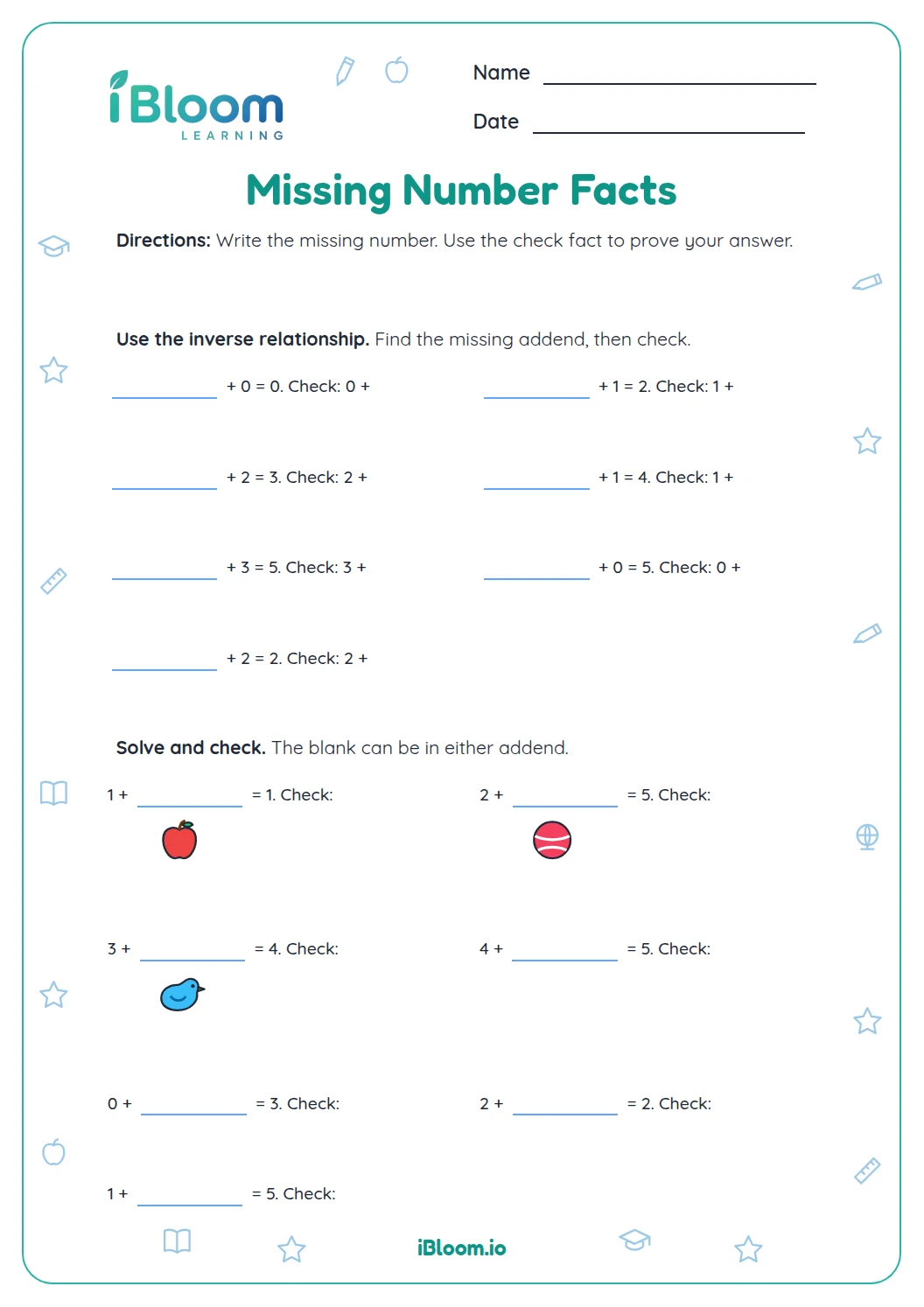
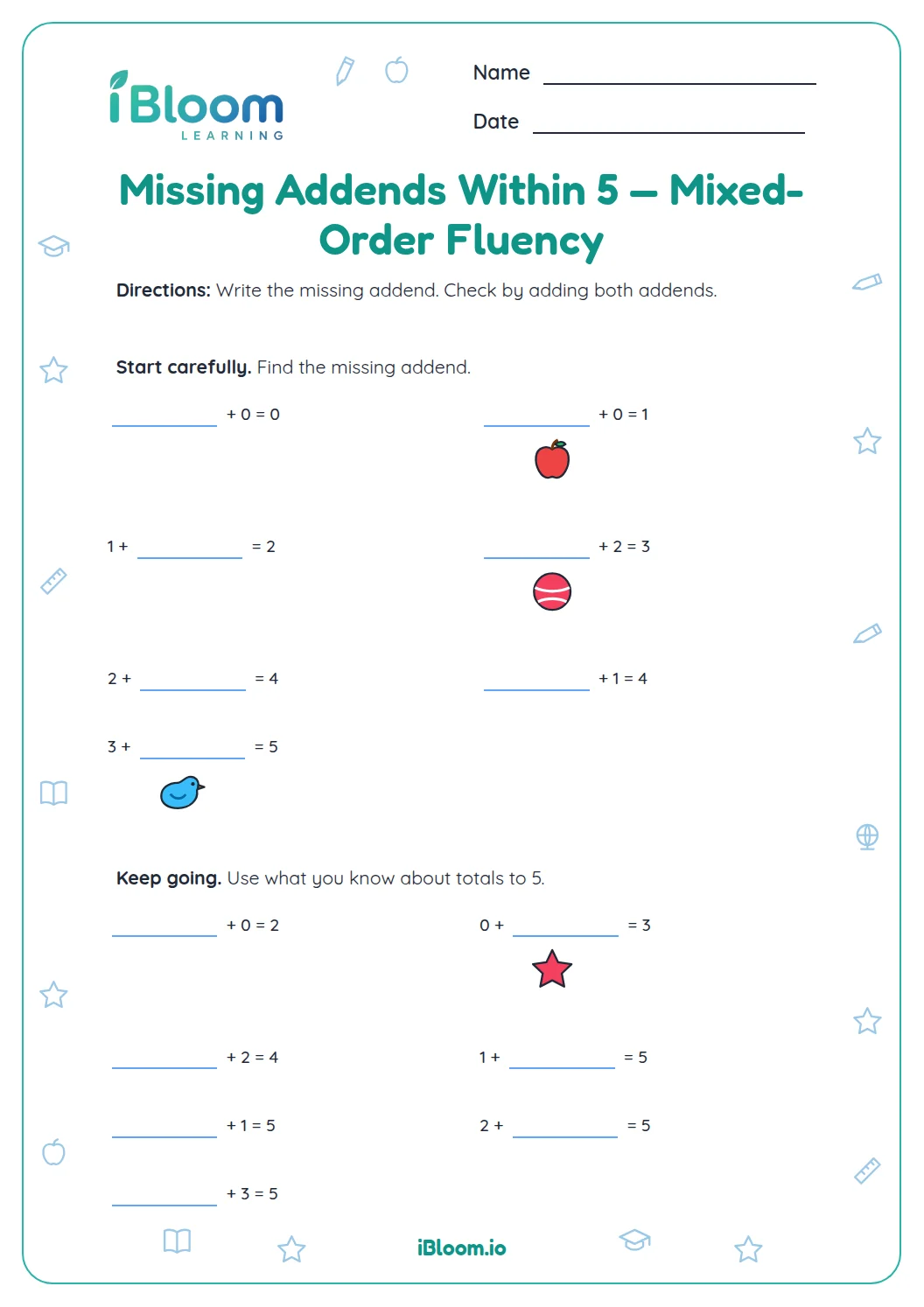
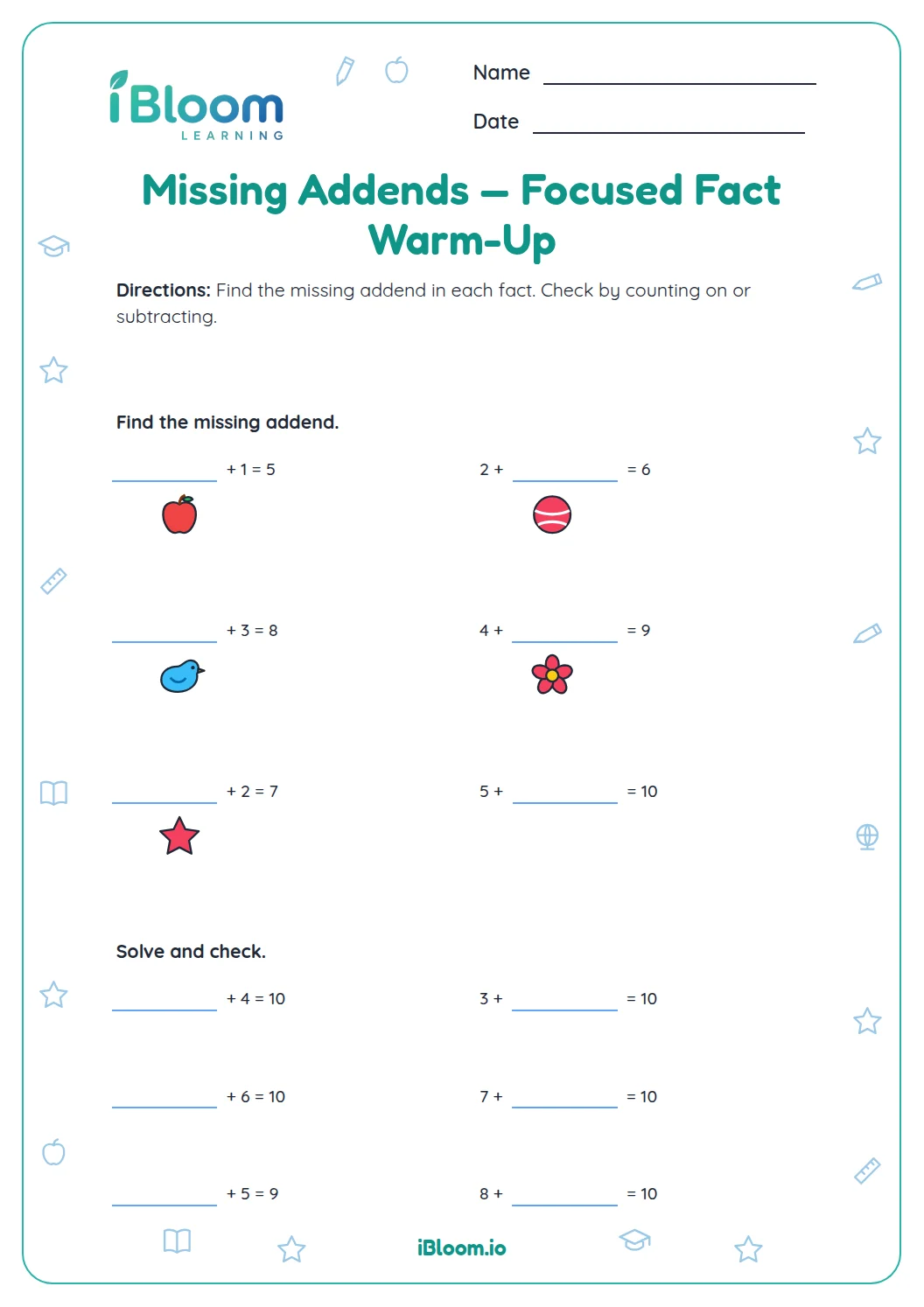
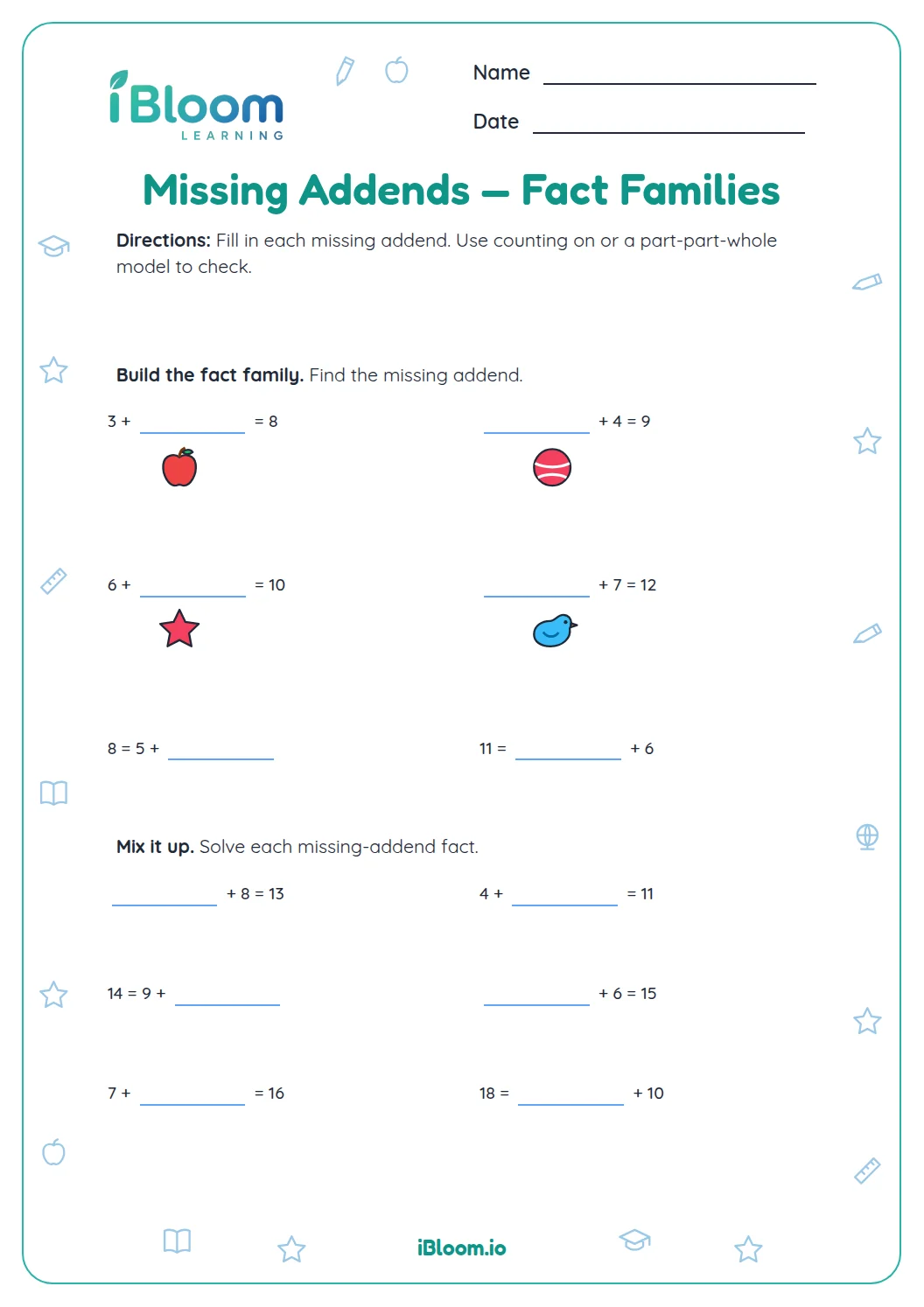
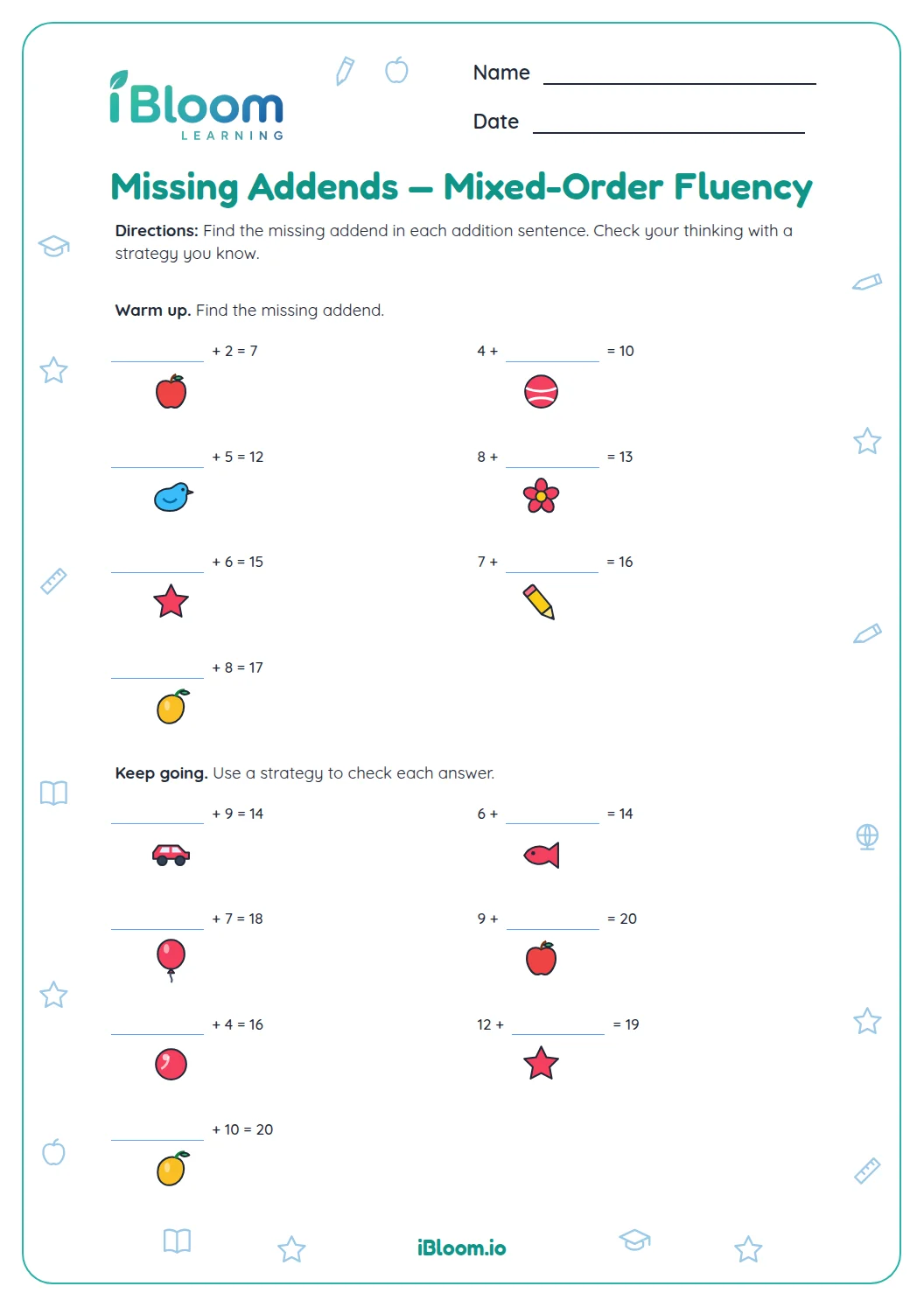
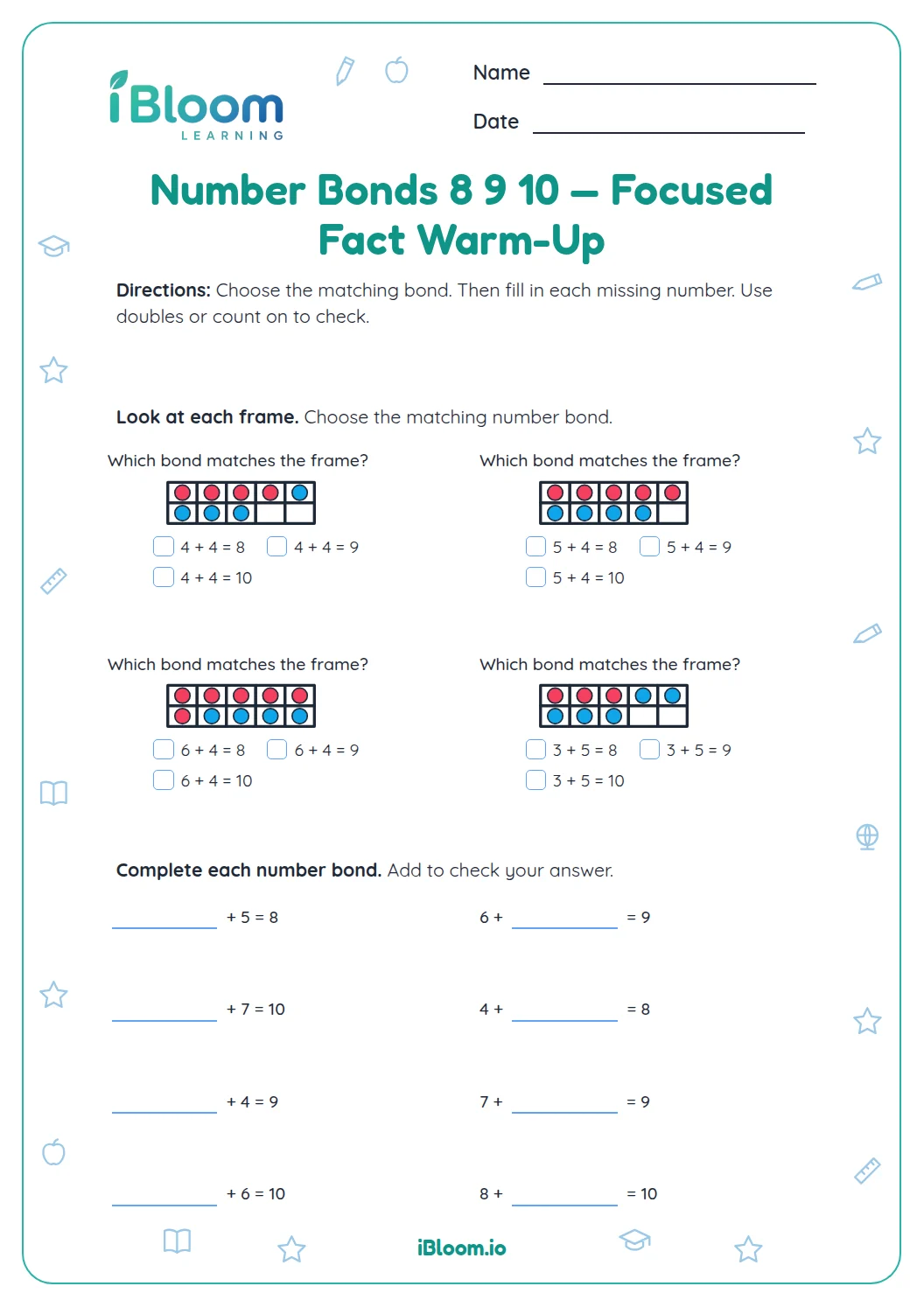
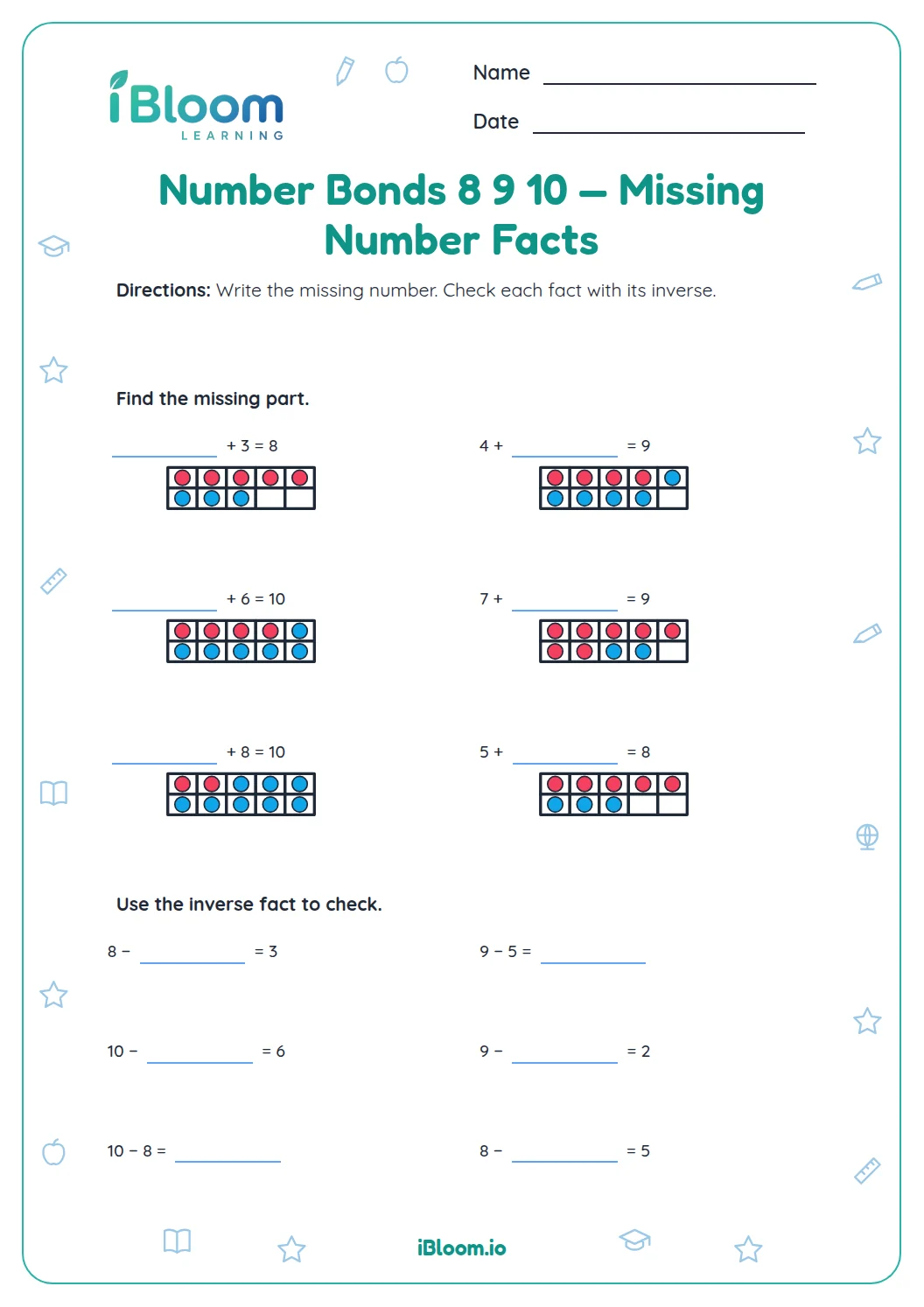
This Grade 1 math printable gives focused practice finding a missing addend in addition facts within 10. Children solve equations with the blank in either position, then use two number bonds to connect a whole with its parts. All 18 items stay within 10, and a separate answer key is included. The practice supports Common Core standard 1.OA.C.6, which builds fluency with addition and subtraction within 10 and encourages strategies such as counting on and using the relationship between operations.
Aligned to 1.OA.C.6
How do you find a missing addend?
Think about how much more the known addend needs to reach the total. Counting on gives the missing part.
- 12 + ___ = 5
- 2Count on from 2: 3, 4, 5.
- 3Answer: 3
How are the equations and number bonds used?
Part A gives equations with the unknown in either addend position. Part B mixes the positions. Part C includes two number bonds, then returns to equations so children use the same part-whole idea in more than one layout.
- Find a missing part in an equation
- Mix the blank’s position
- Connect number bonds and equations
How can the answer key help?
Check a completed group rather than after every fact. For an error, name the known part and total, then count on to find the amount needed.
How to use this worksheet
- 1Read the equation and locate the blank.
- 2Name the known addend and the total.
- 3Count on from the known addend to the total.
- 4For a number bond, use whole = both parts together.
- 5Check that the two addends make the total.
Common mistakes and quick fixes
The mistake
Writing the total in the blank.
The fix
The blank is one addend; add it to the known number to check.
The mistake
Counting the starting addend as the first step.
The fix
Start counting with the next number after the known addend.
The mistake
Reading a number bond part as the whole.
The fix
Find the total at the top, then use the known part to find the other part.
Common Core alignment
This worksheet practices the following Common Core skill.
Use counting on and part-whole relationships to solve addition facts within 10.
On this sheet: The missing-addend facts use counting on and part-whole thinking within 10.
Show the official wordingHide the official wording
Add and subtract within 20, demonstrating fluency for addition and subtraction within 10. Use strategies such as counting on; making ten (e.g., 8 + 6 = 8 + 2 + 4 = 10 + 4 = 14); decomposing a number leading to a ten (e.g., 13 − 4 = 13 − 3 − 1 = 10 − 1 = 9); using the relationship between addition and subtraction (e.g., knowing that 8 + 4 = 12, one knows 12 − 8 = 4); and creating equivalent but easier or known sums (e.g., adding 6 + 7 by creating the known equivalent 6 + 6 + 1 = 12 + 1 = 13).
What to practice next
Make more practice
Further reading
Questions parents and teachers ask
What does this worksheet practice?
This Grade 1 math sheet practices finding missing addends in facts within 10. Children solve equations with the blank in either position and use two number bonds to connect whole numbers with parts. The separate answer key shows the missing number for all 18 questions.
How many questions are included?
There are 18 questions in three parts. The first two parts use missing-addend equations, while the last part includes two number bonds and more equations. Every total stays within 10. The worksheet and answer key each use two pages.
What is a missing addend?
A missing addend is the number needed to complete an addition equation. In 2 + ___ = 5, the missing number is 3 because adding 3 to 2 makes 5. The child can check by putting both parts together again.
How can a child find the missing number?
Name the known addend and the total, then count on from the known number until reaching the total. The number of counts gives the missing part. A number bond offers another view: the whole is made from the two parts.
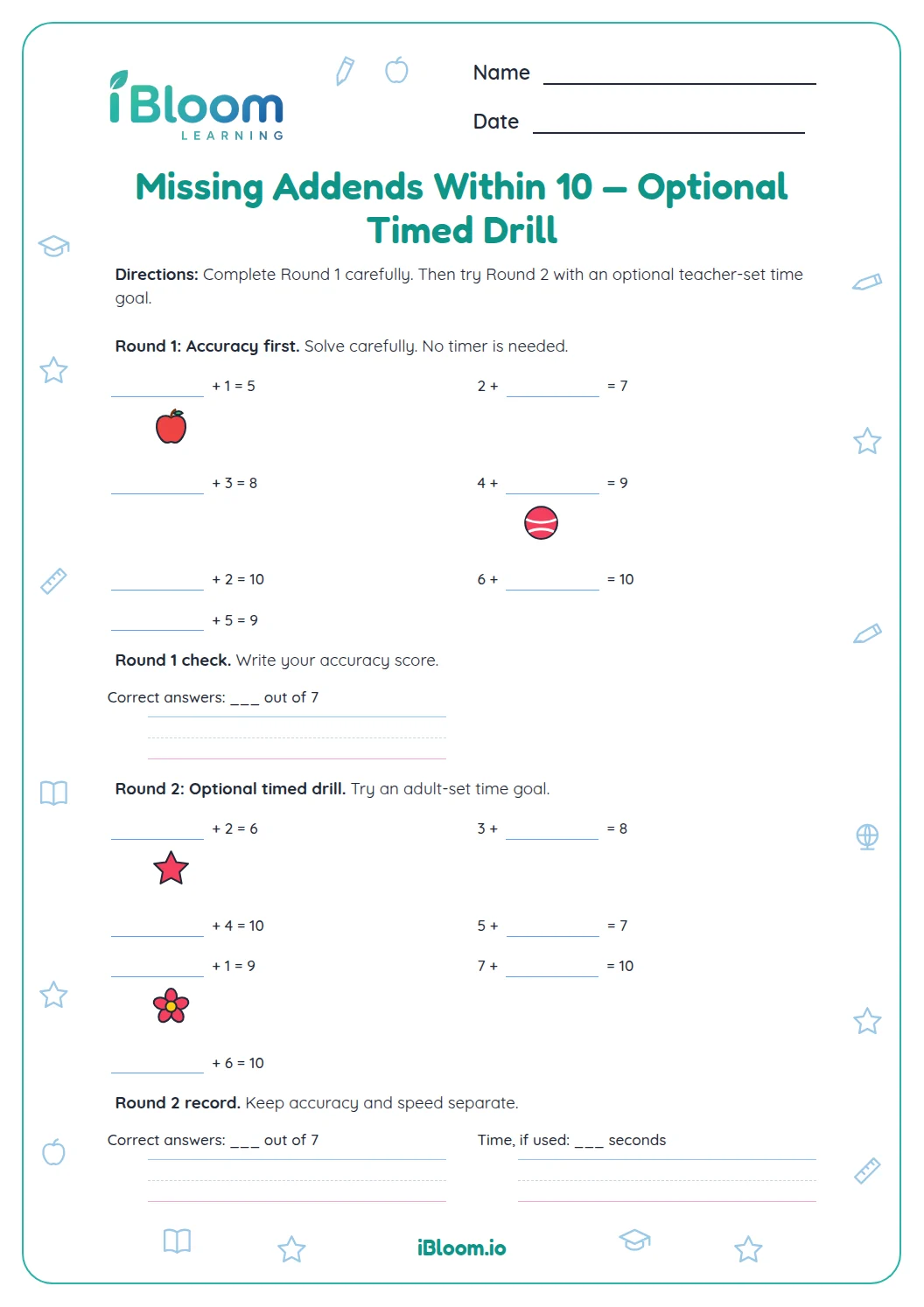
Are the questions timed?
No timer is needed. Children can use counting on, a number bond, or another strategy that makes sense to them. After completing a set, check the missing addends with the separate key and revisit any fact that needs another try.