





About this worksheet
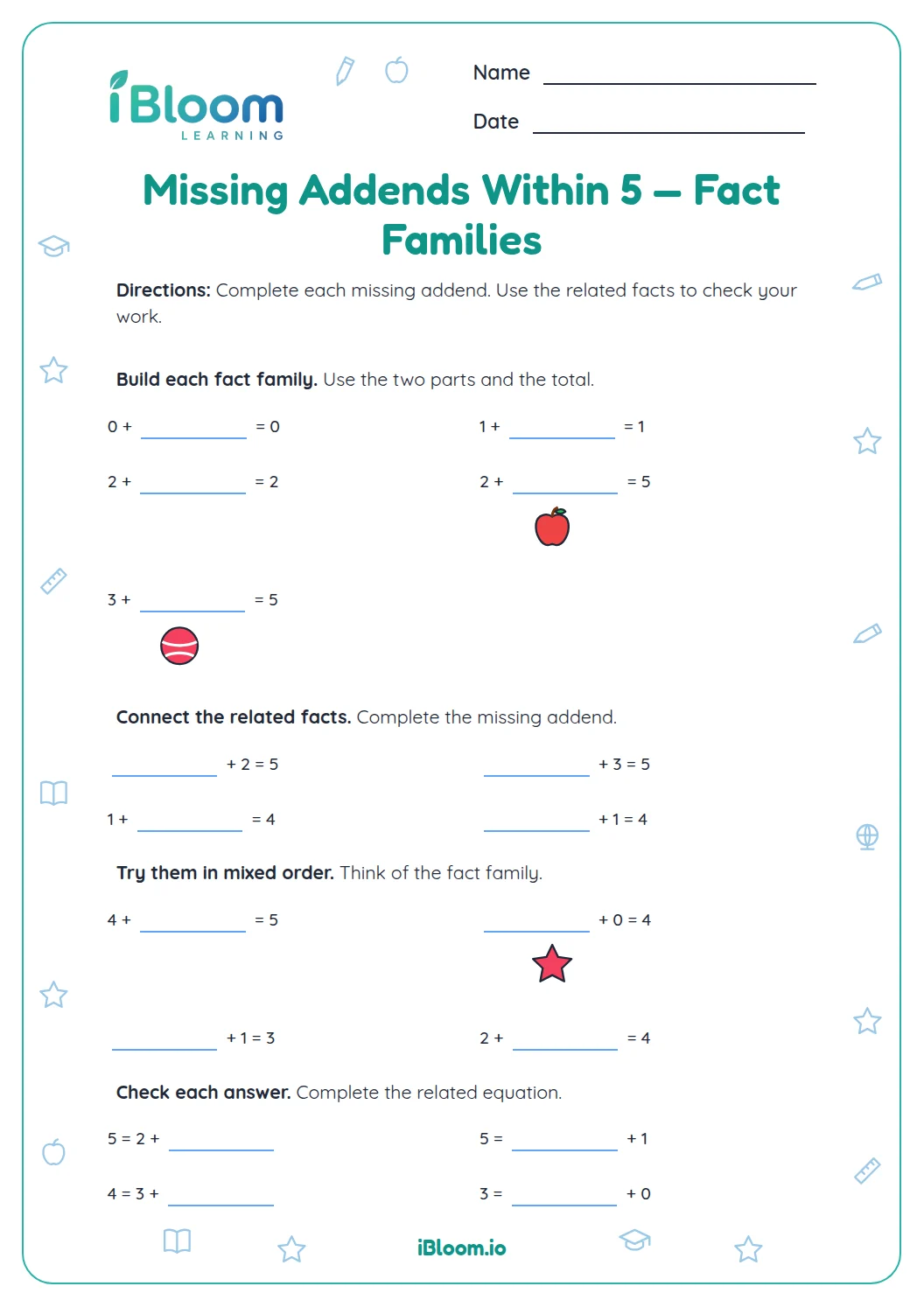
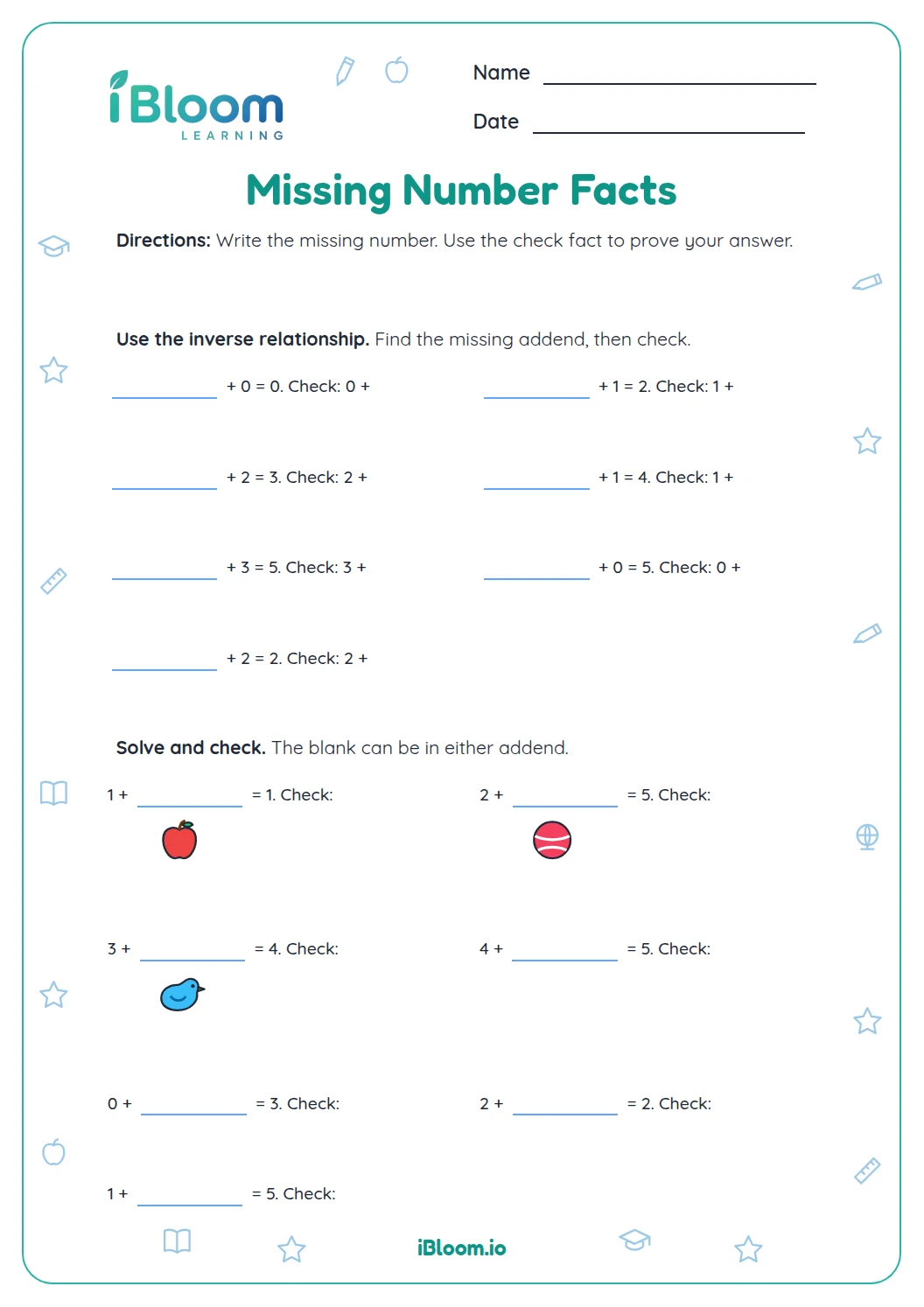
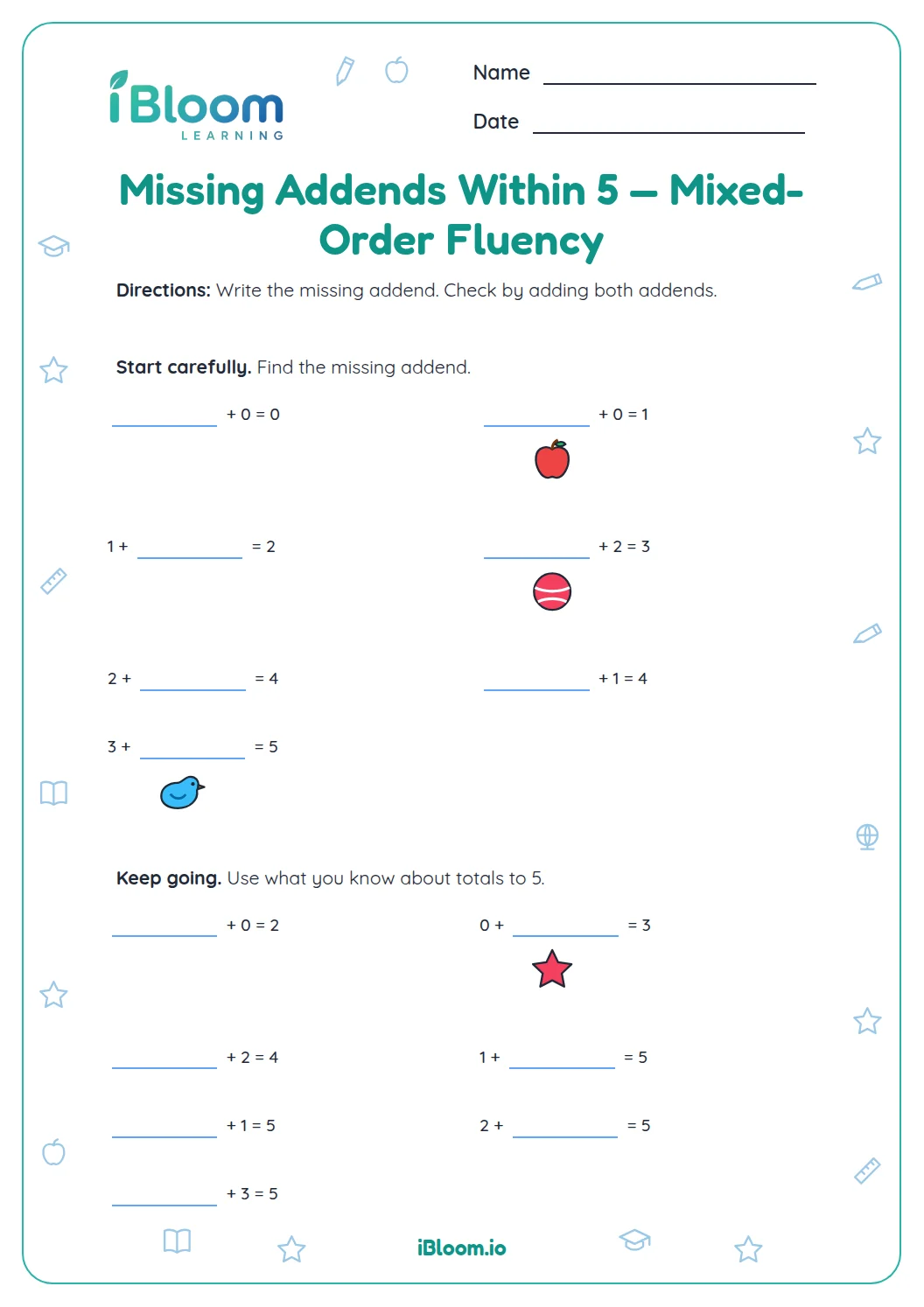
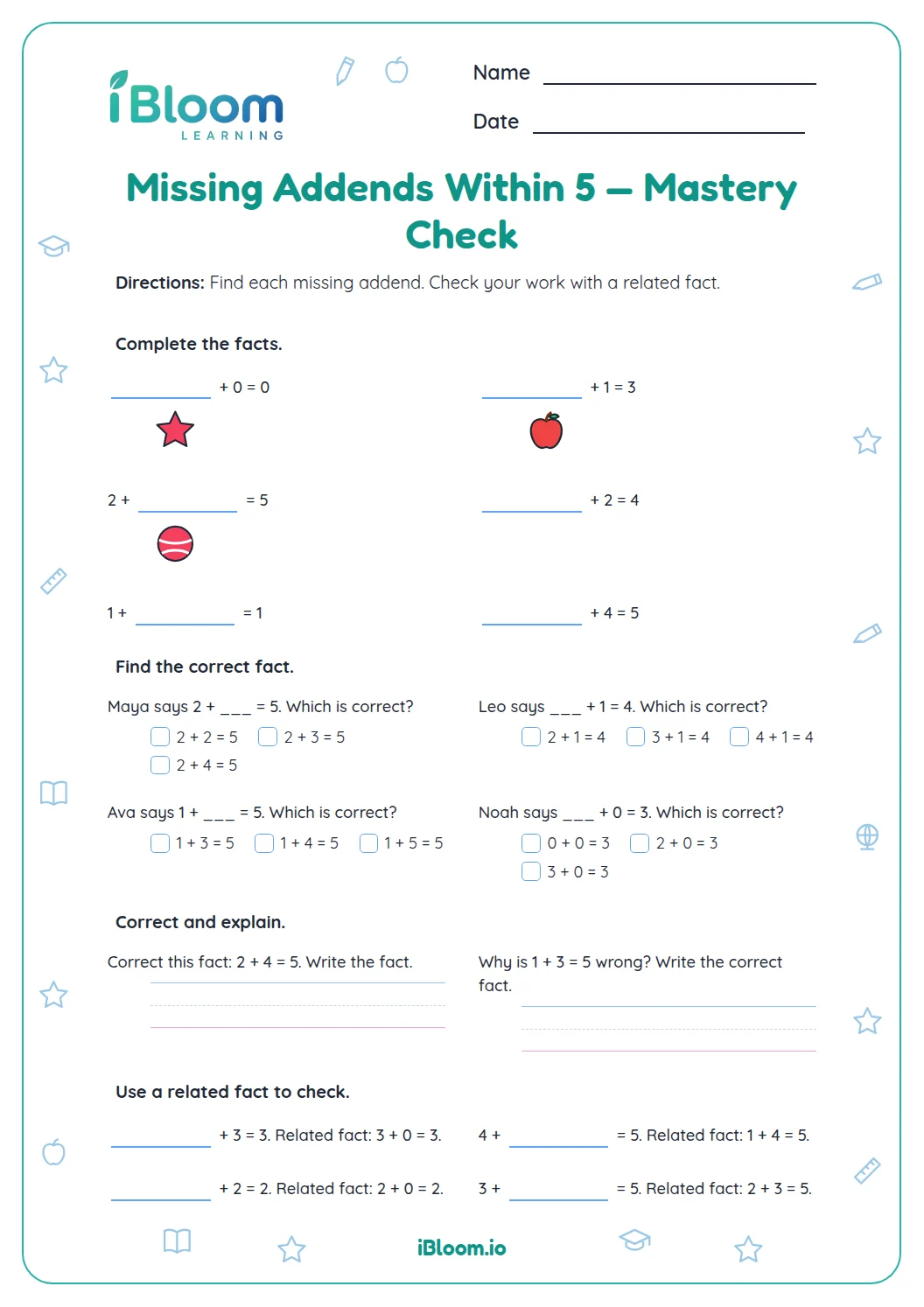
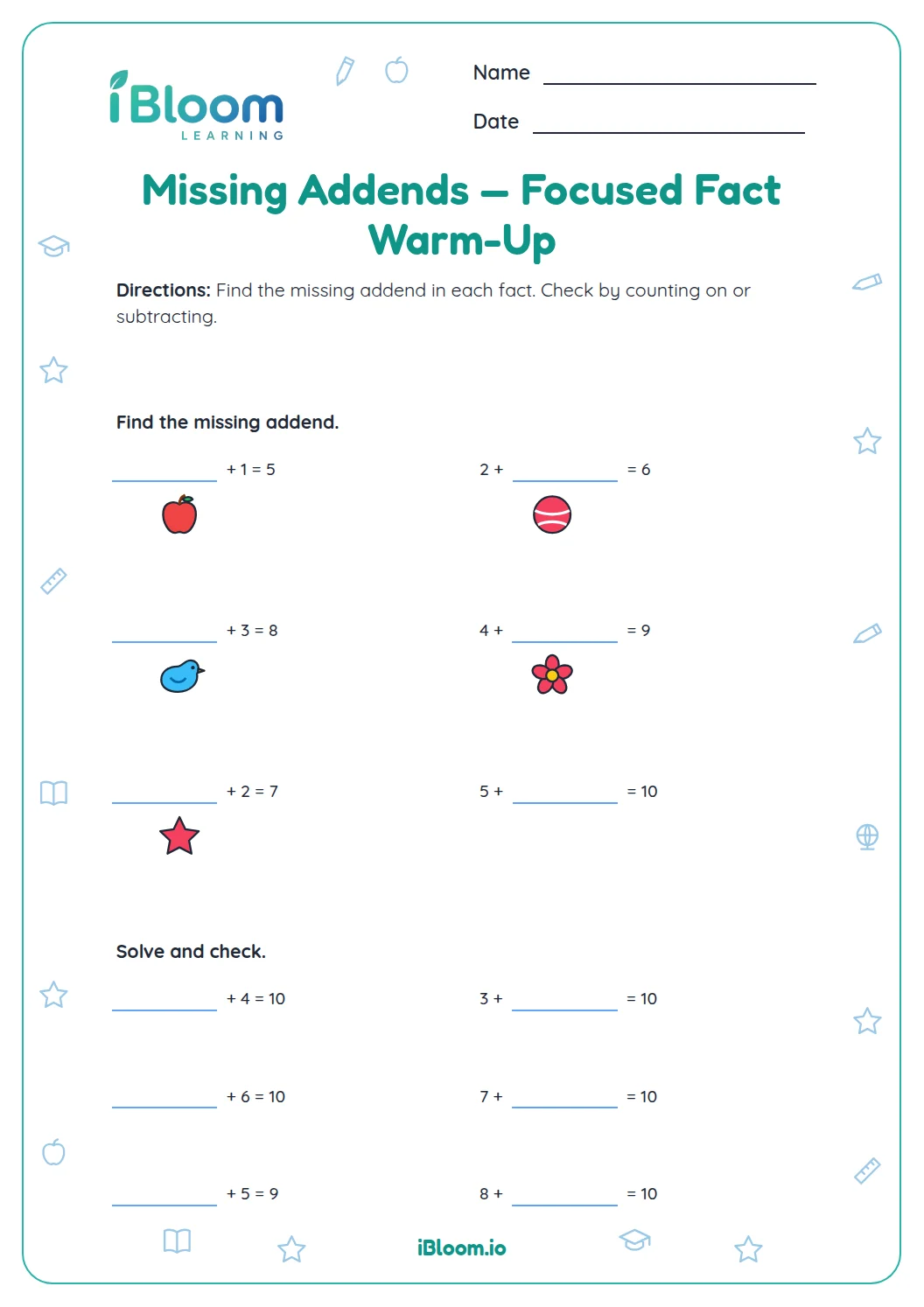
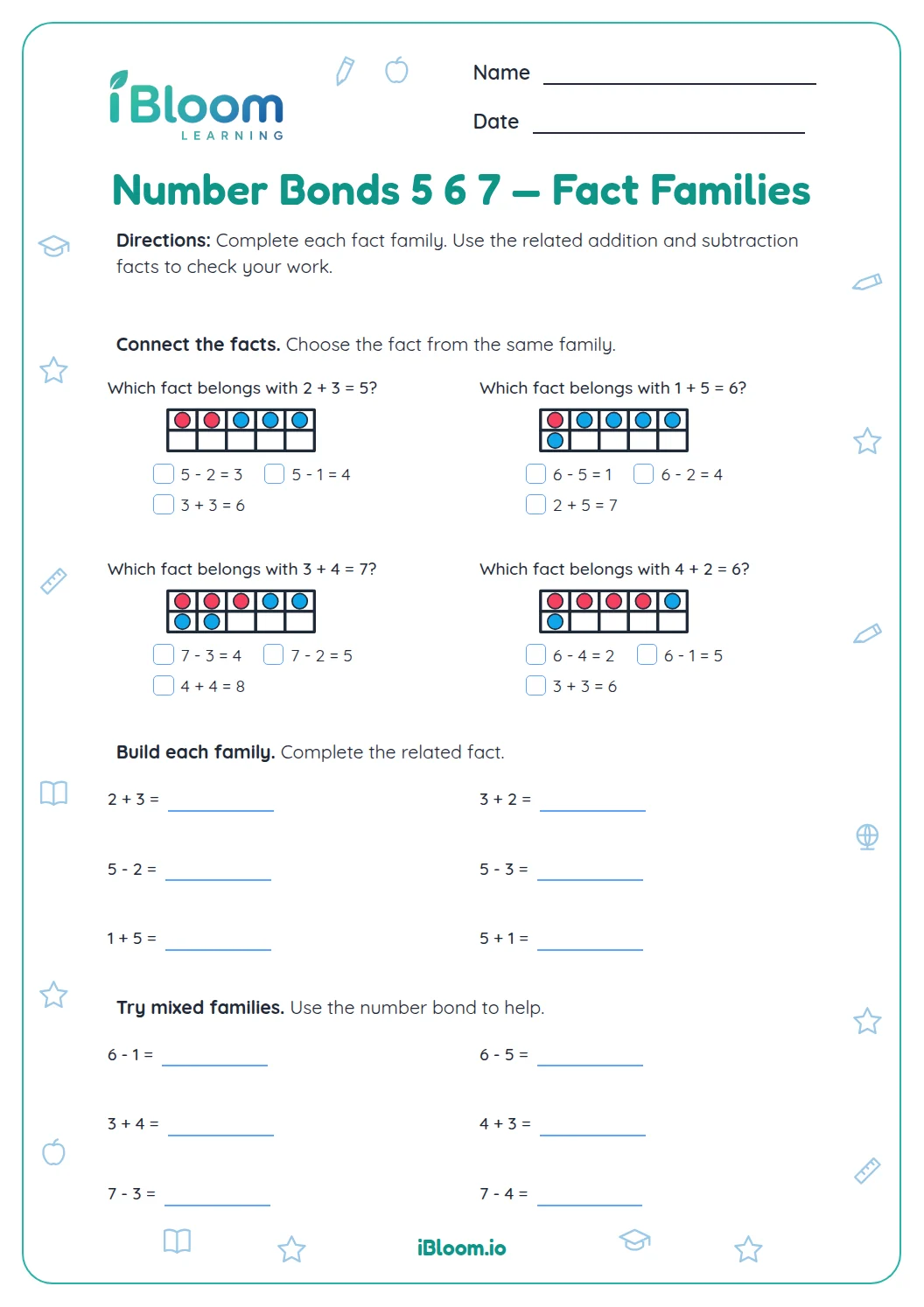
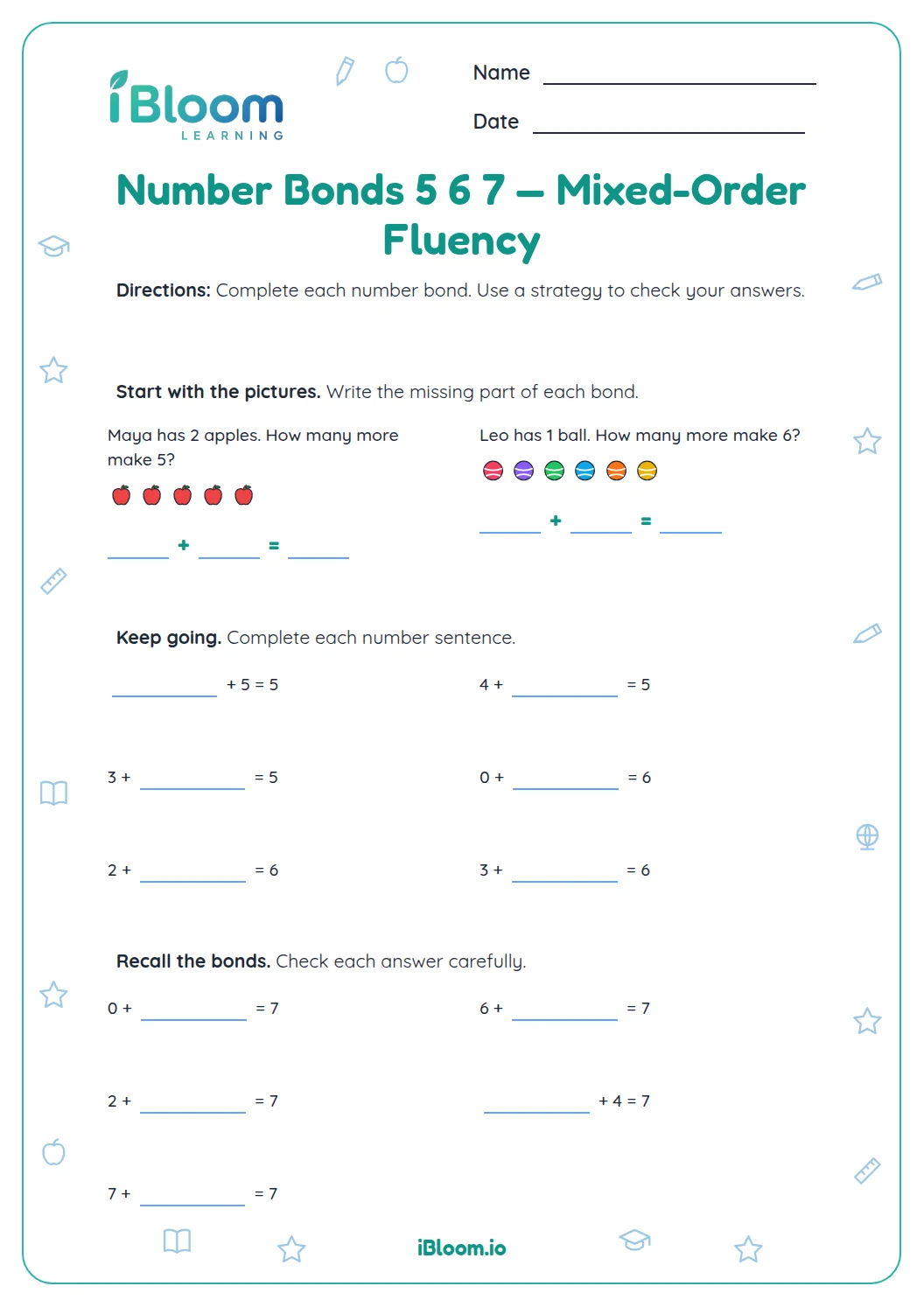
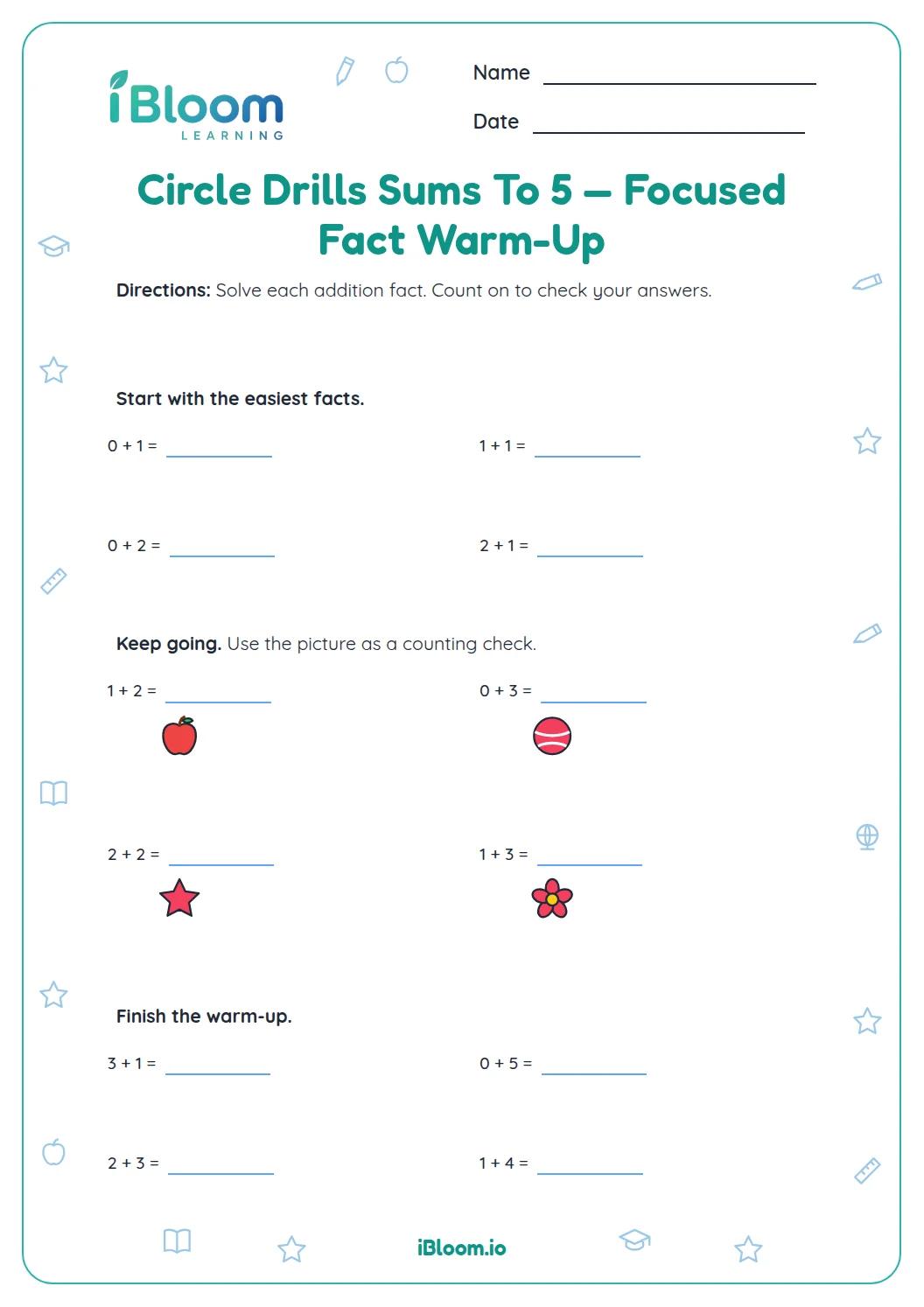
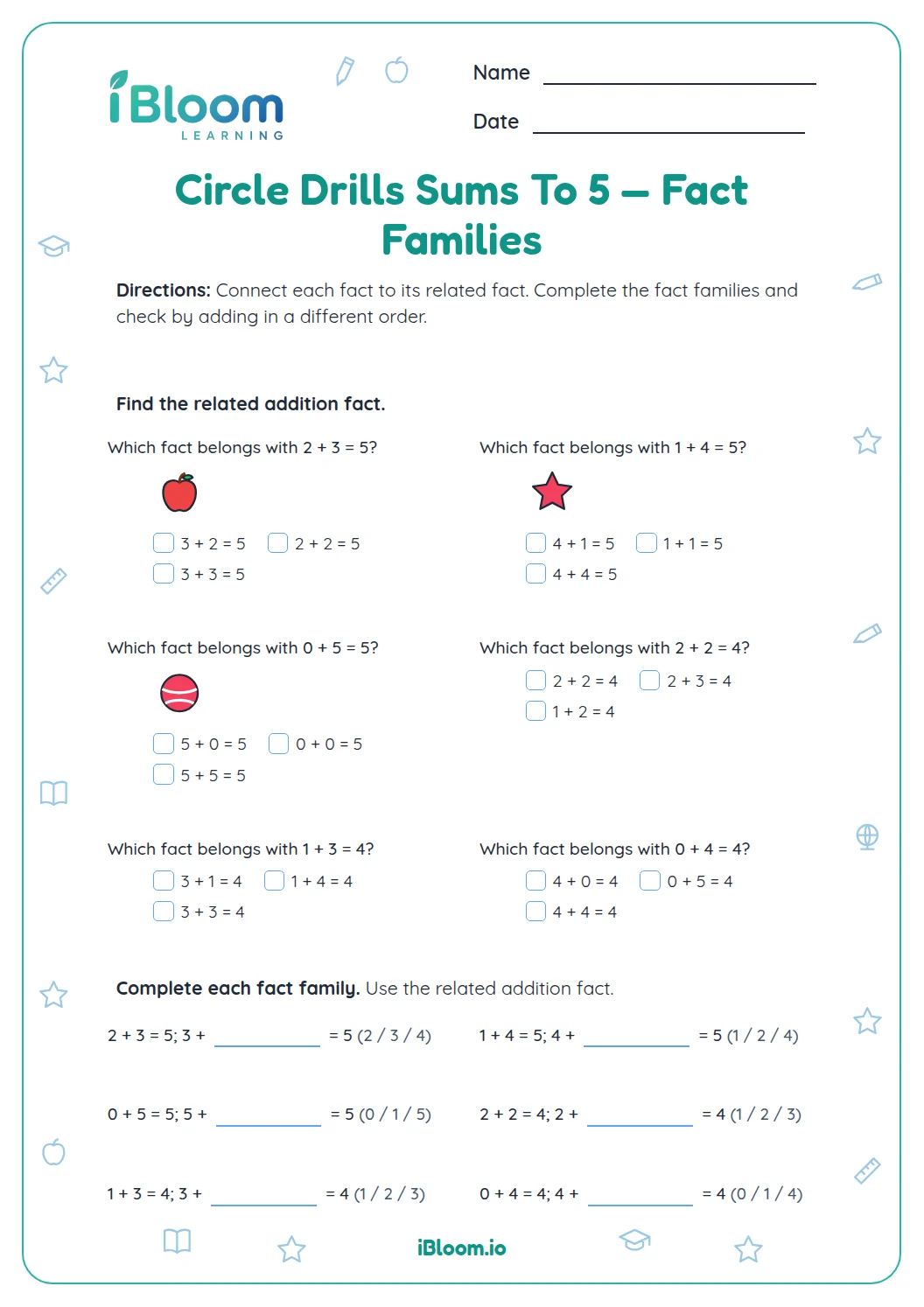
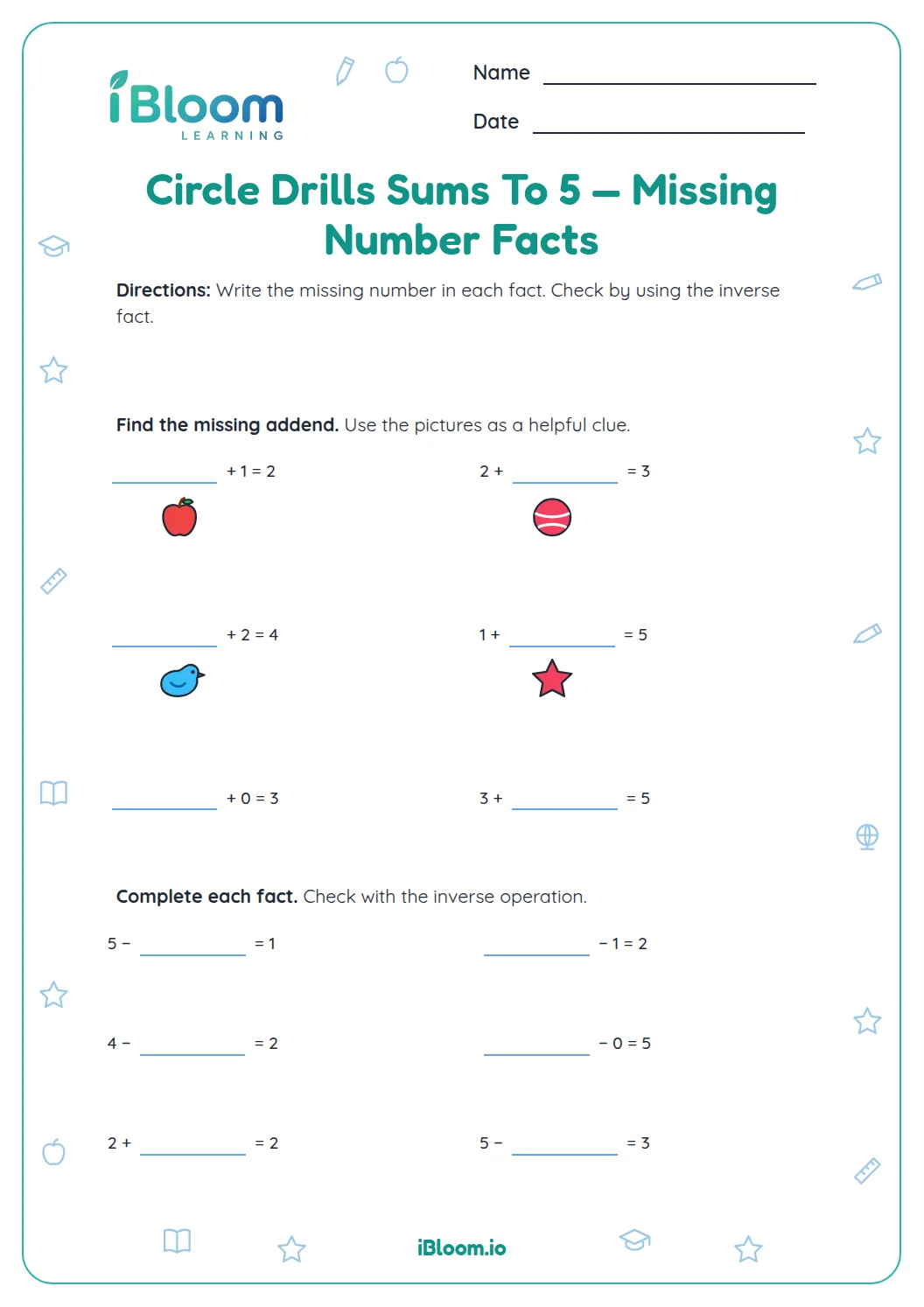
This printable warm-up gives children 20 missing-addend equations with sums from 0 through 5. The practice begins with familiar small facts, then changes which addend is hidden so children think about how the two parts and the total relate. Every answer stays within 5. The included key makes quick checking easy. The sheet practices finding an unknown number in an addition equation, matching CCSS 1.OA.D.8.
Aligned to 1.OA.D.8
How can children find the missing part?
Treat the equation as a whole made from two parts. If one part and the whole are visible, count on from the known part or think about what must be added to reach the total. The blank can move, but the relationship stays the same.
- 12 + ___ = 2
- 2The total is already 2.
- 3Adding zero keeps the total at 2.
- 4Answer: 0
Which facts are practiced?
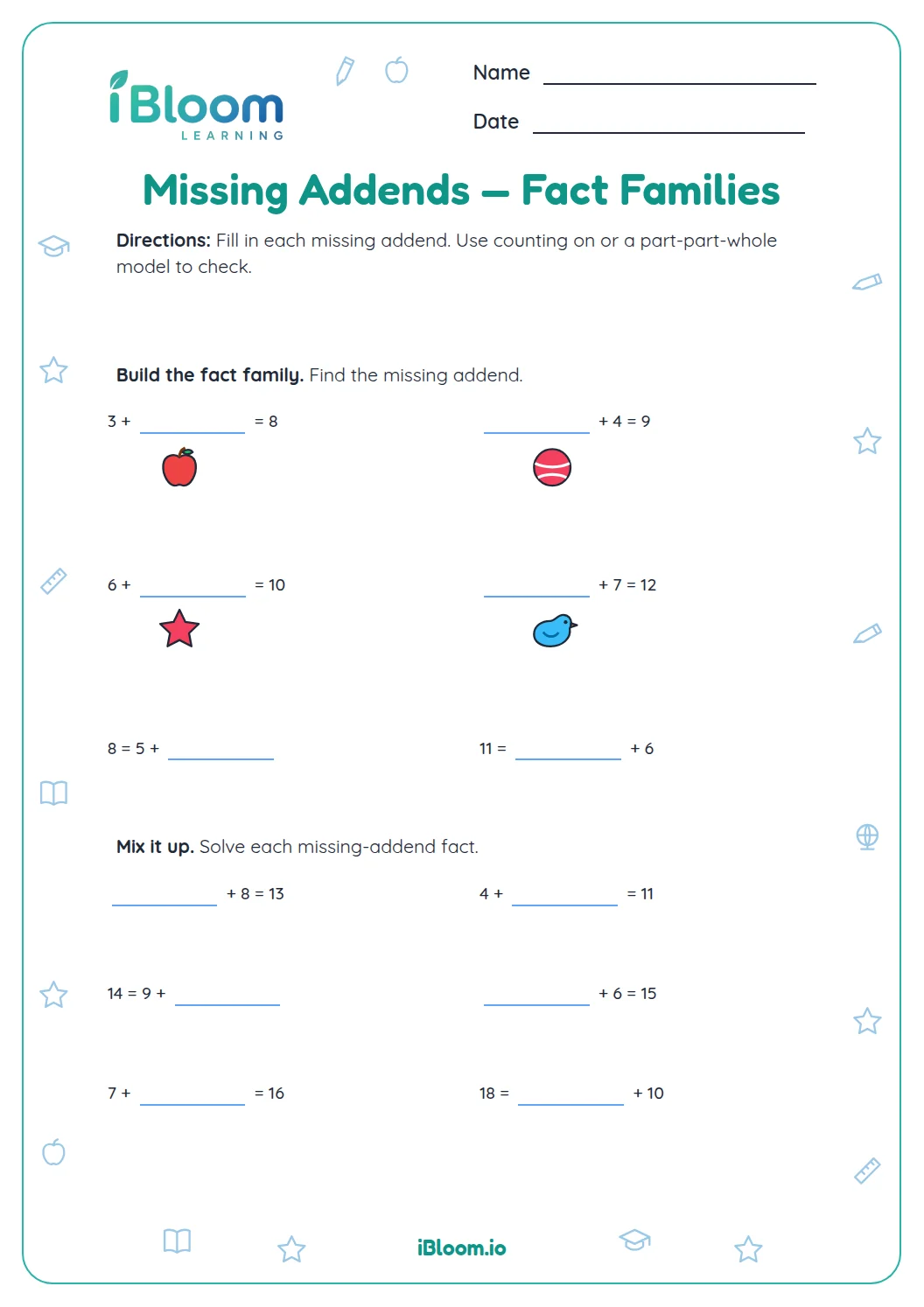
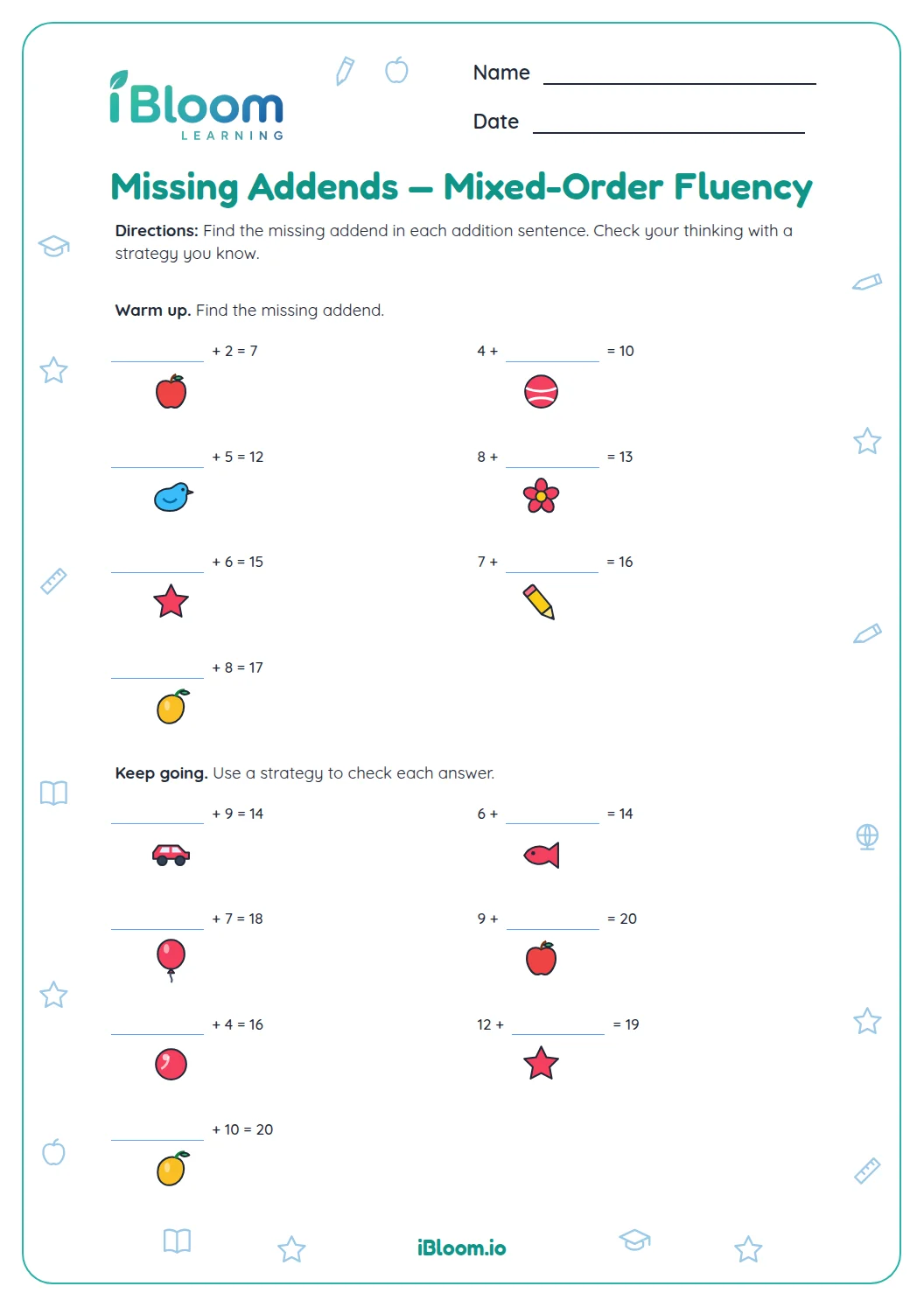
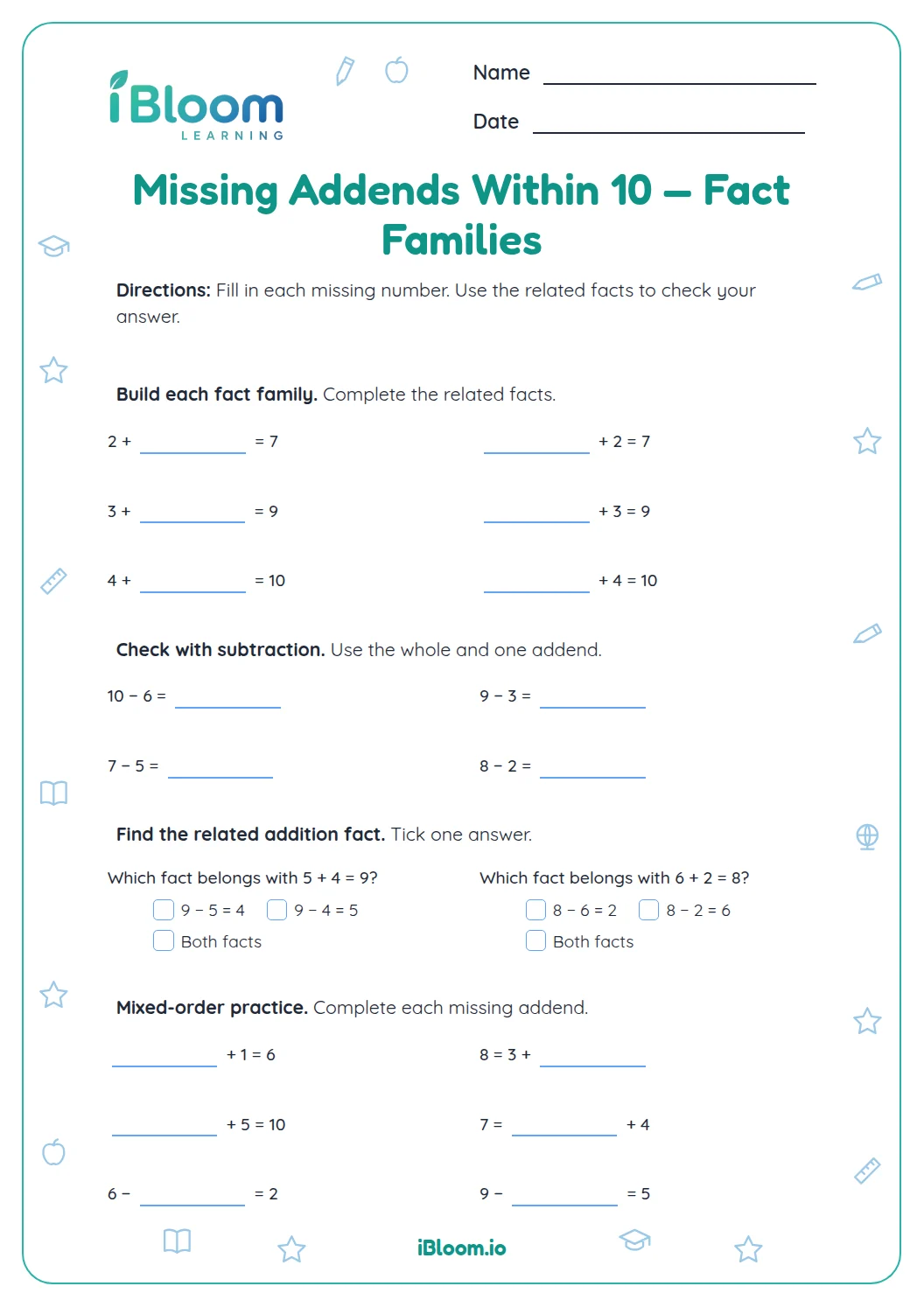
The 20 items use addends from 0 through 5 and sums no greater than 5. Part A begins with direct missing-part facts; later parts shift the blank and mix the order so children attend to the equation rather than memorize one layout.
When does counting on help?
For 2 + ___ = 5, say “2” and count “3, 4, 5.” Three counts are needed, so the missing part is 3. This simple strategy gives children a way to check a fact when the answer is not immediate.
How to use this worksheet
- 1Read the whole equation, including the total.
- 2Point to the known addend and count on to the total.
- 3Write the number of counts in the blank.
- 4For a blank at the beginning, check the same two parts in reverse order.
- 5Review each fact with the answer key and correct any total that does not match.
Common mistakes and quick fixes
The mistake
Writing the total in the blank instead of the missing addend.
The fix
Check that the known addend plus the answer equals the printed total.
The mistake
Counting the starting number as one extra count.
The fix
Say the known number first, then count only the next numbers until the total.
The mistake
Thinking the first addend must always be the known one.
The fix
Addition parts can switch places; use the total and known part to find the missing amount.
Common Core alignment
This warm-up practices finding an unknown addend in a small addition equation.
Find the unknown addend that makes an addition equation true.
On this sheet: Every problem asks children to find an unknown addend in an equation with a total no greater than 5.
Show the official wordingHide the official wording
Determine the unknown whole number in an addition or subtraction equation relating three whole numbers. For example, determine the unknown number that makes the equation true in each of the equations 8 + ? = 11, 5 = _ - 3, 6 + 6 = _ .
What to practice next
Make more practice
Further reading
Questions parents and teachers ask
What does this worksheet help children practice?
This printable focuses on missing-addend facts within 5. It includes 20 small addition equations with a missing part and a matching answer key. Children can work through the questions in order, pause to explain a choice or calculation, and then use the key to review each response. The examples are written for this particular sheet.
Is an answer key included?
Yes. The key includes an answer for all 20 questions, with sample wording where different clear responses can be correct. For an open response, compare the child’s idea with the passage or math relationship and accept an accurate explanation even when the wording differs from the model.
Can children complete this in one sitting?
Yes. The printable is designed for one practice session, and adults can also divide it by part. Begin with the directions, let the child try the first few items, and pause to discuss the strategy. The time estimate is a guide; careful reading or conversation may take longer.
How should I use the answer key?
Use the key after the child has attempted each part. For a missed item, ask which detail, clue, or calculation supports the answer, then revisit the question together. Open responses may have multiple correct versions, so check the idea and its support rather than requiring an exact match to the sample sentence.
What if a child needs help with a question?
Read the directions aloud and return to the specific clue the question asks about. For reading, point back to the sentence with the evidence. For math, name the known numbers and operation before solving. A small hint can help the child continue while still doing the thinking and recording the response.