




About this worksheet
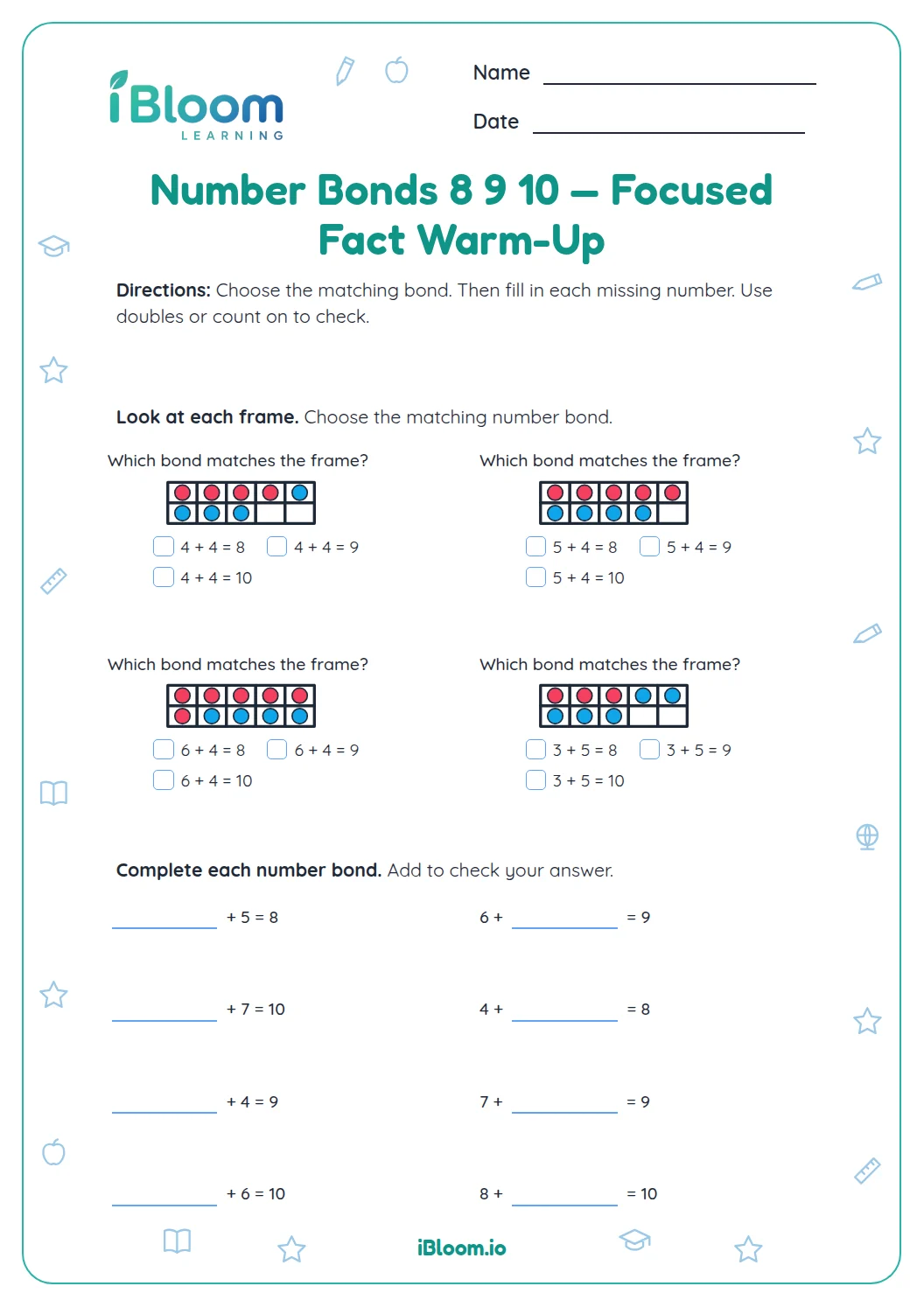
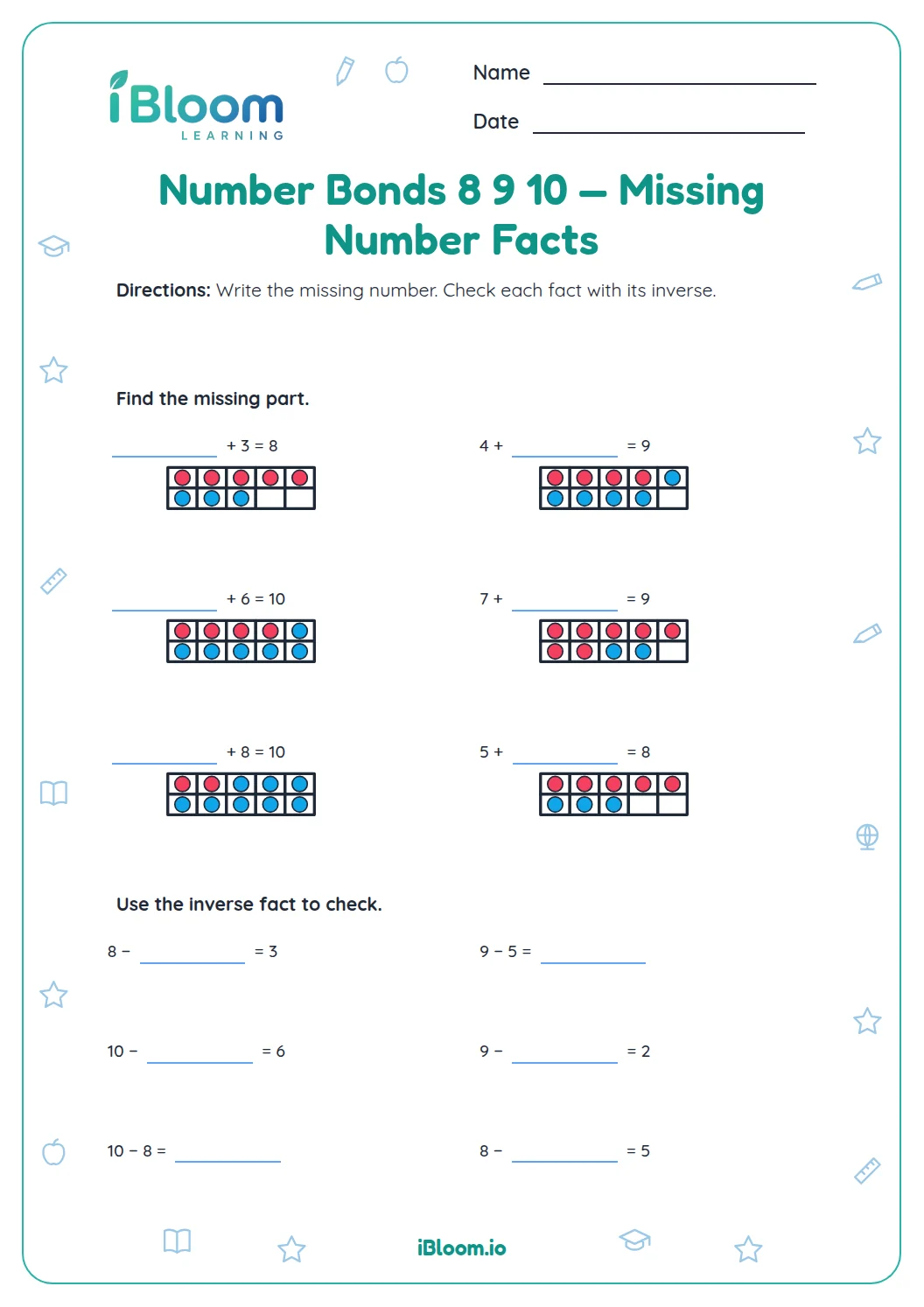
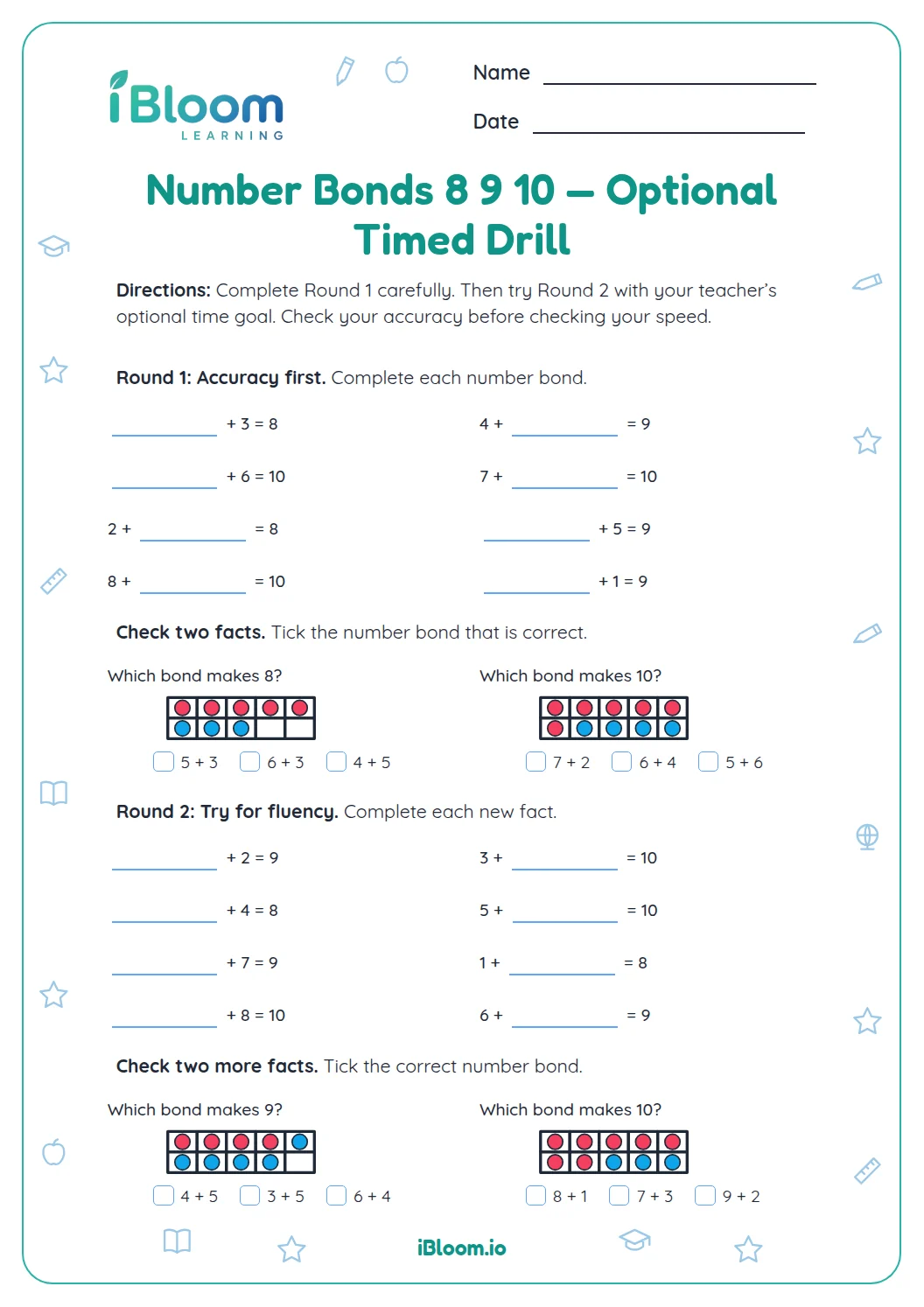
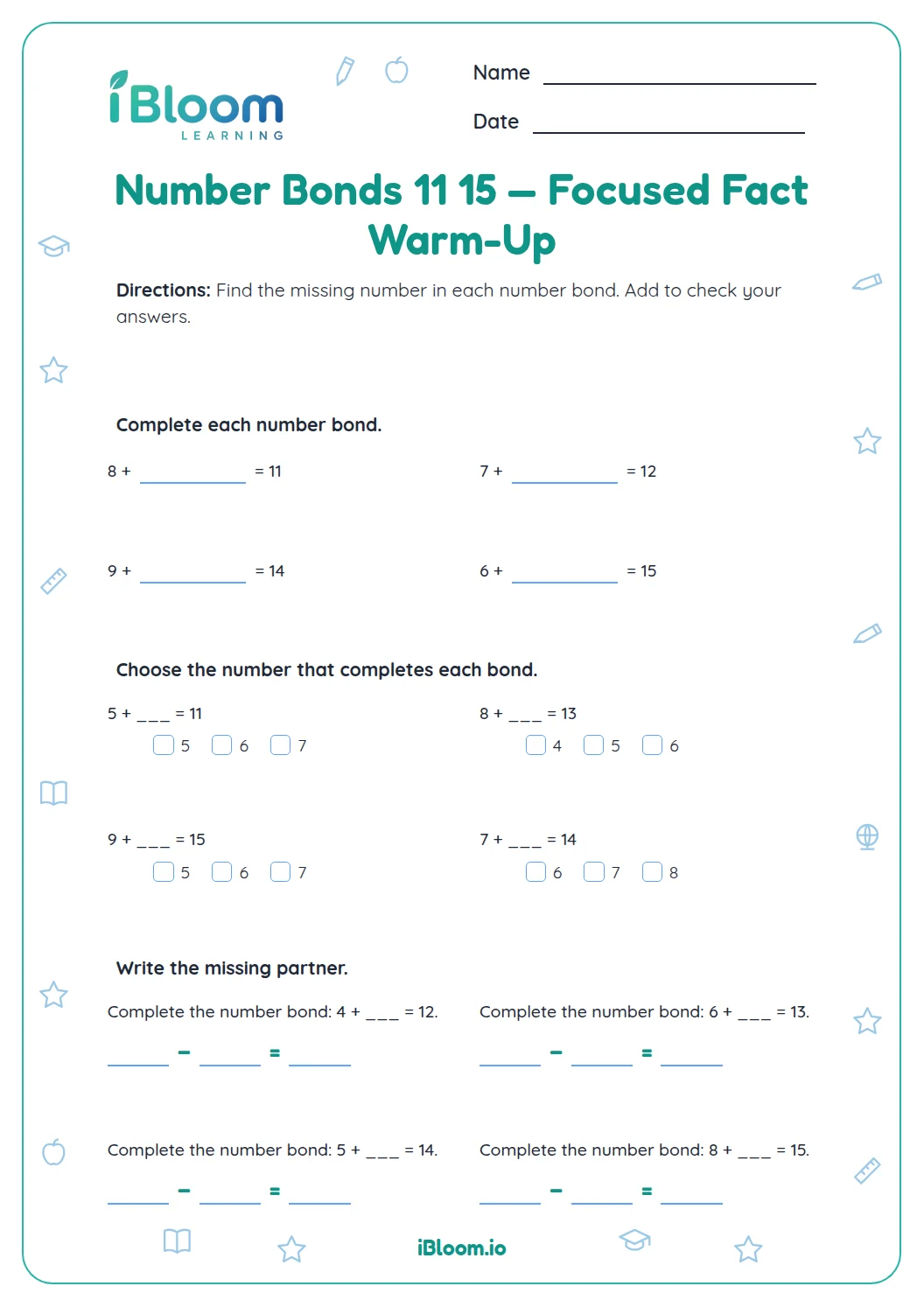
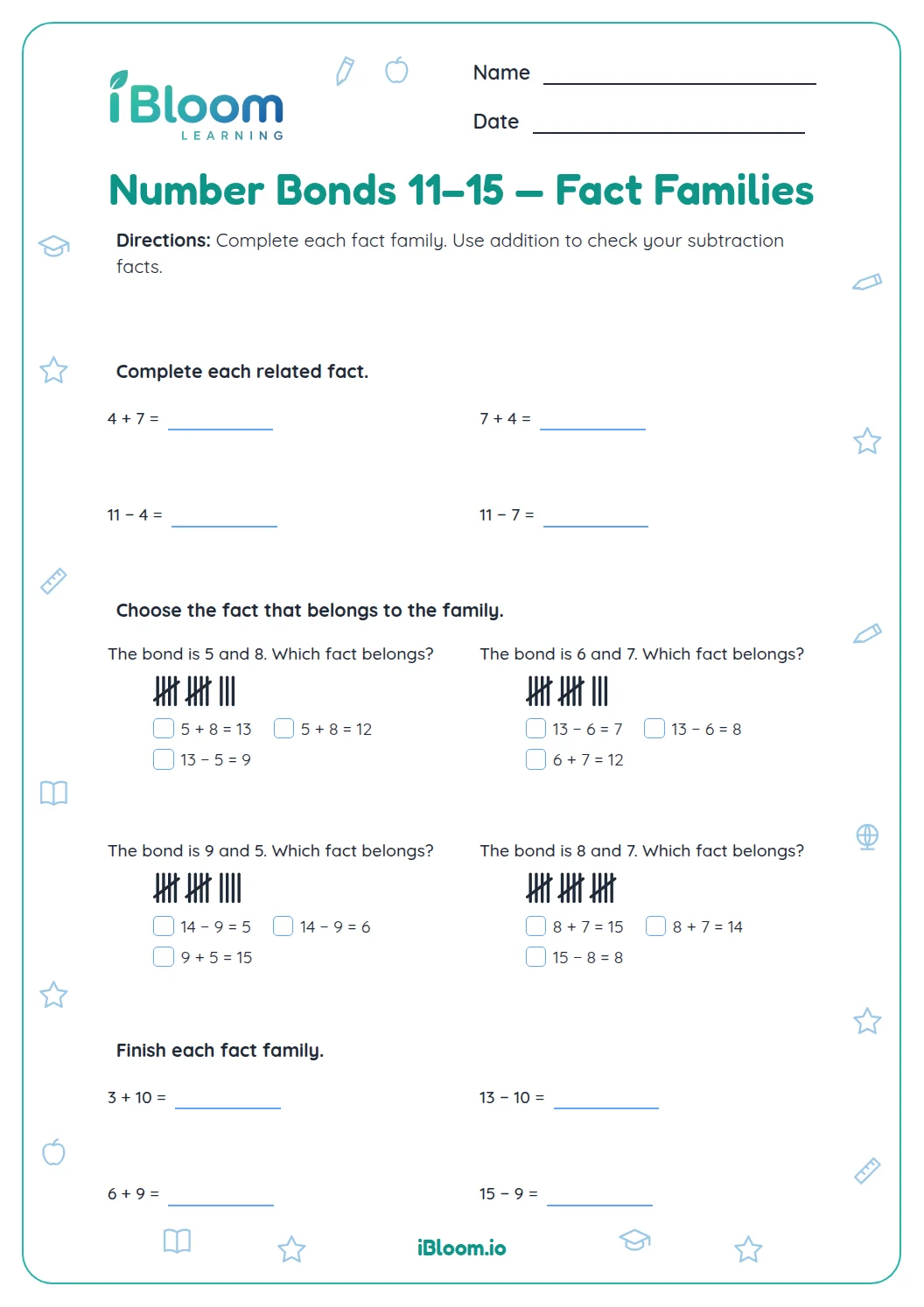
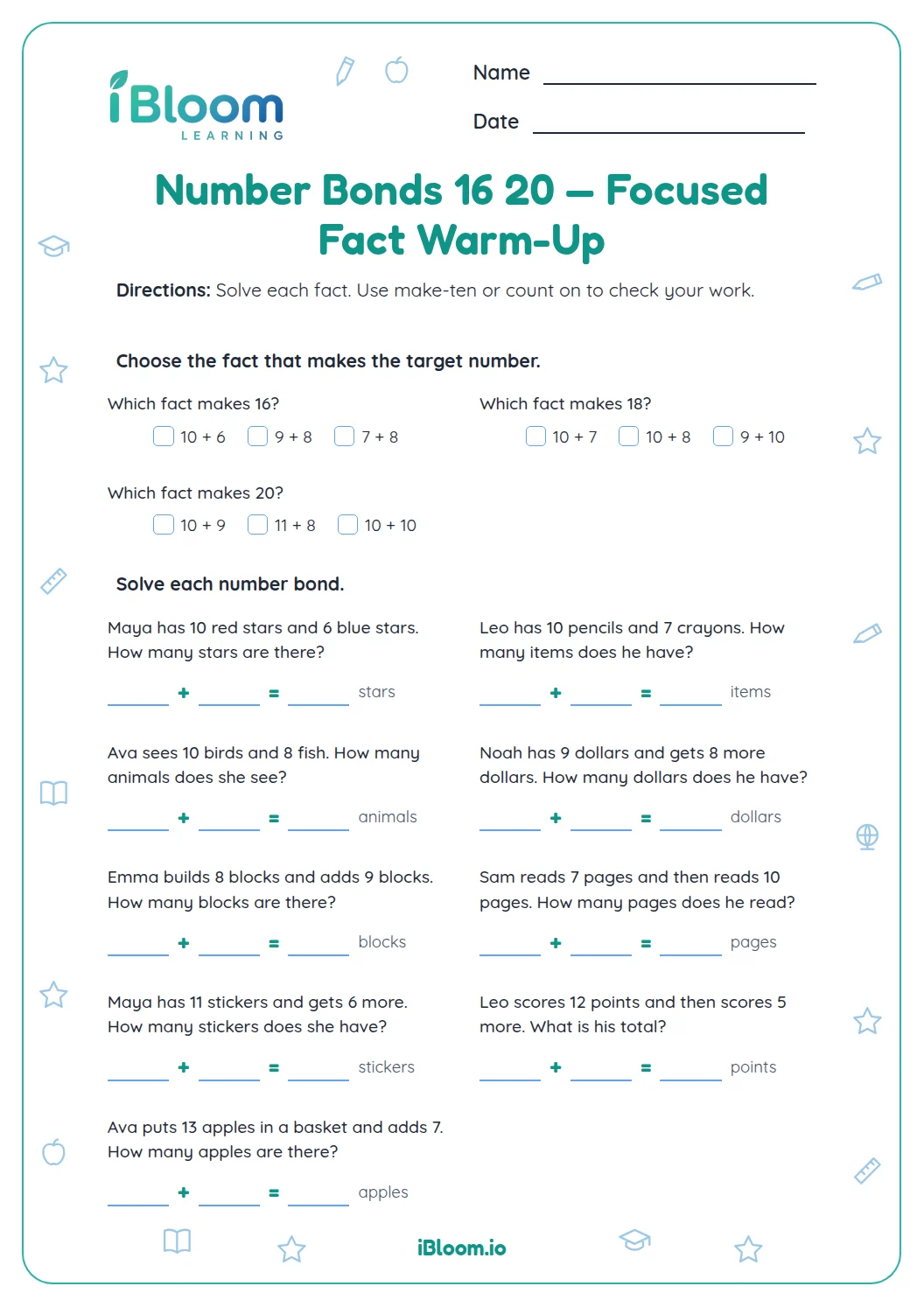
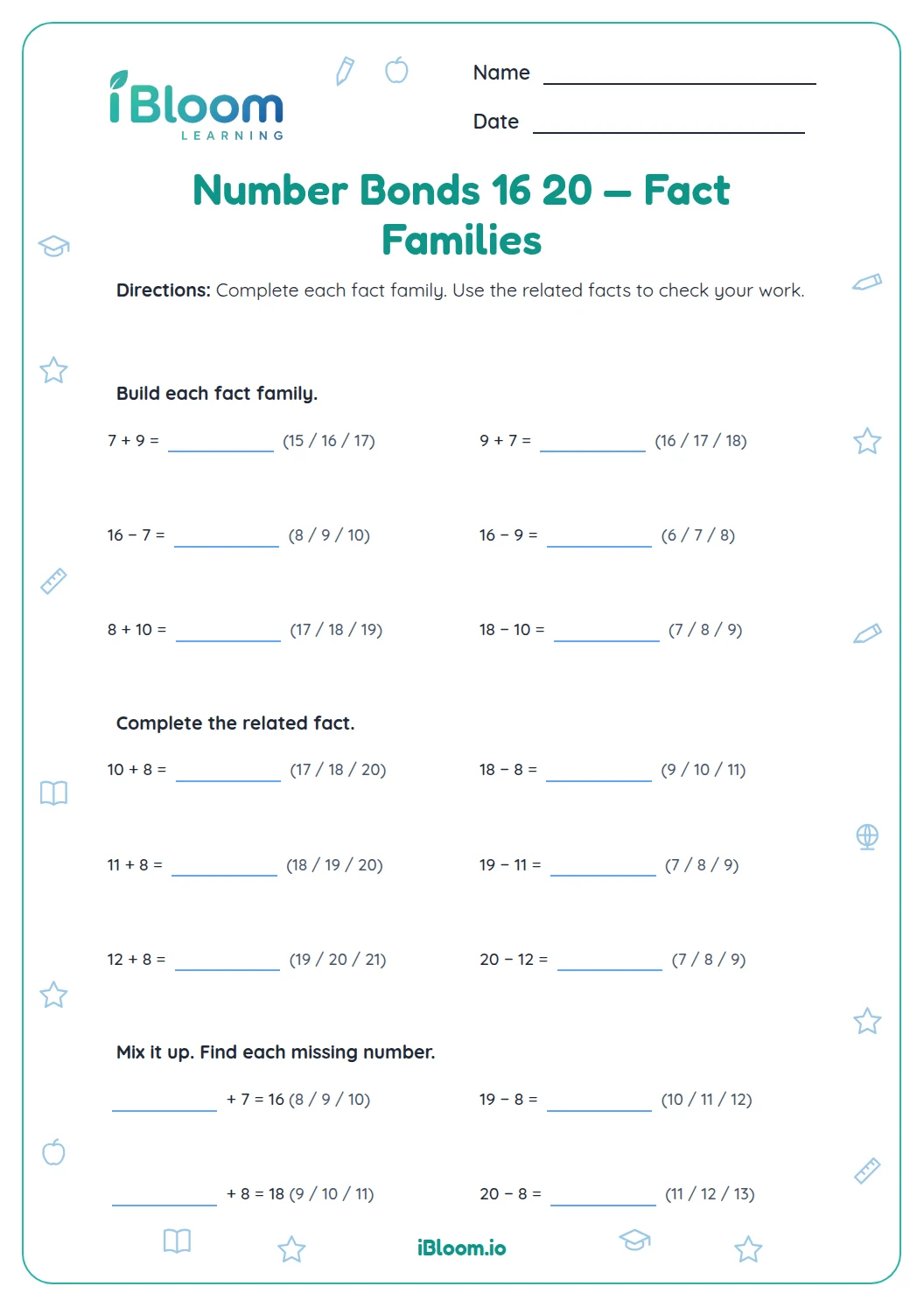
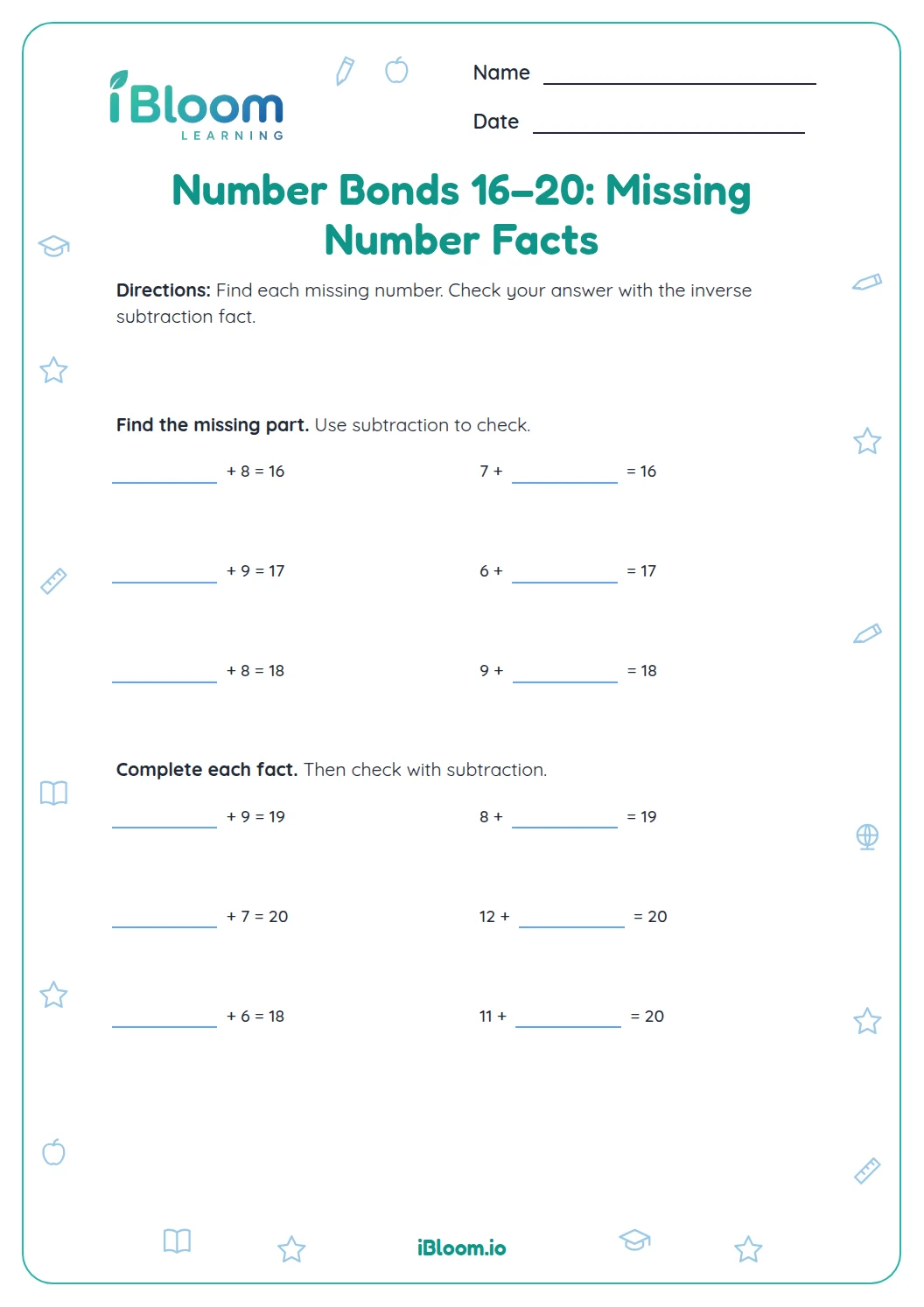
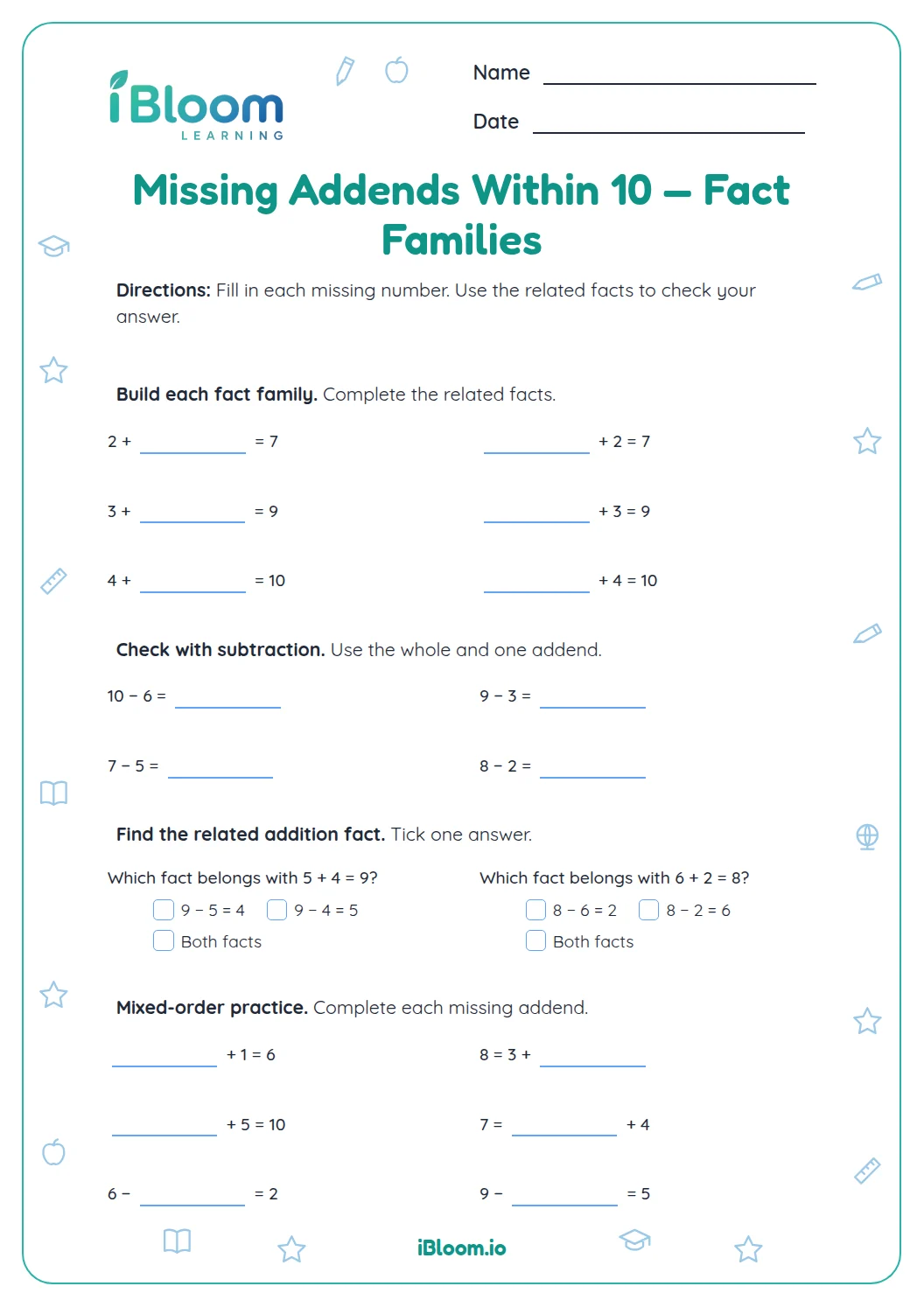
This Grade 1 printable builds number bonds for 8, 9, and 10 into related addition and subtraction facts. Learners complete pictured bonds, solve facts that use the same whole and parts, and identify addition facts from a family. The practice supports Common Core 1.OA.C.6, addition and subtraction within 20, with facts kept within 10. It includes 14 questions across three parts and a separate answer key.
Aligned to 1.OA.C.6
How do number bonds show a fact family?
A number bond names one whole and its two parts. For 3, 5, and 8, the addition facts are 3 + 5 = 8 and 5 + 3 = 8; the related subtraction facts are 8 − 3 = 5 and 8 − 5 = 3.
What is on the printable?
The first part uses pictured bonds for 8, 9, and 10. The next questions use the same whole and parts in addition and subtraction facts. The final questions check how the parts and whole are related.
How can an adult check the work?
Ask the learner to point to the whole and parts before checking a result. The answer key gives the missing number or correct fact, so a missed answer can be checked against the relationship among all three numbers.
A useful way to work through the page
- 1Read the whole number at the top of each bond.
- 2Find the part that completes the whole.
- 3Use the two parts to write an addition fact.
- 4Subtract either part from the whole to check.
- 5Compare each answer with the key and correct the fact family.
Checks that help
The mistake
Treating the whole as one of its parts.
The fix
Check that the two parts add back to the whole.
The mistake
Subtracting the whole from a part.
The fix
Start with the whole, then take away one part.
The mistake
Writing only one addition order.
The fix
Switch the addends to name the related addition fact.
Curriculum alignment
Use addition and subtraction within 20 to solve related facts.
On this sheet: Learners find parts of 8, 9, and 10 and use each whole-part set in addition and subtraction facts.
Show the official wordingHide the official wording
Add and subtract within 20, demonstrating fluency for addition and subtraction within 10.
What to practice next
Make more practice
Further reading
Questions parents and teachers ask
How many questions are on the worksheet?
There are 14 questions in three parts. Learners complete three pictured bonds, solve nine related addition and subtraction facts, and answer two questions about whole-part relationships. The answer key has two pages. Learners can check the answer with the original three-number set.
What does a fact family mean here?
A fact family uses the same three numbers in related addition and subtraction equations. For example, 3, 5, and 8 make two addition facts and two subtraction facts. The sheet practices both operations and asks how the parts relate to the whole. It creates a connection between addition and subtraction.
Should learners use the answer key while working?
It works best as a checking tool after the learner has tried each part. If a response differs, point to the whole and parts and ask which equation can check it. Then correct the fact. This supports checking without relying on memorized answers.
Is this appropriate for Grade 1?
The questions use addition and subtraction facts within 10, which makes the number work accessible for Grade 1 practice. Learners also connect a number bond to both operations. They practice solving facts and using related operations within 10 every time.
What should I do if a learner reverses a subtraction fact?
Have the learner say the whole first and name the part being taken away. Then use the remaining part to check that the two parts still make the whole. This connects the subtraction fact back to the bond. Check the whole and both parts for every equation.