








About this worksheet
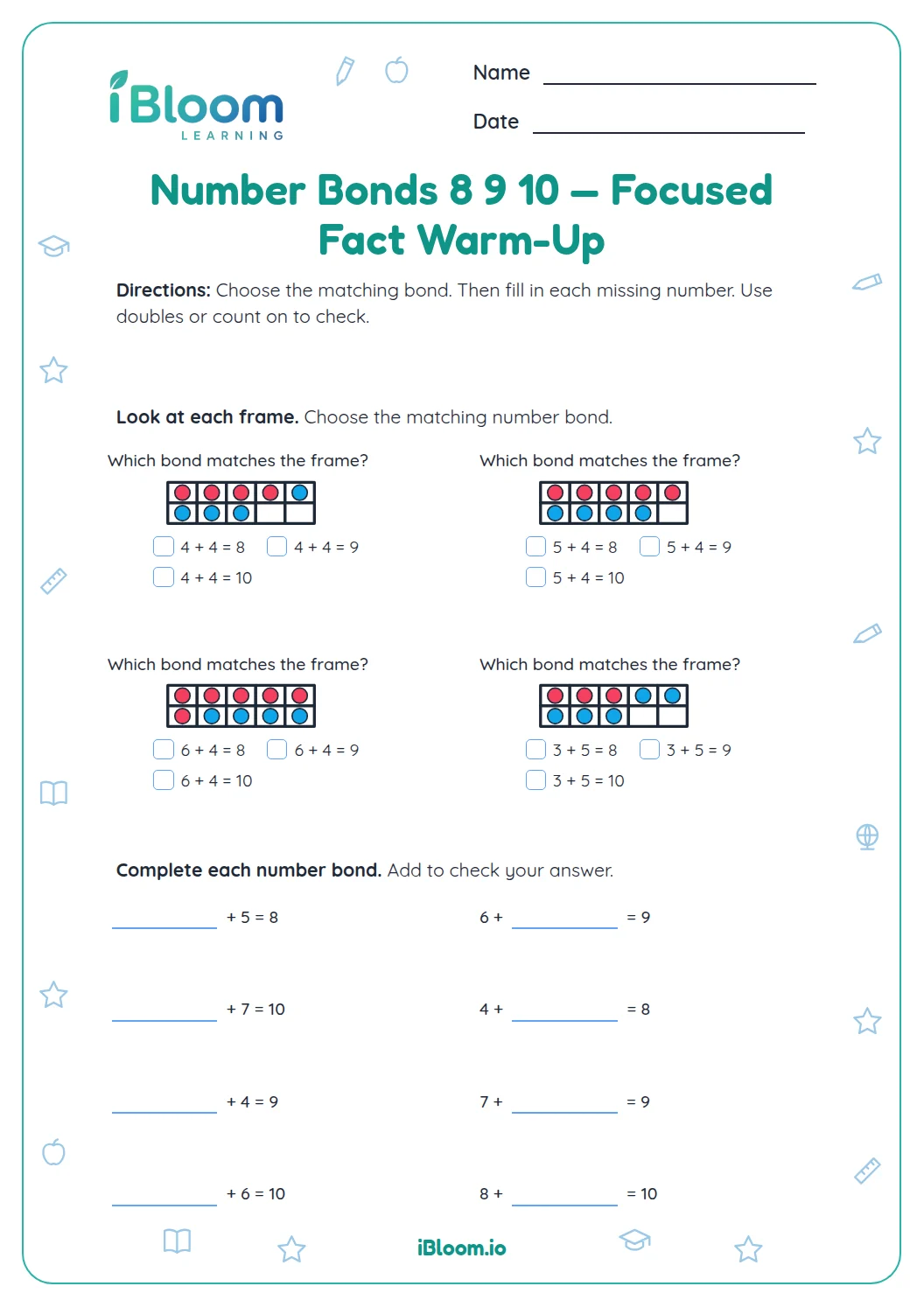
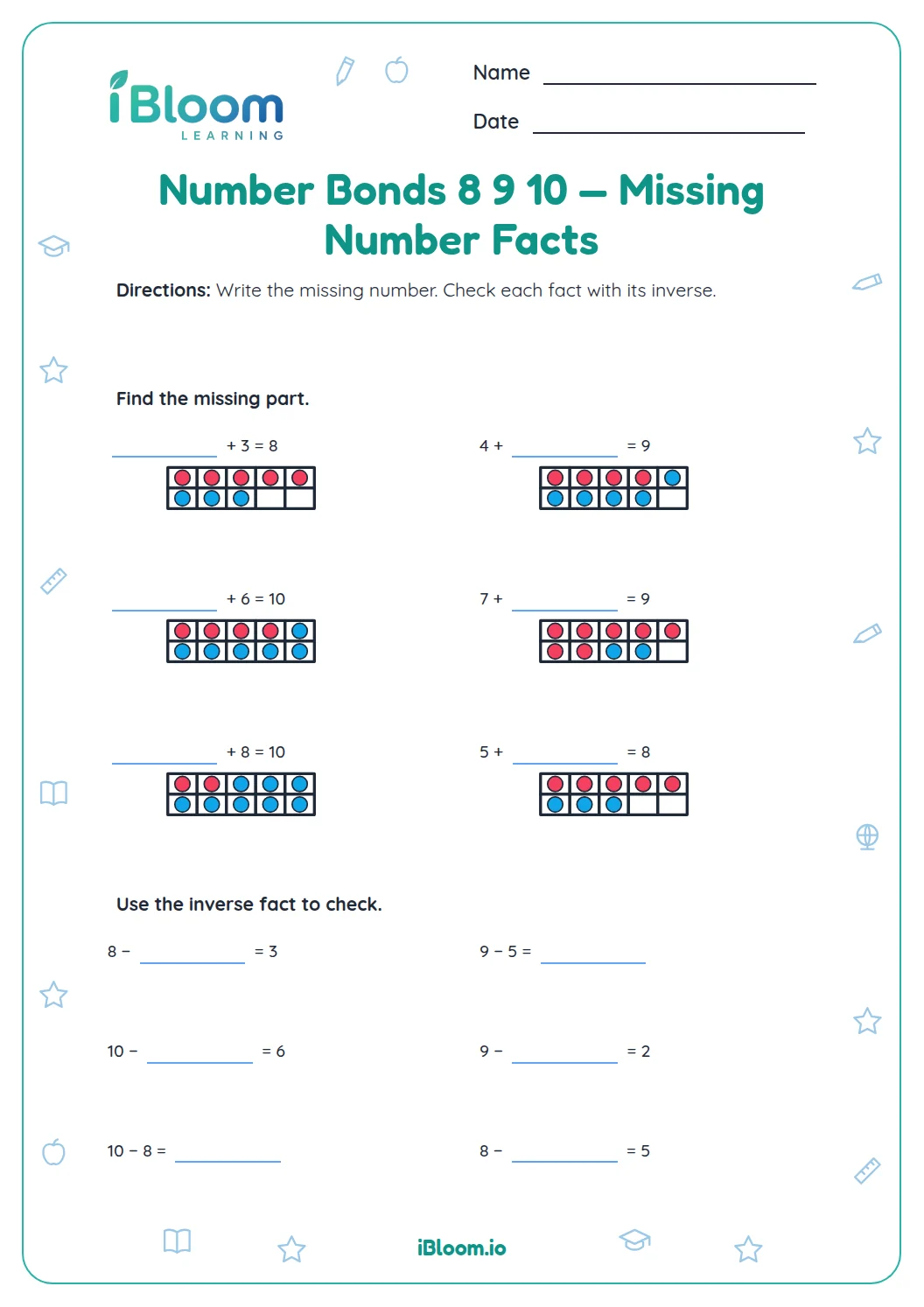
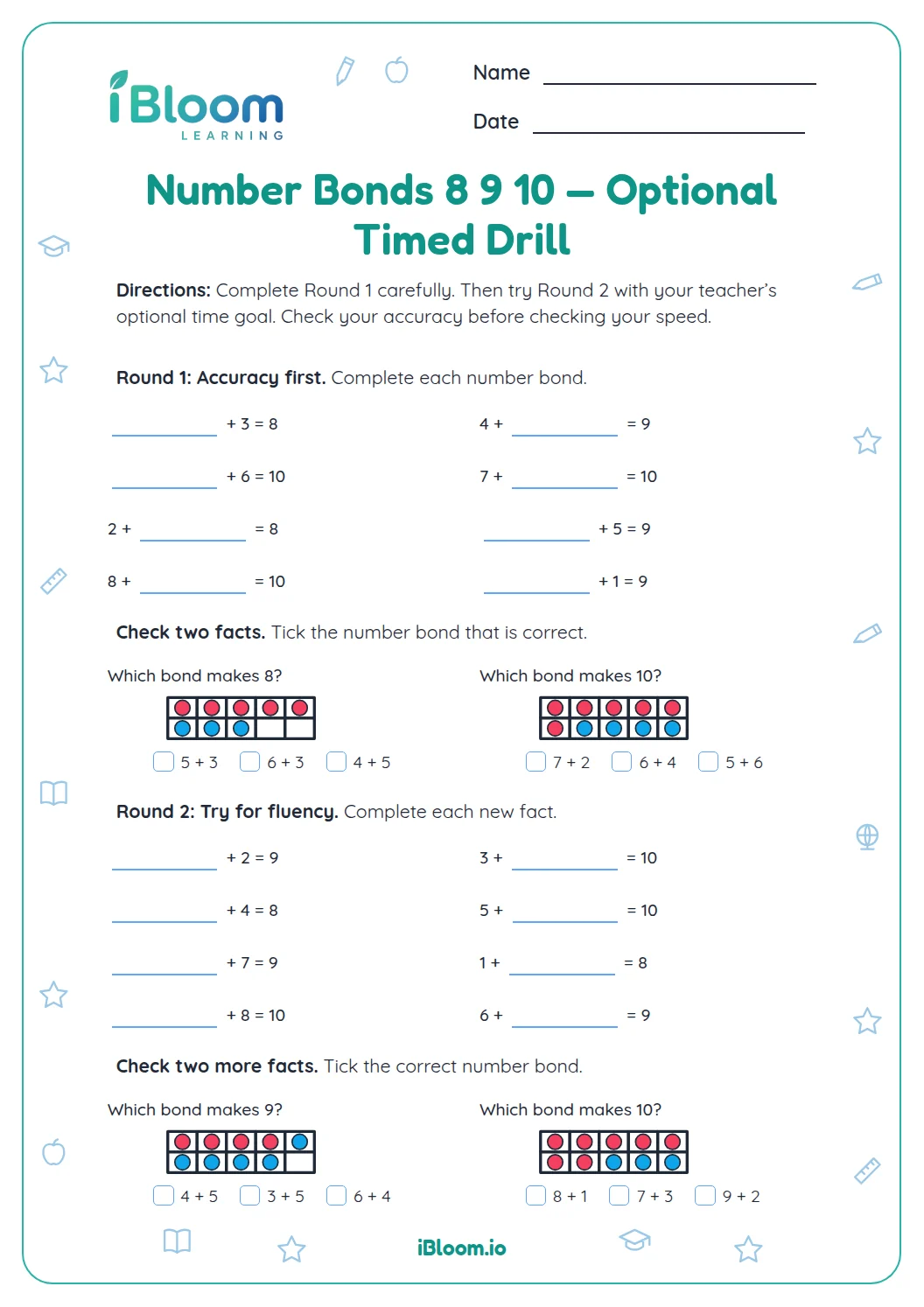
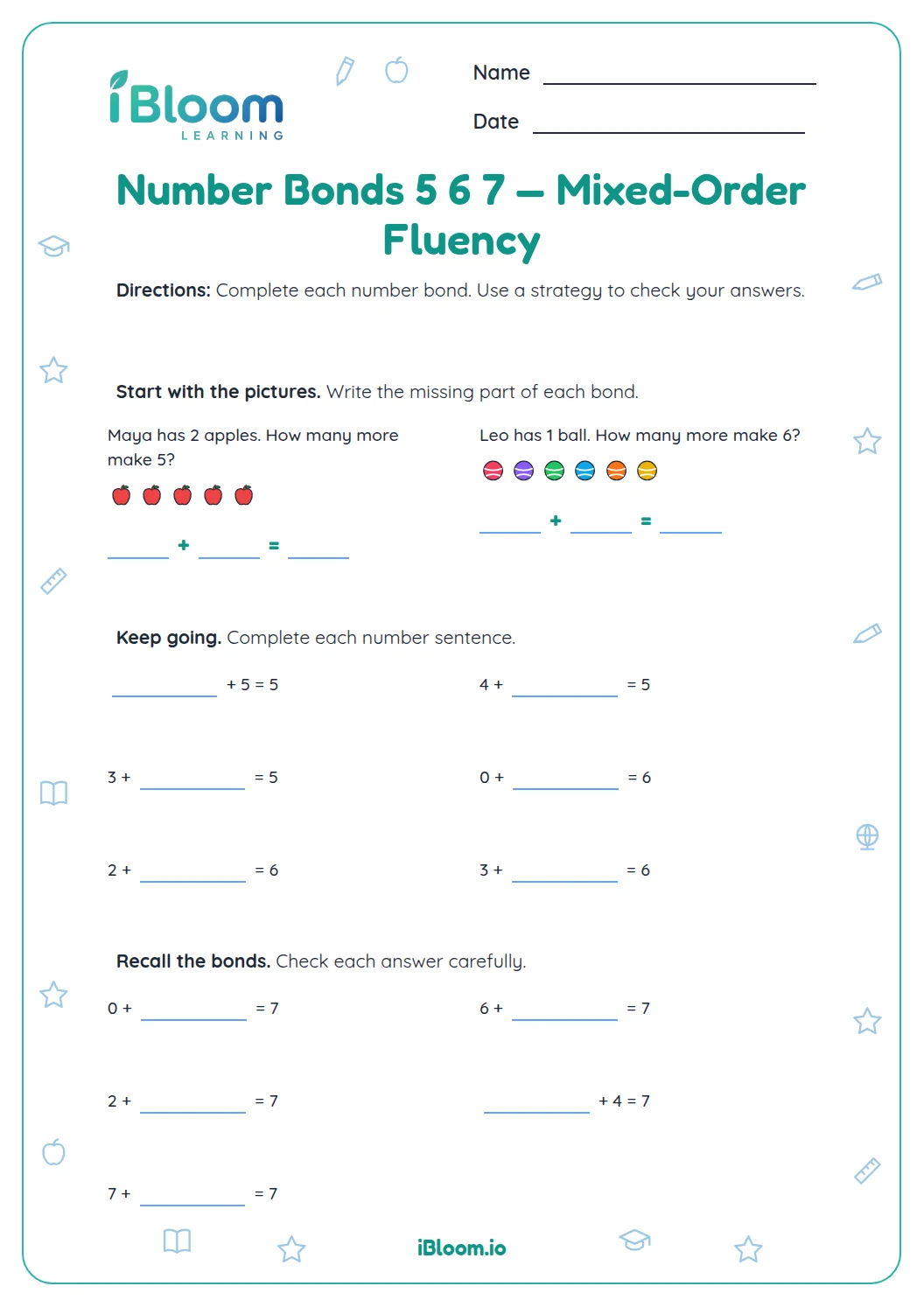
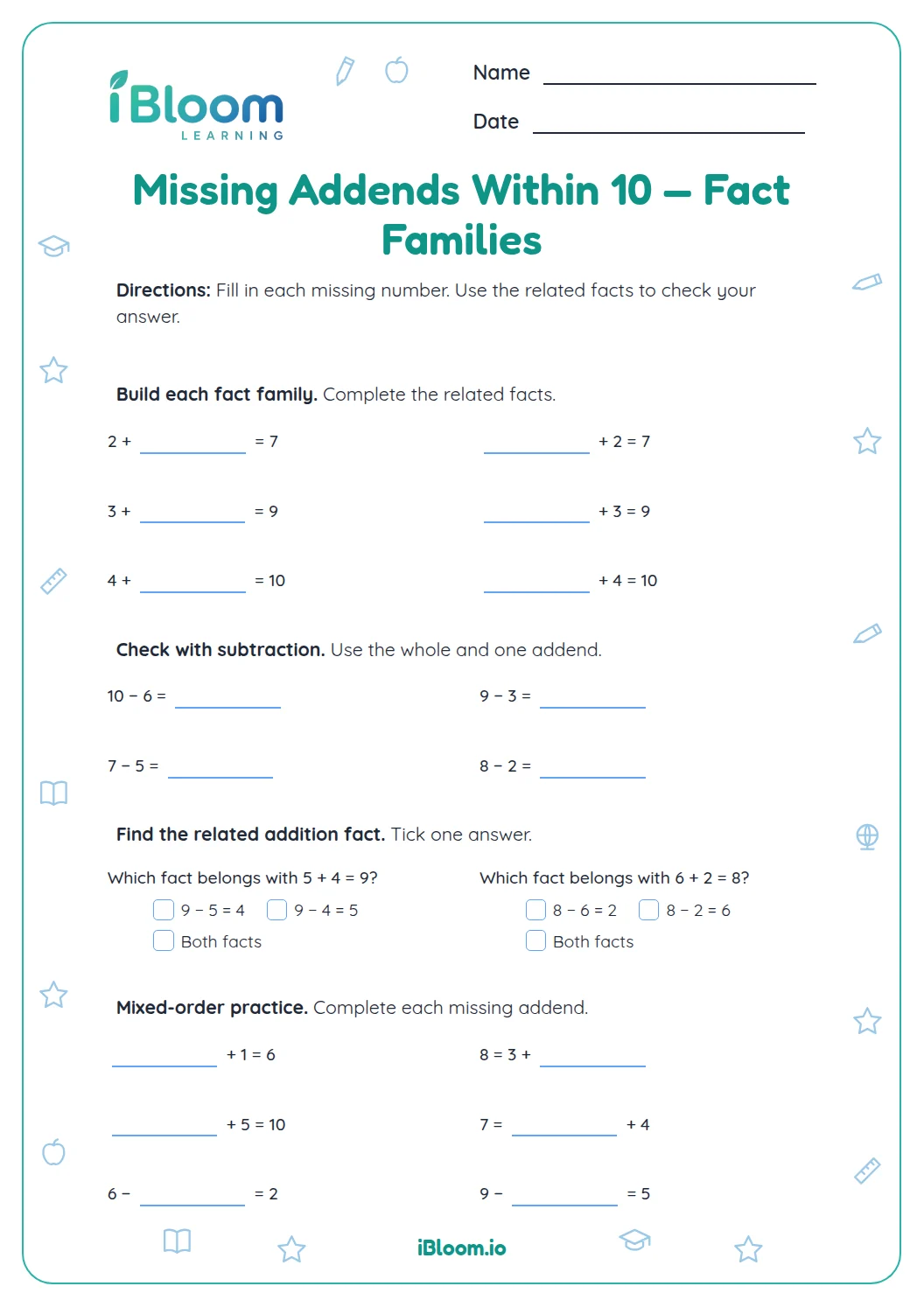
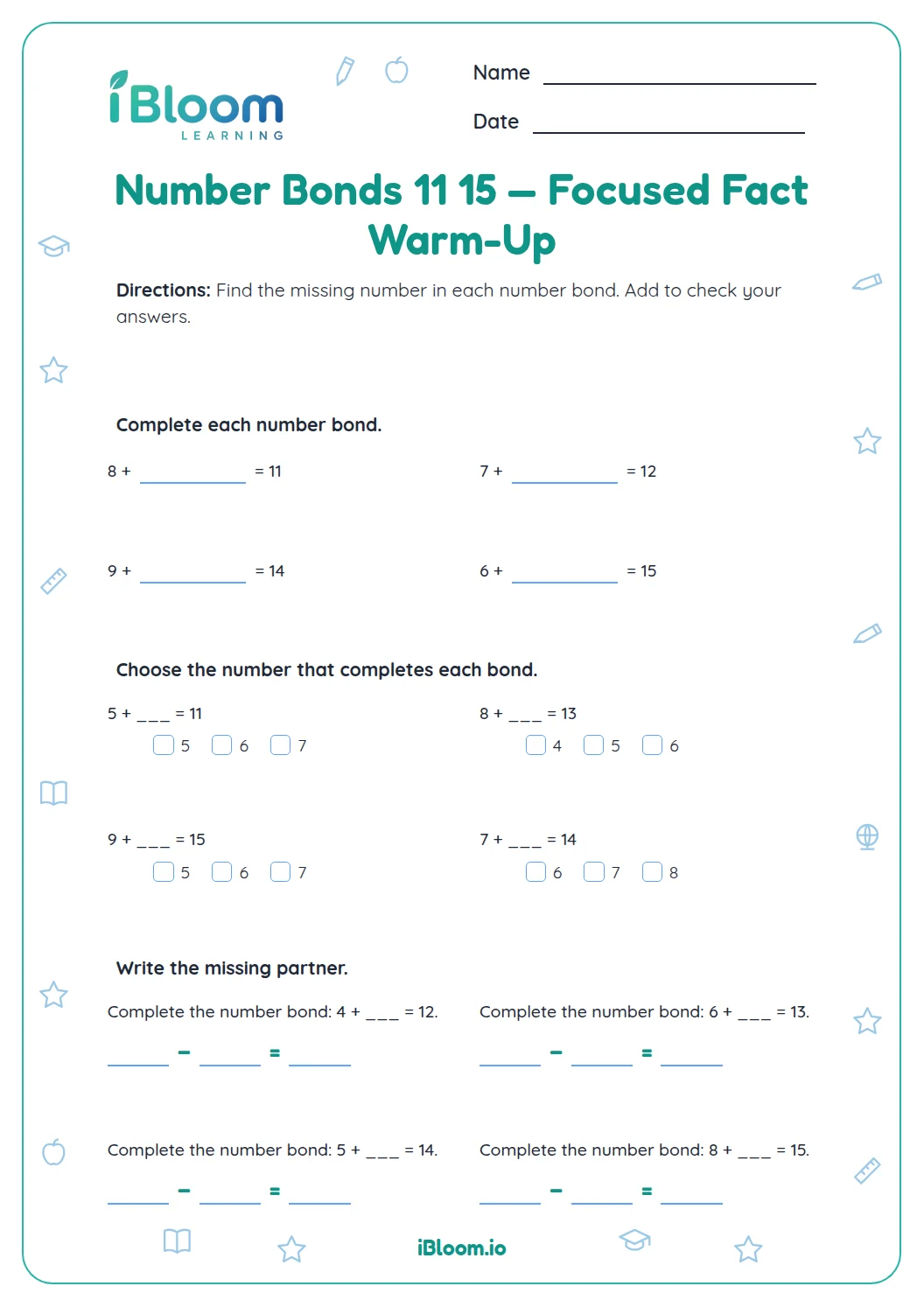
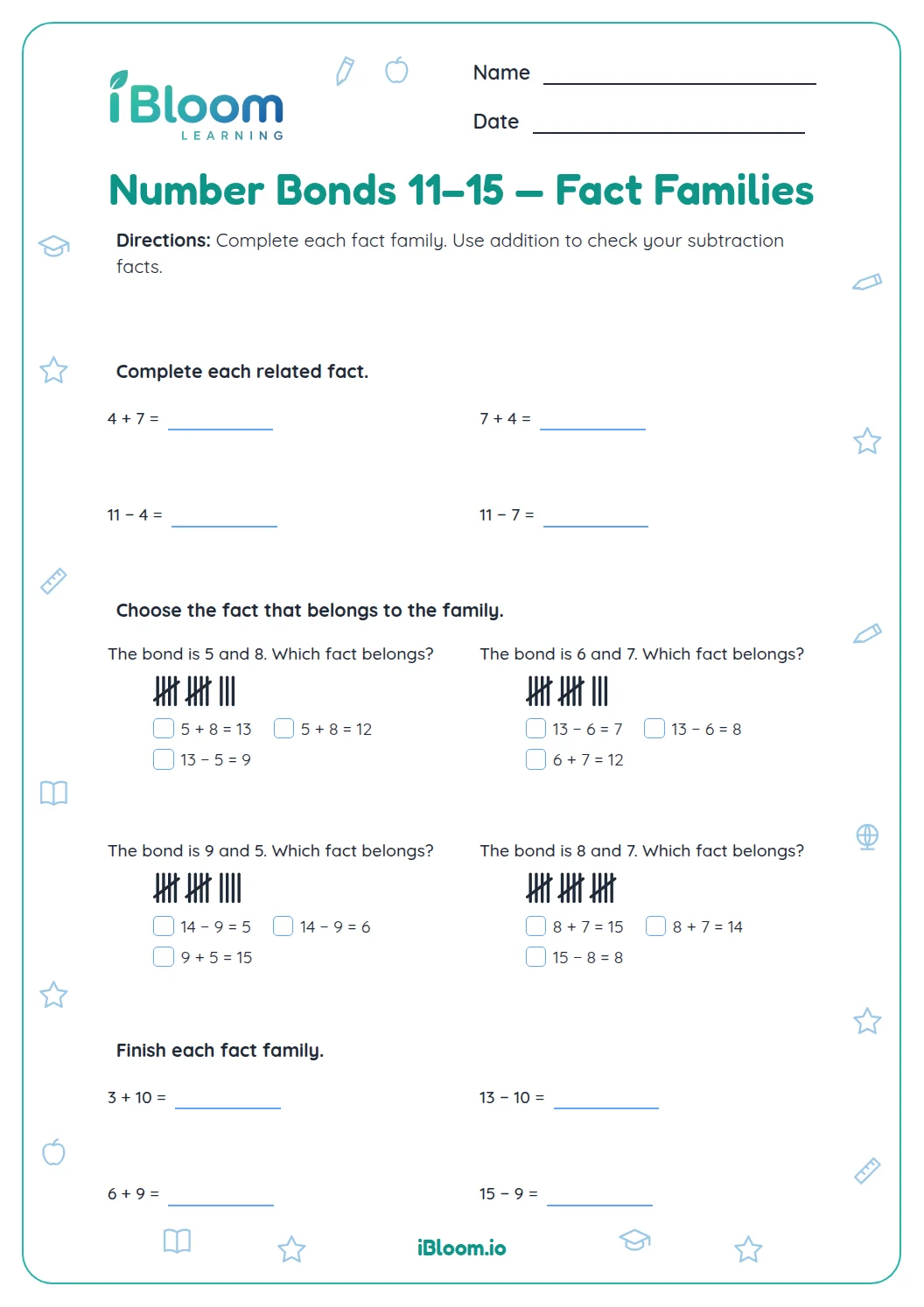
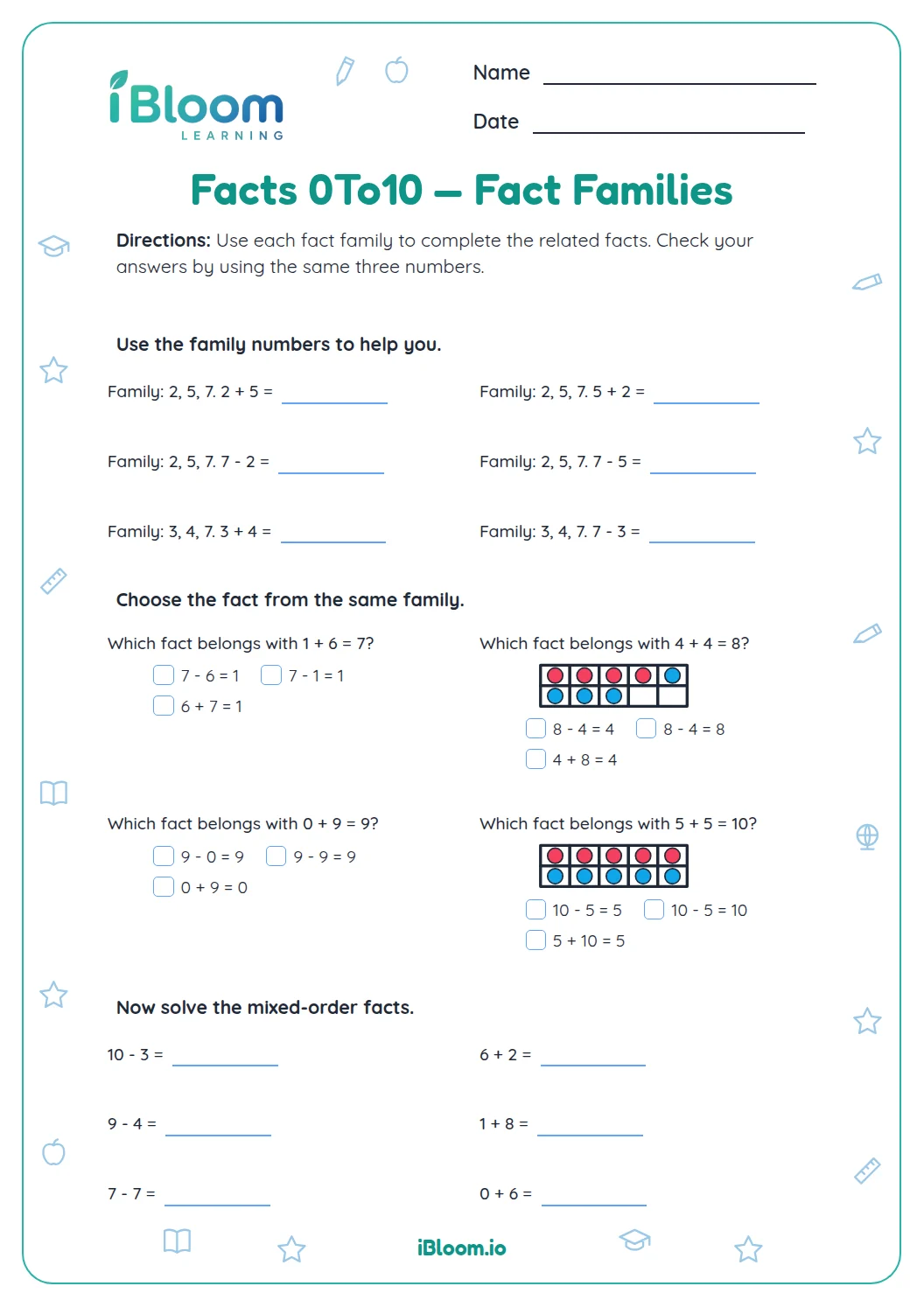
This free Grades 1–2 number bond worksheet checks how well learners know the parts that make 8, 9, and 10. It includes eight missing-part bond questions, three prompts to write related addition facts, and three short stories that use the same whole-and-part reasoning. The work supports addition fact fluency under CCSS 2.OA.B.2. The two-page check builds from visual bonds to equations and applications, with a separate answer key for checking each response.
Aligned to 2.OA.B.2
How do you find the missing part of a bond?
Name the whole, then name the part you can see. The missing part is the amount needed to reach the whole. For question 1, the whole is 8 and one part is 1, so 7 is missing because 1 + 7 = 8.
- 1Whole: 8
- 2Known part: 1
- 38 − 1 = 7
- 4Check: 1 + 7 = 8
How does one bond make two addition facts?
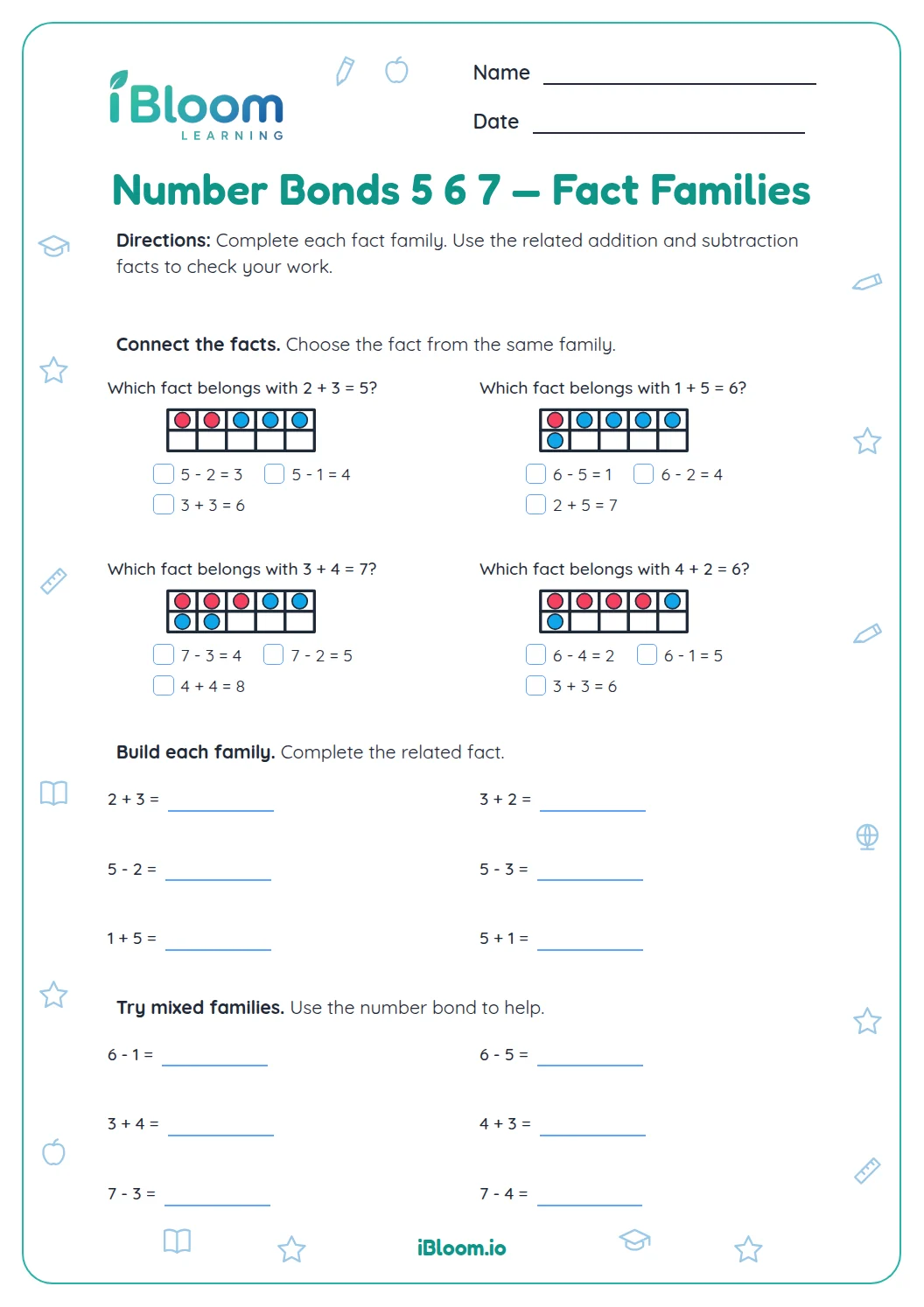
Switching the order of two addends does not change their sum. A bond with parts 3 and 5 and whole 8 gives 3 + 5 = 8 and 5 + 3 = 8. The three equation prompts ask learners to write both facts.
How can you use a bond in a story?
Look for a total and one known amount. If a team needs 10 points and has 6, the missing part is 4 more points. The bond picture is the same relationship as 6 + 4 = 10.
- Part A: find missing parts in bond drawings.
- Part B: write both addition facts for two parts.
- Part C: use whole-and-part thinking in short stories.
How to use this worksheet
- 1Read the whole at the top of the bond.
- 2Identify the part already given.
- 3Subtract the known part from the whole or count up to it.
- 4For fact prompts, use the same addends in both orders.
- 5Check by adding the parts to recover the whole.
Common mistakes and quick fixes
The mistake
Subtracting the whole from the known part.
The fix
Start at the whole and take away the known part to find the missing part.
The mistake
Writing only one related addition fact.
The fix
Switch the order of the addends to write the second fact.
The mistake
Confusing the part that changed with the total.
The fix
In a story, circle the total and underline the amount already known before solving.
Common Core alignment
This worksheet connects visual number bonds with addition facts.
Use addition and related subtraction facts within 20 to find missing addends.
On this sheet: All missing addends are within 10, and the problems invite using known addition facts or their related subtraction facts.
Show the official wordingHide the official wording
Fluently add and subtract within 20 using mental strategies. By end of Grade 2, know from memory all sums of two one-digit numbers.
What to practice next
Make more practice
Further reading
Questions parents and teachers ask
What is a number bond?
A number bond shows a whole and the parts that make it. For example, 8 can be split into 3 and 5 because 3 + 5 = 8. This worksheet checks missing parts for wholes 8, 9, and 10, then connects each relationship to addition facts and short stories.
How can I check a missing part?
Add the known part to the missing part and check that the sum is the whole. If the whole is 9 and one part is 6, the missing part is 3 because 6 + 3 = 9. This quick check confirms that both parts make the whole.
Why are there two addition facts for one bond?
Addition can be done in either order without changing the total. The parts 4 and 6 make 10 in both 4 + 6 = 10 and 6 + 4 = 10. Writing both equations helps learners connect a bond model with related facts.
How does a number bond help with a story?
A story’s total can be the whole, while known amounts are parts. If 9 markers are split between a table and a box, and 4 are on the table, the unknown box amount is 5. The bond relationship is 4 + 5 = 9.
What is on the mastery check?
The worksheet has 14 questions: eight missing-part questions for wholes 8, 9, and 10, three prompts to write both addition facts for a pair of parts, and three short application problems. The key lists each missing part and sample equations. For written stories, check that the known and missing parts make the stated whole.
How should I respond to a missed question?
Ask the learner to name the whole and the part they know, then represent them with counters or a quick sketch. Find what completes the whole and add the parts to check. Revisit the same bond later with the numbers in a different order.