
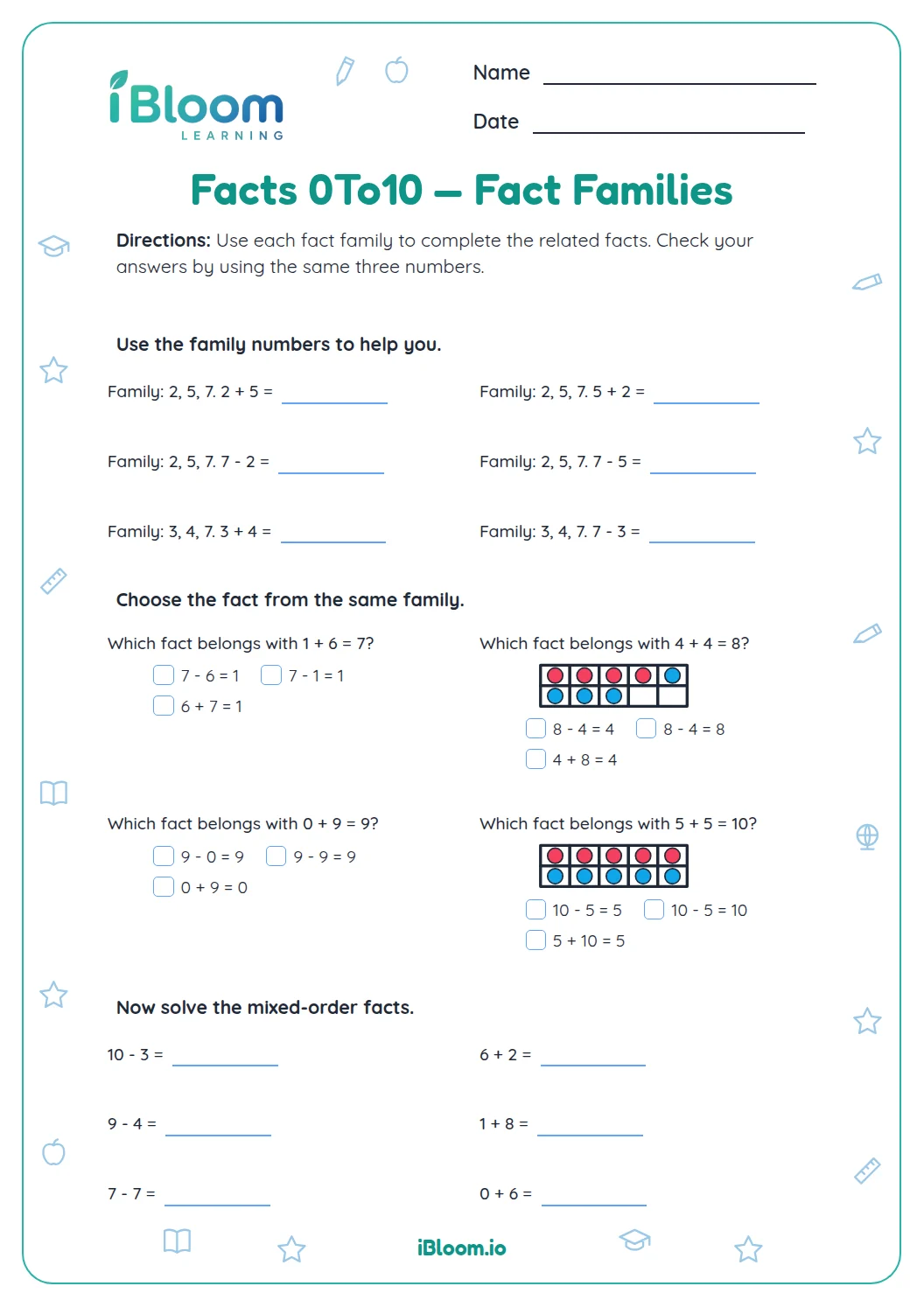


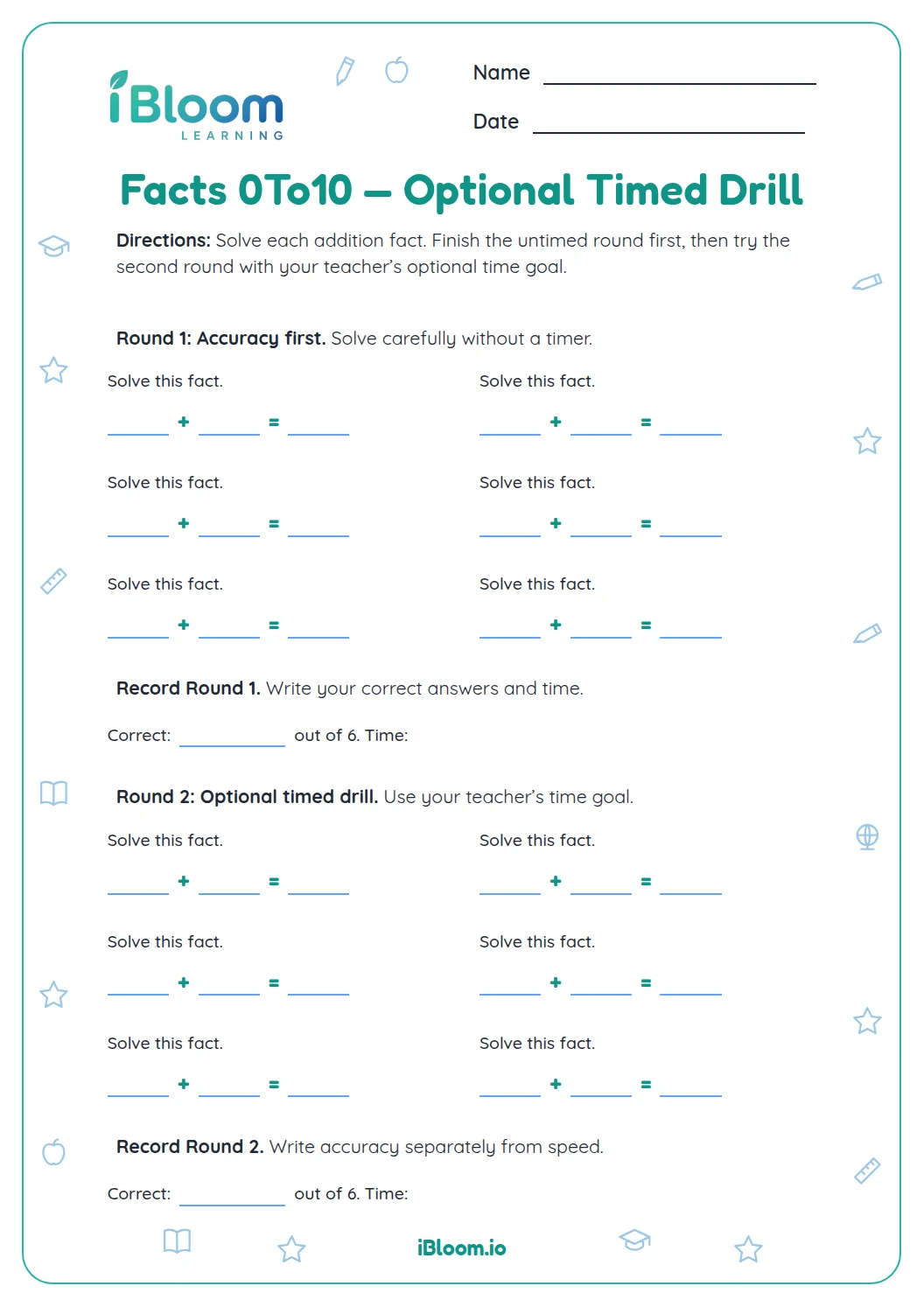
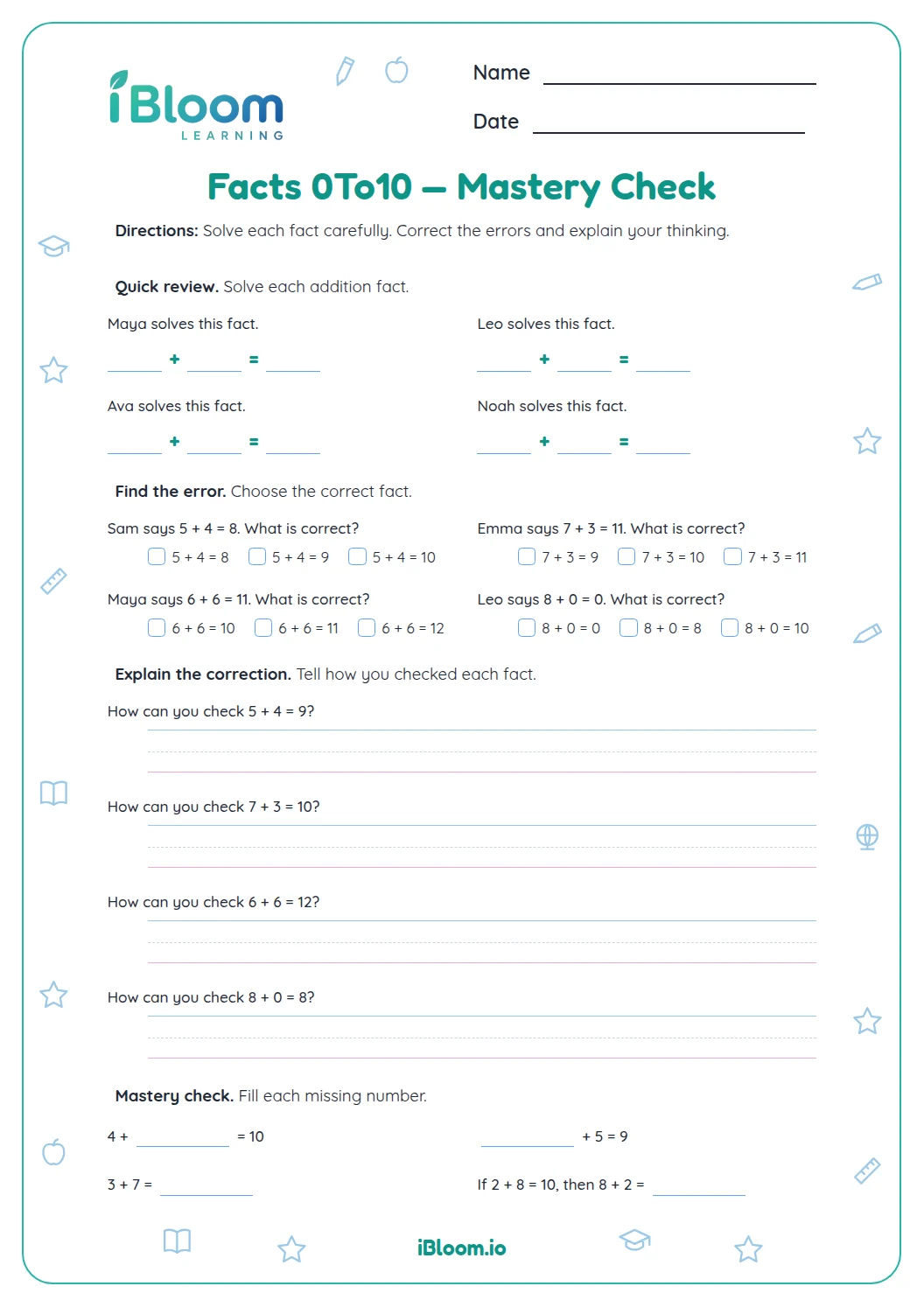
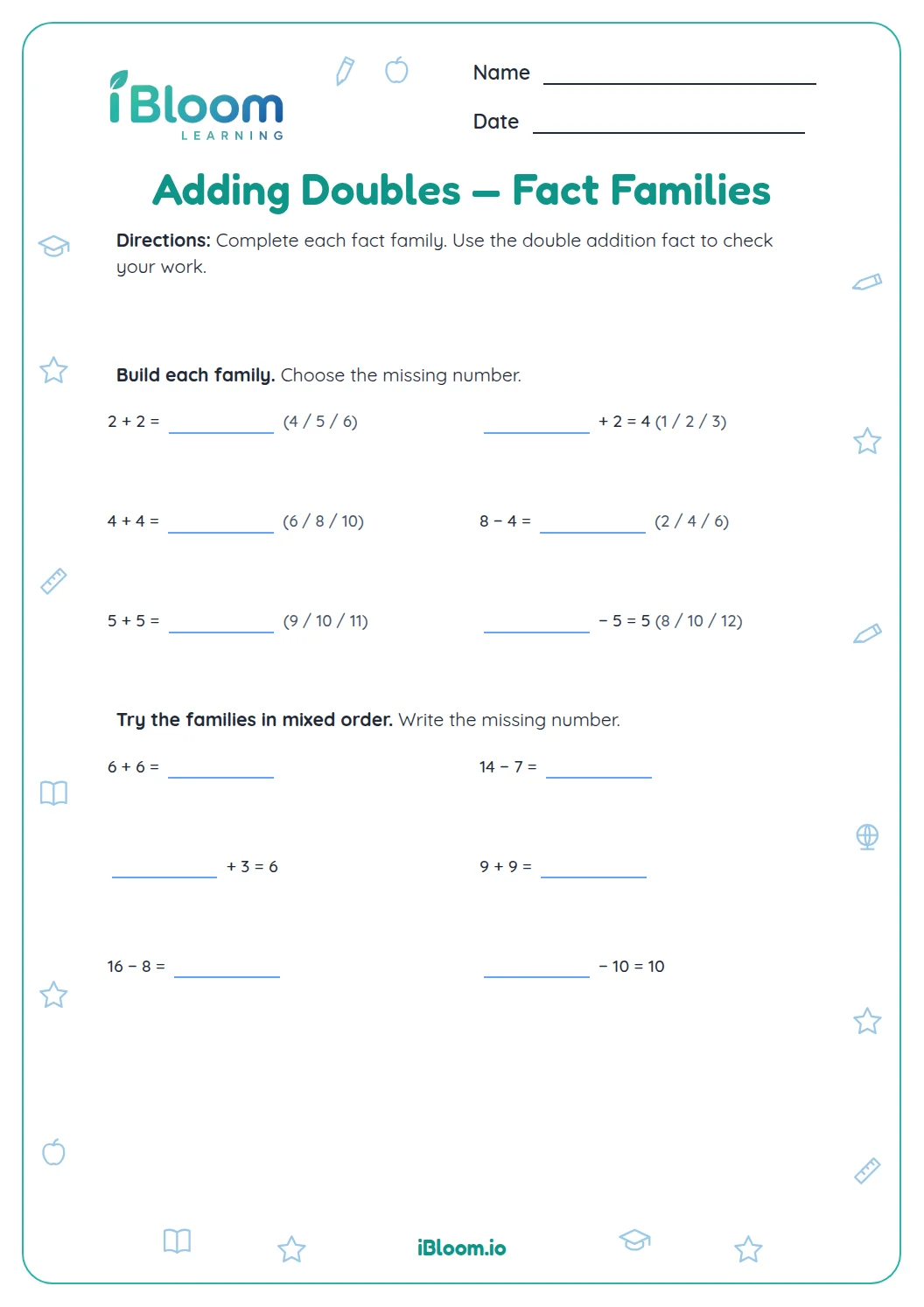

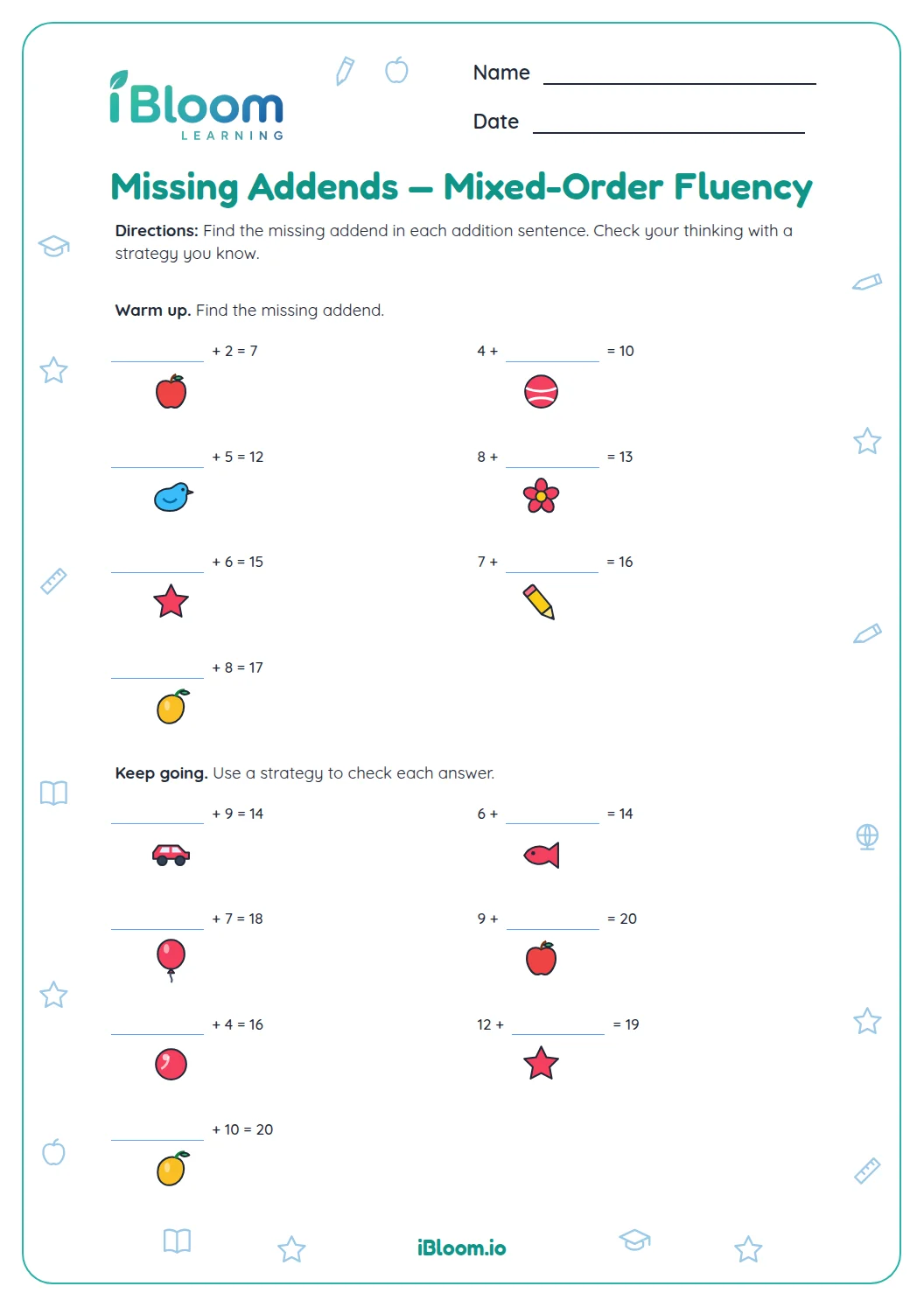
About this worksheet
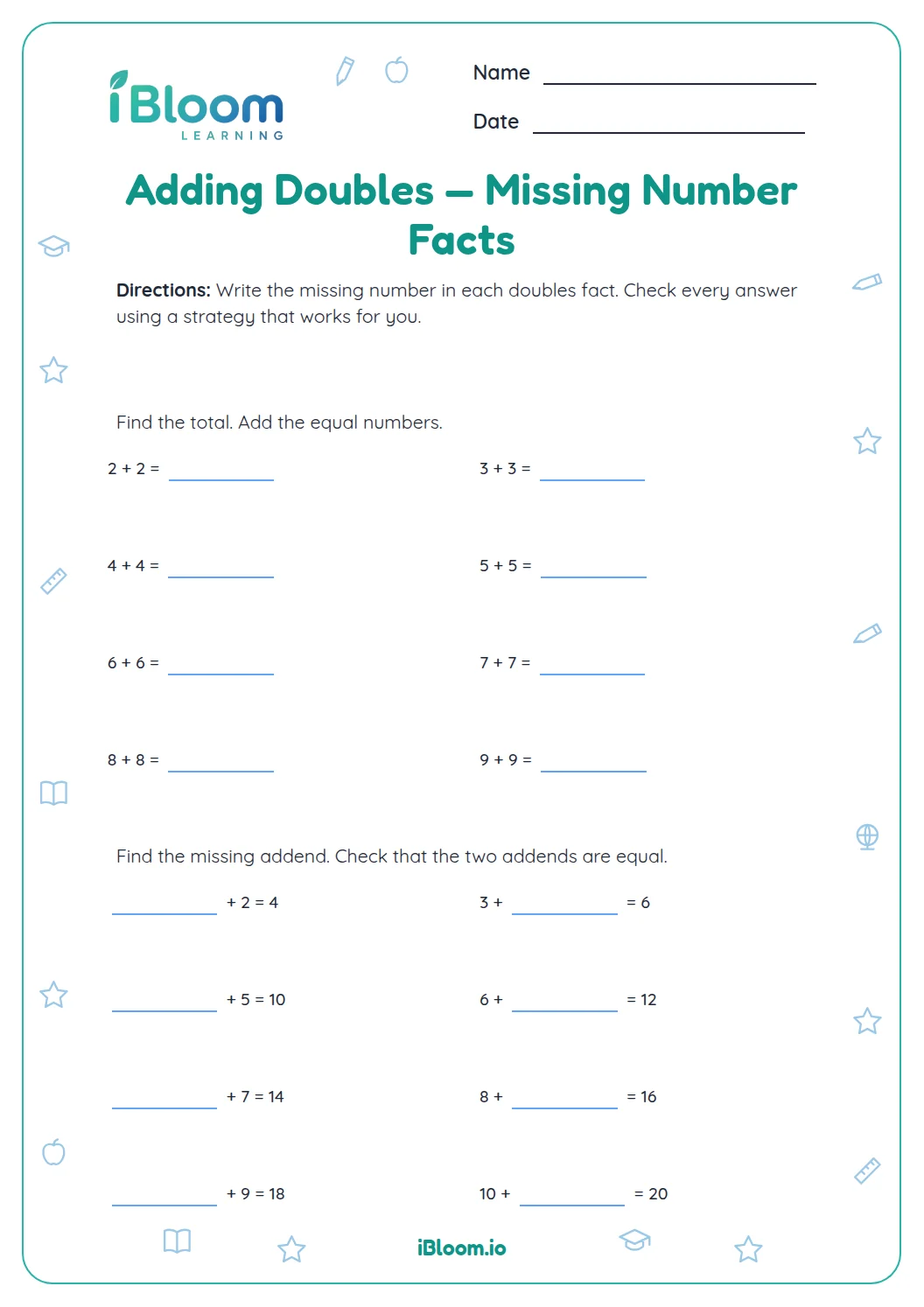
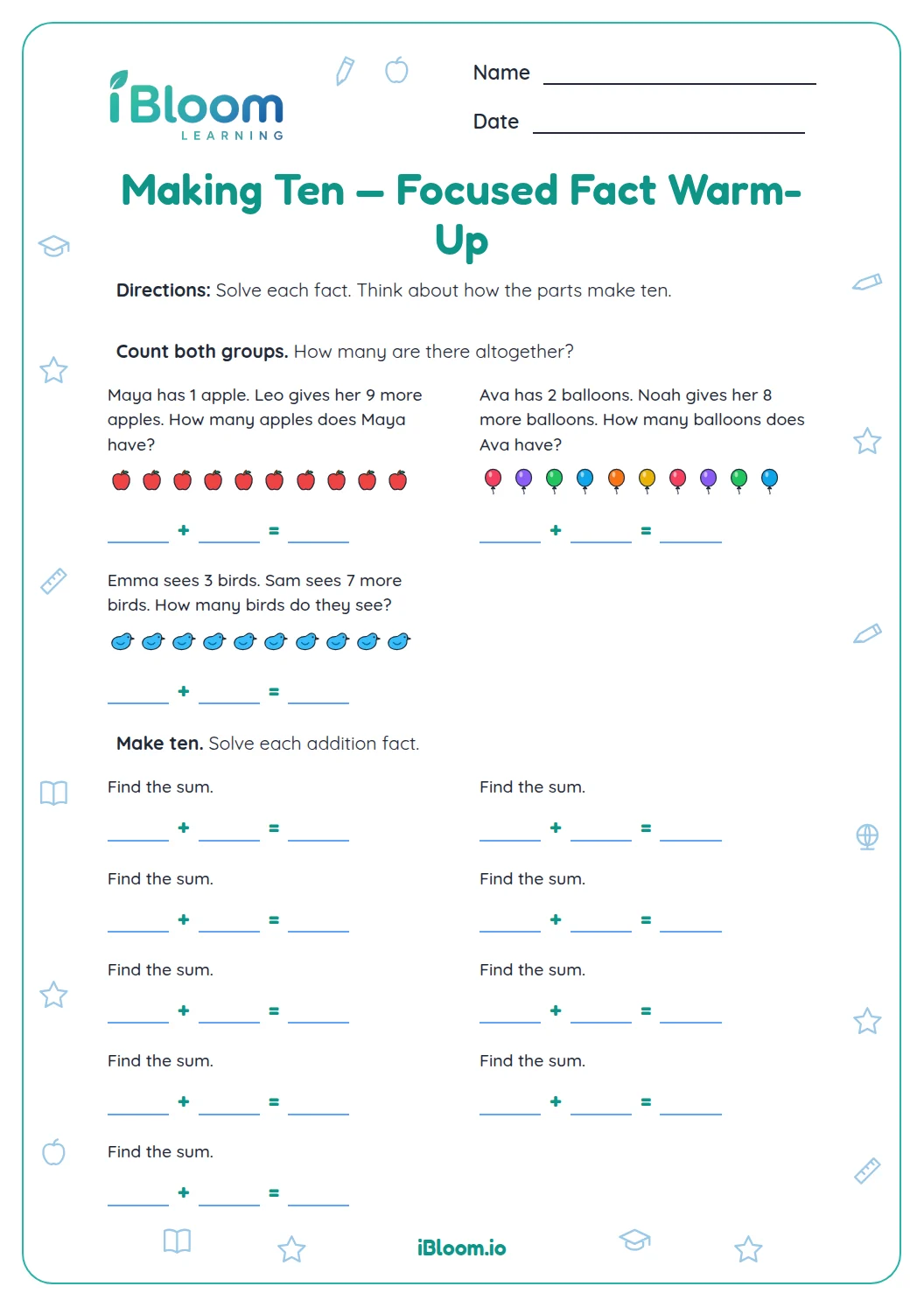
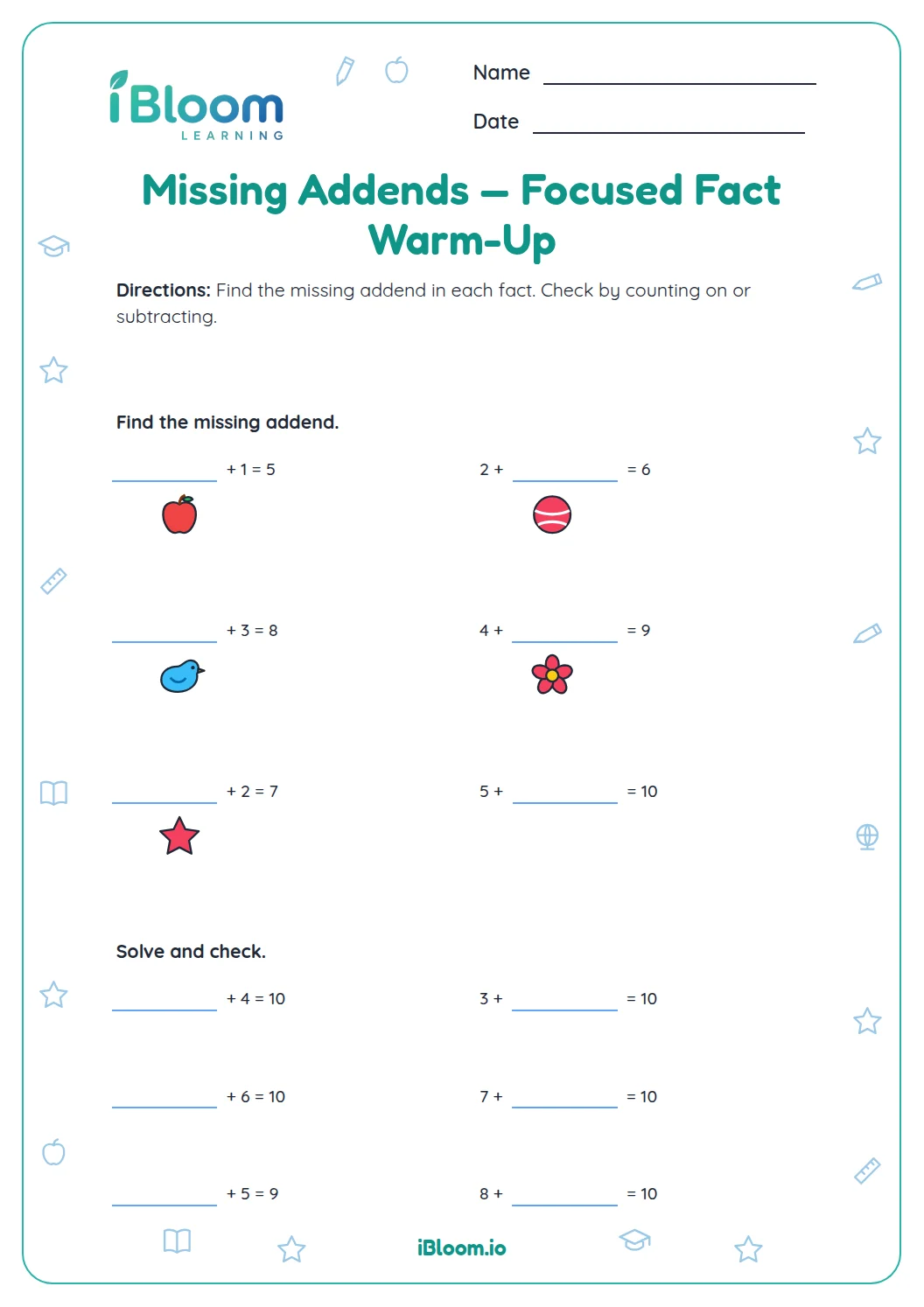
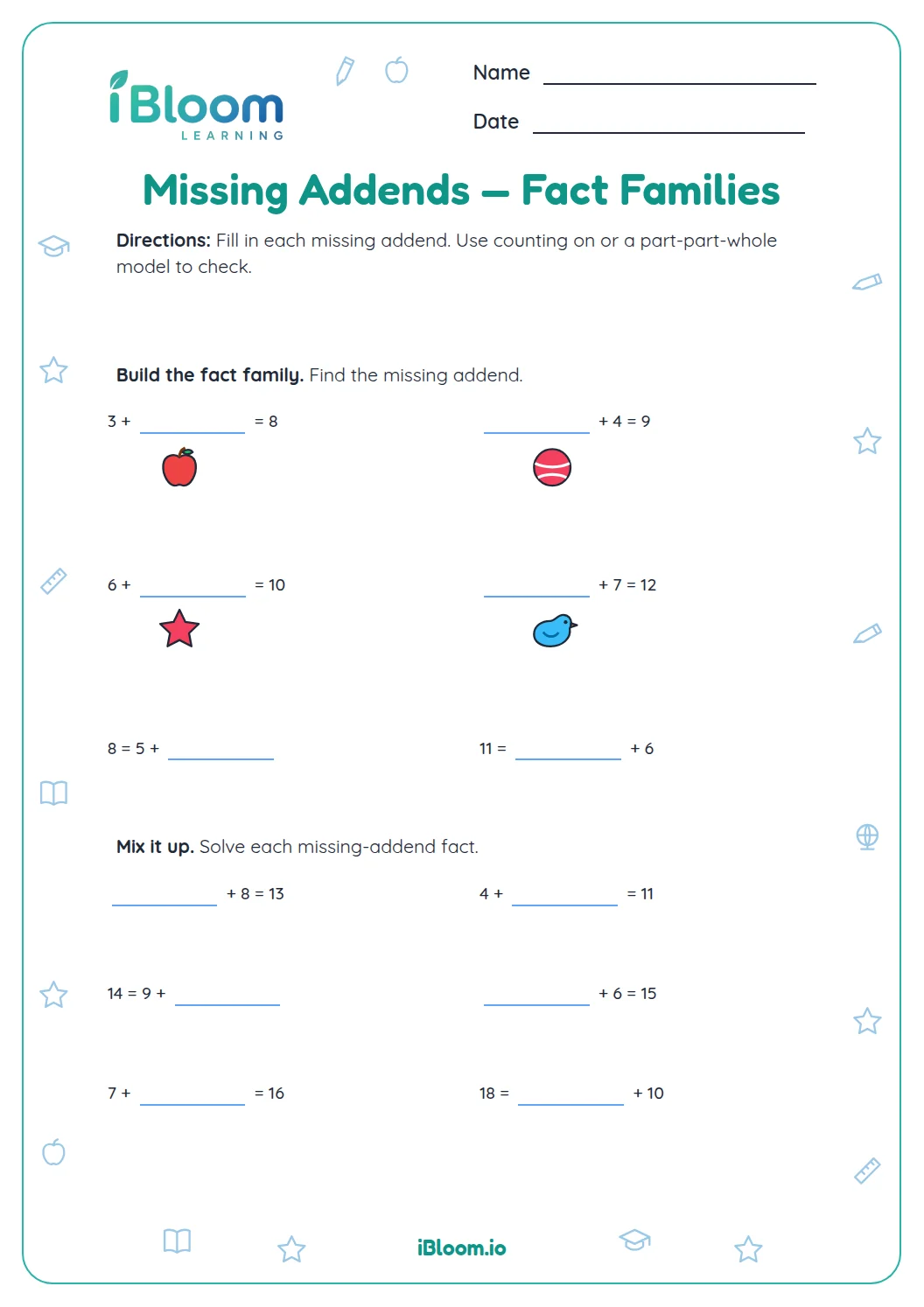
This printable warm-up gives Grades 1–2 students 16 addition equations and 4 short story sums, using addends from 0 through 10. Students find each total and write a number sentence for the stories. The included key supports checking. It practices Common Core 1.OA.C.6.
Aligned to 1.OA.C.6
What does this worksheet practice?
The first 16 items are addition equations. Four short stories then ask students to combine two groups and write a number sentence as well as the total. All addends are from 0 through 10.
How can I work through an example?
For 7 + 5, split 5 into 3 and 2: 7 + 3 = 10, then 10 + 2 = 12. The sum is 12.
- 17 + 5 = 12 → Make ten with 3, then add the remaining 2.
How can students check their work?
For an equation, check that both addends were included in the sum. For a story, write the two groups as an addition sentence and compare its total with the answer key. Use make-ten for facts such as 7 + 5.
How to use this worksheet
- 1Solve the 16 equations in Parts A and B; check each plus sign and both addends.
- 2For a fact such as 7 + 5, make ten by splitting 5 into 3 and 2.
- 3In Part C, underline the two groups named in each story.
- 4Write an addition number sentence and find its sum for each story.
- 5Use the answer key to check the totals and correct any missed addend.
Common mistakes and quick fixes
The mistake
Counting every dot from one.
The fix
Start at the larger addend and count on, or make ten.
The mistake
Mixing up an addend and the sum.
The fix
The addends are the numbers being joined; the sum is the total.
The mistake
Skipping a zero fact.
The fix
Adding zero leaves the other addend unchanged.
Common Core alignment
This page practices the language skill described in 1.OA.C.6.
Use addition strategies and known facts to add within 20.
On this sheet: The equation and story items practice addition within 20 with strategies such as making ten and using known facts.
Show the official wordingHide the official wording
Add and subtract within 20, demonstrating fluency for addition and subtraction within 10. Use strategies such as counting on; making ten (e.g., 8 + 6 = 8 + 2 + 4 = 10 + 4 = 14); decomposing a number leading to a ten (e.g., 13 - 4 = 13 - 3 - 1 = 10 - 1 = 9); using the relationship between addition and subtraction (e.g., knowing that 8 + 4 = 12, one knows 12 - 8 = 4); and creating equivalent but easier or known sums (e.g., adding 6 + 7 by creating the known equivalent 6 + 6 + 1 = 12 + 1 = 13).
What to practice next
Make more practice
Further reading
Questions parents and teachers ask
What does addition facts with addends from 0 to 10 mean?
Each addend, the number being added, is from 0 through 10. The sum can be greater than 10, as in 7 + 5 = 12. This warm-up includes equations and four short stories, with totals within 20. That range is used throughout the equations.
What is in the addition facts warm-up?
Parts A and B contain 16 addition equations, including zero facts, doubles, and make-ten facts. Part C adds four short stories where students write a number sentence and total. The answer key shows the sums and story totals. Each type appears on the printed practice pages.
How many questions are on this worksheet?
The worksheet has 20 questions: 16 equations and four story sums. Students complete equations on the first page and solve the stories on the second page, with a separate two-page answer key. The two parts keep the equations and stories easy to review.
How can students solve a fact like 7 plus 5?
One strategy is to make ten. Take 3 from 5 to make 7 + 3 = 10, then add the remaining 2 to get 12. Students may also use a known fact or count on, then check the total in the answer key.
What should students write for each story problem?
Part C asks students to write a number sentence and find the total. For the red and blue beads, for example, combine 8 and 2 to make 8 + 2 = 10. Check that the written total answers how many items there are altogether.