

About this worksheet
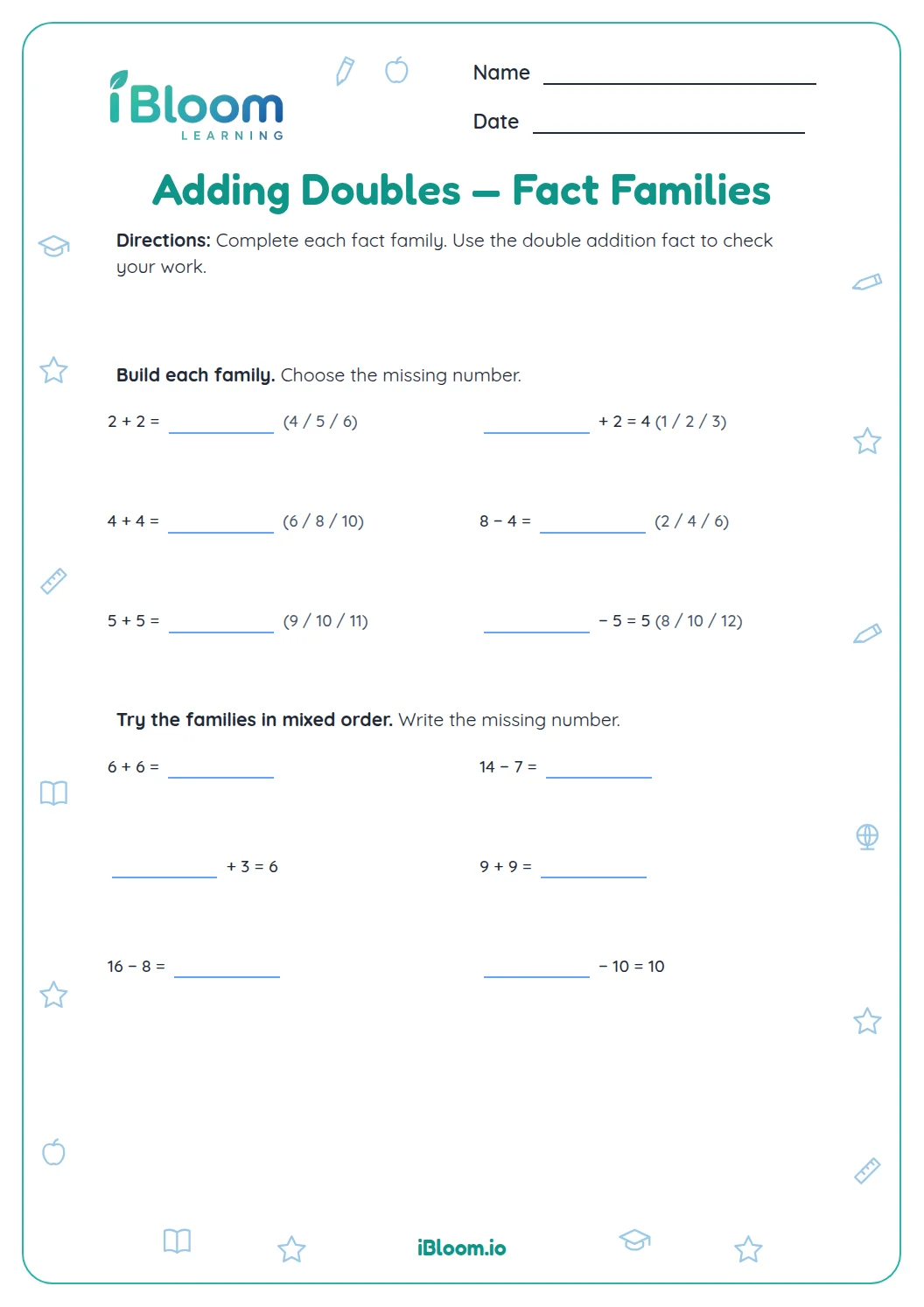
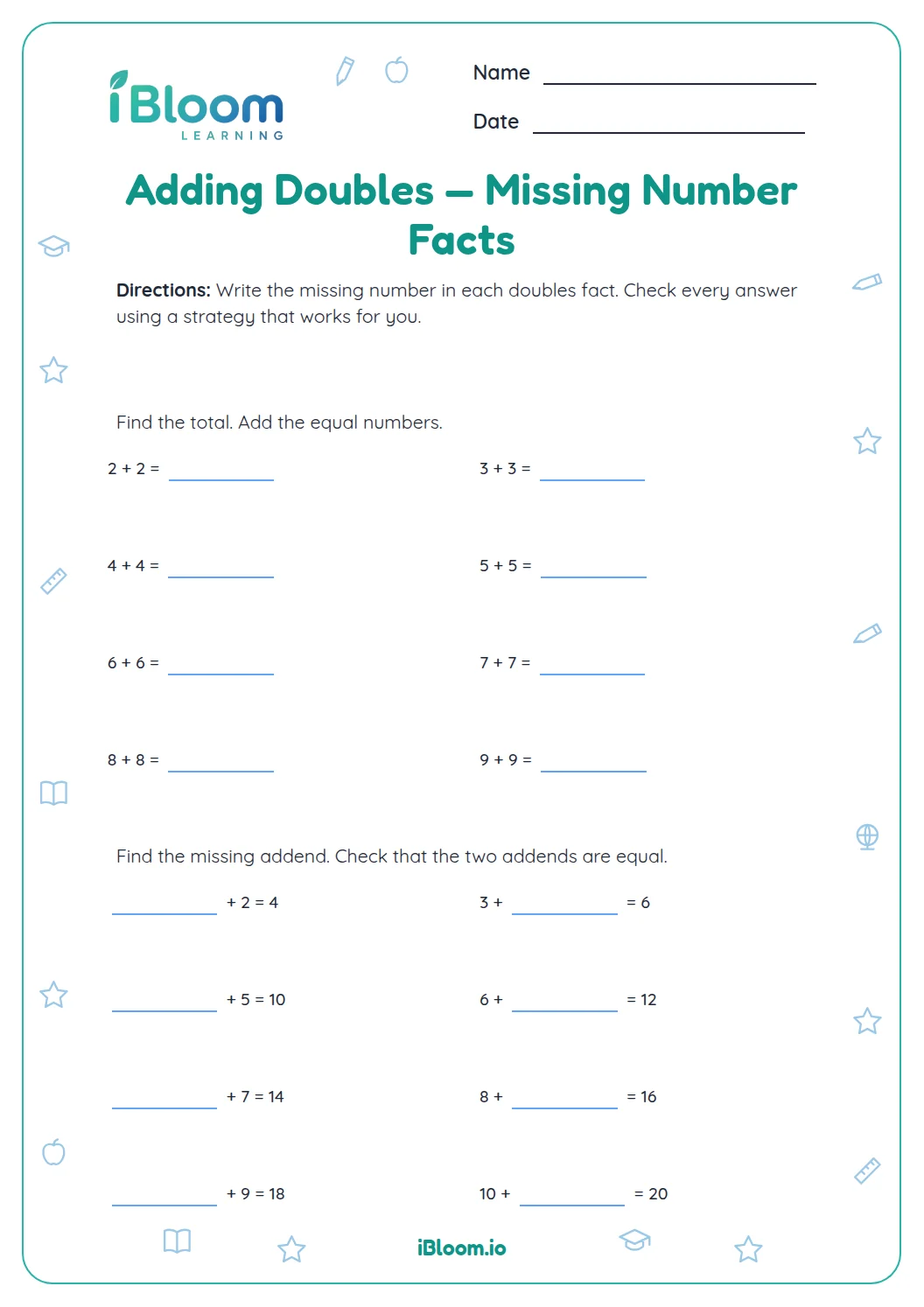
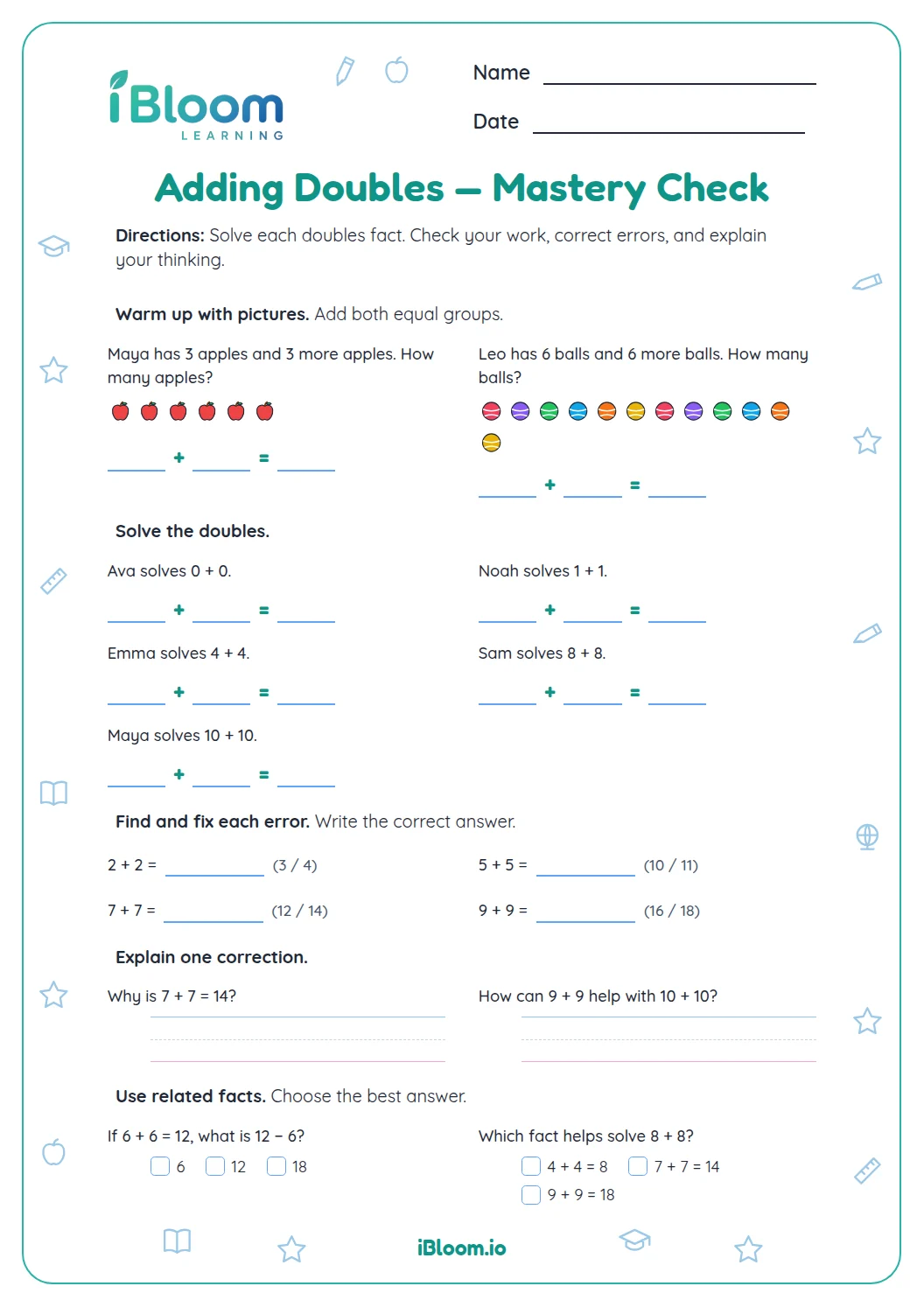
This Grade 1 printable gives learners eleven mixed-order doubles facts, from 0 + 0 through 10 + 10, followed by four short equal-group stories. Each story asks for the total when two people have the same number of items. A separate key gives all 15 sums. The practice supports addition fluency in Common Core 1.OA.C.6.
Aligned to 1.OA.C.6
How does a doubles fact work?
A doubles fact adds the same number twice. In 7 + 7, seven and seven make 14; a learner can count on seven from 7 or picture two equal groups.
The sheet moves from number sentences to four short stories where two people have matching groups.
- 1Noah has 3 birds. Ava has the same number. How many birds altogether?
- 23 + 3 = 6 birds.
How can a learner check the work?
For each story, identify the number in one group, make a second equal group, then add. Check the unit named in the story.
What is included on the printable?
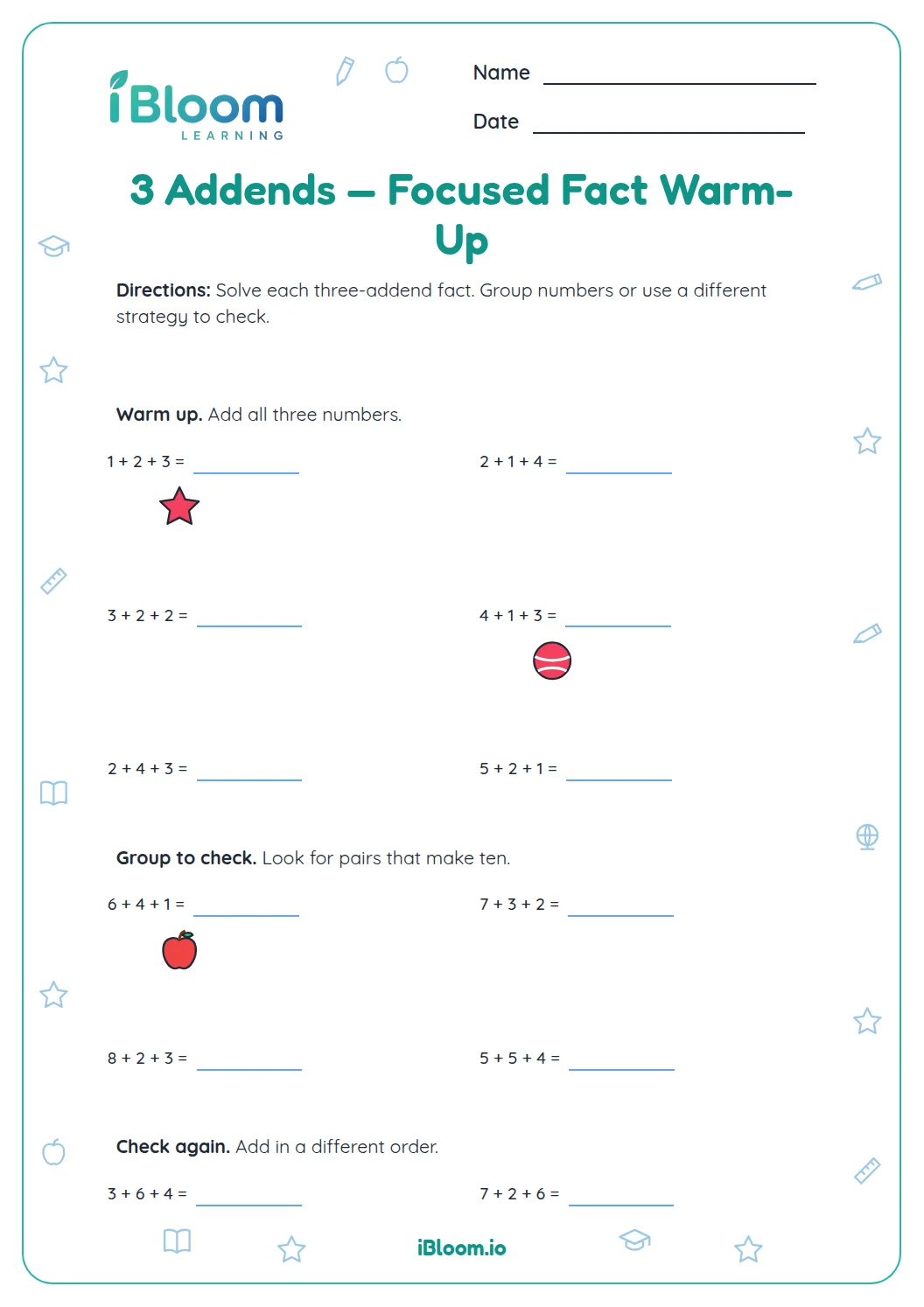
There are eleven number facts and four story problems across two worksheet pages, followed by the answer key.
How to use this worksheet
- 1Read both addends or find the group size in the story.
- 2Notice that a doubles fact has equal addends.
- 3Count on by the same amount or combine two equal groups.
- 4Write the sum and include the story unit when asked.
- 5Use the key to check after attempting all fifteen questions.
Common mistakes and quick fixes
The mistake
Adding different numbers when the story says the groups are equal.
The fix
Use the stated group size twice.
The mistake
Counting the first group again after combining.
The fix
Count each object once, or count on from the first group.
The mistake
Leaving off the item named in a story answer.
The fix
Write the total with birds, apples, pencils, or balloons as appropriate.
Common Core alignment
This worksheet practices the standard below.
Build fluency with doubles facts within 20.
On this sheet: Build fluency with doubles facts within 20.
Show the official wordingHide the official wording
Add and subtract within 20, demonstrating fluency for addition and subtraction within 10. Use strategies such as counting on; making ten (e.g., 8 + 6 = 8 + 2 + 4 = 10 + 4 = 14); decomposing a number leading to a ten (e.g., 13 - 4 = 13 - 3 - 1 = 10 - 1 = 9); using the relationship between addition and subtraction (e.g., knowing that 8 + 4 = 12, one knows 12 - 8 = 4); and creating equivalent but easier or known sums (e.g., adding 6 + 7 by creating the known equivalent 6 + 6 + 1 = 12 + 1 = 13).
What to practice next
Make more practice
Further reading
Questions parents and teachers ask
What does “adding doubles” mean?
A doubles fact adds the same number twice, such as 6 + 6. This sheet practices doubles from zero through ten, followed by four stories with equal groups. Learners can count on by the same amount or picture two matching groups to find each total.
Should the facts be timed?
No timer is needed for this worksheet. It is mixed order practice, not a speed test. Let the learner solve each fact carefully, use counters if useful, and check the answer key afterward. A short timed round can be an optional later activity once the facts feel familiar.
How can counters help with a double?
Make two groups with the same number of counters, then count every counter once. For 3 + 3, place three in one group and three in another; altogether there are six. The four story problems use this same equal-group idea with birds, apples, pencils, and balloons.
Why are some facts repeated?
The facts use different doubles from zero through ten, and some totals also appear in the stories. Seeing a double as a number sentence and in a short situation connects the same addition idea across two formats. The addends in each fact are always equal.
What if my child counts every fact from one?
Counting all the objects is a valid way to begin. Then try counting on: for 7 + 7, say seven and count seven more. The answer key lets the learner check the total, while the equal-group stories offer a concrete way to picture a double.
How should we check the key?
Finish a fact or story before looking at its answer. For a story, check both the total and the item named in the question, such as birds or apples. If the sum differs, build two equal groups or count on again, then compare with the key.