

About this worksheet
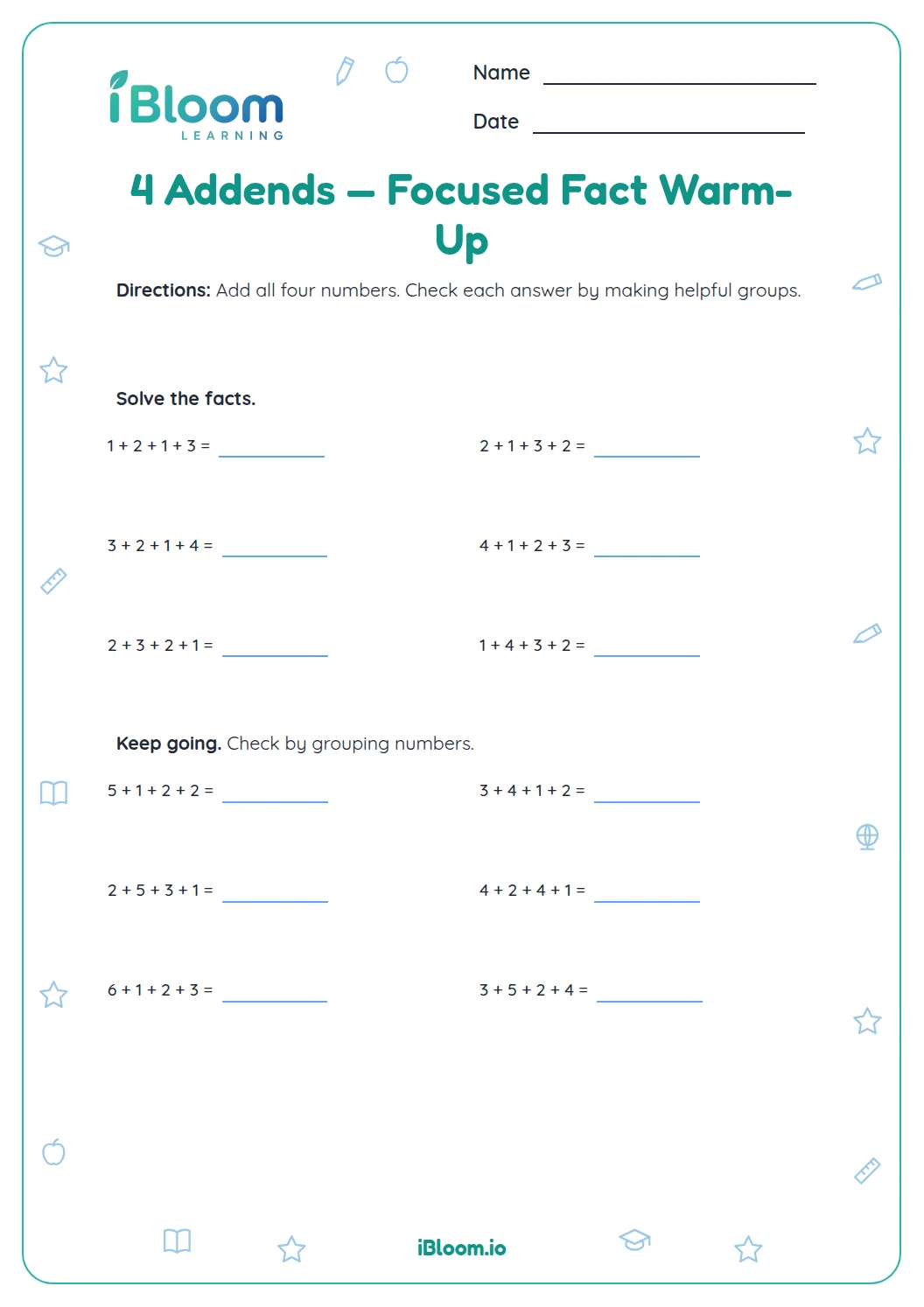
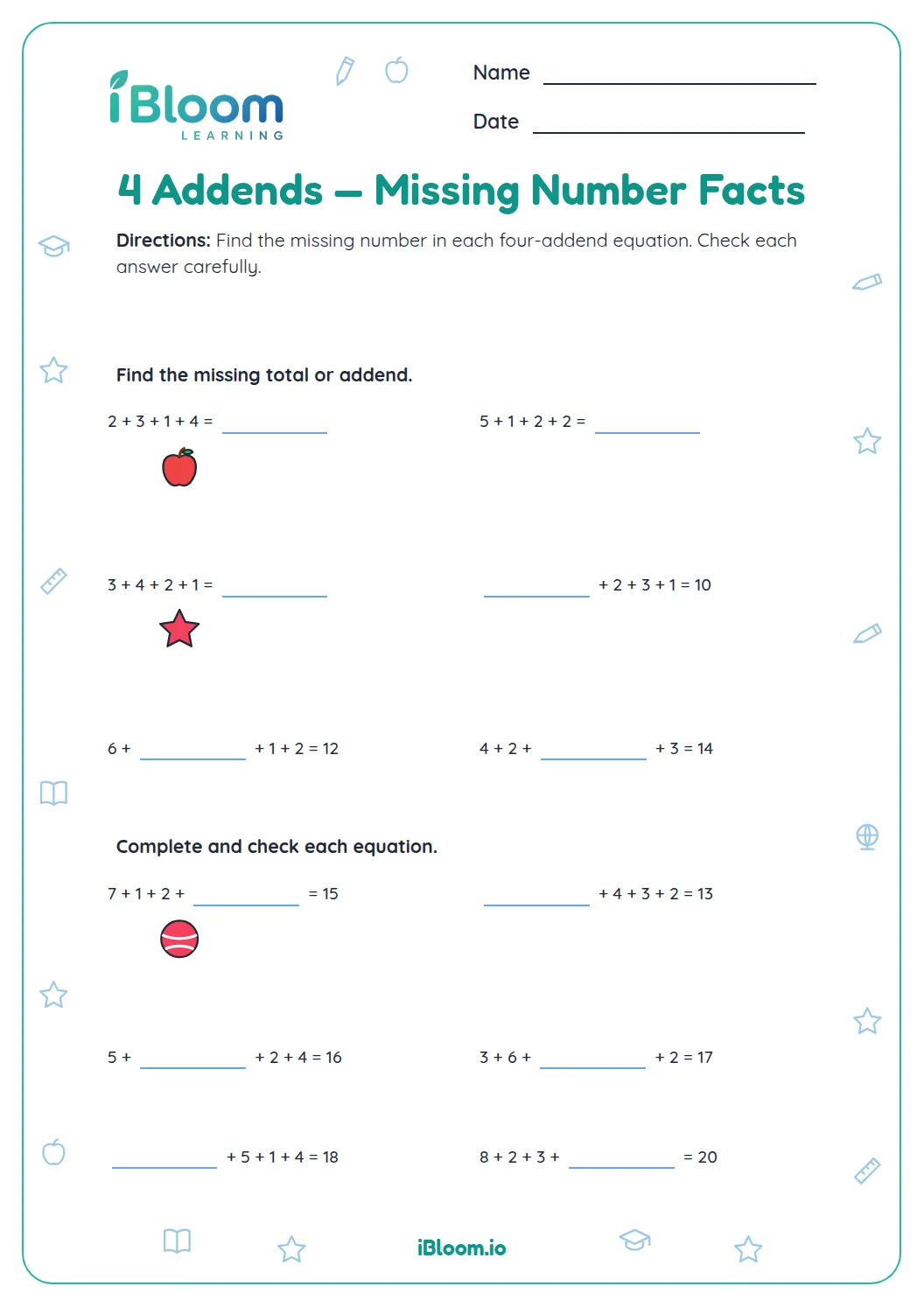
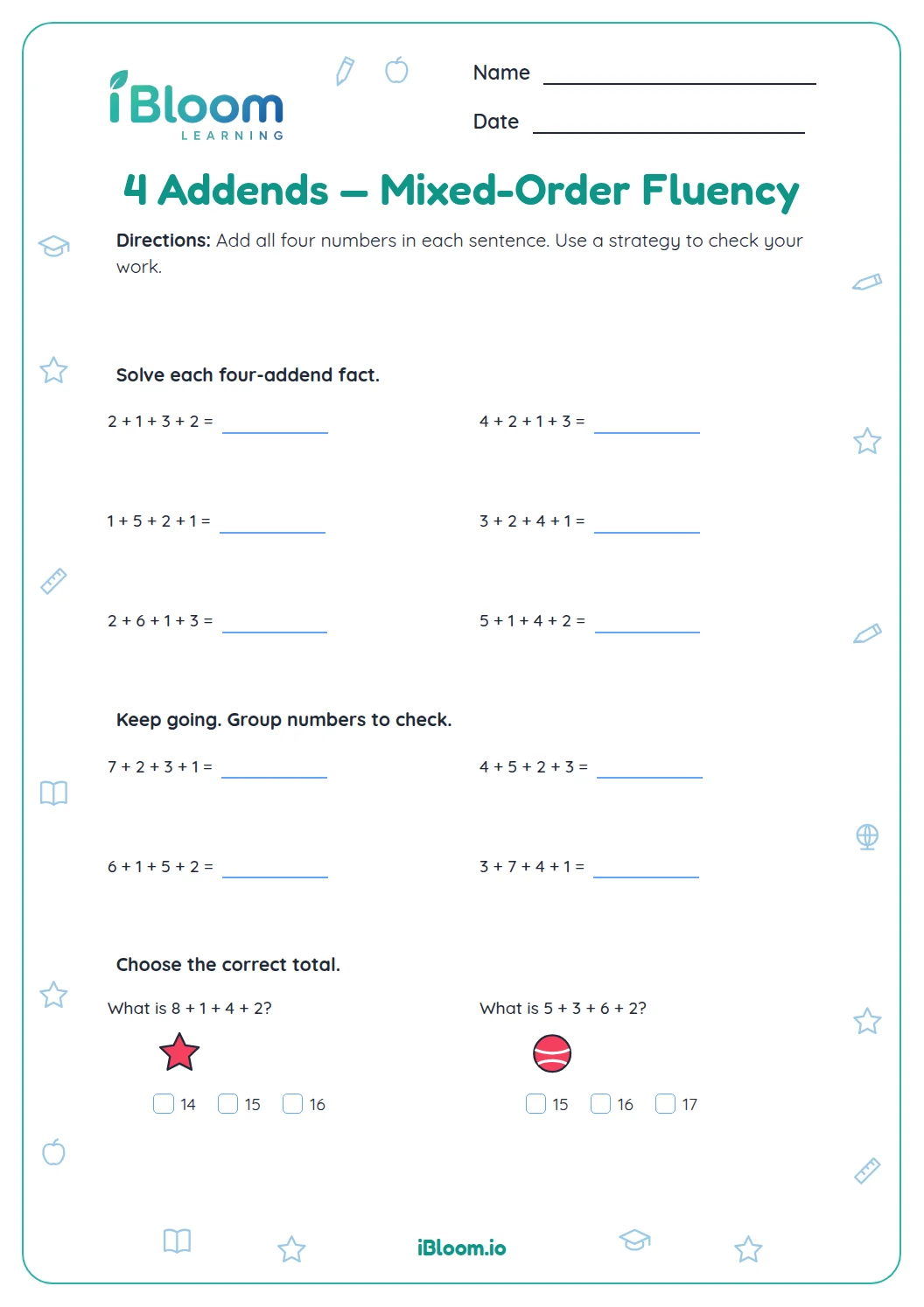
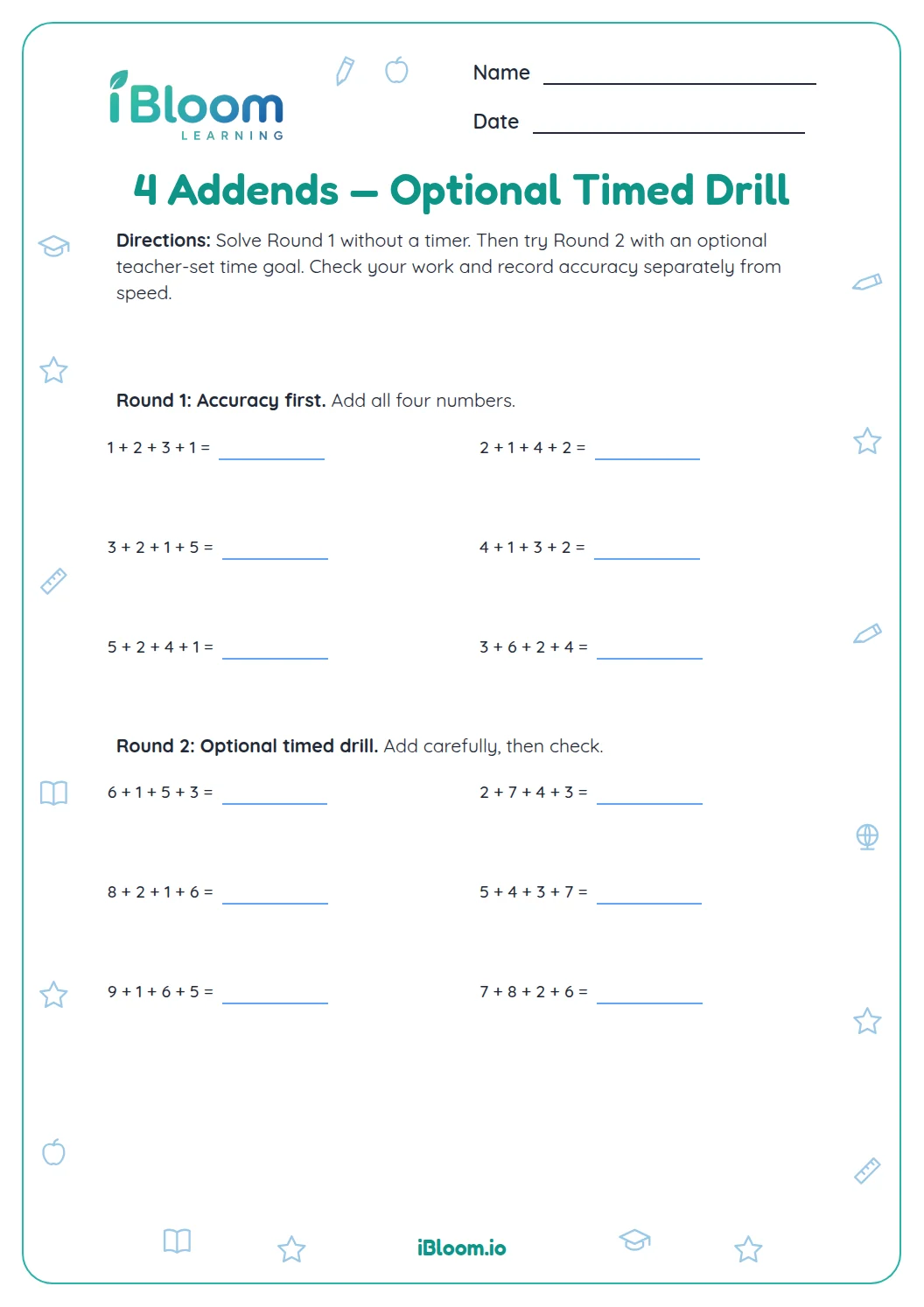
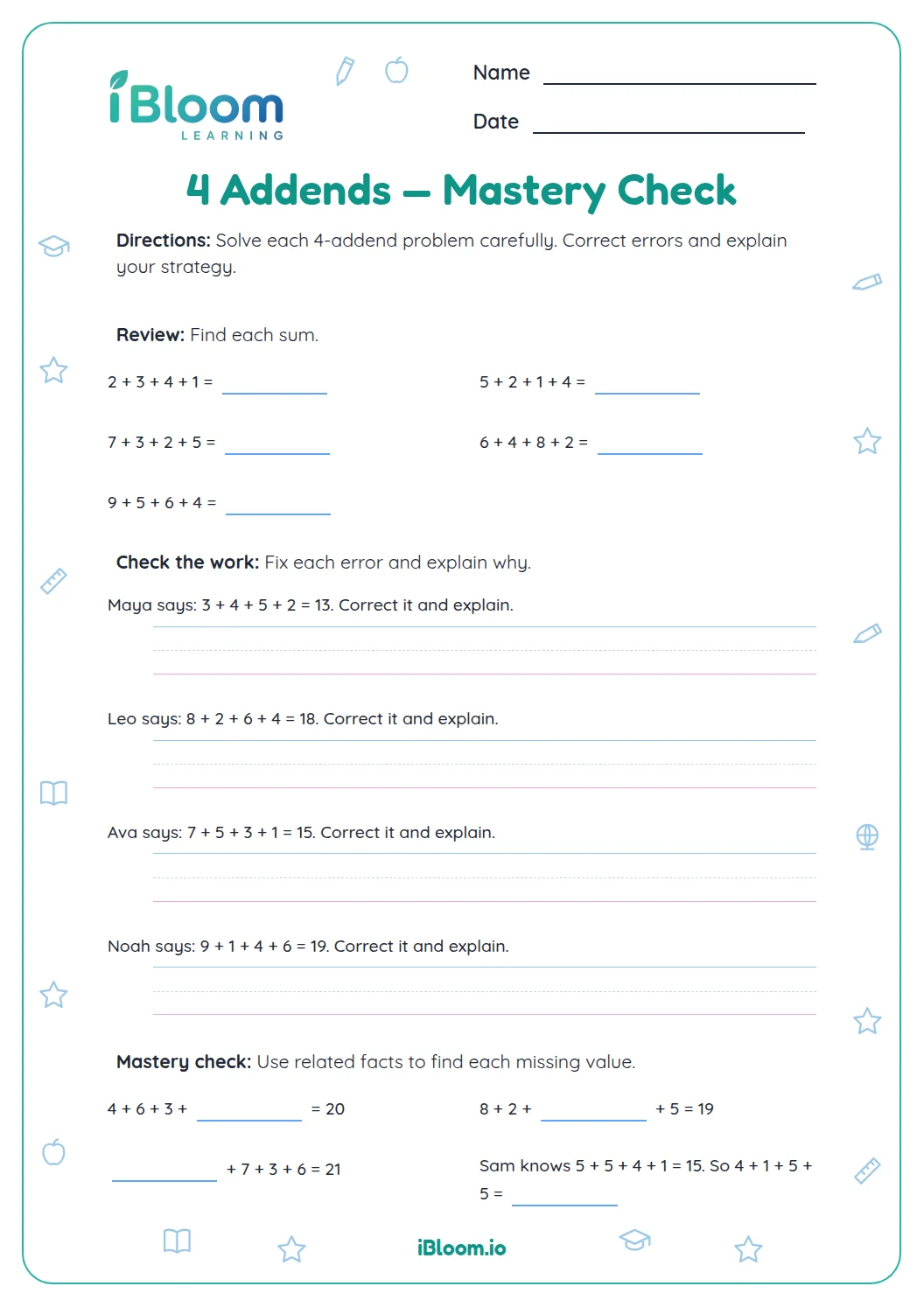
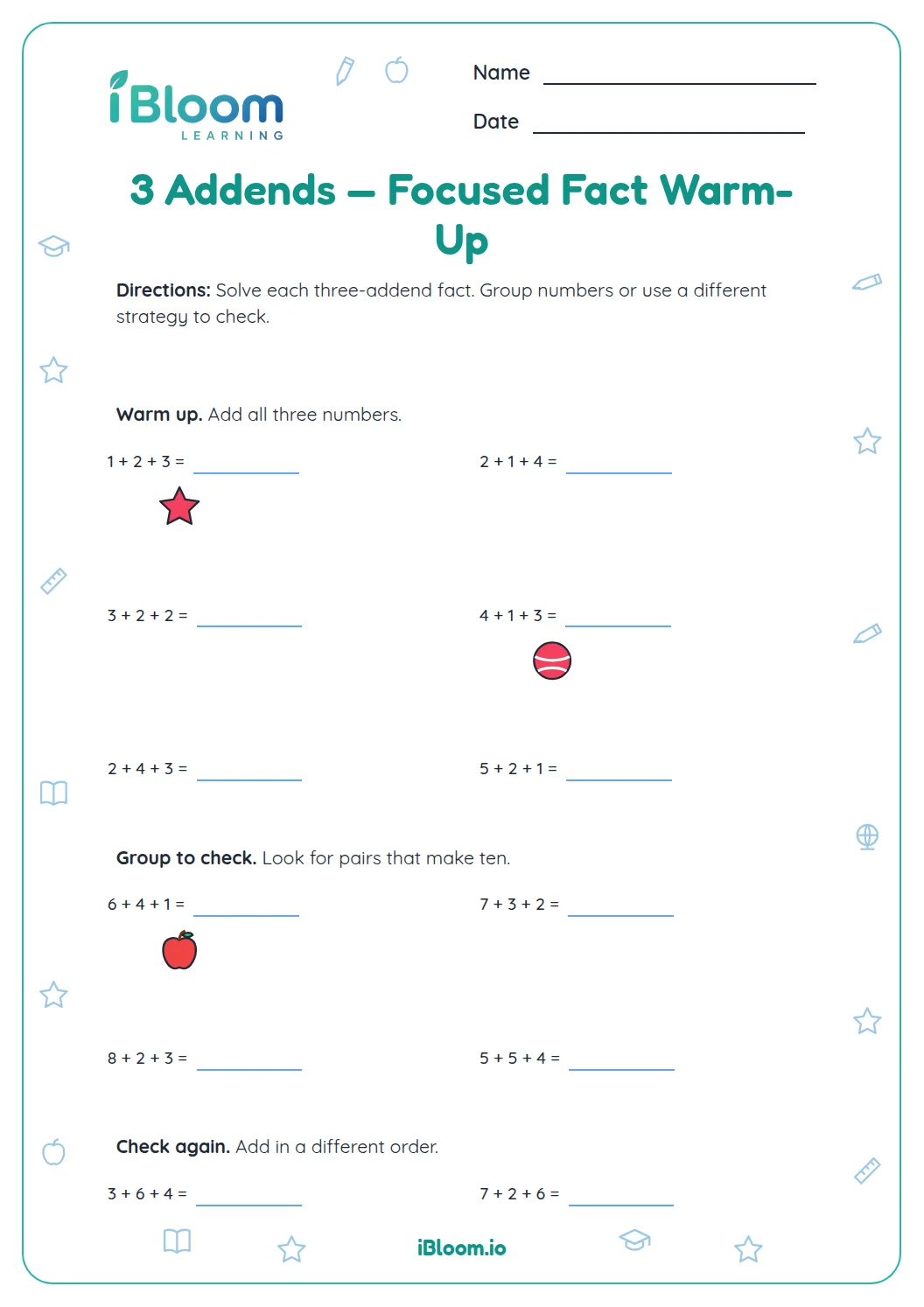
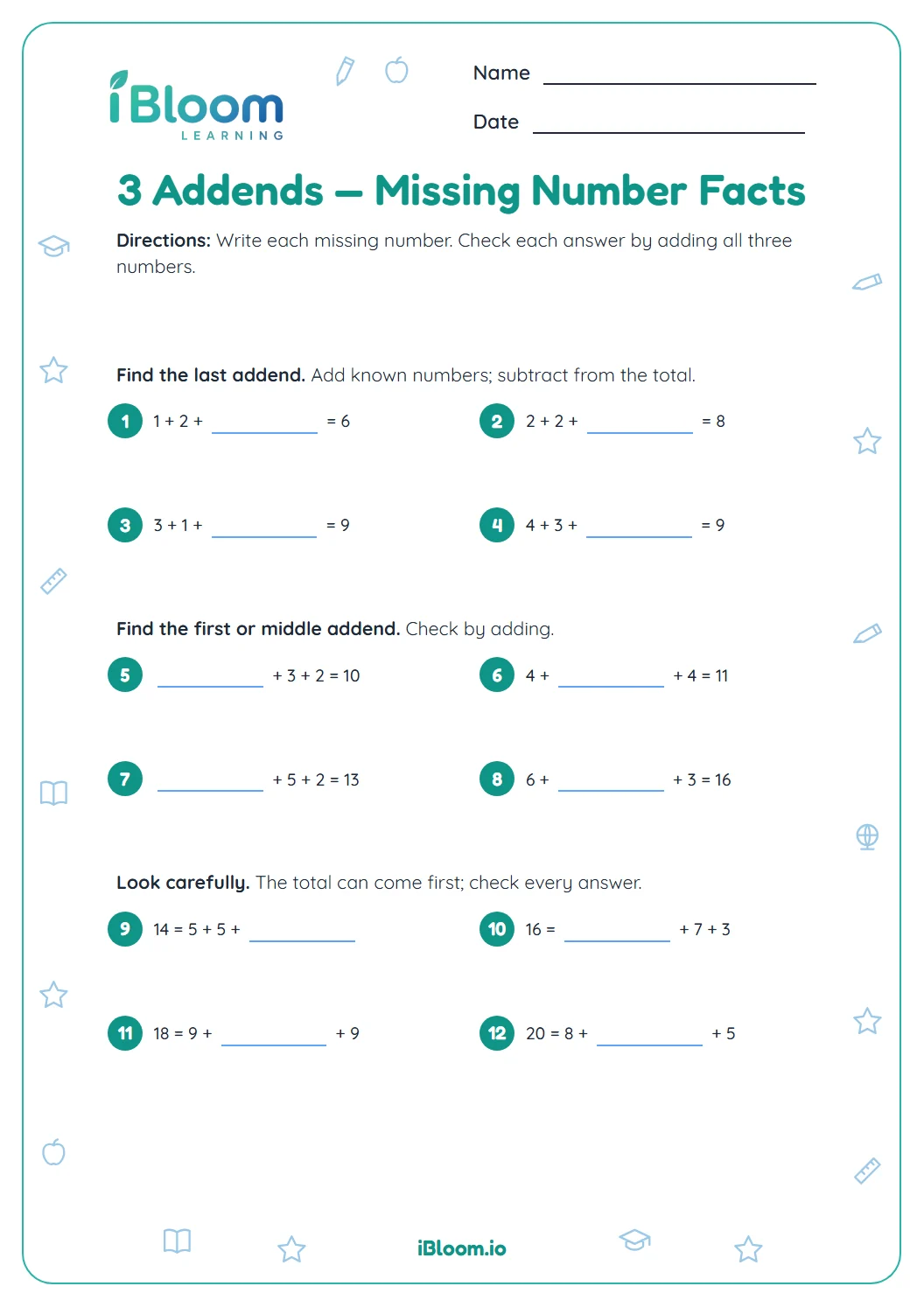
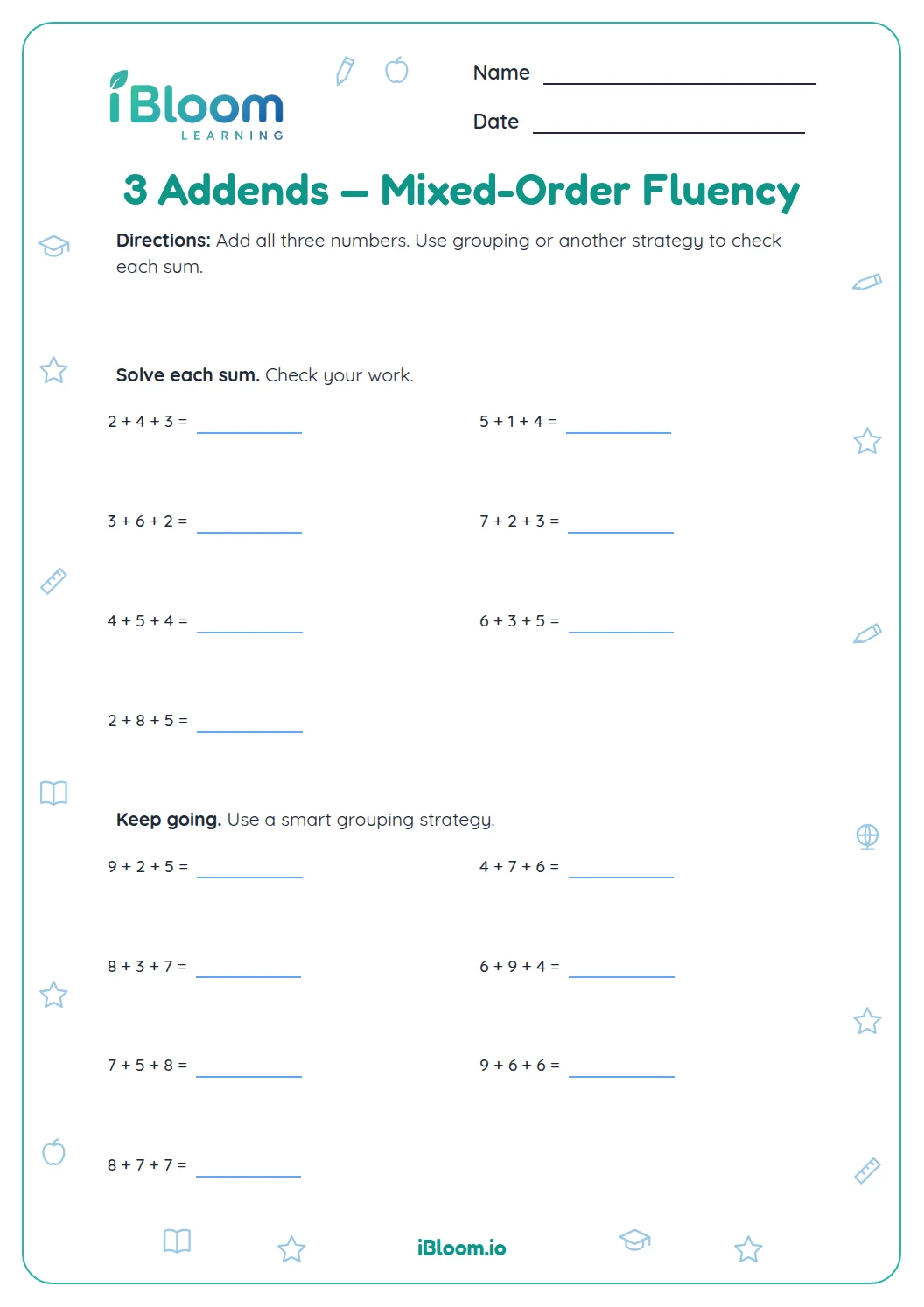
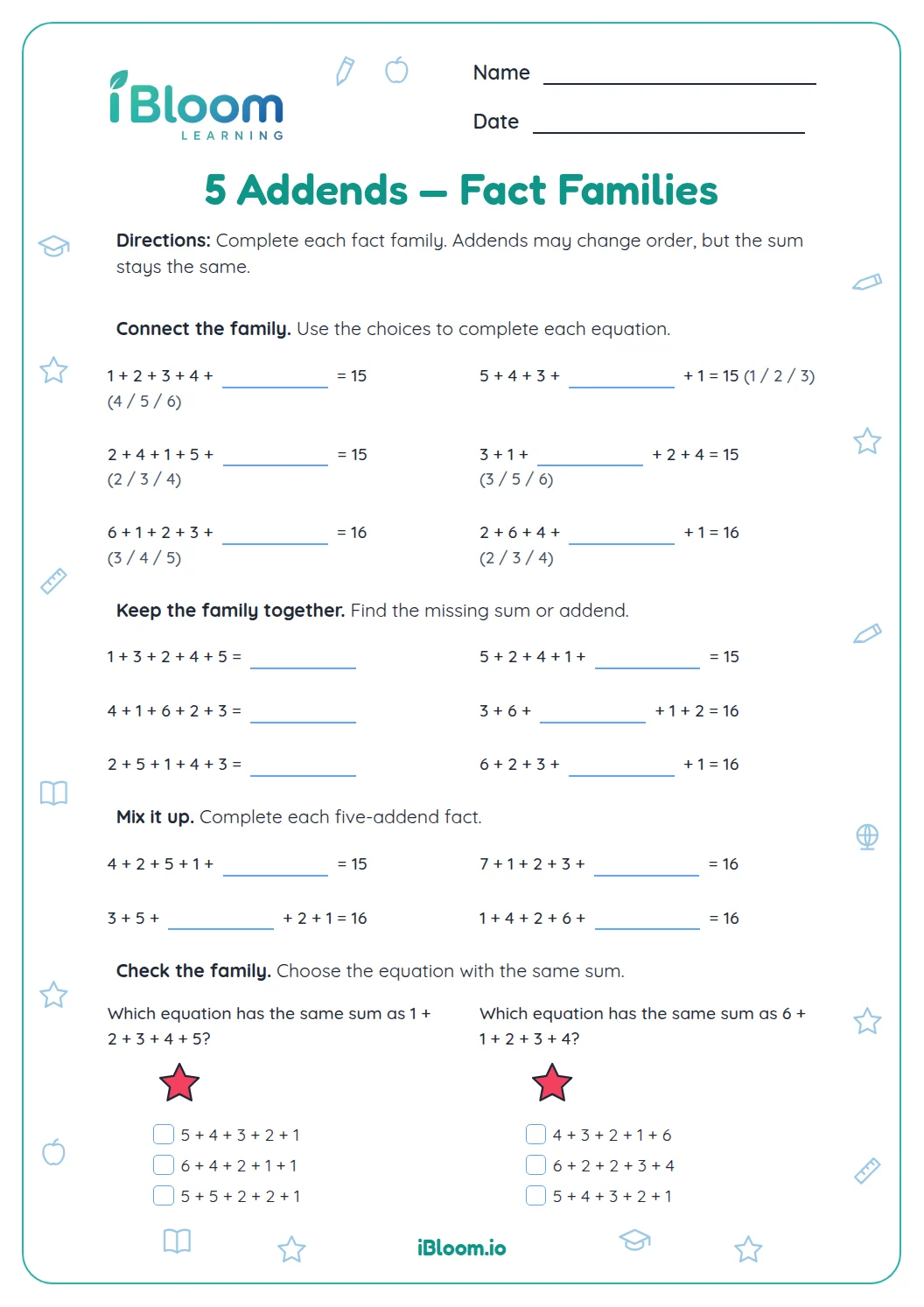
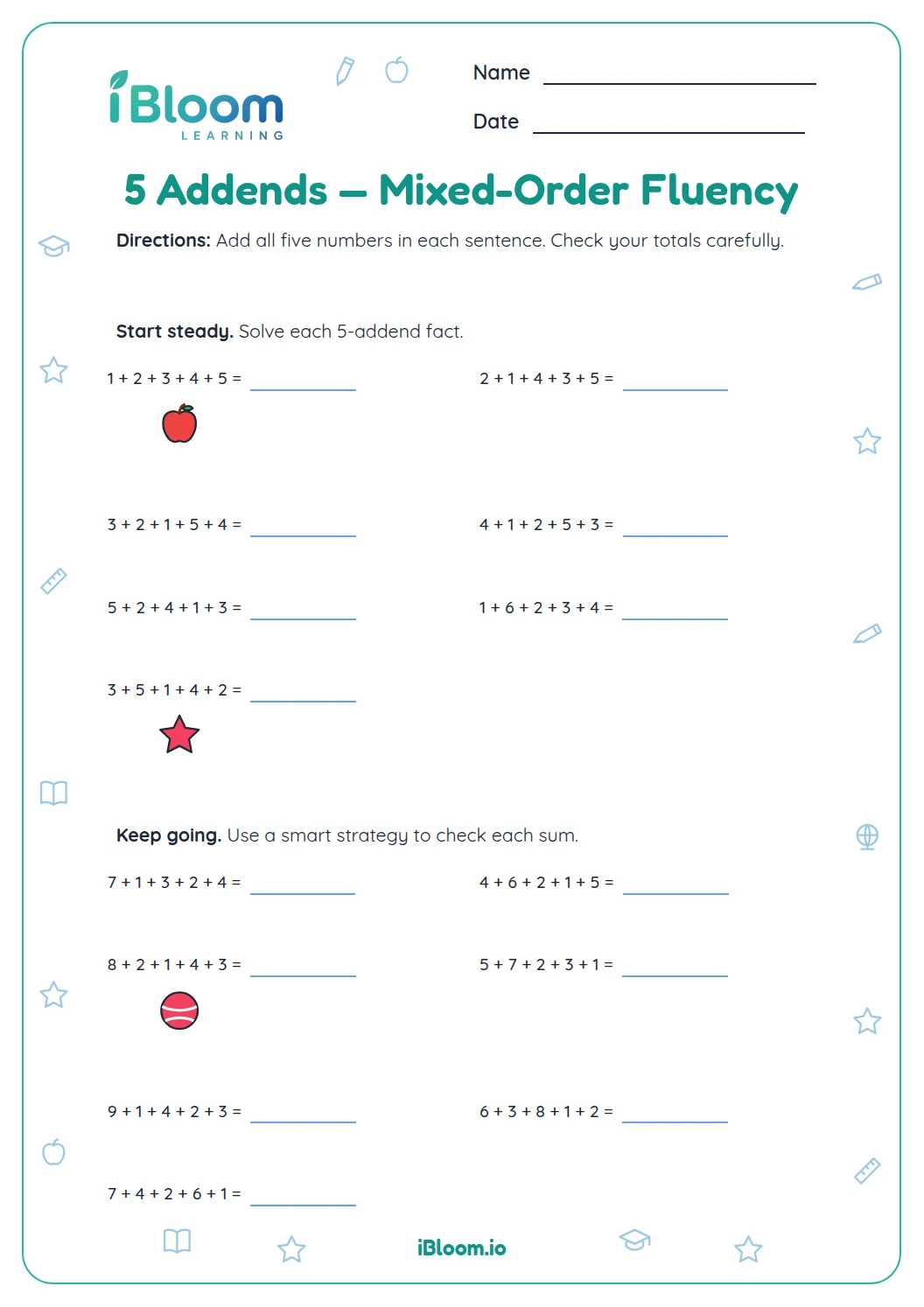
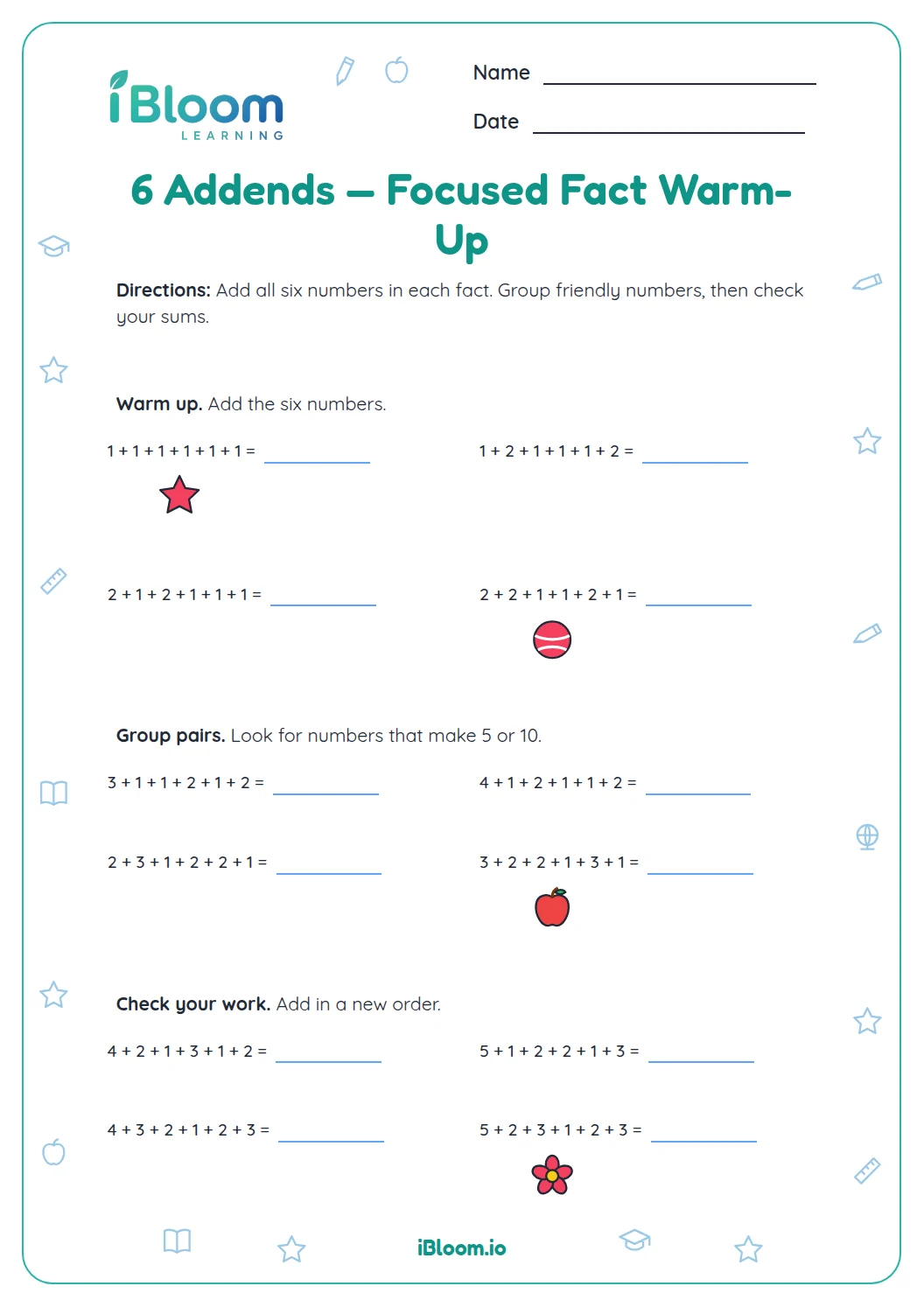
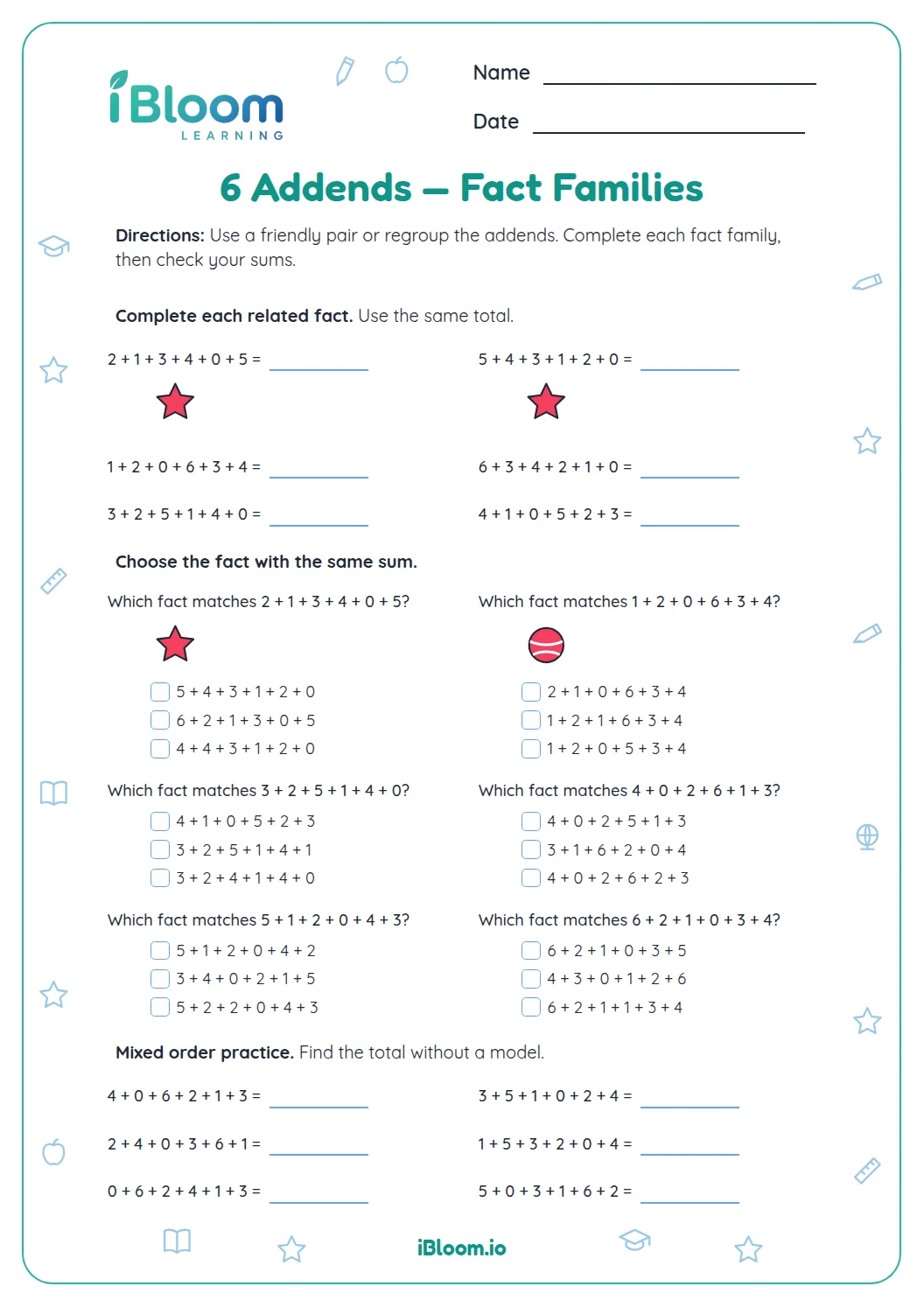
This free printable worksheet is for Grades 1–2 learners practicing four-addend addition and related sums. It includes 18 questions in 3 parts, with focused directions and a separate answer key for checking.
Aligned to 1.OA.B.3
How can you add four numbers in a new order?
Adding four small numbers is easier when you look for pairs that make 10. In question 1, 1 + 2 + 3 + 4 can be grouped as 1 + 4 and 2 + 3, making 10. Rearranging the same addends keeps the total the same.
- 11 + 2 + 3 + 4
- 2(1 + 4) + (2 + 3) = 5 + 5
- 3The sum is 10.
How do you find a missing addend?
Add the numbers you can see, then find how much more is needed to reach the total. For 2 + 3 + ___ + 10 = 16, the known numbers make 15, so the blank is 1.
What makes two sums related?
A reordered sum uses the exact same four addends, including repeats. Question 13 rearranges 1, 2, 3, and 4 as 4 + 3 + 1 + 2. Both arrangements total 10.
How to use this worksheet
- 1Read all four addends, including any repeated number.
- 2Add the numbers and write the total.
- 3For a missing addend, add the known numbers first and compare with the total.
- 4In Part C, check that the reordered sum uses exactly the same four numbers.
- 5Use the answer key to check each total and correct any changed addend.
Common slips and how to fix them
The mistake
Changing the order and changing a number too.
The fix
Match each addend, one at a time; the set must stay exactly the same.
The mistake
Forgetting that a repeated addend appears twice.
The fix
Circle each copy of a repeated number before adding or comparing.
The mistake
Adding the known addends but not comparing with the total.
The fix
Subtract their sum from the given total to find the amount still needed.
Curriculum alignment
Reorder and group four addends without changing the sum.
On this sheet: Reordering four addends uses the commutative and associative properties of addition.
Show the official wordingHide the official wording
Apply properties of operations as strategies to add and subtract.
What to practice next
Make more practice
Further reading
Questions parents and teachers ask
What does a four-addend sum show?
It combines four numbers into one total. Question 1 adds 1, 2, 3, and 4 to make 10. Try pairing 1 with 4 and 2 with 3; each pair makes 5, so the total is 10. Use the same reasoning on the other questions in this section.
How can I find a missing addend?
Add the known addends, then compare their sum with the total. In 2 + 3 + ___ + 10 = 16, the known numbers make 15, so the missing addend is 1. Substitute 1 to check the equation. Use the same reasoning on the other questions in this section.
Why do reordered addends have the same sum?
Changing the order does not change the amount being added. Question 13 uses the same four numbers as question 1 in a different order: 4, 3, 1, and 2. Both sums equal 10. Use the same reasoning on the other questions in this section.
What should children check in a related sum?
Check that every addend appears, including repeated numbers, before comparing totals. For example, a set with two 2s is different from one with only a single 2. Then add the numbers to verify the sum. Use the same reasoning on the other questions in this section.
How many questions and pages are included?
The sheet has 18 questions across three parts, followed by a separate two-page answer key. The parts practice four-number totals, missing addends, and sums with the same addends in a new order. Use the same reasoning on the other questions in this section.