

About this worksheet
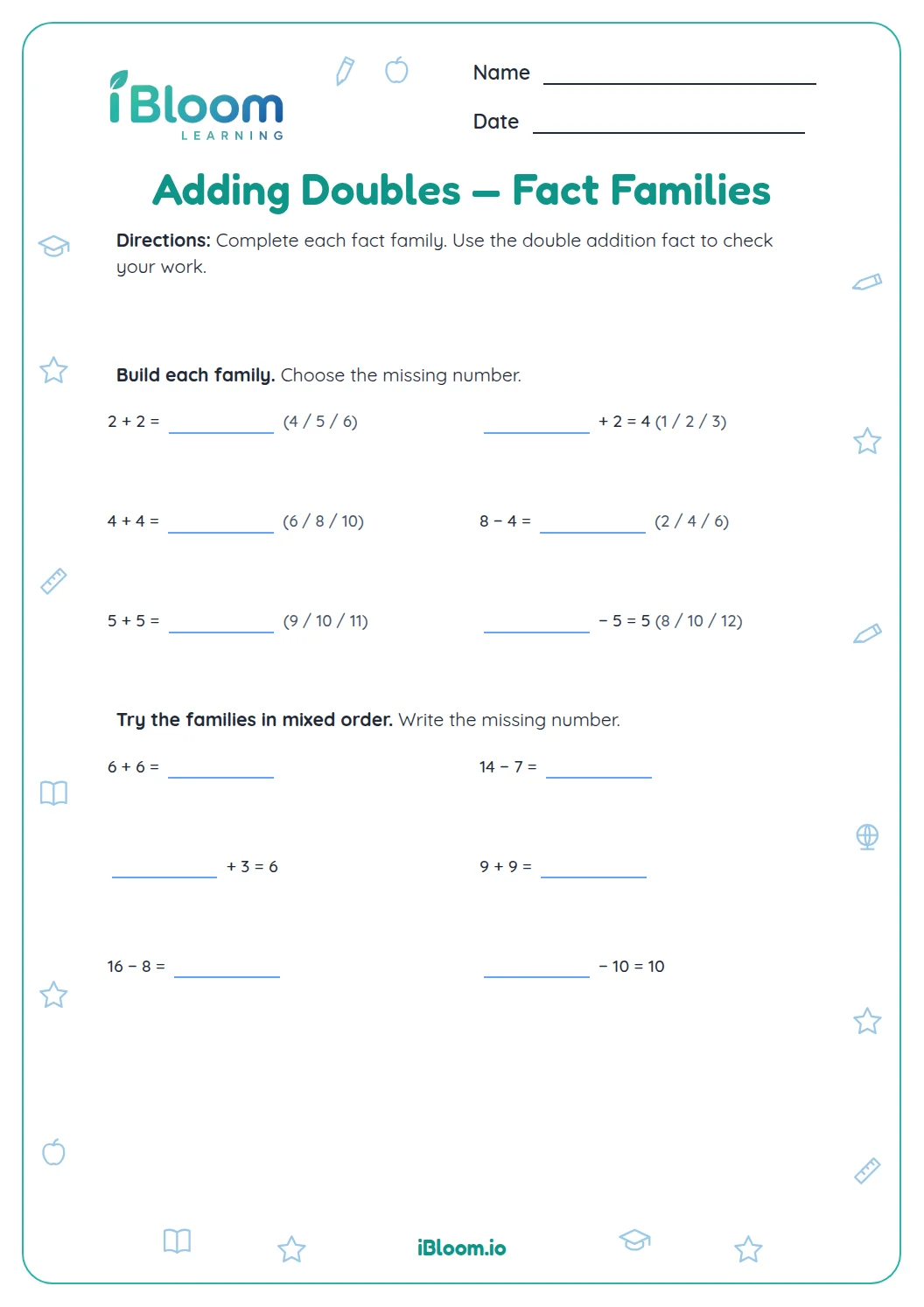
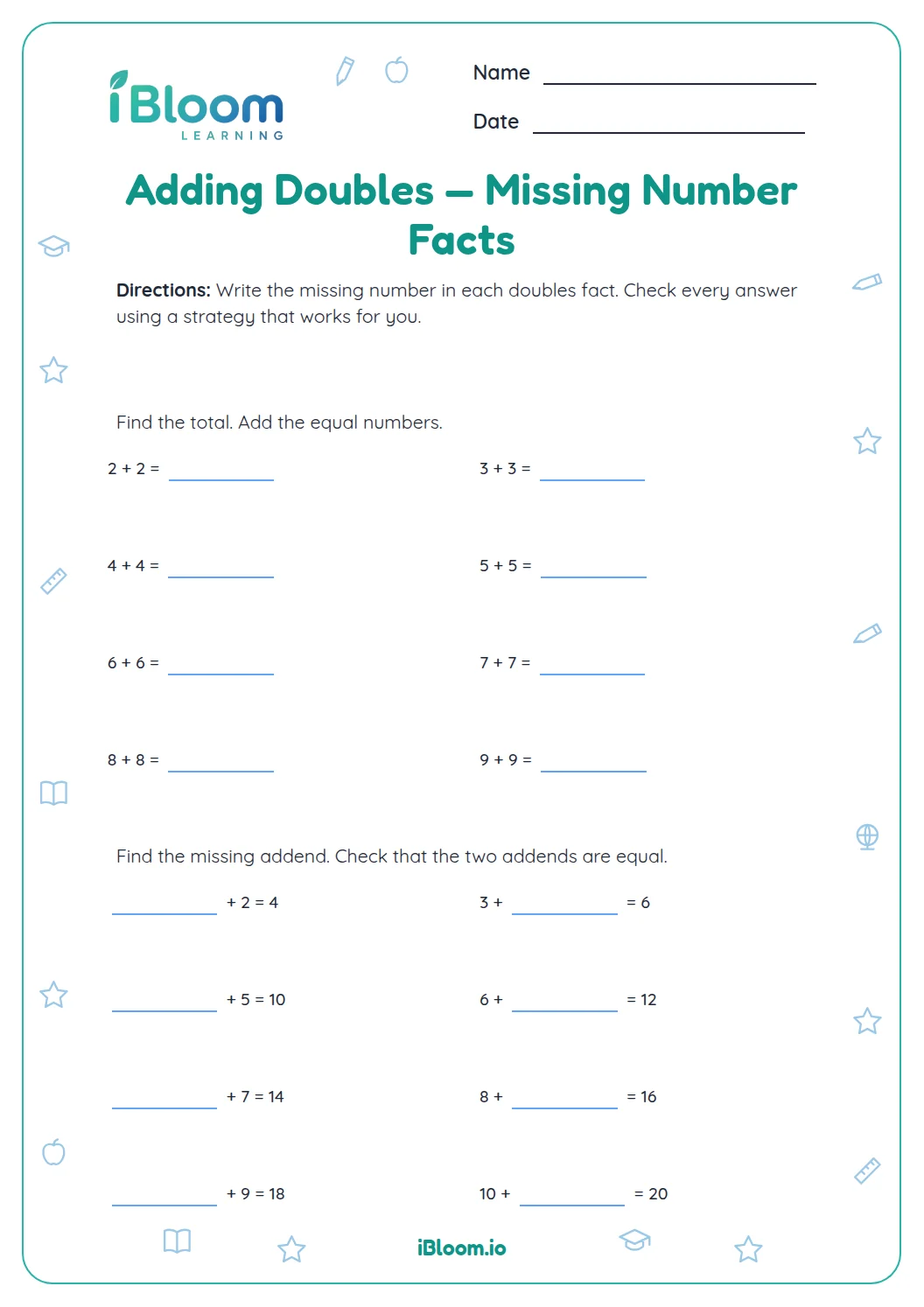
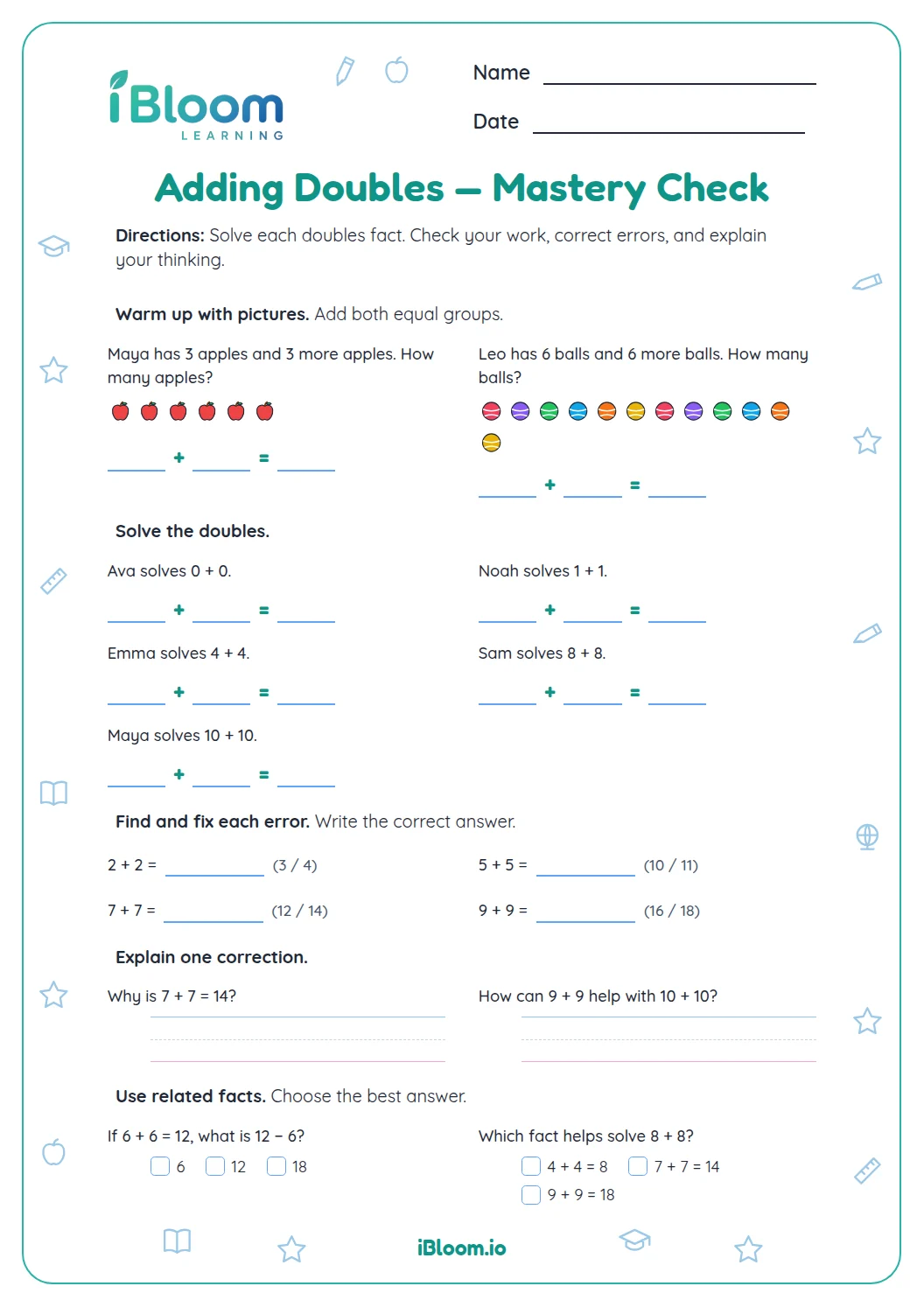
This printable helps children practice addition doubles, facts where both addends are the same. It starts with smaller sums and builds through 18 + 18, then applies doubles to two missing-addend facts. Children can picture two equal groups or use a known double to check a nearby fact. The answer key is separate.
What makes an addition fact a double?
A doubles fact adds the same addend twice. In question 1, 1 + 1 means one and one more, making 2. Children can picture two equal groups or use paired counters.
Once some doubles are familiar, they become useful anchors for nearby sums. Knowing 6 + 6 helps a child reason that 6 + 7 is one more, though this sheet focuses on doubles.
- 11 + 1 = 2
- 2The addends match.
- 3Two ones make two.
How do the doubles lead to missing-addend practice?
The first 18 items practice distinct doubles from 1 + 1 through 18 + 18. The final two questions apply those sums to missing addends, giving children a short check that uses the same doubling idea.
- Part A: eighteen different doubles facts
- Part B: two missing-addend checks
- Answer key: all 20 results
How to use this worksheet
- 1Notice whether the addends match.
- 2For small doubles, count both groups or use counters in pairs.
- 3Say the full equation and its sum.
- 4Use a known double to reason about a nearby fact.
- 5Check the sum by splitting it into two equal groups.
Common mistakes and quick fixes
The mistake
Adding only one copy of the addend.
The fix
Build two equal groups, then count every item in both.
The mistake
Changing a double into the next sum.
The fix
Check that the numbers on both sides of the plus sign match.
The mistake
Counting the first group twice.
The fix
Count the first group, then continue through the second group.
What to practice next
Make more practice
Further reading
Questions parents and teachers ask
Which doubles are included?
A double adds a number to itself, such as 4 + 4 or 9 + 9. The first 18 questions have matching addends and cover 1 + 1 through 18 + 18. Two final missing-addend checks ask children to use the same doubling relationship in a new form.
What does “double” mean in addition?
A double is a sum with two equal addends. In 7 + 7, each group has seven, so the total is 14. The matching addends are the clue that this is a doubles fact. The worksheet practices that pattern with numbers from 1 through 18.
How can counters help with doubles?
Make two equal groups with counters. For 5 + 5, place five counters in one group and five in another, then count all ten. Seeing equal groups connects the written equation to what the sum means. Children may also pair counters as they count.
How do doubles help with nearby facts?
A known double can be an anchor. If a child knows 6 + 6 = 12, then 6 + 7 is one more, or 13. This worksheet practices doubles that make those nearby comparisons easier later. Naming the matching addends helps make the pattern clear.
How many practice items are on the printable?
There are 20 questions in two parts, with a separate answer key. The first 18 practice doubles from 1 + 1 through 18 + 18. Two final items use missing addends to revisit doubling in a different way.
Do all of the doubles fit within 20?
The page includes doubles through 18 + 18, so some sums are greater than 20. Children can use equal groups, pairs or known sums to work through these facts. The separate key gives each result, and missed items can be reviewed again.