

About this worksheet
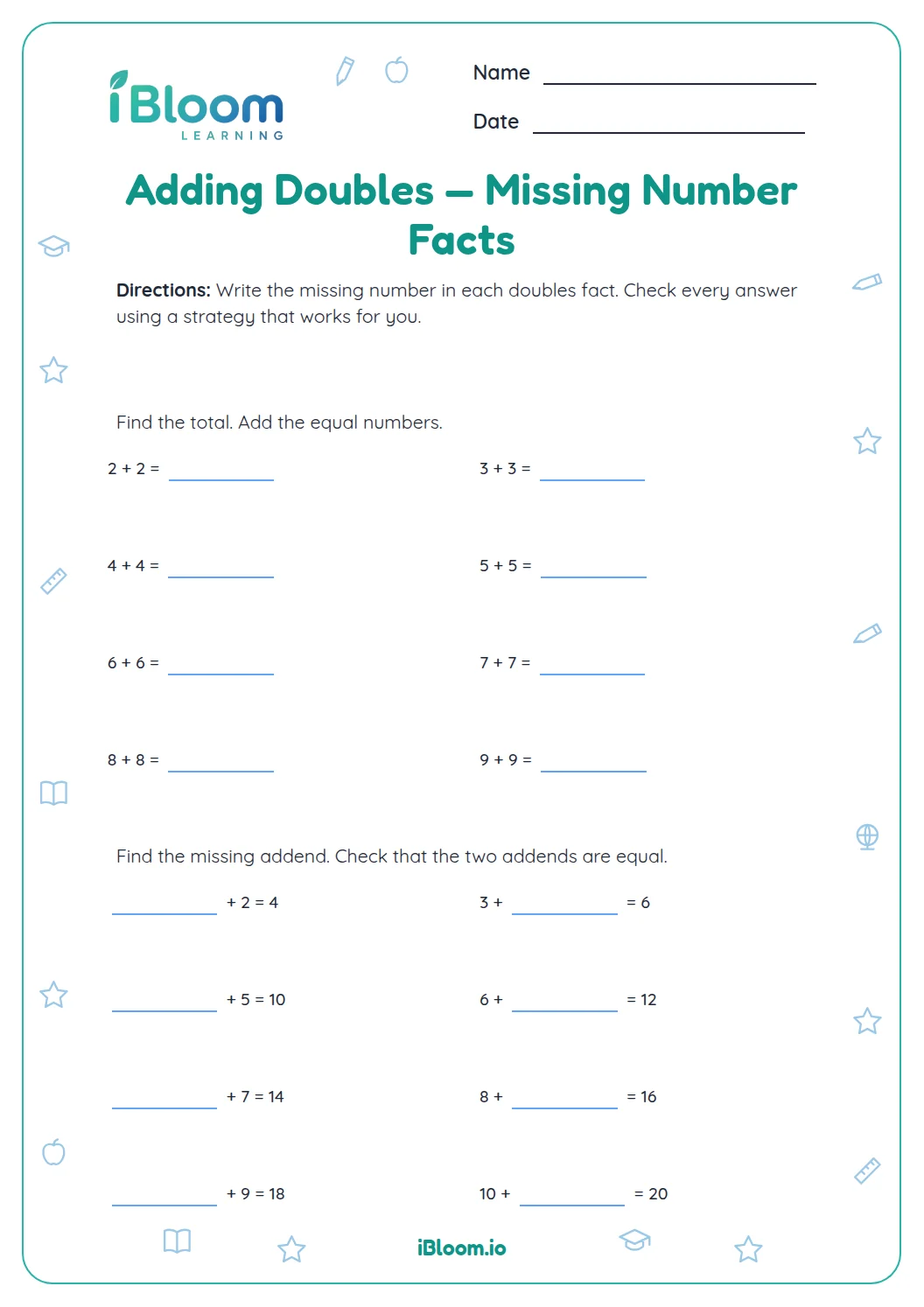
Each problem adds a number to itself, including zero doubles and doubles through 12. The optional timing language keeps accuracy and comfortable practice at the center.
Aligned to 1.OA.C.6
Recall doubles with confidence
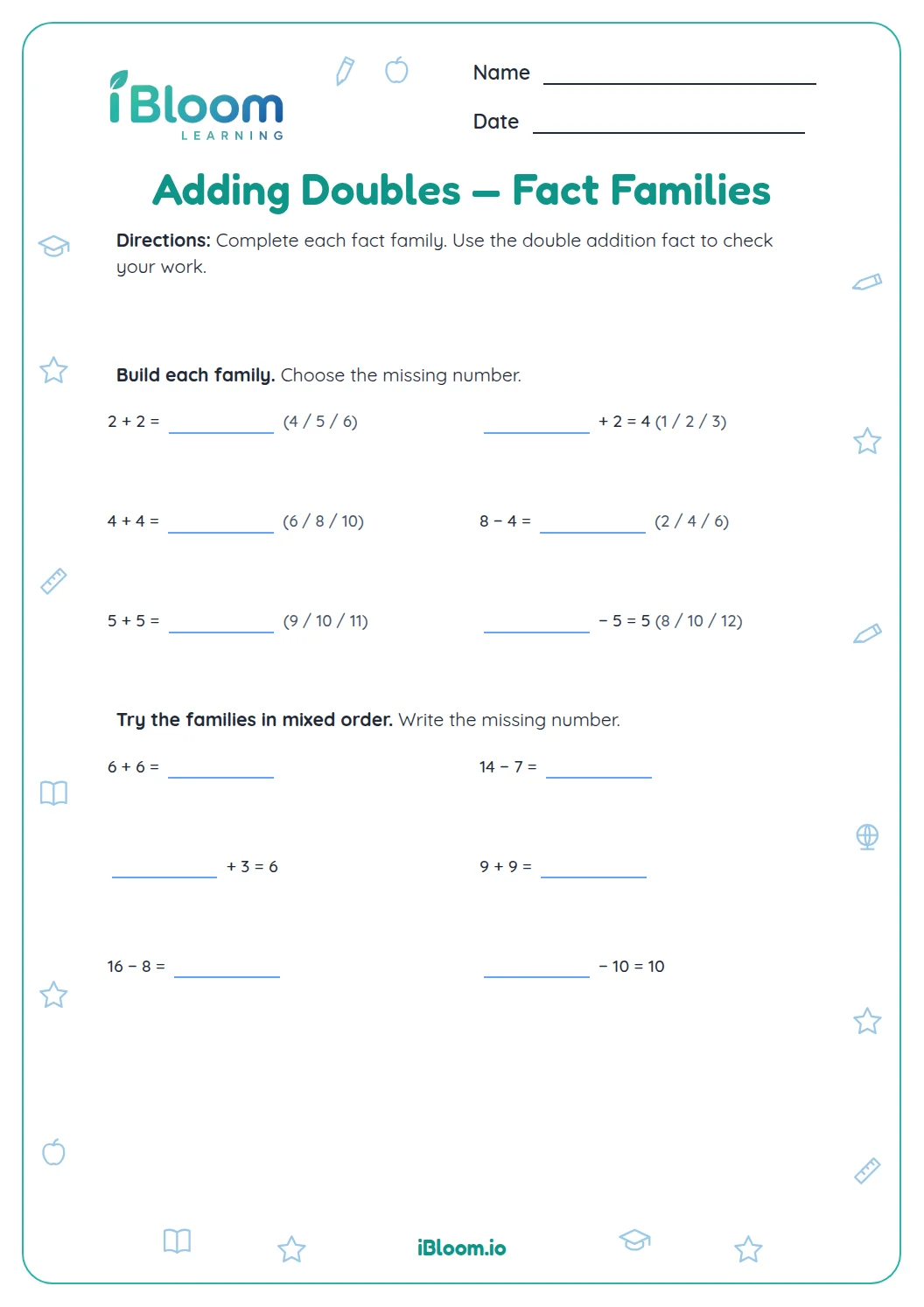
A doubles fact adds equal addends: 7 + 7 is fourteen. Knowing doubles can make nearby facts easier too; a child who knows 6 + 6 can think of 6 + 7 as one more.
The warm-up includes small doubles and builds to larger sums. Zero doubled is zero, and 12 doubled is 24. Look at both addends before answering so the repeated number is clear.
- Part A starts with familiar facts.
- Part B mixes the same idea in different wording.
Keep timing optional
Accuracy comes first. A timer can be a personal challenge after the child understands the facts, but the worksheet works just as well without one. Stop the timer if it makes practice stressful.
For a fact such as 8 + 8, imagine two equal groups of eight or count eight more from eight. This gives a quick way to check a remembered sum.
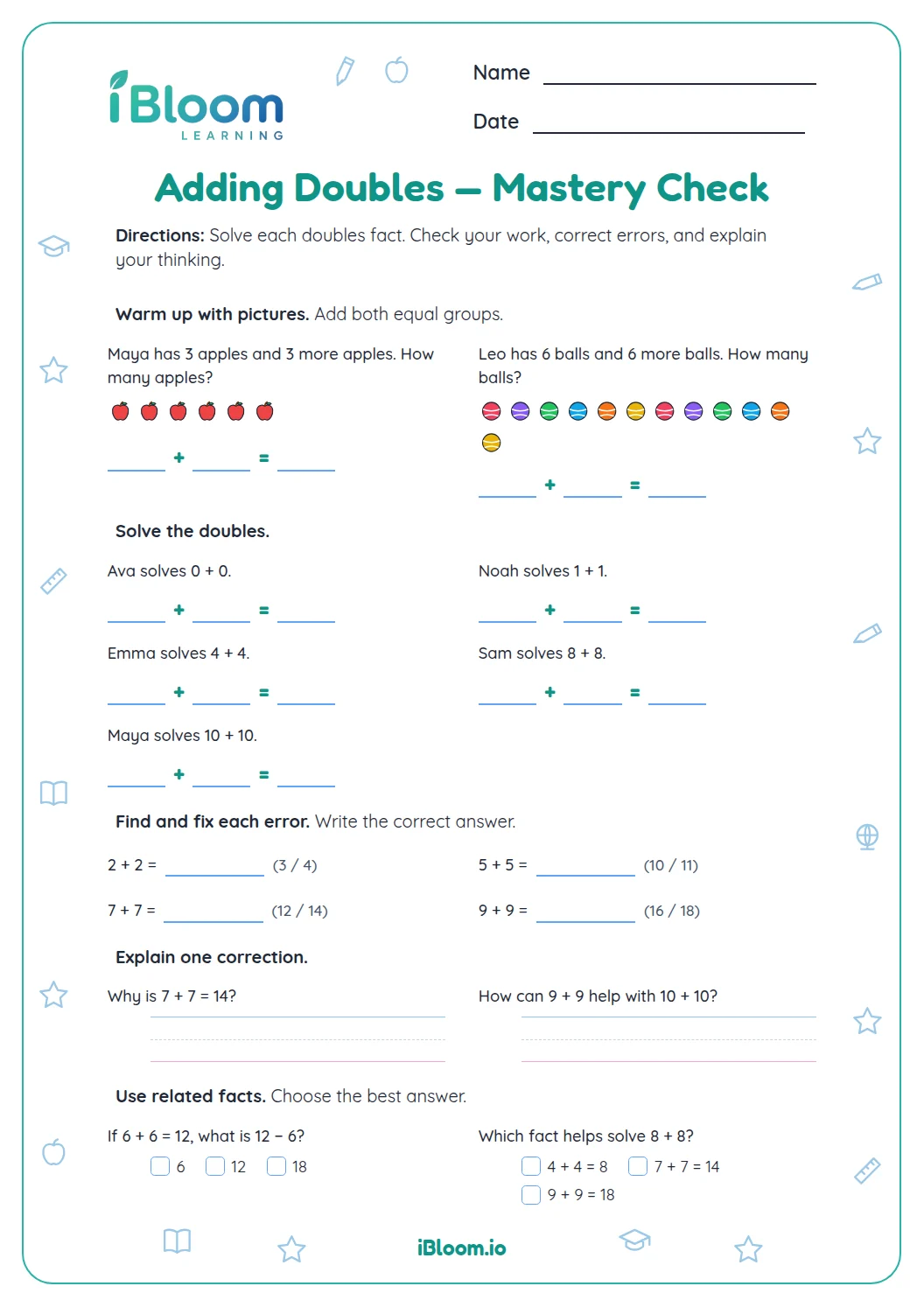
- Part C asks for doubles in words as well as equations.
- Use the answer key to check facts before comparing a time.
How to work through this page
- 1Solve the equation by noticing the equal addends.
- 2For a worded question, identify the number in each equal group.
- 3Check the sum with counters or by counting on.
- 4Use a timer only if it feels fun and helpful.
Common mistakes and how to check
The mistake
Adding different numbers by mistake
The fix
A doubles fact uses the same number twice. Read both addends before adding.
The mistake
Rushing to beat a timer
The fix
A fast incorrect answer does not build fluency. Finish accurately first; timing is optional.
Curriculum alignment
This worksheet practices a specific Common Core skill for this grade.
Adding Doubles
On this sheet: Students add within 20 and use strategies such as doubles to develop fluency.
Show the official wordingHide the official wording
Add and subtract within 20, demonstrating fluency for addition and subtraction within 10. Use strategies such as counting on; making ten (e.g., 8 + 6 = 8 + 2 + 4 = 10 + 4 = 14); decomposing a number leading to a ten (e.g., 13 − 4 = 13 − 3 − 1 = 10 − 1 = 9); using the relationship between addition and subtraction (e.g., knowing that 8 + 4 = 12, one knows 12 − 8 = 4); and creating equivalent but easier or known sums (e.g., adding 6 + 7 by creating the known equivalent 6 + 6 + 1 = 12 + 1 = 13).
What to practice next
Make more practice
Questions parents and teachers ask
What is an addition doubles fact?
A doubles fact adds a number to itself. In 6 + 6, both addends are six, so the sum is twelve. The worksheet includes equations and worded prompts such as “What is double 7?” to practice recognizing the same equal-addend idea in different forms.
Do I need to use a timer?
No. Timing is optional, and children can complete both rounds without a timer. Accuracy comes first; the second round offers a chance to record a personal time after checking answers. An adult can skip timing or stop if it makes the practice less comfortable.
How can I check a doubles answer?
Think of two equal groups or count on by the same amount. For 8 + 8, start at eight and count eight more to reach sixteen. Counters or a number line can also show the two groups and help a child verify the sum.
Why practice doubles more than once?
The sheet repeats the doubles idea with different addends so children practice recalling more than one fact. It starts with smaller doubles and then mixes facts through 12. A child can solve carefully first, check the key, and use timing only if desired.