


About this worksheet
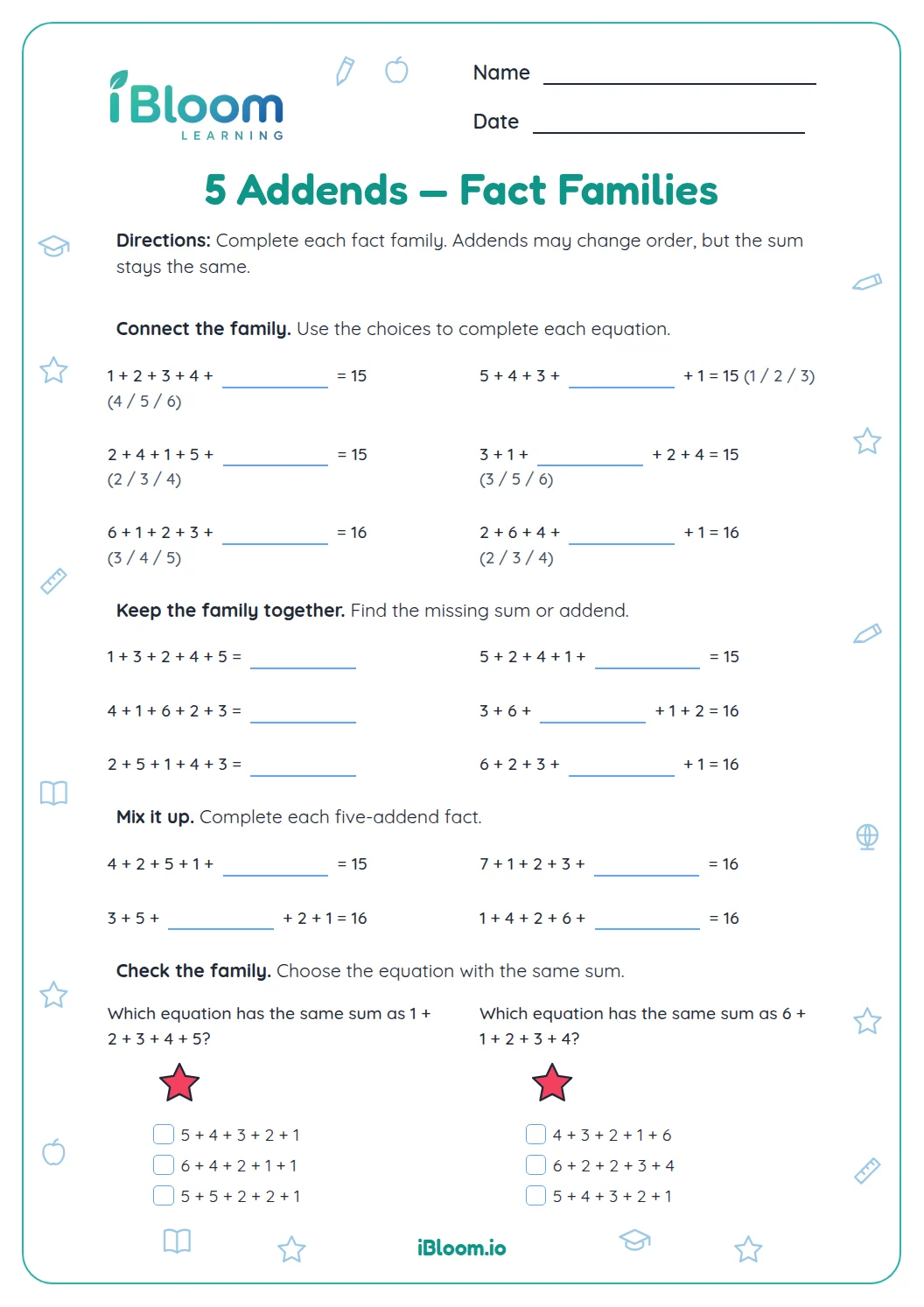
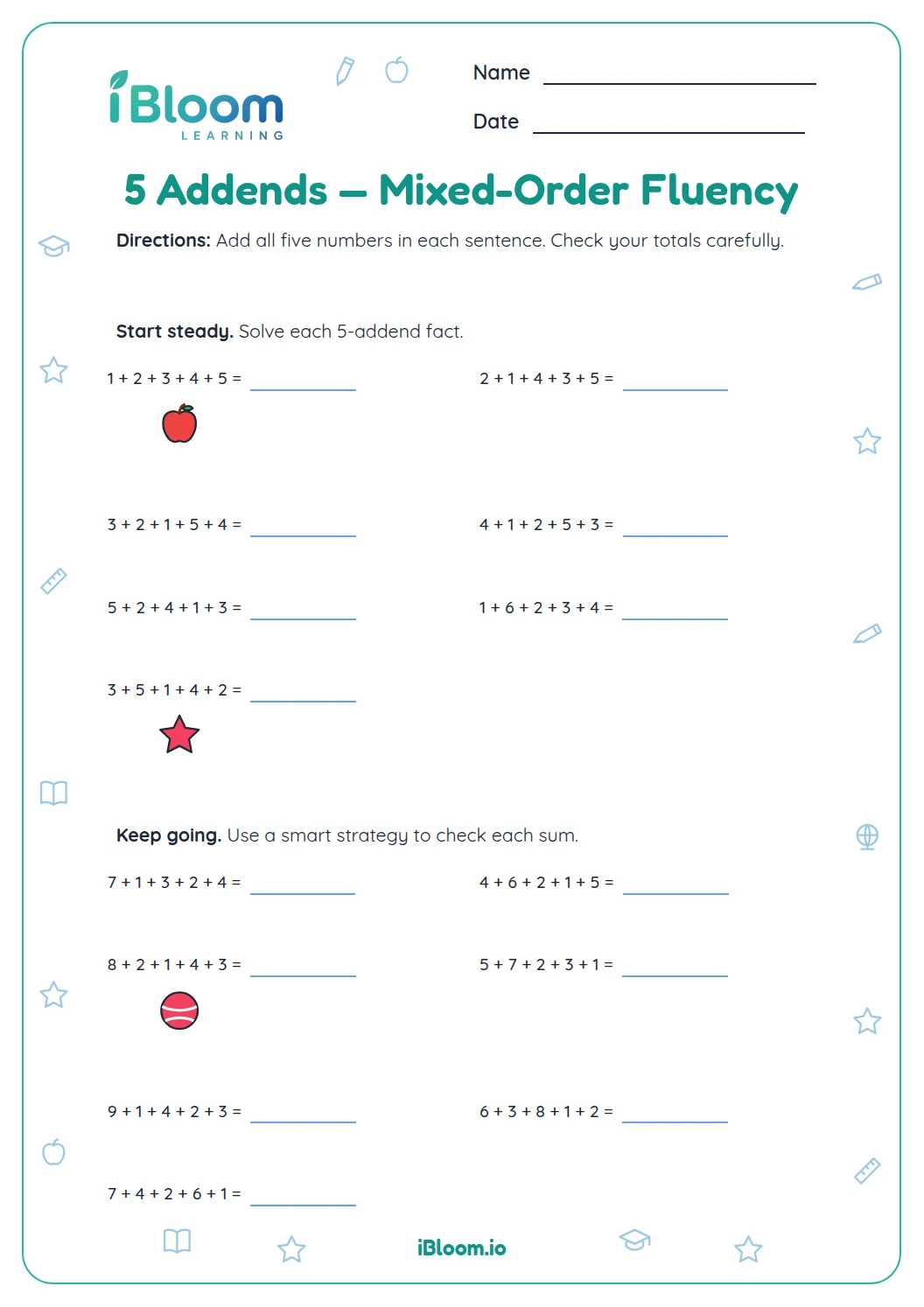
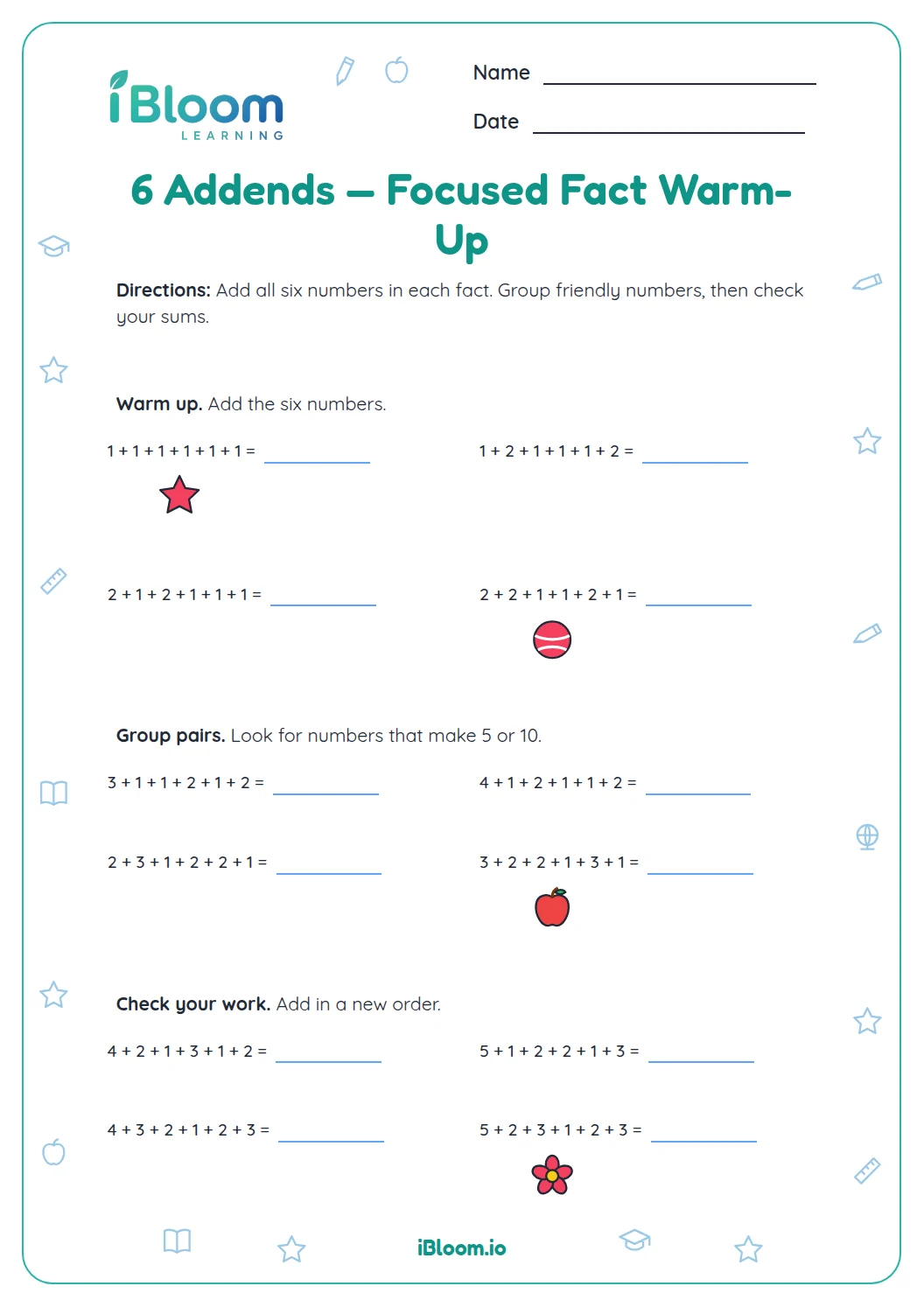
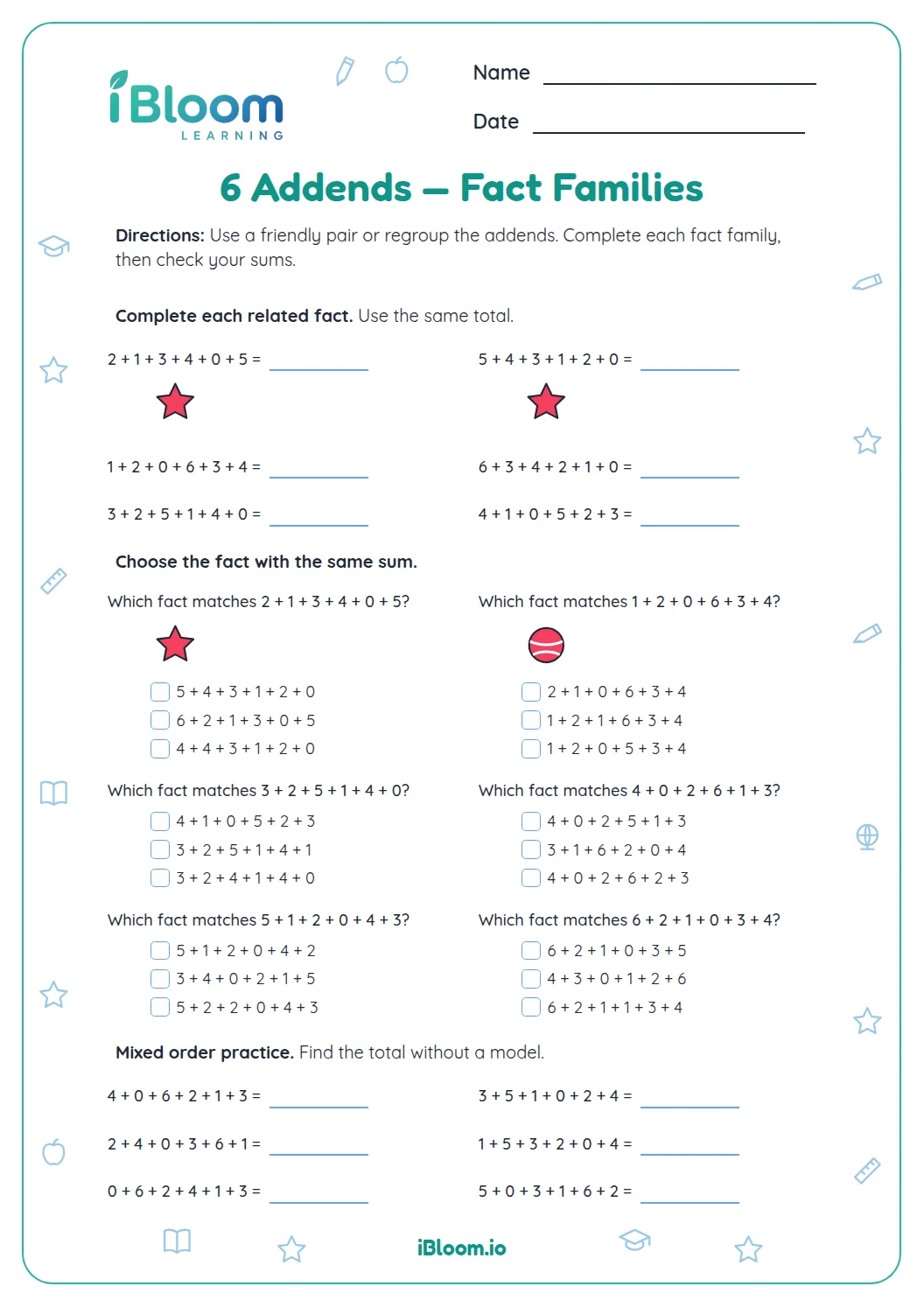
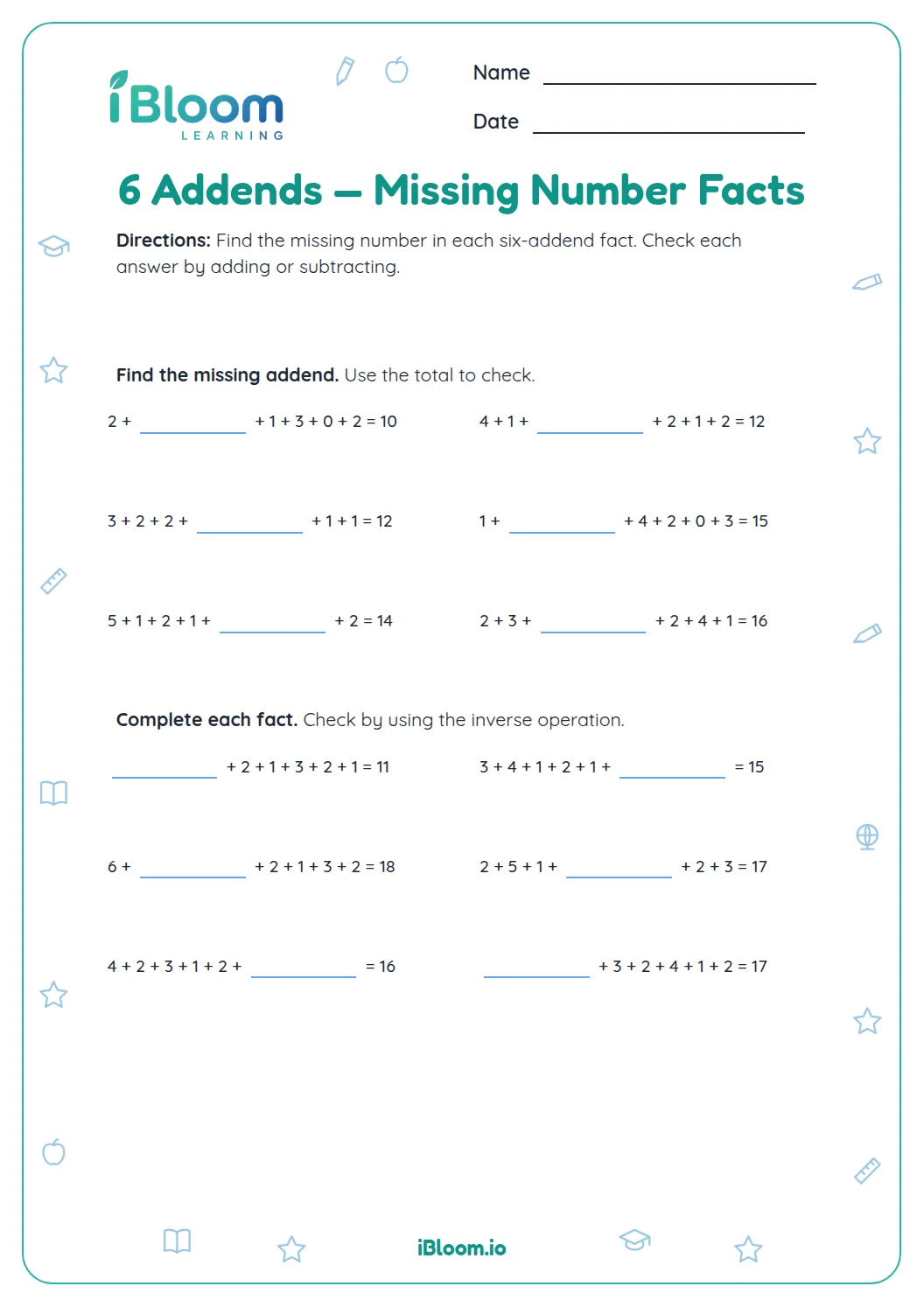
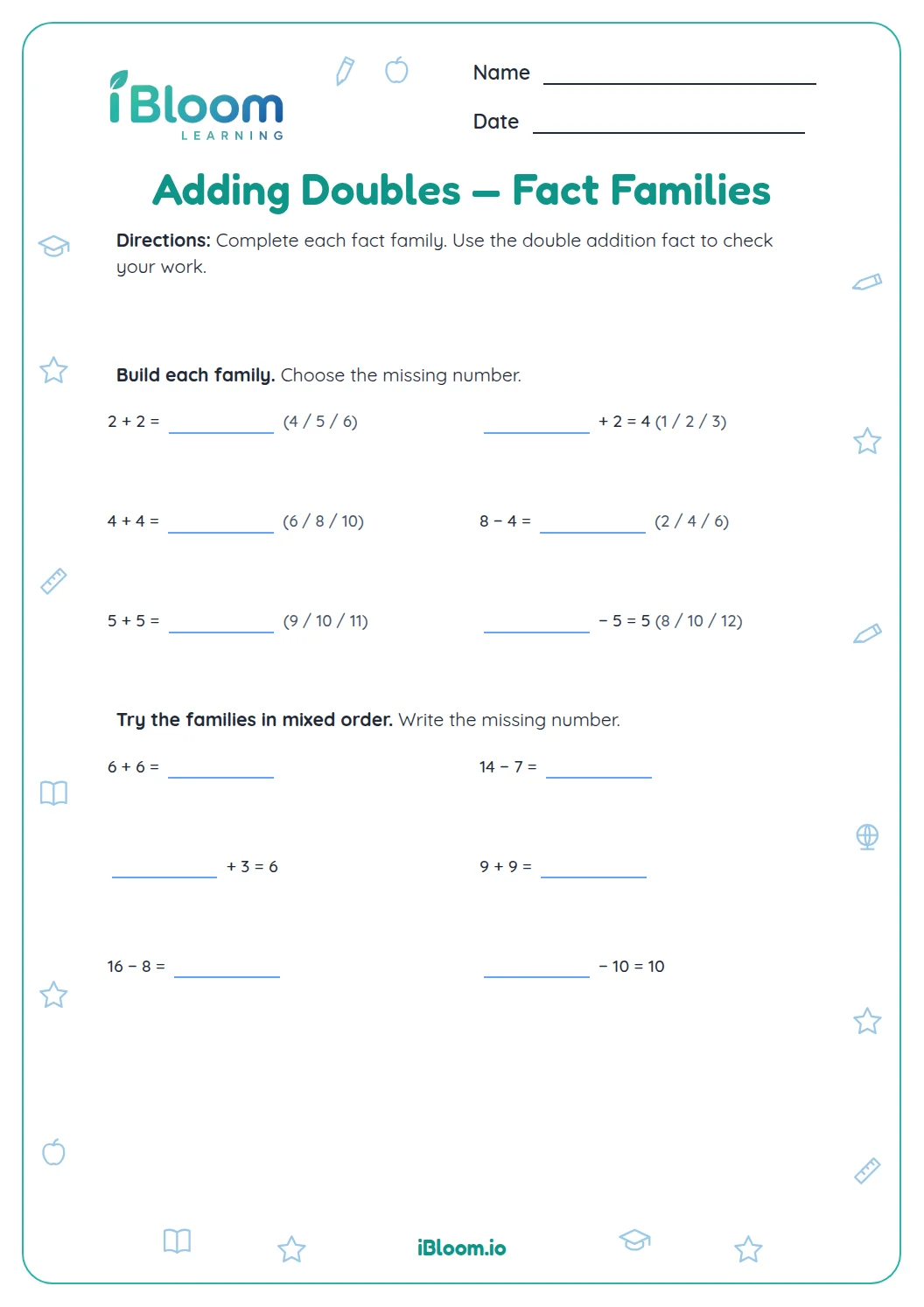
This free Grade 1 worksheet gives students 16 addition equations, each with five single-digit addends. The first part warms up with smaller totals; the next part encourages grouping numbers to make ten; the final part mixes the facts for more independent practice. Students can add in any order and use the separate answer key to check their sums. The activity supports CCSS 1.OA.C.6, adding within 20 with strategies such as making ten.
Aligned to 1.OA.C.6
What is a five-addend equation?
Each problem has five numbers joined by plus signs. Add all five numbers; the order can change because the addends are being added. Part A starts with equations such as 1 + 2 + 3 + 1 + 2.
- 11 + 2 + 3 + 1 + 2
- 2Group 1 + 2 + 3 to make 6, and 1 + 2 to make 3.
- 36 + 3 = 9.
How can making ten help?
In Part B, look for number pairs such as 7 + 3 or 6 + 4. Those pairs make ten and can be added first. For example, in 7 + 1 + 3 + 1 + 2, combine 7 + 3 = 10; then add 1 + 1 + 2 to get 14.
How should students check a five-number sum?
Part C mixes the facts so students choose their own order. Re-add the numbers in a different grouping or check with a number path or counters. Each of the 16 sums is between 9 and 19, and the two-page key lists each total.
A simple plan for each sum
- 1Read all five addends before starting.
- 2Spot a pair that makes ten or another easy group.
- 3Add that group, then bring in the remaining addends.
- 4Write the total in the blank.
- 5Regroup the addends a different way to check, then use the key.
Common five-addend slips
The mistake
Leaving out one addend while grouping.
The fix
Point to each of the five numbers as it is included in a group or running total.
The mistake
Adding only the first three numbers and stopping.
The fix
Count the addends in the equation; five numbers means five contributions to the total.
The mistake
Making a ten but forgetting the numbers left over.
The fix
After the pair makes ten, read across the equation and add every unused number.
Curriculum alignment
This worksheet practices the skill described in the listed standard.
Use strategies such as making ten while adding within 20.
On this sheet: Each problem has five addends and a total within 20; Part B prompts students to group numbers to make ten.
Show the official wordingHide the official wording
Add and subtract within 20, demonstrating fluency for addition and subtraction within 10. Use strategies such as counting on; making ten (e.g., 8 + 6 = 8 + 2 + 4 = 10 + 4 = 14); decomposing a number leading to a ten (e.g., 13 - 4 = 13 - 3 - 1 = 10 - 1 = 9); using the relationship between addition and subtraction (e.g., knowing that 8 + 4 = 12, one knows 12 - 8 = 4); and creating equivalent but easier or known sums (e.g., adding 6 + 7 by creating the known equivalent 6 + 6 + 1 = 12 + 1 = 13).
What to practice next
Further reading
Questions parents and teachers ask
How many problems are on the five-addends worksheet?
There are 16 addition equations, each with five single-digit addends. They are spread across two worksheet pages, with a separate two-page answer key. Students find one total for each equation and may group the addends in a helpful order. Solve the first equation together as a warm-up.
What does “make ten” mean here?
It means finding a pair or group of addends that combines to ten, such as 7 + 3 or 6 + 4. Add that group first, then include the remaining numbers. In 7 + 1 + 3 + 1 + 2, make ten with 7 + 3, then add 1 + 1 + 2.
Can students add the numbers in a different order?
Yes. Students may regroup the addends to make the calculation easier because the equation uses addition throughout. The important part is to include all five numbers and find the total. Part C mixes the facts so students can choose their own grouping.
What is the largest sum on this worksheet?
The largest totals are 19. Across all 16 equations, the answers range from 9 to 19, so the sums stay within 20. This keeps the practice within the Grade 1 addition range and makes it possible to use familiar facts or counters to check.
Which standard does this practice support?
It supports CCSS 1.OA.C.6, adding within 20 with strategies such as making ten. Students practice that strategy by grouping addends before finding a total. Each equation has five single-digit addends, and every answer is within 20. Students practice the strategy within each sum.
How can I help a child who loses track of the addends?
Have the child point to each number as it is added, or draw a small mark under each used addend. After grouping numbers to make ten, check that the other three addends are still included before writing the answer. The key can confirm the final total.