

About this worksheet
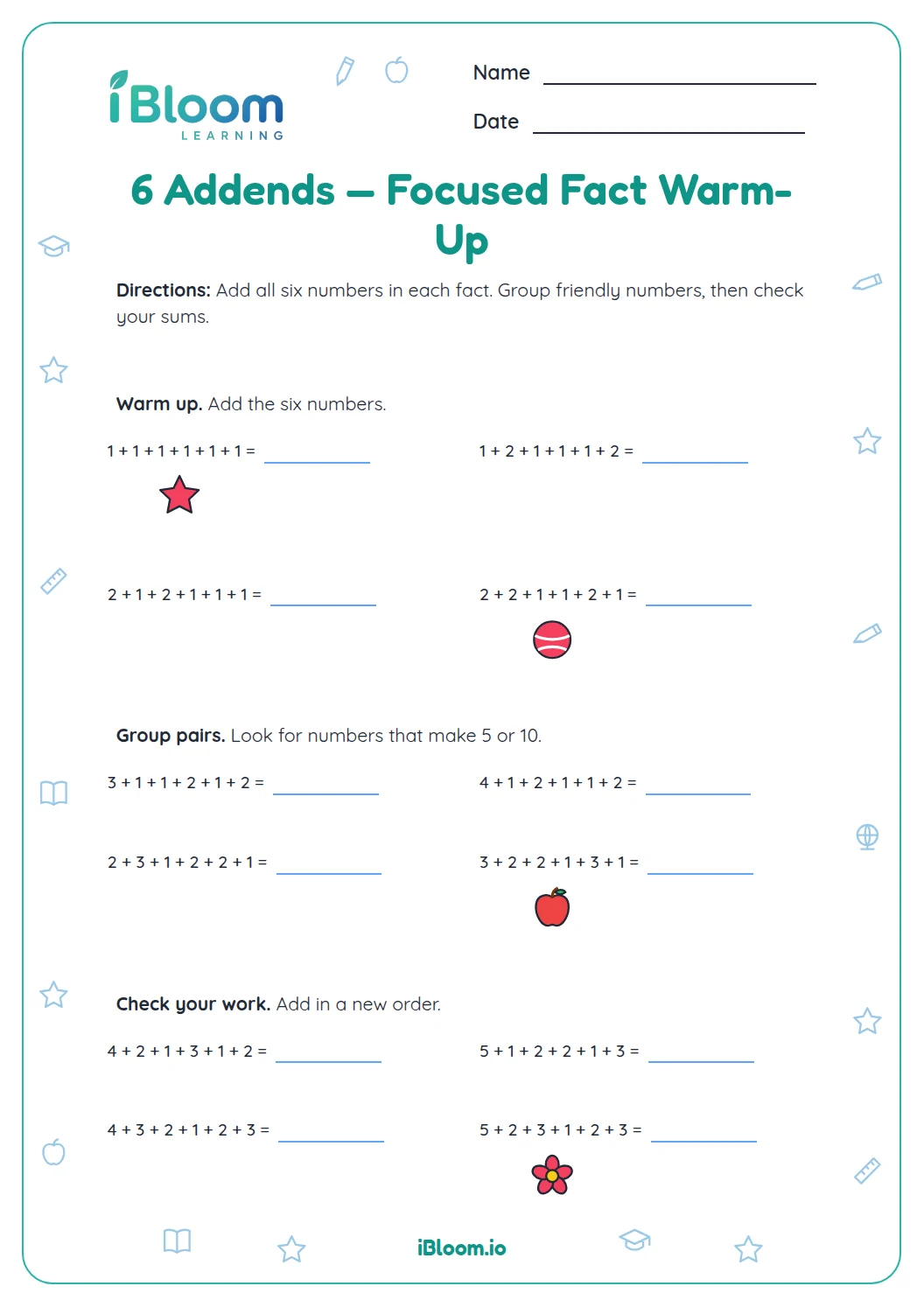
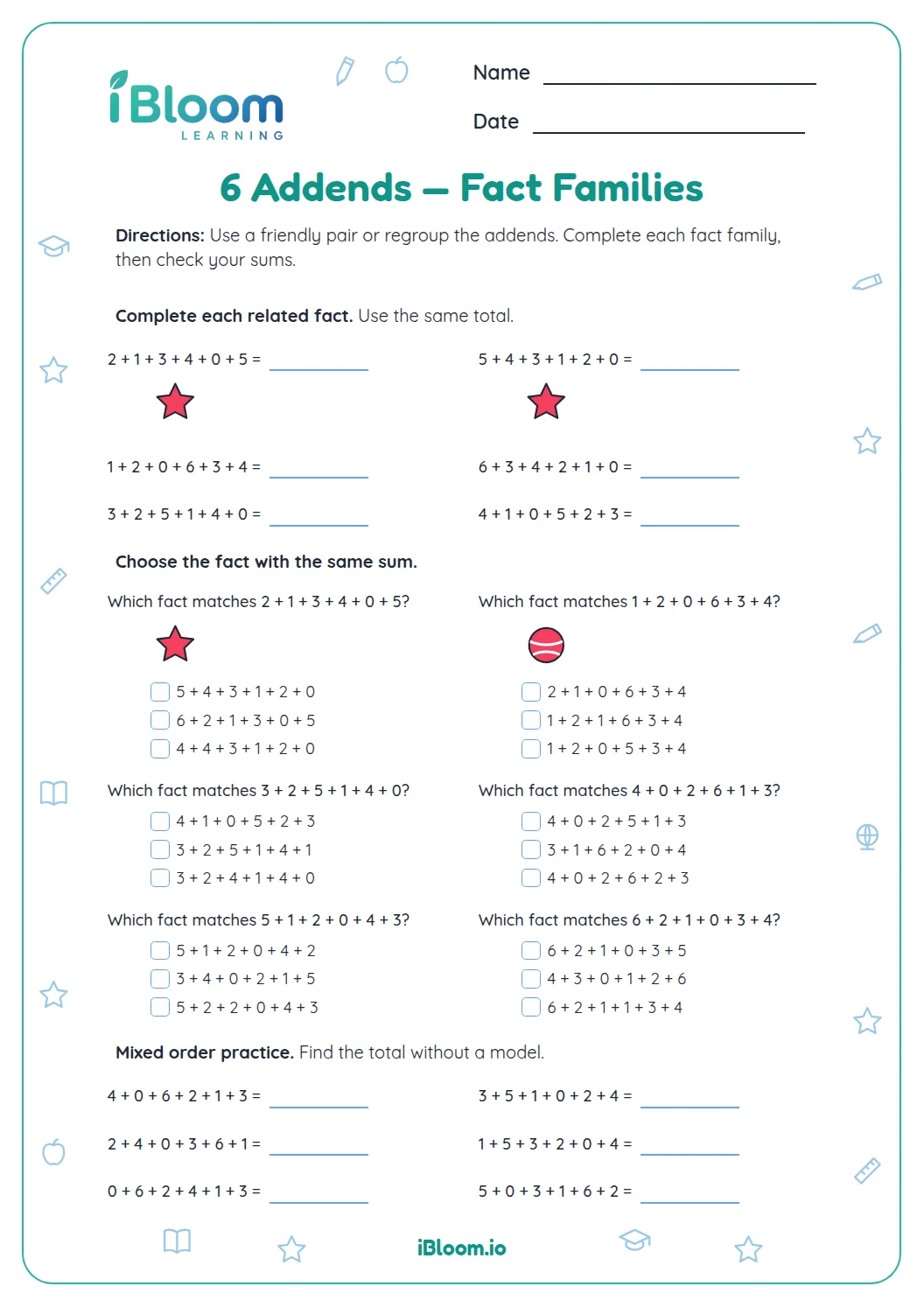
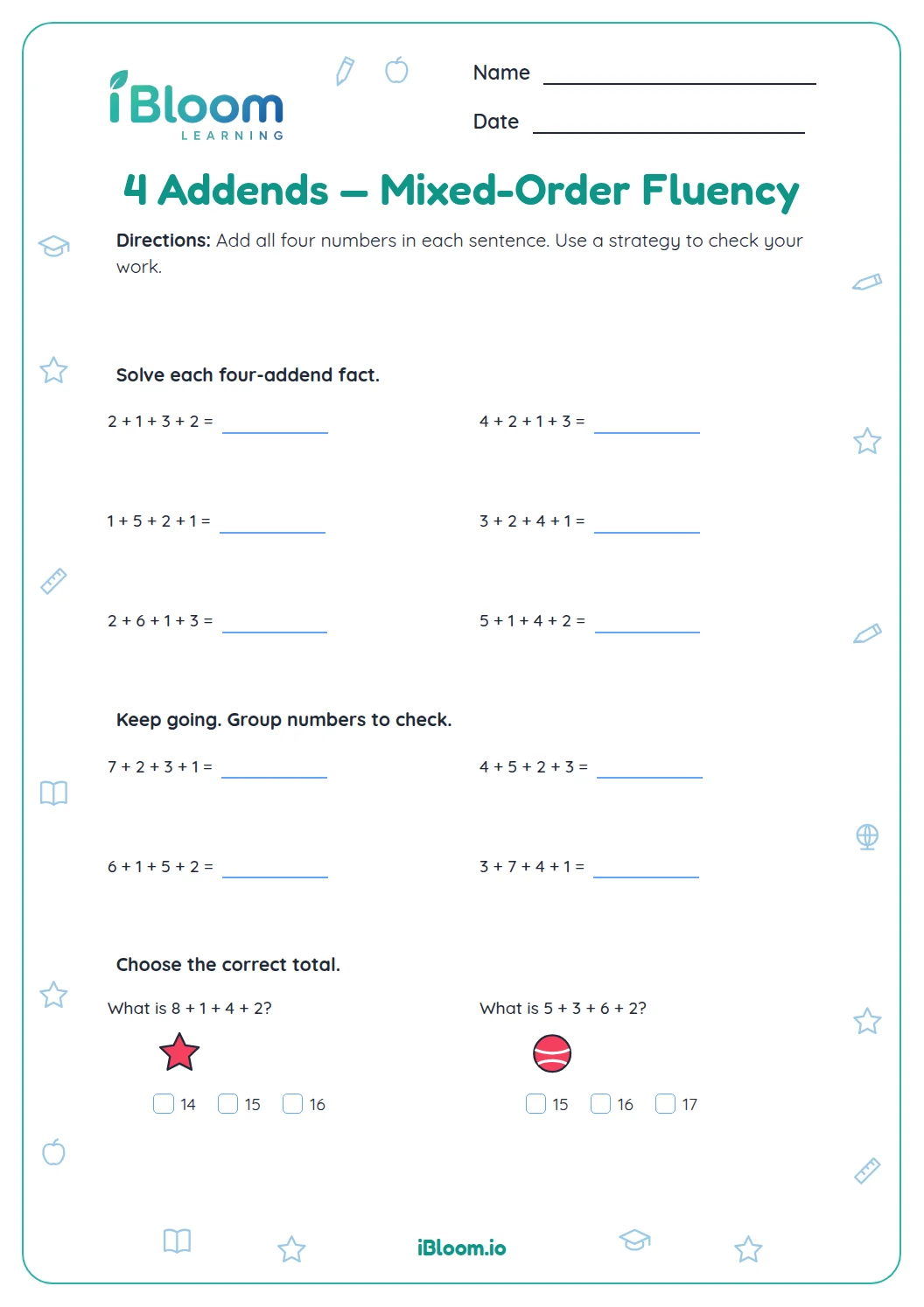
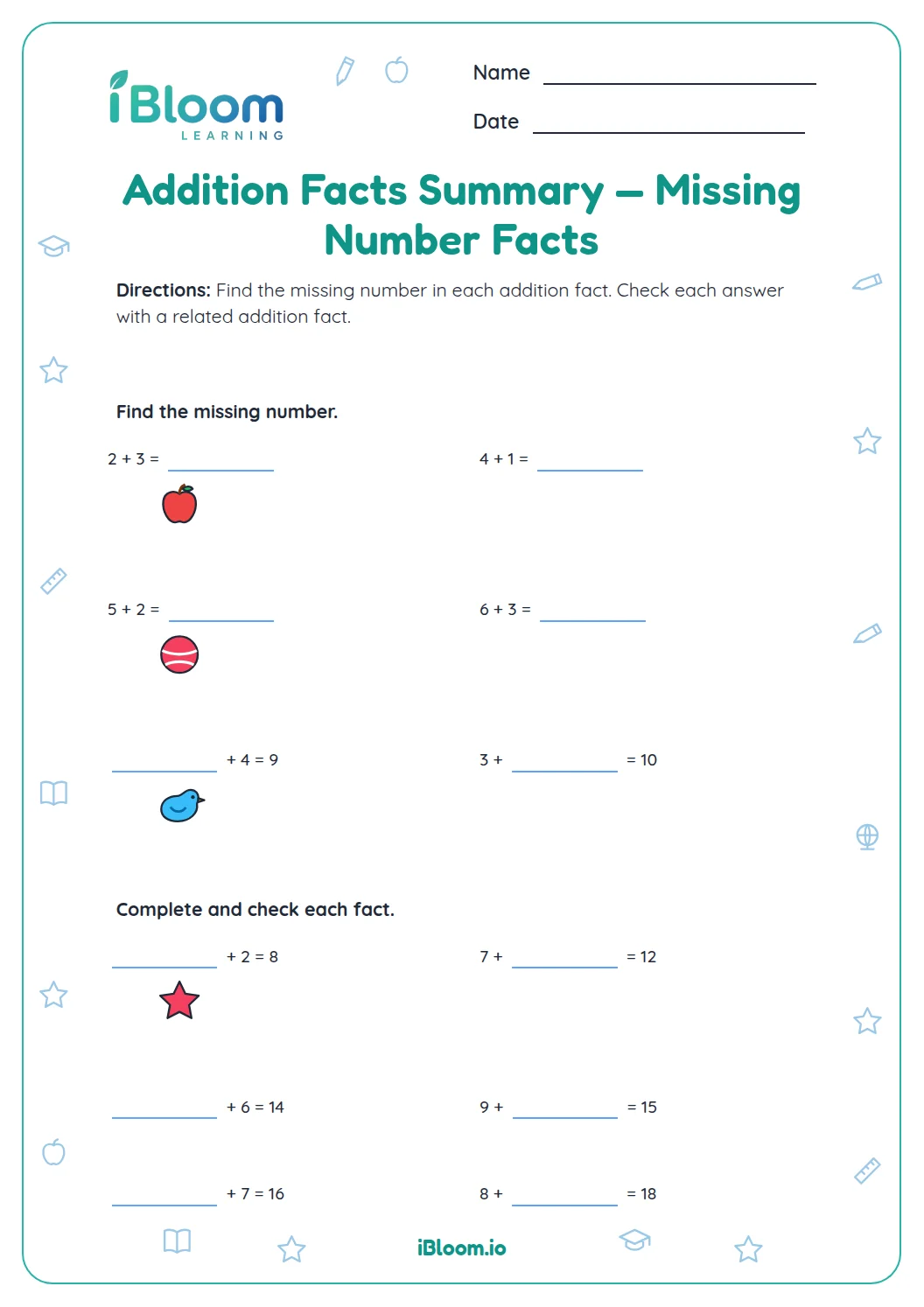
This printable worksheet gives Grade 1 and Grade 2 learners 16 short addition problems, each built from six addends. Part A practices mixed-order sums; Part B asks for one missing addend in a six-number sum. All totals stay within 20, and a separate answer key supports quick checking. The questions practice adding within 20, including strategies named in Common Core 1.OA.C.6.
Aligned to 1.OA.C.6
How can you make six addends easier to add?
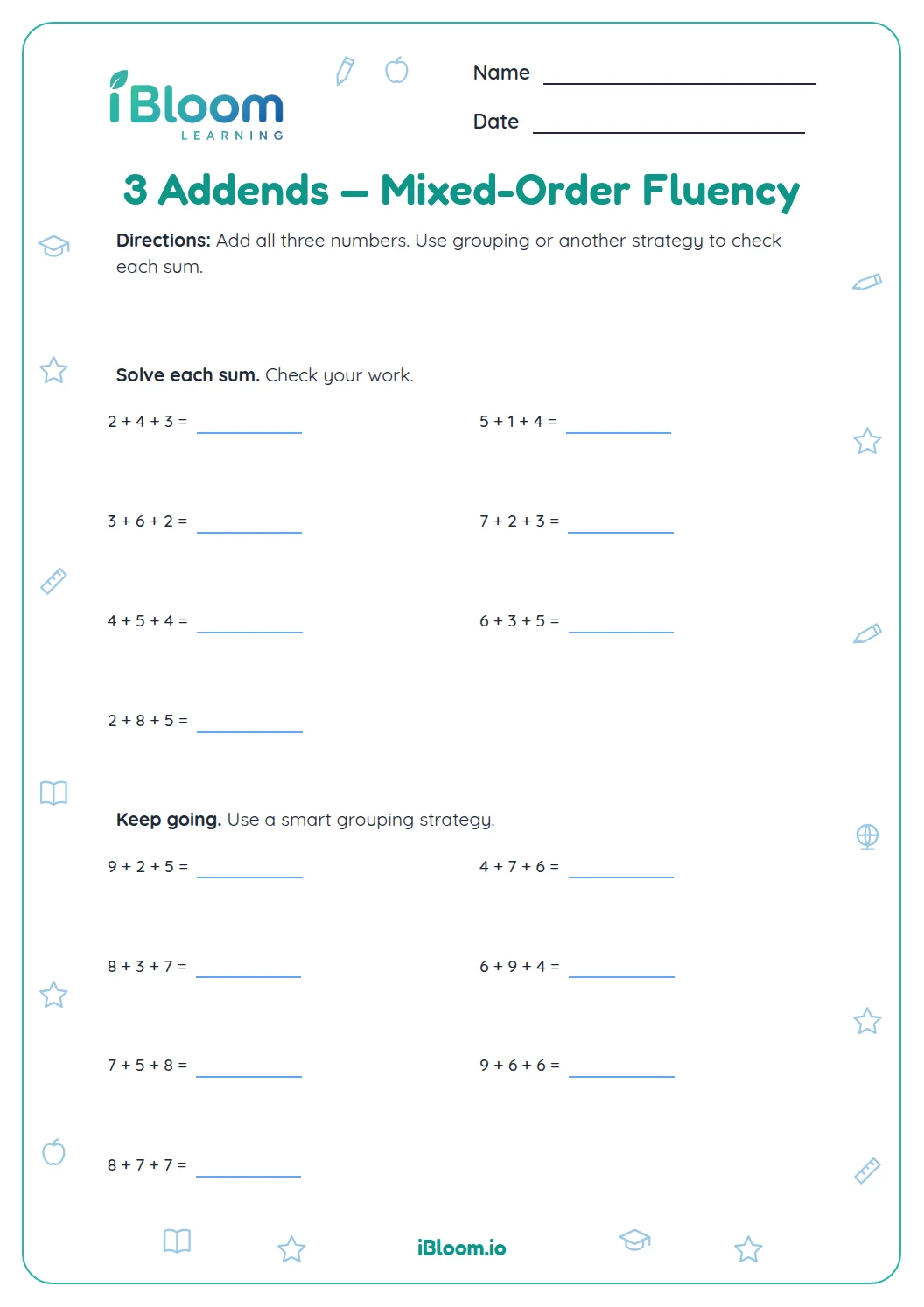
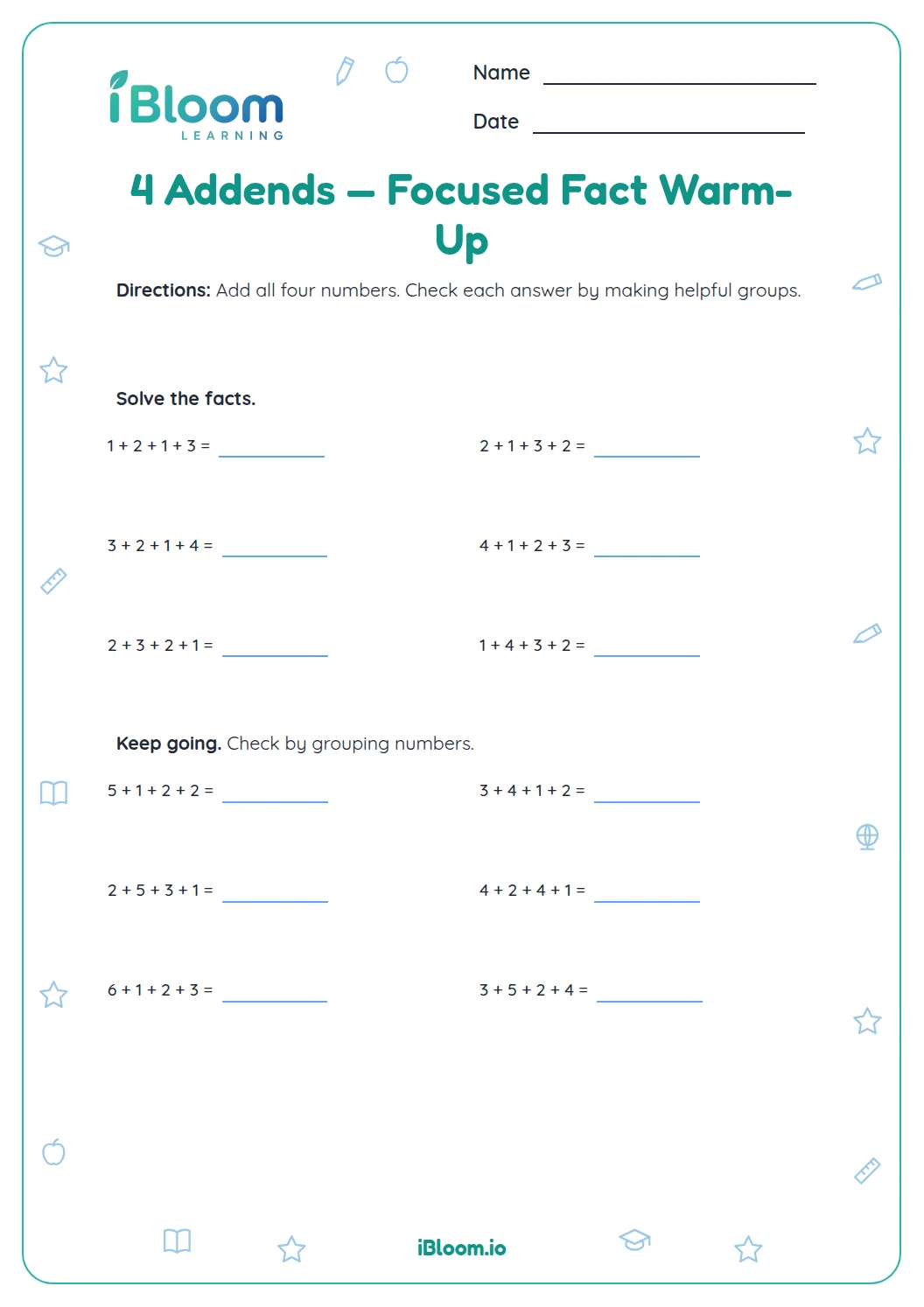
Look for pairs that make 10 or another easy total. Add those groups first, then include the remaining numbers. The addends can be grouped in any order because changing their order does not change the sum.
- 11 + 2 + 1 + 3 + 2 + 1
- 2Pair 1 + 3 = 4 and 2 + 2 = 4.
- 3Then 4 + 4 + 1 + 1 = 10.
How do you find a missing addend?
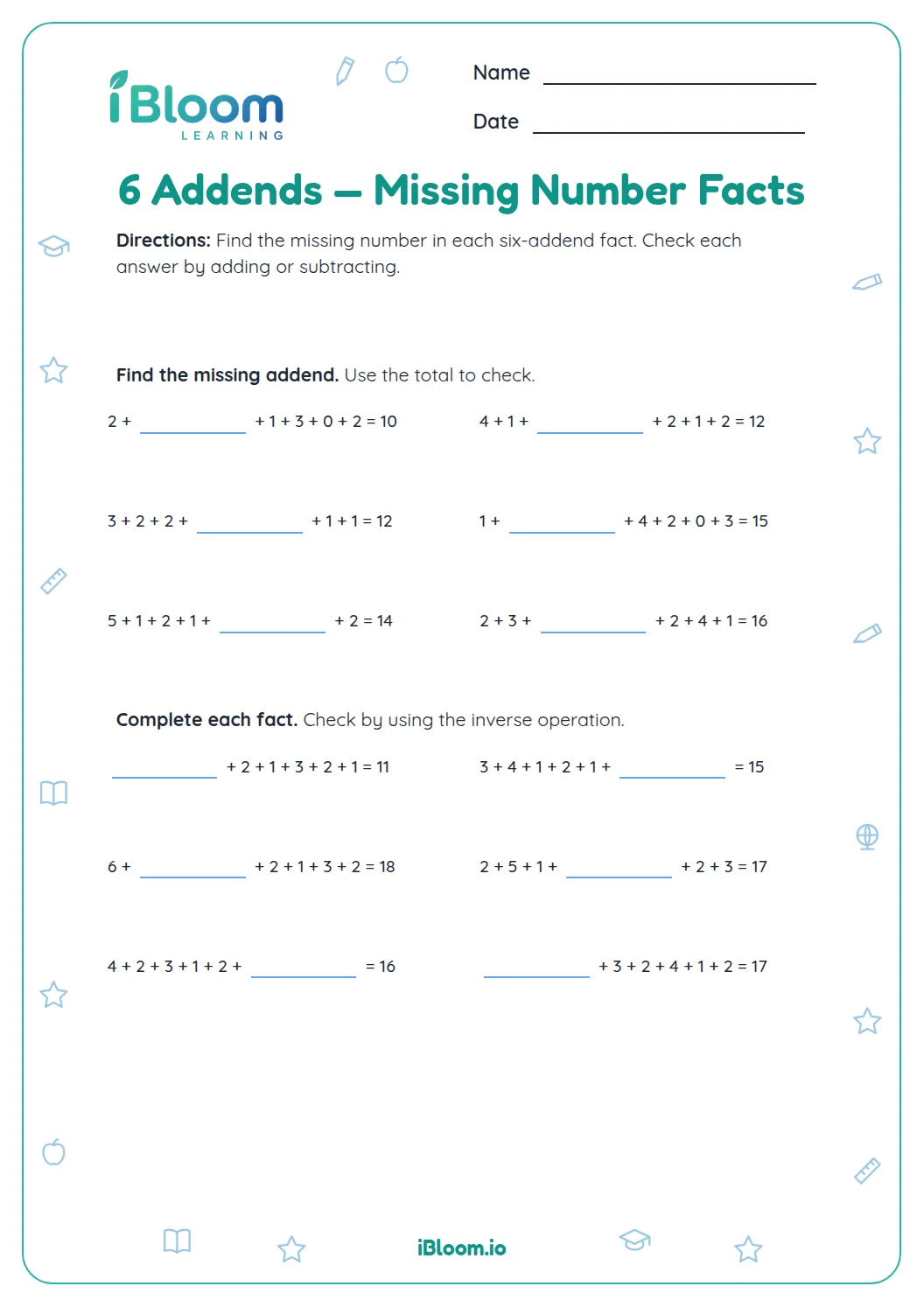
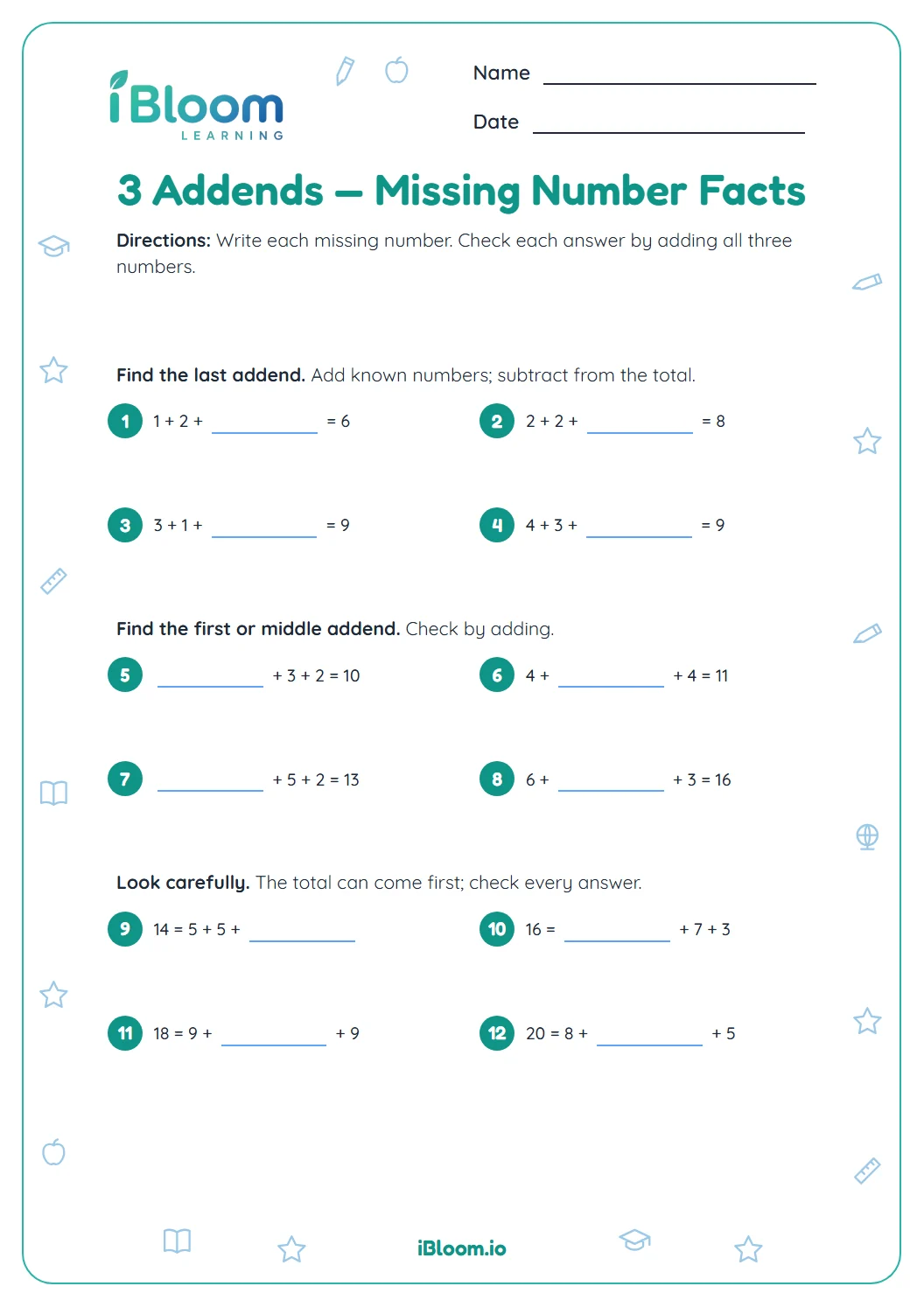
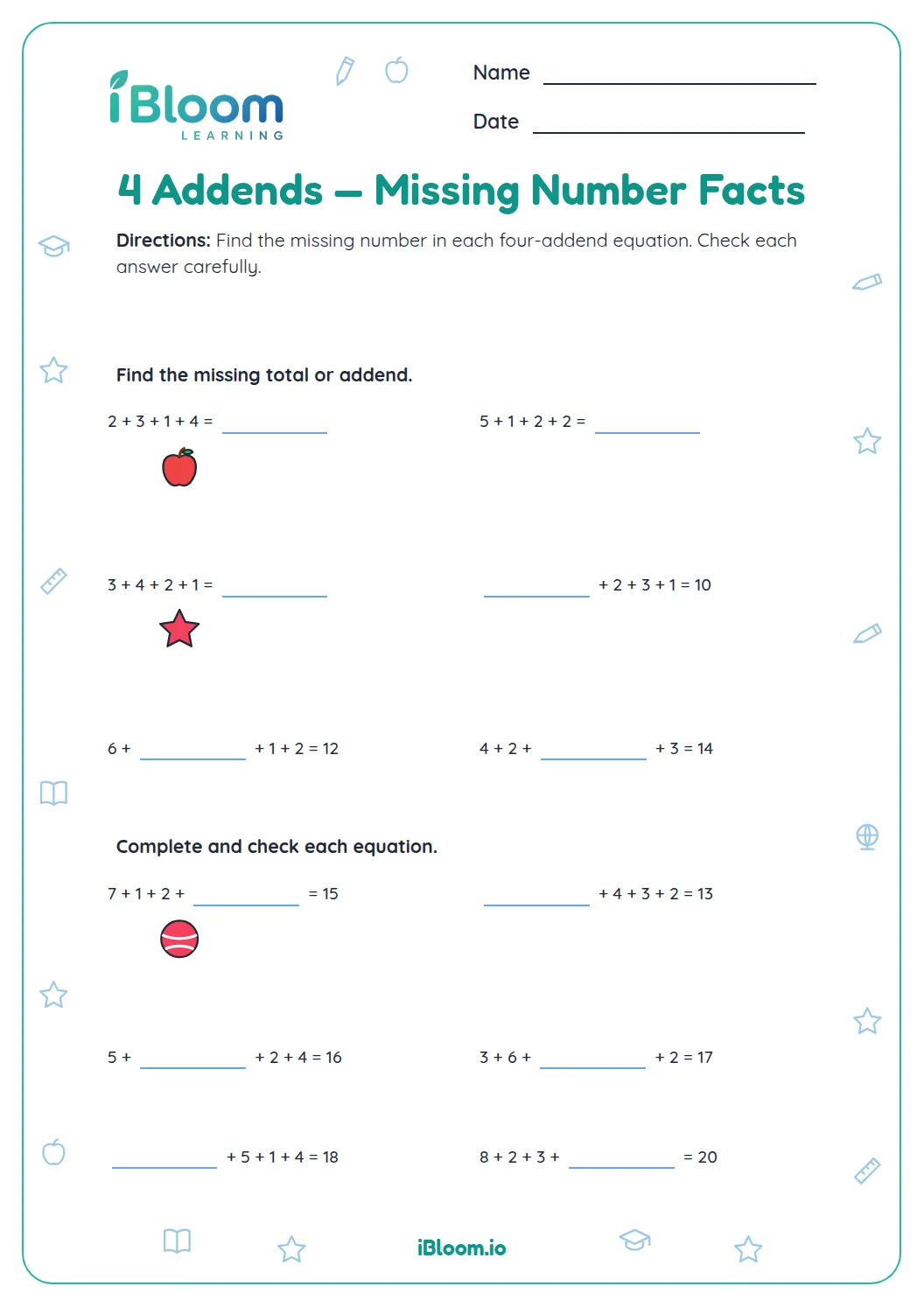
Add the five numbers you can see. Subtract that subtotal from the total to find the missing number. Check by putting it back into the six-addend expression.
- Part B has eight sums with one blank addend.
What is on the two-page drill?
Part A moves through eight mixed-order sums. Part B keeps the six-addend structure but gives the total, so the learner works backward to find one number. Every expression has one answer blank and stays within 20.
- Part A: 8 complete sums
- Part B: 8 missing addends
- The answer key is printed separately.
How to use this worksheet
- 1Scan all six addends before starting.
- 2Circle a pair that makes 10 or another friendly number.
- 3Add the grouped numbers and keep track of what remains.
- 4For a blank, add the known numbers before subtracting from the total.
- 5Check each sum by adding its six values again.
Common mistakes and quick fixes
The mistake
Skipping one addend while counting across the row.
The fix
Touch or point to each of the six numbers once as you add.
The mistake
Adding left to right even when a helpful pair is available.
The fix
Spot a pair that makes 10 first, then add the leftover values.
The mistake
Subtracting the total from the known subtotal for a blank.
The fix
Use total minus known subtotal to find the missing addend.
Common Core alignment
This sheet practices addition fluency within 20.
Add within 20 and use strategies that build fluency within 10.
On this sheet: The mixed-order sums ask children to combine six addends and check the total within 20.
Show the official wordingHide the official wording
Add and subtract within 20, demonstrating fluency for addition and subtraction within 10. Use strategies such as counting on; making ten (e.g., 8 + 6 = 8 + 2 + 4 = 10 + 4 = 14); decomposing a number leading to a ten (e.g., 13 − 4 = 13 − 3 − 1 = 10 − 1 = 9); using the relationship between addition and subtraction (e.g., knowing that 8 + 4 = 12, one knows 12 − 8 = 4); and creating equivalent but easier or known sums (e.g., adding 6 + 7 by creating the known equivalent 6 + 6 + 1 = 12 + 1 = 13).
What to practice next
Make more practice
Further reading
Questions parents and teachers ask
How many questions are on this worksheet?
There are 16 questions across two worksheet pages. Part A has eight six-addend sums, and Part B has eight sums with one missing addend. The separate answer key has two pages so each question and answer remains easy to read.
Are the six addends always in the same order?
No. The addends appear in different orders, so the learner must scan each row instead of relying on a repeated pattern. Looking for pairs that make 10 or another friendly total can make the addition easier to track. Each expression still has six addends.
What is a helpful way to add six numbers?
Look for pairs that make 10, such as 4 and 6, or pairs that make another easy total. Add those groups first, then combine the numbers that remain. The addends can be rearranged without changing the sum, which is why checking the full set matters.
How does the missing-addend part work?
Add the five printed addends, then subtract their subtotal from the total shown after the equals sign. For example, if the known addends total 9 and the full sum is 14, the missing addend is 5. Put 5 back into the expression to check.
Is the worksheet timed?
No timing is needed to complete the sheet. Accuracy and a clear strategy come first. If a teacher or parent chooses to time a later repeat, use the first attempt as a baseline and let the learner work at a comfortable pace.
What is included in the answer key?
Yes. The key lists the sum for each complete equation and the missing value for each Part B problem. It spans two pages so the answers remain legible. An adult can print the two student worksheet pages for practice and keep the key nearby for checking.