
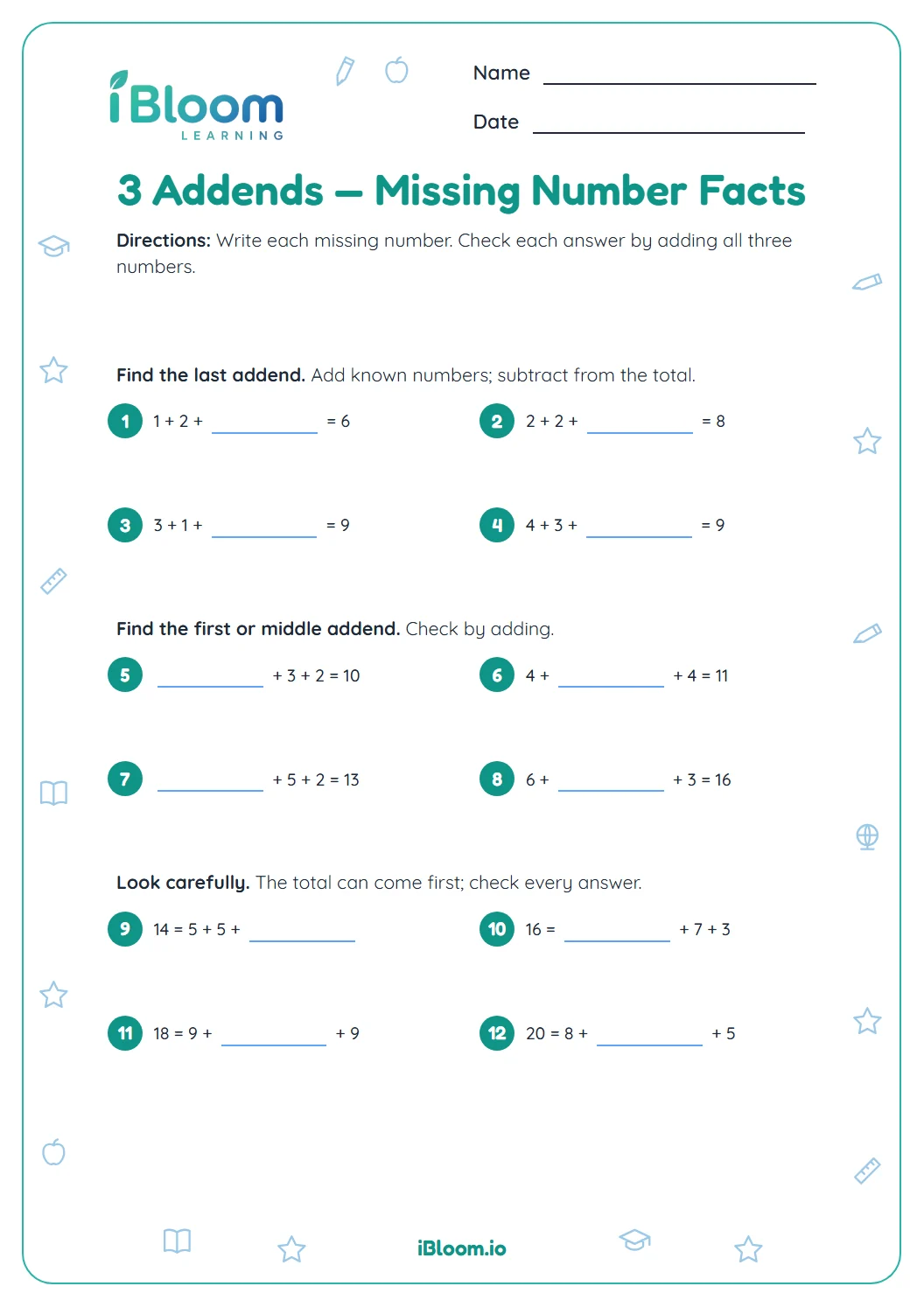
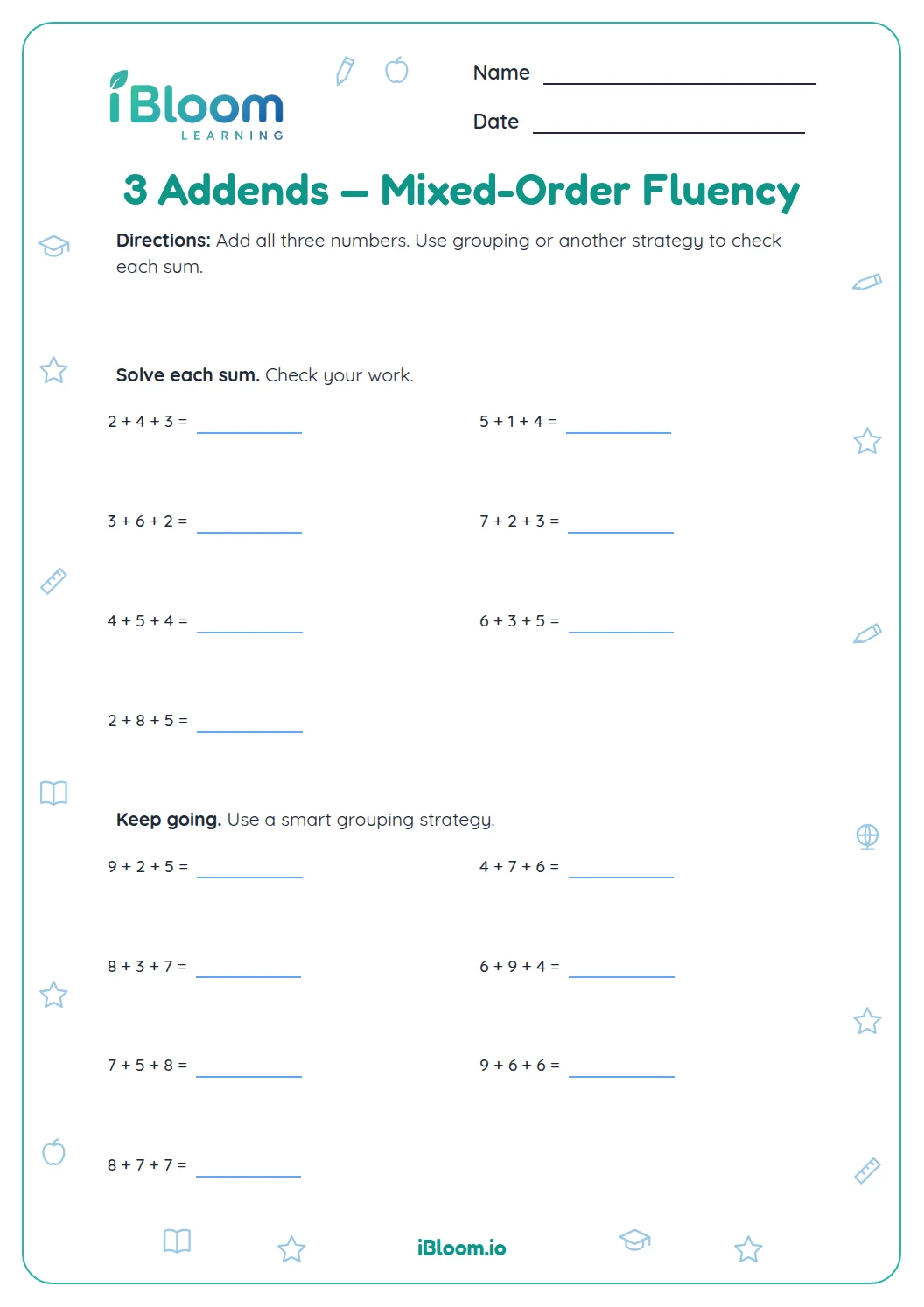
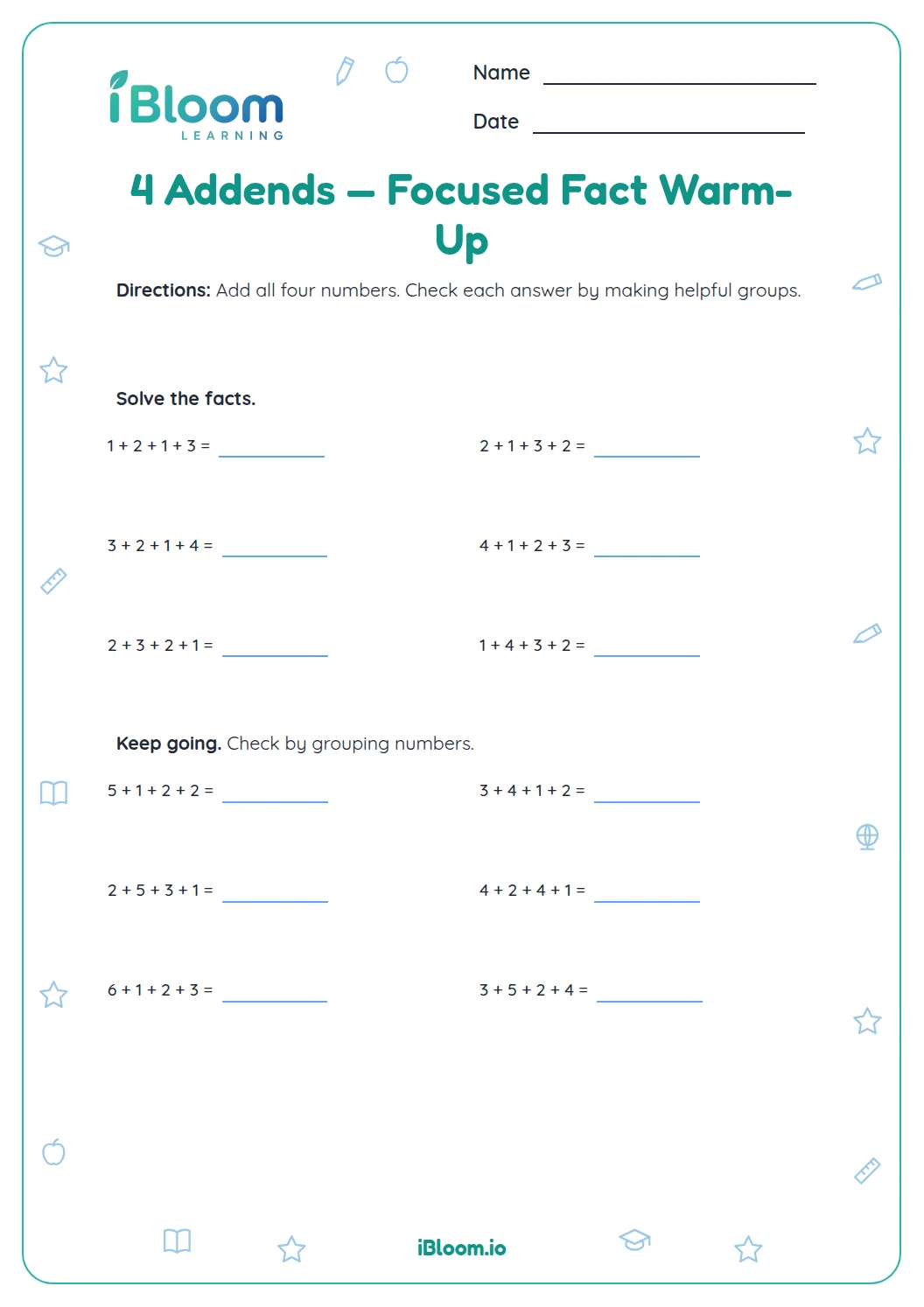
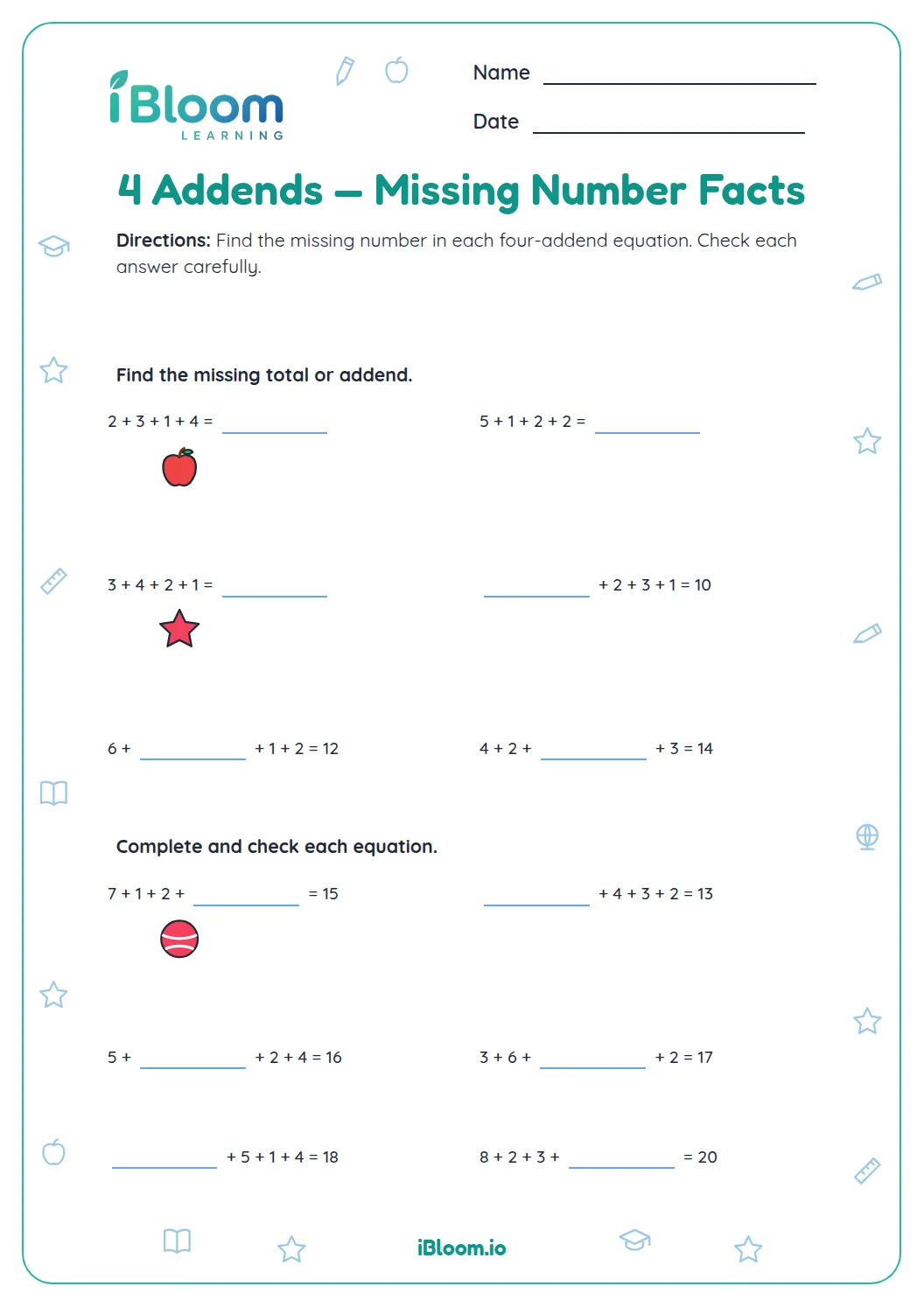
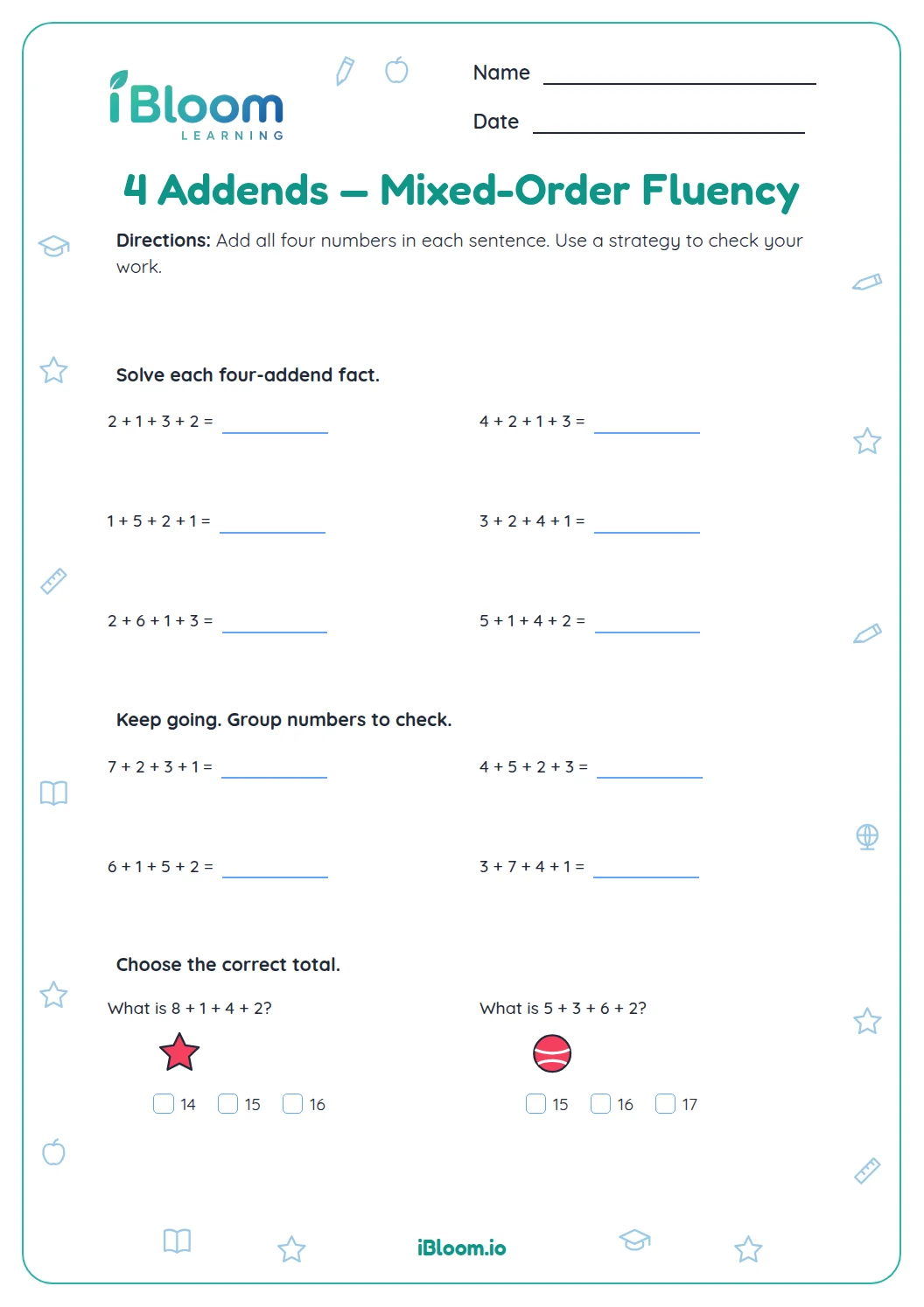
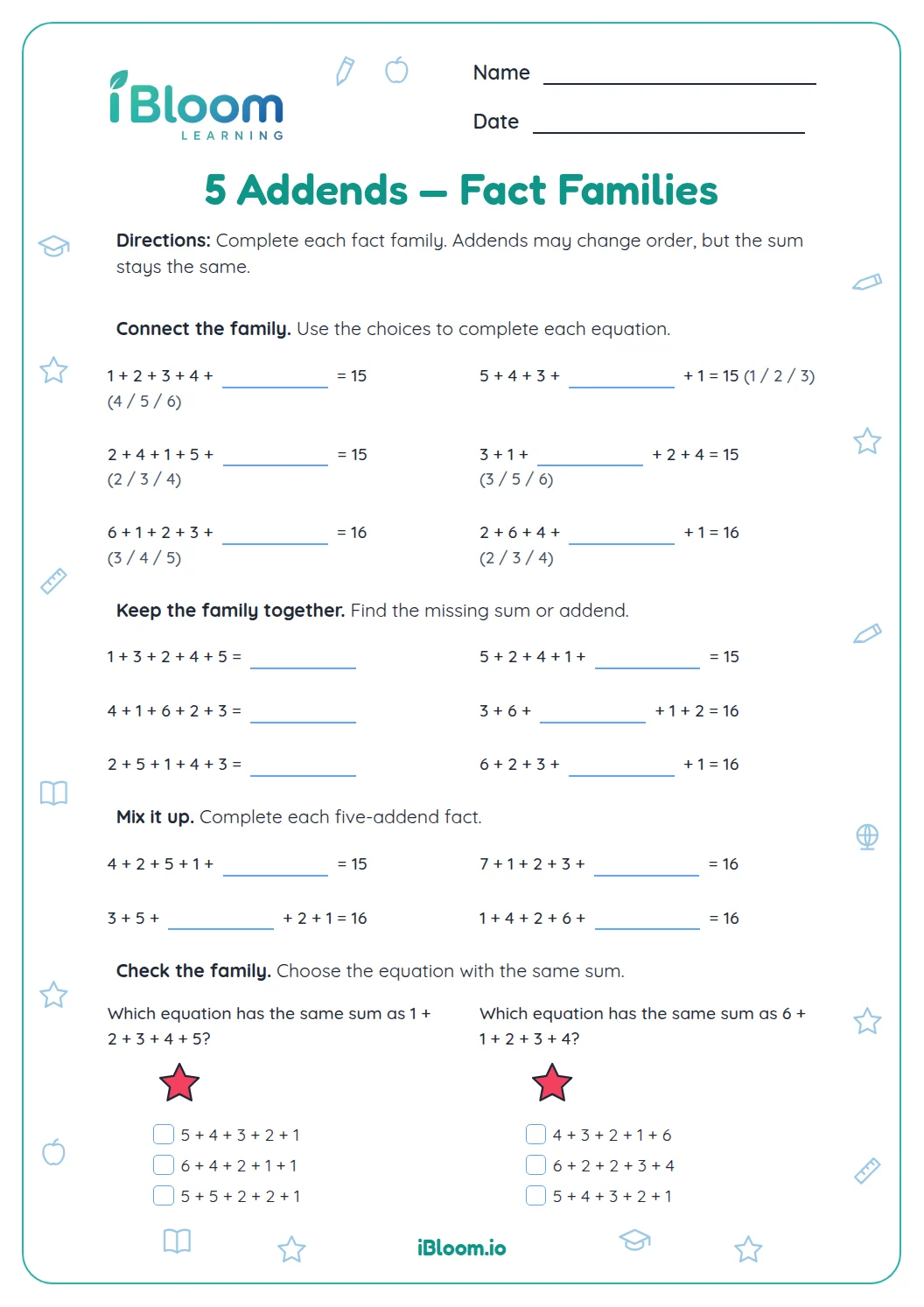

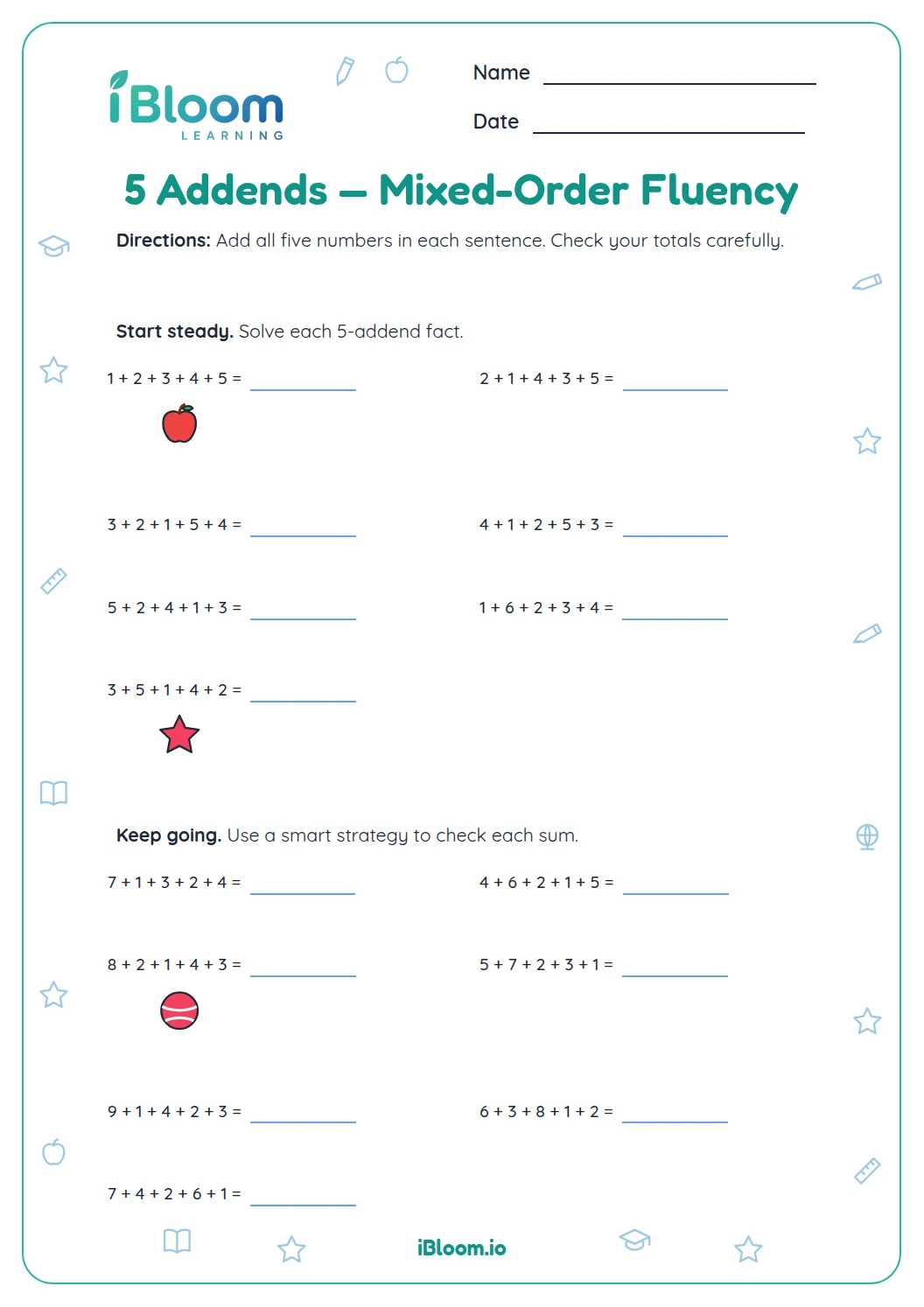
About this worksheet
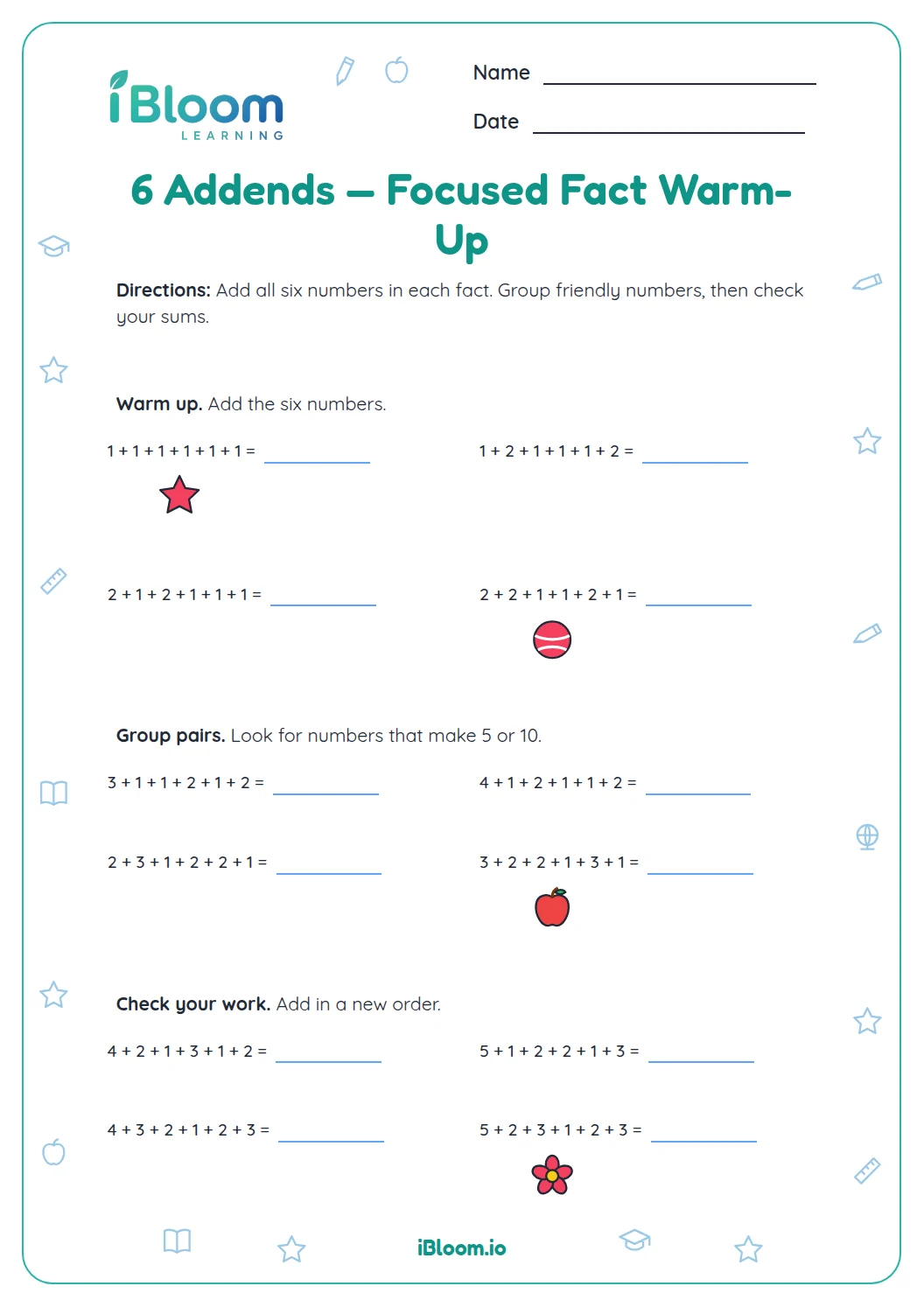
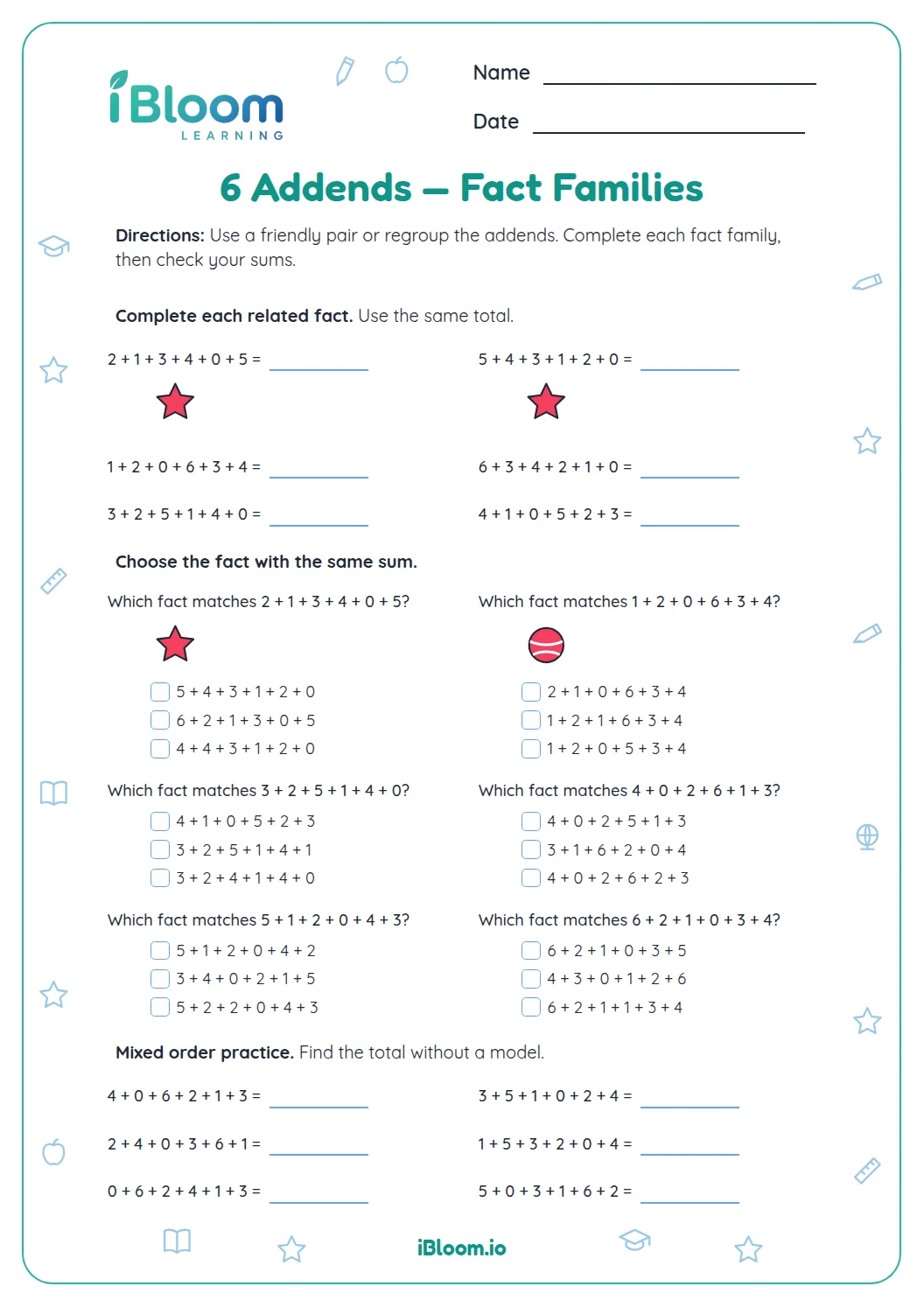
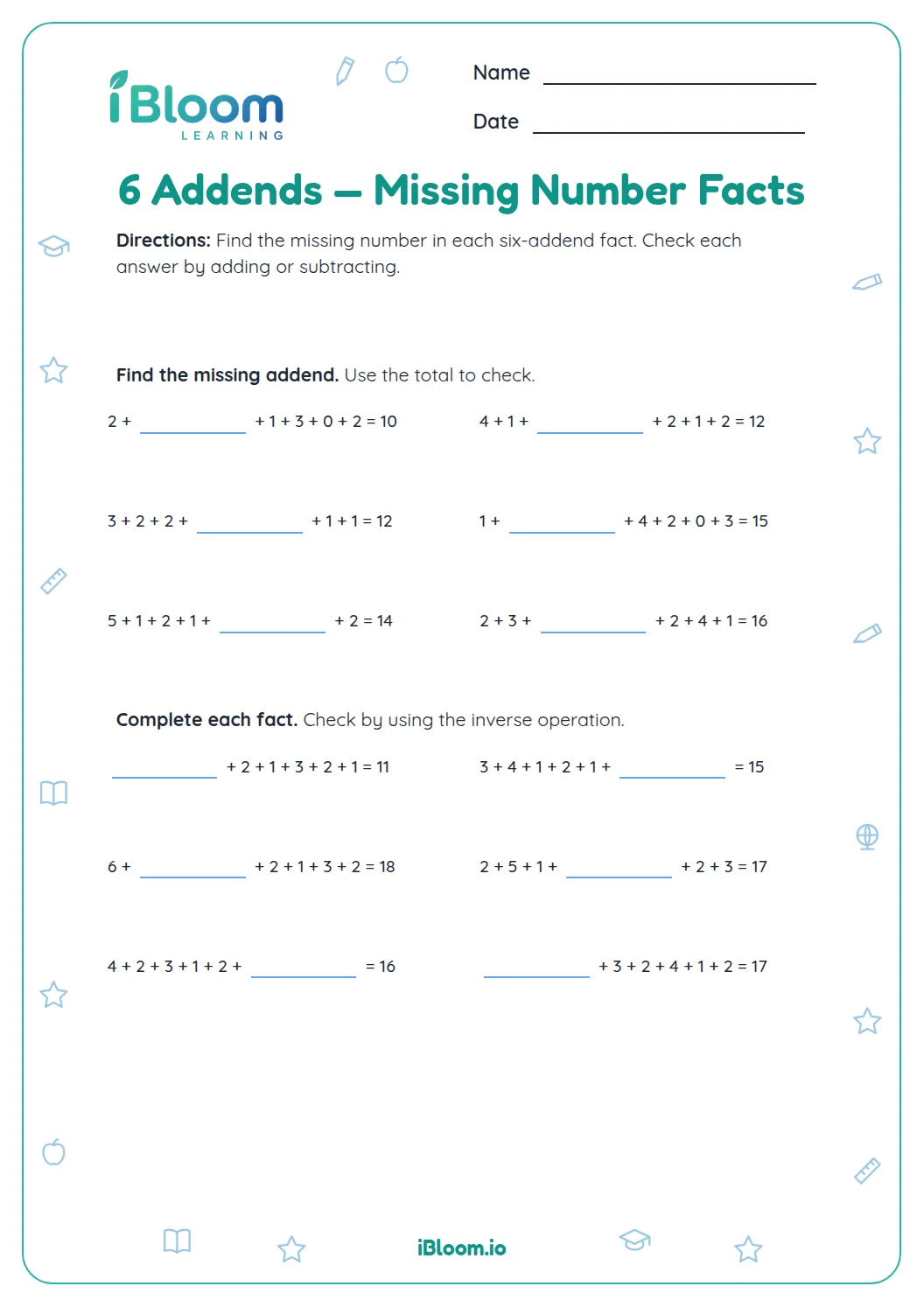
This free printable gives Grades 1–2 students 18 addition equations, each with six single-digit addends. The first round emphasizes accuracy, the second offers an optional timed try, and the final round mixes the order of the terms. Children can group friendly facts to keep track of longer sums, then check their totals with the separate answer key. This sheet practices Common Core 1.OA.B.3 by using properties of operations as strategies for addition.
Aligned to 1.OA.B.3
How can grouping make six addends easier?
Add pairs or groups that are easy to recognize, then combine those totals. In question 1, 2 + 1 + 3 + 2 + 1 + 4 can be rearranged as (2 + 3) + (1 + 4) + (2 + 1) = 5 + 5 + 3 = 13.
How should the optional timed round work?
Complete Round 1 without timing and check the answers first. If a teacher or caregiver wants a speed challenge, use Round 2 only after accuracy is steady. Round 3 returns to mixed-order practice, so accuracy remains the goal.
What does the answer key help check?
The key lists the total for every six-term equation. If a total differs, read the six addends aloud and try a new grouping. A different order is fine as long as all six numbers are included exactly once.
How to use this worksheet
- 1Read every term in the equation before calculating.
- 2Look for pairs that make 5, 10, or another easy total.
- 3Add the grouped totals and compare with a quick estimate.
- 4Finish Round 1 and check accuracy before considering a timer.
- 5Use the final round to practice the same strategy with mixed numbers.
- 6Review missed sums by adding all six terms again in a different grouping.
Common slips and quick fixes
The mistake
Skipping one addend while grouping.
The fix
Mark or point to each of the six numbers as it is used.
The mistake
Adding a number twice after rearranging terms.
The fix
Make pairs and check that each addend appears in one pair only.
The mistake
Rushing the optional timed round and losing accuracy.
The fix
Return to an untimed try, then repeat only when the sums are correct.
Common Core alignment
This sheet practices the following Common Core skill.
Use operation properties as strategies for adding and subtracting.
On this sheet: The six addends invite children to group friendly facts in different ways before adding the total.
Show the official wordingHide the official wording
Apply properties of operations as strategies to add and subtract.
What to practice next
Make more practice
Further reading
Questions parents and teachers ask
How many numbers are in each addition problem?
Each of the 18 equations has exactly six addends, and every term is a single-digit number. Add all six to find the total. Grouping friendly pairs can help you keep track of each term; for example, a pair that makes 10 can be added before the remaining numbers.
Is the timed round required?
No. The second round is optional, and the sheet asks children to work accurately before trying a time goal. A teacher or caregiver can skip timing and use the questions as ordinary addition practice. Use the timing as a choice for review, not as a condition for finishing the worksheet.
What does grouping addends mean?
Grouping means adding convenient pairs or combinations first, then combining those totals. In 2 + 1 + 3 + 2 + 1 + 4, a child could pair 2 + 3 and 1 + 4 before adding the remaining numbers.
How many pages and questions are included?
The worksheet has 18 questions in three rounds, plus two separate answer-key pages. Round 1 has six equations, Round 2 has six optional timed equations, and Round 3 has six mixed-order equations. Each round keeps the same six-addend format while changing the practice focus.
How should an adult use the answer key?
Check the total for each equation, then ask the child to explain one grouping strategy. If a result is off, add the six terms again in a different order and compare the two totals. The separate key gives the total for all 18 questions and can be used for checking after the page is complete.