
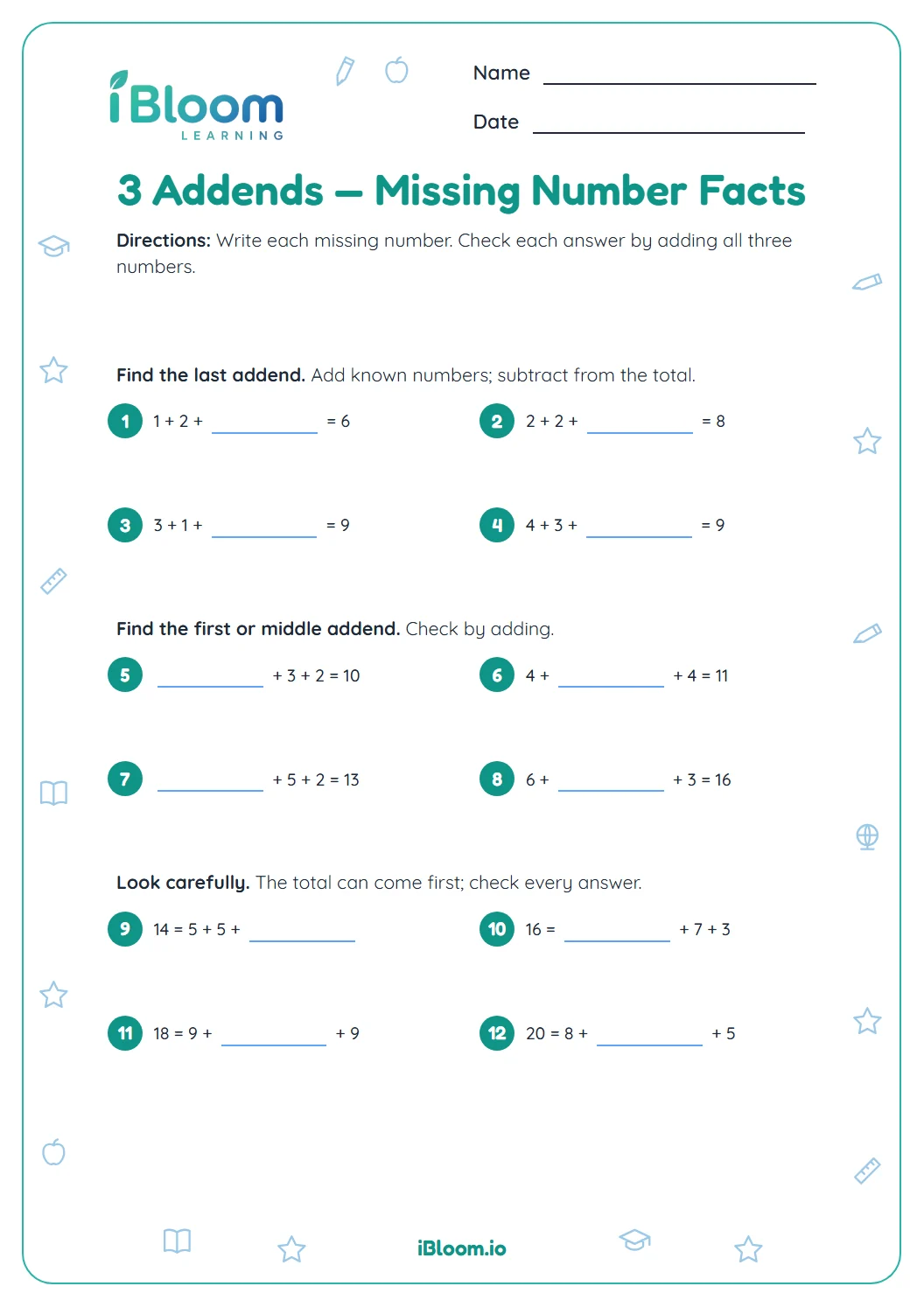
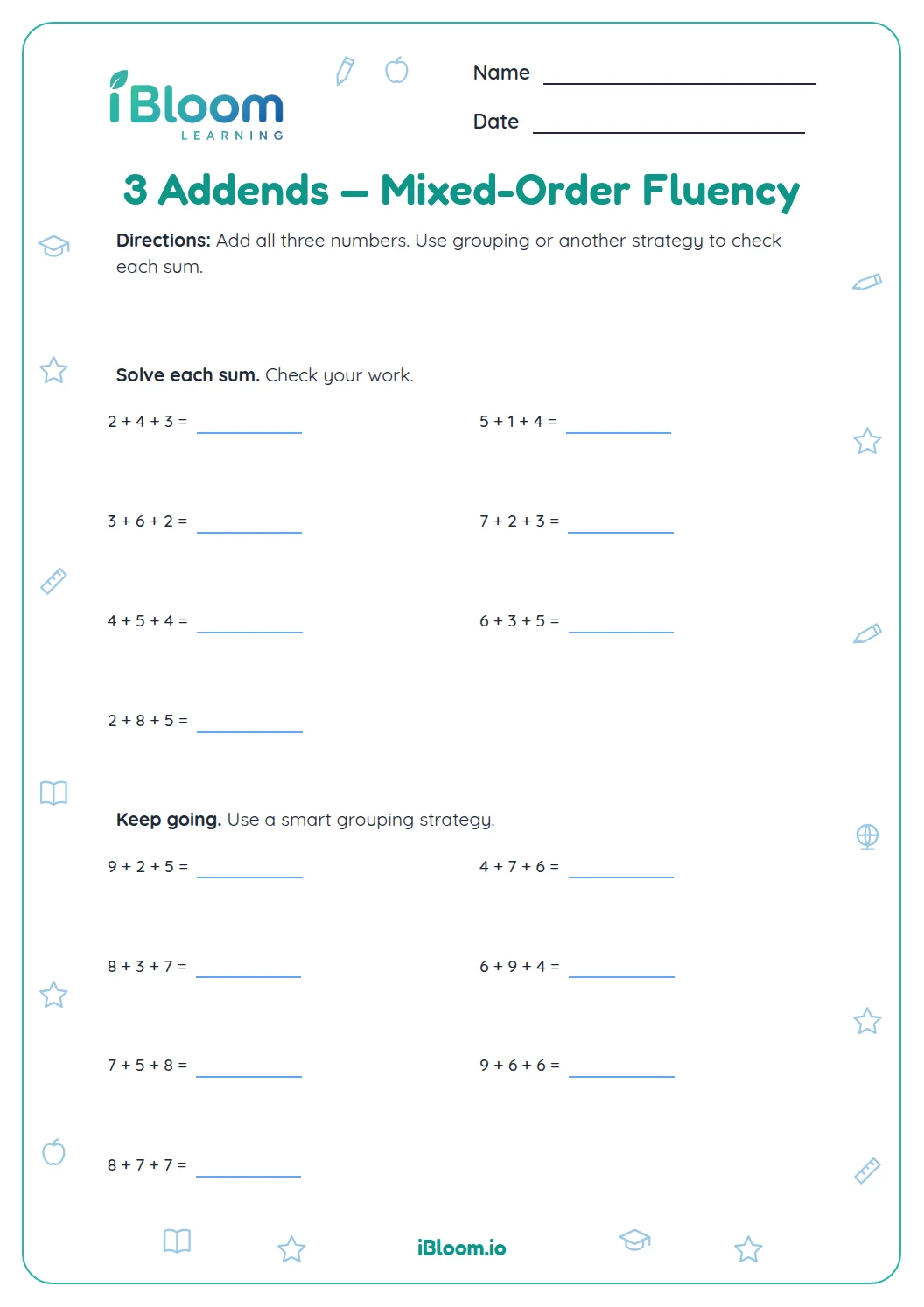
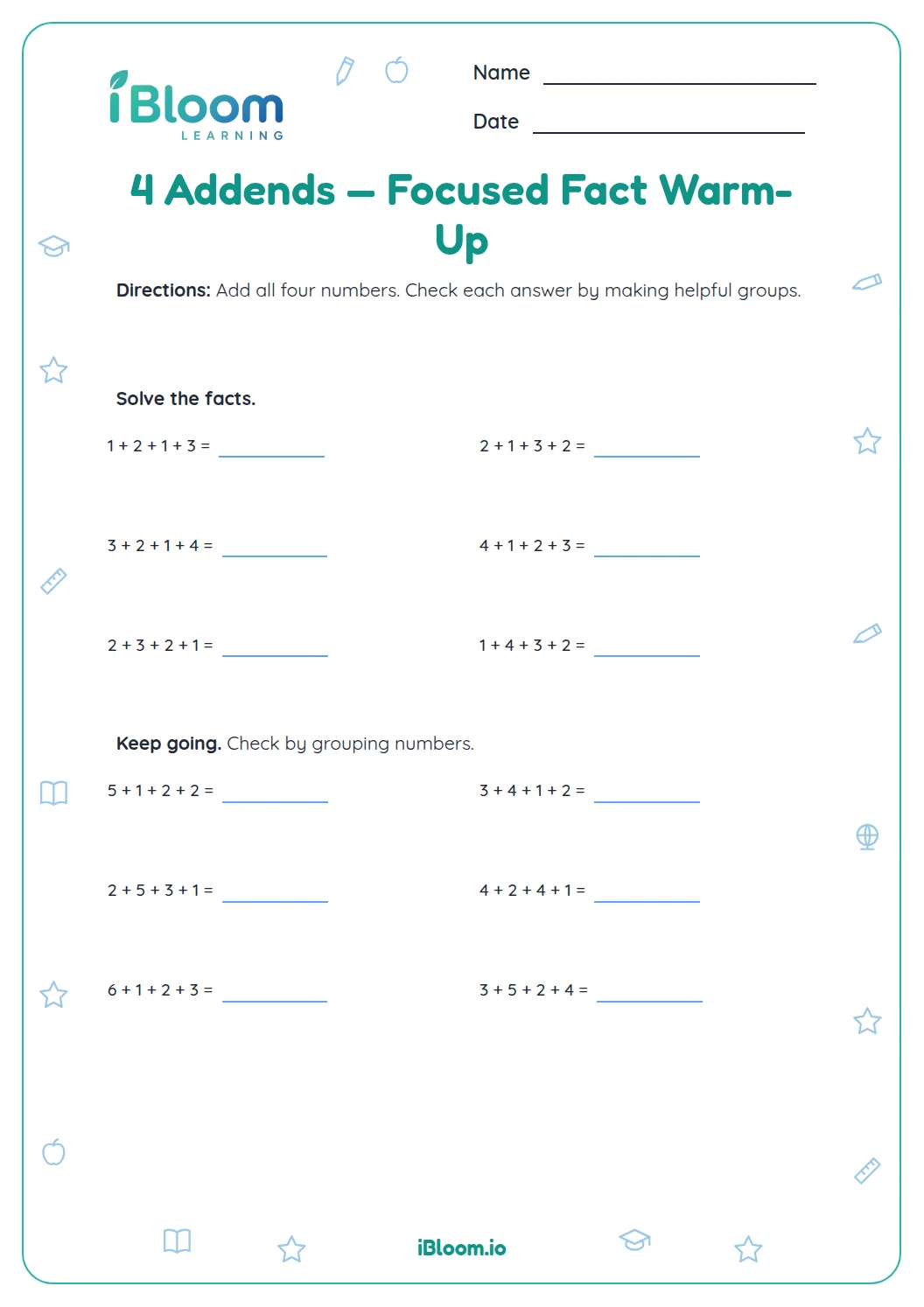
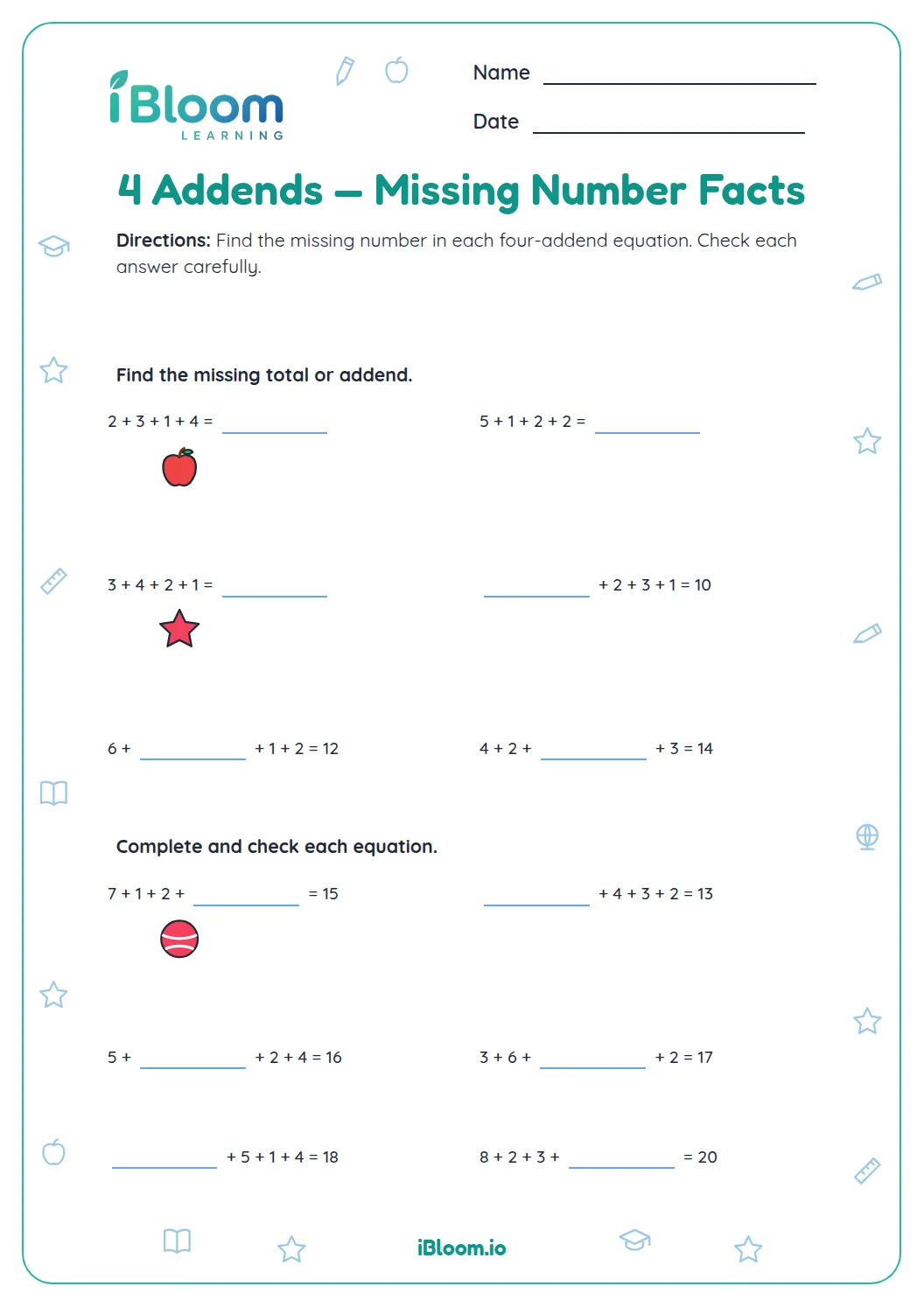

About this worksheet
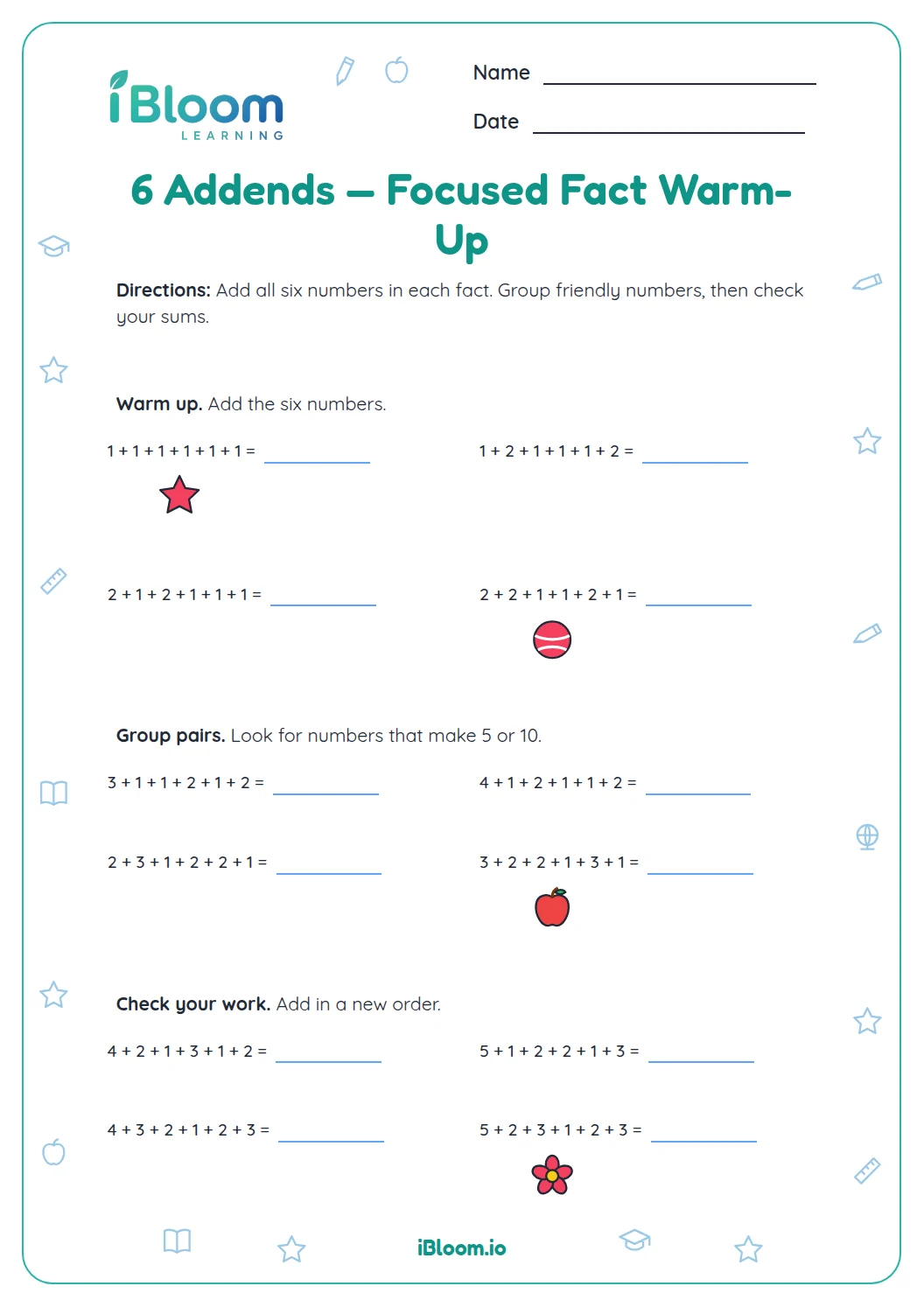
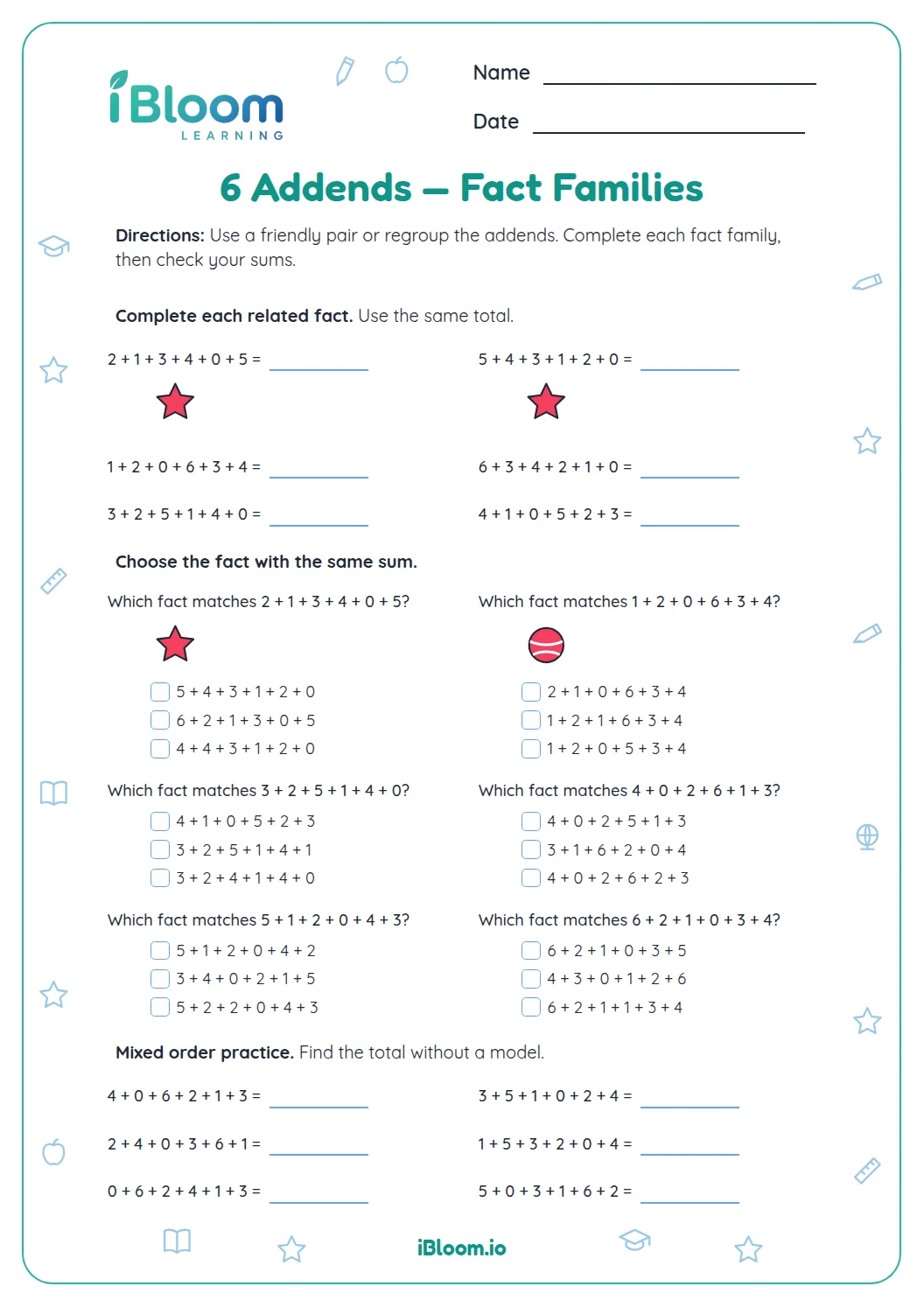
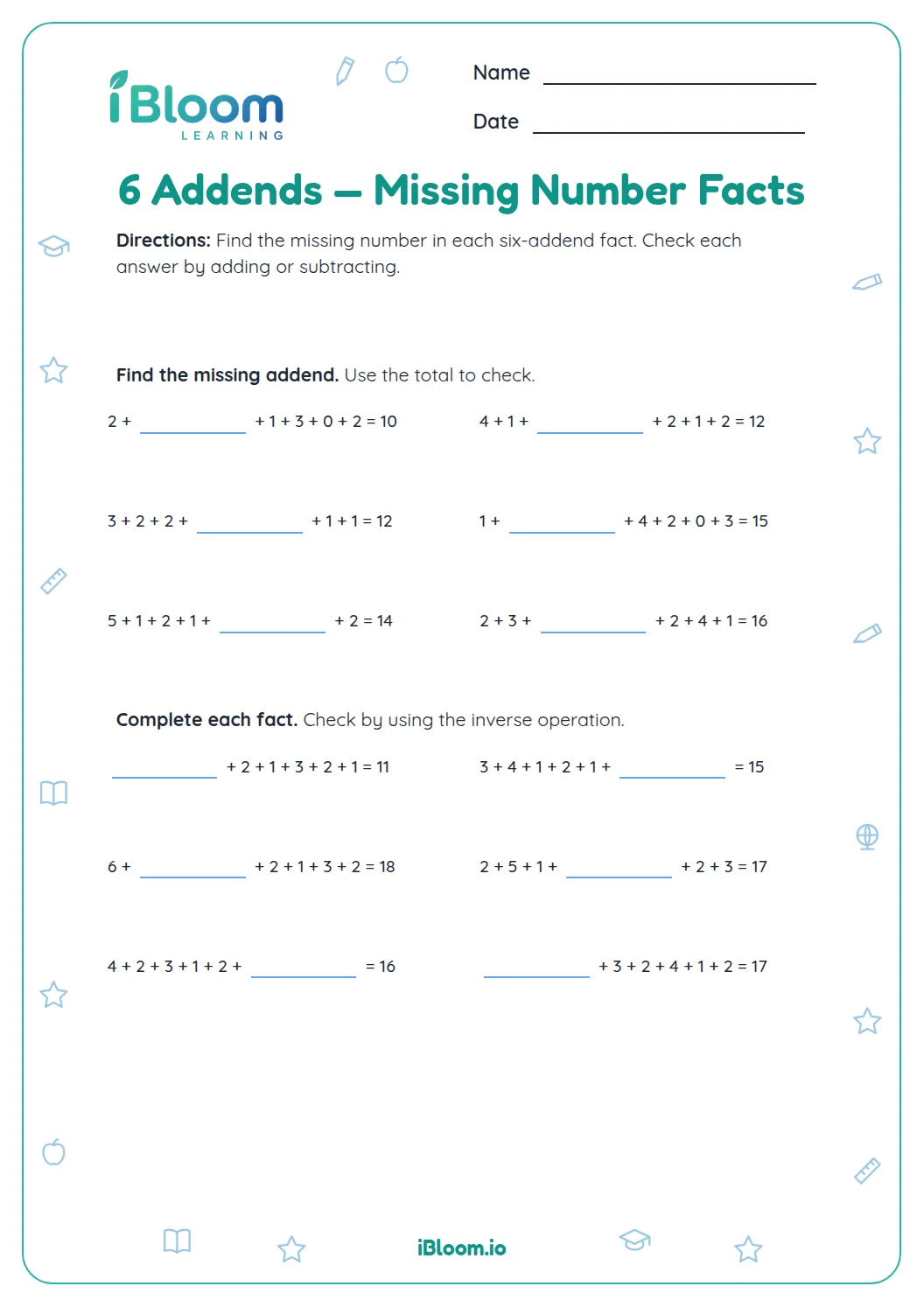
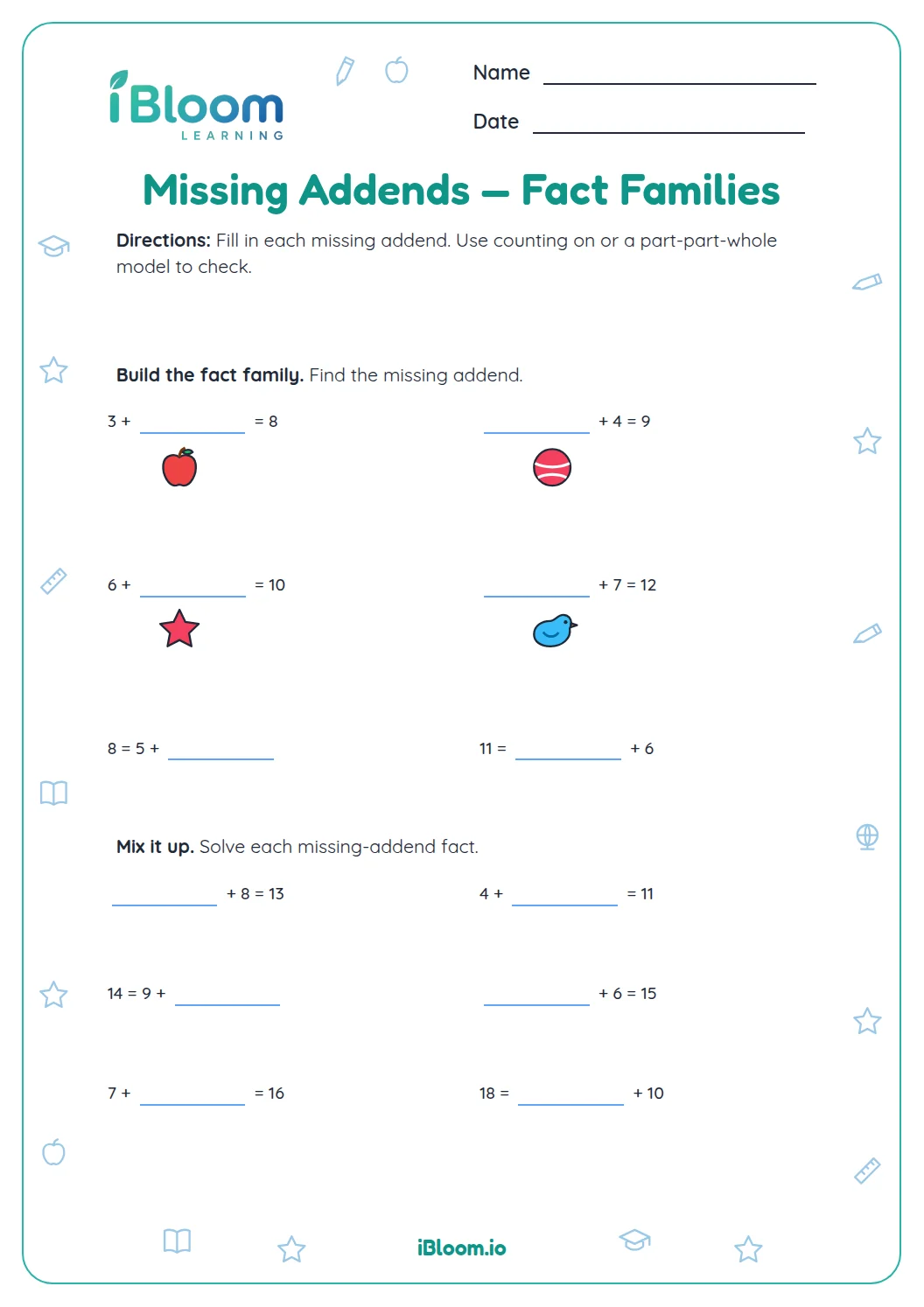
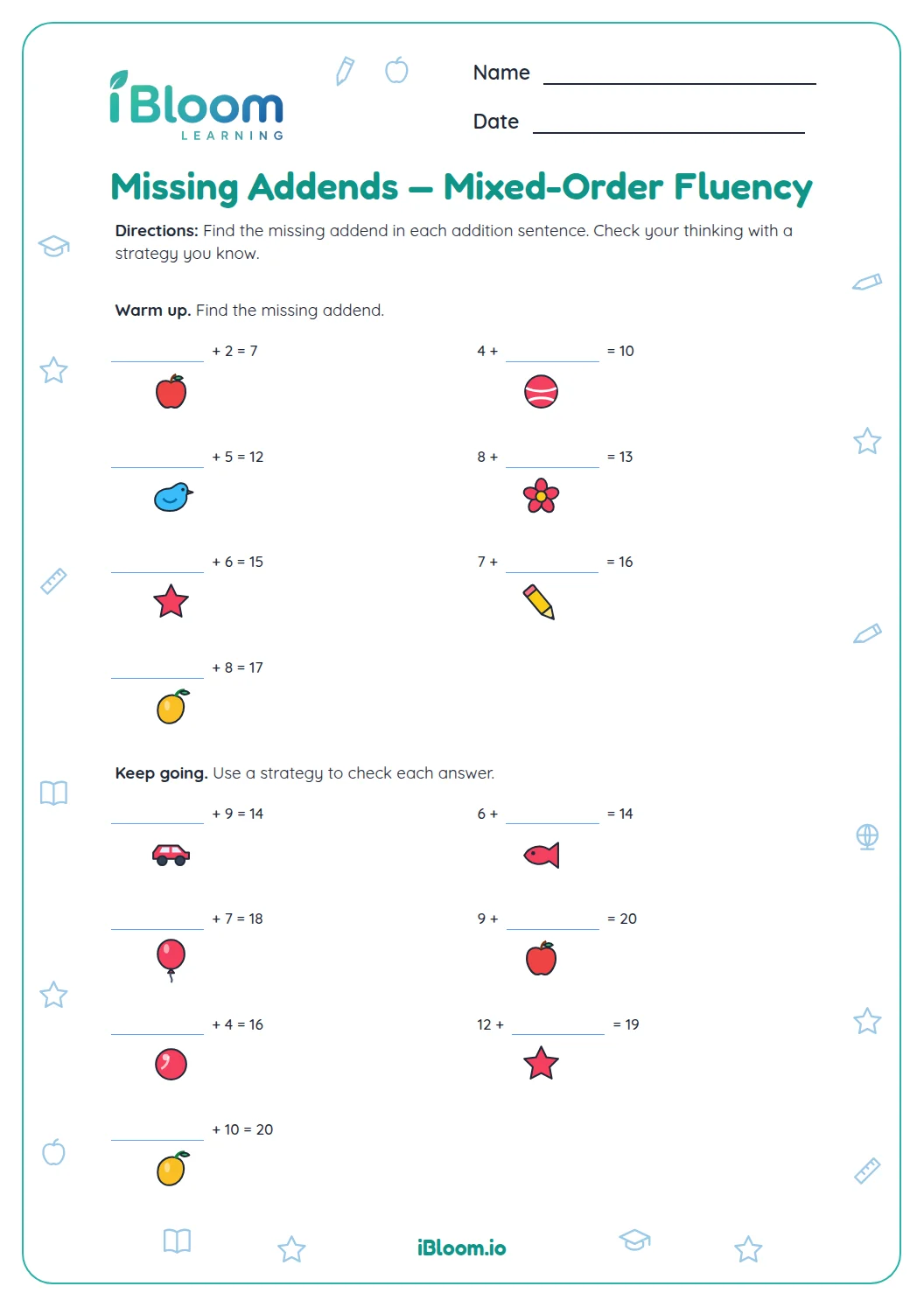
This free addition mastery check gives Grade 1 and Grade 2 learners fourteen tasks with six addends each. Part A has three sums. Part B asks children to correct four incorrect totals. Part C asks them to name groups that help check two six-addend sums. Part D gives five totals and asks for a missing addend. Every correct total is within 20, practicing addition strategies and related subtraction in Common Core 1.OA.C.6. Children can group friendly numbers, track each addend, and verify their corrections. The separate key gives totals, missing numbers, and sample checking strategies.
Aligned to 1.OA.C.6
What does six addends mean?
An addend is a number being added. Each equation has six addends, even when one is zero. In the correction and missing-addend parts, count the six positions before calculating so no number or blank is skipped.
How can grouping make a long sum easier?
Look for pairs that make ten or for small doubles. Keep track with a light pencil mark beside each used addend. Once all six numbers belong to a group, add the group totals.
- 11 + 2 + 3 + 0 + 4 + 5 = ___
- 2Pair 1 + 4, 2 + 3, and 0 + 5.
- 35 + 5 + 5 = 15
- 4All six addends have been used; the answer is 15.
How do children check a reported sum?
Add the six printed numbers rather than trusting the reported total. For question 4, the numbers total 15, so Maya’s 14 needs to be corrected. In Part C, children name pairs or another grouping that accounts for every addend.
How do children find a missing addend?
Add the five visible addends first, then find how much more is needed to reach the stated total. Question 10 has visible addends totaling 12 and a total of 15, so the blank is 3. Substitute 3 and add all six positions to check.
How to use this worksheet
- 1Count six addend positions in question 1.
- 2Choose pairs or a running-total method and complete Part A.
- 3Make a light mark beside each number after using it once.
- 4In Part B, add the visible numbers and find the gap to the total.
- 5Check each missing number by putting it back into the equation.
- 6Use the key to review errors and identify any facts to practice again.
Mistakes to check together
The mistake
Using only five of the six addends.
The fix
Point to each number while adding, then recount the six positions.
The mistake
Adding a repeated number only once.
The fix
Each printed position counts, even when the value is the same.
The mistake
Writing the sum of the visible addends in a blank.
The fix
Compare that subtotal with the stated total; the missing addend fills the difference.
Common Core alignment
Add within 20 and use related subtraction to find a missing addend.
On this sheet: All sixteen six-addend equations have totals within 20 and invite efficient grouping or counting on.
Show the official wordingHide the official wording
Add and subtract within 20, demonstrating fluency for addition and subtraction within 10. Use strategies such as counting on; making ten (e.g., 8 + 6 = 8 + 2 + 4 = 10 + 4 = 14); decomposing a number leading to a ten (e.g., 13 - 4 = 13 - 3 - 1 = 10 - 1 = 9); using the relationship between addition and subtraction (e.g., knowing that 8 + 4 = 12, one knows 12 - 8 = 4); and creating equivalent but easier or known sums (e.g., adding 6 + 7 by creating the known equivalent 6 + 6 + 1 = 12 + 1 = 13).
What to practice next
Make more practice
Further reading
Questions parents and teachers ask
Does six addends mean adding six to another number?
Here it means adding six separate numbers in each equation. Question 1 uses 1, 2, 3, 0, 4, and 5. In the missing-addend section, the blank is one of six positions. Have the child point to all six positions before starting the calculation.
What should children do in the error-correction part?
They should add all six numbers and choose the correct total from the two options. For Maya’s equation, the addends total 15, not 14. Ask the child to point to each number or group pairs before marking the correction.
How can a child explain a correction?
A child can name the pairs or strategy used and show that every addend is included. The key gives sample groupings for two equations, but another correct grouping or a clear running total also works. The goal is to make the check understandable.
Are the totals within 20?
Yes, each correct total is 20 or less. The longer appearance comes from having six addends, not from large answers. Children can use small doubles, pairs that make ten, or a running total, then check that they included each number exactly once.
How do I score the missing-addend questions?
Give credit when the number in the blank makes the entire equation true. The child may count on from the visible subtotal or subtract it from the total. Ask for a substitution check if the answer is uncertain: put the number back and add all six positions.
Should I time this mastery check?
Timing is optional, and the sheet can be completed without a timer. Start by checking whether the child uses all six addends, corrects the reported sums, and finds the missing numbers. If you record a time, consider accuracy too so rushing does not hide a tracking error.