


About this worksheet
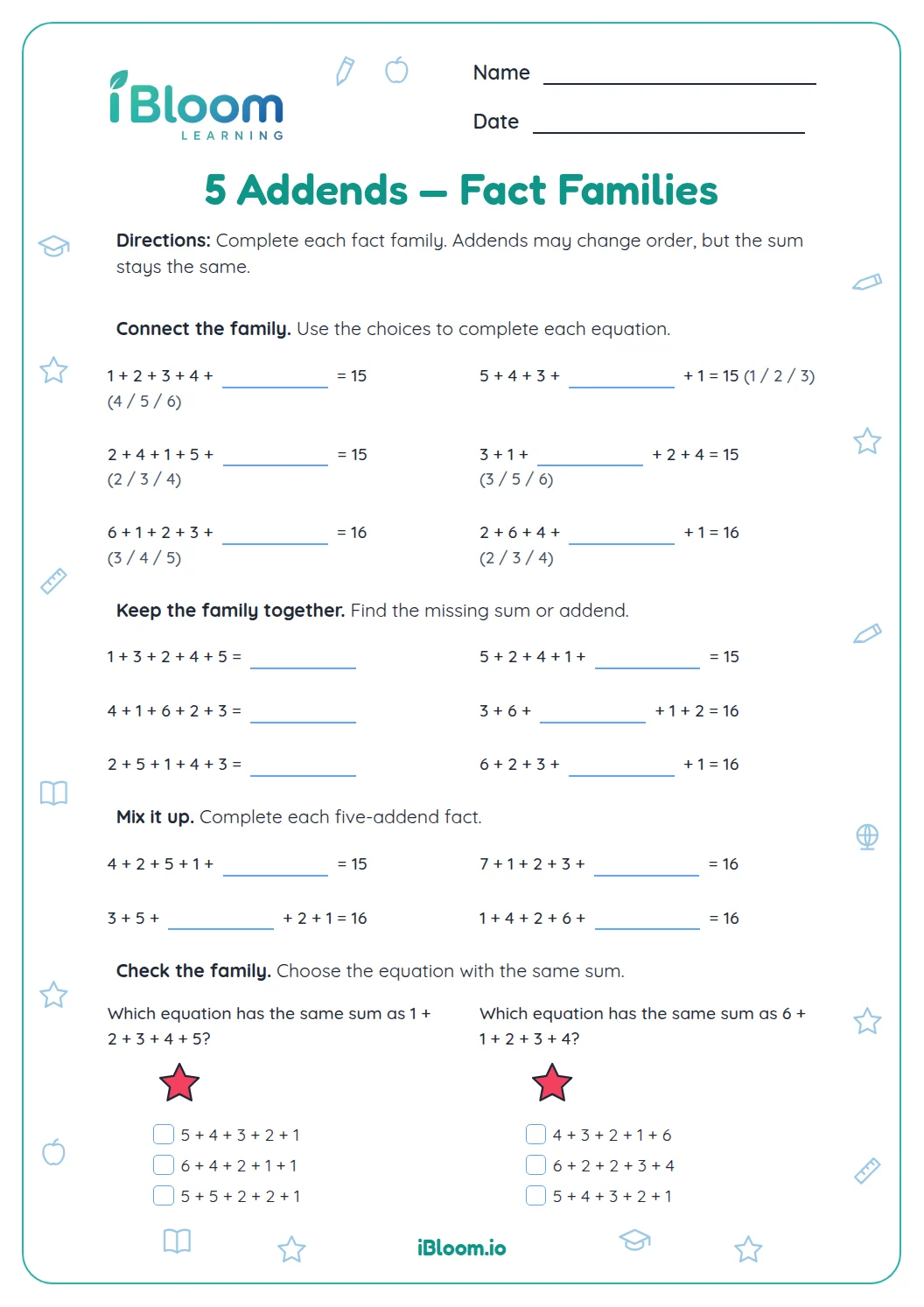
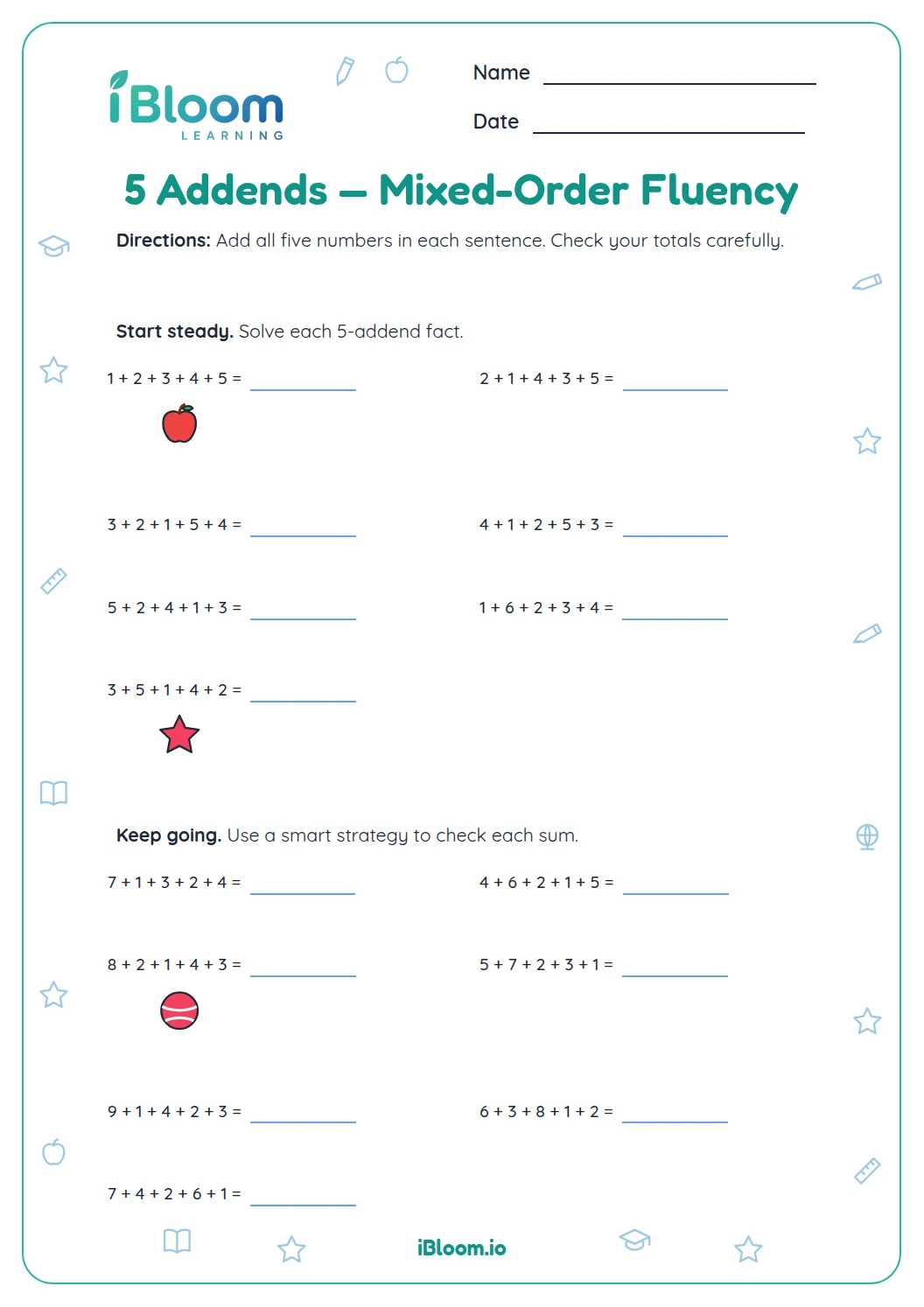
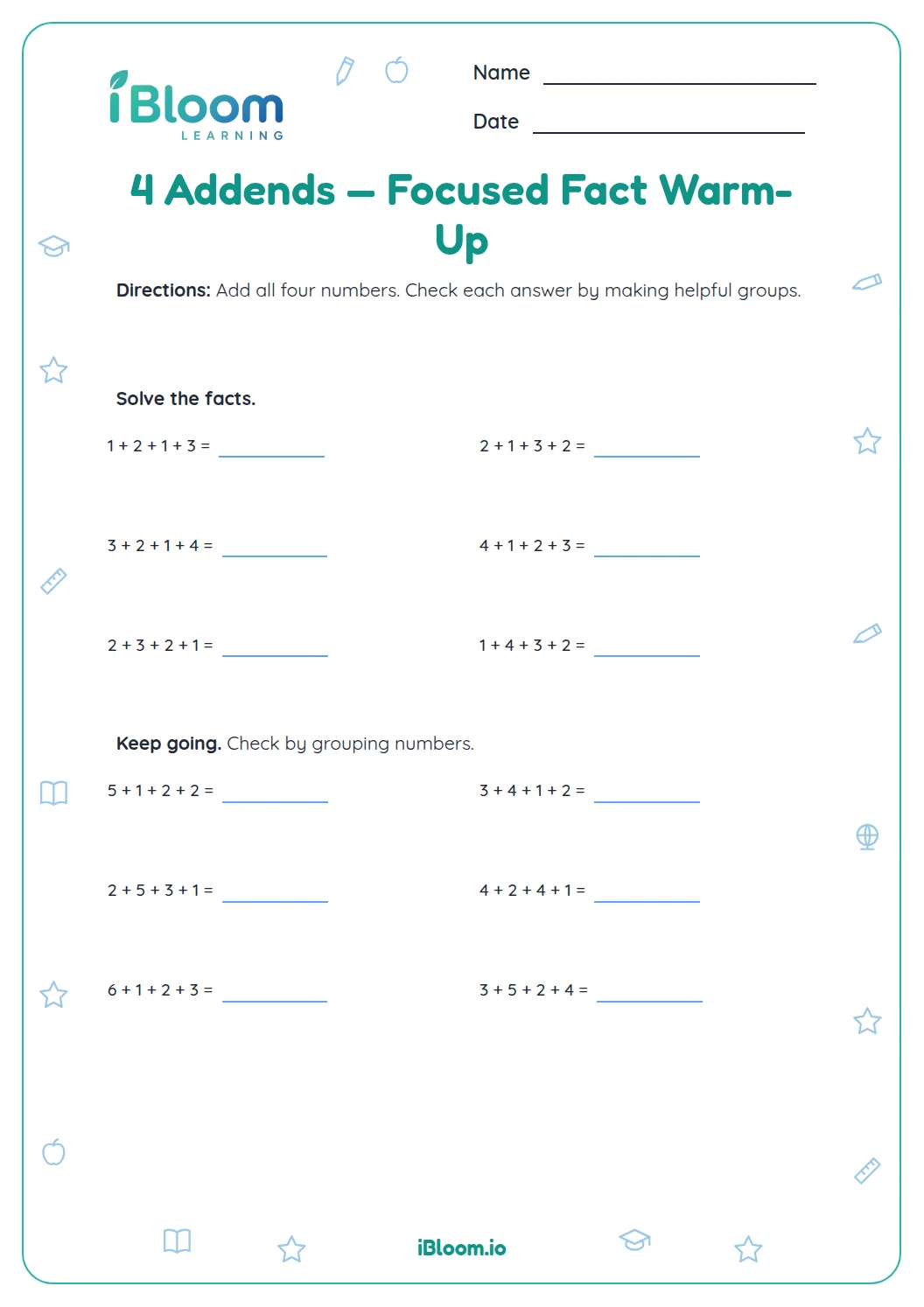
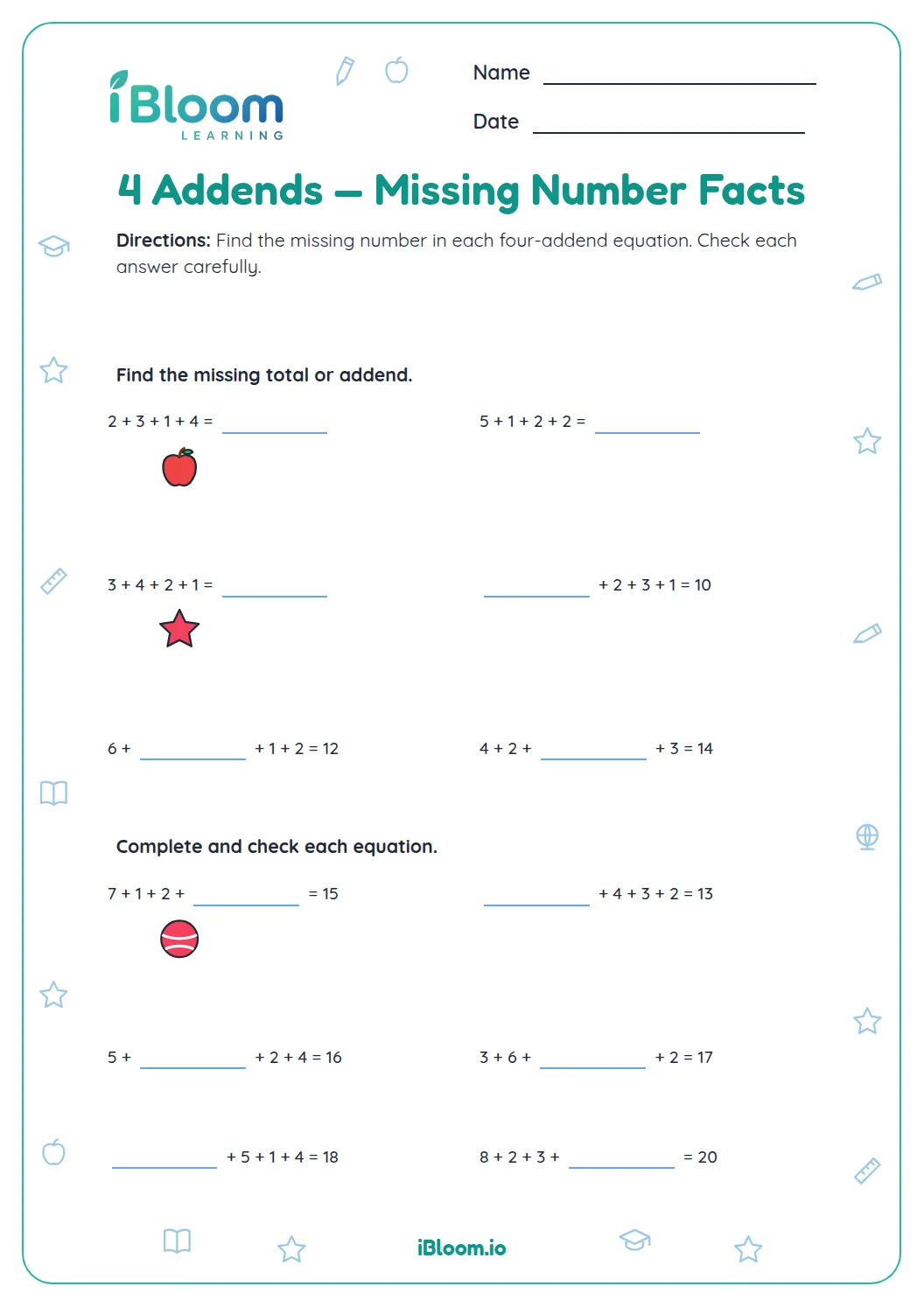
This Grade 2 printable is a mastery check for adding five one-digit addends. Twenty sums are split into three parts, with totals no greater than 20 and a separate answer key. Learners can add from left to right or group facts they know, then check each total.
Aligned to 2.OA.B.2
How can a child add five addends accurately?
Add the numbers in a helpful order. A pair that makes 10 can make the remaining addition easier.
For question 1, 1 + 3 + 2 + 4 + 5 can be grouped as 1 + 4 and 3 + 2 + 5. Those groups total 5 and 10, so the sum is 15.
- 11 + 3 + 2 + 4 + 5
- 21 + 4 = 5; 3 + 2 + 5 = 10
- 35 + 10 = 15
What changes in the second part?
Part A gives a first set of five-addend sums. Part B changes the order and combinations, so learners must attend to every number instead of relying on a repeated pattern. Part C gives another short set for independent checking. All totals stay within 20.
How can families check the work?
Ask the learner to point to the clue or calculation that supports each answer. Use a missed item as a brief chance to model the step, then let the learner try it again.
How to use this worksheet
- 1Read the sheet directions together.
- 2Complete one part before moving to the next.
- 3Pause to check that each response answers the prompt.
- 4Use the separate key to review the work.
Common mistakes and quick fixes
The mistake
Rushing past an important word or symbol.
The fix
Reread the prompt and point to the part that guides the answer.
The mistake
Stopping after an incomplete first step.
The fix
Finish the calculation or response, then check it against the prompt.
The mistake
Changing an answer without checking it.
The fix
Use a quick explanation or check step before revising.
Curriculum alignment
This worksheet practices the listed Common Core standard through its questions.
Practice adding one-digit addends toward fluency within 20.
On this sheet: Each five-addend sum is within 20 and can be found by combining one-digit facts.
Show the official wordingHide the official wording
Fluently add and subtract within 20 using mental strategies. By end of Grade 2, know from memory all sums of two one-digit numbers.
What to practice next
Make more practice
Further reading
Questions parents and teachers ask
What skill does this five-addend sums worksheet practice?
It gives Grade 2 learners focused practice with five-addend sums. The prompts use short steps and the included key lets an adult check each response. The five numbers are all one-digit addends, and each total stays at or below 20.
Is an answer key included?
Yes. A separate answer key is included with the printable. Use it after the learner finishes so the work can be checked question by question. A short pause between the parts can help a learner keep each addend in view.
How should a child start the first part?
Read the direction for the part, then work one item at a time. For the first item, say the steps aloud and check that the answer matches the prompt before continuing. The question asks for one total, so combine every listed number before writing an answer.
How long does the worksheet take?
Plan for about 15 minutes, with extra time if the learner wants to show steps or reread a prompt. The pace can vary with familiarity and whether an adult works through an example first. The key can help an adult notice which fact combinations are already quick and which need practice.
Can this be used for independent practice?
Yes. A learner who knows the skill can work through the parts independently, then use the key with an adult to review any answers that need another look. The learner may choose any addition order that keeps the calculation accurate.