

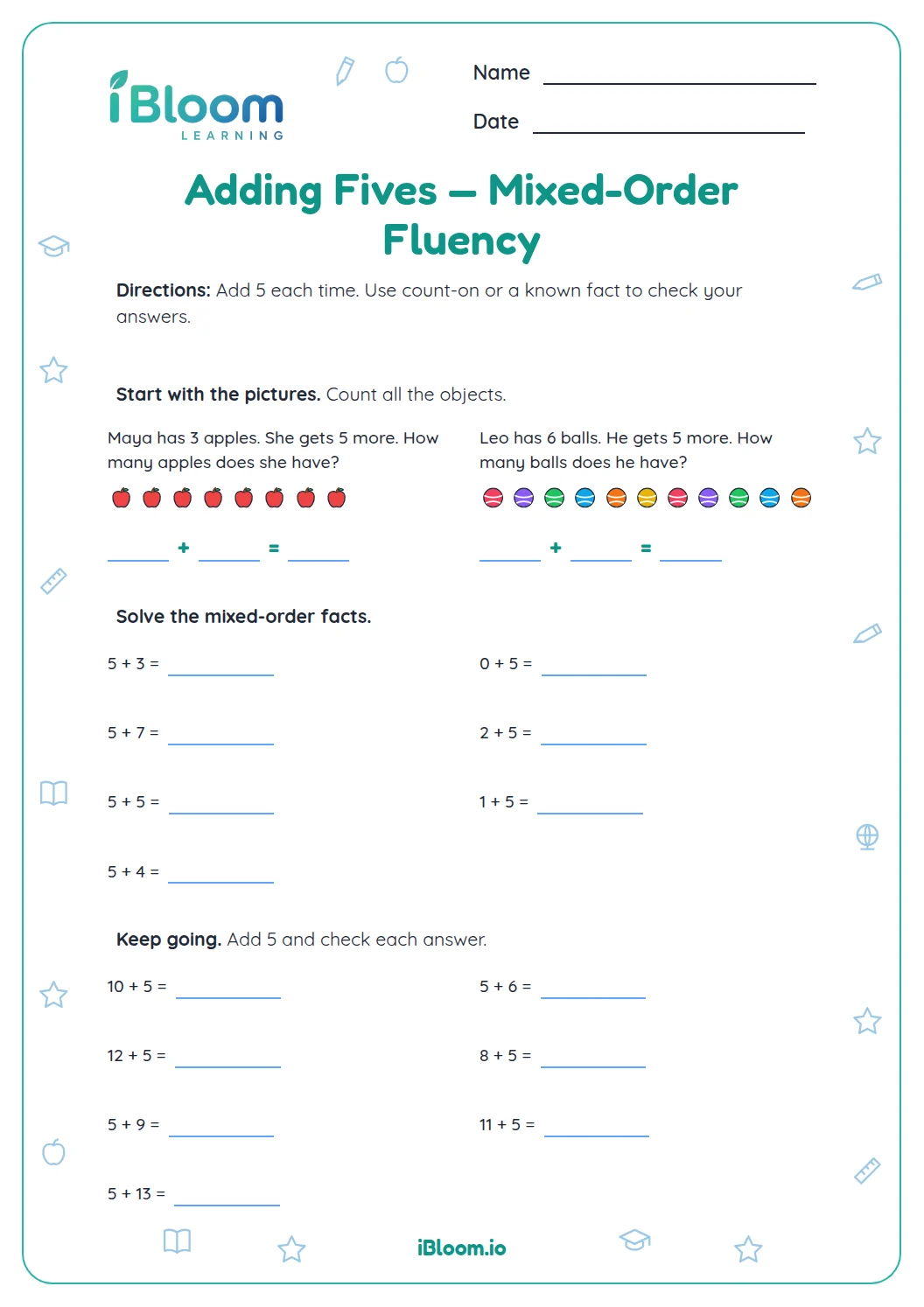
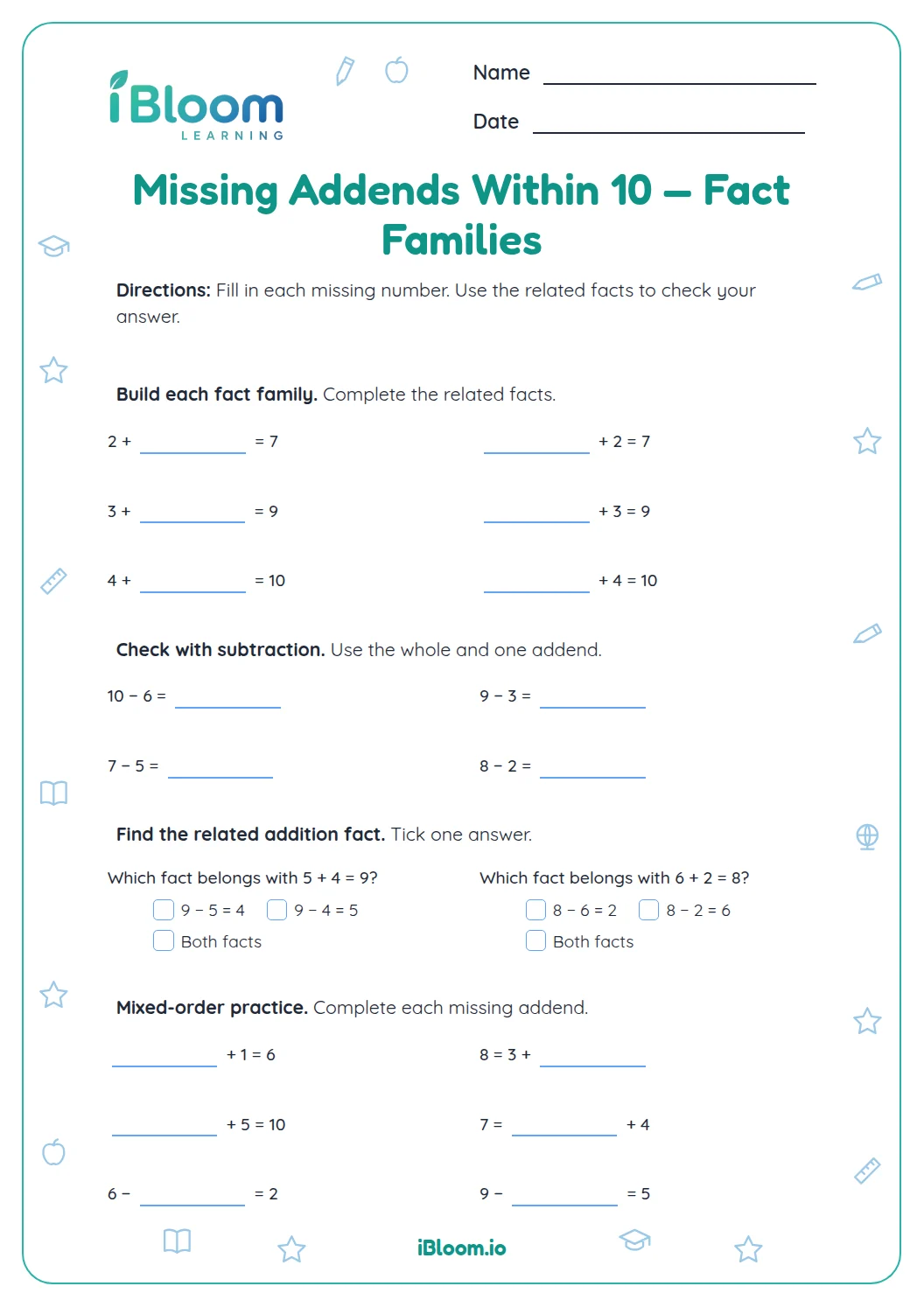


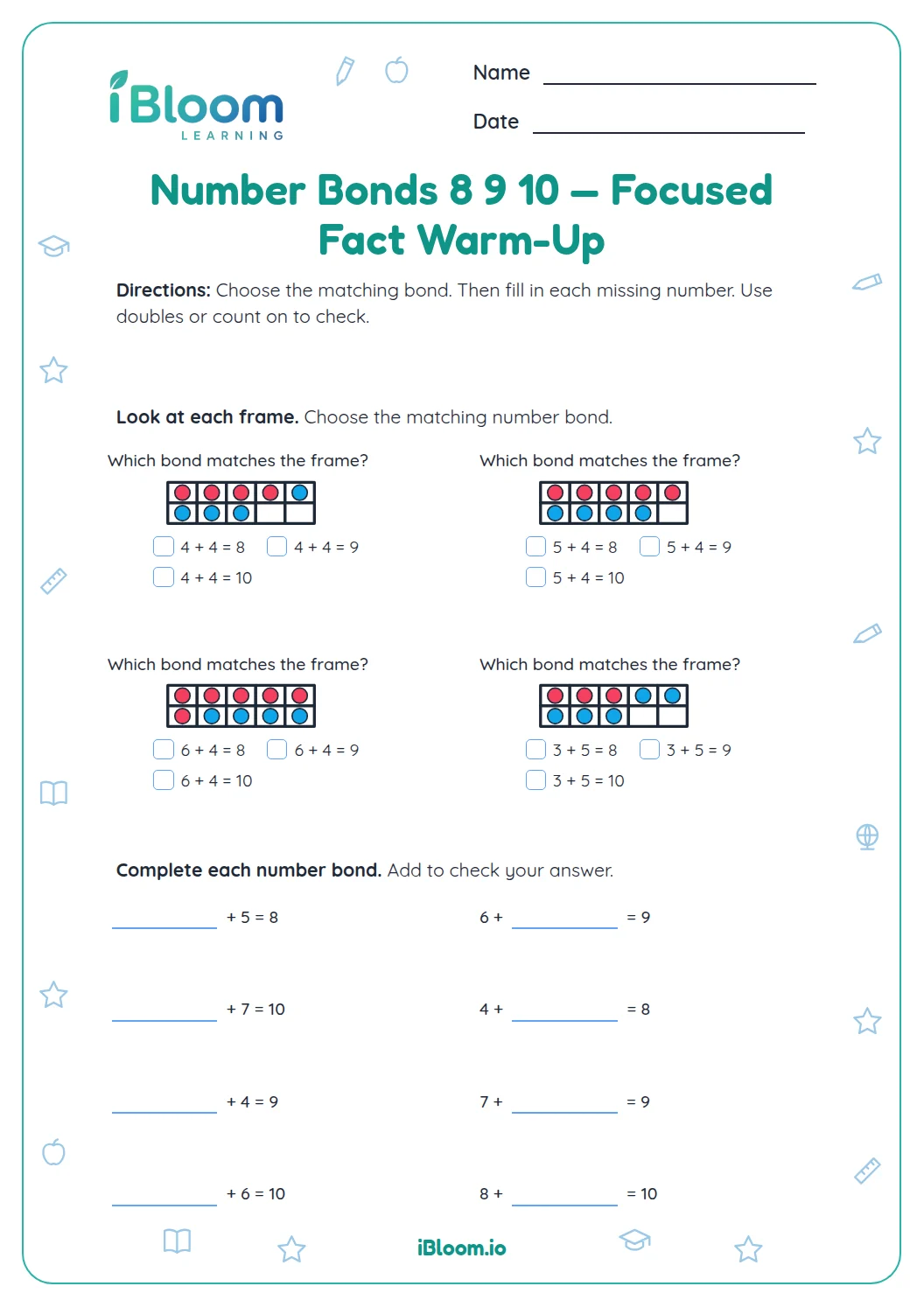
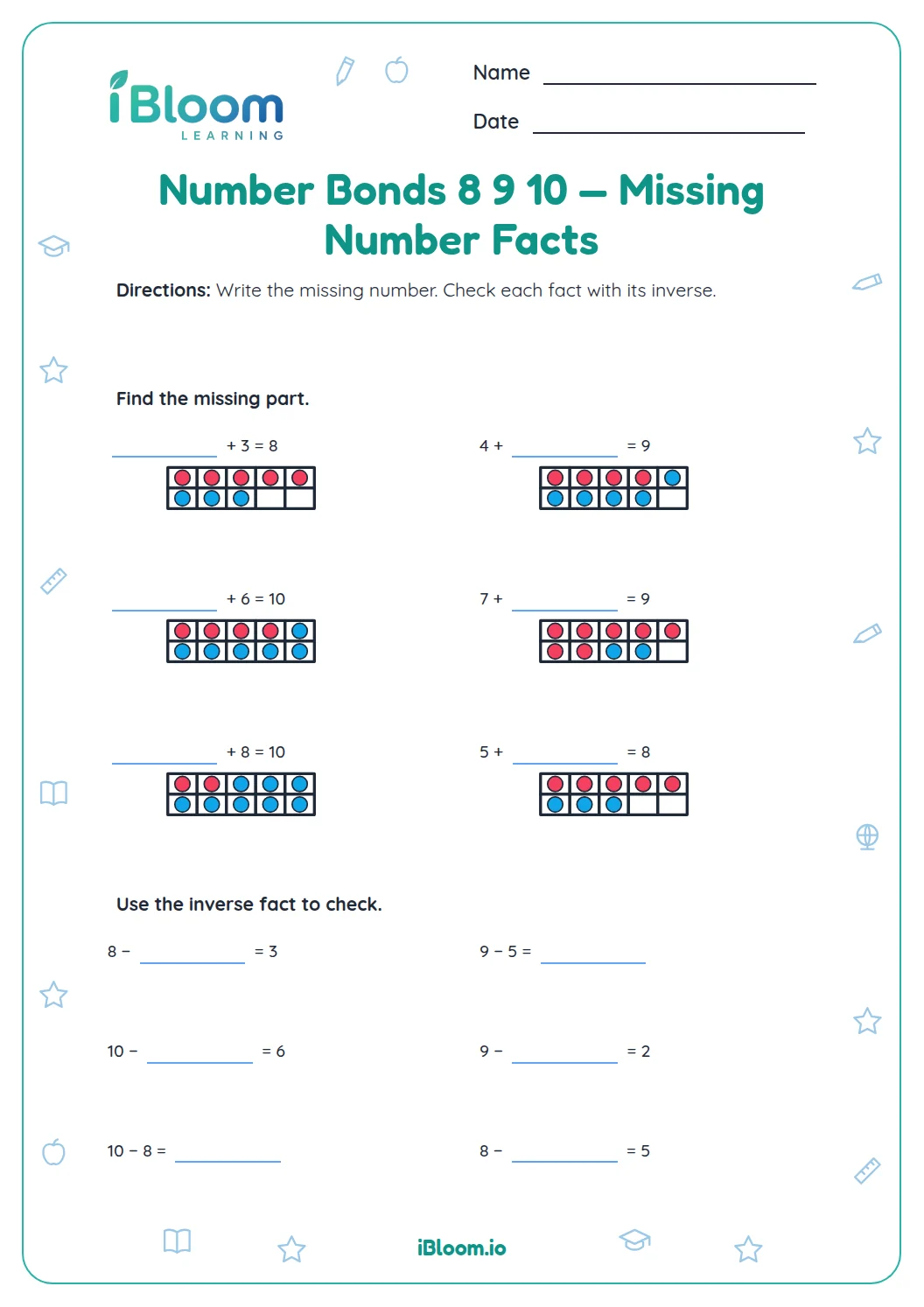

About this worksheet
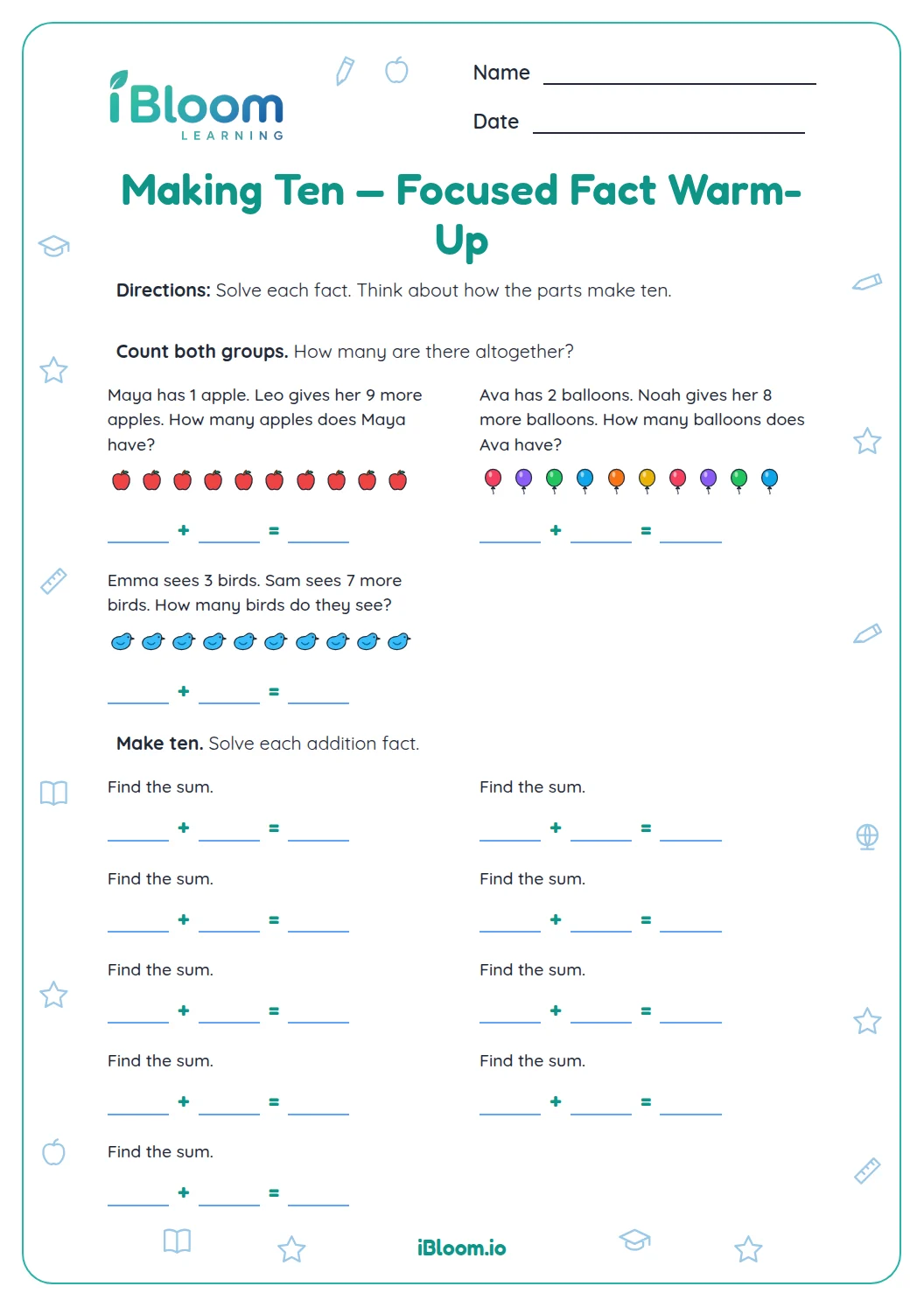
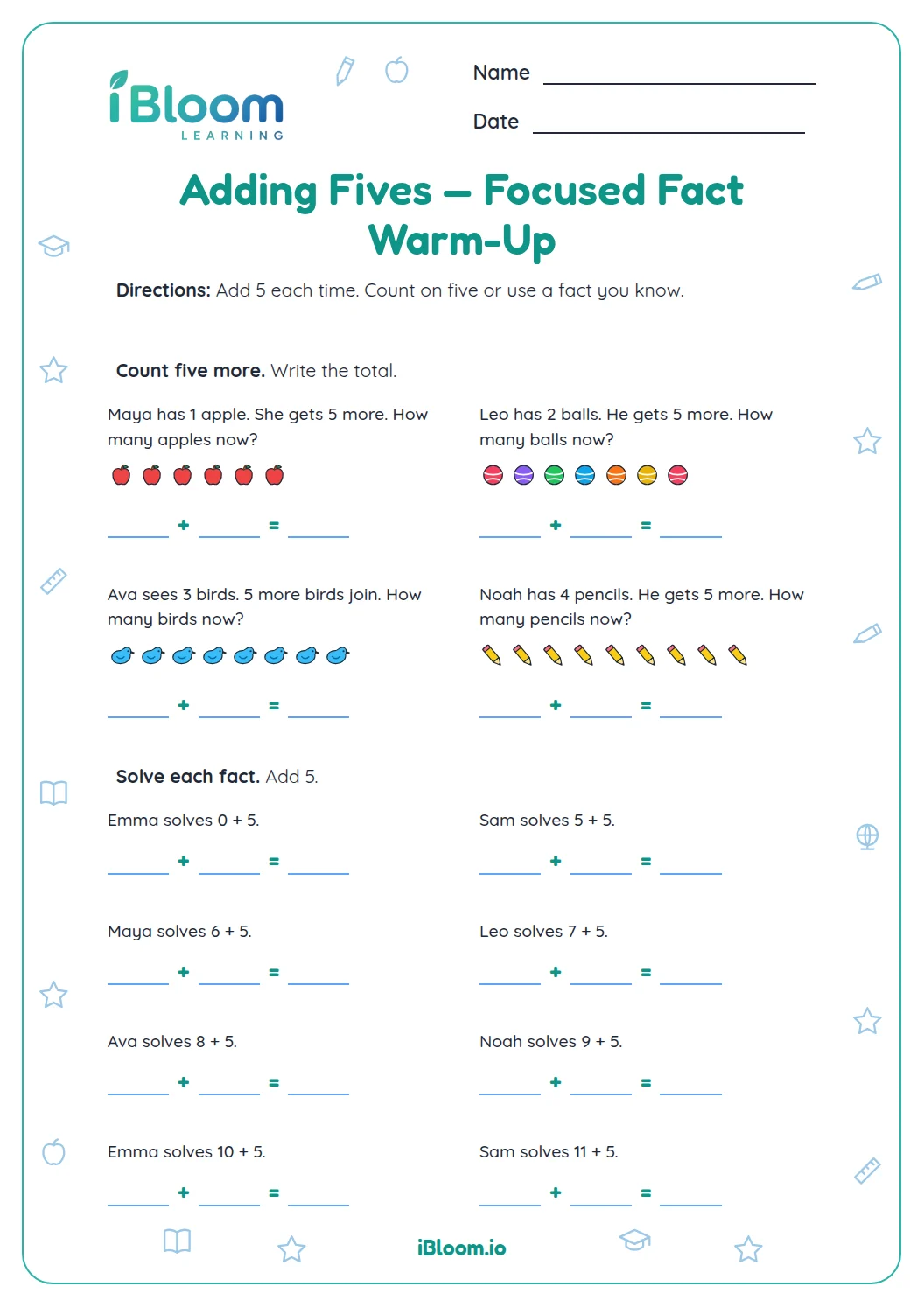
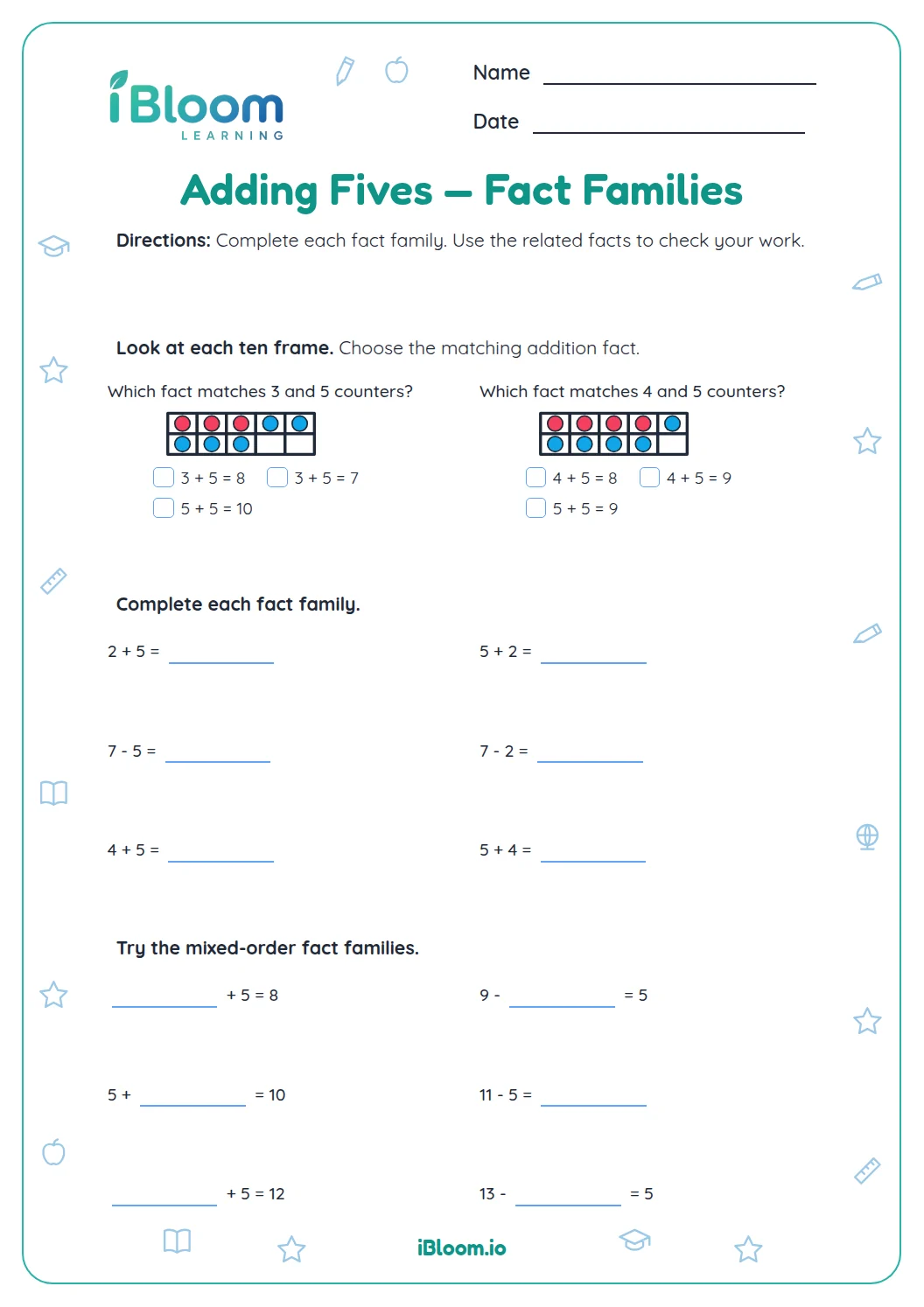
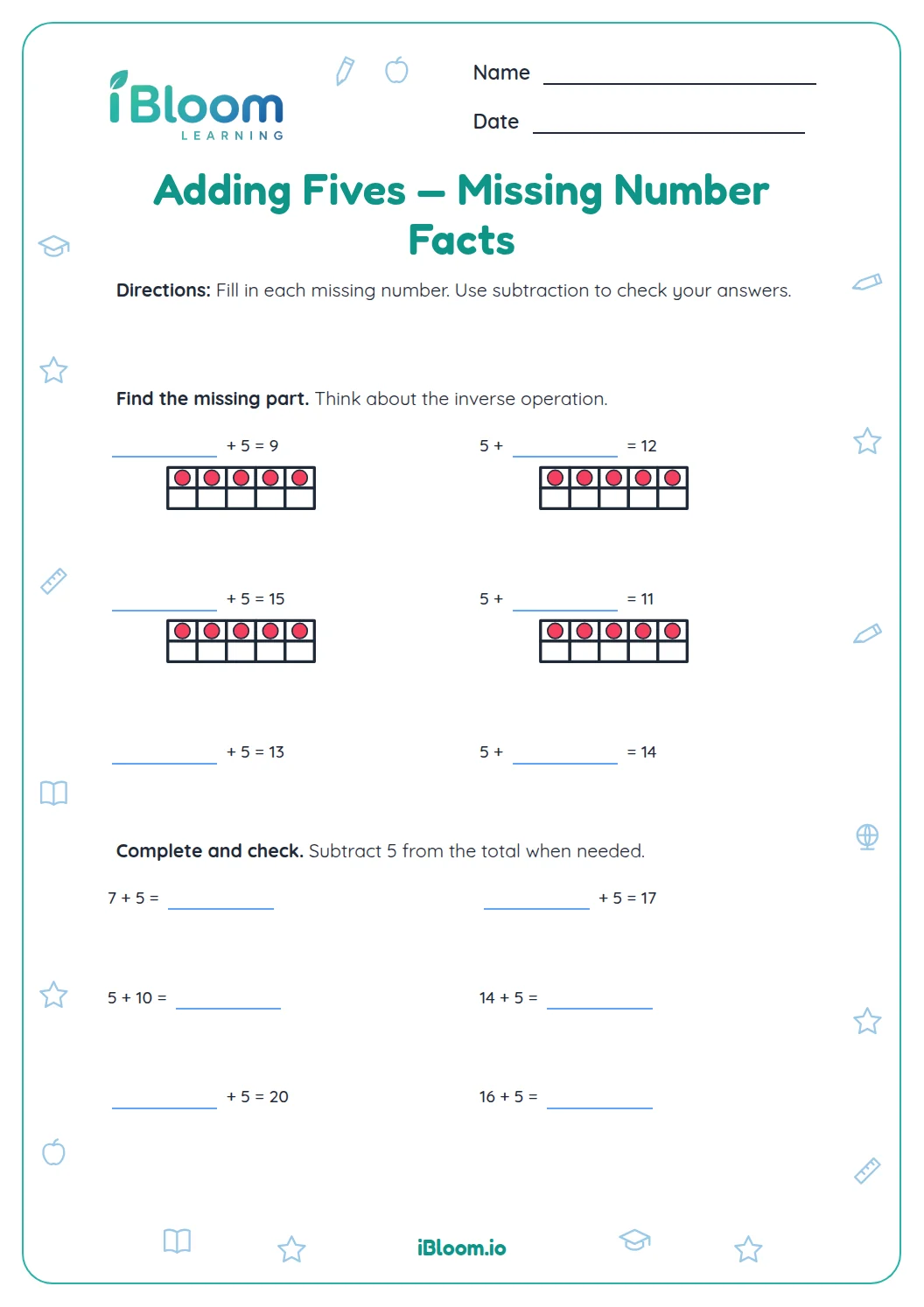
This two-page Grade 1–2 worksheet practices addition facts near 10, sums within 20, and missing addends. Learners use a ten as a helpful landmark, then finish each sum; the final response asks them to show that strategy for 8 + 6. The separate two-page key gives answers and a sample explanation. The practice aligns with CCSS 1.OA.C.6.
Aligned to 1.OA.C.6
What is on the worksheet?
The 16 questions begin with six facts near 10, including totals of 9, 10, and 11. Next come five sums within 20, four missing addends, and one written strategy explanation.
How can a child make ten to solve 8 + 5?
The first number, 8, needs 2 to reach 10. Split 5 into 2 and 3: add 2 to 8, then add the remaining 3. The sum is 13.
- 18 + 5
- 28 + 2 = 10
- 33 remains
- 410 + 3 = 13
How do missing addends work?
Think of the blank as the part needed to reach the total. For 9 + ___ = 14, count on from 9 to 14: five more makes 14.
How to use this worksheet
- 1Read the one-line direction at the start of each part.
- 2Complete the first item together and explain the choice or strategy.
- 3Finish the remaining items without looking at the key.
- 4Compare each answer with the key and mark any item to revisit.
- 5For missed items, explain why the correct response fits.
Common mistakes and quick fixes
The mistake
Adding the whole second addend after already reaching 10.
The fix
Split it: use only what fills 10, then add the part left over.
The mistake
Putting the total in the missing-addend blank.
The fix
Ask what number combines with the known addend to make the total.
The mistake
Writing a correct total without showing the requested strategy.
The fix
For the last item, show the split that makes 10 and the remaining add-on.
Curriculum alignment
The work centers on a standard strategy for addition within 20.
Use making-ten strategies to add within 20.
On this sheet: Questions 7–11 model making a ten to add within 20.
Show the official wordingHide the official wording
Add and subtract within 20, demonstrating fluency for addition and subtraction within 10. Use strategies such as counting on; making ten (e.g., 8 + 6 = 8 + 2 + 4 = 10 + 4 = 14); decomposing a number leading to a ten (e.g., 13 − 4 = 13 − 3 − 1 = 10 − 1 = 9); using the relationship between addition and subtraction (e.g., knowing that 8 + 4 = 12, one knows 12 − 8 = 4); and creating equivalent but easier or known sums (e.g., adding 6 + 7 by creating the known equivalent 6 + 6 + 1 = 12 + 1 = 13).
What to practice next
Make more practice
Further reading
Questions parents and teachers ask
What does making ten mean?
Making ten means splitting one addend so it fills the first number to 10. For 8 + 5, split 5 into 2 and 3: 8 + 2 makes 10, then add 3 to get 13. Part B practices this move with sums within 20.
Are there sums greater than 10?
Yes. Part B has five sums with totals of 13 or 15. Learners can split one addend to reach 10, then add the remaining part. For example, 8 + 5 becomes 10 + 3, which equals 13. This method works for each sum in that part.
How many questions are included?
There are 16 questions in four parts: six facts near 10, five sums within 20, four missing-addend problems, and one written explanation. The worksheet and answer key each have two pages. The final response asks children to show a strategy, not only write a total.
Should children use a timer?
A timer is optional and is not needed to complete the page. The questions ask children to solve accurately and show a making-ten strategy on the last item. Once the strategy feels comfortable, an adult can offer a short, low-pressure fluency round.
How can I help with a difficult sum?
Ask how many more the first addend needs to reach 10. For 8 + 5, that amount is 2. Help the child split 5 into 2 and 3, then combine 10 and 3. Counters can make the split visible.