



About this worksheet
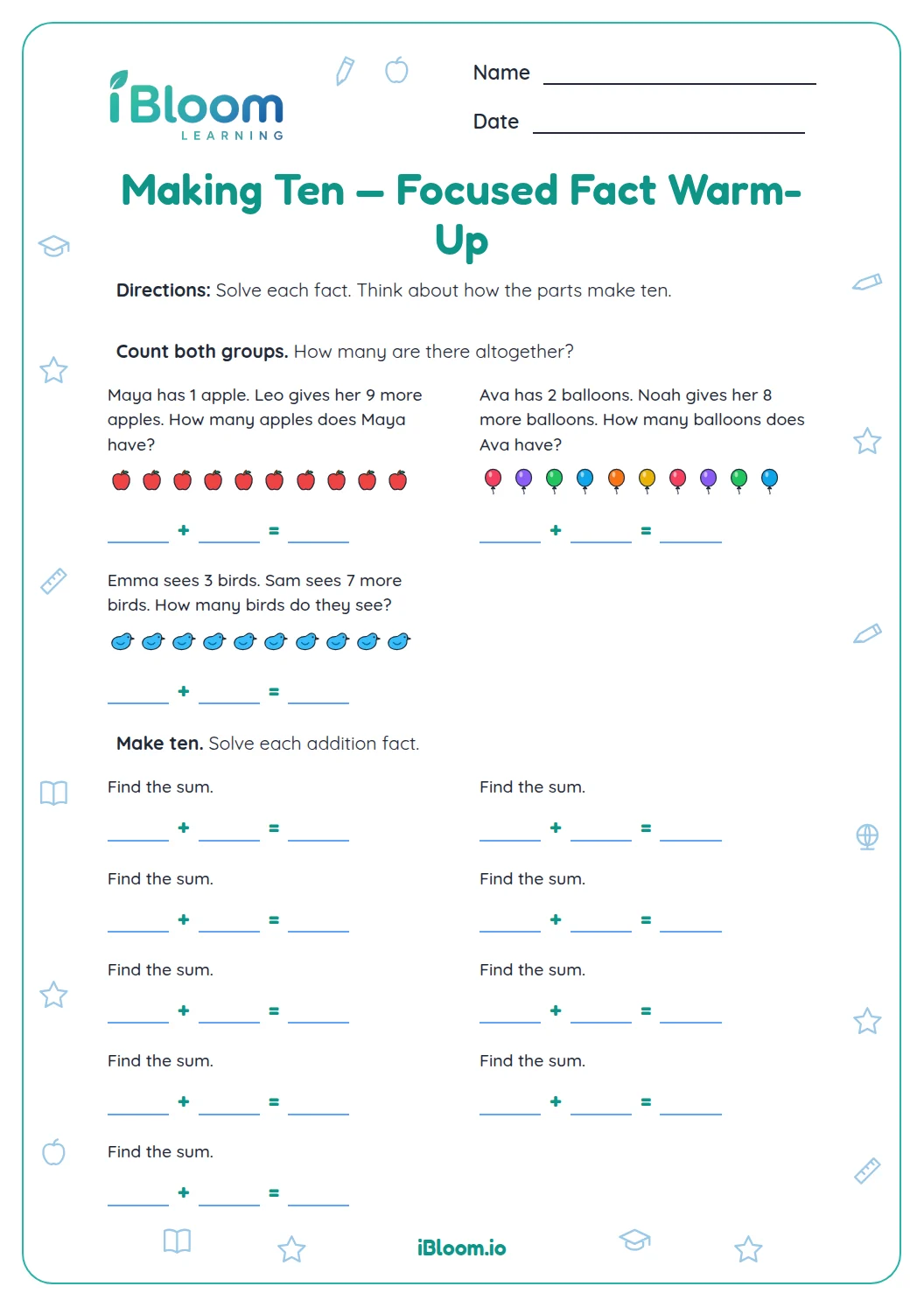
This Grade 1 addition drill uses making ten to solve facts. Students first find missing partners that complete ten, then solve near-ten facts such as 8 + 1. A final set of seven facts can be timed if a teacher or family chooses; timing is optional and accuracy comes first. The answer key supports CCSS 1.OA.C.6.
Aligned to 1.OA.C.6
How does making ten help with addition facts?
This Grade 1 addition drill uses making ten to solve facts. Students first find missing partners that complete ten, then solve near-ten facts such as 8 + 1. A final set of seven facts can be timed if a teacher or family chooses; timing is optional and accuracy comes first. The answer key supports CCSS 1.OA.C.6.
Find how much the first addend needs to reach ten, then add any amount left over. This sheet practices make-ten partners and nearby facts, with an optional timed round.
- 18 + 2 = 10
- 28 needs 2 more to reach 10.
How is the practice organized?
Work through the prompts in order. Use the models or guided examples to establish the method, then apply the same idea independently.
How can students check their work?
A make-ten fact has a total of ten, such as 6 + 4 or 8 + 2. Students use these known pairs as anchors for nearby facts. The first section asks for partners; the later items include sums just below ten.
How to use this worksheet
- 1Read the directions at the top of the sheet.
- 2Work carefully through each item in order.
- 3Use a pencil to show each step or trace each model.
- 4Check the answer key after finishing.
Common mistakes and quick fixes
The mistake
Calling the timer required.
The fix
Timing is optional; finish accurately at a comfortable pace.
The mistake
Choosing a number that does not complete ten.
The fix
Count the empty ten-frame spaces or use 10 minus the known addend.
The mistake
Recording a time before checking answers.
The fix
Check accuracy first, then record time if using the optional round.
Curriculum alignment
This page connects the worksheet practice to the standard below.
Add and subtract within 20, using strategies such as making ten.
On this sheet: Problems practice addition facts by completing a ten.
Show the official wordingHide the official wording
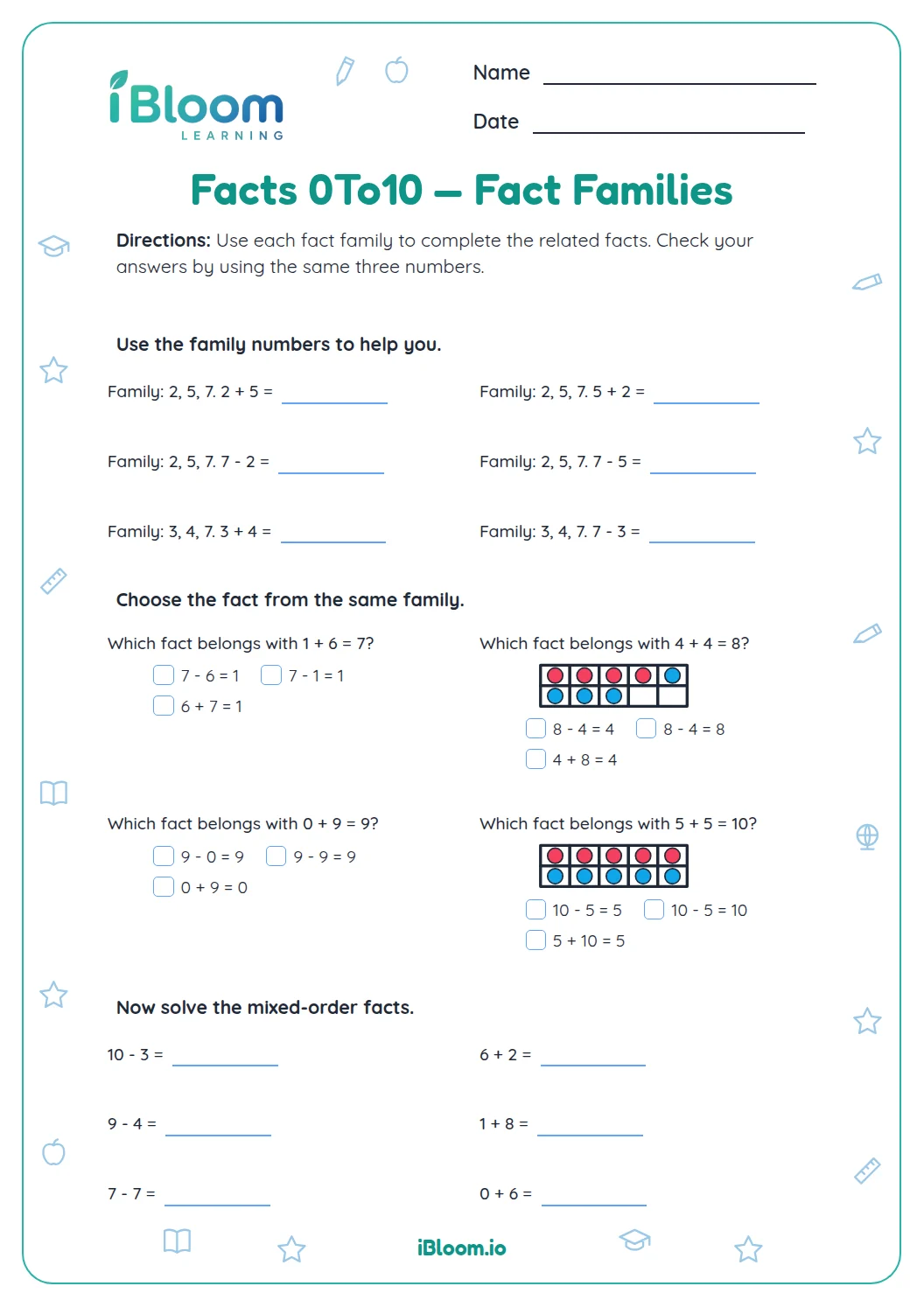
Add and subtract within 20, demonstrating fluency for addition and subtraction within 10. Use strategies such as counting on; making ten (e.g., 8 + 6 = 8 + 2 + 4 = 10 + 4 = 14); decomposing a number leading to a ten (e.g., 13 - 4 = 13 - 3 - 1 = 10 - 1 = 9); using the relationship between addition and subtraction (e.g., knowing that 8 + 4 = 12, one knows 12 - 8 = 4); and creating equivalent but easier or known sums (e.g., adding 6 + 7 by creating the known equivalent 6 + 6 + 1 = 12 + 1 = 13).
What to practice next
Make more practice
Further reading
Questions parents and teachers ask
What is a make-ten addition fact?
A make-ten fact has a total of ten, such as 6 + 4 or 8 + 2. Students use these known pairs as anchors for nearby facts. The first section asks for partners; the later items include sums just below ten. Explain that a pair totaling ten can help solve a nearby addition fact.
Is the timed round required?
No. Timing is optional. Students can complete all seven final facts at a comfortable pace, and an adult may record time only if it helps the practice. Check the answers first and treat accuracy as the goal. The final section leaves room to record a time without making speed the goal.
What does the ten-frame show?
The ten-frame pictures show counters filling ten spaces. A missing partner is the number of empty spaces needed to complete the frame. Students can count those spaces or connect the model to the matching addition equation. Students can count the spaces or subtract the known counter total from ten.
How many facts are on the worksheet?
There are 16 addition facts: five missing-partner or make-ten items and eleven written facts, including the optional seven-fact round. A score area lets students record correct answers and, if desired, elapsed time. The key separates fixed answers from the learner-recorded score and time.
Is an answer key included?
Yes. The key gives the correct number for every fixed addition fact. The score and elapsed-time blanks are for the learner to complete, so those entries will vary with the student’s work and pace. The adult can decide whether recording a time suits the practice session.