




About this worksheet
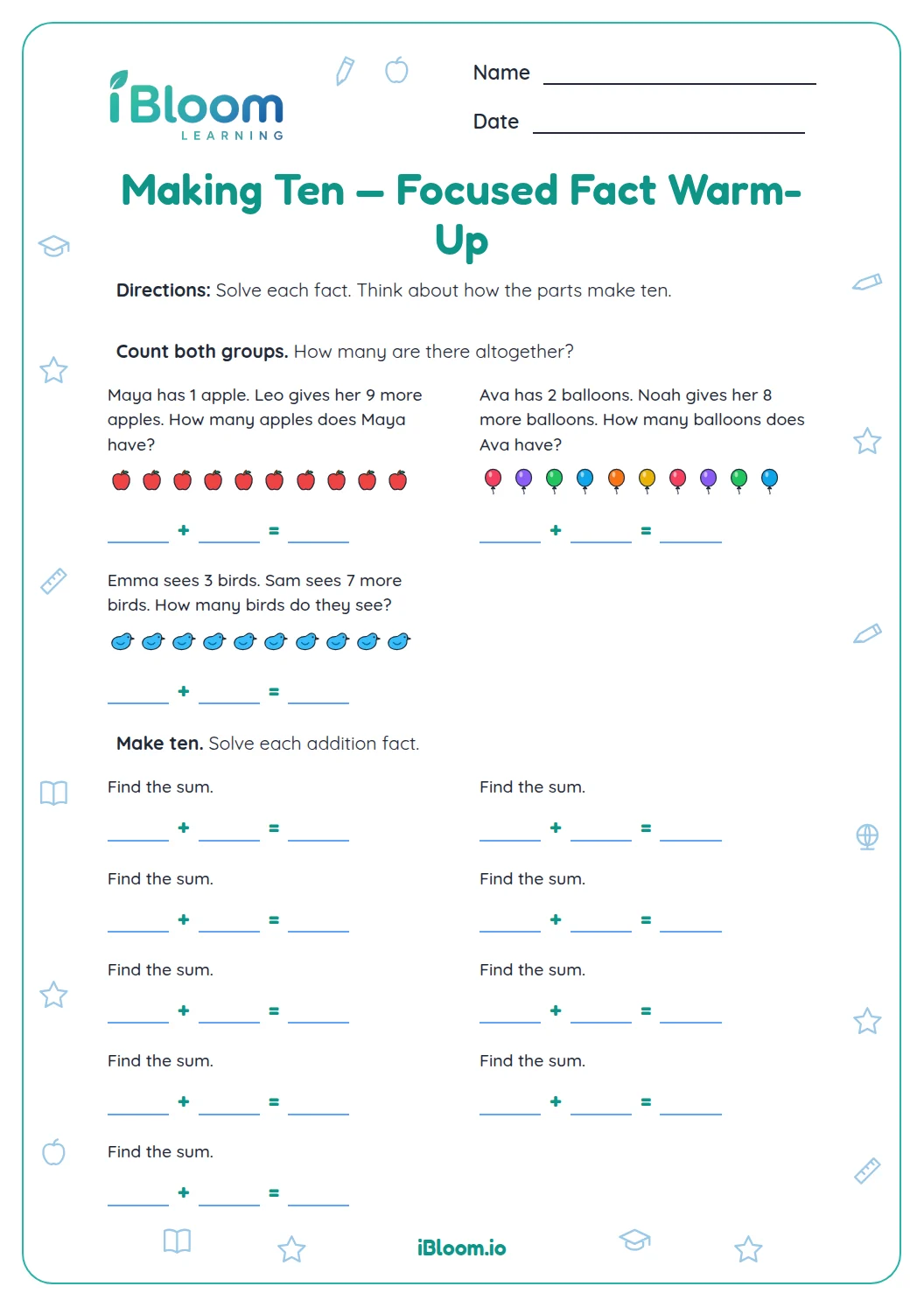
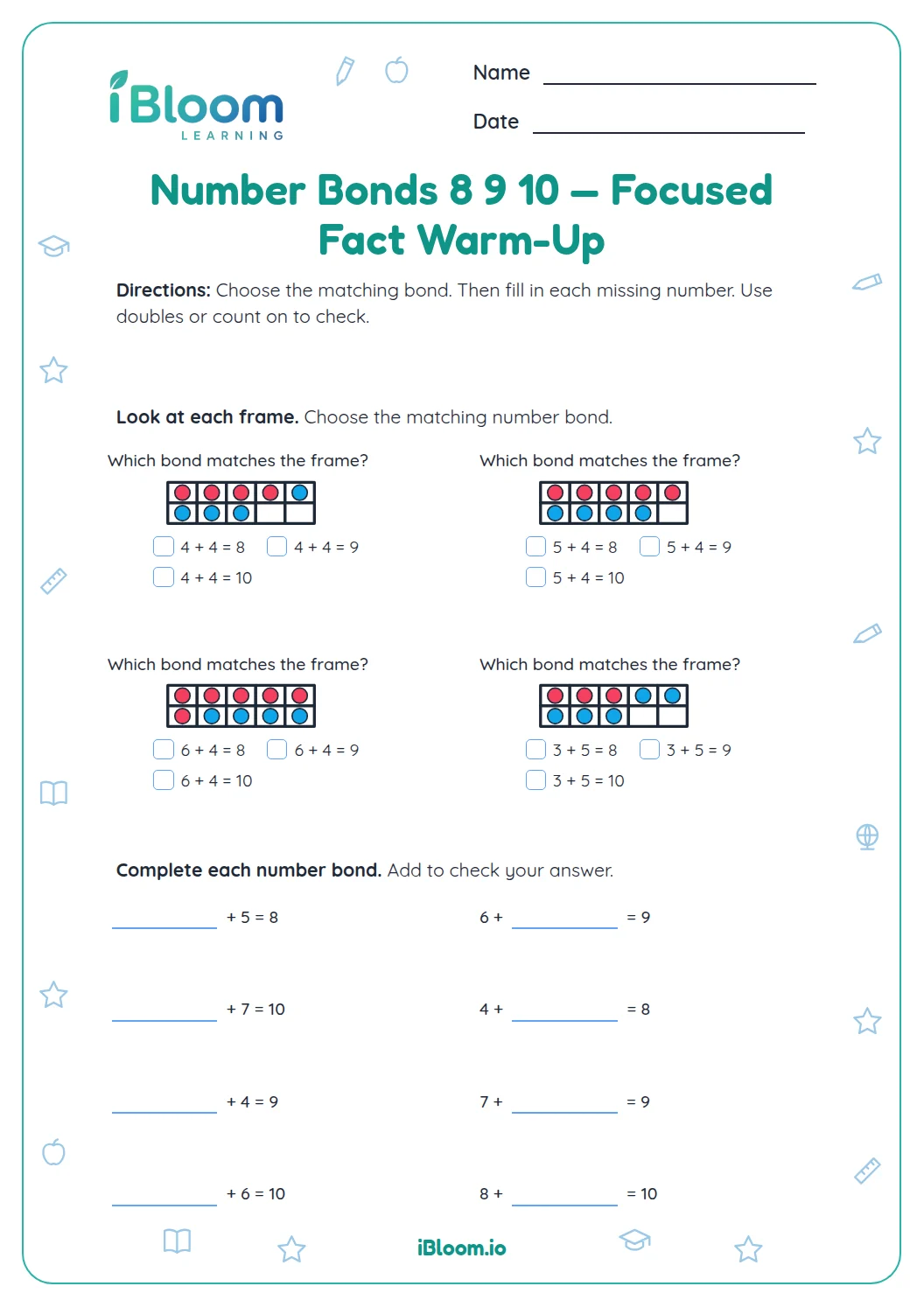
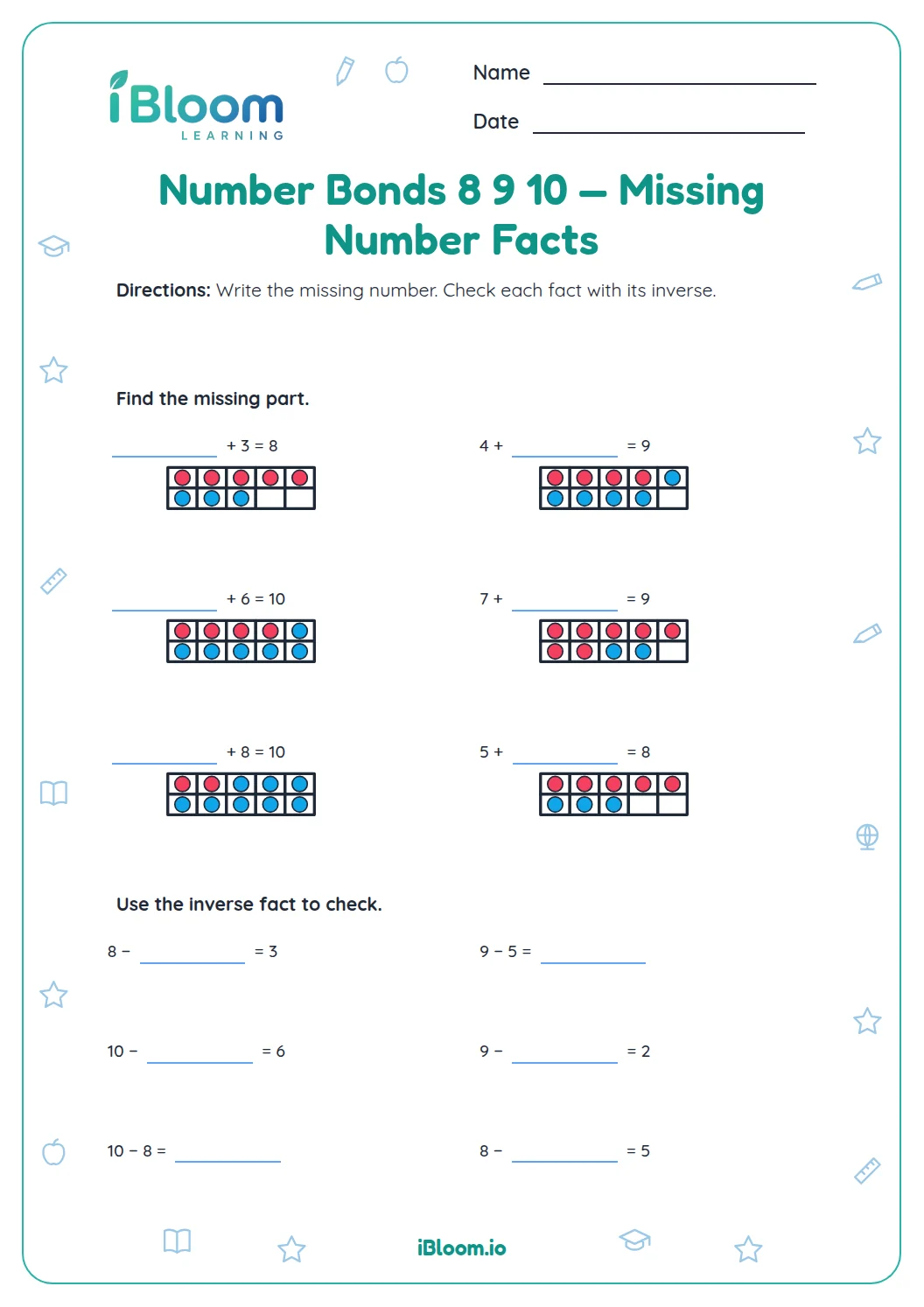
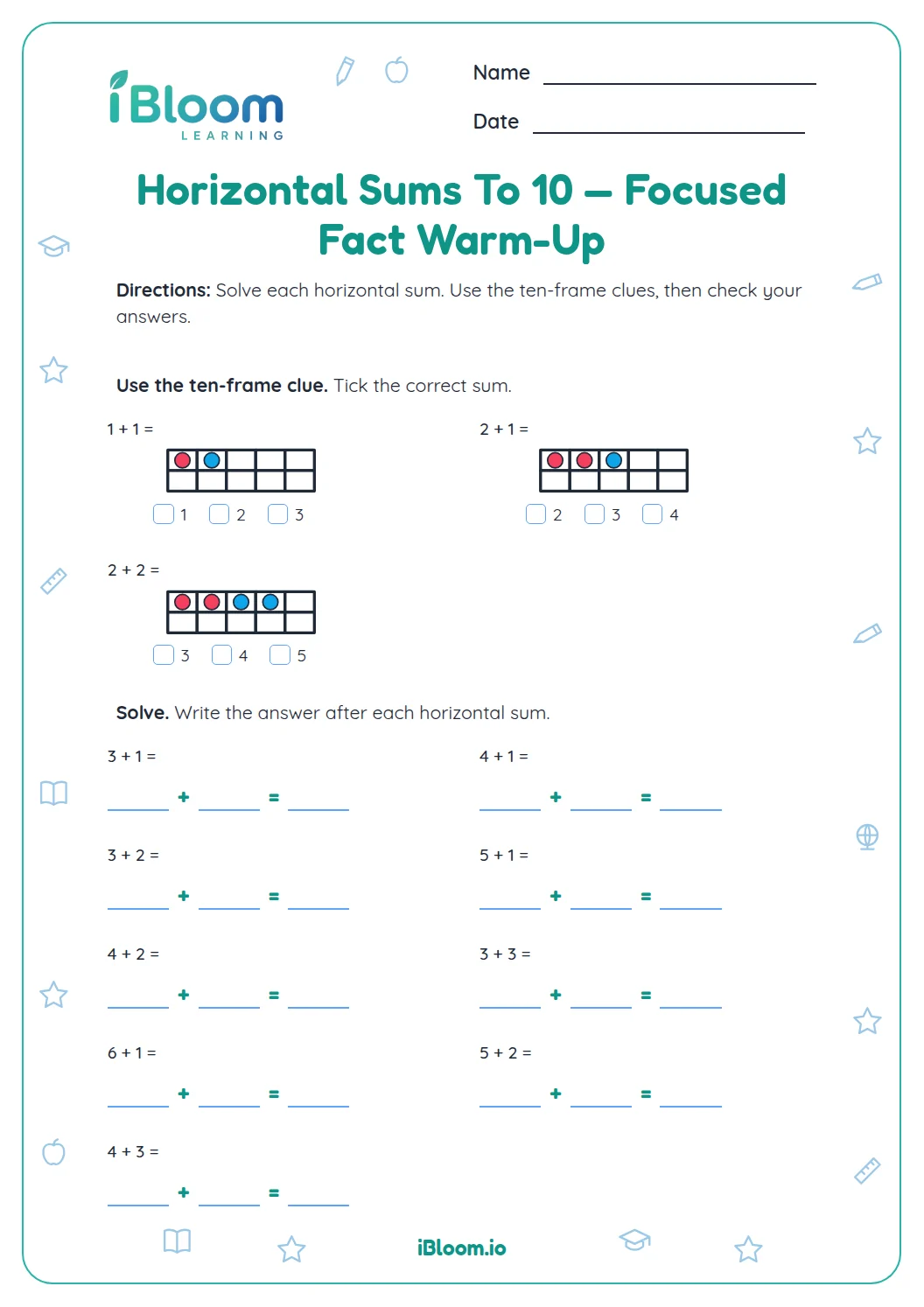
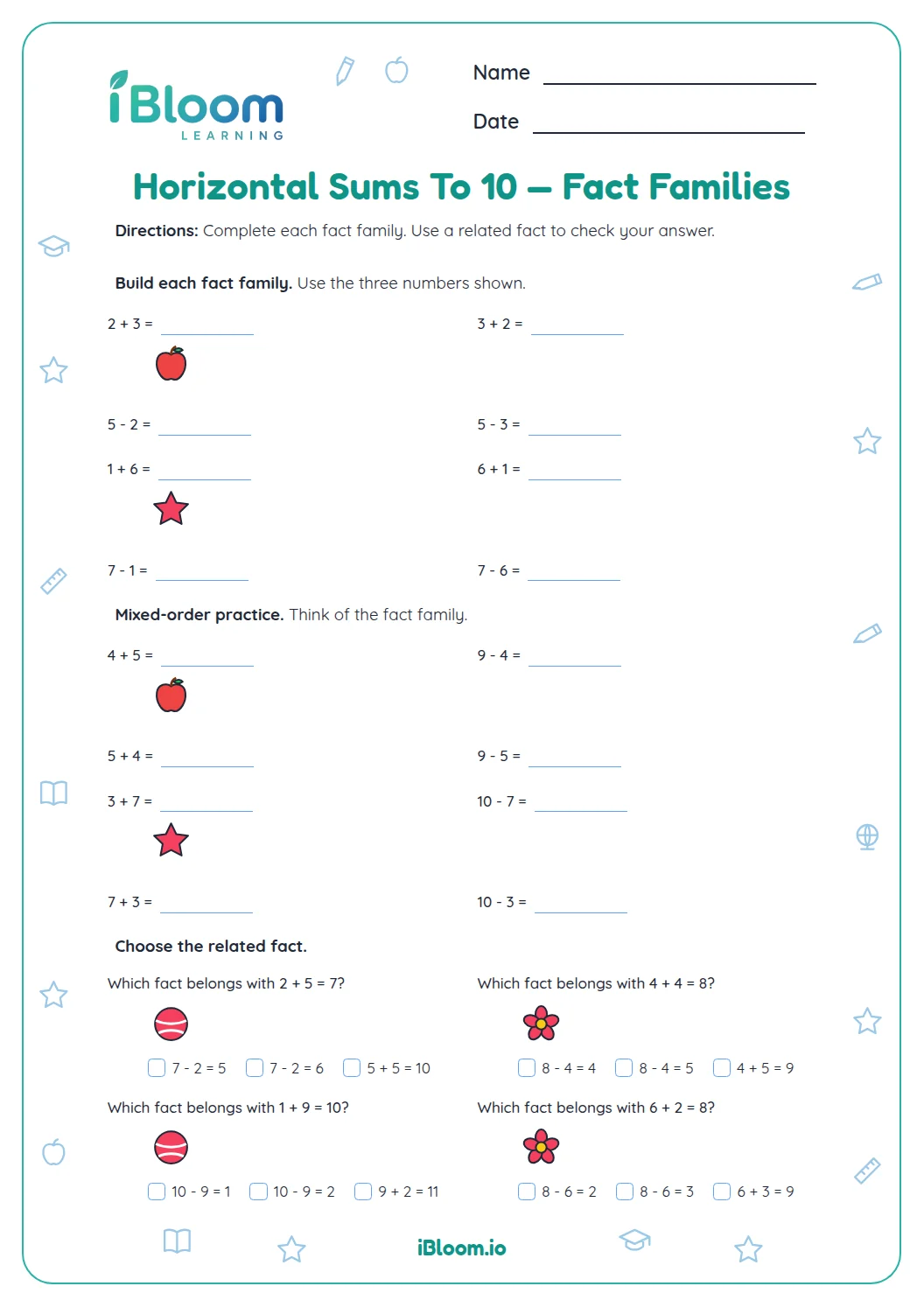
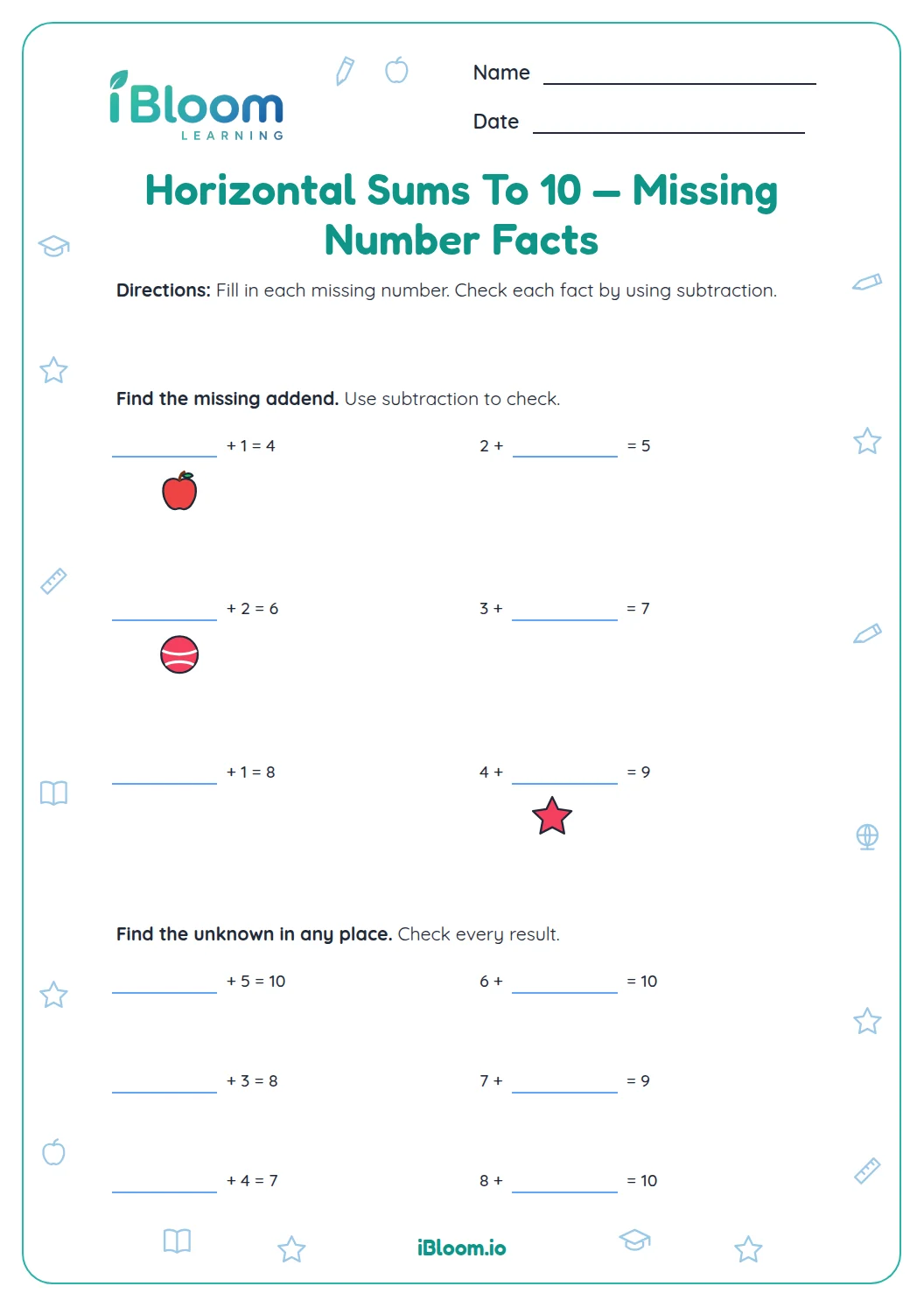
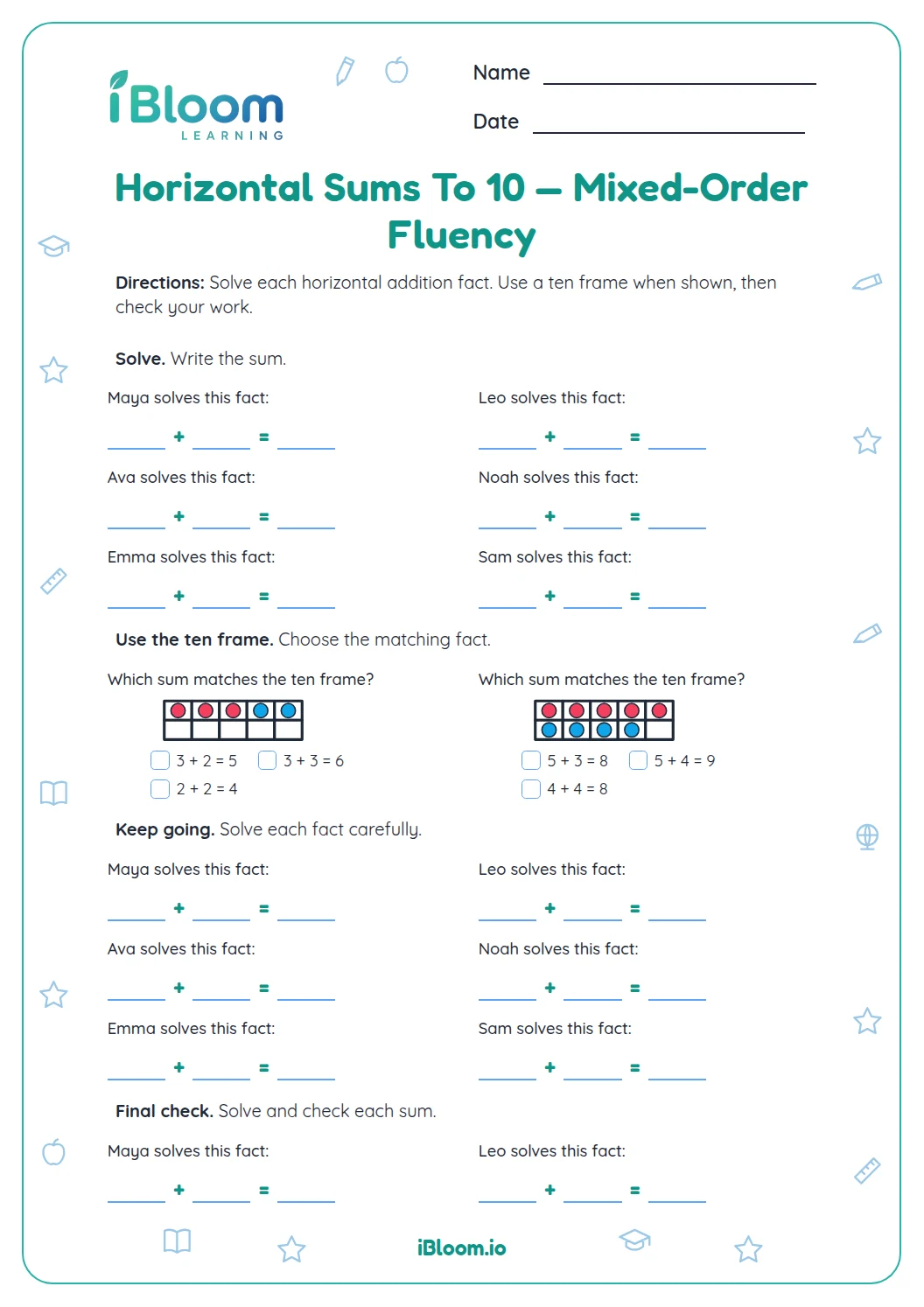
This Grade 1–2 mastery check focuses on making ten in two ways. In Part A, students read eight ten frames and find how many more counters complete a frame. In Part B, they use ten as a helper to add pairs whose sums stay within 20. A separate answer key lists each response. The practice moves from visible counters to equations, with each sum chosen so students can use the make-ten strategy.
How do counters show a partner for ten?
A ten frame has ten spaces. When some spaces hold counters, the open spaces show how many more are needed to complete ten. If there are 6 counters, 4 spaces remain, so 6 and 4 are partners for ten.
Part A uses this visual relationship. Count the empty spaces rather than recounting all ten positions.
- 1A ten frame with 6 counters has 4 empty spaces.
- 26 + 4 = 10, so 4 more counters complete ten.
How do you use ten to add two numbers?
For 8 + 5, split 5 into 2 and 3. Add 2 to 8 to make 10, then add the remaining 3: 10 + 3 = 13. The addend is decomposed, but the total stays the same.
Part B asks students to apply this strategy to different addends. Students may also use another accurate strategy and check that the sum is reasonable.
What is included in this mastery check?
Eight ten-frame questions come first, followed by eight sums that invite a make-ten strategy. The equations vary the addends and do not repeat. The separate answer key lists all 16 answers.
How to use this worksheet
- 1For each frame, count the counters already present.
- 2Count the empty spaces to find the partner that completes ten.
- 3For each sum, decide how many from one addend will fill the gap to ten.
- 4Add the leftover amount to ten.
- 5Check the total with addition or a related subtraction fact.
Common mistakes and quick fixes
The mistake
Counting ten-frame spaces instead of counters.
The fix
Count the filled spaces first, then count the empty spaces.
The mistake
Moving too many or too few counters to make ten.
The fix
Find the gap from the first addend to 10 before splitting the second addend.
The mistake
Forgetting the leftover part after making ten.
The fix
After reaching 10, add the part that was not used to complete ten.
What to practice next
Make more practice
Questions parents and teachers ask
What is a partner for ten?
Two numbers are partners for ten when they add to 10, such as 6 and 4 or 8 and 2. In Part A, the ten frames show one partner with counters, and students find the number of empty spaces for the other.
How does making ten work for 8 + 5?
The number 8 needs 2 more to make 10. Split 5 into 2 and 3, then add 8 + 2 = 10 and 10 + 3 = 13. This worksheet uses the same idea with several different addend pairs.
Can students use another strategy?
Yes. The prompts highlight making ten, but a student who finds a correct answer another way can still check it. Ask the student to explain how the method uses both addends and their total, then compare it with the key.
How many questions are on the check?
There are 16 questions: eight ten-frame complements and eight addition sums. A separate answer key lists every response. Students can check their work and review which partner completes each ten frame, then try saying the matching addition fact aloud.
What grade is this worksheet for?
There are 16 questions across two worksheet pages, followed by a separate answer key. The first eight items use ten frames asking how many counters complete ten; the next eight are addition sums suited to the make-ten strategy. The key lists each response.