


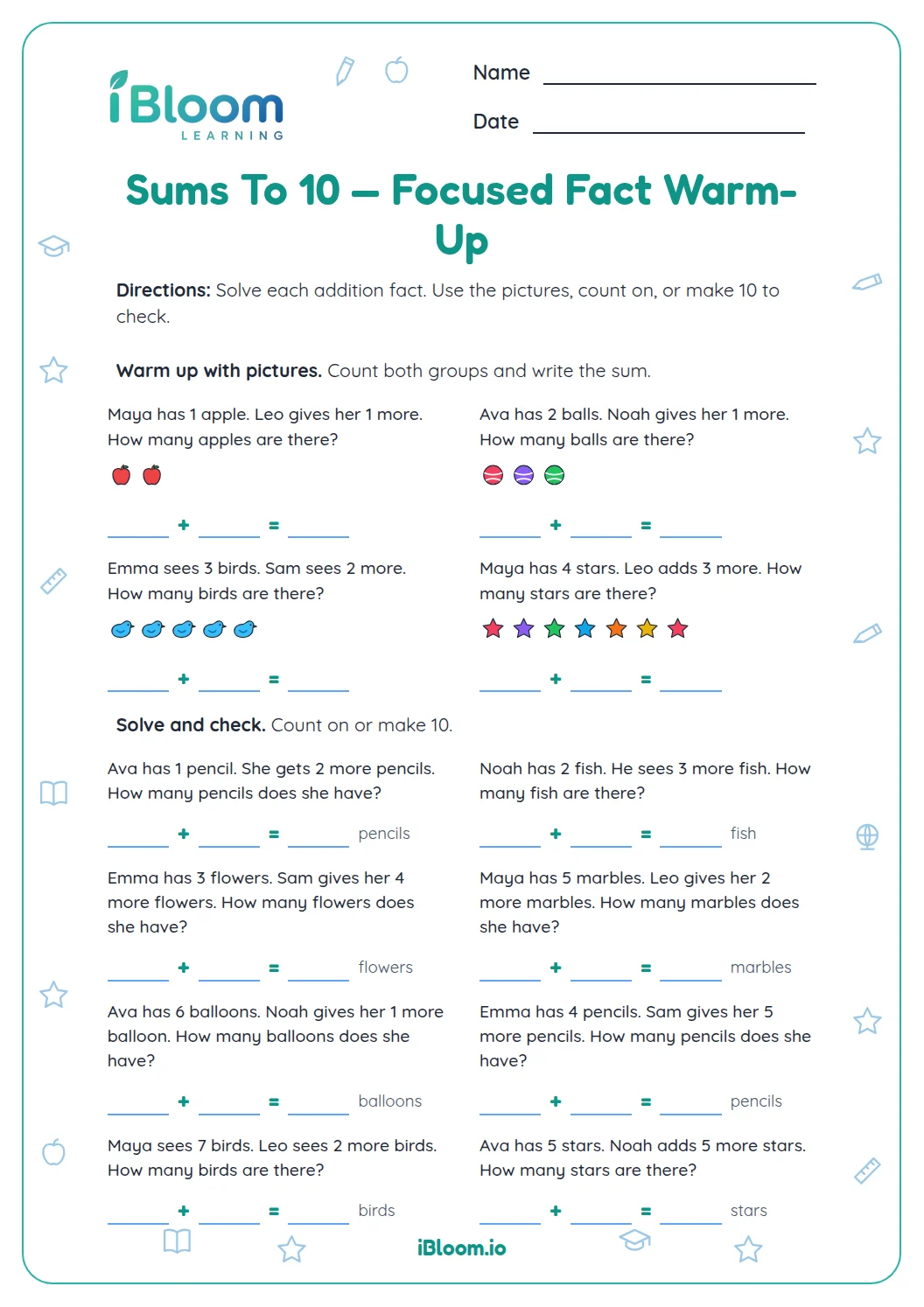
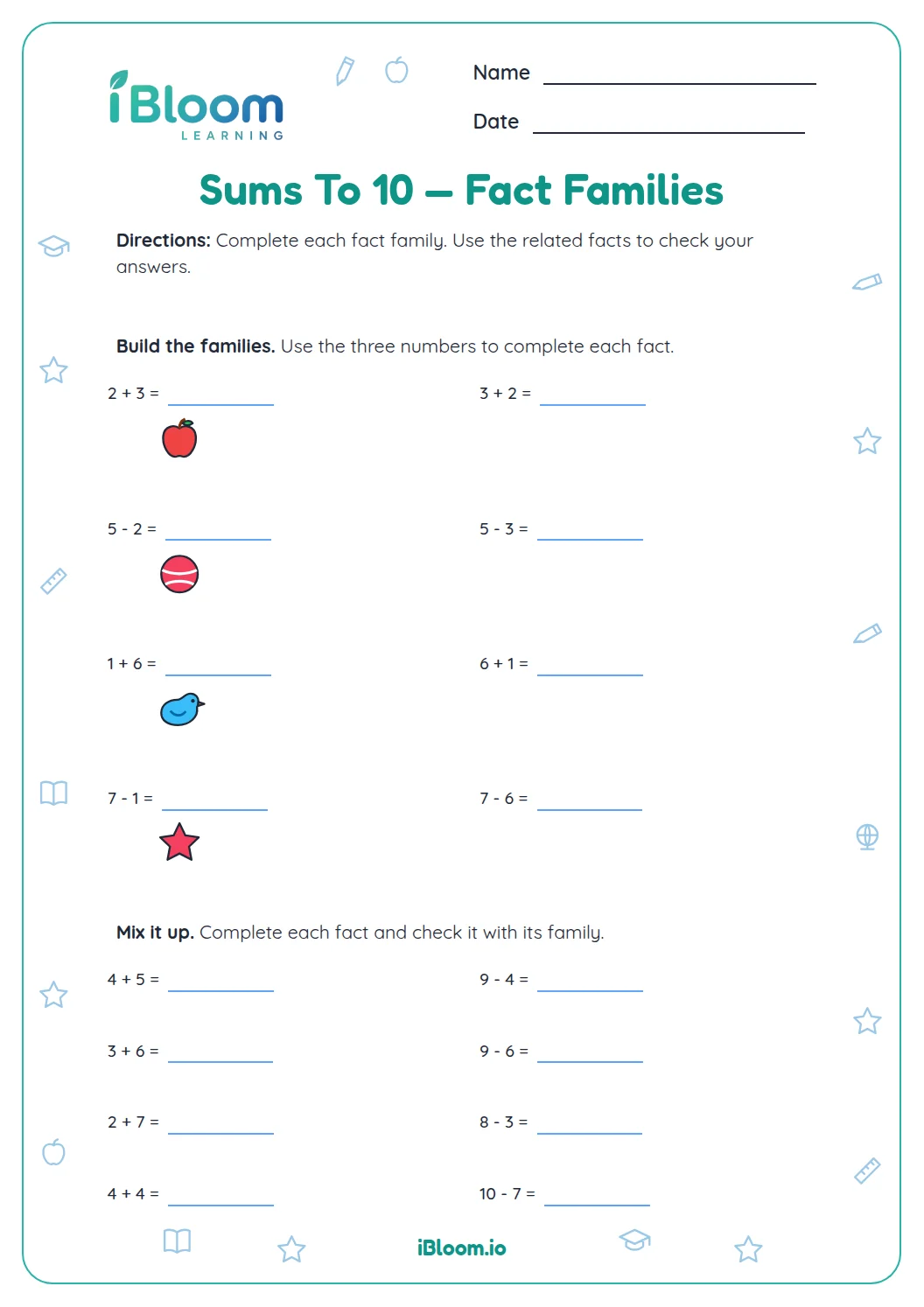
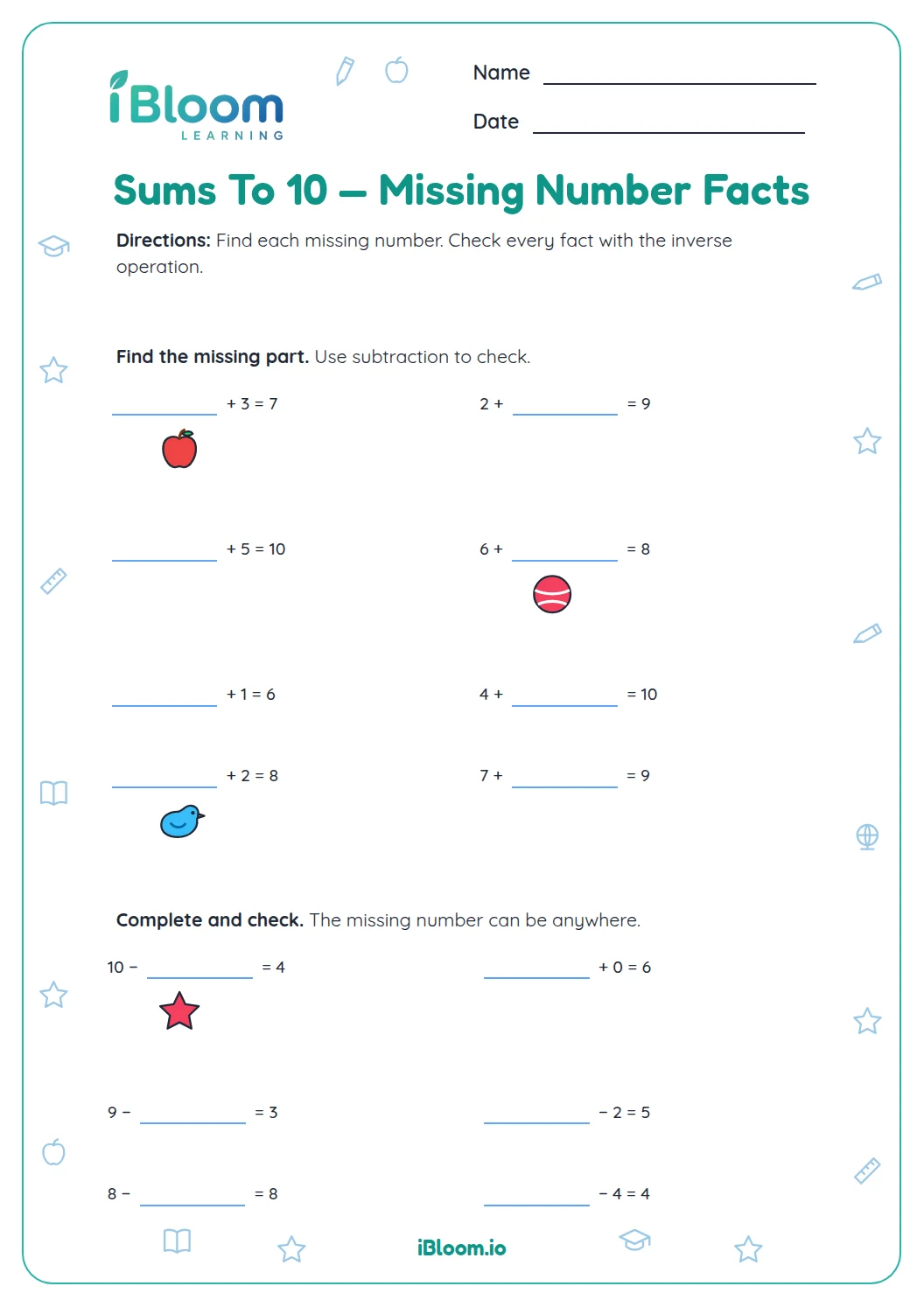
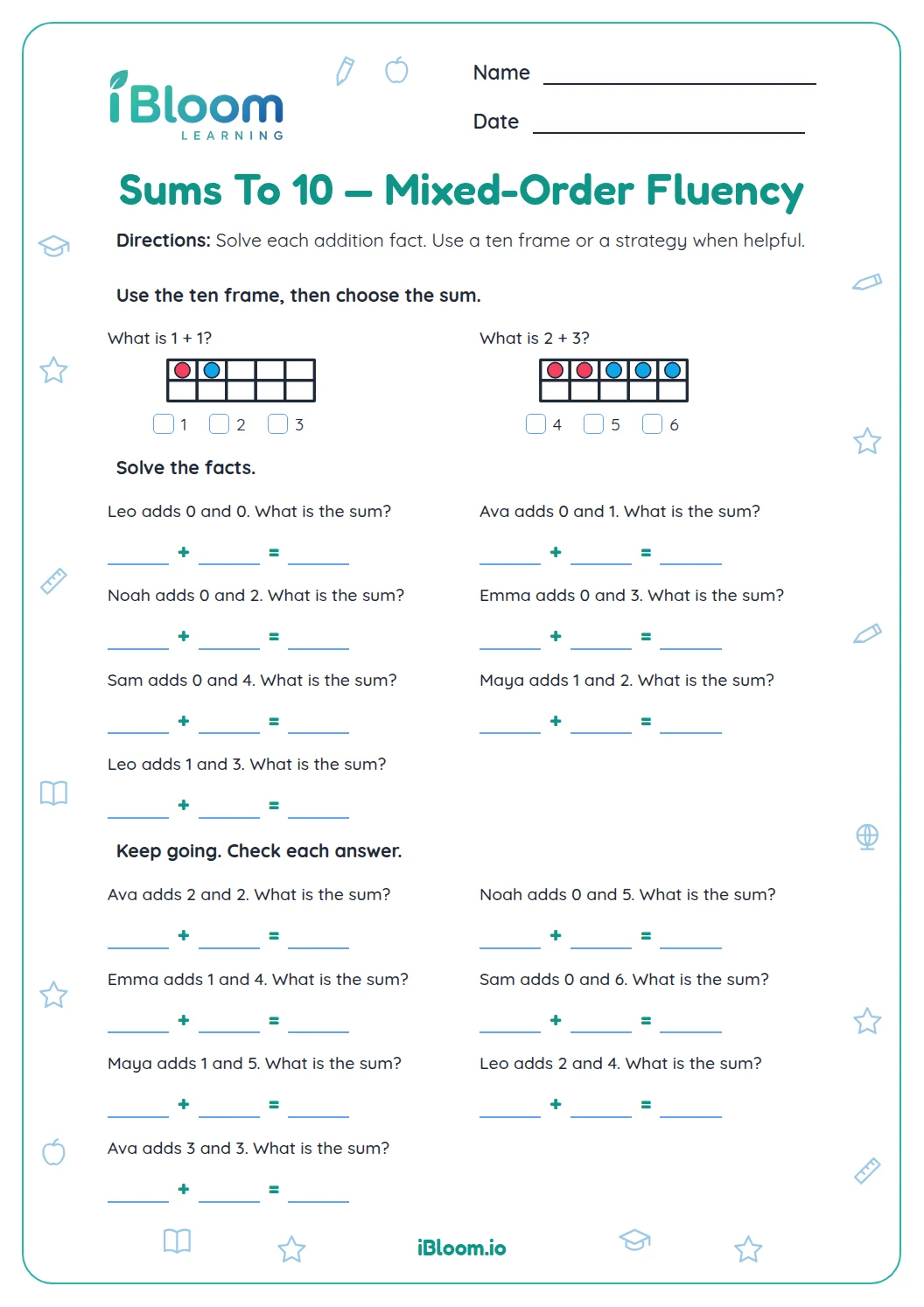
About this worksheet
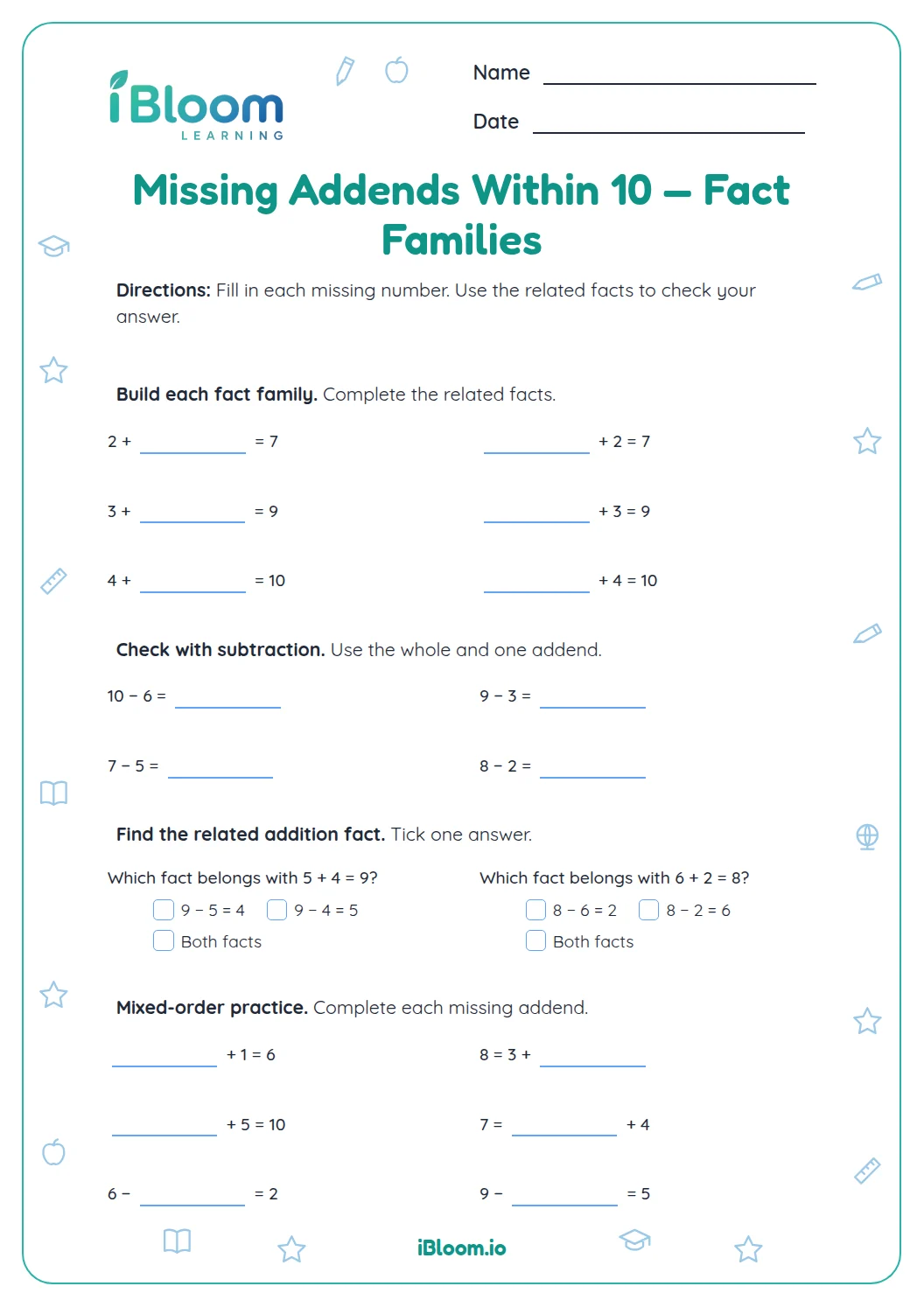
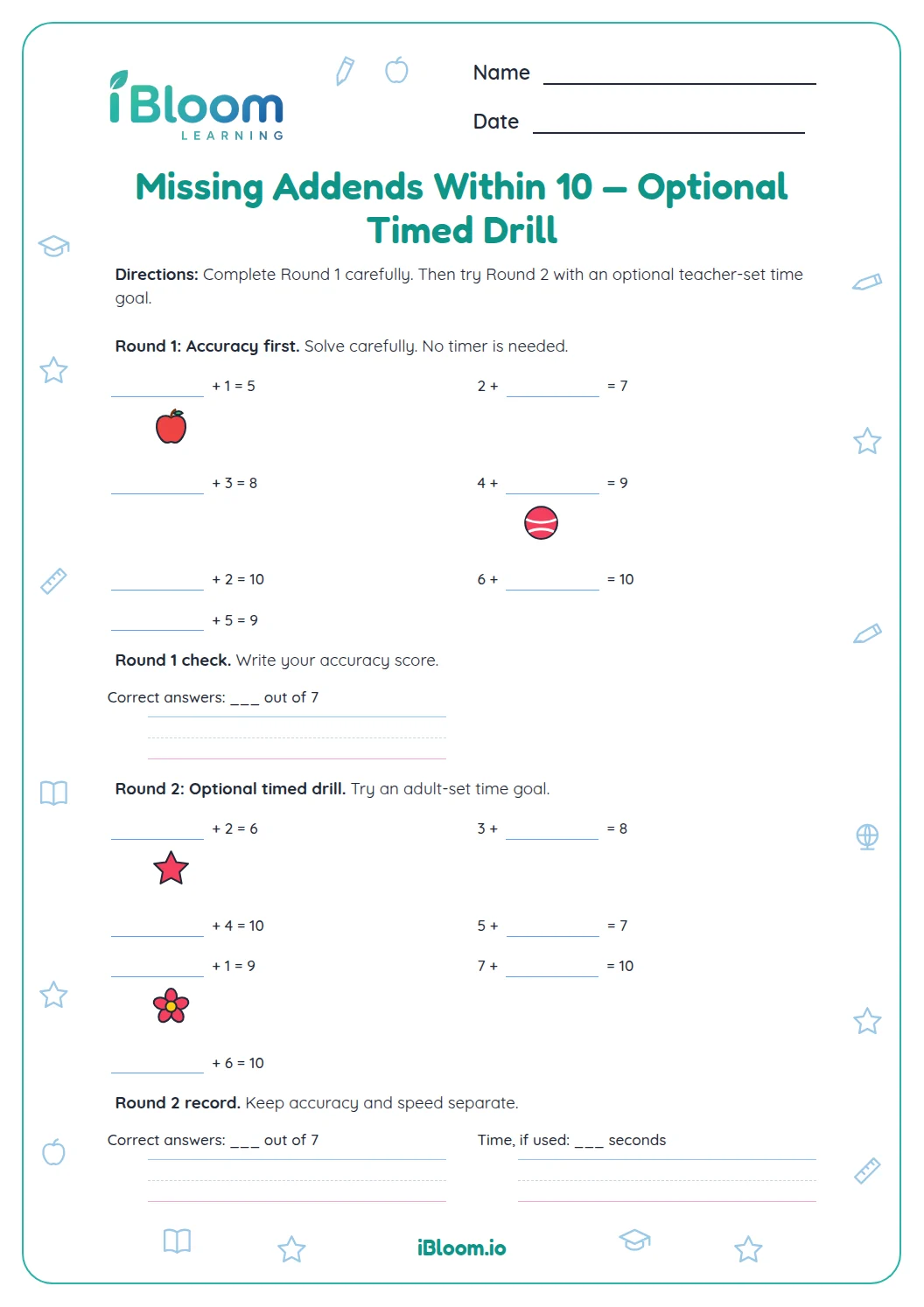
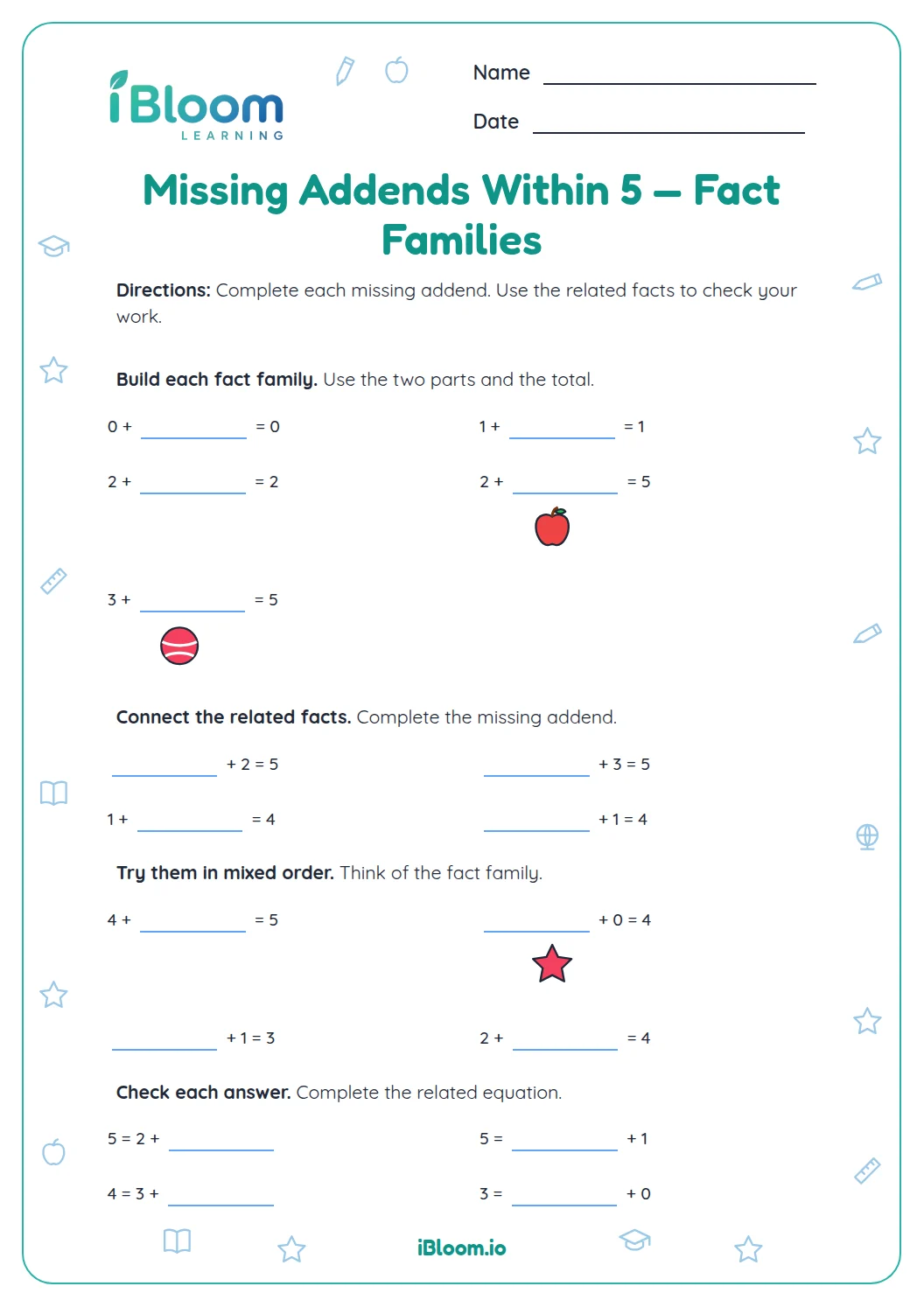
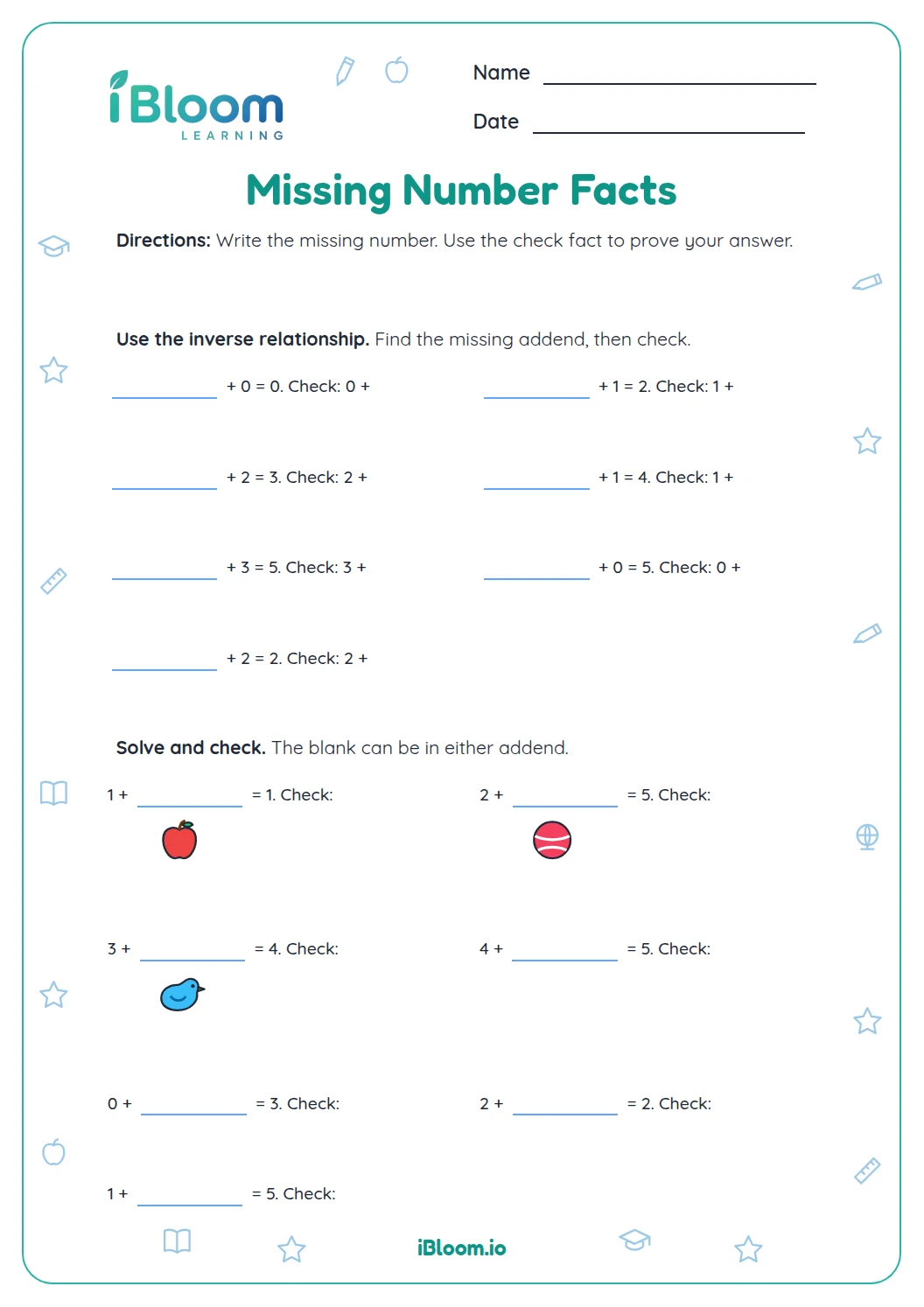
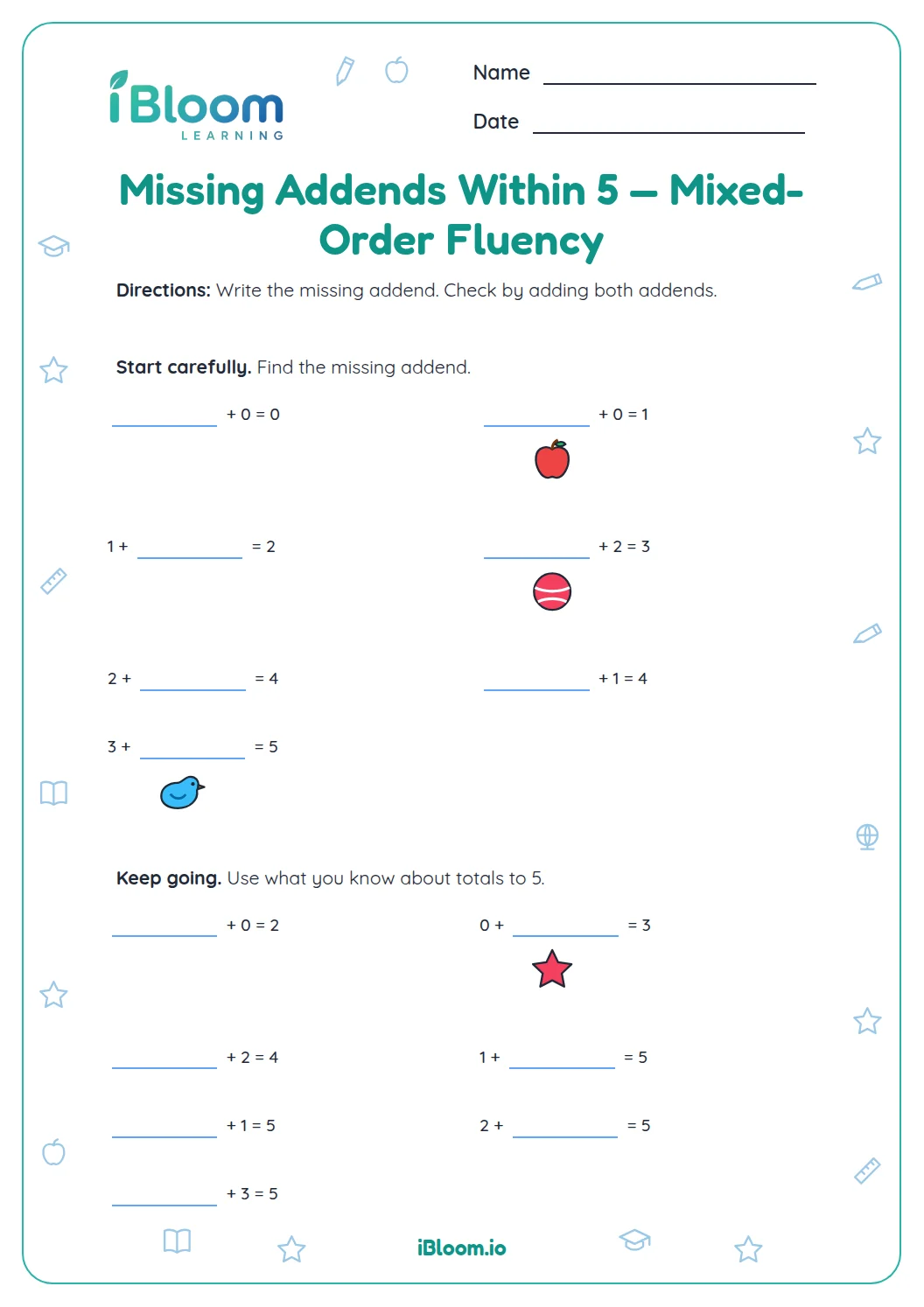
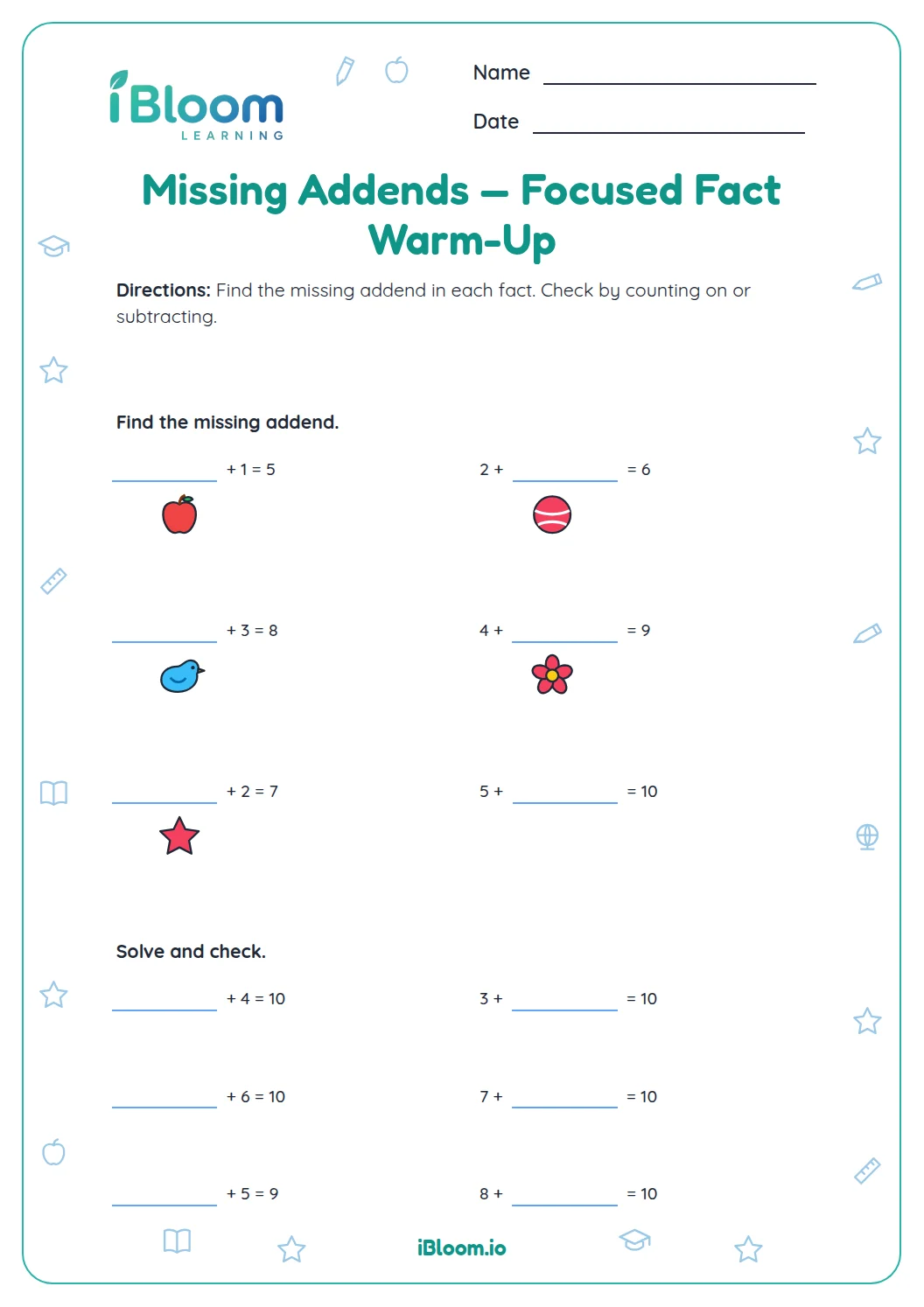
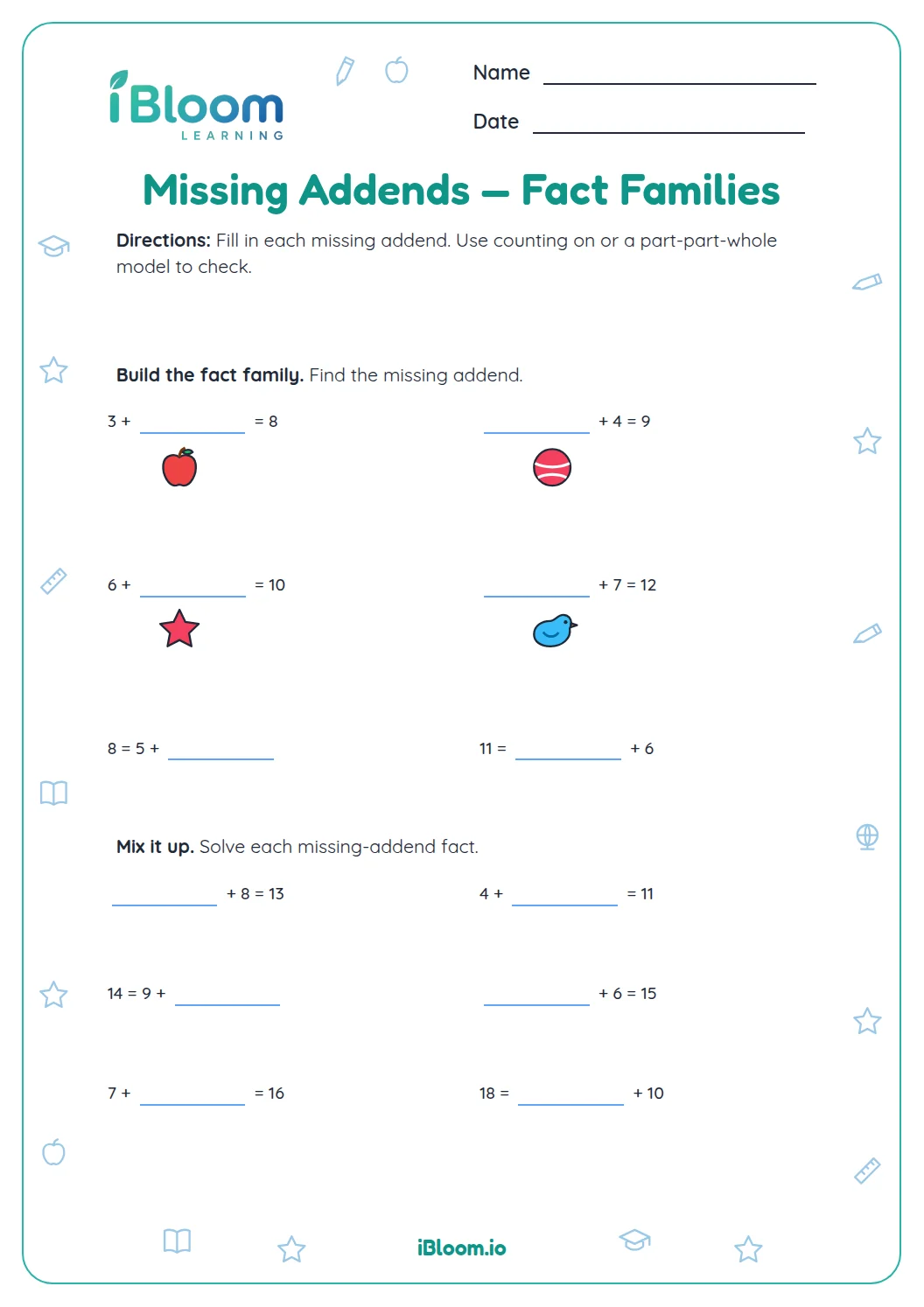
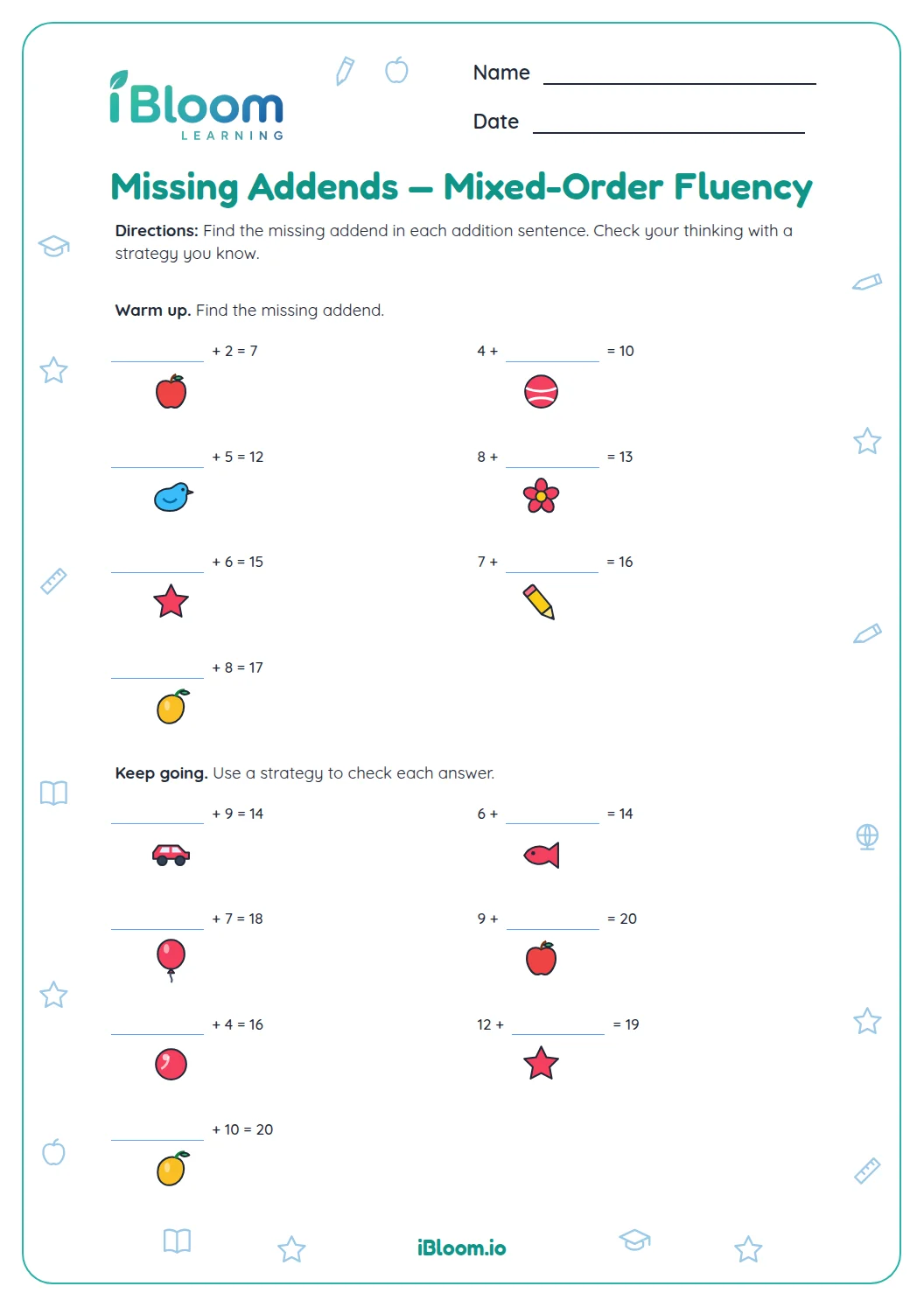
This free printable Grade 1 worksheet helps students practice missing addends within 10. It aligns with Common Core 1.OA.D.8: find the unknown addend that makes an addition equation true. The sheet moves from supported models into independent practice and applied problems. A separate answer key gives concise answers for checking each item.
Aligned to 1.OA.D.8
How do you find the missing part?
Part A gives a total and one addend. Think of the total as two parts, then count on from the known part. In question 1, 3 + ___ = 8, so count 4, 5, 6, 7, 8: five more.
- 1Start with 3.
- 2Count up to 8: 4, 5, 6, 7, 8.
- 3That is 5 steps, so 3 + 5 = 8.
How can you check a possible addend?
Part B offers two possible numbers for each blank. Substitute each choice into the equation and add; only one choice makes the equation true.
How do addition facts help with stories?
Part C turns totals and known parts into short stories. Name the total, write an addition sentence with a blank for the unknown part, then check that the two parts make the total.
How to use this worksheet
- 1Read the direction for the part you are starting.
- 2For each equation, identify the total and the addend you already know.
- 3Count on or subtract to find the missing part.
- 4For each choice, test the number in the equation before selecting it.
- 5In a story, write an addition sentence and include the kind of item in your answer.
- 6Check each response by adding both parts to get the stated total.
Common mistakes and quick fixes
The mistake
Subtracting the known addend from the total but stopping one count early.
The fix
Count the jumps aloud and check by adding the two parts.
The mistake
Putting the total in the missing-addend blank.
The fix
The two addends must combine to make the total.
The mistake
Adding the known part to the total.
The fix
Ask how many more are needed to reach the total, then check the equation.
Common Core alignment
This practice connects each question to a concrete grade-level math skill.
Find the unknown addend that makes an addition equation true.
On this sheet: Find the unknown addend that makes an addition equation true.
Show the official wordingHide the official wording
Determine the unknown whole number in an addition or subtraction equation relating three whole numbers.
What to practice next
Make more practice
Further reading
Questions parents and teachers ask
How do you find a missing addend?
Think of the total as two parts. Start with the known addend and count up to the total, or subtract the known addend from the total; for 3 + ___ = 8, the missing part is 5. Check by adding 3 + 5. Matching question numbers make checking each response straightforward.
How many questions are on this worksheet?
There are 14 questions in three parts: six missing-addend equations, four multiple-choice checks, and four short stories. Every equation and story uses totals no greater than 10, and the answer key lists a response for each item. Matching question numbers make checking each response straightforward.
What can a student do when an answer feels uncertain?
Put the proposed number in the blank and add the two parts. For example, in ___ + 4 = 9, test 5: 5 + 4 equals 9. If the total does not match, adjust the missing part and try again. Matching question numbers make checking each response straightforward.
Does the worksheet include word problems?
Yes. The last four questions describe beads, apples, crayons, and birds. Each story gives a total and one known part, so students can write an addition equation and find the missing amount. Matching question numbers make checking each response straightforward.
Is an answer key included?
Yes. The printable includes a separate key with the missing addends, choices, and story answers. Students can finish all three parts first, then use the key to check each answer and return to any equation that does not balance. Matching question numbers make checking each response straightforward.